The Aftermath: John Gordon – Youngest Casualty of World War I
John was missing in action.
The first confirmation of his death appeared on a German death list dated 4 November 1916. There was also handwritten note on one of the forms that he was believed to be buried in the vicinity of Fromelles. His identification disc was received from Germany in March 1917, but with no information other than that he was deceased.
John was officially listed as killed in action in France on 19 July 1916. A handwritten note on Form B103: 'Believed buried in the vicinity of Fleurbaix Sh 36.
[[Source: NAA: B2455 Gordon, J]]
Way too young! In their book Fromelles: The Final Chapters (2013), Tim Lycett and Sandra Playle observed that John "was only 15 years, ten months and one day old" (page 178). They discuss the youngest recorded Australian soldier to have been killed in action and note that John Gordon was one day younger than another lad who died at Gallipoli. In the more recent book The Lost Boys (2019), Paul Byrnes' research shows that John was the 4th youngest. In any case, all agree he was way too young!
His parents received on his behalf the 1914-15 Star, British War Medal, and Victory Medal. He is commemorated on panel 1 of VC Corner Australian Cemetery and Memorial, Fromelles, France and on panel 115 on the Roll of Honour at the Australian War Memorial in Canberra.
His Brother’s War
John’s older brother William (aka John, per names used on enlistment) went to Europe at the age of 16. He served as a signaller in the 2nd Division Signalling Company in Egypt for more than three years suffering many of the illnesses that soldiers acquired in the tropics including boils, tuberculosis and malaria.
Sapper Gordon returned to Australia after three years’ war service in March 1919 – still a teenager, not turning 20 until the following month. William (1899-1950) did not marry – nor did their sister, Ethel (1906-1973). It seems that William continued to use the name John for various purposes throughout his life and probably did not recover full health after the war.
Family Support
In 2008, a mass grave was discovered that had been dug by the Germans to bury soldiers from the battle. While there have been efforts by the Australian Defence Force and the Fromelles Association of Australia to identify missing solders by DNA testing, John is not yet among those identified.
In 2010, the Sydney Morning Herald (SMH, 7 May 2010, Bridie Smith) reported on the soldiers of Fromelles and noted that one of John’s relatives, Janine Skurray from Adelaide was still waiting to hear if there had been a match. "I'm really keeping my fingers crossed, as they said there were bones found that were from a 15 to 16 year old. I'm hoping that his youth might help identify him," she said. Ms Skurray visited France for the 94th anniversary of the battle. "Even if he is not identified, his name will be there and we will honour him by being there," she said.
Soldier identification work from the bodies in the mass grave is still ongoing.
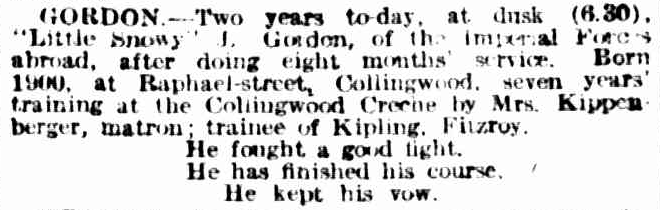
John Gordon, ‘Little Snowy’
He fought a good fight.
He has finished his course.
He kept his vow.
A Y-DNA donor is still being sought for family connections to
| Soldier | John Gordon 1900-1916 |
| Parents | William GORDON, b.1860, Aberdeen, Scotland d.1940, Fitzroy, Vic. | ||
| and Ellen Eliza LEWIS b.1867, South Australia d.1934, Fitzroy, Vic. |
| Grandparents | |||
| Paternal | William Gordon (Scotland) and Unknown | ||
| Maternal | William LEWIS b.1828, Norfolk, Eng. d.1908, Adelaide, S.A. and Rachel SYMONDS b.1835, London, Eng. d.1929, Adelaide, S.A. |