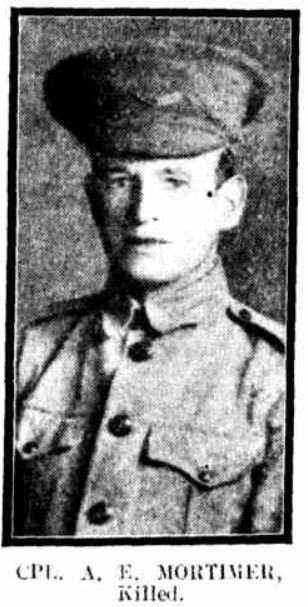
Albert Edward MORTIMER
Eyes blue, Hair light brown, Complexion sallow
Albert Edward Mortimer – A Lancashire Wood Machinist of the 60th Battalion
Can you help find Albert?
Albert’s body was never found after the Battle of Fromelles, and there are no records of his burial.
A mass grave was found in 2008 at Fromelles, a grave the Germans dug for 250 Australian soldiers they recovered after the battle. As of 2024, 180 of these soldiers have been able to be identified via DNA testing.
Albert may be among these remaining unidentified men. There is still a chance to identify him — but we need help. We welcome all branches of his family to come forward to donate DNA to help with his identification, especially those with roots in Queensland and Blackburn, Lancashire, England.
See the DNA box at the end of the story for what we do know about his family.
If you know anything of contacts for Albert, please contact the Fromelles Association.
Please contact the Fromelles Association of Australia to find out more.
Early Life - Lancashire to Australia
Albert was born on 5 February 1887 in Blackburn, Lancashire, England, and baptised there a month later, on 9 March 1887. He was the youngest of eight children born to Robert Gillard Mortimer and Elizabeth Parr, both originally from Uplowman and Halberton, Devon, England:
- Mary Harriet (1869 – c.1945)
- William John (1870 – 1871)
- Charlotte Ellen Jane (1872 – 1905)
- Henry John (1874 – 1948)
- Elizabeth Hannah (1877 – 1931)
- Alice Ann (1880 – 1976)
- Walter (1882 – 1956)
- Albert Edward (1887 – 1916)
Robert was an agricultural labourer, but the family moved north from Devon to work in the cotton mills after their son William had died. Initially Robert worked as a watchman in a cotton factory and later as a carter. The family settled in Blackburn and nearby Clitheroe, raising their children in a working-class household. Through the various census, we can see that there were always several members of the family employed in the cotton industry. In 1901, Albert was working as a woodturner, making shuttles for the cotton mills.
At some stage between 1901 and 1907, Albert spent 3 years with the 1st East Lancashire Regiment. This regiment served in Africa during the South African war, but given Albert’s age it is likely that he remained in the UK. In 1907, 20 year old Albert emigrated to Queensland, Australia, arriving on the Ortova on 11 October in Brisbane. His uncle, Francis Parr, had migrated to Southport, Queensland in 1875 and had married Sarah Pidd in 1882. Albert was likely living with the Parr family, as in 1908 Albert was a labourer at Carrara and Francis was a farmer in the Carrara – Nerang district, west of Gold Coast.
No doubt he would have been good mates with his cousin closest to his age, George Henry Parr, who also fought in the war (Reg. No. 2968). George was killed in France at Passchaendale in 1917. Albert married George’s sister Lucy Jane Parr on 20 March 1909. Their only child, Clarence Hedley Mortimer, was born that same year.
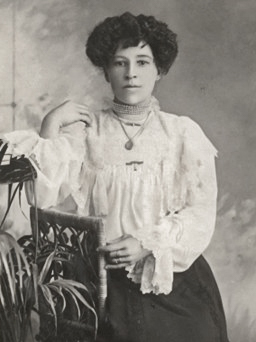
In 1910, the family moved to Melbourne, settling in Clifton Hill. Soon after the move, Albert was working at a North Melbourne timber yard and his hand slipped into a machine and four fingers of his left hand were severed. The following year, he sued his employer for negligence:
Albert Edward Mortimer, of Spensley Street, Clifton Hill, a wood-turner, sued his employer, Clement Davidson (trading as John Buncle and Sons, implement makers of North Melbourne), for £2000 in damages after losing four fingers in a “buzzer” planing machine accident. After the plaintiff’s evidence, both parties reached an undisclosed settlement.
Despite the accident, Albert continued his trade, but by 1915 Albert had become a picture framer and Lucy was a nurse. The family lived at 194 Abbotsford St, North Melbourne. A further misfortune was to strike Albert in January 1915, when Lucy died suddenly from thrombosis while she was visiting at her parents’ home in Southport, Queensland.

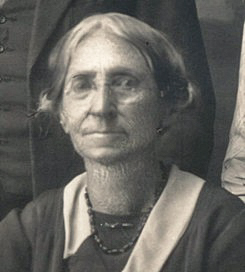
After Lucy’s death, six year old Clarence was raised in Southport, Queensland by Lucy’s parents, Sarah and Francis. Francis was listed as Albert’s next-of-kin when he enlisted.
Off to War
After having lost his wife and having to leave his son to be raised by his family in Queensland, Albert enlisted in the AIF on 6 July 1915 in Melbourne. He was accepted despite the damage to his left hand. The Parr family ’s care for Clarence also reflected a promise made before Albert enlisted — should anything happen to Albert, Clarence would be raised in Southport. Albert was assigned to the 21st Battalion, 7th Reinforcements. After his initial military training, he left Melbourne for the training camps in Egypt on 18 November 1915 aboard HMAT A18 Wiltshire .
With the ‘doubling of the AIF’ as it expanded from two infantry divisions to five, major reorganisations were underway. The 60th Battalion was raised in Egypt on 24 February 1916 at the 40,000-man training camp at Tel-el-Kebir, about 110 km northeast of Cairo and Albert was reassigned to this new unit. Roughly half of the soldiers in the 60th were Gallipoli veterans from the 8th Battalion, a predominantly Victorian unit, and the other half were fresh reinforcements from Australia. Their training continued, necessary to build the bonds necessary for the fighting to come.
Being a bit more mature than most of the recruits, Albert was promoted to Lance Corporal on 25 March and then to Corporal on 13 April. At Fromelles, Albert was the lead for his group of ‘bombers’ (grenades). In mid-March the 60th were inspected by H.R.H the Prince of Wales.
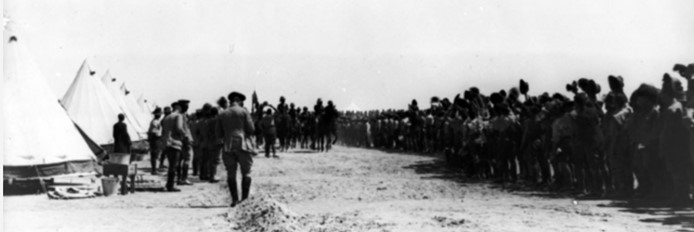
After a month of training at the large camp at Tel el Kebir, they had a two+ day, 50 km march in thermometer-bursting heat across the Egyptian sands from Tel el Kebir to Ferry Post, near the Suez Canal. Prior to marching, only ½ pint of water per bottle was available.
Source- AWM4 23/15/1 15th Brigade War Diaries Feb-Mar 1916 p 6.
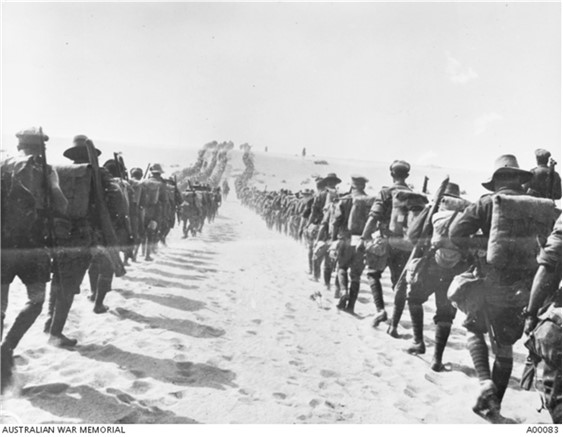
The 60th remained at Ferry Post until 1 June continuing their training and guarding the Suez Canal from any potential threats posed by the Ottoman Army. Their time in Egypt was not all work, however. A 5th Division Sports Championship was held on 14 June, which was won by the 60th’s 15th brigade. Three days later, they received orders to begin the move to the Western Front and were put on trains to Alexandria. The majority of the battalion, 30 officers and 948 other ranks, embarked in Alexandria on the transport ship Kinfauns Castle on 18 June 1916.
After a stop in Malta, they disembarked in Marseilles on 29 June and immediately boarded trains to Steenbecque in northern France, 35 km from Fleurbaix, arriving on 2 July. This area near Fleurbaix was known as the “Nursery Sector” – a supposedly relatively quiet area where inexperienced Allied troops could learn the harsh realities of Western Front trench warfare against the Germans.
But the quiet times and the training period did not last long. On the 7th they began their move to the front, arriving in Sailly on the 9th. Now just a few kilometres from the front, their training continued, although with a higher intensity, I’m sure. The move to Fleurbaix continued and Albert was into the trenches for the first time on 14 July.
The Battle of Fromelles
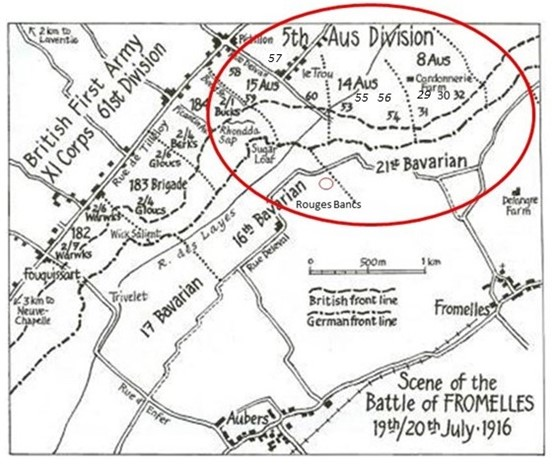
The battle plan had the 15th Brigade located just to the left of the British Army. The 59th and 60th Battalions were to be the lead units for this area of the attack, with the 58th and 57th as the ‘third and fourth’ battalions, in reserve. The main objective for the 15th Brigade was to take the trenches to the left of a heavily armed, elevated German defensive position, the ‘Sugar Loaf’, which dominated the front lines. If the Sugar Loaf could not be taken, the other battalions would be subjected to murderous enfilade fire from the machine-guns and counterattacks from that direction. As they advanced, they were to link up with the 59th and 53rd Battalions on their flanks.
The 60th Battalion faced an especially difficult position in the assault, directly opposite from the Sugar Loaf. On 17 July, they were in position for the major attack against the Sugar Loaf position, but it was postponed due to unfavourable weather. There was a gas alarm, but luckily it was just that. Two days later, Zero Hour for advancing from their front-line trenches was to be 5.45 PM, but the Germans knew this attack was coming and were well-prepared. They opened a massive artillery bombardment on the Australians at 5.15 PM, causing chaos and many casualties.
A fellow soldier, Private Bill Boyce (3022, 58th), summed the situation up well:
“What have I let myself in for?”
The Aussies went over the parapet at 5:45 PM in four waves at 5 minute intervals, but then lay down to wait for the support bombardment to end at 6 PM. Albert was leading his bombing unit in the first of the four waves. Casualties were immediate and heavy. The 15th Brigade War Diaries captures the intensity of the early part of the attack – “they were enfiladed by machine guns in the Sugar Loaf and melted away.”

The British 184th Brigade just to the right of the 59th met with the same resistance, but at 8.00 PM they got orders that no further attacks would take place that night. However, the salient between the troops limited communications, leaving the Australians to continue without British support from their now exposed right flank. It was reported that some got to within 90 yards of the enemy trenches. One soldier said he “believed some few of the battalion entered enemy trenches and that during the night a few stragglers, wounded and unwounded, returned to our trenches.”
Source - AWM4 23/77/6, 60th Battalion War Diaries, July 1916, page 3.
Fighting continued through the night. With known high casualties in the 60th, they were relieved by the 57th Battalion at 7.00 AM. Roll call was held at 9.30 AM. In the ‘Official History of the War’, C.W. Bean said “of the 60th Battalion, which had gone into the fight with 887 men, only one officer and 106 answered the call.”
Source - CHarles Bean, Chapter XIII page 442
To get some perspective of the battle, when Charles Bean, Australia’s official war historian, attended the battlefield two and half years later, he observed a large quantity of bones, torn uniforms and Australian kit still on the battlefield. The final impact of the battle on the 60th was that 395 soldiers were killed or died of wounds, of which 315 were not able to be identified.
Albert’s Fate
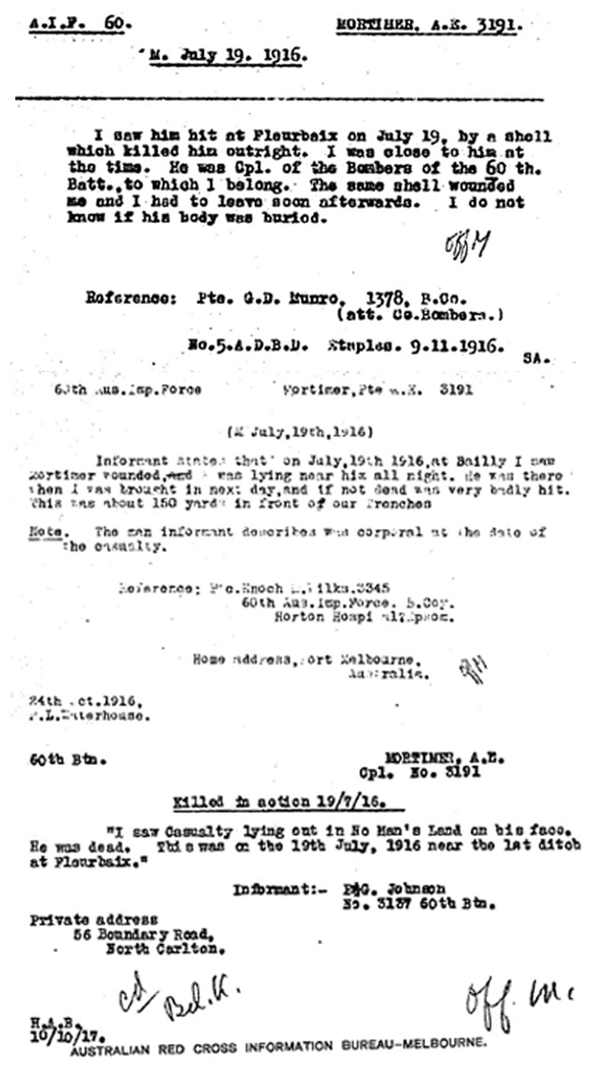
Albert was among the large number of the ‘missing’ . While he was declared as having been killed in action after a formal review on 5 August 1916, the Army and the Red Cross searched records, hospitals and POW information for months to find out more details. Testimonies from several comrades confirmed that Albert had been well into the advance where he was killed by a shell, but that his body was not able to be recovered.
Private George D. Munro (1378, B Company) reported:
“I saw him hit at Fleurbaix on July 19, by a shell which killed him outright. I was close to him at the time. He was Corporal of the Bombers of the 60th Battalion … The same shell wounded me and I had to leave him soon afterwards.”
Private Enoch M. Wilks (3345, B Company) and Private Patrick G. Johnson (3137, 60th Battalion) confirmed this and added Albert had been about 150 yards from the Australian trenches.
After the Battle - Albert’s Son Clarence
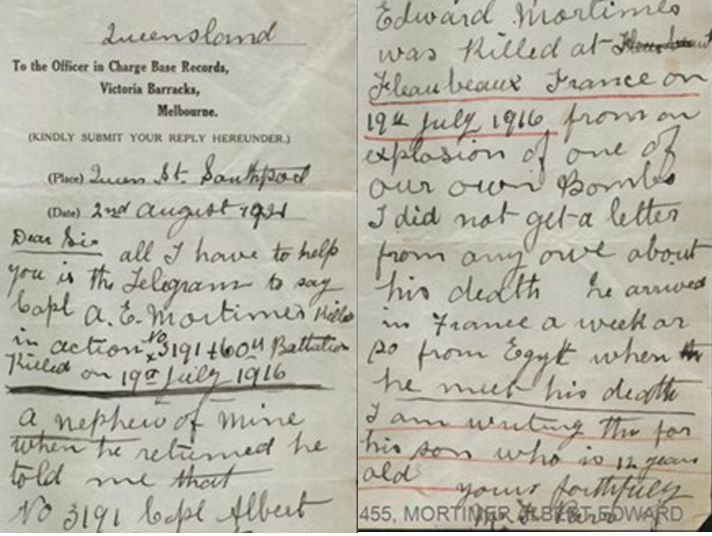
The Parr family more than kept it’s promise to raise Albert’s son Clarence. Sarah Parr pursued Base Records in Melbourne to get news of what happened to Albert and asked for any of his personal belongings to provide some degree of closure.
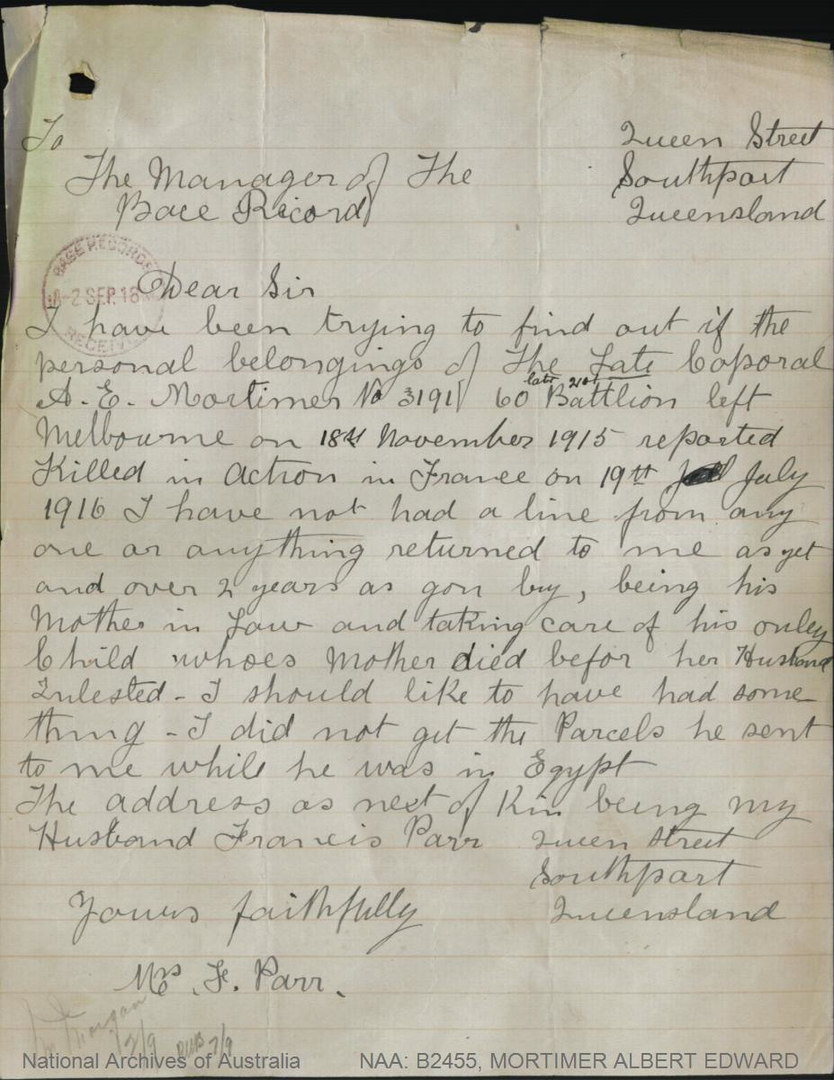
In 1921 she again pleaded for information on behalf the12 year old Clarence.
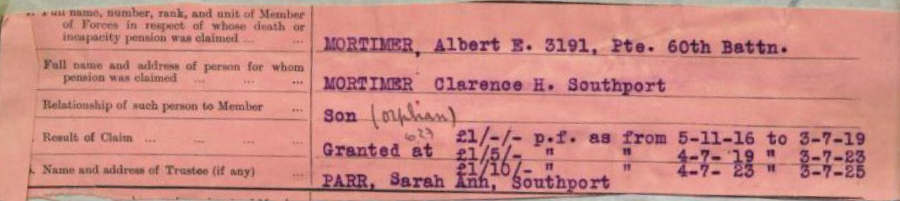
She also pursued the Army to know how the underage Clarence was going to be able to receive Albert’s pension when he became of age, which she was able to accomplish.
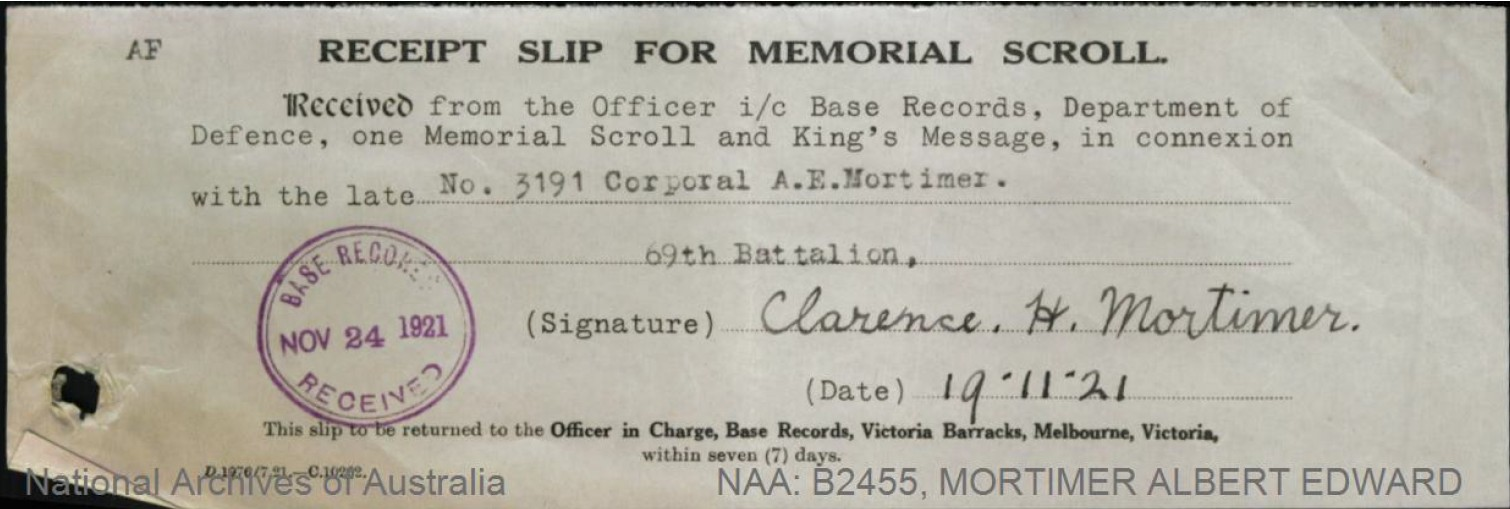
Clarence was also able to be the recipient of Albert’s awards - the Victory Medal, the British War Medal, the 1914–15 Star, a Memorial Plaque and a Memorial Scroll, for which he proudly signed the receipts when they were distributed.
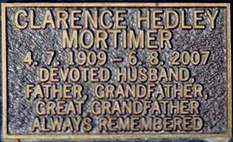
As intended, Clarence grew up in Queensland. And, like his father, he served his country – the RAAF in World War 2. Clarence lived a long life into the 21st century — a lasting link to the father lost at Fromelles in 1916.
Finding Albert
Albert’s remains were not recovered, he has no known grave. After the battle, the Germans recovered 250 Australian soldiers and placed them in a burial pit at Pheasant Wood. This grave was discovered in 2008 and since then efforts have been underway to identify these soldiers by DNA testing from family members. As of 2024, 180 of the soldiers have been identified, including two of the 315 unidentified soldiers from the 60th Battalion.
We welcome all branches of Albert’s family to come forward to donate DNA to help with his identification, especially those with roots in Queensland Blackburn, England. If you know anything of family contacts, please contact the Fromelles Association. We hope that one day Albert will be named and honoured with a known grave.
Please visit Fromelles.info to follow the ongoing identification project and Roy’s story.
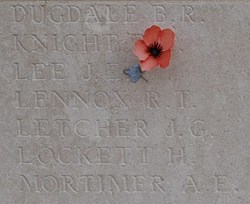
DNA samples are being sought for family connections to
| Soldier | Albert Edward Mortimer (1887 – 1916) |
| Parents | **Robert Gillard Mortimer (1846 – 1914) and Elizabeth Parr (1847 – 1908), both born in Devon, England – later of Blackburn, Lancashire |
| Siblings | Mary Harriett (1869 – 1945) m John William Butterworth | ||
| Charlotte Ellen Jane (1872 – 1905) m Ernest Slater | |||
| Henry John (1874 – 1948) m Annie | |||
| Elizabeth Hannah (1877 – 1931) m William Green | |||
| Alice Ann (1880 – 1976) m James Walsh | |||
| Walter (1882 – 1956) m Ann Ingham |
| Grandparents | |||
| Paternal | William Mortimer and Mary Gillard of Halberton, Devon, England | ||
| Maternal | Humphry Parr (1824–) and Jane Webber (1828–) of Uplowman, Devon, England |
Seeking DNA Donors

Contacts
(Contact: carla@fromelles.info or geoffrey@fromelles.info).
(Contact: army.uwc@defence.gov.au or phone 1800 019 090).
Donations
If you are able, please contribute to the upkeep of this resource.
(Contact: bill@fromelles.info ).