Alfred at The Western Front
Early in 1916, the 29th Battalion was assigned to the 8th Brigade of the 5th Division, after a reorganization that saw the AIF expand from two infantry divisions to five. On 14th June, they embarked on the troop ship HMT Tunisian in Alexandria, bound for France arriving at Marseilles nine days later. The soldiers were taken from the southernmost part of France to the north by train to Hazebrouck. Alfred wrote a letter to his sister from the train, describing the French countryside. This letter is still talked of in the family, although unfortunately it was later destroyed in a fire in Timboon in Victoria’s Heytsebury Forest.
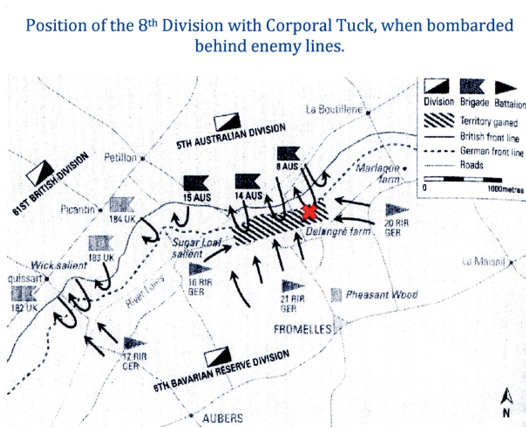
On 19th July 1916, the 32nd Battalion left the trenches at 5:53pm, and the 31st at 5.58pm, to attack and take the German front line. The battle was so intense that both the support and reserve Battalions (the 30th and 29th respectively) became embroiled in holding the positions, captured at such a high cost. The involvement of two companies of the 29th (with Alfred Tuck) was to press on and capture the German 2nd line and from there fighting to capture Delangre Farm was extraordinarily heavy.
After considerable research, Tuck family member, Vic Teasdale, describes how he believes Alf Tuck met his fate:
“Elements of the 8th and 14th Brigades were successful in capturing the German front line, however due to poor reconnaissance the second German line was not where it was thought to be but much further back. Thus, the Australians ‘dug in’ 200 meters behind the German front line and, from there, tried to attack Delangre Farm which was further into German lines.
In fact, Delangre Farm was part of the German 2nd ‘line of defence’ and very heavily armed and fortified. As a result, the Australians were pinned down and came under heavy fire and bombardment from Delangre Farm and many other directions. I would suspect Alfred Tuck would have been somewhere in this vicinity.
As a result, there was a mix of Battalions building an Australian line behind the German front line, but they ended up as 4 separate ‘islands of troops’ in a ‘sea’ of Germans with little communication between themselves or H.Q.
Worse still, at 10pm, it was reported that the Battalions of the 8th and the 14th Brigade’s had few supplies and that there was no hope of any reaching them.
At 11:40pm, the Germans counter-attacked and began to reclaim their front line. Thus, the Australians were attacked from all sides and particularly from the sides and rear, so they tried to retreat through the German front line and then back to their own lines through ‘no-man’s land’. It is reported that many men decided to stay and fight, rather than to “run the gauntlet” and be shot in the back. Such was the ferocity of fire now enveloping our boys.
Fighting continued throughout the night, and it is generally accepted that the Germans had recaptured all their trench system by 9am, though there are reports of Australian soldiers being captured after that time.”
Trapped behind enemy lines, Alfred Tuck’s body was not recovered by his comrades and it appears that he was buried in a mass grave at Fromelles by the Germans. This was confirmed by German records and their eventual return of Alfred’s identification disc to British military authorities.
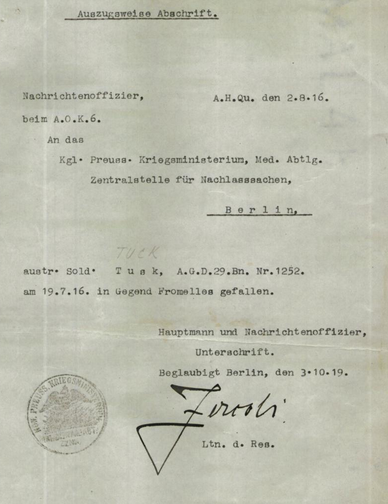
There was also evidence given by 1175 Private John E. McINTOSH, D Company, 29th Battalion to the Red Cross on 3 October 1916:
“At 9 p.m. on July 19th, the 29th Battalion holding trenches at Freomelles (sic), and attacking enemy trench about 300 yards off. The Battalion held second line enemy trenches for 11 hours. Cpl Tuck in command of No. 12 Section. Informant was told next morning by Private Grant of D. Coy, 12 Section, that during the attack a shell burst near Corporal Tuck and after the smoke and mud had cleared off, there was no sign of him, and several other men standing near him. Several men saw this besides informant.”
The “Terrible, Soul Destroying Time”, seeking news about Alfred
With the benefits of hindsight, the sequence of events surrounding Alfred’s death has now been largely pieced together but the family at the time had to endure months of virtually no information. What snippets they received were incomplete or conflicting and led to doubt and confusion with hopes being raised then cruelly dashed.
Below is a timeline identified through correspondence between family members and military authorities or the Red Cross. The family correspondents are Alfred’s father, James Tuck, and Alfred’s brother-in-law, J.H.V. Dale (known as Victor - husband to his sister, Ethel). Page numbers refer to the AIF Personnel Dossier for Alfred Tuck.
17 November 1916 - From James Tuck to Colonel Hawker, 3rd Military District Headquarters:
“I have just seen a letter sent by No 3345 Pte R Fagan, 7th Reinforcement 29th Battalion 8 Inf Brigade A.I.F., that No. 1252 Cpl A G Tuck, D Coy 29 Battalion 8 Inf Brigade A. I. F. is now a prisoner, can you give me any particulars of my son he was officially reported missing between nineteenth and twentieth of July last, by doing so you will greatly oblige me.”
28 November 1916 - From Base Records to James Tuck:
“I beg to state no report other than ‘Missing 19/20th July 1916’ has been received here concerning your son, No. 1252 Corporal A. G. Tuck, 29th Battalion, but if you will obtain and forward to this office the original letter ….in which you state it is mentioned that your son is a Prisoner of War, upon receipt of same, and if such action is warranted, enquiries will be instituted by cable and the result communicated to you.”
4 December 1916 - From James Tuck to Base Records:
“…in reply beg to state that I have interviewed Miss Fagan with regards to the letter written by her brother 3345 Pte R Fagan 29th Batt stating that my son Cpl A G Tuck is a prisoner. I regret that unfortunately the letter has been accidently destroyed. Enclosed is a letter from one of my son's mates I received some time ago.”
11 December 1916 -From Base Records to James Tuck:
“There is nothing in the letter you enclosed, to warrant investigations being made.”
25 January 1917 - From the Victorian branch of the Australian Red Cross to J.H.V. Dale:
“Re: Corporal A.G. Tuck…..and four others. Lance Corporal A. Pollard, No. 1208 states
Sergeant O.S. Cole, 15th Platoon, D Company, sent through a list of men in our Battalion who are also prisoners. These men's names including Corporal Tuck appeared on the list. We would again point out that this information is unofficial, and we do not vouch for its accuracy but send same on knowing it to be of interest.”
26 January 1917 - From J.H.V. Dale to Base Records:
“In regard to the above mentioned (Corporal Tuck) of whom no trace seems to have been found. Could you supply me with the full address of the relations of 1131 Pte D. Grant D Company 29th Battalion. This soldier was constantly with Corpl Tuck and the address of his next of kin may help. Sergeant O.S. Cole 15th Platoon D Company (prisoner of war) sent a list of names of men from 29th who were prisoners and he included the name of Corpl Tuck.”
31 January 1917 - From Base Records to J.H.V. Dale, including the address of Private Grant's next of kin and requested:
“If you are in receipt of reliable documentary evidence that he is a Prisoner of War, and will forward same to this office, if it is decided such action is warranted, investigations will be made, and the result communicated to next of kin.”
2 February 1917 - From J.H.V. Dale to Base Records, enclosing a copy of the Red Cross letter:
“this is the second occasion on which reports have been made by members of 29th Battalion stating that Corporal Tuck was taken prisoner.”
6 February 1917 - From Base Records to J.H.V. Dale:
“in view of the information contained in the letter you enclosed, a cable has been despatched to London requesting the authorities to investigate the case. Upon receipt of a reply you will be promptly communicated with.”
2 April 1917 - Telegram from Colonel Hawker to James Tuck advising Alfred killed in action.
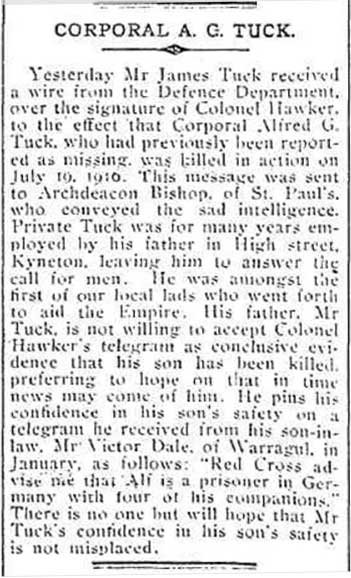
3 April 1917 -From James Tuck to Colonel Hawker, 3rd Military District Headquarters:
“I received your Wire but I cannot understand it in the face of Red Cross information that Cpl A. G. Tuck is a prisoner of war Dulmen Germany. Also, from Sgt A.S. Cole 1321 that my son is a prisoner with him in Dulmen with four companions and Pte R Fagan 3345 of 7th. Reinforcement 29 Battalion 8th Infantry Brigade A. I. F., that he is a prisoner of war. Kindly let me know how you have arrived at it that my son was killed on the 19 July 1916 by doing so you will greatly oblige me.”
16 April 1917 - From Base Records to James Tuck:
“I have to state the report ‘killed in action, previously reported missing 19/7/16’ is evidently the result of a Court of Enquiry held to investigate the case. The evidence upon which this decision was based is not yet available at this office, but you will be notified immediately upon receipt of further details.”
8 June 1917 - From James Tuck to Colonel Hawker, 3rd Military District Headquarters:
“Kindly send certificate of Death of my son Cpl Tuck A.G. No. 1252… “
15 June 1917 - From Base Records to James Tuck:
“..enclose herewith, as requested, certificate of report of death…”
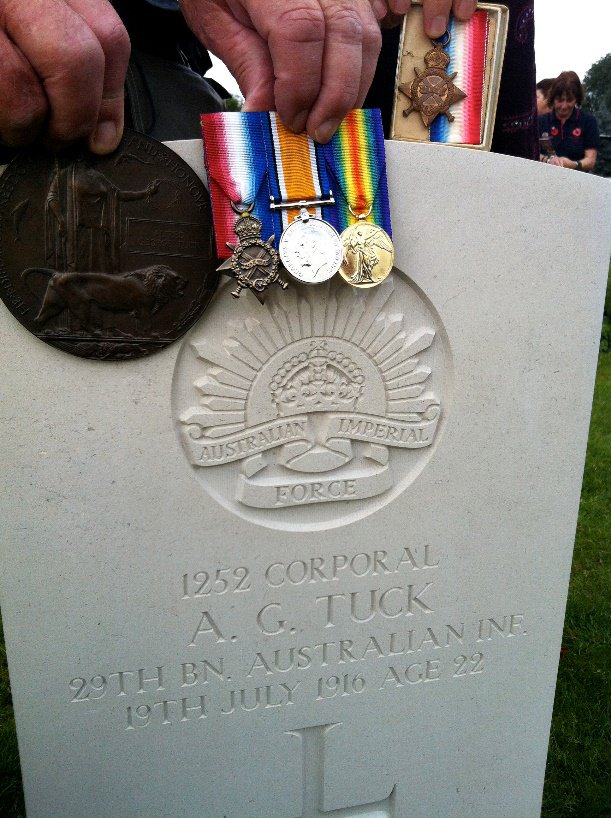
In November 1917, Alfred’s identification disc was returned to his father as next of kin. It appears that no other personal effects were located.
Finding Alfred
Until recently the location of Alfred’s remains was unknown which caused his family considerable angst, especially as he was first reported to be a Prisoner of War. It took many months before family received positive confirmation of his death.
Thanks to Lambis Englezos’ persistence in locating the mass grave and the team at the Unrecovered War Casualties, Alfred Tuck was identified in 2012.
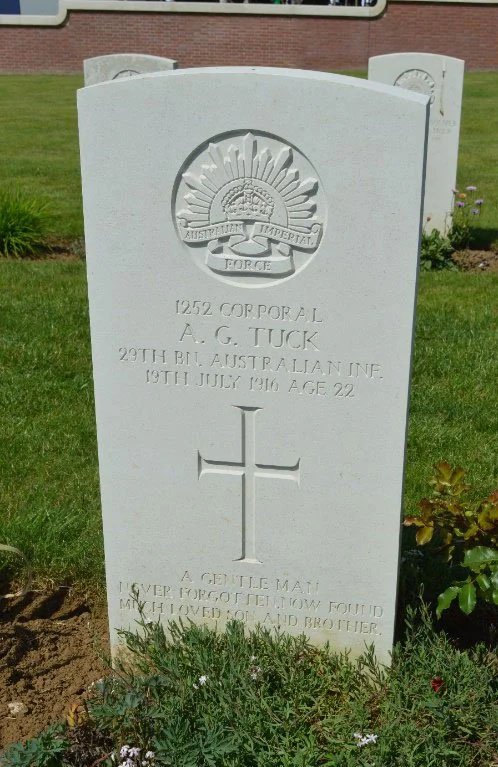
Margaret Kirby, a relative, travelled to France for the ceremony to unveil his gravestone in July 2012. She never knew Tuck and in fact, no family member is alive who has first-hand memories of the man. After researching, recalling oral history and putting together old letters, the family decided on the following inscription on his gravestone:
“A gentle man
Never forgotten Now found
Much loved son and brother”