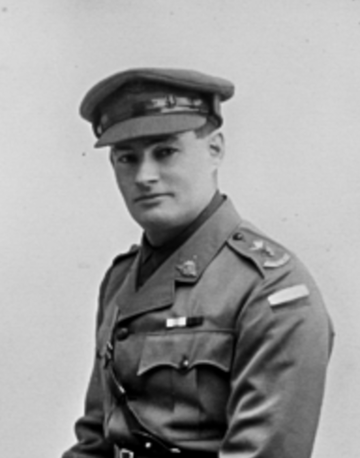
Samuel Ernest Goold MILLS
Eyes chest 37 inches, Hair eyes grey, Complexion hair brown (dark)
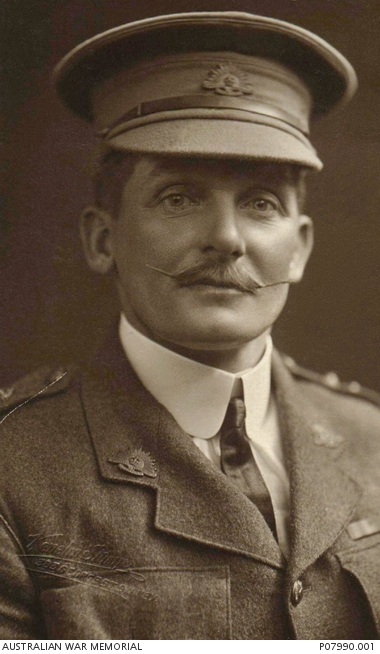
Captain S. E. G. Mills MC – “A Soldier and a Man”
Early Life - From Parramatta to the Gold fields of Western Australia
Samuel Ernest Goold Mills, known to family and friends as “Ernie”, was born on 11 July 1881 at the field of Mars (now Dundas) , near Parramatta, New South Wales, the only son of Charles William Mills and Eliza Goold. His sister was Hannah Mary Eliza (‘Elsie’). Both sides of the family had been in NSW for two generations from English and Irish backgrounds. Eliza’s father was a businessman, politician magistrate and churchman. Ernie attended the local Public School.
Due to the terrible ‘Depression in the 90s’, the Mills family made a move to the gold fields of Western Australia. At the time, there was no land route to the west so it was an arduous trip– 4000 km by sea to Fremantle and then about 600 km by steam train to Kalgoorlie. After being in Kalgoorlie Boulder for many years, they moved south to the Dundas/Norseman gold rush. When his father Charles died in 1911, he was cited in the local papers as being one of the pioneers of the Dundas Goldfields.
The Boer War Volunteer
As a young man, Ernie worked as a miner and drover and was a keen cyclist — his enlistment papers later noted scars on his back and hip, “all due to bicycle racing.” He developed a reputation for determination and good humour, qualities that would stay with him throughout two wars. In March 1900, at just nineteen, he volunteered for service in the Boer War, joining the 4th Western Australian Imperial Bushmen Contingent.
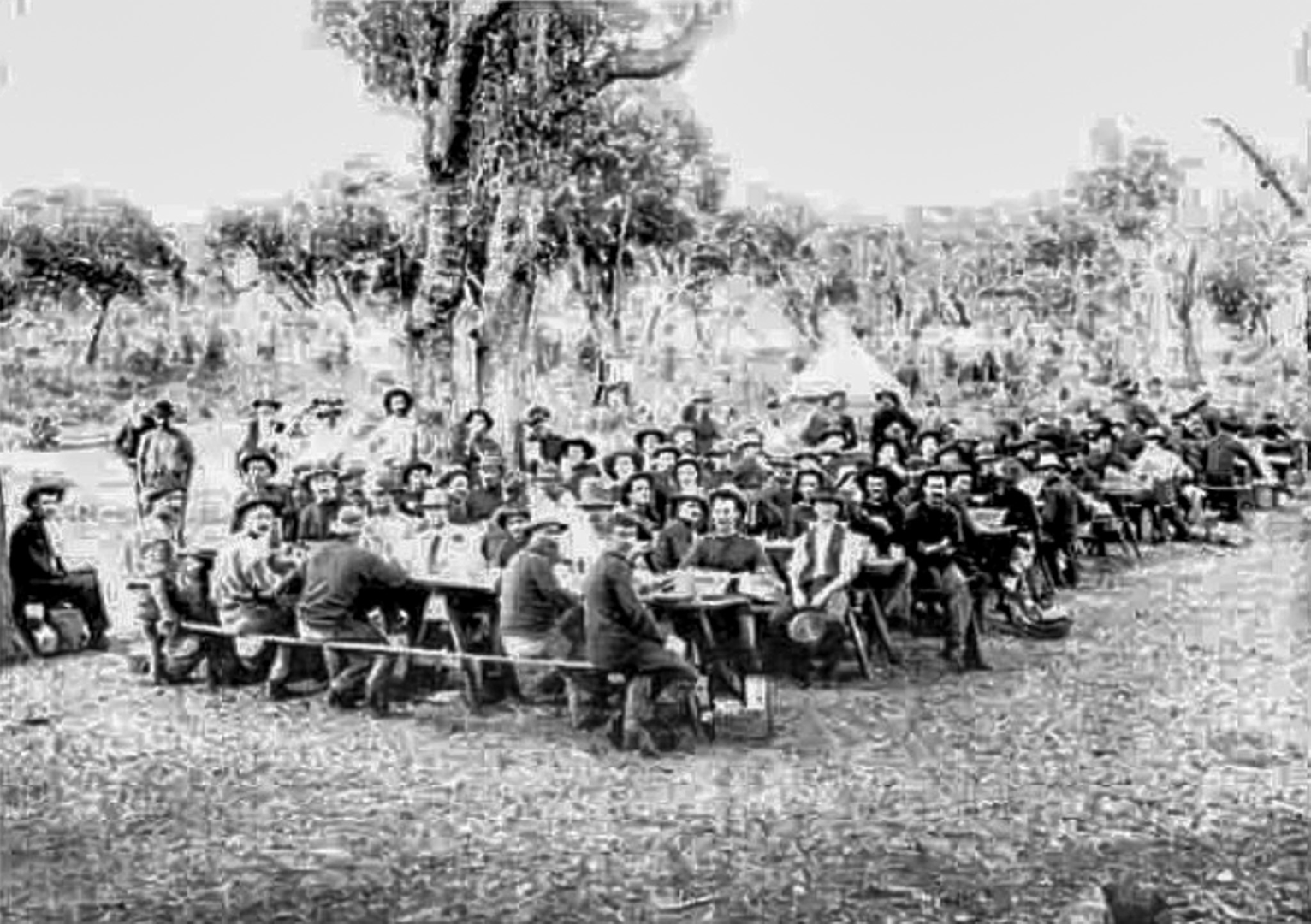
His letters home from South Africa, published in the Norseman Times, show a sharp observer with a soldier’s eye for detail and a dry colonial wit. Writing from Belfast and Machadodorp, he described the endless marching and the rough fighting of General Plumer’s column:
“Marching these long distances without anything particular to do to break the monotony is rather slow; I would rather have something to beat. … I am still in ‘tip-top nick’ and have not been sick for a day all along.”
Only weeks later, writing from Reitfontein, he witnessed the full brutality of battle and praised the courage of the stretcher-bearers:
“I have heard a lot about firing on the white flag, but that day was the first time I actually saw it done. They deliberately fired on the ambulance bearers… These men, who are so seldom mentioned, deserve every praise that can be given them.”
When he returned home from the war in 1901, his father wrote proudly to the Cumberland Argus, sharing news of his son’s return:
“You will be glad to hear that my son, Ernest, has returned from the war in South Africa, and is looking well after the trip, and weighs 12 stone. He grew taller and heavy, notwithstanding all they went through. He brought some valuables and interesting trophies back with him. At present he is working in one of the mines here.”
Ernie settled at Norseman and later took up farming near Prescott Vale, close to Albany. On 21 May 1908, he married Philippa Ethel Krakouer, daughter of Philip and Mary Jane Krakouer (née Ridler) — linking him to another family whose members, including Private Samuel Thomas James Ridler, would also serve and fall at Fromelles.
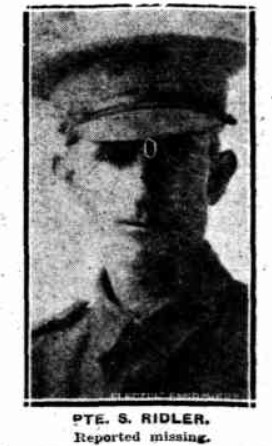
By 1915, Ernie was 33, a Boer War veteran, farmer, and miner — respected in both Kalgoorlie and Albany. When war came again, he volunteered once more, joining the Australian Imperial Force.
Off to War
When war broke out in 1914, Ernie Mills was farming near Prescott Vale, close to Albany. On 8 April 1915, he joined the Australian Imperial Force as a Private, initially with the 6th Battalion, then the 3rd and finally to ‘D’ Company of the newly formed 32nd Battalion. Half of the 32nd Battalion were from Western Australia and half from South Australia. Training began at Blackboy Hill Camp, near Perth. His previous Boer War experience and his age amongst all the young recruits quickly marked him as a natural leader.
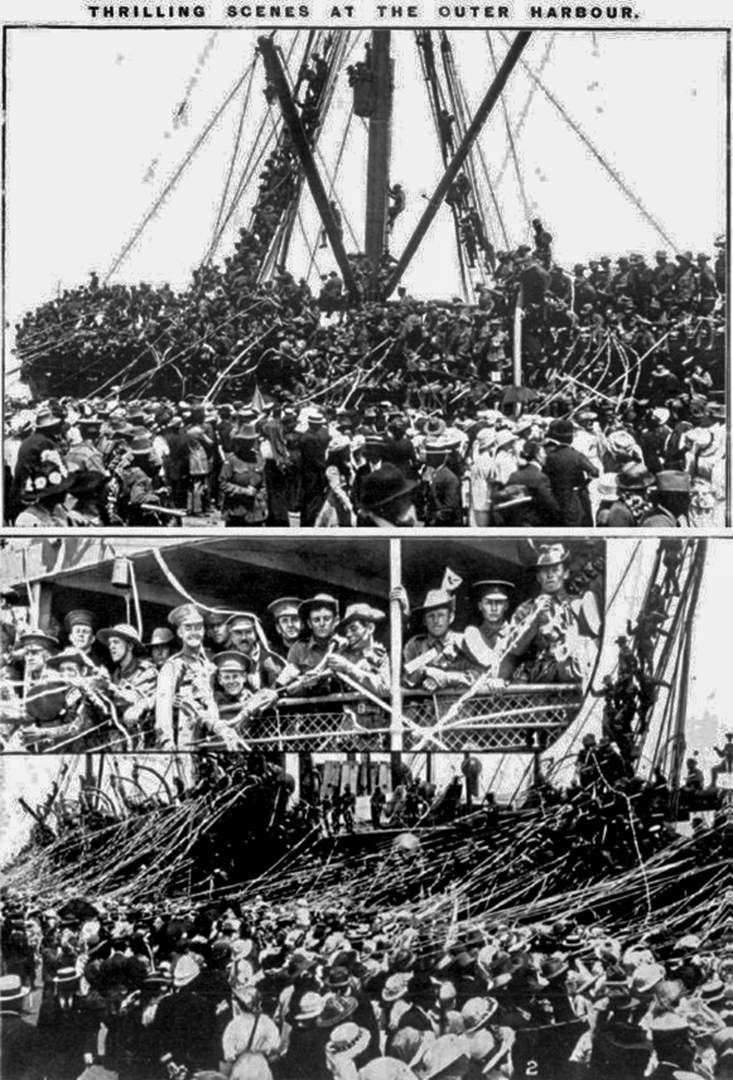
He attended Officer Training School in June, was promoted to Sergeant on 1 August 1915, and then to Company Sergeant Major that same month. The men from WA arrived in Adelaide at the end of September and the full battalion was assembled at the Cheltenham Racecourse Camp. Training continued until they departed for Egypt on 18 November 1915, with the unit being split between two troop ships HMAT A2 Geelong and HMAT A13 Katuna.
As reported in The Adelaide Register:
“The 32nd Battalion went away with the determination to uphold the newborn prestige of Australian troops, and they were accorded a farewell which reflected the assurance of South Australians that that resolve would be realized.”
The 32nd arrived in Suez on 14 December 1915 and moved to El Ferdan just before Christmas. A month later they marched to Ismailia and then to the major camp at Tel-el-Kebir where they stayed for February and most of March. Tel-el-Kebir was about 110 km northeast of Cairo and the 40,000 men in the camp were comprised of Gallipoli veterans and the thousands of reinforcements arriving regularly from Australia.
In March, Ernie was promoted to Second Lieutenant. Their next stop was at Duntroon Plateau and then at Ferry Post until the end of May, where they trained and guarded the Suez Canal. Their last posting in Egypt was a few weeks at Moascar. One soldier’s diary complained of being “sick up to the neck of heat and flies”, of the scarcity of water during their long marches through the sand and he described some of the food as “dog biscuits and bully beef”. He did go on to mention good times as well with swims, mail from home, visiting the local sights and the like.
Source AWM C2081789 Diary of Theodor Milton PFLAUM 1915-16, page 29, page 12
During their time in Egypt the 32nd had the honour of being inspected by H.R.H. Prince of Wales.

After spending six months in Egypt, the call to support the British Expeditionary Force on the Western Front came in mid-June. The 32nd left from Alexandria on the Transylvania on 17 June 1916, arriving at Marseilles, France on 23 June and they were immediately entrained for a three-day train trip to Steenbecque. Their route took them to a station just out of Paris, within sight of the Eiffel Tower, through Boulogne and Calais, with a view of the English Channel, before disembarking and marching to their camp at Morbecque, about 30 kilometres from Fleurbaix. Theodor Pflaum (No. 327) and Wesley Choat (No. 68) wrote about the trip:
“The people flocked out all along the line and cheered us as though we had the Kaiser as prisoner on board!!” – Theodore Pflaum
“The change of scenery in La Belle France was like healing ointment to our sunbaked faces and dust filled eyes. It seemed a veritable paradise, and it was hard to realise that in this land of seeming peace and picturesque beauty, one of the most fearful wars of all time was raging in the ruthless and devastating manner of "Hun" frightfulness”. – Wesley Choat
They were headed to the area of Fleurbaix in northern France which was known as the ‘Nursery Sector’ – a supposedly relatively quiet area where inexperienced Allied troops could learn the harsh realities of Western Front trench warfare against the Germans. But the quiet times did not last long. Training continued with a focus on bayonets and the use of gas masks, assuredly with a greater emphasis, given their position near the front. The 32nd were into the trenches for the first time on 16 July, only three weeks after arriving in France.
The Battle of Fromelles
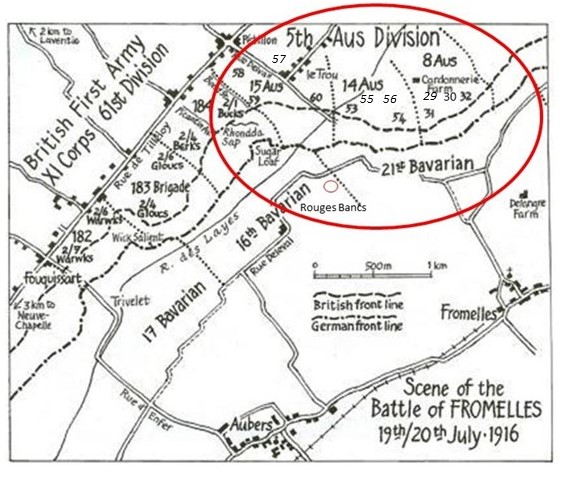
On the 17th they were reconnoitring the trenches and cutting passages through the barbed wire, preparing for an attack, but it was delayed due to the weather. Ernie wrote home to his wife Philippa with characteristic humour and affection, optimistically describing the battalion’s preparations for its first battle:
“We are not doing much work now, just enough to keep us fit—mostly route marching and helmet drill. We have our gas helmets and steel helmets, so we are prepared for anything. They are both very good, so a man is pretty safe.”
The overall plan was to use brigades from the Australian Fifth Division to conduct a diversionary assault on the German trenches at Fromelles. The 32nd Battalion’s position was on the extreme left flank, with only 100 metres of No Man’s Land to get to the German trenches. As they advanced, they were to link up with the 31st Battalion on their right. However, their position made the job more difficult, as not only did they have to protect themselves while advancing, but they also had to block off the Germans on their left, to stop them from coming around behind them. On the morning of the 18th, A Company and C Company went into the trenches to relieve B and D Companies, who rejoined the next day.
Lieutenant Frederick Stolz described the calm before the storm:
“The fellows were wonderfully cool and not during the whole time did I see anyone get excited or do anything silly, and such a lot were only young boys of between 18 to 20.”
The Zero Hour for advancing from their front-line trenches was to be 5.45 PM, but the Germans knew this attack was coming and were well-prepared. They opened a massive artillery bombardment on the Australians at 5.15 PM, causing chaos and many casualties. The charge over the parapet began at 5.53 PM. A and C Company were in the first and second waves to go, B & D were in the third and fourth. They were successful in the initial assaults and by 6.30 PM were in control of the German’s 1st line system (map Trench B), which was described as “practically a ditch with from 1 to 2 feet of mud and slush at the bottom”.
Source AWM4 23/49/12, 32nd Battalion War Diaries, July 1916, page 11
Unfortunately, with the success of their attack, ‘friendly’ artillery fire caused a large number of casualties because the artillery observers were unable to confirm the position of the Australian gains. The 32nd were able to take out a German machine gun in their early advances, but were being “seriously enfiladed” from their left flank.
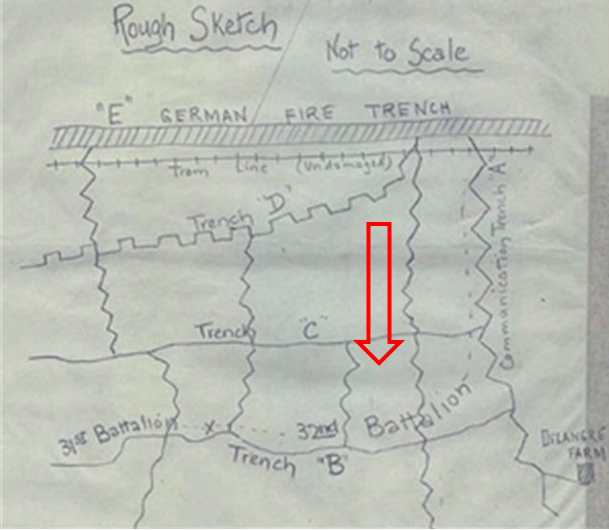
By 8.30 PM their left flank had come under heavy bombardment with high explosives and shrapnel. Return bombardment support was provided and the 32nd were told that “the trenches were to be held at all costs”.
Source - AWM4 23/49/12, 32nd Battalion War Diaries, July 1916, page 12
Fighting continued through the night. The Australians made a further charge at the main German line beyond Trench B, but they were low on grenades, there was machine gun fire from behind them from the emplacement at Delangre Farm and they were so far advanced that they were getting shelled by both sides. In the early morning of the 20th, the Germans began a counterattack from the Australian’s left flank, bombing and advancing into Trench A (map).
Given the Australian advances that had been made earlier, the rear Trench E had been left almost empty, which then enabled the Germans to regain that trench and envelop the men of the 32nd. At 5.30 AM the Germans attacked from both flanks in force and with bombing parties. Having only a few grenades left, the only resistance they could offer was with rifles:
“The enemy swarmed in and the retirement across No Mans’ Land resembled shambles, the enemy artillery and machine guns doing deadly damage.”
What was left of the 32nd had finally withdrawn by 7.30 AM on the 20th. The initial roll call count was devastating – 71 killed, 375 wounded and 219 missing. To get some perspective of the battle, when Charles Bean, Australia’s official war historian, attended the battlefield two and half years later, he observed a large quantity of bones, torn uniforms and Australian kit still on the battlefield. The final impact was that 228 soldiers of the 32nd Battalion were killed or died from wounds sustained at the battle and, of this, 166 were unidentified. Ernie survived the battle and in his letters home, he recalls the bravery of the men:
“They came over the parapet like racehorses……… However, a man could ask nothing better, if he had to go, than to go in a charge like that, and they certainly did their job like heroes."
After the Battle
In a letter written from No. 2 Eastern General Hospital, Brighton, just five days later, Ernie recounted the chaos of the attack to his wife Philippa:
“Our division and an English one made an attack on the German lines on our particular front. We got the first German line and went about 150 yards past. Here we held for about twelve hours, but had to retire again as we could not hold our flanks. It was awful having to retire and not able to take the wounded.”
He had been wounded twice — once in the leg and once in the wrist — but refused evacuation until the following morning. His platoon was nearly annihilated.
“All I could find of my own platoon was a lance-corporal and signal men. There may be more who were wounded earlier and got back and taken to hospital. I was posted as missing and the chaps were very good when I turned up. Poor old Fred Hulks was killed at the head of his platoon, leading them like the soldier he was.”
Lieutenant Frederick Hulks was killed in action at Fromelles and has no known grave.
Among those who fell that night were Corporal Robert Courtney Green (D Company), Lance Corporal Allan Bennett (1602, D Company), and Private Samuel T. J. Ridler (1036, C Company) — all later identified in 2010 among the soldiers buried by the Germans at Pheasant Wood.
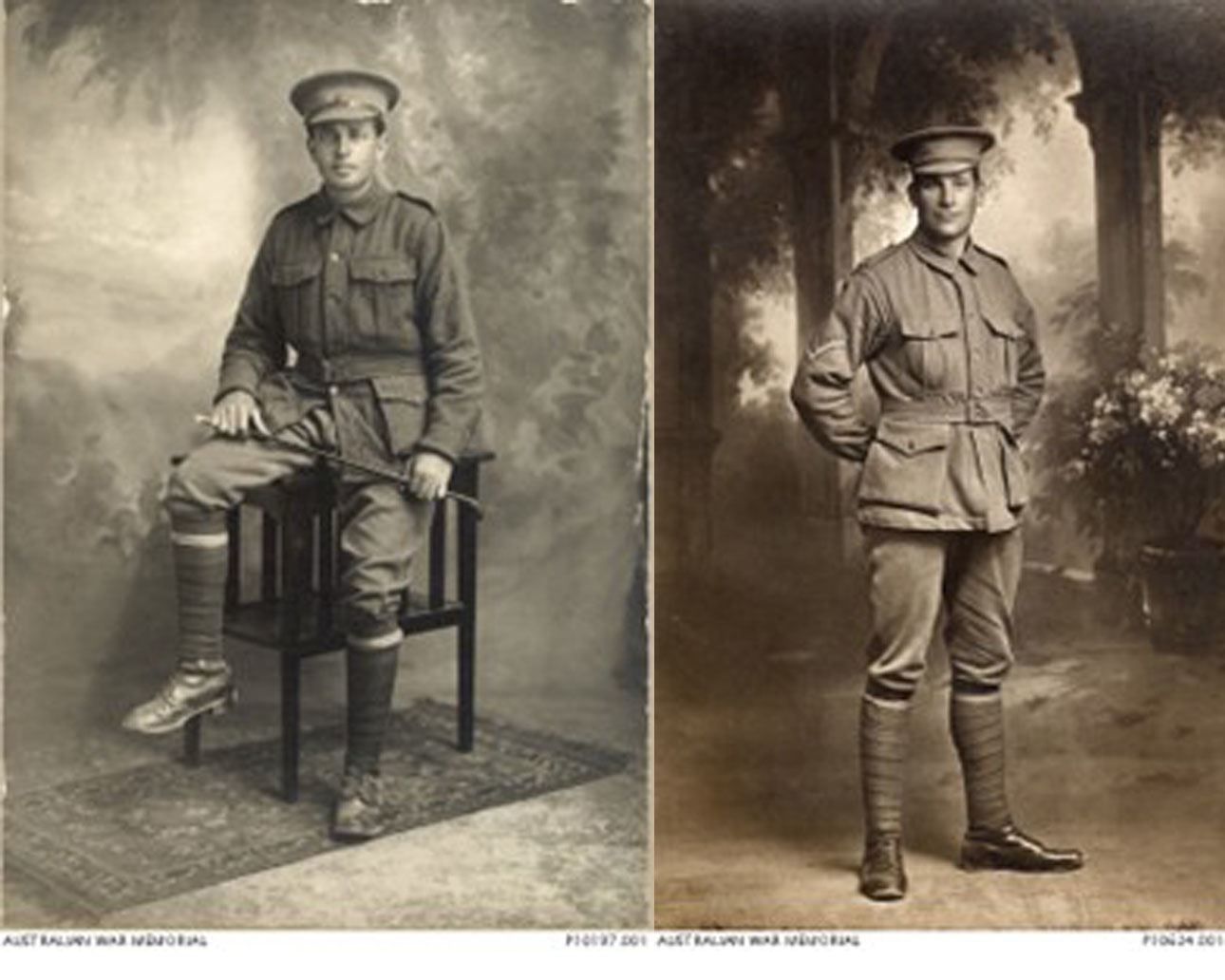
Ernie’s letter vividly records his attempt to save Corporal Green and Lance Corporal Bennett under heavy shellfire:
“One of my corporals, Green by name, was hit and lying under very heavy artillery fire in a ditch, with only his head out of water, and in danger of drowning. Bennett and a chap named Brotrell volunteered to come with me and get him and put him under cover. We got Green half out and Bennett got hit with a piece of shell on the back of the hip and put him out of action. He begged us to leave him, but a chap named Mitchell came and we got them both under cover. The saddest part of the whole thing is that no stretcher-bearers got through to us at all and we could not get any wounded away at all who couldn’t be moved without a stretcher, so that both Green and Bennett were probably captured.”
Ernie was one of the few officers of the 32nd Battalion to return from the field that night. As he later wrote, his survival was sheer luck:
“I was lucky to get back as I was hit going over in the first place but not enough to stop me. Of course, by morning I wasn’t feeling like Sheffields, but I managed to get half-way across No Man’s Land when I petered out. They turned machine guns on anything that moved and so wiped most of the wounded out.”
Despite his wounds, he continued taking water to the wounded through the night — work that undoubtedly saved lives. The Albany Advertiser later described how the people of his hometown followed his every move, publishing his letters with admiration for his composure and courage under fire. For Ernie, it was the beginning of a long recovery and an enduring sense of duty to those who fell beside him.
After Fromelles –A Military Cross
Following the desperate fighting at Fromelles, Ernie was evacuated to England with wounds to his left leg and right wrist. His letter from No. 2 Eastern General Hospital, Brighton, reveals the stoic humour and quiet courage that defined him:
“I got smacked in the leg and arm on July 19 and have since then been in hospital here, having the time of my life — motor drives nearly every day since I could get about. They had to operate and get a few pieces out — one from the right wrist and a piece of bone from the left leg — but they are all right now and nearly healed.”
While recovering, he remained upbeat and self-deprecating. In a later letter he joked:
“I think I showed remarkable judgment in selecting the nice little wounds I got. There was a fine range to select from.”
Despite downplaying his efforts in the battle and his injuries, he was awarded the Military Cross.
The official citation for his Military Cross, gazetted on 29 August 1916, confirms that the award recognised his leadership and endurance during the Battle of Fromelles, not Pozières as some later reports suggested:
“For conspicuous gallantry and devotion to duty in action. Though twice wounded early in the attack, he continued firing at his post throughout the night, displaying great personal courage.”
The citation precisely matched his own description of events that night, when he led his platoon through twelve hours of bombardment and counter-attacks before being forced to withdraw.
Back into Battle – Killed a year later at Passchendaele
By late 1916 he had rejoined the 32nd Battalion in France, was promoted to Lieutenant, and then, following further training at Divisional Infantry School in England, rose to Captain in March 1917. His men admired him deeply. When word reached them of his promotion, they presented him with a gold watch in gratitude for his leadership — a gesture that meant more to him than any decoration:
“He stated that he had been transferred to another company, and the N.C.O.s and men of his old company had presented him with a gold watch, which he said he valued more than a V.C., as it showed what his men thought of him.”
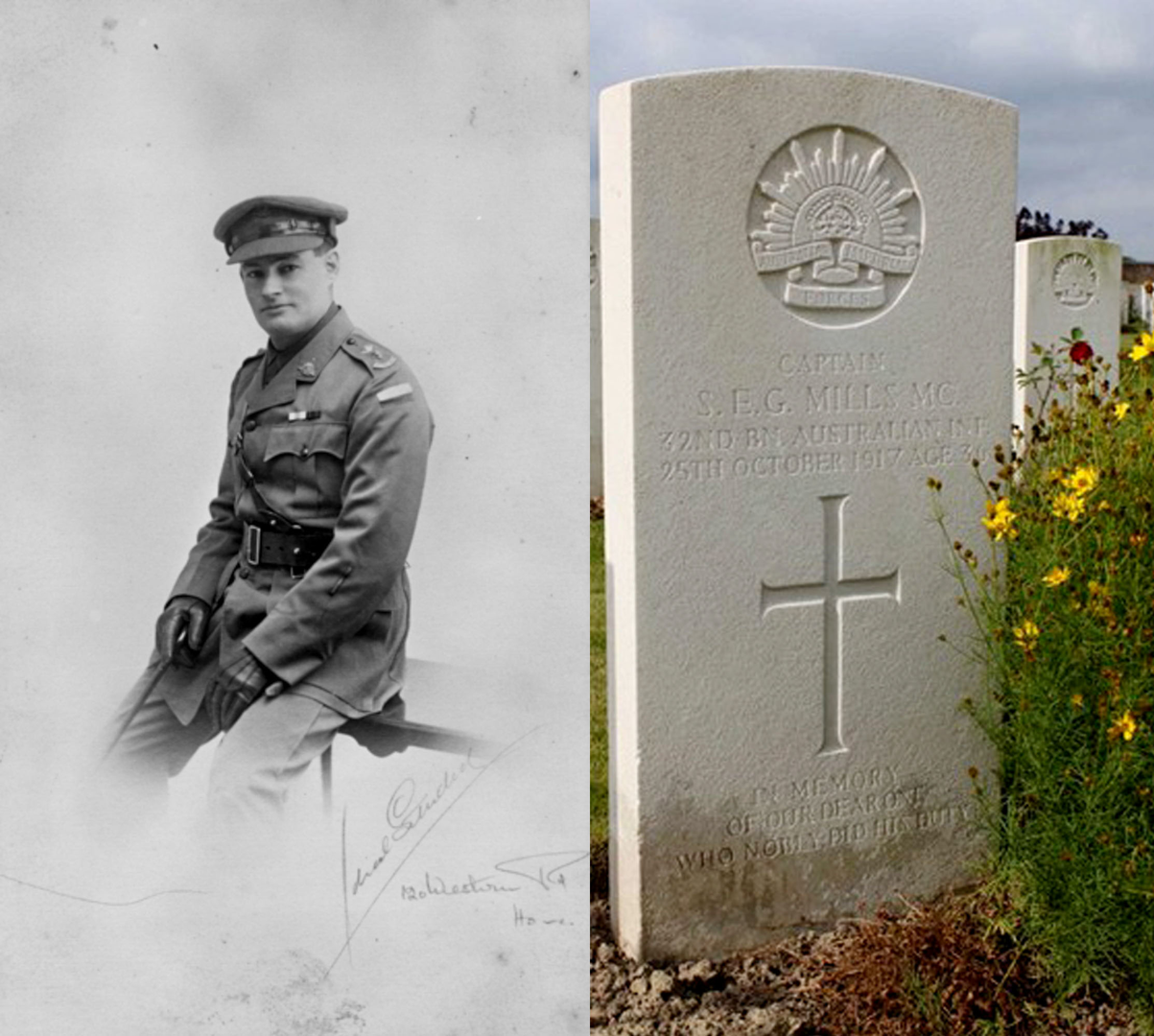
During 1917, the 32nd Battalion took part in the Third Battle of Ypres, also known as the Battle of Passchendaele — a campaign notorious for its relentless artillery fire, mud, and devastating losses. Ernie, now a Captain, was commanding a company of men who had already followed him through Fromelles. On 25 October 1917, while leading his company in the battle, Ernie was killed. He was 36 years old. In the Daily Herald’s tribute, his men’s admiration was clear:
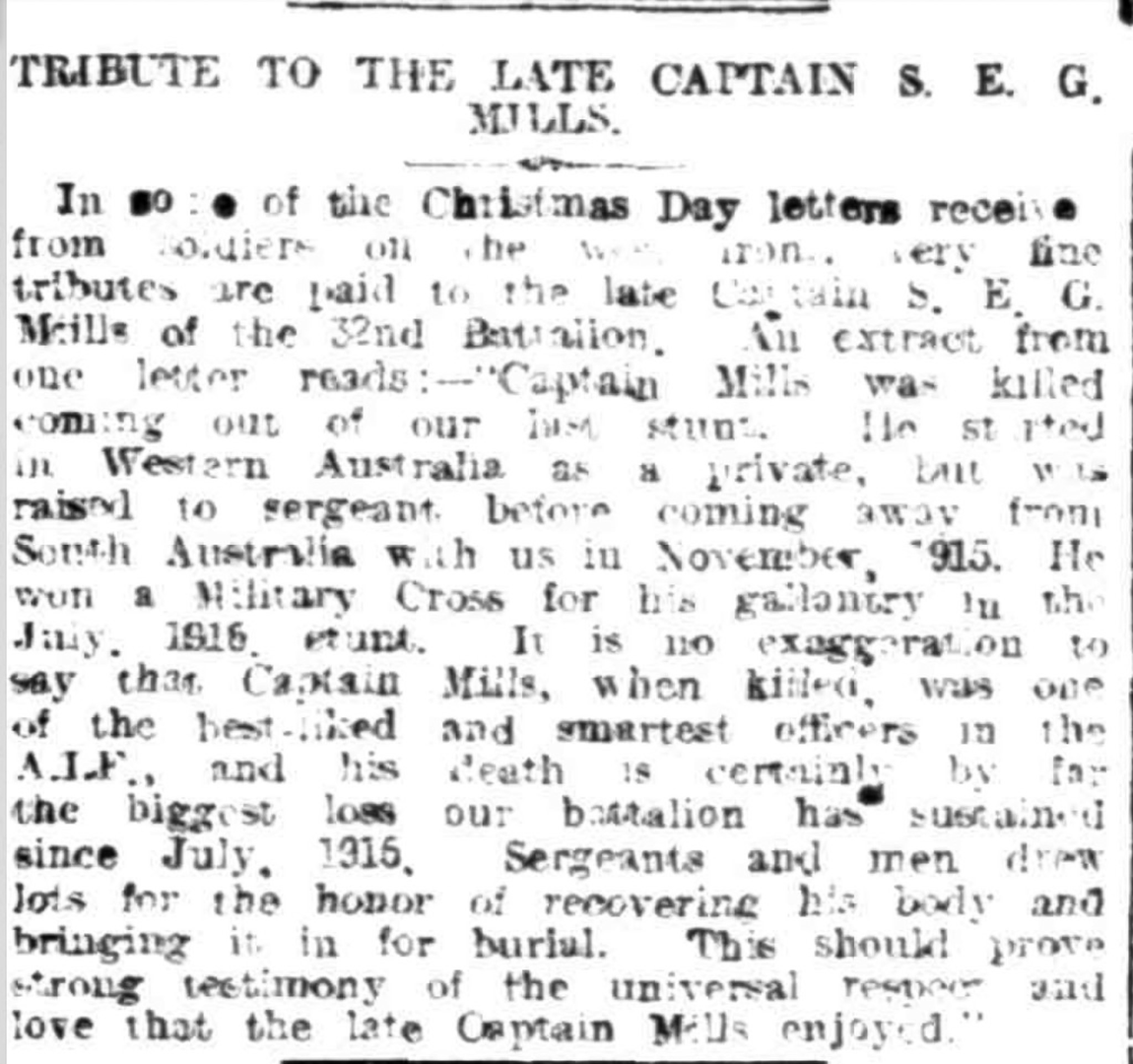
“It is no exaggeration to say that Captain Mills, when killed, was one of the best-nerved and smartest officers in the A.I.F., and his death is certainly by far the biggest loss our battalion has sustained since July 1916… The universal respect and love that the late Captain Mills enjoyed was shown by the eagerness of all to bring in his body for burial.”
He was laid to rest with honour at The Huts Cemetery, Dickebusch, Belgium — Plot XII, Row B, Grave 4.
In The Albany Advertiser, his friends paid tribute with simple words that captured the man behind the medals:
A soldier and a man.
Philippa
After Ernie was killed at Ypres on 25 October 1917, the news reached his widow Philippa through official channels. She had already endured months of uncertainty during the war — writing to Base Records in 1916 when he was first wounded at Fromelles, anxiously seeking any word of his recovery and again in 1917. Now she faced the final telegram. The Albany Advertiser recorded her family’s sorrow:
“Killed in action, in France, Captain S. E. Mills, M.C., dearly loved husband of Philippa, and beloved son-in-law of Mr. and Mrs. P. Krakouer, and brother-in-law of Lea and Thelma, Samuel and Phillip (returned). Deeply regretted.”
In 1925, Philippa travelled from Perth to Europe to visit his grave at The Huts Cemetery, Dickebusch, Belgium — Plot XII, Row B, Grave 4 — where she left a wreath on behalf of their family. Ernie’s Sister Elsie married George Joseph Bennett 1898, Norseman, they had three children. George died 1903. Philippa and their daughters Eliza and Elsie moved back to Sydney after the death of Ernie.
Legacy
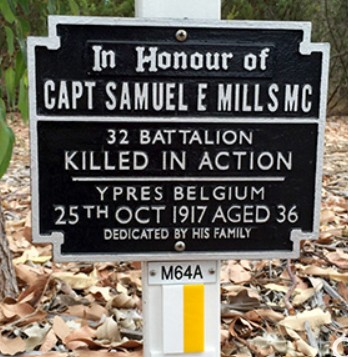
Ernie’s service and sacrifice are commemorated on the Kings Park Honour Avenue Plaque No. M64A, beside that of his wife’s uncle Private Samuel Ridler and his comrade Corporal Allan Bennett and near to Robert Courtney Green, who were all later identified from the mass grave the German’s dug at Pheasant Wood for the 250 soldiers that they recovered from the battlefield.
Links to Official Records
The Fromelles Association would love to hear from you

Contacts
(Contact: carla@fromelles.info or geoffrey@fromelles.info).
(Contact: army.uwc@defence.gov.au or phone 1800 019 090).
Donations
If you are able, please contribute to the upkeep of this resource.
(Contact: bill@fromelles.info ).