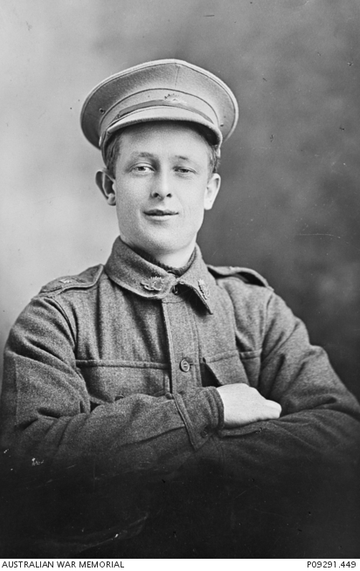
Edwin Aloysius VINCENT
Eyes blue, Hair brown, Complexion fair
Edwin Aloysius Vincent — “A Vaudeville star who went out singing”
Can you help find Leo?
Edwin Aloysius (Leo) Vincent’s body was never found after the Battle of Fromelles and there are no records of his burial.
A mass grave was found in 2008 at Fromelles, a grave the Germans dug for 250 Australian soldiers they recovered after the battle. As of 2024, 180 of these soldiers have been able to be identified via DNA testing.
Leo may be among these remaining unidentified men. There is still a chance to identify him — but we need help. We welcome all branches of his family to come forward to donate DNA to help with his identification, especially those with roots in Southwark, Adelaide South Austraila.
See the DNA box at the end of the story for what we do know about his family.
If you know anything of contacts for Leo, please contact the Fromelles Association.
Early Life
Edwin Aloysius Vincent — known to family and friends as Leo — was born on 16 November, 1896 in Adelaide, South Australia. He was the third son of Thomas Aloysius Vincent and Hannah (née Wilkins) of 21 Cawthorne Street, Southwark, South Australia, who had married at Port Adelaide in 1888.
Their children were:
- Amy Bewick (1888–1953)
- Bewick Henry (1890–1917) AIF, Killed in Action
- William Goldsborough (1892–1916) AIF, Killed in Action
- Edwin Aloysius “Leo” (1896–1916) AIF Killed in Action
- John Bewick (1899–1952)
- Thomas Ambrose (1901–1976)
Thomas had emigrated to Australia from Newcastle upon Tyne, England in the 1880’s. He worked for more than thirty years with the South Australian Railways at Saddleworth, Terowie, Hamley Bridge and finally in Southwark, Adelaide. Hannah was born on the Lefevre Peninsula in 1866, the daughter of John Wilkins and Julia Forde, both early South Australian settlers. Leo and his brothers attended Christian Brothers’ College in Adelaide, where they were remembered as bright and good-humoured students.
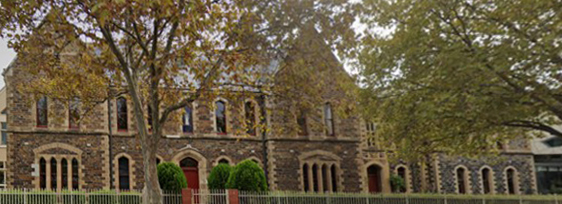
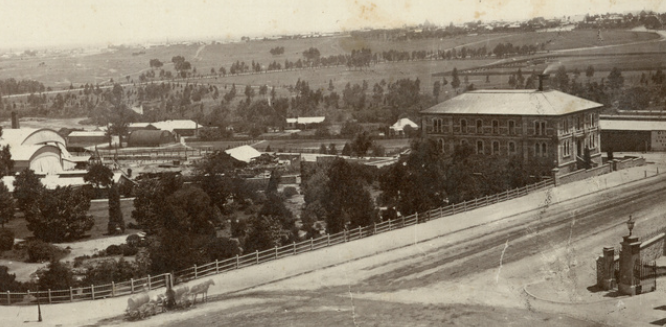
After leaving school, Leo spent six years working at the Government Printing Office and then joined Messrs. Cornell & Co. in Pirie Street, Adelaide, suppliers of ‘every type of bicycle equipment’.
But it was on the stage where Leo truly came alive. With a gift for rhythm, humour and charm, he became a familiar face in Adelaide’s vaudeville circuit, performing “ragtime” numbers and comedy that were the height of popular entertainment in the years before the war. By 1913 he was performing under the stage name “Ned Vincent”, appearing at Bosley’s Vaudeville Company benefits and charity nights. “Among the artists were the Chard Sisters, Mr. Ned Vincent (who was recalled several times), ..”
Source – Bosley’s Vaudeville. (9 April 1913). Daily Herald (Adelaide, SA : 1910–1924), p. 2. http://nla.gov.au/nla.news-article124940598
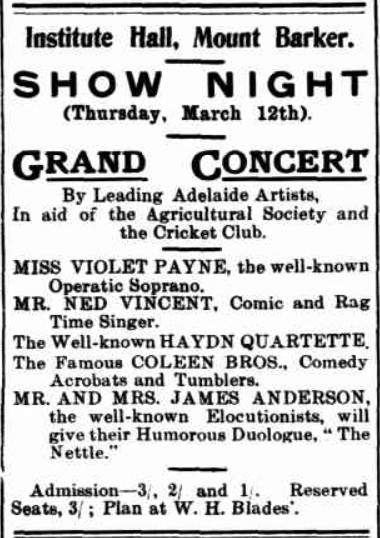
That same year, he joined Fred World’s Vaudette Company, performing alongside leading local and interstate entertainers at Port Adelaide’s Dale Street Vaudeville Hall, performing at major venues such as the Tivoli (now known as Her Majesty’s Theatre) and lending his voice to community fundraising concerts.
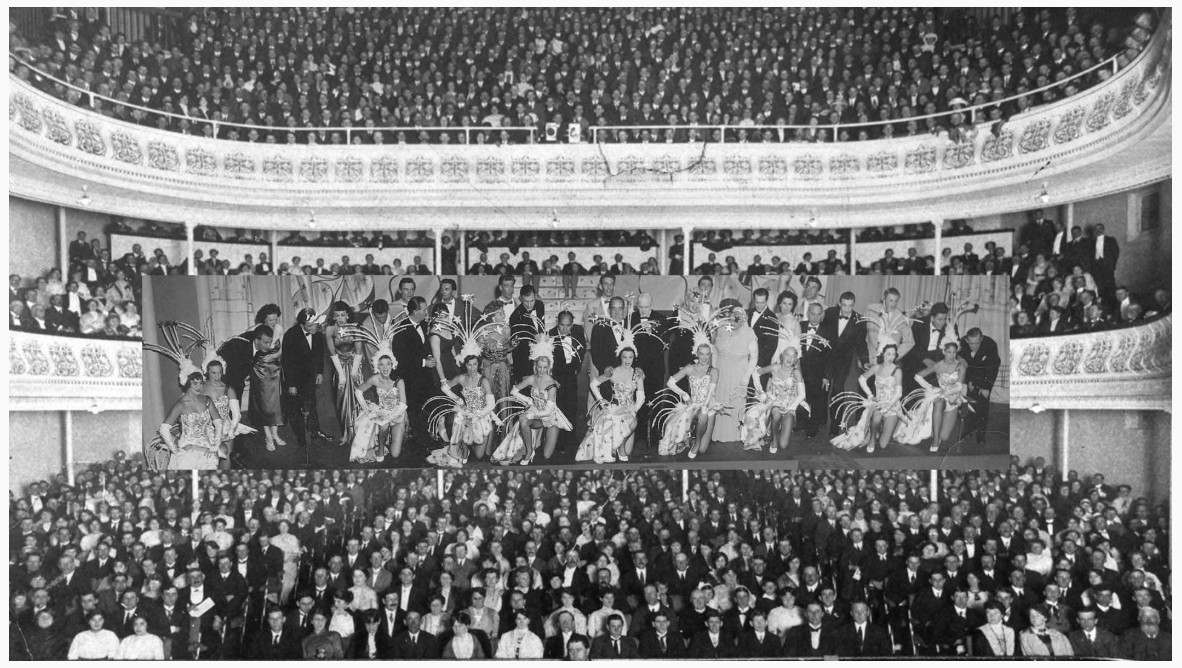
In January 1914, Leo appeared in an amateur ragtime contest at the New Tivoli Theatre in Grote Street, sharing the bill with the visiting American performer Gene Greene — dubbed “the Emperor of Ragtime.” The newspaper reported:`“After many vain attempts the artist succeeded in coaxing Mr. Vincent, one of the competitors, on to the stage. Mr. Vincent was plainly not appearing before a similar audience for the first time... His first song was ‘Ragtime Melodies,’ and as an encore he rendered ‘Robert E. Lee,’ both of which were loudly applauded.”`
Source: TIVOLI. (5 January 1914). Daily Herald (Adelaide, SA : 1910–1924), p. 2. http://nla.gov.au/nla.news-article105612245
In 1915, Leo, just eighteen, a wiry showman with a ready grin, swapped the theatre lights and the familiar streets of Southwark to enlist with the AIF. With his entertainment skills he became known as “the most popular man in the Battalion.”
Source - AWM Red Cross Wounded and Missing File – Edwin Vincent page 3
Off to War
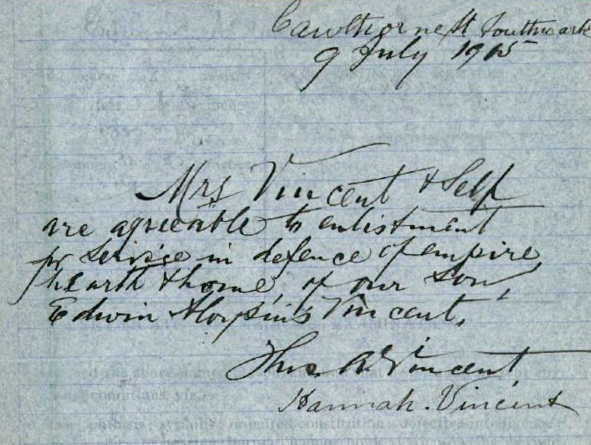
Leo enlisted at Keswick, South Australia, on 9 July 1915, declaring his occupation as vaudeville artist. As he was only 18, he needed his parents’ approval, which they wholeheartedly gave for his “services in defence of empire, hearth and home”.
He was assigned to A Company, 32nd Battalion, part of the newly formed 8th Brigade in the 5th Australian Division, which was composed of men from both South and Western Australia. The battalion trained at Mitcham Camp, where Leo’s energy and humour reportedly made him a favourite among his mates. He embarked from Adelaide on 18 November 1915 aboard the HMAT A2 Geelong, bound for Egypt.
As reported in The Adelaide Register:
“The 32nd Battalion went away with the determination to uphold the newborn prestige of Australian troops, and they were accorded a farewell which reflected the assurance of South Australians that that resolve would be realized.”
The 32nd arrived in Suez on 14 December 1915 and moved to El Ferdan just before Christmas. A month later they marched to Ismailia and then to the major camp at Tel-el-Kebir where they stayed for February and most of March.
Tel-el-Kebir was about 110 km northeast of Cairo and the 40,000 men in the camp were comprised of Gallipoli veterans and the thousands of reinforcements arriving regularly from Australia. Their training was challenging and the 32nd was posted outside of Cairo, but the soldiers did have time to explore Cairo. As described in kathrynshistoryblog.com, “While entertainments in the camps were popular, the soldiers wanted somewhere to go when they were exploring Cairo and so the YMCA responded by taking over the Soldiers' Club at the Ezbekiah Gardens.”

The concerts were a mixture of professional concert parties, including the famed Lena Ashwell troupes and the soldiers’ divisional bands. There was an average of 1,600 men visiting each day. It not unlikely that that Leo was involved with the nightly concerts - something doing every night – entertainment was the word. He was well known in the 32nd as a ragtime singer. After Tel-el-Kebir, the 32nd moved east and their next stop was at Duntroon Plateau and then at Ferry Post until the end of May where they trained and guarded the Suez Canal. Their last posting in Egypt was a few weeks at Moascar.
After spending six months in Egypt, the call to support the British Expeditionary Force on the Western Front came in mid-June. The 32nd left from Alexandria on the ship Transylvania on 17 June 1916, arriving at Marseilles, France on 23 June 1916 and they then immediately entrained for a three-day train trip to Steenbecque. Their route took them to a station just out of Paris, within sight of the Eiffel Tower, through Boulogne and Calais, with a view of the English Channel, before disembarking and marching to their camp at Morbecque, about 30 kilometres from Fleurbaix. Leo admiringly described the rolling countryside scenes of France in his final letter home as reported in the local papers:
“He paid high tribute to the geniality of the French people and the universal picturesque scenery. Though tokens of mourning prevailed he was impressed with the jovial tone of the populace arising from the anticipation of eventual victory.”
The 32nd were headed to the area of Fleurbaix in northern France which was known as the ‘Nursery Sector’ – a supposedly relatively quiet area where inexperienced Allied troops could learn the harsh realities of Western Front trench warfare against the Germans. But the quiet times did not last long. Training continued with a focus on bayonets and the use of gas masks, assuredly with a greater emphasis, given their position near the front.
The 32nd moved to the Front on 14 July and Leo was into the trenches for the first time on 16 July, only three weeks after arriving in France. For Leo Vincent, the performer turned soldier, the curtain was about to rise on a very different stage.
The Battle of Fromelles
On the 17th they were reconnoitering the trenches and cutting passages through the barbed wire, preparing for an attack, but it was delayed due to the weather. D Company’s Lieutenant Sam Mills’ letters home were optimistic for the coming battle:
“We are not doing much work now, just enough to keep us fit—mostly route marching and helmet drill. We have our gas helmets and steel helmets, so we are prepared for anything. They are both very good, so a man is pretty safe.”
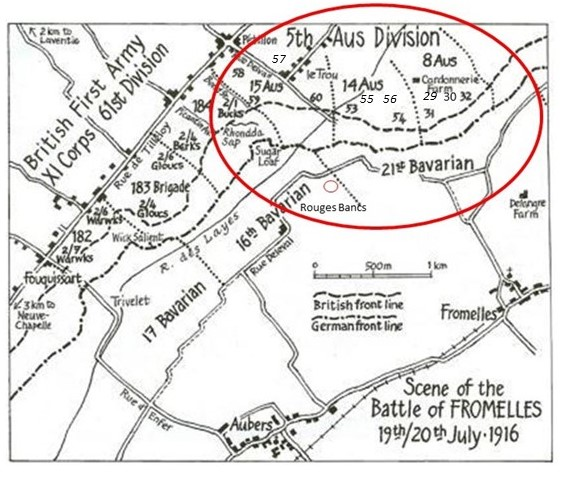
The overall plan was to use brigades from the Australian Fifth Division to conduct a diversionary assault on the German trenches at Fromelles. The 32nd Battalion’s position was on the extreme left flank, with only 100 metres of No Man’s Land to get the German trenches. As they advanced, they were to link up with the 31st Battalion on their right. However, their position made the job more difficult, as not only did they have to protect themselves while advancing, but they also had to block off the Germans on their left, to stop them from coming around behind them. On the morning of the 18th, Leo’s A Company and C Company went into the trenches to relieve B and D Companies, who rejoined the next day.
Lieutenant Frederick Stolz described the calm before the storm:
“The fellows were wonderfully cool and not during the whole time did I see anyone get excited or do anything silly, and such a lot were only young boys of between 18 to 20.”
The Zero Hour for advancing from their front-line trenches was to be 5.45 PM, but the Germans knew this attack was coming and were well-prepared. They opened a massive artillery bombardment on the Australians at 5.15 PM, causing chaos and many casualties. The charge over the parapet began at 5.53 PM. Leo’s A Company and C Company were in the first and second waves to go, B & D were in the third and fourth.
They were successful in the initial assaults and by 6.30 PM were in control of the German’s 1st line system (map Trench B), which was described as “practically a ditch with from 1 to 2 feet of mud and slush at the bottom”.
Source AWM4 23/49/12, 32nd Battalion War Diaries, July 1916, page 11
Unfortunately, with the success of their attack, ‘friendly’ artillery fire caused a large number of casualties because the artillery observers were unable to confirm the position of the Australian gains. The 32nd were able to take out a German machine gun in their early advances, but were being “seriously enfiladed” from their left flank.

By 8.30 PM their left flank had come under heavy bombardment with high explosives and shrapnel. Return bombardment support was provided and the 32nd were told that “the trenches were to be held at all costs”.
Source - AWM4 23/49/12, 32nd Battalion War Diaries, July 1916, page 12
Fighting continued through the night. The Australians made a further charge at the main German line beyond Trench B, but they were low on grenades, there was machine gun fire from behind them from the emplacement at Delangre Farm and they were so far advanced that they were getting shelled by both sides. In the early morning of the 20th, the Germans began a counterattack from the Australian’s left flank, bombing and advancing into Trench A (map).
Given the Australian advances that had been made earlier, the rear Trench E had been left almost empty, which then enabled the Germans to regain that trench and envelop the men of the 32nd. At 5.30 AM the Germans attacked from both flanks in force and with bombing parties. Having only a few grenades left, the only resistance they could offer was with rifles:
“The enemy swarmed in and the retirement across No Mans’ Land resembled shambles, the enemy artillery and machine guns doing deadly damage.”
What was left of the 32nd had finally withdrawn by 7.30 AM on the 20th. The initial roll call count was devastating – 71 killed, 375 wounded and 219 missing. To get some perspective of the battle, when Charles Bean, Australia’s official war historian, attended the battlefield two and half years later, he observed a large quantity of bones, torn uniforms and Australian kit still on the battlefield. The final impact was that 228 soldiers of the 32nd Battalion were killed or died from wounds sustained at the battle and, of this, 166 were unidentified. Lieutenant Sam Mills survived the battle. In his letters home, he recalls the bravery of the men:
“They came over the parapet like racehorses……… However, a man could ask nothing better, if he had to go, than to go in a charge like that, and they certainly did their job like heroes."
Leo’s Fate - Wounded and coming back across No Man’s Land singing?
While reported missing in action soon after the battle, no more news was coming through about Leo’s fate. The Army and the Red Cross were actively seeking to track down ALL of the missing soldiers, as significant task given the nature of the battle. At Christian Brothers’ College, his old school, prayers were said for him at morning assemblies. His family at Cawthorne Street, Southwark, clung to hope — Hannah Vincent writing letters to military authorities even months later, pleading for confirmation, which the Army was unable to provide.
`“May we hope you will be in a position to alleviate our distress by removal of intolerable suspense?” 23 August 1916`
Source: NAA: B2455, Edwin A Vincent, p. 38
The three available Red Cross statements witness statements collected months after the battle all put Leo in the advanced areas of the batttle and wounded and, BUT with markedly differently conclusions:
- “While they were coming back from the raid the other men who were with him saw him wounded, and coming back across No Man’s Land singing. No one ever saw him again.” - Private Clifford Smith (3915)
- “He was lying wounded in the German trench … so he was either taken prisoner or killed.” - Corporal J. Longstaff (671)
- “I have seen a photograph of a group of prisoners taken in Germany. Vincent was among them.” - Sergeant W. Carr (6)
The more detailed responses are below.
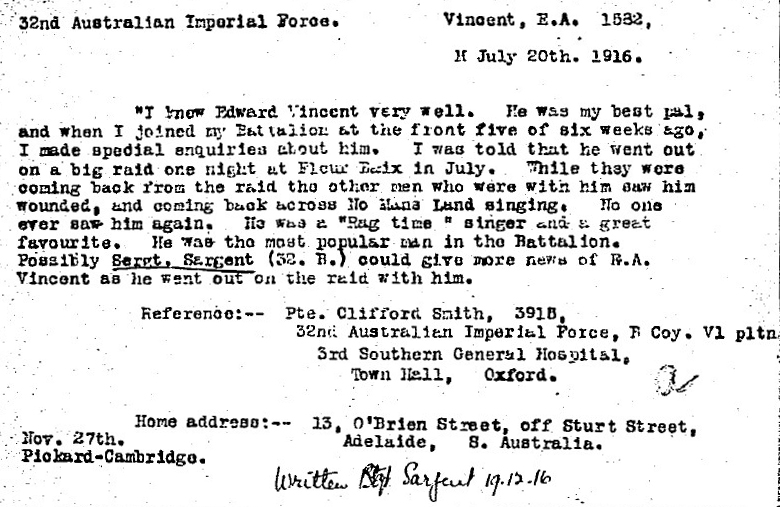
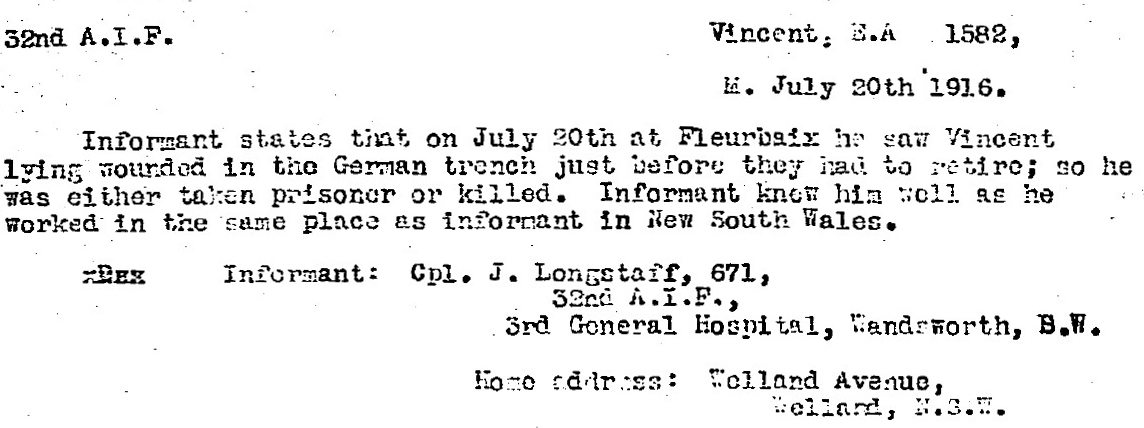

Unfortunately, no confirmation ever came from Germany to confirm him being a POW, and his identification disc was never recovered, so “the most popular man in the Battalion” was truly missing. It was not until August 1917, more than a year after the battle, that a Court of Enquiry Held in the Field officially determined his fate as having been Killed in Action, 20 July 1916. Leo was awarded the 1914-15 Star Medal, the British War Medal, the Victory Medal, a Memorial Plaque and a Memorial Scroll.
Three Sons Lost
Leo’s parents watched three of their sons march away to war — each to a different front, each never to return. Two of their sons died within three days of each other and the third was killed nine months later.
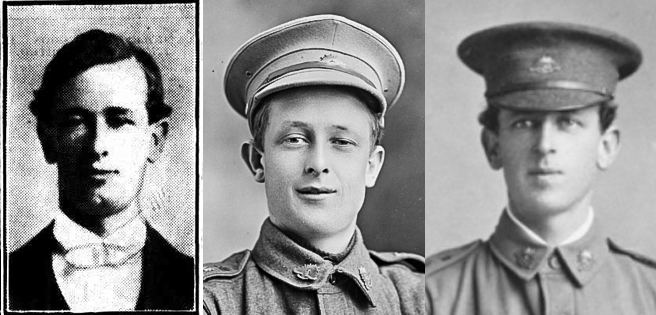
William Goldsborough Vincent (2230, 10th Battalion / Field Company Engineers)
William enlisted in March 1915 and sailed from Adelaide on the HMAT Borda. He served through Gallipoli and was later sent to France, where he was killed in action at Pozières on 23 July 1916, aged 23…three days after Leo was killed.
Corporal Bewick Henry Vincent (3517, 50th Battalion, formerly 10th)
Berwick was killed in action at Noreuil, France, on 2 April 1917, aged 26. He was the eldest of the three who served. He had married before enlisting, joining the AIF in August 1915 and sailed with the 11th Reinforcements of the 10th Battalion. He was was later transferred later to the 50th Battalion. He was commended for “good work under fire” in November 1916 by Major General Sir H. V. Cox. Having lost three of her sons, newspaper tributes described Hannah Vincent as one of South Australia’s most bereaved war mothers. The boys’ father, Thomas Aloysius Vincent, never recovered from the blow:
“The late Mr. Thomas Aloysius Vincent, who died at the Adelaide Hospital on August 1, had been in the employ of the South Australian Railways for over thirty-two years... Twelve months ago word was received from the military authorities that of the three sons serving at the front William Goldsborough had been killed and that Edwin Aloysius was missing. Mr. Vincent never seemed to get over the shock... His widow and several children survive him.”
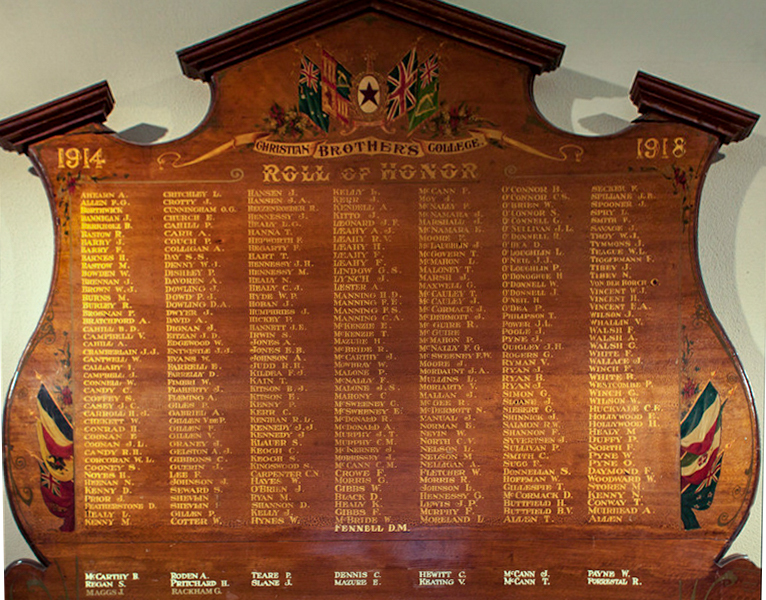
Hannah lived on at Cawthorne Street until her death in 1956, aged 90. The Vincents’ sacrifice became part of South Australia’s wartime legend — a family that gave three sons for their country, all remembered with love and honour. All three sons are included on the Christian Brothers School Roll of Honour.
He is commemorated at:
Adelaide Christian Brothers' College WW1 Roll of Honor
Australian War Memorial Roll of Honour
Finding Leo
Leo’s remains were not recovered; he has no known grave. After the battle, the Germans recovered 250 Australian soldiers and placed them in a burial pit at Pheasant Wood. This grave was discovered in 2008 and since then efforts have been underway to identify these soldiers by DNA testing from family members. As of 2024, 180 of the soldiers have been identified, including 41 of the 166 unidentified soldiers from the 32nd Battalion.
We welcome all branches of Leo’s family to come forward to donate DNA to help with his identification — particularly those with roots in SA. If you know anything of family contacts, please contact the Fromelles Association. We hope that one day Leo will be named and honoured with a known grave.
Please visit Fromelles.info to follow the ongoing identification project and Leo’s story.
DNA samples are being sought for family connections to
| Soldier | Edwin Aloysius “Leo” Vincent (1896–1916) |
| Parents | Thomas Aloysius Vincent (1856–1917) & Hannah Wilkins (1866–1956) |
| Siblings | Amy Bewick (1888–1953)b Sandwell, m Michael Ryan | ||
| Bewick Henry (1890–1917) b Saddleworth– m Sylvia Napier, AIF 50th btn KIA, Noreuil, France | |||
| William Goldsborough (1892–1916) b Bowden –AIF 10th Btn, KIA at Pozières | |||
| John Bewick (1899–1952) b Thebarton, m Clare Bennett | |||
| Thomas Ambrose (1901–1976) b Southwark, m Ella Johnson |
| Grandparents | |||
| Paternal | William Vincent, Northumberland, & Jane Richards | ||
| Maternal | John Wilkins, Middlesex & Julia Forde, unknown |
Links to Official Records
The Fromelles Association would love to hear from you

Contacts
(Contact: carla@fromelles.info or geoffrey@fromelles.info).
(Contact: army.uwc@defence.gov.au or phone 1800 019 090).
Donations
If you are able, please contribute to the upkeep of this resource.
(Contact: bill@fromelles.info ).