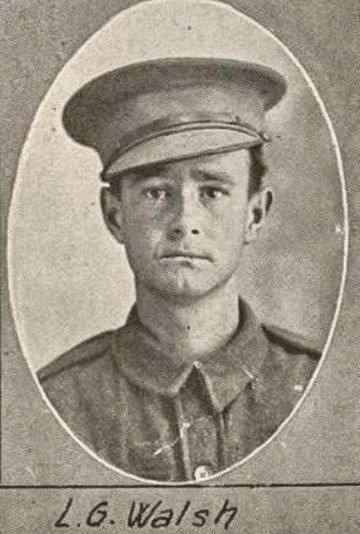
Leslie Gordon WALSH
Eyes brown, Hair brown, Complexion fresh
Leslie Gordon Walsh – A Casino Cordial Maker Lost at Fromelles
Early Life
Leslie Gordon Walsh was born into a large Catholic family in 1893 at Casino, New South Wales. He was the youngest of ten children born to James Walsh and Flora McDonald. His siblings were Arthur Thaddeus, James Alexander, Francis Allen, Florence Mary, Lily, Ernest John, Christina Kate, Minnie, and Annie. Another brother, Thomas Grafton Edmund, had died in infancy. The Walsh family had deep ties to the Richmond district. Leslie’s grandfather, Thaddeus Walsh, was Casino’s first police officer. Leslie’s father originally trained as a saddler in Casino before running his own business.
Over the years he expanded into new ventures, taking over the Royal Hotel and eventually managing a cordial factory. When James died in 1911, he was described as “not only a prominent townsman, but one of nature’s gentlemen … whose kind disposition and generous nature will be much missed.”
Source- Obituary. (1911, July 14). The Richmond River Express and Casino Kyogle Advertiser (NSW : 1904 - 1929), p. 7. http://nla.gov.au/nla.news-article125697413
Leslie grew up in Casino at a time when the town was prospering as a hub of farming, rail, and small industry. His family was well known in the district through their businesses, civic service, and church life. By the time he was in his early twenties, Leslie had followed his father into the local cordial trade, working as a cordial maker.
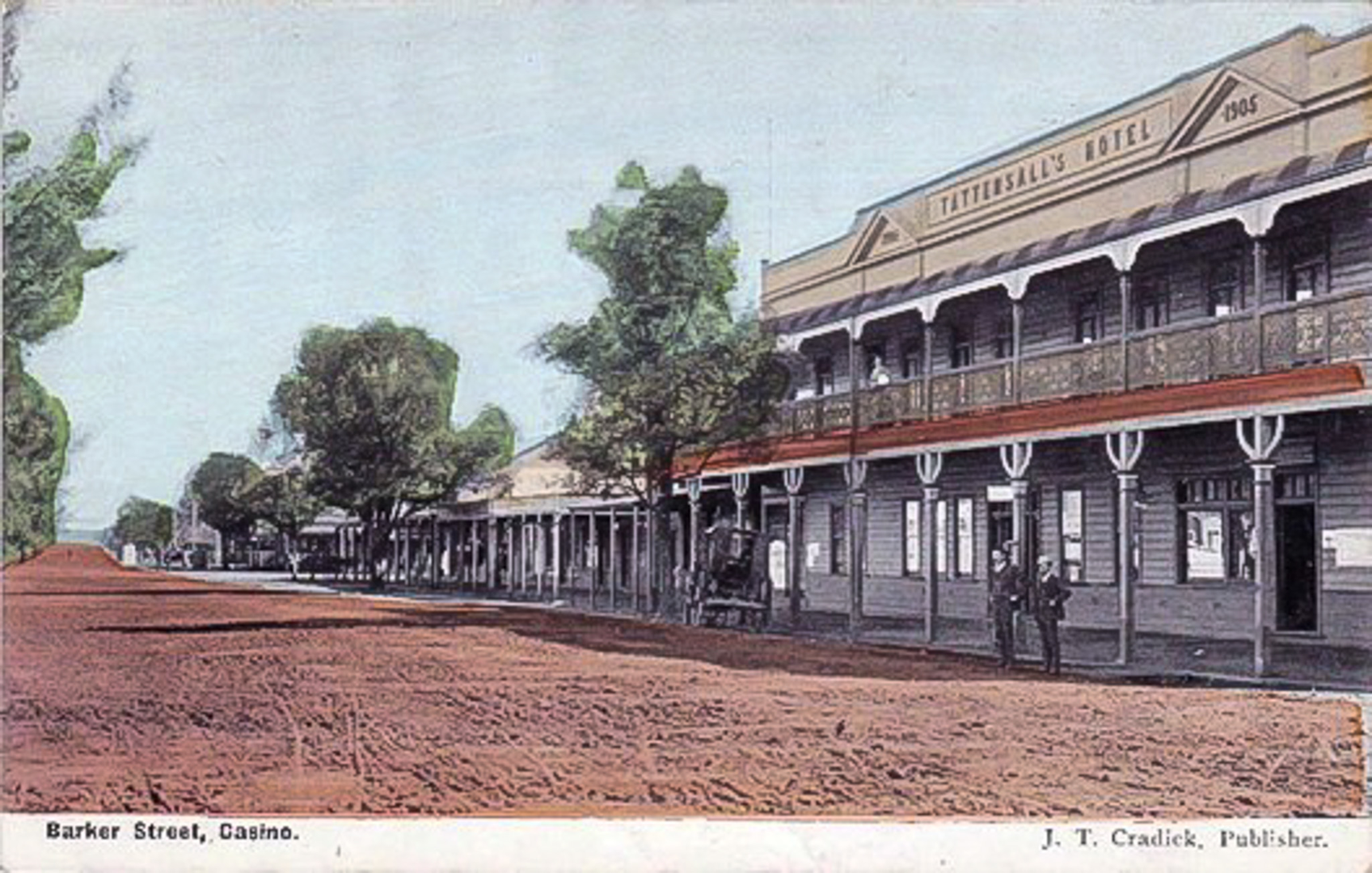
Off to War
Leslie answered the Call to War when he was 22, enlisting on 26 July 1915 in Brisbane. He was assigned to A Company of the newly formed 31st Battalion. He was one of fifteen young men from Casino who departed together for training at Enoggera. The town turned out in force to farewell them:
“Fifteen young men left Casino yesterday for Enoggera. There were hundreds of people at the station to give them a send-off, and the greatest enthusiasm prevailed … The names of those who left by the train are- … L. G. Walsh …”
The Battalion was formed with two companies from Queensland and two companies from Victoria. All were joined in early October at Broadmeadows in Victoria.
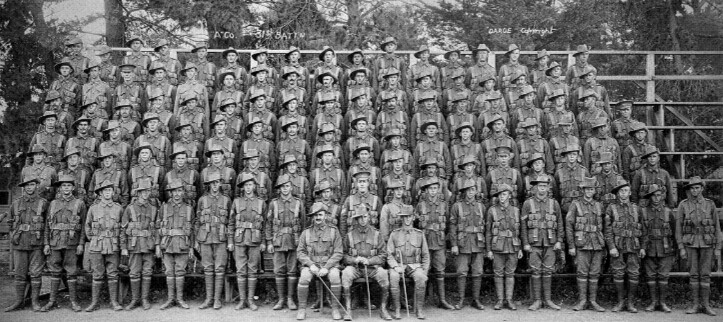
Before sailing from Melbourne on 9 November aboard the troopship Wandilla, the 991 soldiers of the 31st had been on parade in Melbourne in front of a good crowd. The Minister for Defence, H.F. Pearce said:
“I do not think I have ever seen a finer body of men.”
Leslie disembarked at Suez on 7 December 1915.
The 31st were first sent to Serapeum to continue their training and to guard the Suez Canal from any potential threats posed by the Ottoman Army. Near the end of February, they moved to the large camp at Tel-el-Kebir, which was about 110 km northeast of Cairo. The 40,000 men in the camp were comprised of Gallipoli veterans and the thousands of reinforcements arriving regularly from Australia. The 60 km trip must have been unpleasant, as it was reported that they were moved in “dirty horse trucks.”
Source - AWM4 23/48/7, 31st Battalion War Diaries, Feb 1916, page 5
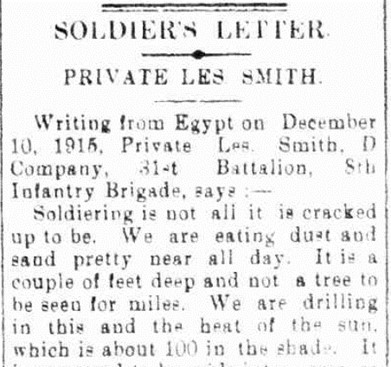
The next move was at the end of March, back to the Suez Canal at the Ferry Post and Duntroon Camps and then finally to Moascar at the end of May. In March Leslie was admonished for overstaying leave — absent without leave from 17–19 March — and lost three days’ pay. Such minor lapses were not uncommon among young soldiers adapting to military life. The months passed in training and sightseeing, but by the time the 31st Battalion was transferred to France, the men were all heartily sick of Egypt. Private Les Smith’s (934) letter home pretty well sums it up
“We are eating dust and sand pretty near all day. It is couple of few feet deep and not a tree to be seen for miles. We are drilling in this and the heat of the sun which is about 100 in the shade.”
On 15 June, the 31st Battalion began to make their way to the Western Front, first by train from Moascar to Alexandria and then sailing to Marseilles. Leslie’s A Company, B and D companies were aboard the troopship Hororata and C company was aboard the Manitou. After disembarking on 23 June, they were immediately boarded onto trains to Steenbeque and then marched to their camp at Morbecque, 35 km from Fleurbaix in northern France, arriving on 26 June. The battalion strength was 1019 soldiers.
The area near Fleurbaix was known as the “Nursery Sector” – a supposedly relatively quiet area where inexperienced Allied troops could learn the harsh realities of Western Front trench warfare against the Germans. But the quiet times and the training period did not last long. Training continued, now with how to handle poisonous gas included in their regimen. They began their move towards Fromelles on 8 July and by 11 July they were into the trenches for the first time, in relief of the 15th Battalion.
The Battle of Fromelles
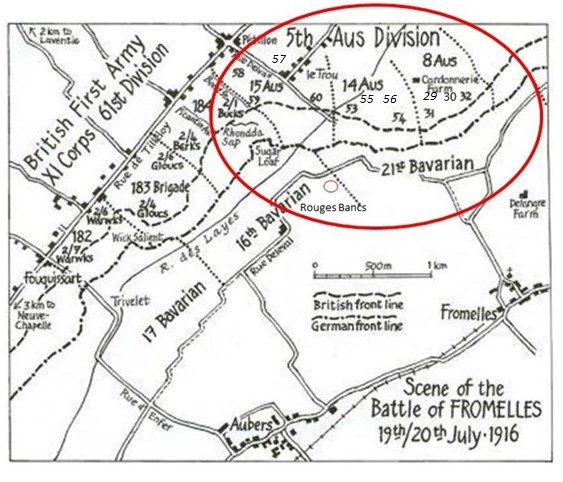
The overall plan was to use brigades from the Australian Fifth Division to conduct a diversionary assault on the German trenches at Fromelles. The main attack was planned for the 17th, but bad weather caused it to be postponed.
On the 19th they were back into the trenches and in position at 4.00 PM. The Zero Hour for advancing from their front-line trenches was to be 5.45 PM, but the Germans knew this attack was coming and were well-prepared:
“Just prior to launching the attack, the enemy bombardment was hellish, and it seemed as if they knew accurately the time set.”
The assault began at 5.58 PM and they went forward in four waves, Leslie’s A Company and C Company were in the first two waves and B and D Company in the 3rd and 4th waves. There were machine gun emplacements to their left and directly ahead at Delrangre Farm and there was heavy artillery fire in No-Man’s-Land. The pre battle bombardment did have a big impact and by 6.30 PM the Aussies were in control of the German’s 1st line system (Trench B in the diagram below), which was described as “practically a ditch with from 1 to 2 feet of mud and slush at the bottom.”
Source - AWM4 23/49/12, 32nd Battalion War Diaries, July 1916, page 11
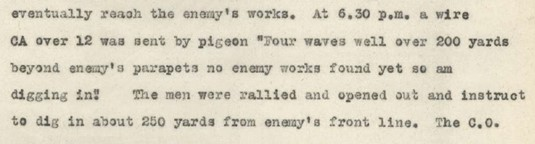
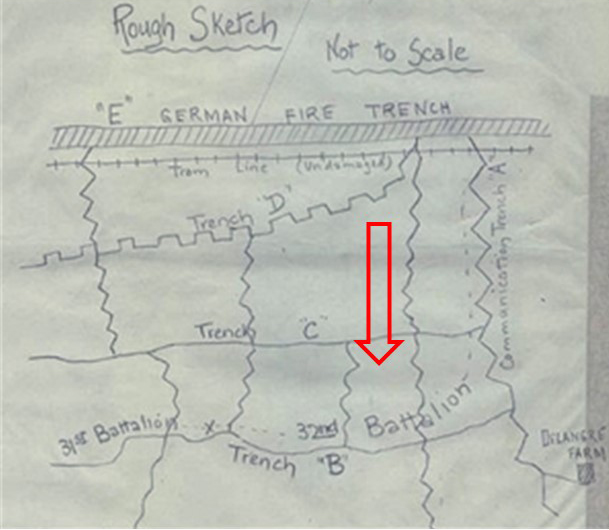
Unfortunately, with the success of their attack, ‘friendly’ artillery fire caused a large number of casualties. By 8.30 PM the Australians’ left flank had come under heavy bombardment with high explosives and shrapnel. Return bombardment support was provided and the 32nd, who also had the job of holding the flank to the left of the 31st, were told that “the trenches were to be held at all costs”.
Source - AWM4 23/49/12, 32nd Battalion War Diaries, July 1916, page 12
Fighting continued through the night. The Australians made a further charge at the main German line beyond Trench B, but they were low on grenades, there was machine-gun fire from behind from the emplacement at Delangre Farm and they were so far advanced that they were getting shelled by both sides. At 4.00 AM the Germans began an attack from the Australian’s left flank, bombing and advancing into Trench A (map). Given the Australian advances that had been made earlier, portions of the rear Trench E had been left almost empty, which then enabled the Germans to be in a position to surround the soldiers. At 5.30 AM the Germans attacked from both flanks in force and with bombing parties.
Having only a few grenades left themselves, the only resistance the 31st could offer was with rifles:
“The enemy swarmed in and the retirement across No Mans’ Land resembled a shambles, the enemy artillery and machine guns doing deadly damage.”
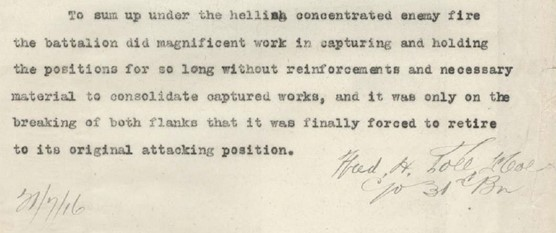
The 31st were out of the trenches by the end of the day on the 20th. From the 1019 soldiers who left Egypt, the initial impact was assessed as 77 soldiers were killed or died from wounds, 414 were wounded and 85 were missing, including Leslie. To get some perspective of the battle, when Charles Bean, Australia’s official war historian, attended the battlefield two and half years later, he observed a large quantity of bones, torn uniforms and Australian kit still on the battlefield. The ultimate total was that 162 soldiers of the 31st were either killed or died from wounds and of this total 82 were missing/unidentified. The bravery of the soldiers of the 31st was well recognised by their own Battalion commanders.
After the Battle
For Leslie’s family in Casino, the aftermath of Fromelles was a time of confusion and grief. He was first reported “missing” in late July 1916. On 22 August, his status was changed to “wounded and missing”, but there was still no firm news. Company Sergeant-Major Arthur E Adams (129) of the 31st Battalion, who had enlisted at the same time as Leslie, wrote what he could about Leslie -
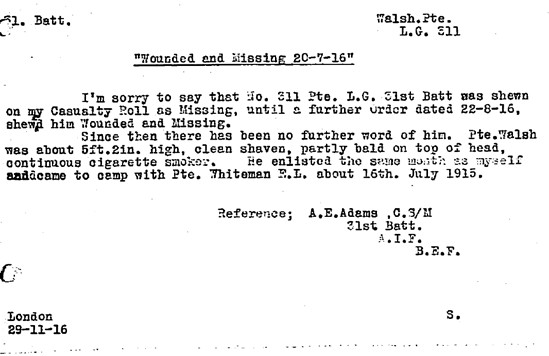
In late November 1916, a German death list reached the Australian Red Cross Bureau that confirmed Leslie had been killed and his identity disc recovered from his body. This indicates that Leslie would have been fighting in the advanced areas of the attack when he was killed. On 24 February 1917, his ID disc was officially received by the authorities in London with the stark notation:
“No particulars afforded except that soldier is deceased. To be reported KILLED IN ACTION, 20/7/16.”
A Court of Inquiry in the Field held in March 1917 formally declared that Leslie had been killed in action on 20 July 1916. His ID disc was sent to his family in November 1917. A later German letter, translated and witnessed in Berlin in 1919, gave a bit more detail:
“Australian Soldier Walsh L.G. 311, 31st Battalion fell on 19/7/16 in the neighbourhood of Fromelles.”— Royal Prussian War Office, Medical Section, Death Voucher, 2 August 1916 (witnessed 1 November 1919)
In Casino, grief was shared in small ways — in March 1917, the Casino and Kyogle Courier noted the coincidence of a letter arriving from another 31st Battalion man, Private Thomas Bentley (2857), on the very day the town received confirmation of Leslie’s death - “Pte. Bentley left in the same battalion as Pte. L. G. Walsh, and it is a coincidence that the letter from the former arrived on the same day as news was received of the latter’s death while a prisoner of war in Germany.”
Source - Casino and Kyogle Courier and North Coast Advertiser, 17 March 1917, p. 2
Interestingly, his Army files carry an undated, handwritten note with a very general map reference about being buried. A large number of soldiers have a similar annotation. It is not known whether someone knew something about Leslie or if it was just be a simple statement about the reality of the battle, but nothing more came of it at the time.

Leslie was awarded the 1914-15 Star Medal, the British War Medal, the Victory Medal, a Memorial Plaque and a Memorial Scroll. For his mother Flora, who had already lost her husband James in 1911, the official details brought no peace. She had received Leslie’s identity disc, but there was no word of a grave. She lived for more than two decades after the war, never knowing where her youngest son was buried. Leslie is commerated on on Panel 4 at the VC Corner Memorial inFromelles and on the Casino and District Memorial Hospital First World War Roll of Honour.
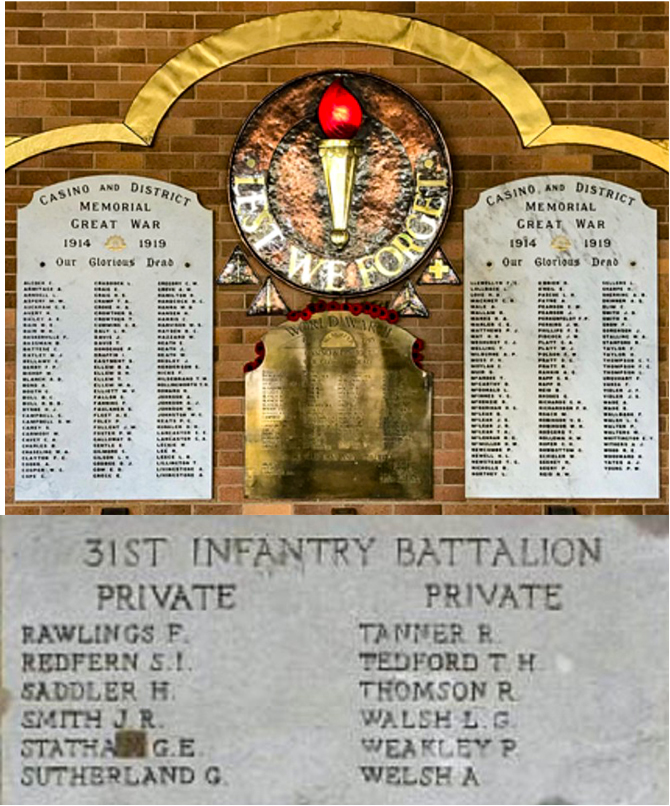
Casino and District Memorial Hospital and VC Corner Fromelles
Family at War – Brother Ernest – Meritorius Service Medal
Leslie, the youngest of ten, was the only one of his siblings to be killed in action, but he was not the only one to serve. His older brother Ernest (16378) enlisted in November 1915 and was posted to the Australian Army Medical Corps, 18th Battalion. Serving throughout the war on the Western Front, Ernest was recognised for his tireless care of the sick and wounded.
He received the Meritorious Service Medal - “Has served throughout with the A.A.M.C. details attached to 18th Battalion. Both in and out of the line he has been unsparing of self. His work of looking after wounded and sick has been invaluable in the line and in quarters has materially assisted to maintain the high standard of health.”
Source - Commonwealth Gazette No. 113, 6 October 1919
Ernest returned to Australia in 1919 and became licensee of the Commonwealth Hotel in Casino. When he died suddenly in 1945, his funeral was marked with full military honours — the casket draped with the Australian flag, a guard of honour from the Returned Soldiers’ League, and the Last Post sounded over his grave.
Discovery
For many decades, Leslie’s name was one of hundreds carved into the memorial at VC Corner Cemetery, his resting place unknown. That began to change in 2008, when a mass grave was discovered at Pheasant Wood on the outskirts of Fromelles which contained the remains of 250 Australian and British soldiers, recovered and buried by the Germans after the battle. They still remained unidentified, however. A major DNA identification project followed the discovery of the mass grave and this led to Leslie’s fate being resolved.
In 2011, almost 95 years after his death, he was able to be formally identified and given a named headstone at the Fromelles (Pheasant Wood) Military Cemetery. His great-nephews Peter and Adrian Walsh, of Casino, were among the family who came to know his story only after this identification.
Peter reflected:
“We often talked about another great uncle, William John Bayley … but there was never any mention of this (great) uncle.”
William John Bayley (3344), had also served in the 31st Battalion, but did not fight in the Battle of Fromelles. He was wounded in action on 30 August 1918 at Villers Carbonnel and died the next day.
He is buried at Daours Community Cemetery Extension, Plot VIII, Row B, plot 29.
Adrian Walsh attended Leslie’s dedication ceremony, while Peter planned to visit the grave later. For the family, who had lived for nearly a century without knowledge of his fate, the unveiling of his headstone gave them both closure and pride. His headstone was unveiled at a special ceremony at the newly created Fromelles (Pheasant Wood) Military Cemetery, which was attended by Australian and French dignitaries, soldiers, and descendants.
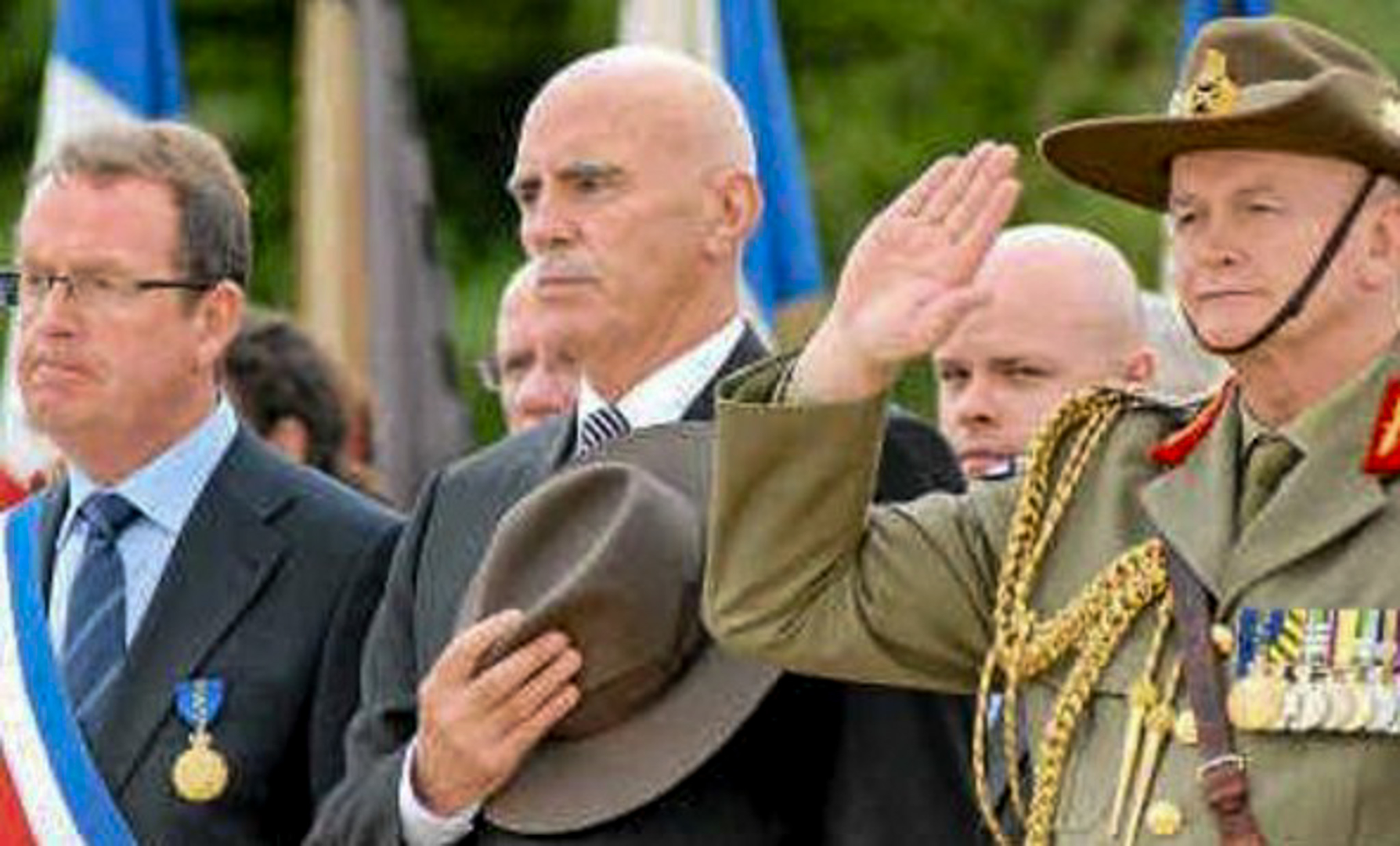
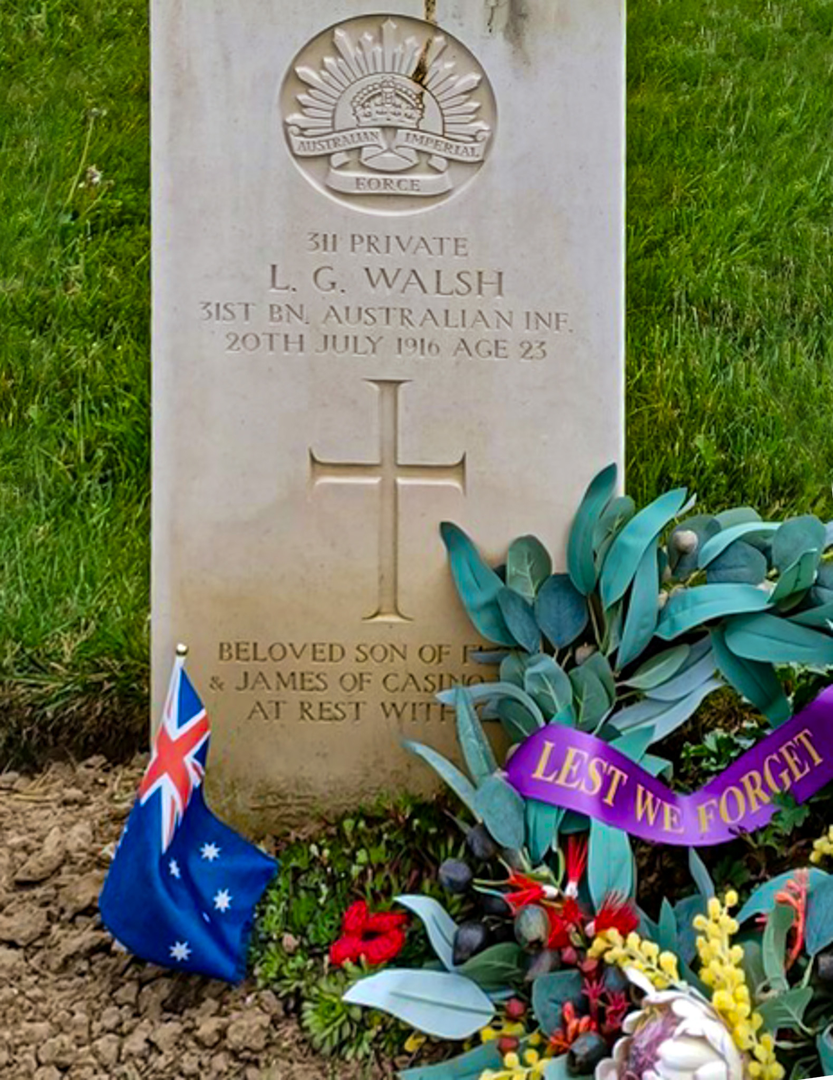
“At Rest with God”
Four years later, in 2015, Timothy Walsh, Leslie’s great-great-nephew, visited Fromelles and delivered a powerful Anzac Day reflection:
“My great great uncle, Leslie Gordon Walsh, was a cordial maker from Casino who ended up far from home on the other side of the world in the trenches of Northern France.
At the time of his death, he was 23 years old. Leslie was 5ft 5 inches tall - certainly not a big man, and he weighed a mere 57 kgs.
He would not have been a terribly imposing figure on the battlefield.
I am not sure it would have mattered much if he was. When the attack sounded on June 19, 1916 he went over the top into a wall of artillery and machine gun fire. It was the first day of the Battle of Fromelles.
Many consider this day to be the bloodiest day in Australian military history. For the Australians, the operation was a complete disaster.
There were over 5,500 Australian casualties; almost 2,000 were killed in action or died of wounds, Leslie was among them.
It is believed that the loss suffered by the Australians at Fromelles is the greatest loss by a single division in a 24 hour period during the entire First World War.
It is said that the German soldiers on the other side of "no man's land" were well informed of the impending Australian attack and in several places had signs prepared stating "Advance Australia Please".
Last year I visited the battlefields of Northern France and Belgium and was aghast at the enormity of what I saw, hundreds of kilometres of battlefields and endless memorials, shrines of remembrance and cemeteries honouring the fallen on both sides.
On the third day of my travels, I visited Pheasant Wood Cemetery on the outskirts of Fromelles.
With its immaculately kept white headstones, Pheasant Wood Cemetery, is Leslie's final resting place. When you visit a place like Pheasant Wood Cemetery, with row after row of headstones, it can be easy to forget that each person laying before you has their own story, their own hometown, their own mother, father, brothers and sisters.
Leslie is buried under headstone 119. The inscription reads - L.G. Walsh, Casino, 31st Battalion, Australian INF, 23 Years, beloved son of Flora and James at rest with God. Suddenly WW1 becomes extraordinarily personal and real to me.
I don't write many letters but I felt a need to write one to Leslie.
For me, it was important to let him know that the Walshes of Casino know where he is and that we are proud of him. Aside from myself, my uncle and cousin are the only other people from our family to have visited Leslie's grave.
That boy from Casino, a town on the other side of the world, has had three visitors in the past 100 years. Not even Flora and James, Leslie's parents, were able to visit him. After James and Flora died, I wonder how many times Leslie's name has been spoken?
Speaking it to you today means a lot to me.
Despite Leslie walking the earth nearly 100 years before me, he will forever be 23. Many years younger than I am as I speak to you today.
History books and movies are often written about 'military geniuses' and powerful leaders.
Rightly or wrongly, they will never be forgotten, but nor should 23-year-old cordial makers from small country towns.
Lest we forget.
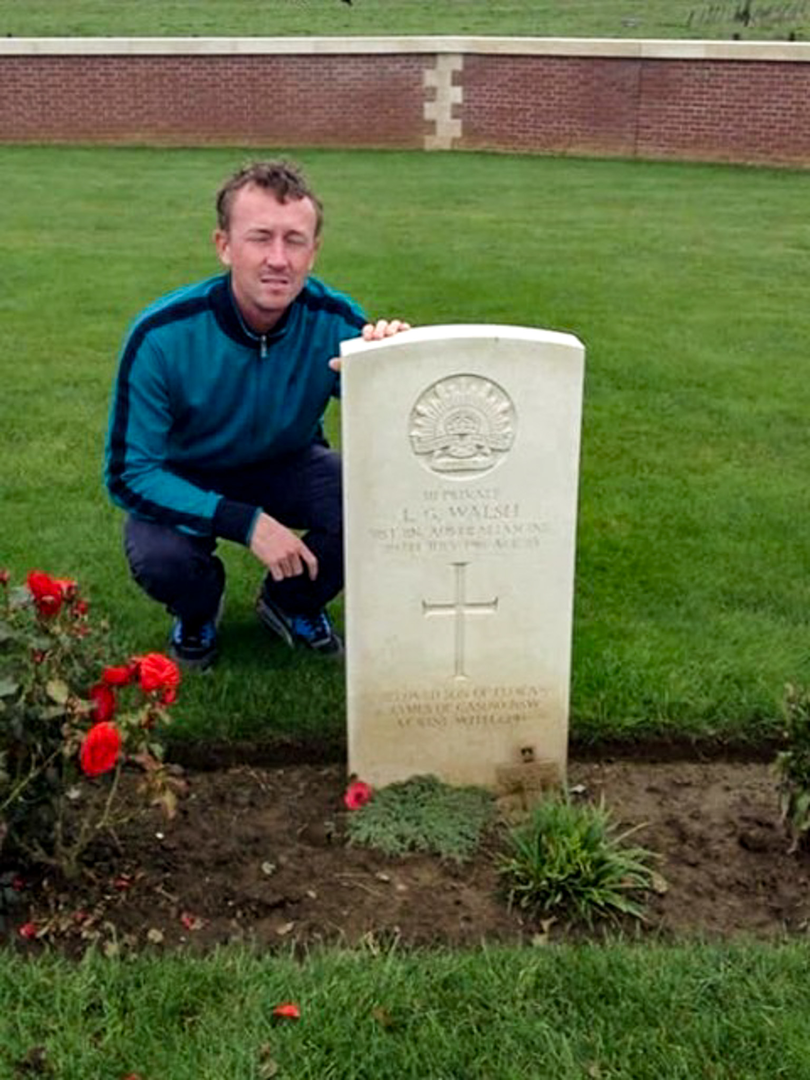
Across three generations, the Walsh family’s story reflects both service and sacrifice - Ernest’s decorated return, Leslie’s loss at Fromelles, and the rediscovery of his story by later descendants who ensured his name would not be forgotten. Today, Leslie lies in Plot II, Row F, Grave 13 of Fromelles (Pheasant Wood) Military Cemetery, his headstone inscribed:
“Beloved son of Flora & James of Casino. At rest with God.
From a forgotten name in a casualty list, Leslie Gordon Walsh has become remembered once more — honoured by his hometown of Casino, by his family across generations, and by all who keep alive the story of Fromelles.
Links to Official Records
The Fromelles Association would love to hear from you

Contacts
(Contact: carla@fromelles.info or geoffrey@fromelles.info).
(Contact: army.uwc@defence.gov.au or phone 1800 019 090).
Donations
If you are able, please contribute to the upkeep of this resource.
(Contact: bill@fromelles.info ).