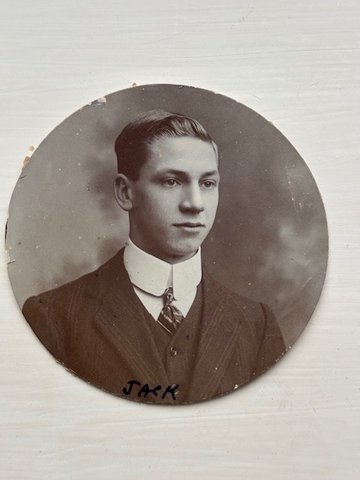
Percy John GREENWOOD
Eyes green, Hair light brown, Complexion fresh
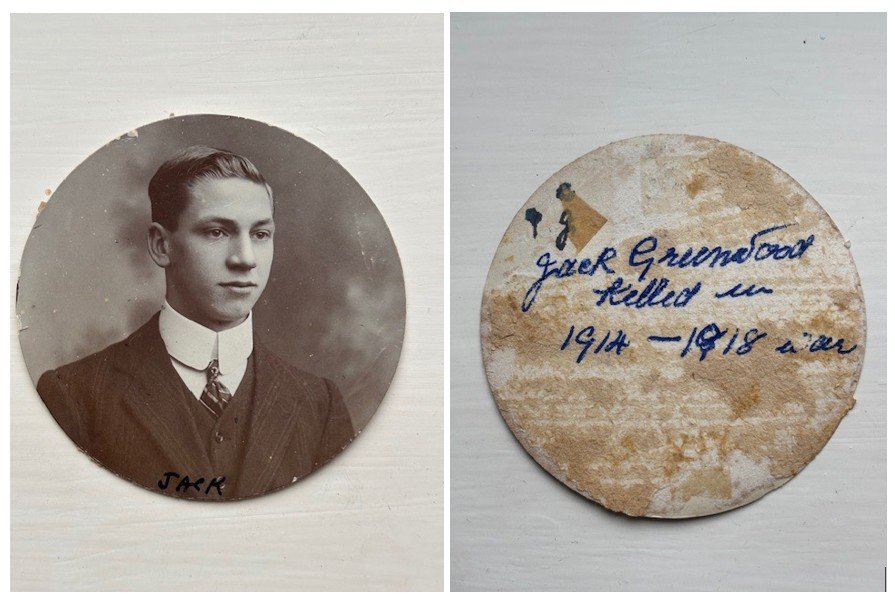
Percy "Jack" Greenwood of Tunbridge Wells
Can you help find Jack?
Percy John "Jack" Greenwood's body was never recovered after the Battle of Fromelles, and he has no known grave.
In 2008, a mass grave containing the remains of 250 Australian soldiers was discovered at Pheasant Wood, near Fromelles. These were men recovered and buried by the Germans following the battle. As of 2026, 181 of those soldiers have been identified through a combination of DNA testing and historical research. /p>
Jack may be among the remaining unidentified soldiers. There is still an opportunity to identify him, but we need your help. We are particularly seeking Y-DNA donors descended through the direct male line of the Greenwood family of Tunbridge Wells, Kent, England. /p>
See the DNA Summary at the end of this story for details of Jack's family and the known Greenwood descendants./p>
If you are related to Jack, know someone connected to the Greenwood family, or believe you may be able to help, please contact the Fromelles Association of Australia.
Early Life
Percy John Greenwood, known as Jack, was born in June 1893 at Tunbridge Wells, Kent, England, the son of Henry Greenwood (1854–1903) and Kezia Seward (1858–1929). He was one of eleven children, although two brothers, Frank and George Harry, died in infancy. Jack grew up in Tunbridge Wells, where his father served as a respected police inspector. His childhood was marked by tragedy when Henry died suddenly in May 1903 at just 47 years of age, leaving Kezia widowed with nine surviving children, five of whom were still dependent on her.
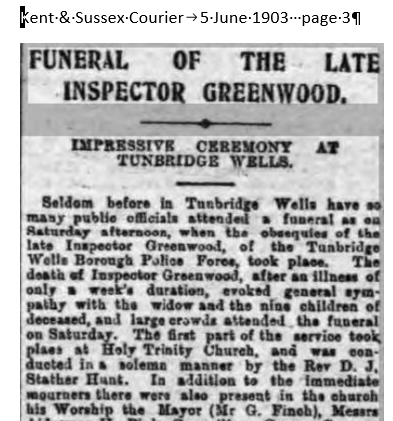
The surviving children of Henry and Kezia Greenwood were:
- Everard Fred GREENWOOD (1880–1953)
- Tolmash Kenneth (Thomas) GREENWOOD (1882–1954)
- Agnes Jane (Jessie) GREENWOOD (1884–1959)
- Lily Caroline GREENWOOD (1885–1972)
- Reginald GREENWOOD (1890–1973)
- Percy John (Jack) GREENWOOD (1893–1916)
- Elsie Maud GREENWOOD (1896–1916)
- Donald Seaward GREENWOOD (1898–1972)
- Leslie GREENWOOD (1900–1968)
The 1901 Census records the family living at 43 Albert Street, Tunbridge Wells, where Henry was employed as a police constable. By the 1911 Census, following Henry's death, Kezia was supporting the family from their home in Hill Street, Tunbridge Wells. Jack, then 17, was employed as an apprentice printer, having begun his training with the Tunbridge Wells Advertiser at about 13 years of age. He completed a six-year apprenticeship as a printer's machinist, learning the trade that would shape his working life.
Seeking new opportunities, Kezia emigrated to Western Australia aboard the Armadale, arriving at Fremantle on 10 June 1913 with six of her children, including Jack. His older brother Everard followed the family the following year, while Tolmash (Thomas) and Lily remained in England. The Greenwood family settled at North Fremantle, and Jack found employment as a printer's machinist in Geraldton. Like many young migrants, he had only recently begun building a new life in Australia when the First World War changed the course of his future.
Off to War
Following the outbreak of the First World War, Percy John Greenwood, known as Jack, enlisted in the Australian Imperial Force on 21 August 1915 at Blackboy Hill, Western Australia. A 22-year-old printer's machinist from Geraldton, he named his widowed mother, Kezia Greenwood of North Fremantle, as his next of kin. Initially allotted to the 28th Battalion, Jack embarked from Fremantle aboard HMAT Medic on 18 January 1916. On arrival in Egypt, he was transferred to the newly formed 32nd Battalion, joining many fellow Western Australians from the Blackboy Hill camp.
The 32nd Battalion was raised in August 1915 as part of the newly formed 8th Brigade, 5th Division. It was a composite unit, the right half of the battalion from South Australia and the left from Western Australia. Training began at Mitcham Camp, Adelaide, where officers and recruits began to forge their identity as one fighting unit.
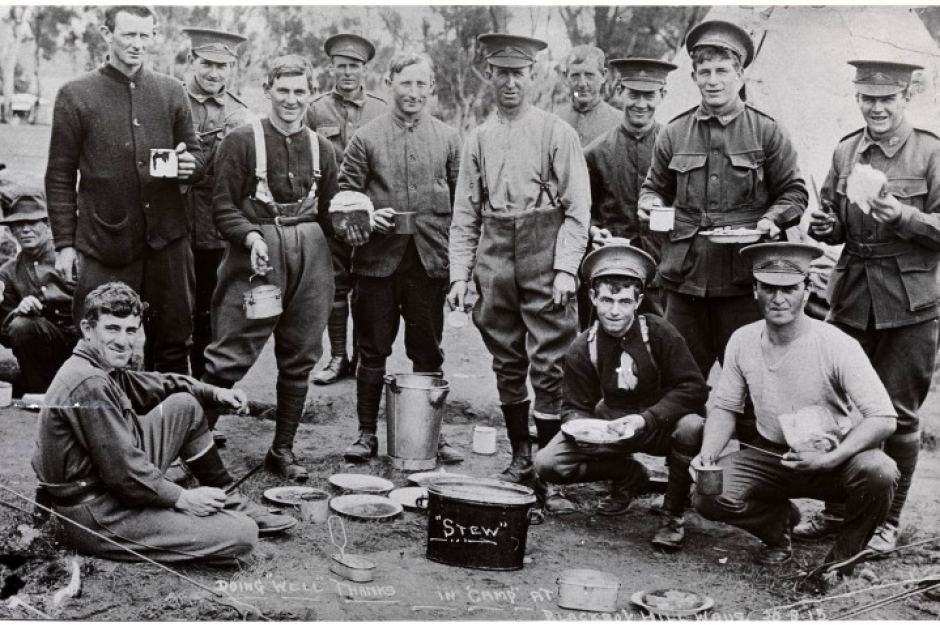
The battalion embarked from Outer Harbor, South Australia, on 18 November 1915 aboard HMAT Geelong, disembarking at Suez a month later. They spent the next six months moving between El Ferdan, Ismailia and Tel El Kebir. At Duntroon Plateau and Ferry Post they took on guard duties along the Suez Canal, finishing their training at Moascar in May 1916. The heat, monotony and rations left an impression.
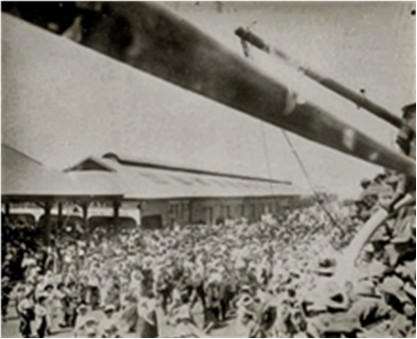
Theodore Pflaum wrote at the time:
“sick up to the neck of heat and flies… dog biscuits and bully beef.”
In June, the battalion boarded the Transylvania at Alexandria bound for France. After disembarking at Marseilles on 23 June 1916, they travelled north by train, passing through the French countryside and small villages where they were greeted enthusiastically. Private Theodor Pflaum noted “The people flocked out all along the line and cheered us as though we had the Kaiser as prisoner on board!!”
Source: Australian War Memorial. Diary of Theodor Milton Pflaum, 1916, C2081791, p. 8
For many of the men, the shift from the sand of Egypt to the lush fields of France was a welcome change. Private Wesley Choat reflected on the contrast:
“The change of scenery in La Belle France was like healing ointment to our sunbaked faces and dust filled eyes. It seemed a veritable paradise, and it was hard to realise that in this land of seeming peace and picturesque beauty, one of the most fearful wars of all time was raging in the ruthless and devastating manner of 'Hun' frightfulness.”
By mid July, the battalion had moved into billets near Estaires and Morbecque. On 14 July 1916 they moved into the front area for the first time. Two days later they entered the trenches at Bois Grenier opposite the German lines near Fromelles. D Company's Lieutenant Sam Mills wrote home with quiet confidence. “We are not doing much work now, just enough to keep us fit mostly route marching and helmet drill. We have our gas helmets and steel helmets, so we are prepared for anything. They are both very good, so a man is pretty safe.”
Source: "Somewhere in France." (1916, October 21). Albany Advertiser (WA: 1897–1954), p. 3. http://nla.gov.au/nla.news-article70125271
On 17 July, patrols reconnoitred the German trenches and working parties cut gaps through the wire in preparation for the attack. The assault was postponed because of bad weather, leaving the men to wait under increasing German shellfire. Unaware of what lay ahead, Jack and the 32nd Battalion stood ready for their first battle on the Western Front. Within days the battalion would suffer one of the worst casualty rates of any Australian battalion during the First World War.
Battle of Fromelles
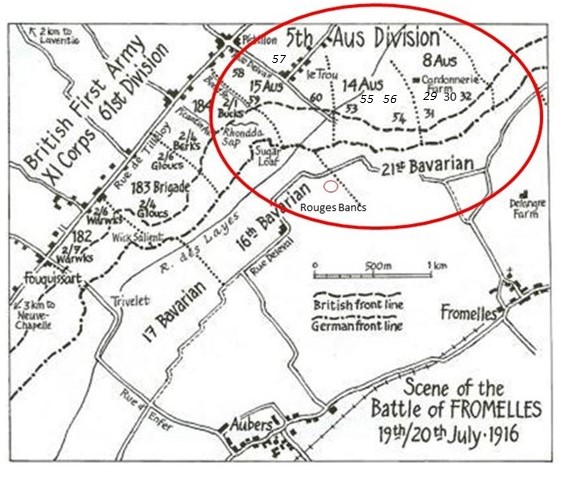
Only weeks after arriving in France, the 32nd Battalion was thrown into its first major action on the Western Front, the disastrous Battle of Fromelles on 19 and 20 July 1916. It would prove to be one of the bloodiest days in Australia's military history and, for the 32nd Battalion, a baptism of fire that decimated its ranks.
The 32nd Battalion moved into the front area on 14 July and entered the trenches for the first time on 16 July in the Bois Grenier sector, just south of Armentières. The men began preparing for the planned attack by reconnoitring the German lines and cutting passages through the wire. The assault was originally scheduled for 17 July but was delayed because of bad weather, leaving the men in position under increasing German shellfire.
The Australian 8th Brigade, including the 32nd Battalion, was positioned on the extreme left flank of the attacking front. Their role was to advance across approximately 100 metres of No Man's Land, capture the German front line system and secure the left of the Allied attack. Being on the flank added enormous risk. They would be exposed not only from the front but also from the side and, ultimately, from behind.
Private Frederick Stolz, later commissioned, remembered the composed attitude of the young soldiers around him just before the advance:
“The fellows were wonderfully cool and not during the whole time did I see anyone get excited or do anything silly, and such a lot were only young boys of between 18 to 20.”
At 5.45 PM on 19 July, the battalion was in position. The plan was for C and A Companies to move out first, followed by B and D Companies. Instead of charging immediately, the first two waves moved into No Man's Land and lay down, waiting for the British artillery bombardment to lift. At 6.00 PM the barrage lifted and the order came to advance. The 32nd rushed the German trenches and encountered devastating machine gun and rifle fire from the front and left flank.
Despite this, the battalion succeeded in capturing the first German trench system by 6.30 PM. Throughout the night, fighting continued as the Australians pressed on into the second line. However, the trenches were flooded and waist deep in water, making movement and defence extremely difficult. Private William Ludemann later recalled:
“They flooded it and the chaps were up to their waists in water all night.”
Source: FFFAIF, DIGGER 59, June 2017. "Lieutenant Frederick Carl Stolz, 32nd Battalion.
The situation rapidly deteriorated. As the 14th and 15th Brigades on the right failed to gain or hold ground, the 8th Brigade became dangerously isolated. Ammunition and grenades were running low. Enfilading machine gun fire from the German strongpoint at Delangre Farm swept the captured trenches. The 32nd Battalion was now under shellfire from both German and British artillery.
At 4.00 AM on 20 July, the Germans launched a counterattack from the Australian left. The rear trench line, stripped of defenders to reinforce the front, had been left almost empty. German forces exploited the gap and began moving in behind the 32nd Battalion's forward position. By 5.30 AM they attacked both flanks in force with bombing parties.
The 31st Battalion War Diary, whose men were fighting alongside the 32nd Battalion on the flank, recorded the chaos of the withdrawal:
“The enemy swarmed in and the retirement across No Mans' Land resembled shambles, the enemy artillery and machine guns doing deadly damage.”
Jack was among those who never returned from the battlefield. Reported missing after the attack, his fate remained uncertain for many months. The 32nd Battalion suffered 718 casualties from approximately 800 men engaged, more than 90 per cent of its front-line strength. It was one of the highest casualty rates suffered by any Australian battalion in a single day during the war. Entire companies were reduced to handfuls of survivors, while communities across South Australia and Western Australia lost brothers, sons, friends, workmates and sporting teammates in a single night.
Many of the battalion's dead were never recovered from the battlefield. Some were buried by the Germans in mass graves behind their lines at Pheasant Wood. Following the discovery of the mass grave in 2008, historical and DNA research has continued to restore the names of the missing. As of 2026, 181 of the 250 Australian soldiers recovered from Pheasant Wood have been positively identified, including a number of men from the 32nd Battalion. Jack may yet be among those still awaiting identification.
After the Battle
Following the Battle of Fromelles, Jack was officially reported as missing. Like hundreds of Australian families, his mother, Kezia Greenwood, endured months of uncertainty, hoping that her son had survived and perhaps been taken prisoner.
On 4 November 1916, Jack's name appeared on a German Totenliste (Death List), issued through the German prisoner-of-war information system. Because the notification was transmitted through prisoner-of-war channels, Australian authorities initially believed he may have been a prisoner of war. The Australian Red Cross also noted that his name had appeared on the German death list while enquiries continued into his fate.
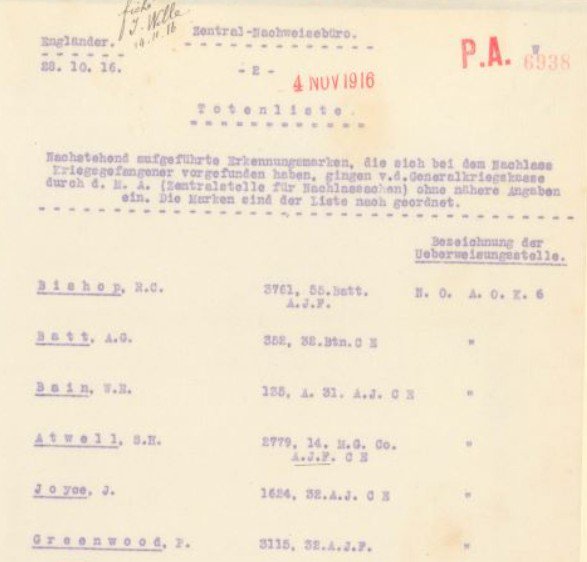
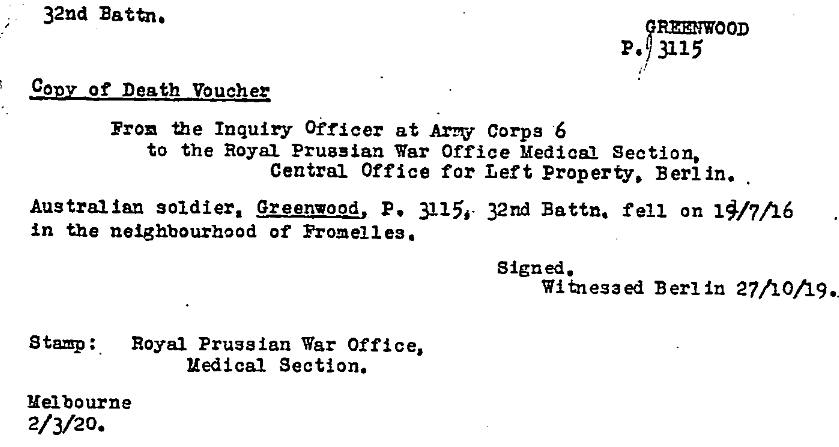
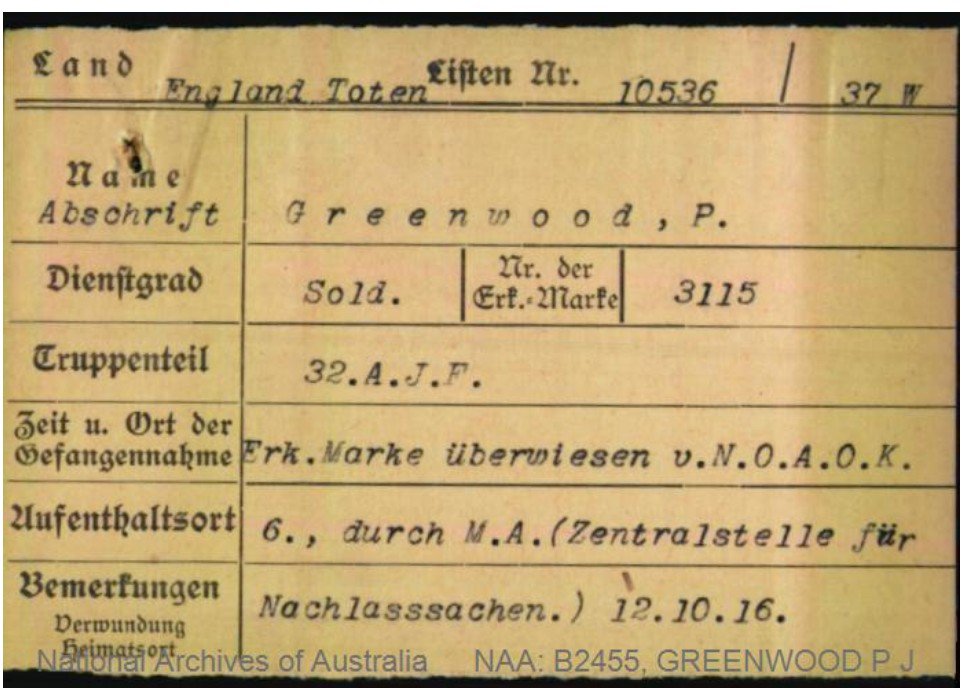
As further information was received from Germany, it became clear that the notification was not reporting a prisoner but confirming Jack's death. A Court of Enquiry subsequently determined that he had been killed in action on 20 July 1916, bringing an end to almost a year of uncertainty for his family. German records later confirmed that Australian soldier Greenwood, P.J., No. 3115, 32nd Battalion, had "fallen in the neighbourhood of Fromelles" on 19 July 1916. His identification disc was eventually returned to Australia, but his body was never recovered and he has no known grave.
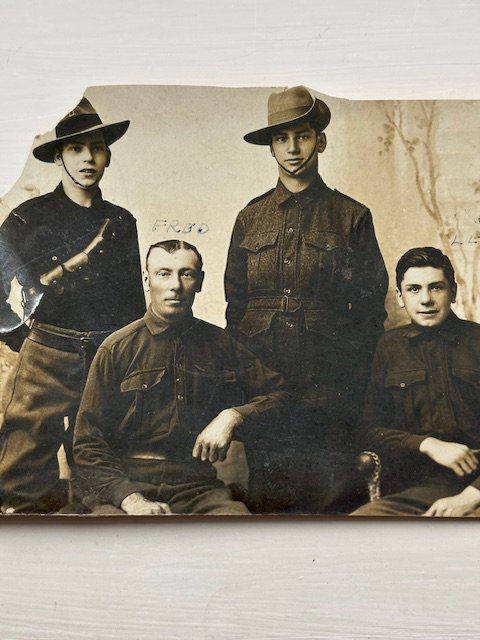
Kezia never abandoned hope of learning more about her son's fate. In 1919 she wrote to the Australian Red Cross enclosing a photograph of Jack and one of his brothers, thanking the organisation for its efforts and hoping the image might assist further enquiries. Sadly, no additional information came to light, and the photograph was not retained with the file.
In 1922, the Imperial War Graves Commission wrote to Kezia seeking a personal inscription for Jack's headstone. She replied that although she had been informed her son had been killed in action on 20 July 1916, "I have never been told in which place or action he was killed." The authorities promptly replied that Jack had died during the Battle of Fromelles, explaining the purpose of their enquiry. By then, however, six years had passed since his death and his final resting place remained unknown.
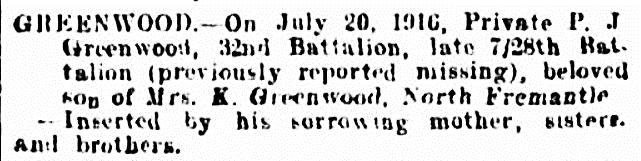
As news of Jack's death reached Western Australia, his family placed a simple notice in the Western Mail.
Jack's Dead Man's Penny
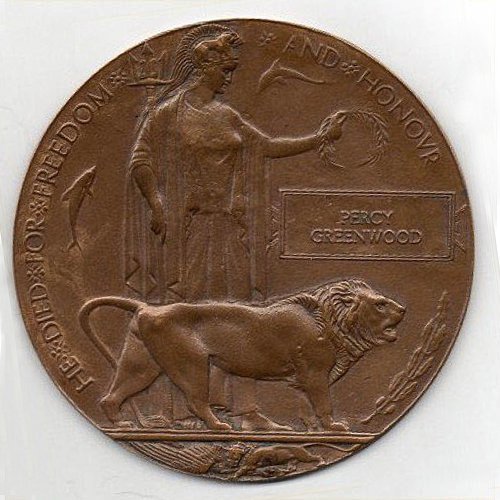
As Jack's next of kin, Kezia Greenwood received his Memorial Plaque, Memorial Scroll and campaign medals. Commonly known as the "Dead Man's Penny", the bronze Memorial Plaque was issued to the families of all British and Empire service personnel who died during the First World War. Cast with the recipient's name but no rank, it served as a lasting tribute to those who made the ultimate sacrifice.
More than a century later, Jack's Memorial Plaque unexpectedly surfaced for sale through a United Kingdom militaria dealer. Recognising its significance, researchers from the Fromelles Association of Australia arranged for its purchase, ensuring it would be preserved alongside Jack's story rather than disappearing into a private collection.
Today, the plaque is held by the Fromelles Association of Australia as a permanent reminder of Jack's service and sacrifice. It also serves another purpose: helping to raise awareness of the ongoing search for Greenwood family Y-DNA donors, with the hope that Jack may one day be identified among the remaining unknown soldiers recovered from Pheasant Wood.
Jack is commemorated at:
- Australian War Memorial Roll of Honour, Canberra, ACT
- Fremantle 849 Memorial, Fremantle, Western Australia
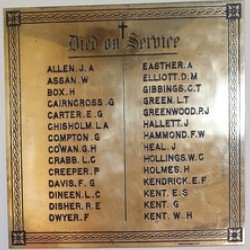
- Geraldton Cathedral of the Holy Cross Honour Roll, Geraldton, Western Australia
- Geraldton District Great War Honour Roll, Geraldton, Western Australia
- Kings Park State War Memorial, Perth, Western Australia
- North Fremantle Cenotaph, North Fremantle, Western Australia
- V.C. Corner Australian Cemetery Memorial, Fromelles, France
Finding Jack
More than a century after the Battle of Fromelles, Percy John "Jack" Greenwood remains one of Australia's missing soldiers. Although commemorated on memorials in Australia and France, he has no known grave.
The discovery of the Pheasant Wood mass grave in 2008 has transformed the search for soldiers like Jack. Through a combination of historical research and DNA testing, 181 of the 250 Australian soldiers recovered from the site have now been identified. Jack may yet be among those still awaiting their name.
The Fromelles Association of Australia continues to research Jack's story and is seeking suitable Greenwood family Y-DNA donors to assist with his identification. Every new family connection brings the possibility that one day Jack will be identified, buried under his own name, and reunited with his family history after more than a century.
DNA samples are being sought for family connections to
| Soldier | Percy John "Jack" Greenwood (1893–1916) |
| Parents | Henry Greenwood (1854–1903), born Medstead, Hampshire; died Tunbridge Wells, Kent and Kezia Seward (1858–1929), born Wield, Hampshire; died Fremantle, Western Australia |
| Siblings | Everard Fred Greenwood (1880–1953) – one adopted daughter | ||
| Frank Greenwood (1882–1882) – died in infancy | |||
| Tolmash Kenneth (Thomas) Greenwood (1882–1954) – one son and one daughter (Y-DNA line sought) | |||
| Agnes Jane (Jessie) Greenwood (1884–1959) | |||
| Lily Caroline Greenwood (1885–1972) | |||
| George Harry Greenwood (1889–1889) – died in infancy | |||
| Reginald Greenwood (1890–1973) – one adopted son | |||
| Elsie Maud Greenwood (1896–1916) | |||
| Donald Seaward Greenwood (1898–1972) – no issue | |||
| Leslie Greenwood (1900–1968) – one daughter |
| Grandparents | ||||
| Paternal | Bridger Greenwood (1810–1895) and Caroline Knight (1824–1893), both of Medstead, Hampshire, England | |||
| Maternal | William Seward (1825–1875) and Charlotte Goodall (1832–1909), both of Wield, Hampshire, England |
Seeking DNA Donors

Contacts
(Contact: carla@fromelles.info or geoffrey@fromelles.info).
(Contact: army.uwc@defence.gov.au or phone 1800 019 090).
Donations
If you are able, please contribute to the upkeep of this resource.
(Contact: bill@fromelles.info ).