William BRASHER
Eyes blue, Hair brown, Complexion fresh
William Brasher – A Hard Life, A Brave End
With thanks to relative John Adler for family information for this story.
Can you help find William?
William Brasher’s body was never found after the Battle of Fromelles and there are no records of his burial.
A mass grave was found in 2008 at Fromelles, a grave the Germans dug for 250 Australian soldiers they recovered after the battle. As of 2024, 180 of these soldiers have been able to be identified via DNA testing.
William may be among these remaining unidentified men. There is still a chance to identify him — but we need help. We welcome all branches of his family to come forward to donate DNA to help with his identification, especially those from the wider Brasher, Ford, Fletcher, or Du-Heaume family lines.
See the DNA box at the end of the story for what we do know about his family.
If you know anything of contacts for William, please contact the Fromelles Association.
Please contact the Fromelles Association of Australia to find out more.
Early Life - Poverty, Neglect and a Ward of the State
William was born in Northcote, Victoria, around 1891–1892, the ninth of the eleven children of George Brasher Ford and Mary Ann née Fletcher. They had married in 1876. (Note – all the children were born as ‘Ford’, but, for reasons unknown, this was changed to Brasher at some stage. George died as George Brasher.)
Their children were:
- Mary Ann Matilda (“Tilly”) (1877–1911)
- Annette Rose (“Rose Russell”) (1879–1911)
- George Alfred (1880–unknown)
- Annetta “Nellie” (1882–1943)
- May (1885–1979)
- Daisy (1886–1886)
- Alice Brasher (1887–1966)
- Arthur Henry (1889–1933)
- Theodore “William” (1891–1916)
- Minnie (1893–1916)
- Sybil Isabella (1899–1899)
William was raised in a ‘very troubled’ family situation. When William was about two, his father spent nine months in prison for horse stealing. Then, in 1893 with the family living in Fitzroy, his mother was arrested and charged with vagrancy. She appeared in court carrying a baby and walking beside a toddler (Minnie and William) and both were deemed to be neglected. The police told the magistrate that George Ford had recently been released from gaol and had “cleared out,” leaving his wife and children homeless. Mary Ann had been “sleeping in unoccupied houses at night and begging for food in the daytime.”
Source - Foisting Children on the State. (28 August 1893). The Age (Melbourne, VIC 1854–1954), p. 7. http://nla.gov.au/nla.news-article193420048
A warrant was issued for George’s arrest and shortly afterwards multiple Brasher children were made wards of the state. Records show William was taken into care on 19 September 1893 and he remained in care until he was 18.
Source - Victoria, Children’s Registers of State Wards, 1850–1893
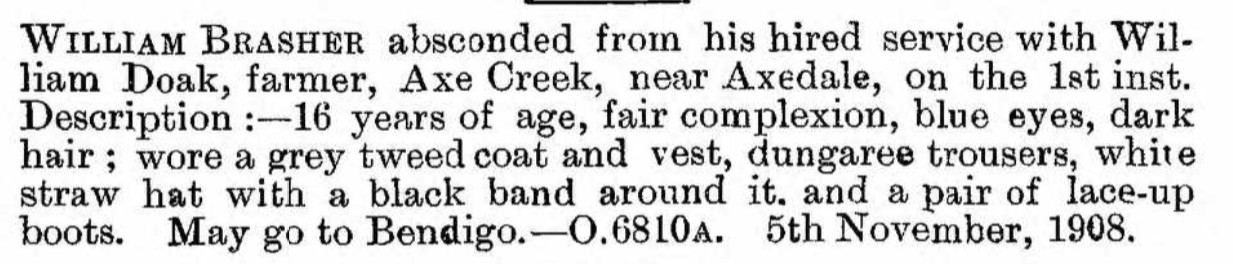
Life in care was harsh. William spent years in institutions including Royal Park, Bayswater and Sunbury, where he was labelled “neglected” and later “uncontrollable.”
Source - Victoria Police Gazette, 12 Nov 1908
At 16, he absconded from a farm placement at Axe Creek, a detail later noted in the Victorian Police Gazette.
In June 1911, the family was further shattered when William’s sisters Tilly and Rose Russell died in the infamous Fitzroy Double Poisoning. During a night of drinking in Little George Street, Fitzroy, Rose poisoned Tilly with cyanide of potassium — then took the same poison herself. Newspapers reported - “Mrs Rose Russell… announced her intention of poisoning her sister, Matilda Ford… She afterwards admitted that she had poisoned both her and herself.”
Source - DOUBLE TRAGEDY. (13 June 1911). The Herald, p.8. http://nla.gov.au/nla.news-article242228486
George was devastated. Weeks later, he was found in Geelong having twice attempted suicide by poisoning, telling police he was “the father of the two victims of the Fitzroy tragedy” and intended to destroy himself.
Source - BENT ON SUICIDE. (8 July 1911). The Ballarat Star, p.1 http://nla.gov.au/nla.news-article216643793
By this time, William had already faded from the ward system and was working as a labourer.
Off to War
William enlisted at the Melbourne Depot On 20 September 1915, under the name of William Brasher. He passed his medical exam - 5 feet 2 inches tall with blue eyes, brown hair and a fresh complexion. His file noted old scars on his back and arms, and a tattoo of clasped hands on his right forearm. He was allocated to the 8th Reinforcements, 23rd Battalion and did his initial military training at Royal Park, Seymour and Broadmeadows. The new recruits carried heavy packs on long route marches and were drilled in musketry, bayonet work, and entrenching. Like many young Victorian volunteers, William came from labouring work, so the physical strain was likely less of a shock than the military discipline.
On 5 January 1916, he embarked from Melbourne on HMAT Afric, joining the thousands of other reinforcements bound for the camps in Egypt. With the ‘doubling of the AIF’ as it expanded from two infantry divisions to five, major reorganisations were underway. After arriving in Egypt, he was reassigned to the 24th Battalion for about a month and then to the 60th Battalion on 4 April 1916. The 60th Battalion had been raised in Egypt on 24 February 1916 at the 40,000-man training camp at Tel-el-Kebir, about 110 km northeast of Cairo. Roughly half of the soldiers were Gallipoli veterans from the 8th Battalion, a predominantly Victorian unit, and the other half were fresh reinforcements from Australia.
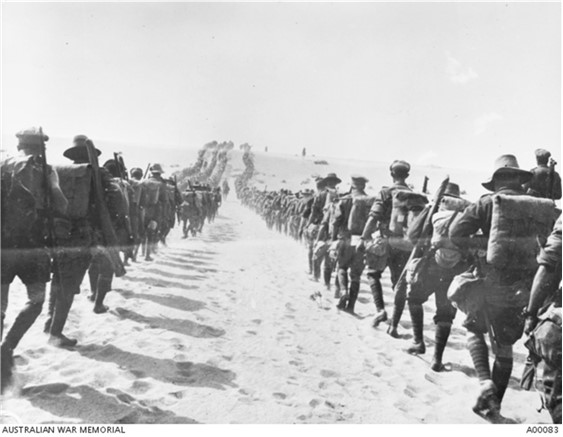
He was at Ferry Post until 1 June continuing training and guarding the Suez Canal from any potential threats posed by the Ottoman Army. His time in Egypt was not all work, however. A 5th Division Sports Championship was held on 14 June, which was won by the 60th’s 15th brigade. On 17 June the 60th received orders to begin the move to the Western Front and were on trains to Alexandria. The majority of the battalion, 30 officers and 948 other ranks, embarked in Alexandria on the transport ship Kinfauns Castle on 18 June 1916. After a stop in Malta, they arrived in Marseilles on 29 June and were immediately put on trains, arriving in Steenbecque in northern France, 35 km from Fleurbaix, on 2 July.
This area near Fleurbaix was known as the “Nursery Sector” – a supposedly relatively quiet area where inexperienced Allied troops could learn the harsh realities of Western Front trench warfare against the Germans. But the quiet times and the training period did not last long. On the 7th they began their move to the front, arriving in Sailly on the 9th. Now just a few kilometres from the front, their training continued, although with a higher intensity, I’m sure. William was into the trenches for the first time on 14 July.
The Battle of Fromelles
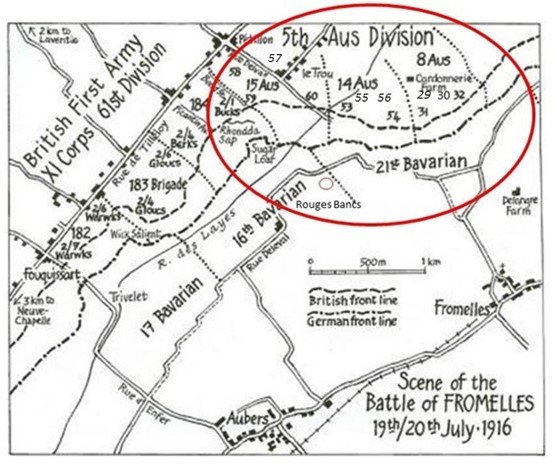
The battle plan had the 15th Brigade located just to the left of the British Army. The 59th and 60th Battalions were to be the lead units for this area of the attack, with the 58th and 57th as the ‘third and fourth’ battalions, in reserve. The main objective for the 15th Brigade was to take the trenches to the left of a heavily armed, elevated German defensive position, the ‘Sugar Loaf’, which dominated the front lines. If the Sugar Loaf could not be taken, the other battalions would be subjected to murderous enfilade fire from the machine-guns and counterattacks from that direction.
As they advanced, they were to link up with the 59th and 53rd Battalions on their flanks. The 60th Battalion faced an especially difficult position in the assault, right across from the ‘Sugar Loaf’. On 17 July, they were in position for the major attack against the Sugar Loaf position, but it was postponed due to unfavourable weather. There was a gas alarm, but luckily it was just that. Two days later, Zero Hour for advancing from their front-line trenches was to be 5.45 PM, but the Germans knew this attack was coming and were well-prepared. They opened a massive artillery bombardment on the Australians at 5.15 PM, causing chaos and many casualties.
A fellow soldier, Private Bill Boyce (3022, 58th), summed the situation up well:
“What have I let myself in for?”
The Aussies went over the parapet at 5.45 PM in four waves at 5 minute intervals, but then lay down to wait for the support bombardment to end at 6.00 PM. A Company and William’s B Company were in the first two waves and C and D in the next two. Casualties were immediate and heavy, but Corporal William Holtham (4801), a machine gunner with the battalion, later wrote of the men’s courage as they stepped into the open:
“Not a man flinched, not a single chap hung back when his turn came. They were just up and over.”
The 15th Brigade War Diaries captures the intensity of the early part of the attack – “they were enfiladed by machine guns in the Sugar Loaf and melted away.”

The British 184th Brigade just to the right of the 59th met with the same resistance, but at 8.00 PM they got orders that no further attacks would take place that night. However, the salient between the troops limited communications, leaving the Australians to continue without British support from their now exposed right flank. It was reported that some got to within 90 yards of the enemy trenches. One soldier said he “believed some few of the battalion entered enemy trenches and that during the night a few stragglers, wounded and unwounded, returned to our trenches.”
Source - AWM4 23/77/6, 60th Battalion War Diaries, July 1916, page 3.
Fighting continued through the night. With known high casualties in the 60th, they were relieved by the 57th Battalion at 7.00 AM. Roll call was held at 9.30 AM.
In the ‘Official History of the War’, C.W. Bean said:
“of the 60th Battalion, which had gone into the fight with 887 men, only one officer and 106 answered the call.”
To get some perspective of the battle, when Charles Bean, Australia’s official war historian, attended the battlefield two and half years later, he observed a large quantity of bones, torn uniforms and Australian kit still on the battlefield. The final impact of the battle on the 60th was that 394 soldiers were killed or died of wounds, of which 313 were not able to be identified.
After the Battle
William was reported as among the many missing in action after the attack. The Army did undertake a major effort to find the soldiers, but there are no witness statements in William’s files to describe what might have happened to him, not necessarily surprising given the nature of the battle for the 60th. A Court of Enquiry held in the field on 4 August 1917 formally ruled that he had been killed in action on 19 July 1916.
William was awarded the British War Medal, the Victory Medal, a Memorial Plaque and a Memorial Scroll. However, his father’s address was unknown when the medals were available and William’s medals were noted as “untraceable”. By June 1923, both his mother and his father had been in contact with the Army and William’s medals were given to his mother.
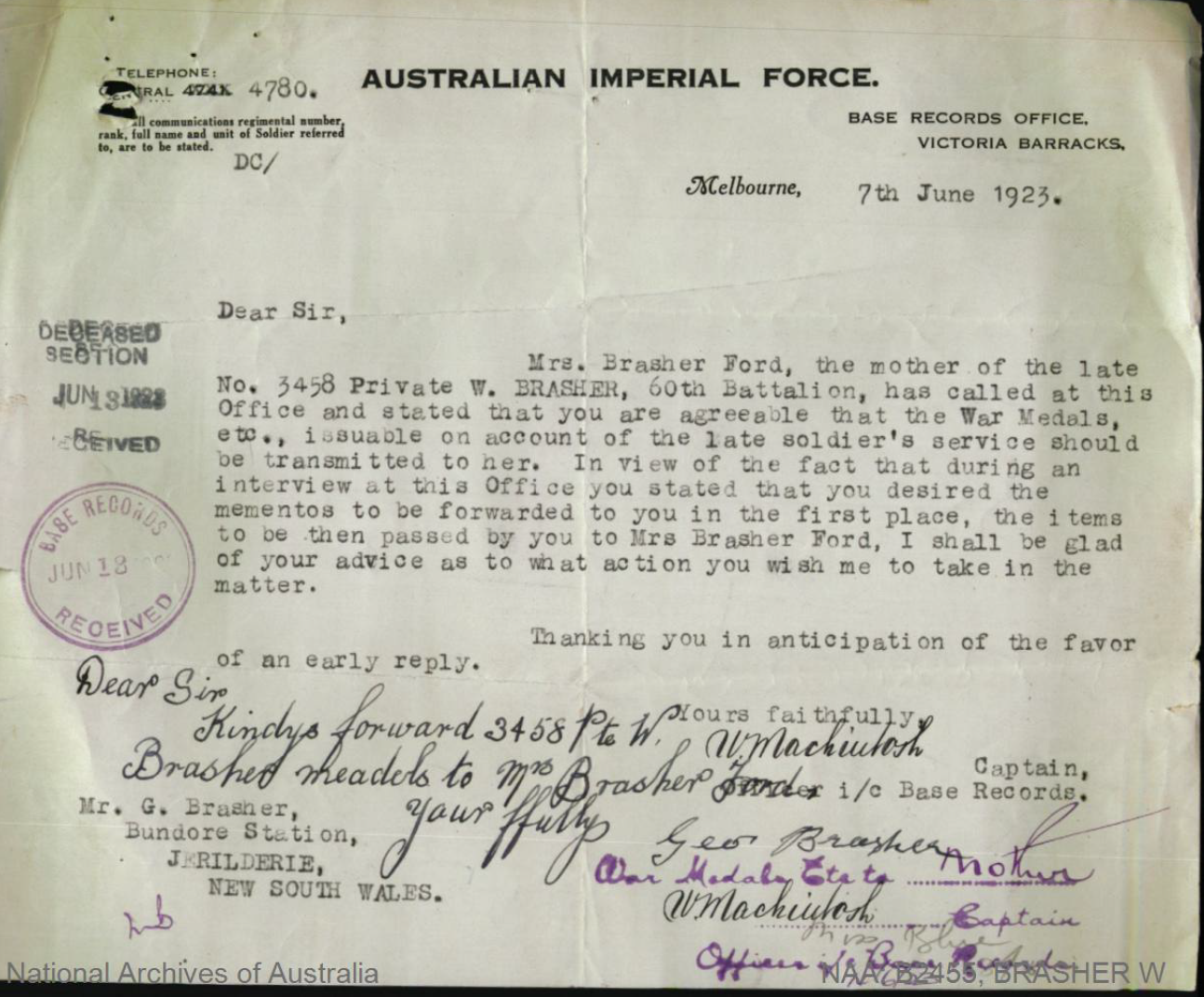
Both of his parents lived for many years without answers about their son. George died in July 1925 and Mary Ann in 1938.
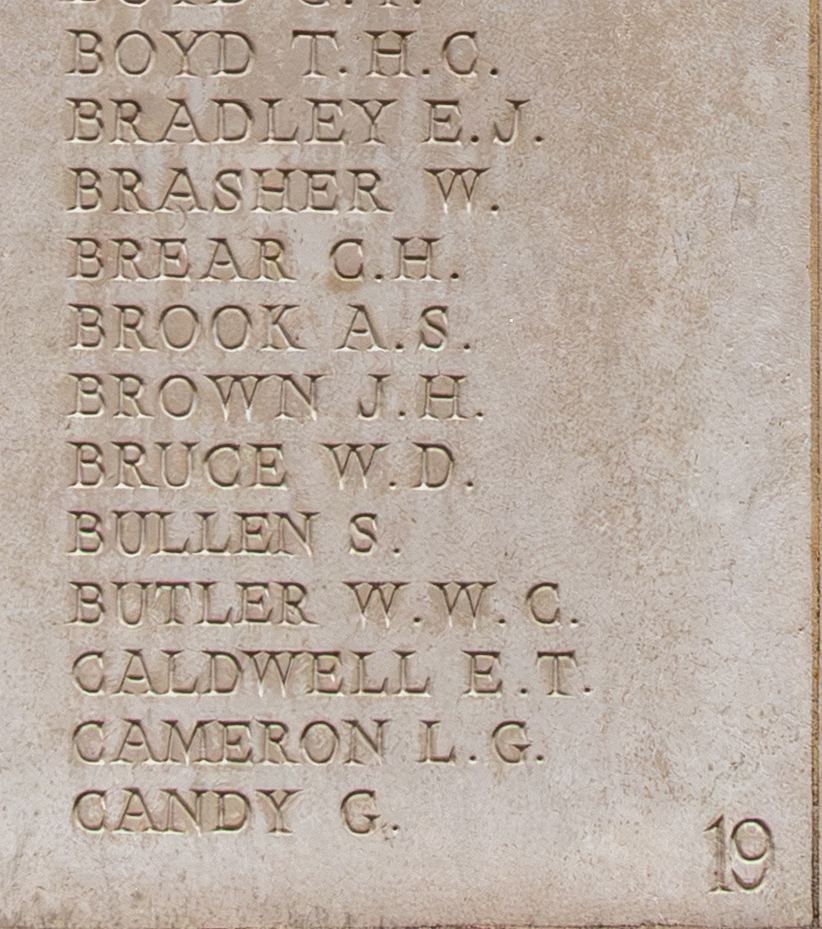
William is commemerated at VC Corner Australian Cemetery Memorial, Fromelles, France and the Australian War Memorial.
Finding William
William remains were not recovered; he has no known grave. After the battle, the Germans recovered 250 Australian soldiers and placed them in a burial pit at Pheasant Wood. This grave was discovered in 2008 and since then efforts have been underway to identify these soldiers by DNA testing from family members. As of 2024, 180 of the soldiers have been identified, including two of the 313 unidentified soldiers from the 60th Battalion.
We welcome all branches of Wiliam’s family to come forward to donate DNA to help with his identification, especially those from the wider Brasher, Ford, Fletcher, or Du-Heaume family lines.
If you know anything of family contacts, please contact the Fromelles Association. We hope that one day William will be named and honoured with a known grave.
Please visit Fromelles.info to follow the ongoing identification project and William’s story.
DNA samples are being sought for family connections to
| Soldier | William Brasher born Theodore Ford (1891–1916) |
| Parents | George Brasher Ford (c.1858–1925), Melbourne, Victoria | ||
| Mary Ann Fletcher (c.1855–1938), Melbourne, Victoria |
| Siblings | Mary Ann Matilda (1877–1911) | ||
| Annette Rose (1879–1911) Married George Henry Russell | |||
| George Alfred (1880–?) | |||
| Annetta “Nellie” (1882–1943) Married Adolphus Du-Heaume | |||
| May (1885–1979) Married Collins | |||
| Daisy (1886–1886) | |||
| Alice (1887–1966) Married (1) Donald McKay; (2) Francis “Frank” Collins; (3) George James Cameron | |||
| Arthur Henry (1889–1933) | |||
| Minnie (1893–1916) | |||
| Sybil Isabella (1899–1899) |
| Grandparents | |||
| Paternal | George Brasher? and Annette McAnulty, Victoria | ||
| Maternal | William Edward Fletcher (1817–1883), Norfolk/Melbourne & Mary Ann Dorgan (1832–?), New York/Melbourne |
Links to Official Records
Seeking DNA Donors

Contacts
(Contact: carla@fromelles.info or geoffrey@fromelles.info).
(Contact: army.uwc@defence.gov.au or phone 1800 019 090).
Donations
If you are able, please contribute to the upkeep of this resource.
(Contact: bill@fromelles.info ).