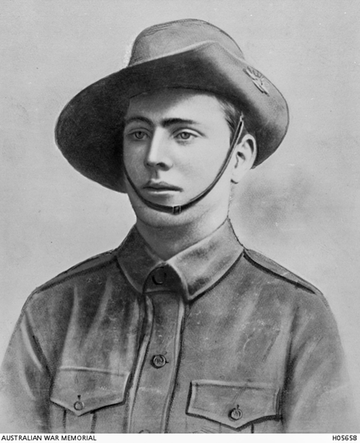
Colin Campbell BARR
Eyes brown, Hair fair, Complexion fair
Dave and Colin Barr — Brothers Together in the Charge
Can you help find Dave?
Dave Barr’s body was never found after the Battle of Fromelles, and there are no records of his burial. His brother Colin died of wounds in August 1916 and is buried in England.
A mass grave was found in 2008 at Fromelles, a grave the Germans dug for 250 Australian soldiers they recovered after the battle. As of 2024, 180 of these soldiers have been able to be identified via DNA testing.
Dave may be among these remaining unidentified men. There is still a chance to identify him — but we need help. We welcome all branches of his family to come forward to donate DNA to help with his identification, especially those with roots in Melbourne, Victoria and Barr ancestors from Paisley, Scotland and Thompsons from London.
See the DNA box at the end of the story for what we do know about his family.
If you know anything of contacts for Dave, please contact the Fromelles Association.
Early Life
David (Dave) Barr was born in Richmond, Victoria in 1890 and his younger brother Colin Campbell Barr in 1896. They were two of Robert Barr’s and Maria Margaret Thompson’s twelve children:
- Margaret “Maggie” Barbara (1873–1947)
- Marie “May” Janet (1875–1926)
- Archibald “Archie” (1876–1962)
- Jessie McKean (1878–1932)
- Robert Barr (1880–1880)
- George Doyle (1881–1965)
- Robert “Bob” (1883–1952)
- Edward “Ted” Charles Cleverley (1886–1926) AIF 5797, 21st Bn, died from war wounds
- Alice Ann Wordsworth (1888–1969)
- David (1890–1916) AIF 3474 60th Bn, KIA Fromelles
- Rupert (1894–1971)
- Colin Campbell (1896–1916) AIF 3479 60th Bn, DOW after Fromelles
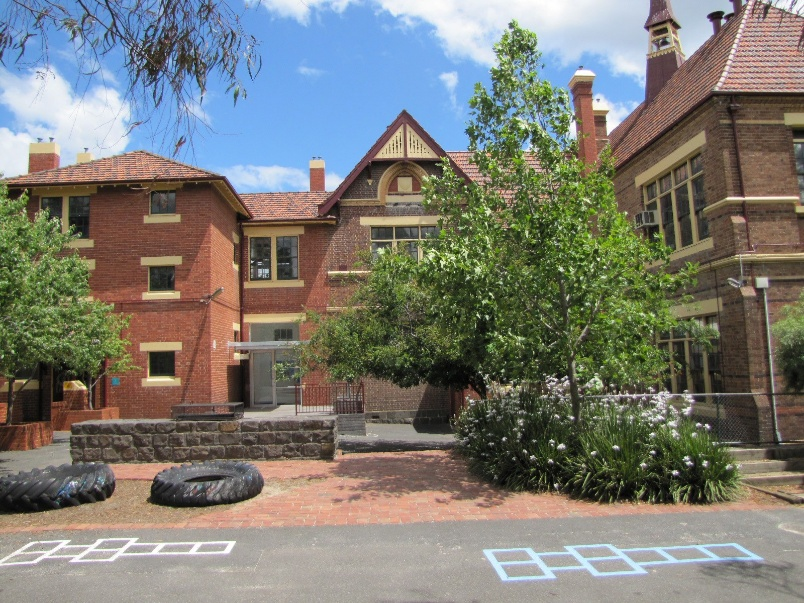
The Barr grandparents had migrated to New South Wales in1863 from Paisley in Scotland, when Robert was 13. Maria’s ancestors were from London. Robert and Maria raised their large family at 109 Mary Street, Richmond. The Barr children grew up surrounded by cousins and the bustle of early 20th-century Richmond. The children attended Hawthorn West State School. After their schooling, Ted, Dave and Colin became tanners/leather dressers.
Off to War
Dave and Colin enlisted together in Melbourne on 7 August 1915, determined to ‘do their bit.’ Prior to enlistment, the younger Colin spent 12 months in the Citizens’ Military Force, a requirement at the time. Both were assigned to the 8th Battalion, 22nd Reinforcements and would have undergone their military training at the Broadmeadows Camp. Their older, married brother Ted enlisted exactly a year later, 7 August 1916, and was assigned to the 21st Battalion, 16th Reinforcements. Dave and Colin embarked from Melbourne on HMAT A19 Afric on 5 January 1916, headed for the camps in Egypt.
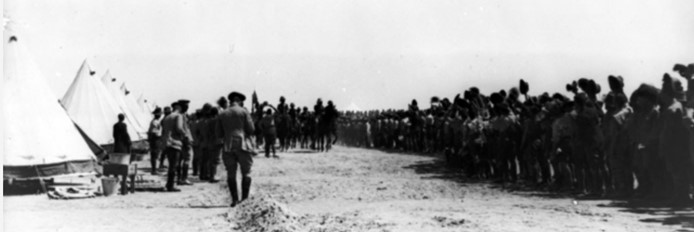
Ted left Australia on 2 Ocober 1916 and arrived in France, via England, in February 1917. With the ‘doubling of the AIF’ in 1915/16 as it expanded from two infantry divisions to five, major reorganisations were underway. Both Dave and Colin were transferred to the newly formed 57th Battalion and then a few days later to the 60th Battalion. The 60th Battalion was raised in Egypt on 24 February 1916 at the 40,000-man training camp at Tel-el-Kebir, about 110 km northeast of Cairo. Roughly half of the soldiers were Gallipoli veterans from the 8th Battalion, a predominantly Victorian unit, and the other half were fresh reinforcements from Australia. Their training continued, necessary to build the bonds in the new battalions necessary for the fighting to come. In mid-March they were inspected by H.R.H the Prince of Wales.
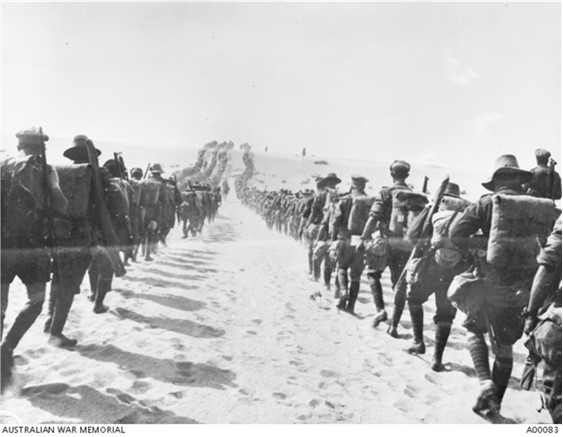
After a month of training at the large camp at Tel el Kebir, they had a two+ day, 50 km march in thermometer-bursting heat across the Egyptian sands from Tel el Kebir to Ferry Post, near the Suez Canal. Prior to marching, only ½ pint of water per bottle was available.
Source- AWM4 23/15/1 15th Brigade War Diaries Feb-Mar 1916 p 6.
They remained at Ferry Post until 1 June continuing their training and guarding the Suez Canal from any potential threats posed by the Ottoman Army. Their time in Egypt was not all work, however. A 5th Division Sports Championship was held on 14 June, which was won by the 60th’s 15th brigade. The boys wrote home and their mother Maria, sent a proud update to the local paper, quoting the boys’ letter in full colour just days before they sailed for France:
“They have been on guard in the desert for four months and state they are in good health and contented. They have now been transferred to the machine gun section, and will, by this time, be in France. The boys mention that every mail the monotony was broken when they received the ‘Guardian.’ It cheered them up to read the news of Richmond. They declare that there is quite a panic among the Richmond boys to get the ‘Guardian,’ and everybody forgets his troubles when it arrives. They are all excellent swimmers now, as they had a dip in the Canal every day. They wish to be remembered to all friends…”
On 17 June they had received orders to begin the move to the Western Front and were on trains to Alexandria. The majority of the battalion, 30 officers and 948 other ranks, embarked in Alexandria on the transport ship Kinfauns Castle on 18 June 1916. After a stop in Malta, they disembarked in Marseilles on 29 June and were immediately put on trains, arriving in Steenbecque in northern France, 35 km from Fleurbaix on 2 July. This area near Fleurbaix was known as the “Nursery Sector” – a supposedly relatively quiet area where inexperienced Allied troops could learn the harsh realities of Western Front trench warfare against the Germans.
But the quiet times and the training period did not last long. On the 7th they began their move to the front, arriving in Sailly on the 9th. Now just a few kilometres from the front, their training continued, although with a higher intensity, I’m sure. The move to Fleurbaix continued and 60th were into the trenches for the first time on 14 July.
The Battle of Fromelles
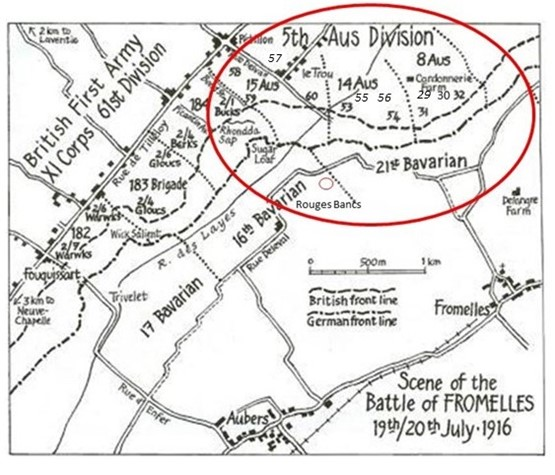
The battle plan had the 15th Brigade located just to the left of the British Army. The 59th and 60th Battalions were to be the lead units for this area of the attack, with the 58th and 57th as the ‘third and fourth’ battalions, in reserve. The main objective for the 15th Brigade was to take the trenches to the left of a heavily armed, elevated German defensive position, the ‘Sugar Loaf’, which dominated the front lines. If the Sugar Loaf could not be taken, the other battalions would be subjected to murderous enfilade fire from the machine-guns and counterattacks from that direction.
As they advanced, they were to link up with the 59th and 53rd Battalions on their flanks. The 60th Battalion faced an especially difficult position in the assault, right across from the ‘Sugar Loaf’. On 17 July, they were in position for the major attack against the Sugar Loaf position, but it was postponed due to unfavourable weather. There was a gas alarm, but luckily it was just that. Two days later, Zero Hour for advancing from their front-line trenches was to be 5.45 PM, but the Germans knew this attack was coming and were well-prepared. They opened a massive artillery bombardment on the Australians at 5.15 PM, causing chaos and many casualties.
A fellow soldier, Private Bill Boyce (3022, 58th), summed the situation up well, “What have I let myself in for?”
Source: Australian War Memorial Collection C386815
The Aussies went over the parapet at 5:45 PM in four waves at 5-minute intervals, but then lay down to wait for the support bombardment to end at 6.00 PM. A and B Companies were in the first two waves, C and Dave and Colin in D Company in the next two. Dave and Colin, standing shoulder-to-shoulder in the shallow trench at Fromelles, two Richmond boys far from home, mud on their boots and looking out over the flat French fields, ready to make the charge. Corporal William Holtham (4801), a machine gunner with the battalion, later wrote of the men’s courage as they stepped into the open. “Not a man flinched, not a single chap hung back when his turn came. They were just up and over.”
Source: DIGGER 17, December 2006, p. 8
Corporal William Totman (385), 60th Btn witnessed Dave and Colin at the charge:
“Just before crossing over, he and his brother shook hands, kissed one another and said ‘goodbye.’”
“Directly he (Dave) crossed, a shell struck him, killing him instatntly in the presence of his brother.”
Colin was also hit in the back by the shrapnel, but…the battle raged on. Colin laid in No-Man’s-Land for two days before returning to the Austrlian lines. The 15th Brigade War Diaries captures the intensity of the early part of the attack – “they were enfiladed by machine guns in the Sugar Loaf and melted away.”

The British 184th Brigade just to the right of the 59th met with the same resistance, but at 8.00 PM they got orders that no further attacks would take place that night. However, the salient between the troops limited communications, leaving the Australians to continue without British support from their now exposed right flank. It was reported that some got to within 90 yards of the enemy trenches. One soldier said he “believed some few of the battalion entered enemy trenches and that during the night a few stragglers, wounded and unwounded, returned to our trenches.”
Source - AWM4 23/77/6, 60th Battalion War Diaries, July 1916, page 3.
Fighting continued through the night. With known high casualties in the 60th, they were relieved by the 57th Battalion at 7.00 AM.
Roll call was held at 9.30 AM. In the ‘Official History of the War’, C.W. Bean said “of the 60th Battalion, which had gone into the fight with 887 men, only one officer and 106 answered the call.”
Source - Chapter XIII page 442 T
o get some perspective of the battle, when Charles Bean, Australia’s official war historian, attended the battlefield two and half years later, he observed a large quantity of bones, torn uniforms and Australian kit still on the battlefield. The final impact of the battle on the 60th was that 394 soldiers were killed or died of wounds, of which 313 were not able to be identified.
Colin - Fighting for His Life After the Battle
Both brothers were among the missing immediately after the battle, but Colin did make it back. He had severe ‘GSW’ (gunshot/shrapnel wounds) and was evacuated to England on the hospital ship St Denis on 23 July and transferred to the 1000 bed Brooke Brook War Hospital, Woolwich for treatment.
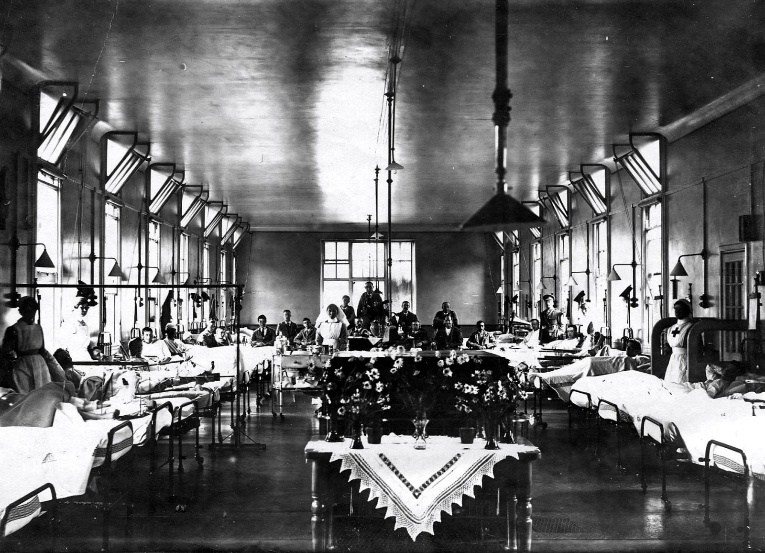
While seriously injured, Colin did manage to write a letter to his parents about Dave, and he was relatively upbeat about his own condition –
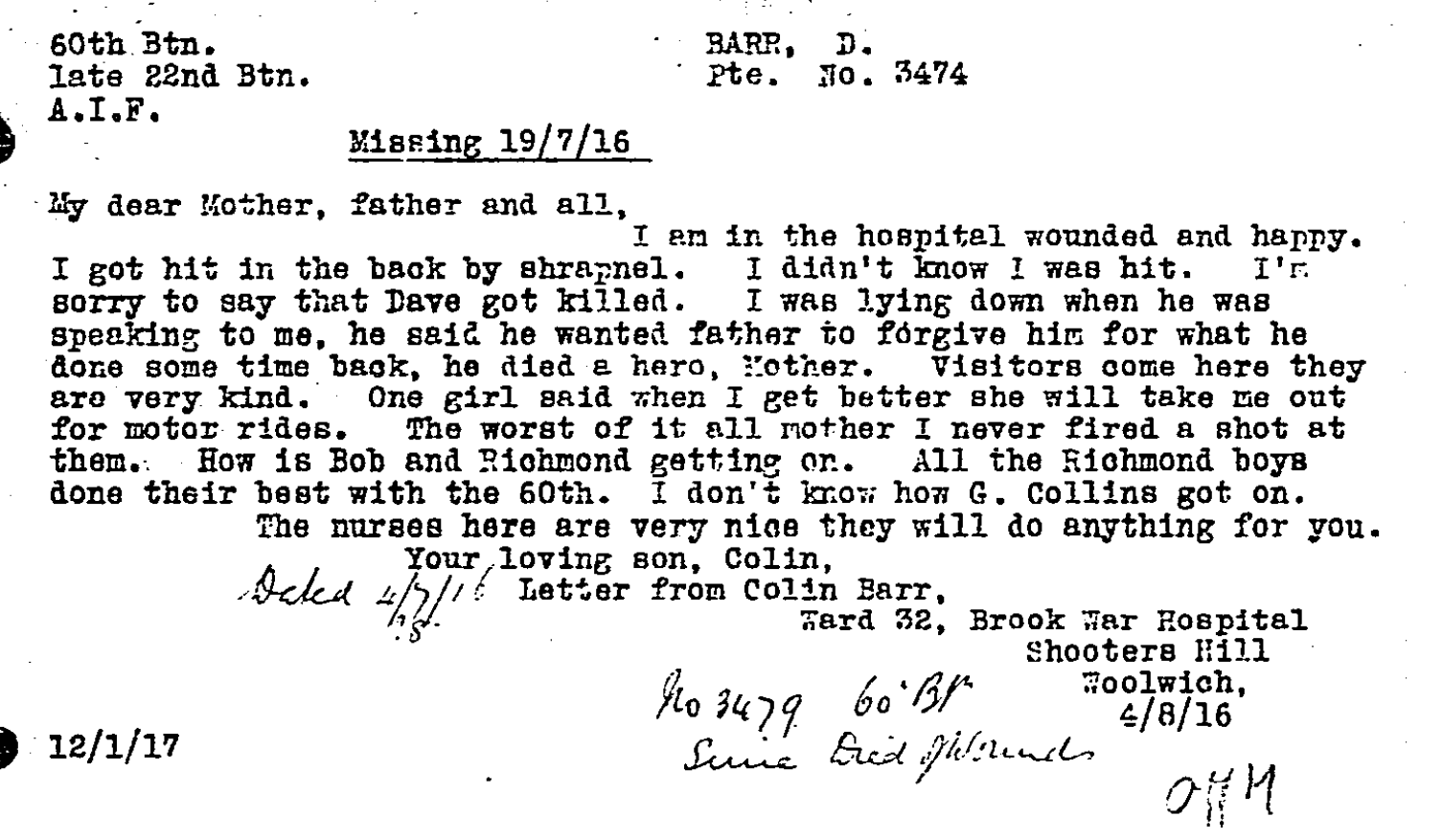
He did pass on Dave’s last wish for his father to forgive him for something Dave had done some time back - some regret? some youthful mistake? - but he also stated that Dave had “died a hero”. By late July However, Colin was placed on the dangerously ill list. Miss Bloxham, a volunteer visitor, later described how the young soldier — “only nineteen and looks even younger” — drifted in and out of delirium, clinging to her hand for comfort when he could no longer recognise faces.
Source: Biography by Cathy Sedgwick – WW1 Australian War Graves in England/UK
Despite the staff’s efforts, Colin’s condition deteriorated rapidly and on 31 August 1916, he died in hospital, just six weeks after being wounded at Fromelles. A nurse at Brook War Hospital wrote to the Red Cross with a fuller picture of Colin’s final days:
“He appeared quite happy and contented all the time he was here and was very pleased with everything that was done for him… He dictated several letters home… He died very peacefully and apparently in no pain.”
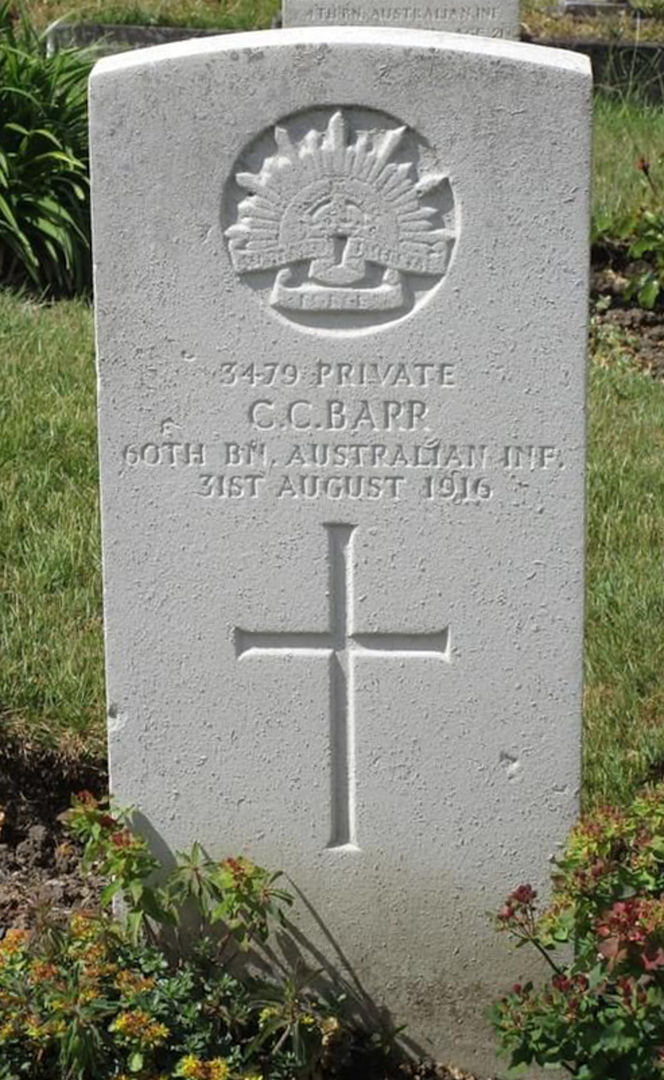
He was buried in Greenwich Cemetery, London. In 1920, his body was exhumed and relocated to Grave 46, Section Z, where his headstone still stands today.
The Family wait…and wait
When the roll was finally taken after Fromelles, neither Dave nor Colin Barr answered their names. The 60th Battalion had been so badly cut to pieces that reliable casualty lists were impossible for weeks. Base Records could only notify the Barr family in Richmond that both sons were missing — the most dreaded word a parent could receive. As wounded men were evacuated to England, the first verified details emerged. Red Cross investigators visited hospitals across London and gathered witness statements confirming what had happened in the chaos of the attack.
The Barr family’s heartbreak unfolded in the most brutal sequence imaginable — all of it recorded by the Richmond Guardian. The newspaper first published Mrs Barr’s letter in September 1916, written before she knew that Colin, too, had died:
“With deep regret I have to inform you that my son, Private Dave Barr, was killed in action on July 19, and his brother, Private Colin Barr, was wounded at the same time. I have received a letter from the chaplain of the Brook War Hospital, Woolwich, where Colin is, to notify me that Dave was killed, and that Colin was with him to the last. He received his last message home to us. The chaplain informs me that Colin is doing fairly well, and is being well cared for.
I knew nothing about poor Dave until receiving the chaplain’s letter, as the Defence Department could give me no information excepting that he had been missing since July 19. It is a terrible blow to me to lose my dear boy, but I thank God he was conscious to the last, and died a noble death fighting for his King and Country. So I will try and bear my trouble as bravely as possible.”
The article then described that the very next day she had received news that Colin, too, had died.
” So now, dear sir, both my poor boys have sacrificed their lives for King and Country. It is a terrible blow to me, as both Dave and Colin were two of my youngest children. Dave was 25 years of age, while poor Colin, who was the baby of the family, had not yet reached his 20th birthday. They went away together and served by each other’s side.”So now dear sir, both my poor boys have sacrificed their lives for King and country.”
Meanwhile, the search for Dave’s remains continued for months. A Court of Enquiry held in the field on 4 August 1917 confirmed his fate as Killed in Action, 19 July 1916, but no grave was ever located.
Ted’s War
Dave and Colin’s older brother Ted enlisted exactly a year after they had, 7 August 1916, and was assigned to the 21st Battalion, 16th Reinforcements. He would not have known about their fates. If his brothers did not get to fire a shotm in the War, Ted certainly did. He arrived in France in February 1917. In early May 1917, the 21st battalion fought at Bullecourt and then in October participated in the 3-kilometre advance that captured Broodseinde Ridge, east of Ypres. Like the rest of the AIF, the battalion saw out the year recuperating from the trials of the Ypres sector.
After helping to blunt the German spring offensive of April 1918, the 21st battalion participated in the battles that would mark the beginning of Germany's defeat - Hamel, Amiens and Mont St. Quentin. The fighting for Mont St Quentin resulted in the battalion's only Victoria Cross, awarded to Sergeant Albert Lowerson. Ted was wounded multiple times – gunshot wounds to his hands, chest, arm, thigh/hip and shoulder.
He also was gassed, but remained on duty. He was evacuated twice to England and returned. On 9 December 1918 he was declared medically unfit due to a hip wound and gastric symtpoms from the gassing. He returned to Australia in January 1919. But his health never fully recovered. He died relatively young — in 1926 at East Melbourne, aged just 40. A husband and father, Ted left behind his wife Florence May (née Muirhead) and their two children, Rupert and Maud.
Legacy
In the years that followed the Battle of Fromelles, the Barr family honoured Dave and Colin with memorial notices that spoke of both grief and pride. One of the most poignant appeared on the anniversary of their deaths:
“BARR.—In loving memory of our dear sons and brothers, Private Colin C. Barr, died of wounds on 31st August, 1916; also Private David Barr, killed in action at Pozieres, France, on July 19, 1916 (previously reported missing).
For those to whom the call has comeWe pray Thy tender welcome home,The toil, the bitterness, all past,We trust them to Thy love at last.O, hear a people's prayer for all,Who, nobly striving, nobly fall.”—Inserted by their sorrowing mother, father, sisters and brother.
Both brothers were awarded the 1914-15 Star Medal, the British War Medal, the Victory Medal, a Memorial Plaque and a Memorial Scroll. Dave and Colin are remembered today on:
- VC Corner Australian Cemetery and Memorial, Fromelles (Dave)
- Greenwich Cemetery, London (Colin)
- Australian War Memorial Roll of Honour, Canberra
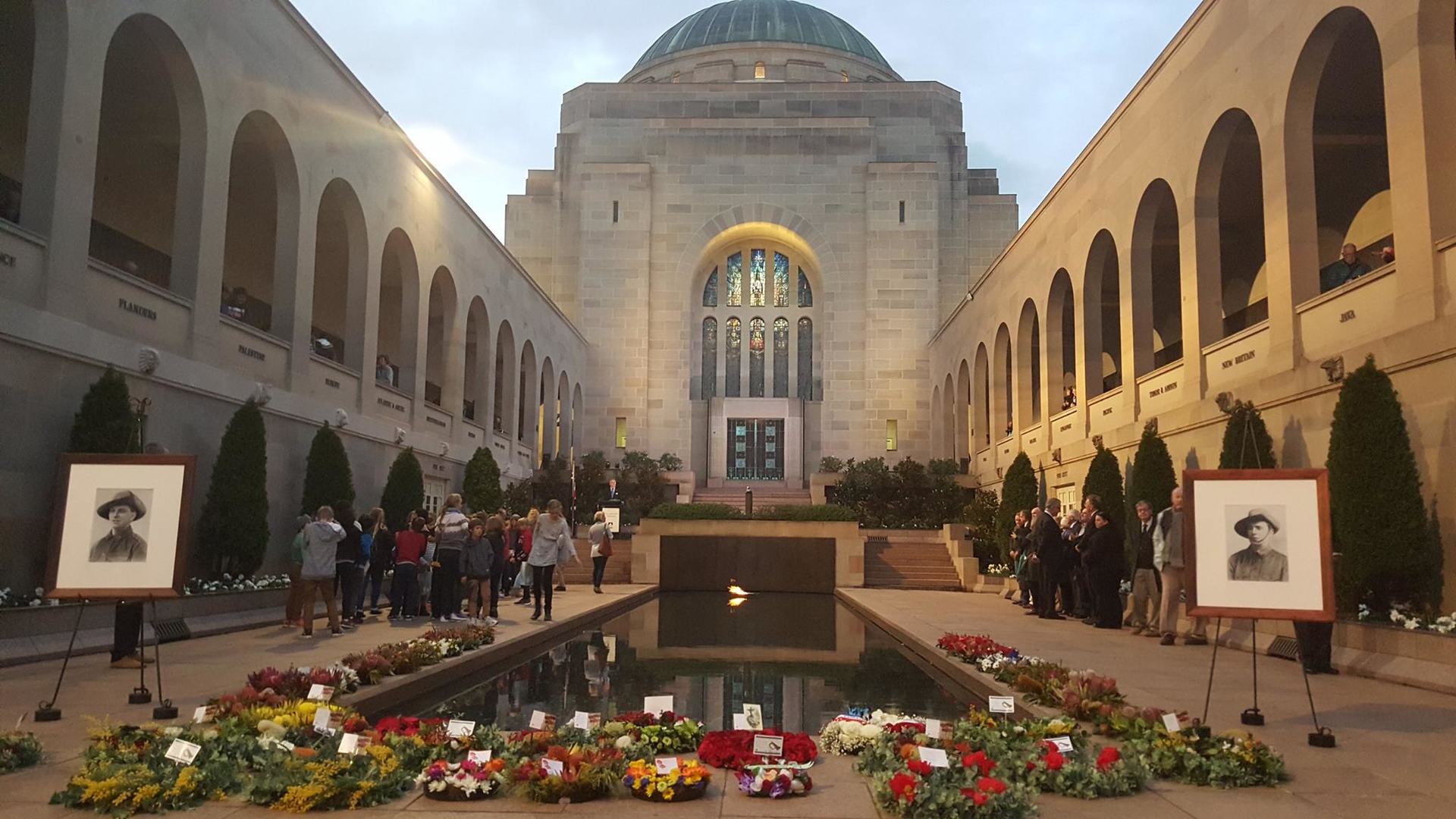
On the the 100th anniversary of the battle, at the Australian War Memorial a Last Post Ceremony was held to honour Dave and Colin,19 July 2016.
Finding Dave
Dave’s remains were not recovered; he has no known grave. After the battle, the Germans recovered 250 Australian soldiers and placed them in a burial pit at Pheasant Wood. This grave was discovered in 2008 and since then efforts have been underway to identify these soldiers by DNA testing from family members. As of 2024, 180 of the soldiers have been identified, including 2 of the 313 unidentified soldiers from the 60th Battalion.
We welcome all branches of Dave’s family to come forward to donate DNA to help with his identification. If you know anything of family contacts, especially from Richmond, Victoria and the Barr and Thompson lines, please contact the Fromelles Association. We hope that one day Dave, like his brother Colin, will be named and honoured with a known grave.
Please visit Fromelles.info to follow the ongoing identification project and Daved’s story.
DNA samples are being sought for family connections to
| Soldier | David Barr (1890–1916) and Colin Campbell Barr (1896–1916) |
| Parents | Robert Barr (1850–1927), born Paisley, Renfrewshire, Scotland; lived Richmond, Victoria and Maria Margaret Thompson (1850–1925), born Richmond, Victoria; lived Richmond, Victoria |
| Siblings | Margaret Barbara “Maggie” (1873–1947) | ||
| Marie Janet “May” (1875–1926) | |||
| Archibald “Archie” (1876–1962) married Annie Evaline Lewis | |||
| Jessie McKean (1878–1932) | |||
| Robert (1880–1880) | |||
| George Doyle (1881–1965) married Alice Jane Gregory | |||
| Robert “Bob” (1883–1952) | |||
| Edward Charles Cleverley “Ted” (1886–1926) married Florence May Muirhead | |||
| Alice Ann Wordsworth (1888–1969) married David (or Daniel) Francis Conway “Con Carroll” | |||
| Rupert (1894–1971) |
| Grandparents | |||
| Paternal | Archibald Barr (c.1805–1877), born Houston, Renfrewshire, Scotland; died Victoria and Jane Derrick (c.1819–?), born Largs, Ayrshire, Scotland | ||
| Maternal | George Doyle Thompson (c.1821–1876), born London, England; died Melbourne, Victoria and Esther Turner (1826–1885), born Aldgate, Middlesex, England; died Richmond, Victoria |
The Fromelles Association would love to hear from you

Contacts
(Contact: carla@fromelles.info or geoffrey@fromelles.info).
(Contact: army.uwc@defence.gov.au or phone 1800 019 090).
Donations
If you are able, please contribute to the upkeep of this resource.
(Contact: bill@fromelles.info ).