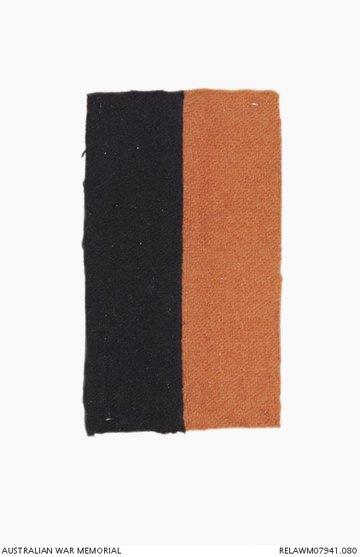
57th Battalion
Off to War
With the 'doubling of the AIF' as it expanded from two infantry divisions to five, major reorganisations were underway.
The 57th Battalion was formed on 18 February 1916 at Tel-el-Kebir, Egypt. It was created from experienced Gallipoli veterans of the 5th Battalion, together with newly arrived reinforcements from Australia. Reflecting the composition of the 5th Battalion, most of the men came from the suburbs of Melbourne and regional Victoria. The battalion became part of the 15th Brigade, 5th Australian Division.
Training throughout March and April focused on musketry, bayonet fighting, bombing, route marches and field exercises. Like the other battalions of the division, the men undertook the demanding march to Ferry Post on the Suez Canal before returning to camps around Tel-el-Kebir and Moascar for further training. Replica trench systems were constructed where the battalion rehearsed attacking and defending trench positions in preparation for service on the Western Front.
On 16 June 1916 the battalion embarked aboard HMAT Huntsend (A50) at Alexandria, arriving at Marseilles on 24 June. After several days in crowded troop trains they travelled north through France, eventually reaching the Fleurbaix sector near the Belgian border. There they completed final training before moving into the front line.
On 17 July, the battalion entered the trenches opposite the German positions at Fromelles. Heavy rain forced the planned attack to be postponed for two days, leaving the Australians crowded into muddy assembly trenches under continual German shellfire while awaiting the assault.
The Battle of Fromelles
The battle plan placed the 15th Brigade immediately to the left of the British attack. Unlike the 59th and 60th Battalions, which were to spearhead the assault against the formidable German position known as the Sugar Loaf, the 57th Battalion was assigned a supporting role. Once the leading battalions had captured the German front line, the 57th was to move forward to reinforce and consolidate the captured trenches.
At 5.53 PM on 19 July 1916, the assault commenced behind the artillery barrage. As the 59th and 60th Battalions advanced, they were met by devastating machine-gun fire from the Sugar Loaf. The 57th Battalion soon followed into No-Man's-Land, moving forward with ammunition, bombs and entrenching tools to reinforce the captured positions.
Despite the terrible losses suffered by the assaulting battalions, parties from the 57th successfully reached the German trenches, where they helped repel repeated counter-attacks throughout the night. Conditions rapidly deteriorated as German artillery and trench mortars pounded the captured positions, while bombing attacks intensified along the trench system.
By the early hours of 20 July, it had become clear that the Australian foothold could not be maintained. German counter-attacks threatened both flanks, communication with brigade headquarters had largely broken down, and ammunition was running dangerously low. Orders were eventually received to withdraw, with the survivors making their way back across No-Man's-Land under continuous shellfire and machine-gun fire.
Although spared the catastrophic losses suffered by the leading battalions, the 57th Battalion nevertheless endured heavy casualties while reinforcing the captured trenches and assisting the withdrawal. In the days that followed, the battalion remained in the front line around Fromelles, helping hold the shattered sector as the 5th Australian Division recovered from its disastrous introduction to the Western Front.
The Battle of Fromelles became one of the darkest days in Australian military history. In less than twenty-four hours, the Australian 5th Division suffered more than 5,500 casualties, while the 57th Battalion lost more than 200 officers and men killed, wounded or missing in its first major action in France. Many of those recorded as missing were later found to have been buried by German troops in mass graves at Pheasant Wood, where DNA identification work continues today. As of 2026, soldiers from the 57th Battalion are among those identified from the recovered remains.