marks on 4th & 5th finger of left hand small scar right knee
Religion
Presbyterian
Fromelles
Took part in Battle of Fromelles
Fate
Killed in Action, 11 May 1917, Bullecourt, France, aged 40
Place of Burial
No known grave
Commemorated
Villers-Bretonneux Memorial, France
Positively Identified
No
Simon Fraser – “Don’t forget me, cobber”
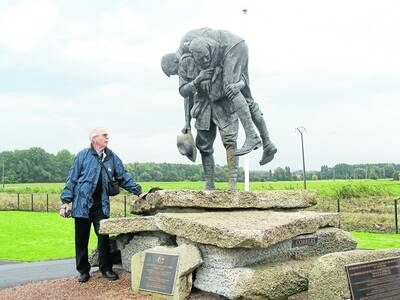
Max Cameron admires the Cobbers statue at Fromelles in France. The statue was inspired by the actions of his great uncle Simon Fraser who was among those who rescued wounded men from the battlefield at Fromelles.
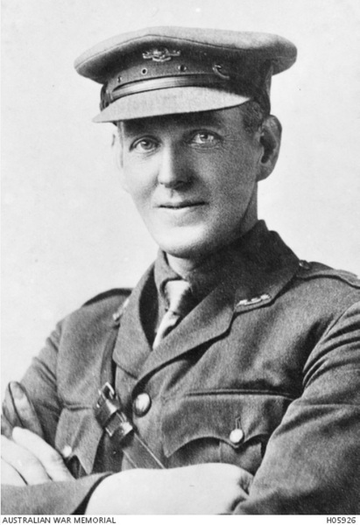
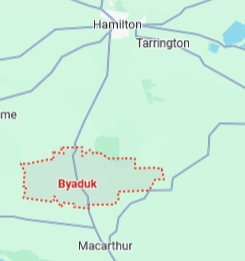
Simon Fraser was born in 1877 at Byaduk, Victoria, the youngest child of James Fraser (1826–1897) and Mary McDonald (1832–1885). He grew up on the family farm, “Aird,” near Byaduk, alongside his eight siblings:
William (1857–1890)
Donald (1858–1931)
Helen (1861–1955)
Peter (1863–1941)
Christy (Chrissie) (1865–1955)
Colin (1868–1942)
Margaret Ann (1870–1961)
Johanna (1873–1917)
Simon (1877-1917)
He attended Byaduk State School and became an accomplished farmer and rifleman, actively involved in the Byaduk Rifle Club for over a decade. His upbringing in a large, hardworking Scottish farming family instilled in him a strong sense of responsibility, loyalty, and duty to community and country.
Byaduk in the Western District of Victoria.
sourceGoogle Maps
Known for his leadership, kindness, and community spirit, Simon contributed to nearly every aspect of Byaduk life. He served as a director of the Byaduk Dairy Company from its inception, was a long-serving committee member of the Mechanics' Institute, and sat on the Board of Management of the Byaduk Presbyterian Church. Standing just over 6 feet (183 cm) tall, he was an imposing figure whose height and strength served him well both on the sporting field and later on the battlefield. A keen sportsman, Simon was president and a strong player with both the Byaduk Football Club and the Byaduk Tennis Club. He was also the first president of the Byaduk Horticultural Society, leading it for several years, and was widely recognised as one of the district's finest shots through the Byaduk Rifle Club.
His military experience pre-dated the Great War. Simon served for nine years with the Victorian Mounted Rifles, attaining the ranks of Acting Sergeant and Sergeant. Formed in 1885, the Victorian Mounted Rifles recruited from rural communities, with many members drawn from local rifle clubs. It was a semi-professional force whose members were expected to provide their own horses for service. This experience gave Simon valuable leadership and military skills that saw him appointed an Acting Sergeant immediately upon enlisting in the AIF in July 1915.
Off to War
With the 'doubling of the AIF' as it expanded from two infantry divisions to five, major reorganisations were underway. The 57th Battalion was formed on 18 February 1916 at Tel el Kebir, Egypt. It was raised from experienced Gallipoli veterans of the 5th Battalion, together with newly arrived reinforcements from Melbourne and north eastern Victoria, including Acting Sergeant Simon Fraser. Commanded by Lieutenant Colonel James Stewart, the battalion became part of the 15th Brigade of the 5th Australian Division. The new battalion was established during a period of rapid expansion of the Australian Imperial Force following the Gallipoli campaign. Experienced officers and non-commissioned officers were dispersed throughout the newly raised units to provide leadership and training for thousands of reinforcements arriving from Australia.
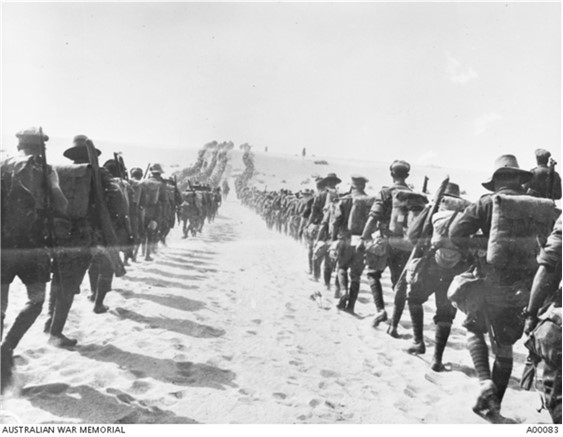
With nine years' service in the Victorian Mounted Rifles and the rank of Acting Sergeant, Simon was one of the experienced NCOs helping train and lead the new battalion. Over the following weeks, the men trained intensively in musketry, bayonet fighting, bombing, signalling, entrenching and field manoeuvres, preparing for the fighting that lay ahead on the Western Front. By the end of March, much of the battalion's initial training had been completed, and the men undertook the arduous 60-kilometre march to Ferry Post on the Suez Canal. Carrying full marching order under the Egyptian sun, the journey tested the endurance of the newly formed unit before it returned to camp for further instruction.
Route March from Tel-el-Kebir
sourceAustralian War Memorial Collections A00083
During May, the battalion moved to Katoomba Heights, where extensive replica trench systems had been constructed in the desert sands. Here the men rehearsed every aspect of trench warfare, practising attacks behind simulated artillery barrages, consolidating captured trenches, bombing enemy positions and repelling counter-attacks. These realistic exercises were designed to prepare the battalion for the conditions they would soon encounter in France.
Writing from Egypt during this period, Private Harry Vivian Forster captured the eagerness felt by many of the men awaiting active service:
"So far we have not been put into action, but we never know when we will have to start, and the sooner the better."
On 19 June 1916, the battalion embarked at Alexandria aboard HMT Caledonian. After crossing the Mediterranean, the transport arrived at Marseilles on 29 June, where the men disembarked to a warm welcome from French civilians before boarding crowded troop trains for the long journey north towards the Western Front. The battalion eventually reached the Armentières sector, where it completed further training before being introduced to trench warfare opposite Fromelles. Like many Australian units arriving in France, Simon and his comrades quickly learned that there was no truly quiet sector. Even before the major offensive began, they experienced German shellfire, sniper activity and the constant demands of life in the front line.
Writing home from France on 2 July 1916, Private George Usher described his first impressions of the country and the anticipation of moving into action:
"The Frenchmen are very industrious people and speaking of those living out of Paris, everyone seems to have a small plot of ground and all under cultivation with potatoes, grape vines, fruit trees, wheat, oats and hay and other fodders... We are close to the firing line, and I believe the enemy aeroplanes pass over this way occasionally... all our boys are anxious to be in these moves, we are only 18 miles away from them... Our food now could not be better though the quantity is small."
On 15 July, while occupying the front line opposite Fromelles, the battalion experienced its first sustained German bombardment. The battalion war diary recorded:
"0630 – Enemy commences shelling our position. This was continued until 1230. The shelling was mostly high explosive and did considerable damage to our parapets.
2030 – The Battalion on our right made a gas attack which started the enemy shelling.
2115 – The fire shifted on to our 'B' & 'C' Coys and we suffered severe shelling till about 2330. Our communication trenches and firing line were damaged."
Simon Fraser was among those sent into No Man's Land to prepare lanes through the German barbed wire ahead of the planned assault. Recalling the day, he wrote:
I had been sent out by Captain with a party for two nights to get the barb wire ready for the charge over, the captain paying me the compliment of saying that I was selected because of work done on the 15th while we were under a five hours bombardment, and for which he recommended me, with a lot of others, for mention in despatches. Why, I do not know. Still, it is satisfactory to feel that you have been appreciated."
Heavy rain forced the planned attack to be postponed for forty-eight hours, leaving the Australians crowded into muddy assembly trenches under continual shellfire as they waited for the order to advance.
The Battle of Fromelles
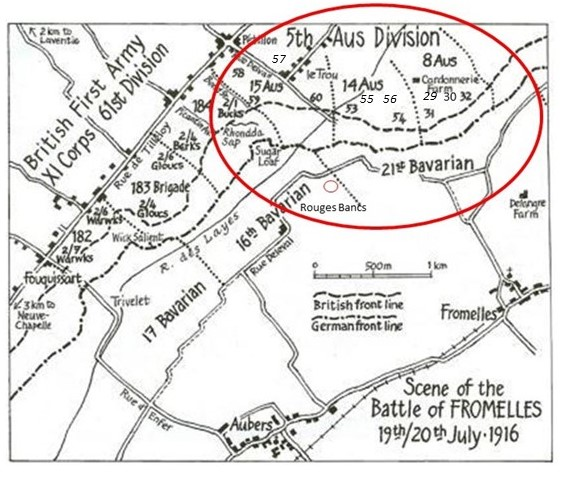
Map of the scene of the Battle of Fromelles showing troop placements
Less than a month after arriving in France, Simon and the men of the 57th Battalion faced their first major action on the Western Front. Opposite them lay the German defences near the village of Fromelles, dominated by the heavily fortified Sugar Loaf salient. Protected by deep trenches, reinforced parapets, concrete dugouts and interlocking machine-gun fire, it was one of the strongest positions on the battlefield. At 5.45 PM on 19 July 1916, the 59th and 60th Battalions advanced across almost 400 metres of open ground into devastating rifle and machine-gun fire. The attack quickly faltered as the Germans poured fire into the advancing Australians. Messages reaching Brigade Headquarters within minutes painted a desperate picture:
"cannot get on the trenches as they are full of the enemy."
"every man who rises is shot down."
The brigade's after-action report later recorded that the attacking battalions "were enfiladed by machine guns in the Sugar Loaf and melted away."
Source - AWM4 23/15/5, 15th Brigade War Diary, July 1916, p. 56.
Although the 57th Battalion remained in reserve, it was soon called forward to reinforce the shattered front line. Writing home twelve days later, Simon reflected on the ordeal:
"Just a sheet to let you know that I have been through the mill and came out without a mark except scratched hands through cutting and putting up wire entanglements. I went into the trenches on the 10th and am out now for a three day spell in supports."
"For the first ten days we were in Hades. There were bombardments of high explosives and shrapnel from both sides every day, but two nights in particular were 'hotties.' Fritz sent everything in creation he could think of into our trenches. Even a double furrow plough came over. Not from their trenches, but blown over the parapet by high explosive."
Despite the constant danger, Simon retained his characteristic humour "These live shells are great for rooting things up, and would be grand for breaking up a rough paddock for the plough. But it takes a thundering lot of them to get a man."
"Our battalion did not hop over with the big stunt... We were supporting when the charge was made, and had to hold our line. The battalions that went over met with too hot a reception as the distance was too far. When we came up the artillery was mixing things up a bit. High explosives and shrapnel were flying everywhere. We did a 200 yards sprint across the open. I did not think I could run so well. Luckily only three of our company were hit crossing the open to our old trenches, but the bombardment kept up all night, and a good many of my mates passed out. So far three of my section have been killed and two wounded badly out of twelve."
The Battle was a disaster.
"The attack failed, and losses were great: the 5th Australian Division suffered 5,533 killed and wounded; the 61st British Division suffered 1,547."
After the Battle
When the fighting ended, Simon volunteered for one of the battle's most dangerous tasks. For the next three days, parties from the 57th Battalion searched No Man's Land for wounded men, often under continuing sniper and artillery fire:
"For the next three days we did great work getting in the wounded from the front, and I must say Fritz treated us very fairly though a few were shot while at the work. Some of these wounded were game as lions and got rather roughly handled, but haste was necessary... It was no light work getting in with a heavy weight on your back, especially if the poor fellow had a broken arm or leg and no stretcher handy. You had to be down and get him on your back, then rise and duck for your life with a chance of getting a bullet before you reached cover."
It was during one of these rescue missions that Simon heard the words that would become forever associated with his name:
One foggy morning in particular I remember. We could hear someone over toward the German entanglements calling for a stretcher bearer. It was an appeal no man could stand against, so some of us rushed out and had a hunt... just then another man about 20 yards away sang out,
"Don't forget me cobber."
I went in and got four volunteers, and we brought both men in safely."
Despite everything he had witnessed, Simon retained a remarkable sense of humanity "It is very funny how one watching the effect of our guns on the German trenches remarks 'Good oh!' as their parapets and dugouts fly up in the air. One does not think till afterwards that those poor devils who are just as anxious for the war to end as we are, may be flying with the debris."
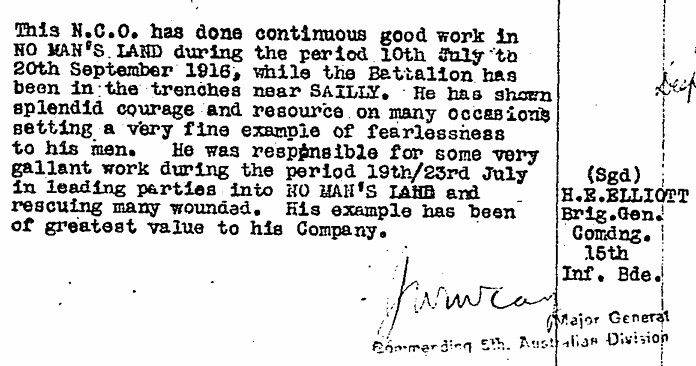
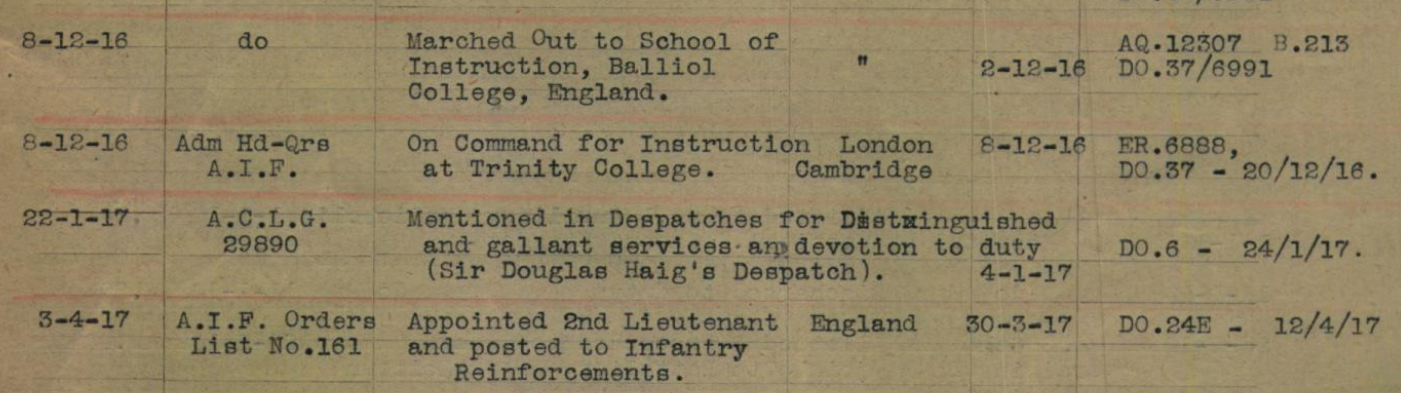
Simon continued to serve with distinction in the months following Fromelles. His courage and leadership during the battle and its aftermath were recognised when Brigadier General H.E. "Pompey" Elliott recommended him for a Mention in Despatches, writing:
"This N.C.O. has done continuous good work in No Man's Land… showing splendid courage and resource on many occasions… His example has been of greatest value to his Company."
Page 31 of his War Record
source
His leadership did not go unnoticed. Late in 1916 Simon was selected for officer training in England. On 2 December 1916, his service record shows he was attached to the Balliol College Officer Cadet Battalion, Oxford, supernumerary to the 57th Battalion, before later attending instruction at Trinity College, Cambridge. During the First World War, Balliol College became one of Britain's principal officer training centres, its historic buildings housing thousands of British and Dominion officer cadets preparing for service on the Western Front "Balliol's Broad Street site hosted thousands of British and Commonwealth officer cadets on short training courses… the Army was in effect renting the property."
On 1 April 1917, Simon was commissioned as a Second Lieutenant and transferred to the 58th Battalion, returning to France to rejoin the 15th Brigade just weeks before the fighting at Bullecourt.
Bullecourt
Bullecourt is one of the lesser-known battlefields of the Western Front, yet it was a significant and costly campaign for the Australian Imperial Force. In 1917, the small village in northern France was heavily fortified by the Germans as part of the Hindenburg Line, protected by belts of barbed wire, machine gun posts, and deep trenches. Two major battles were fought here: the First Battle on 11 April and the Second Battle starting on 3 May.
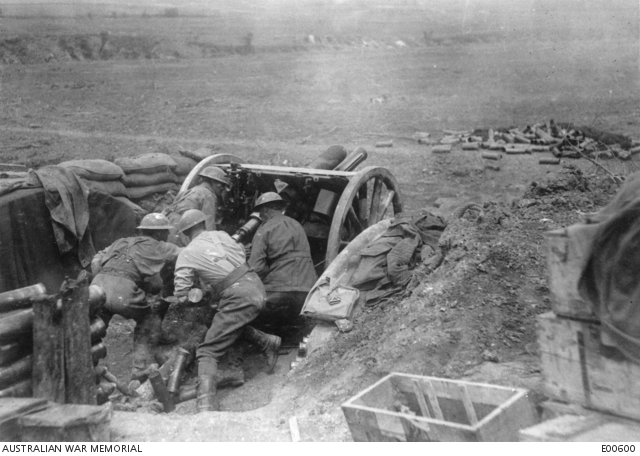
Four members of the Australian Field Artillery using an 18 pounder gun in action at Noreuil Valley, during the fight for Bullecourt
Australian commanders were deeply apprehensive about the British planning for these attacks, fearing their men would be left vulnerable. General John Monash later wrote:
“Our men are being put into the hottest fighting and are being sacrificed in hair-brained ventures, like Bullecourt and Passchendaele …”
The First Battle began disastrously. Tanks failed to arrive on time, leaving the infantry exposed to devastating machine gun fire. Though they breached parts of the German line, nearly a third were killed or wounded, and over 1,100 taken prisoner. Less than a month later, the Second Battle commenced on 3 May. This time, Australian and British troops attacked together under relentless artillery bombardment and counter-attacks. The Australians succeeded in capturing parts of the Hindenburg Line, but the cost was immense: 7,000 casualties. The losses were so severe that plans for a new 6th Division were abandoned to provide reinforcements for shattered units. It was during these savage days that Simon, serving with the 58th Battalion, was killed in action on 11 May 1917, aged 40. Multiple witness reports describe his death.
Lieutenant L. Davis wrote:
“Lieut Fraser was a platoon commander in my Company and was killed in action at Bullecourt during an exceptionally heavy bombardment of our lines by the enemy artillery. Death was instantaneous… his death was deeply regretted by all ranks who knew him for his conduct and personal example both in and out of the line.”
2422 Corporal Charles G. Grandin recorded:
“Pte James, a battalion runner of the 58th, told me that Lt. Fraser was blown to pieces in the trench before the attack. He was only recognised by his signet ring.”
3002 Private Ruston G Stephenson similarly reported:
“He was killed at Bullecourt by a shell which landed right on the parapet. It wounded quite a number of men besides killing and burying some amongst which was Lieut. Fraser. We tried to unearth him but could not on account of the barrage. We only found his arm which was identified by Lieut. Davis as belonging to him by a ring which was on one of the fingers.”
2916 Private Leo J. Kehoe confirmed:
“Lieut. Fraser was killed instantly by a shell, while in the front line, about half a mile east of Bullecourt. It was impossible to bury him. He was my platoon officer, so I knew him quite well.”
Finally, 1937 Private Thomas J. Hewitt stated:
“2nd Lieut. Fraser was blown to pieces on the 11th of May in the evening after dark in the Hindenburg line just to the right of Bullecourt. I saw one of his arms just afterwards but do not know what had happened to the rest of him as a lot of earth had been thrown over the place, nor do I know whether he was afterwards found and buried.”
These reports confirm that Simon’s death was instantaneous, caused by a direct shell hit that killed him and others in his platoon. His body was never recovered, and he has no known grave.
After the Battle
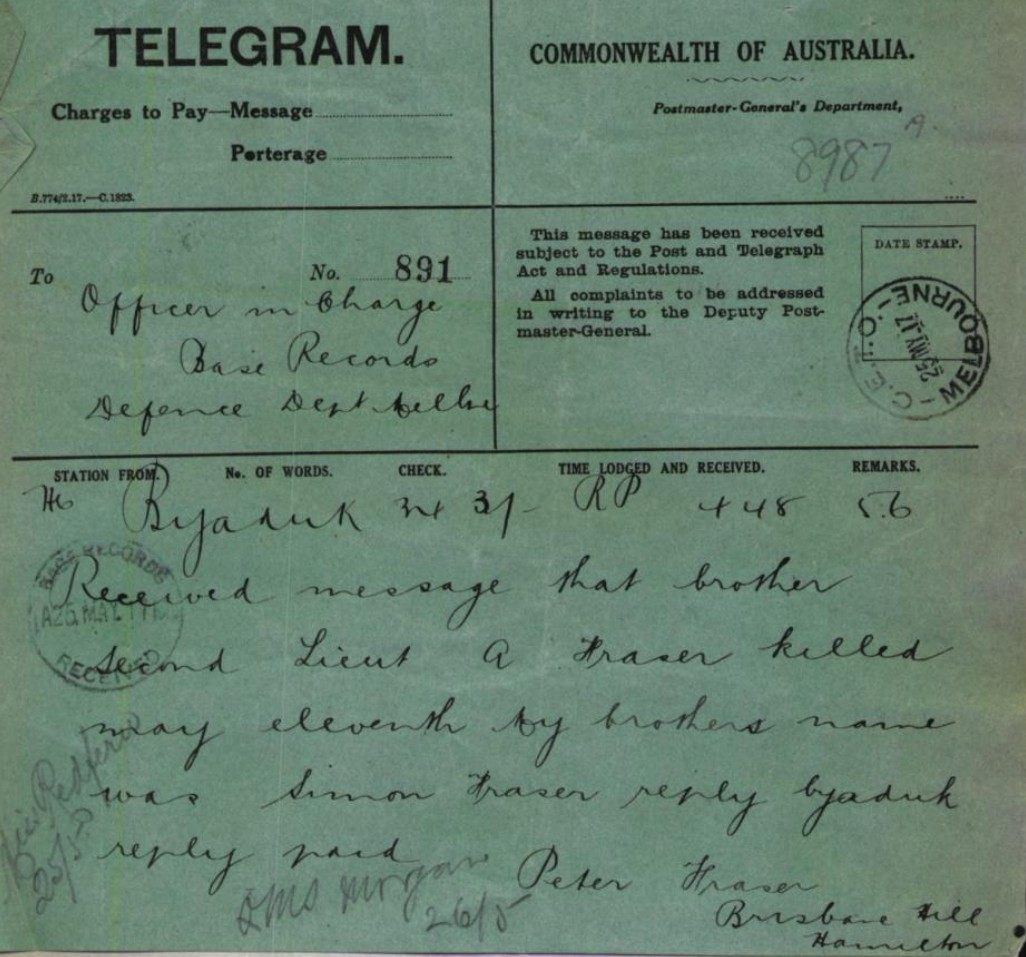
Following his death at Bullecourt on 11 May 1917, Simon Fraser’s body was never recovered. Multiple witness reports confirmed he was killed instantly by a direct shell hit during exceptionally heavy artillery bombardment. Although he was temporarily identified by his signet ring, the chaos of battle and continuing enemy fire prevented recovery or burial.
Telegram sent by his brother
sourceNAA: B2455, FRASER Simon – First AIF Personnel Dossiers 1914–1920
Simon has no known grave and is commemorated on the:
Villers-Bretonneux Memorial, France
Australian War Memorial Roll of Honour, Canberra (Panel 167)
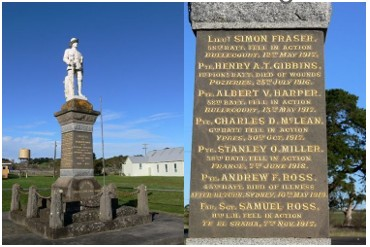
Byaduk War Memorial, Victoria
Byaduk Pictorial Honour Roll, Victoria
Cobbers Memorial, Australian Memorial Park, Fromelles, France
Cobbers Sculpture, Shrine of Remembrance, Melbourne
Simon Fraser’s death was deeply mourned in his home community of Byaduk and beyond. He was remembered not only as a brave soldier but as a man of great character and public spirit. The Hamilton Spectator described the impact of his loss:
“Lieutenant Fraser was held in the very highest esteem by everyone with whom he came in contact, and was recognised as a straightforward and broadminded man, who was always ready to do a good turn for anybody, and such a man any community can ill afford to lose.”
Cobbers Memorial – Remembering Simon Fraser
Simon Fraser’s bravery and compassion at Fromelles are immortalised in the Cobbers Memorial sculptures, which depict his famous rescue of a wounded man from No Man’s Land after the battle. The original “Cobbers” statue stands at the Australian Memorial Park near Fromelles, France. Created by sculptor Peter Corlett, it portrays Simon carrying a wounded soldier over his shoulders, inspired by his words “One foggy morning… we could hear someone over towards the German entanglements calling for a stretcher-bearer. It was an appeal no man could stand against… Then another man about 30 yards out sang out ‘Don’t forget me, cobber.’ I went in and got four volunteers with stretchers, and we got both men in safely.”
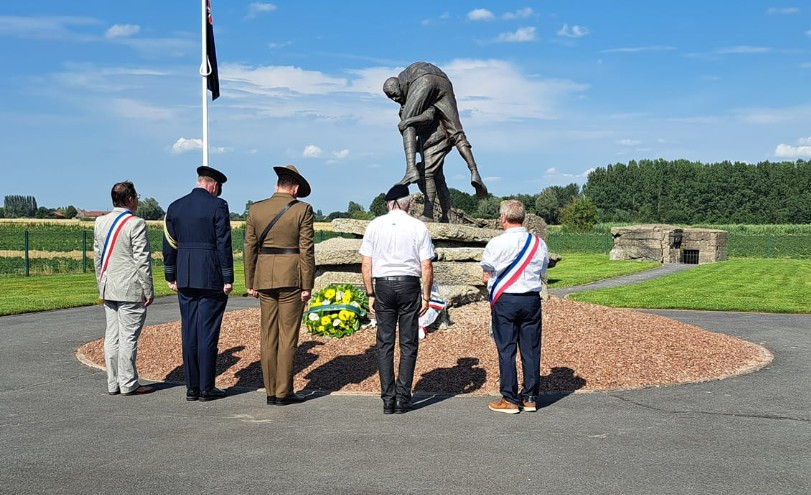
Source- Hamilton Spectator, 30 Sep 1916, p.8.http://nla.gov.au/nla.news-article133708493Each year on 19 July, a small ceremony is held at the Fromelles site to honour those who fought in the battle.
July 19th 2024 Ceremony at the Cobber’s statue.
sourceJames Smith, Fromelles Association
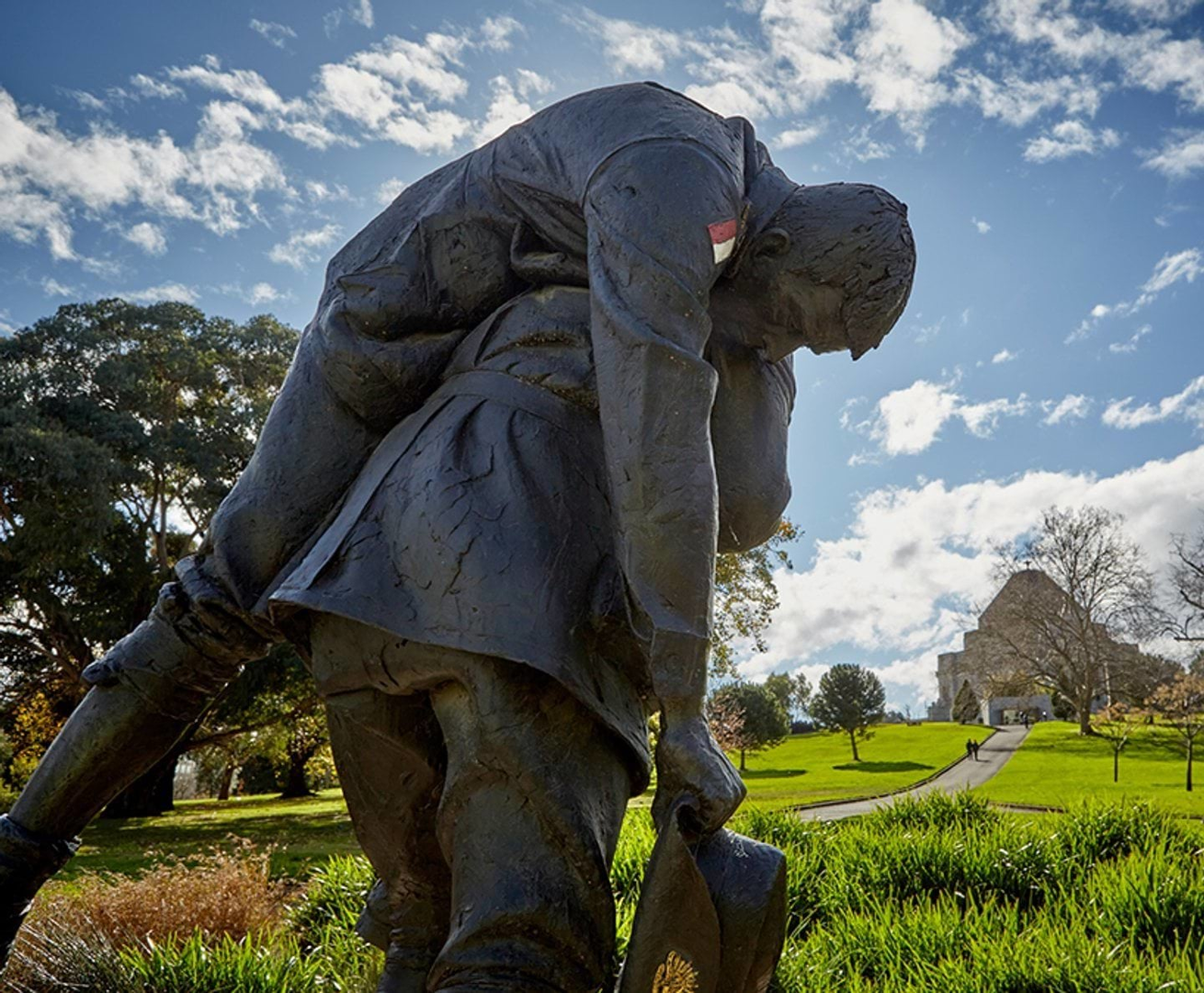
A second cast of the statue was later installed at the Shrine of Remembrance in Melbourne. During the casting process, family members placed pieces of barbed wire recovered from the Fromelles battlefield into the molten bronze, creating a powerful physical and symbolic connection between the sculpture, the battlefield, and families back home. At the Melbourne Cobbers statue, the Friends of the 15th Brigade hold a commemorative service each year on 19 July to mark the Battle of Fromelles.
The copy of the statue at Melbourne Shrine of Remembrance Cobbers 2008. Sculptor: Peter Corlett. Bronze cast by Meridian Sculpture Founders.
His name is forever linked to the words “Don’t forget me, cobber,” immortalised in Peter Corlett’s sculpture depicting Simon rescuing a wounded man from No Man’s Land. The memorial stands as a tribute to his courage, compassion, and the enduring spirit of mateship he embodied – reminding Australians of the true cost of war and the unbreakable bonds between soldiers.
The Fromelles Association would love to hear from you
Contacts
The Fromelles Association welcomes all contact regarding this soldier.
(Contact: carla@fromelles.info or geoffrey@fromelles.info).
We also urge any family members to contact and register with the Australian Army
(Contact: army.uwc@defence.gov.au or phone 1800 019 090).
Donations
The Fromelles Association maintains this web site, purely by donations received. If you are able, please contribute to the upkeep of this resource.
(Contact: bill@fromelles.info ).