Mystery Men of Fromelles
More than a century after the Battle of Fromelles, some of the men who may lie among the remaining unidentified soldiers recovered from Pheasant Wood are still waiting to have their identities restored.
For many of these soldiers, we know their names, their service and something of their lives. What we do not yet have are the suitable family DNA donors needed to determine whether they are among those still unidentified.
These are our Mystery Men of Fromelles.
The Fromelles Association of Australia is searching for their families in Australia and around the world. A single family connection could provide the DNA needed to help restore a soldier's identity.
Can you help us find their families?
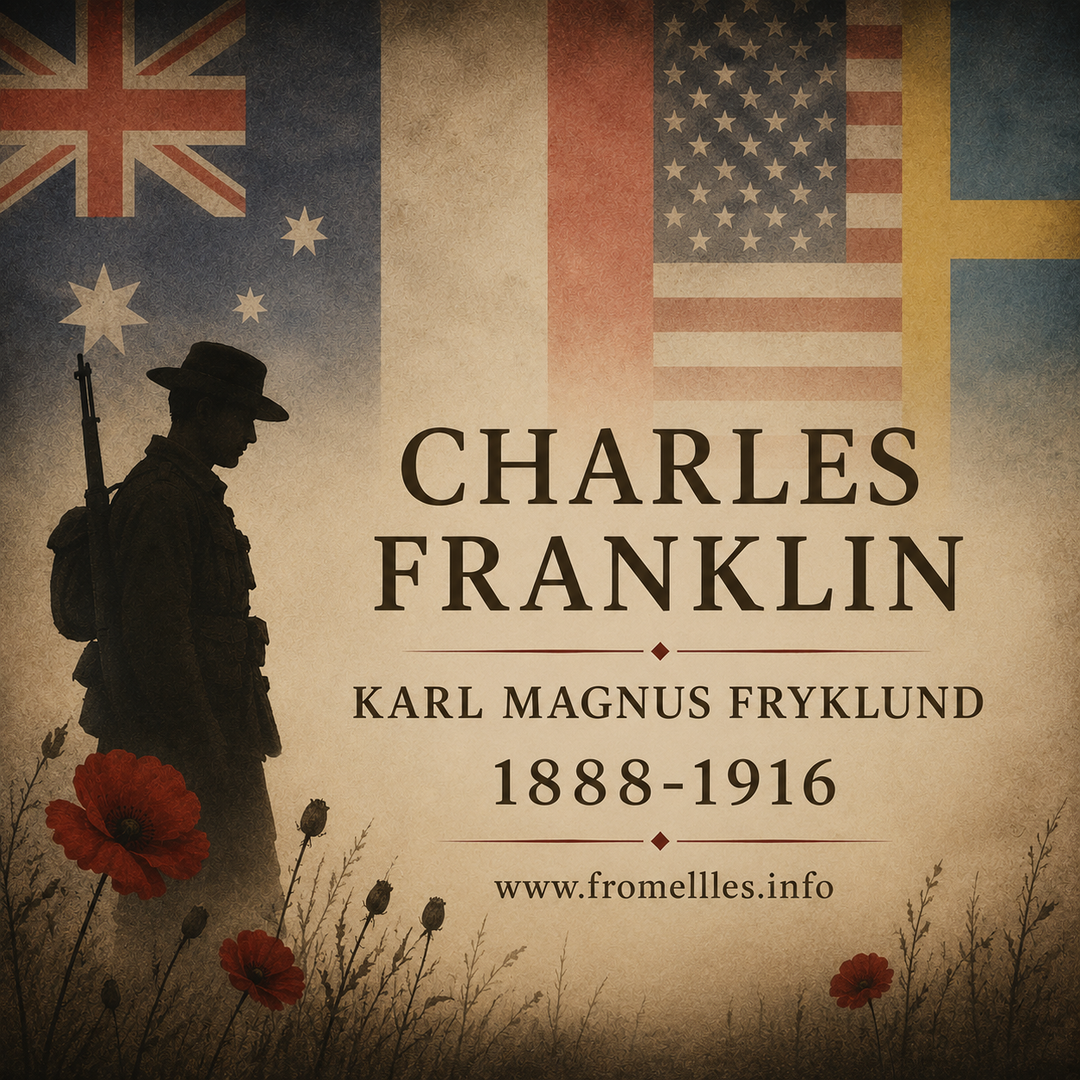
Charles Magnus Franklin
Born Karl Magnus Fryklund
Born in Sweden and raised in the United States, Charles came to Australia and enlisted in the AIF. Serving with the 55th Battalion, he was killed at the Battle of Fromelles on 20 July 1916. He has no known grave.
We have been unable to find suitable DNA donors for Charles. We are searching for relatives in Sweden, Finland and the USA who may be able to help identify him, particularly those connected to the Fryklund, Kangas or Hoglund families.
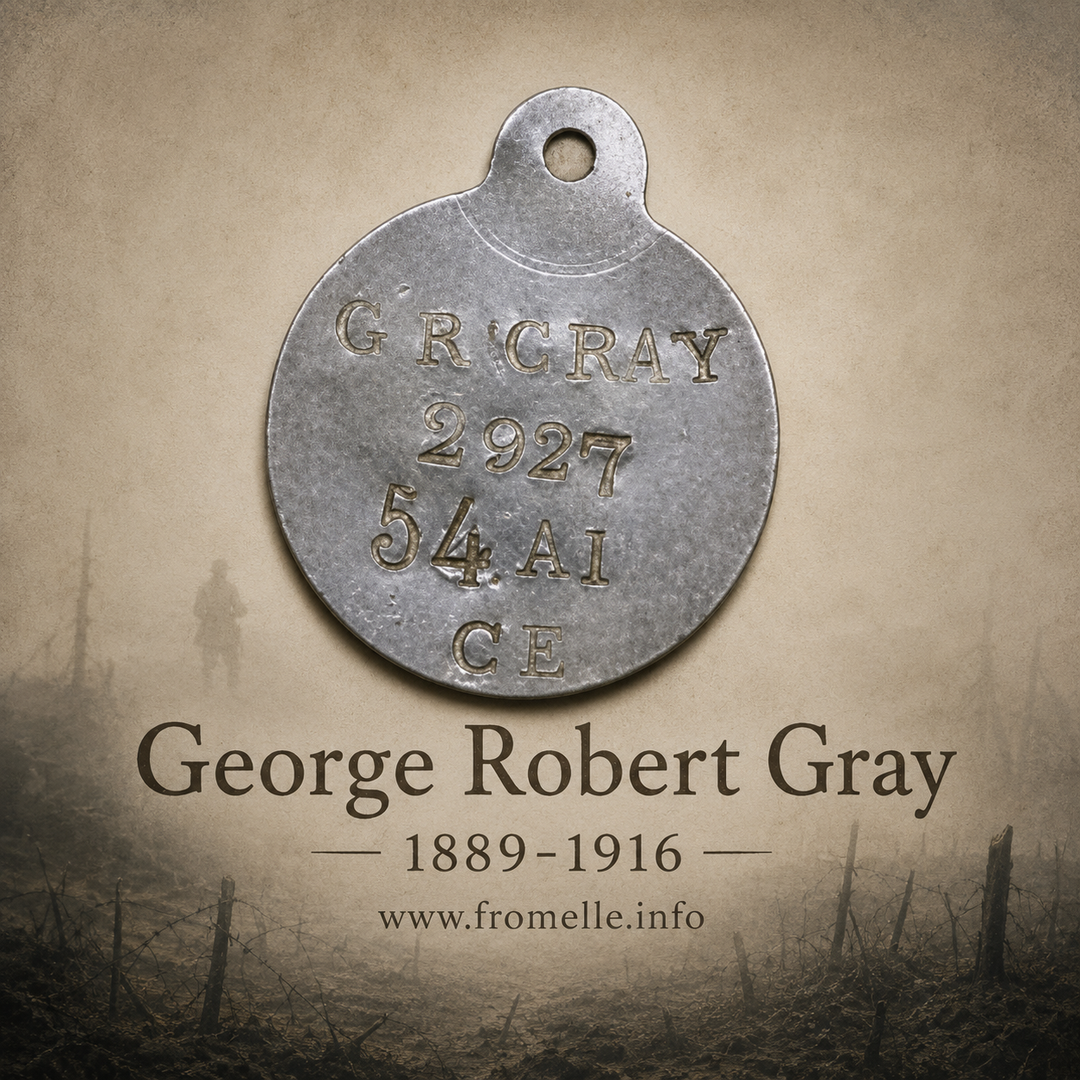
George Robert Gray
George enlisted in Sydney in 1915, giving his father as Charles Gray of Bexley. Serving with the 54th Battalion, George survived the initial assault at Fromelles and reached the German trenches. Evidence suggests he was captured during the fighting but died shortly afterwards in German hands. His identification tag was later returned by the Germans, but his body has never been identified and he has no known grave.
Despite years of research, we have been unable to conclusively trace George's birth or establish his family. Even after the war, the Army and Public Trustee were unable to locate his father. Was George Robert Gray his real name, or is there a family connection still waiting to be discovered?
We are searching for anyone who may know more about George Robert Gray or Charles Gray of Bexley, Sydney, and for relatives who may help us uncover George's identity and family.
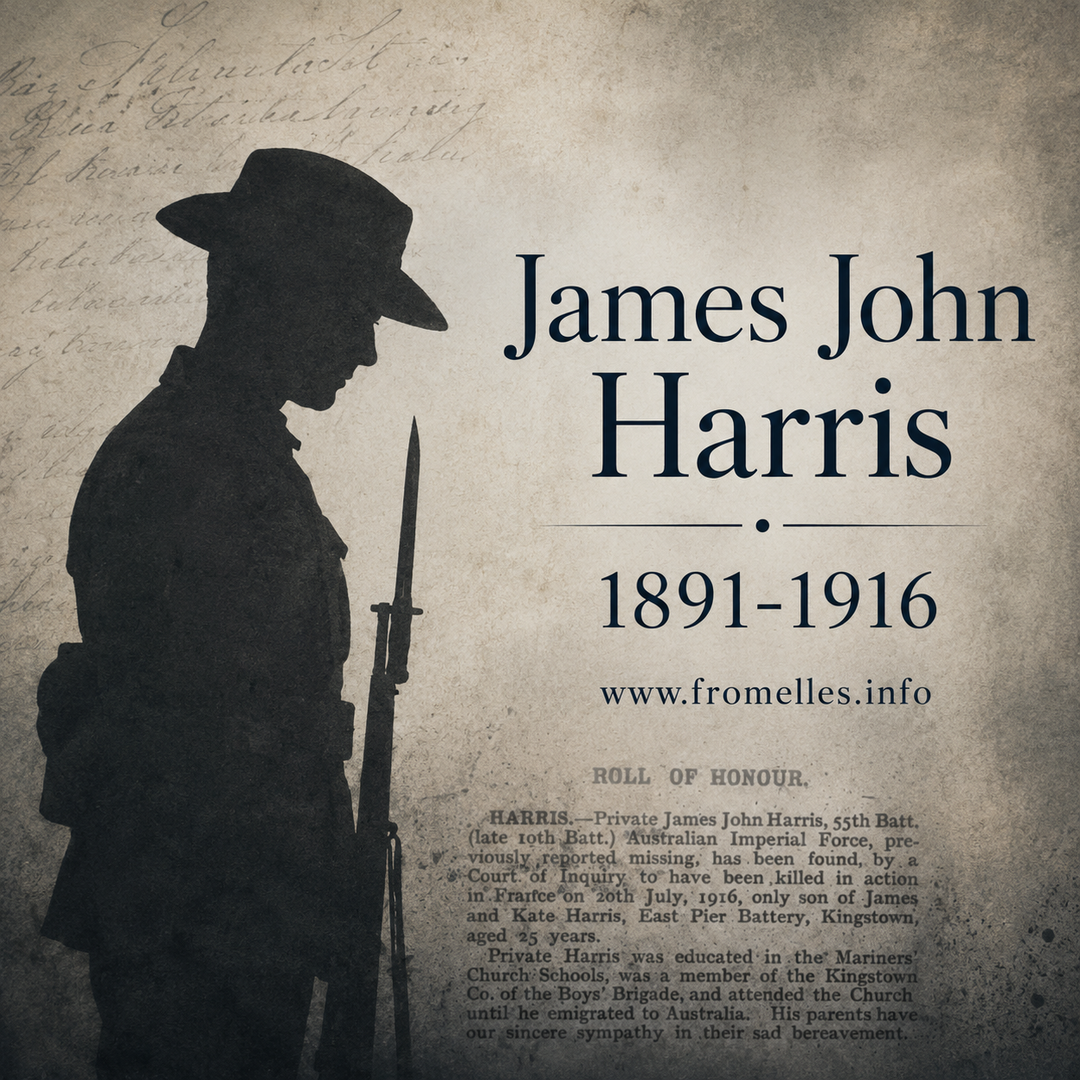
James John Harris
James John Harris was born in Kingstown, now Dún Laoghaire, County Dublin, Ireland, in 1891. He emigrated to Australia in 1911 and was working as a farm hand before enlisting in November 1915. Serving with the 55th Battalion, James was killed during the Battle of Fromelles on 20 July 1916, aged just 25. His name later appeared on a German Death List, raising the possibility that he may have been buried at Pheasant Wood. He has no known grave.
For years, we have searched for James's family in the hope of finding a suitable DNA donor, but every potential path has led to a brick wall. We have been unable to trace living relatives through the direct paternal line needed for Y-DNA or the direct maternal line needed for mitochondrial DNA. As we move further back through the generations, even the identities of some of James's supposed ancestors become uncertain.
We are searching for anyone with a family connection to James John Harris, the Harris family of Kingstown or Dún Laoghaire, or the Smith family of County Wicklow who may be able to help solve the mystery.
Arthur Mossop James
Born in Chelsea, London, Arthur Mossop James travelled first to Canada and then to Australia, where he was working as a clerk when he enlisted in 1915. He served with the 30th Battalion and was killed during the Battle of Fromelles on 20 July 1916, aged 28. His body was never recovered, although his identification disc was later returned by the Germans.
Arthur's family history has created a difficult DNA mystery. He was an only child, his father is unknown, and tracing his maternal line has required research back to the 1700s. Could his middle name, Mossop, hold a clue to his father's identity?
We are searching for relatives who may be able to help provide the DNA needed to identify Arthur if his remains are among the unidentified soldiers recovered at Pheasant Wood.
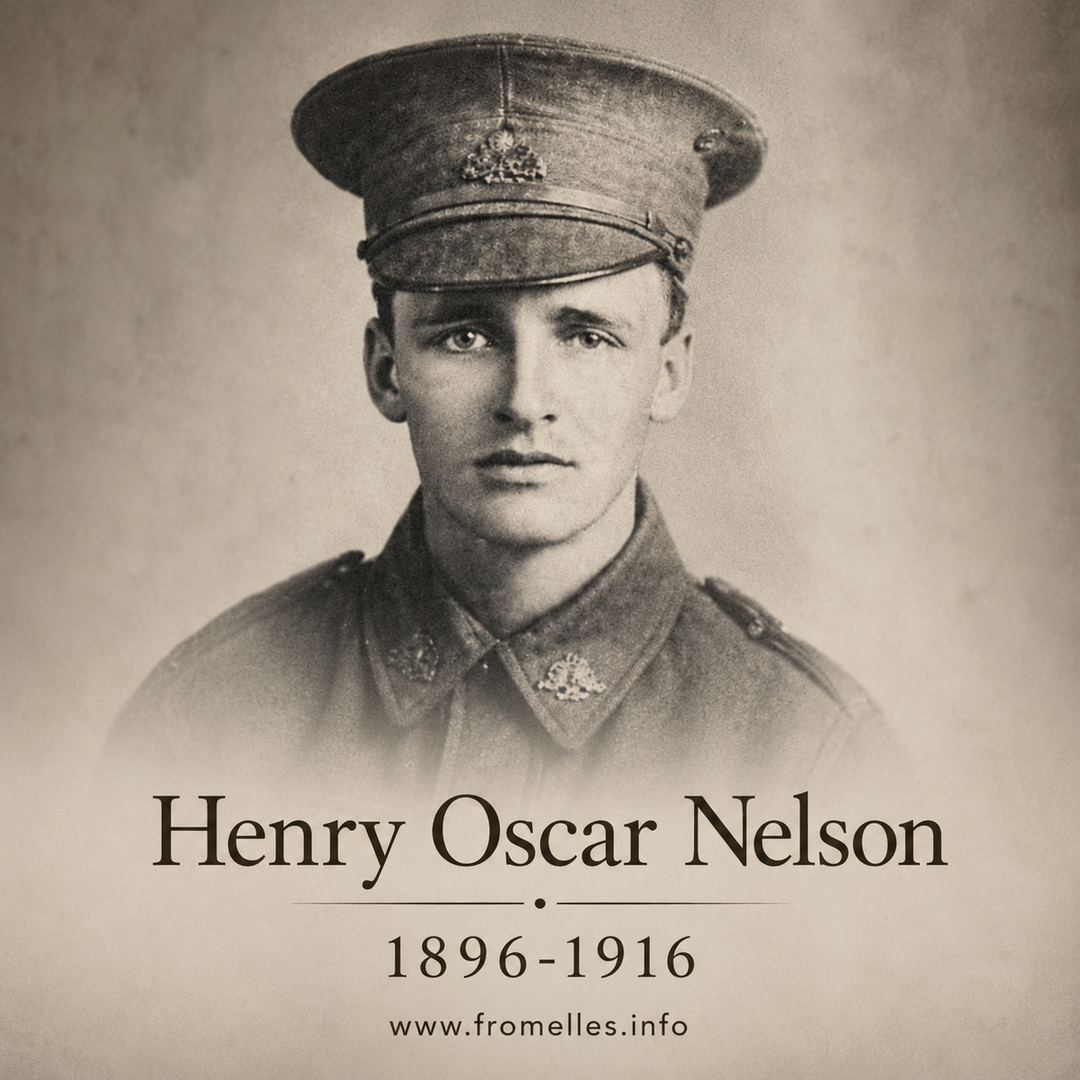
Henry Oscar Nelson
Born in Wellington, New Zealand, Henry Oscar Nelson was just 19 when he enlisted in Australia alongside his older brother Frederick. The brothers were given consecutive service numbers, Henry 728 and Frederick 727, and served together with the 30th Battalion.
On 20 July 1916, Henry was killed during the Battle of Fromelles. Frederick was wounded. Henry was initially listed as missing, but his name later appeared on a German death list and his identity disc was returned. His body was never identified, and today he has no known grave. Henry may be one of the unidentified Australian soldiers recovered from the mass grave at Pheasant Wood.
For years, researchers have searched across Australia, New Zealand, Sweden and Ireland, trying to unravel Henry's family history and locate the DNA donors who could help determine whether he is among the remaining unidentified soldiers. The search has reached numerous dead ends, particularly surrounding the true identity and Swedish origins of Henry's father, Martin Nelson.
We are searching for anyone connected to the Nelson, McCracken, Symonds or Jackson families, or who believes they may be related to Henry's family in Sweden, Ireland, New Zealand or Australia.
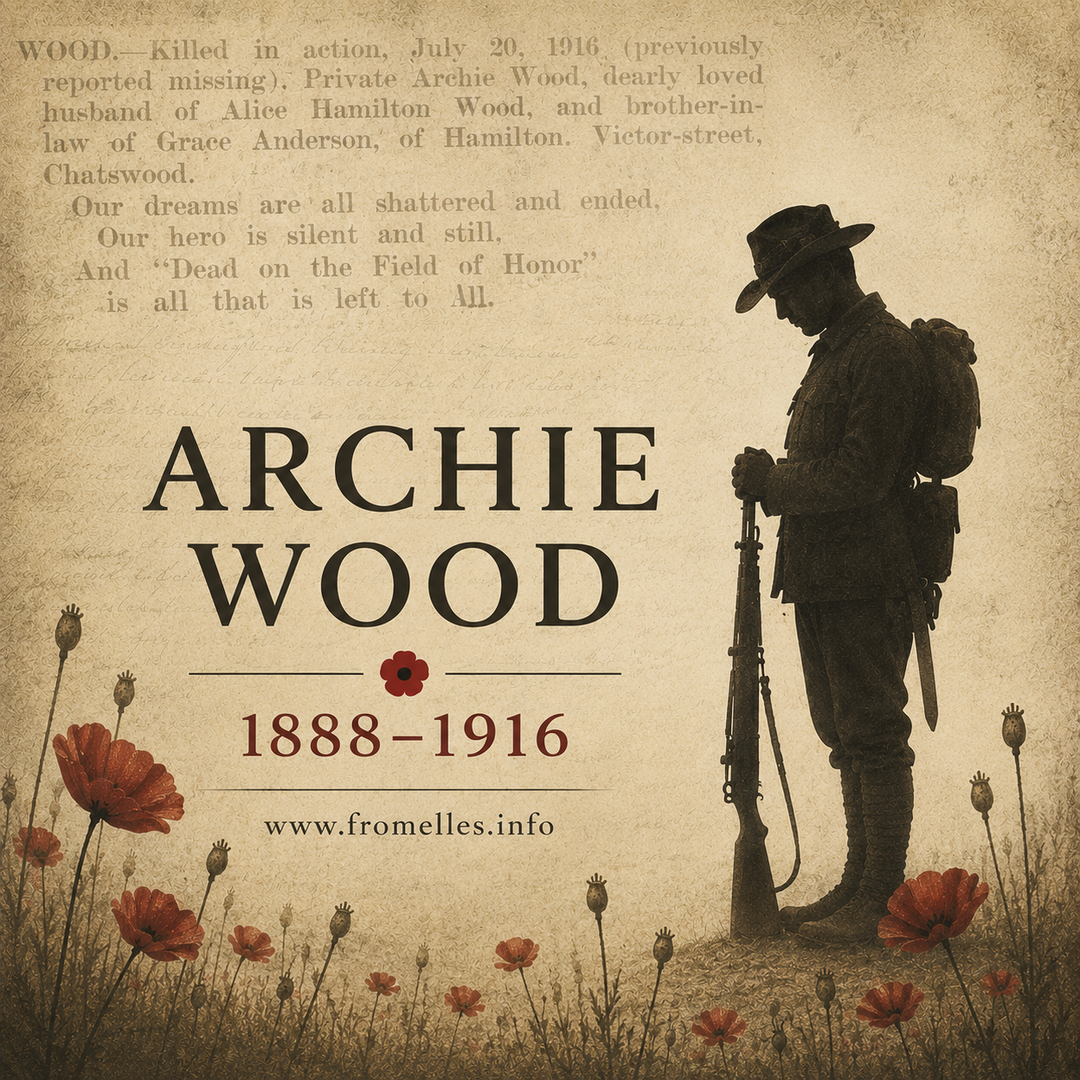
Archie Wood
Born in Melbourne, Archie Wood enlisted in the AIF in July 1915. Serving with the 30th Battalion, he was killed at the Battle of Fromelles on 20 July 1916. He has no known grave.
Despite extensive research, we have been unable to trace Archie's family. His records name his parents as Edward William Wood and Annie Perry, while his original next of kin was an unnamed aunt connected with Inglewood, Queensland. Archie married Alice Hamilton Anderson shortly before leaving Australia, but the couple had no children.
We are searching for relatives of the Wood or Perry families who may be able to help identify him.
Could you be the connection we are looking for?
You do not need to share a soldier's surname to be related. Family connections can extend through daughters, sisters, cousins and generations of marriage and migration.
If you recognise a name, family or location in any of these stories, please contact the Fromelles Association of Australia.