Frederick DALE
Eyes brown, Hair dark brown, Complexion medium fair
Frederick Dale – Presumed Buried in No-Man’s Land
Can you help us identify Fred?
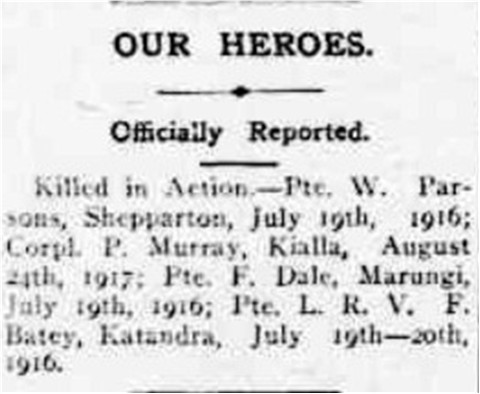
Frederick Dale’s body was never found after the Battle of Fromelles and there are no records of his burial.
A mass grave was found in 2008 at Fromelles, a grave the Germans dug for 250 Australian soldiers they recovered after the battle. As of 2024, 180 of these soldiers have been able to be identified via DNA testing.
Fred may be among the remaining 70 unidentified men. There is still a chance to identify him — but we need help. We welcome all branches of his family to come forward to donate DNA to help with his identification, especially those with roots Hobart, Tasmania and areas around Melbourne, Victoria.
See the DNA box at the end of the story for what we do know about his family.
If you know anything of contacts for Fred, please contact the Fromelles Association.
Early Life - A blended family under a grandmother’s care
James Frederick (Fred) Dale was born on 9 July 1896 at the Carlton Women’s Hospital, Victoria. His mother was Ellen Bridget Jones/Dale, but there is no formal record of his father. Fred’s grandmother was Mary Ann (nee Bishop). Mary Ann and her first husband, John Jones had four children, Ellen was the second. However, John died in 1883 and Mary Ann married Thomas Dale in 1885. They had ten children – a combined Dale/Jones household of fourteen children. Given the number of children Mary Ann and Thomas had, some of Fred’s uncles and aunts were about the same age as Fred.
Ellen was 20 when Fred was born. Four years later, she married Thomas Elsegood, of Mernda, Victoria. With Fred well ensconced in his grandmother’s large family by that time, he remained in their care of his grandmother after Ellen married. Mary Ann repeatedly referred to Fred as her son in later records and memorials. Ellen and Thomas had two children, Thomas Stewart and Edith Florence. Ellen died during the childbirth of their third child, despite an operation to save her. It was described as “A Hopeless Case” in the local papers.
Source - "A HOPELESS CASE." (1909, April 14). The Argus (Melbourne, Vic. : 1848 - 1957), p. 6. http://nla.gov.au/nla.news-article10684811
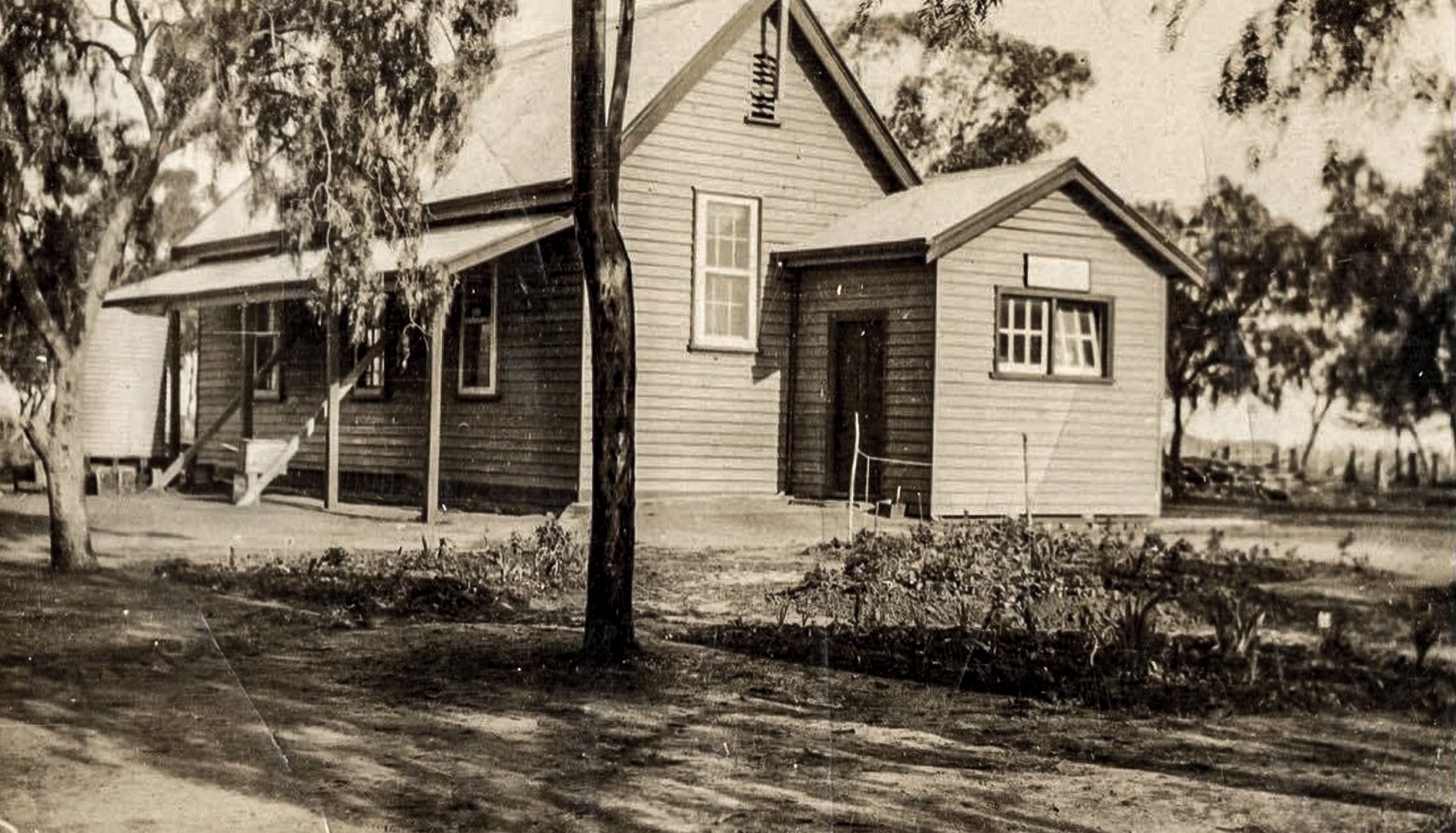
Fred attended State school and by his late teens, he was living and working as a labourer in northern Victoria. His address was listed as the Marungi Post Office, via Shepparton.
Off to War
Fred’s uncles (raised as his brothers), Thomas Donald “Doubledee” Dale and George Thomas Dale and several cousins served for Australia. Thomas was in the Boer War, a veteran of Thorneycroft’s Mounted Infantry and the Bushveldt Carbineers. He fought at Spion Kop, Laing’s Nek and the Relief of Ladysmith before enlisting for the AIF in 1917. He joined the 4th Light Horse Regiment in the Middle East. He survived the war and returnedto Australia in 1919 at the age of 38. George (5th Battalion) was killed in action during the landing at Gallipoli on 25 April 1915, aged 22.
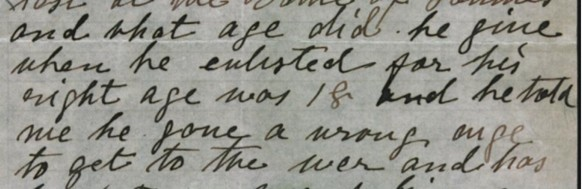
He was among the first Australians to land that morning and one of the earliest casualties of the campaign. George’s name is recorded at Plugge’s Plateau Cemetery, Gallipoli, and on the Australian War Memorial Roll of Honour, Panel 43. Even with George’s death at Gallipoli, Fred was keen to join the AIF, enlisting in Melbourne, Victoria on 20 July 1915. He did increase his age to 21 on his enlistment papers so as not to need parental permissions. He did tell his grandmother about this…after the fact.
He named his friend Henry Fletcher as next of kin, but this was changed later to be his grandmother Mary Ann. Fred was assigned to the 8th Battalion, 12th Reinforcements and after his initial military training, he embarked from Melbourne on 23 November 1915 aboard the HMAT A40 Ceramic, headed for Egypt. His grandmother Mary Ann did make a trip to Victoria to see Fred before he left. When Fred arrived in Egypt a ‘doubling of the AIF’ was underway as it expanded from two infantry divisions to five and there were major reorganisations in progress.
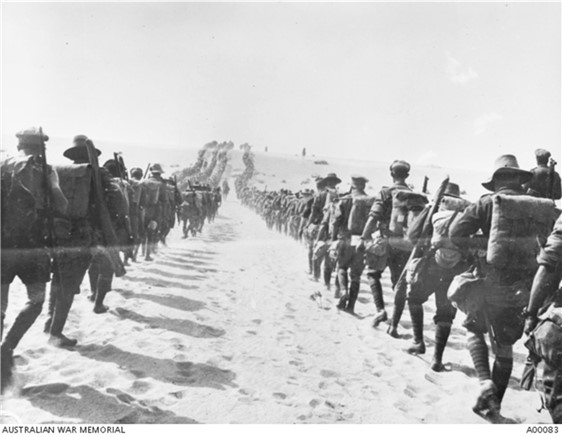
The 59th Battalion was raised in Egypt on 21 February 1916 at the 40,000-man training camp at Tel-el-Kebir, about 110 km northeast of Cairo. Approximately half of the new battalion came from the 7th Battalion Gallipoli veterans and the other half was reinforcements from Australia. The 59th was predominantly composed of men from rural Victoria. After a month of training at the large camp at Tel- el-Kebir, the 59th had a two+ day, 50 km march in thermometer-bursting heat across the Egyptian sands from Tel-el-Kebir to Ferry Post, near the Suez Canal. Prior to marching, only ½ pint of water per bottle was available. Source- AWM4 23/15/1 15th Brigade War Diaries Feb-Mar 1916 p 6.
A month later of continuing training and guarding the Suez Canal they were relieved and headed for the camp at Duntroon Plateau. Fred’s time in Egypt was not all work, however. A 5th Division Sports Championship was held on 14 June, which was won the by the 59th’s 15th Brigade. The very next day they began preparations for heading to the Western Front. Fred departed Egypt aboard the Kinfauns Castle on 18 June 1916. After a brief stop in Malta, he disembarked at 7.00 AM in Marseilles on 29 June and by 10.00 PM they were on a train headed for Steenbeque, 35 km from Fleurbaix in northern France, arriving on 2 July.
This area near Fleurbaix was known as the “Nursery Sector” – a supposedly relatively quiet area where inexperienced Allied troops could learn the harsh realities of Western Front trench warfare against the Germans. But the quiet times did not last long. Training continued, but with a higher sense of urgency, and it now included the use of gas masks and learning to deal with the effects of large shells. The move to the front continued and on 9 July they were in Sailly sur la Lys, just 1000 yards from the trenches. Fred entered the front-line trenches for the first time at 4.00 PM on 18 July 1916.
The Battle of Fromelles
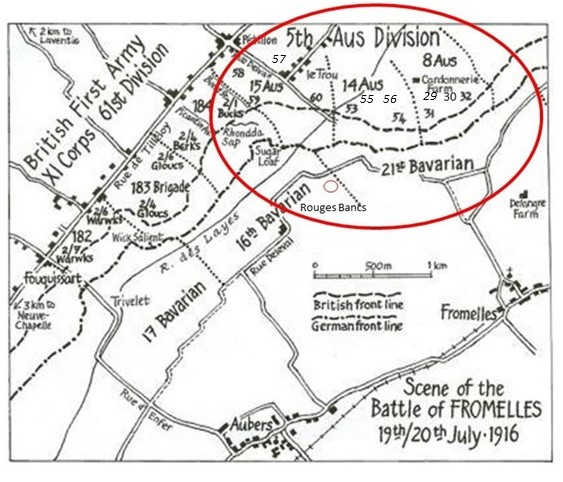
The battle plan had the 15th Brigade located just to the left of the British Army. The 59th and 60th Battalions were to be the lead units for this area of the attack, with the 58th and 57th as the ‘third and fourth’ battalions, in reserve. The main objective for the 15th Brigade was to take the trenches to the left of a heavily armed, elevated German defensive position, the ‘Sugar Loaf’, which dominated the front lines. If the Sugar Loaf could not be taken, the other battalions would be subjected to murderous enfilade fire from the machine-guns and counterattacks from that direction. As they advanced, they were to link up with the 60th battalion and the British on their flanks.
The main attack was planned for 17 July, but it was delayed due to bad weather. On 19 July, Zero Hour for advancing from their front-line trenches was to be 5.45 PM, but the Germans knew this attack was coming and were well-prepared. They opened a massive artillery bombardment on the Australians at 5.15 PM, causing chaos and many casualties. A fellow soldier, Bill Boyce (3022, 15th Brigade, 58th Bn), summed the situation up well, “What have I let myself in for?” Source - Australian War Memorial Collection C386815
Their attack on the German lines began at 5.45 PM on the 19th. The 59th went over their parapet in four waves at 5 minute intervals, but then laid down to wait for the support bombardment to end at 6 PM. A & B Companies were in the first two waves, and Fred’s C Company and D Company were in the third and fourth wave of the attack. They were attempting to advance across flat, open ground in broad daylight under full enemy observation. There was immediate and intense fire from rifles and the Sugar Loaf machine guns. As documented in the messages sent back to HQ just after the attacks began:
“cannot get on the trenches as they are full of the enemy”
“every man who rises is shot down”
“‘they were enfiladed by machine guns in the Sugar Loaf and melted away”
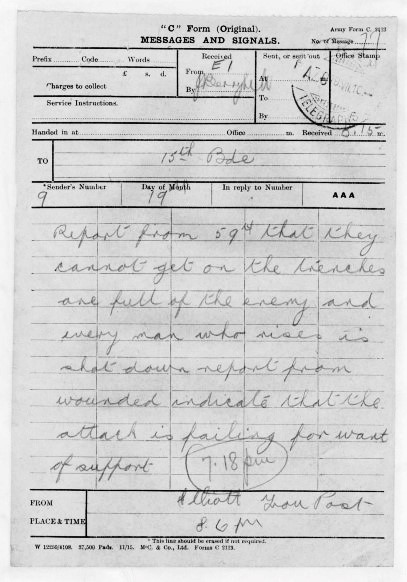

The British 184th Brigade just to the right of the 59th met with the same resistance, but at 8.00 PM they got orders that no further attacks would take place that night. However, the salient between the troops limited communications, leaving the Australians to continue without British support from their now exposed right flank. The official reports indicate advances against the Sugar Loaf fortification were limited, but individuals’ reports suggest that some did reach the German parapet. However, their gains were impossible to hold and with little support being available they had to drop back.
The attack was ended early on the morning of the 20th. At the 8.00 AM roll call, out of a battalion of about 1000 soldiers, 4 officers and 90 other ranks reported in. Fred did not report in. While there was no ceasefire following the battle, parties did go to No-Man’s Land to bring back wounded soldiers and over 200 were recovered on 20 July. To get some perspective of the battle, when Charles Bean, Australia’s official war historian, attended the battlefield two and half years later, he observed a large quantity of bones, torn uniforms and Australian kit still on the battlefield.
The initial toll reported for the 59th was 26 killed or died of wounds, 394 were wounded and 274 were missing – 694 soldiers. Ultimately, 334 soldiers were killed in action or died from their wounds from this battle. 239 of these soldiers were unidentified.
After the Battle
With the scale and the nature of the battle, the Army and Red Cross were busily searching for information on the missing, but there was nothing immediate to send to Fred’s family. His grandmother, Mary Ann Dale, waited anxiously for ANY news about her ‘son’, first writing on 11 September and then again in May 1917. The Army politely replied to her May letter, “I regret to state that although the overseas authorities are doing everything in their power to trace records of the Force reported missing, no further information has been received…”
Source - NAA, B2455 Frederick Dale page 34
With no witness records from the Army or Red Cross records and no reports of capture from the Germans, a Court of Enquiry held in the field on 29 August 1917 formally declared Fred’s fate as “Killed in Action, 19 July 1916.”
Source – NAA, B2455, Dale, page – First AIF Personnel Dossiers 1914–1920, p 30
Several years later, after things had sufficient time to settle down, the Army sent letters to families to see if there was anything that they might have come up that they could add. Mary Ann’s had gotten some information from a mate of Fred’s, confirming he was killed in the attack and buried where he fell / never found after the battle.
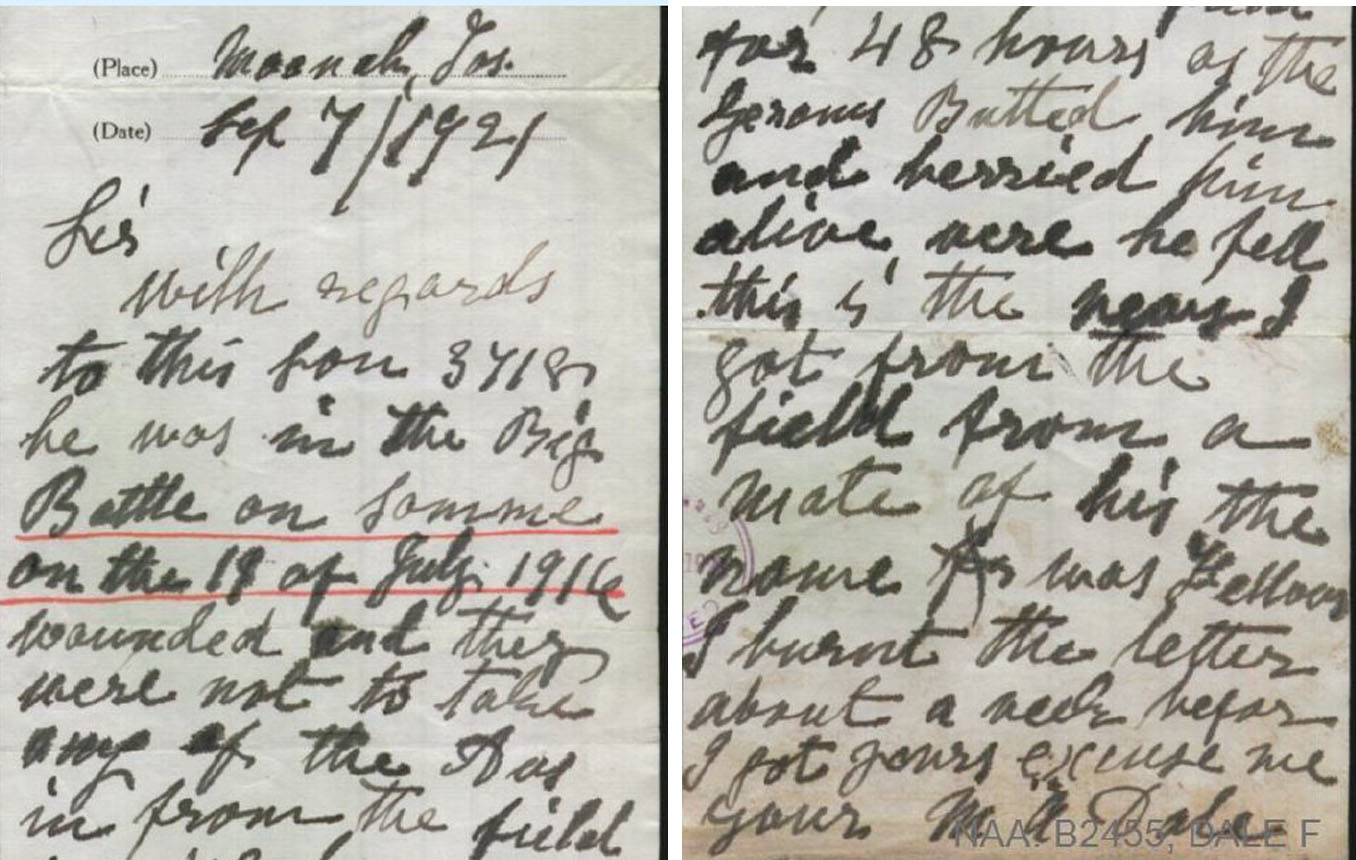
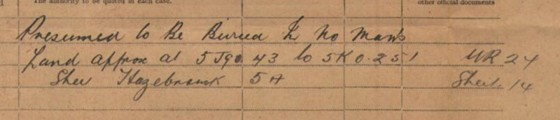
As she was still clearly upset two years about having lost both Fred and George, she ends her letter saying she had BURNED the letter with the information from Fred’s mate. While there is no record of a burial for Fred, his AIF file does include an undated and imprecise reference to him ‘’presumably being buried’. This is most likely a general recognition that he was among all the soldiers left in the chaos of No-Man’s-Land, as reported by Fred’s mate Fellows.
Family at War
The Dale family of Hobart and New Norfolk, Tasmania, gave more than most. Across two generations, at least four members of the same family served in overseas conflicts, and three never came home.
Private George Thomas Dale – Gallipoli
Fred’s uncle, Private George Thomas Dale (5th Battalion), was killed in action at Gallipoli on 25 April 1915, aged 22. He was among the first Australians to land that morning and one of the earliest casualties of the campaign. George’s name is recorded at Plugge’s Plateau Cemetery, Gallipoli, and on the Australian War Memorial Roll of Honour, Panel 43.
Private Clarence Dale – Royal Navy
Another of Fred’s uncles, Clarence Dale, served in the Royal Navy during the First World War. Family records and newspaper notices report that he was killed in the North Sea, likely during the early naval engagements of the war. His name appeared alongside those of George and Fred in later memoriam notices that mourned “three brothers who made the great sacrifice.” Although there is reports he survived and moved to America.
Corporal Thomas Donald “Doubledee” Dale
Boer War verteran. The eldest of the Dale brothers, Thomas Donald “Doubledee” Dale, had already served in the Boer War before re-enlisting for the AIF in 1917 as part of the 4th Light Horse Regiment.
Remembering Fred
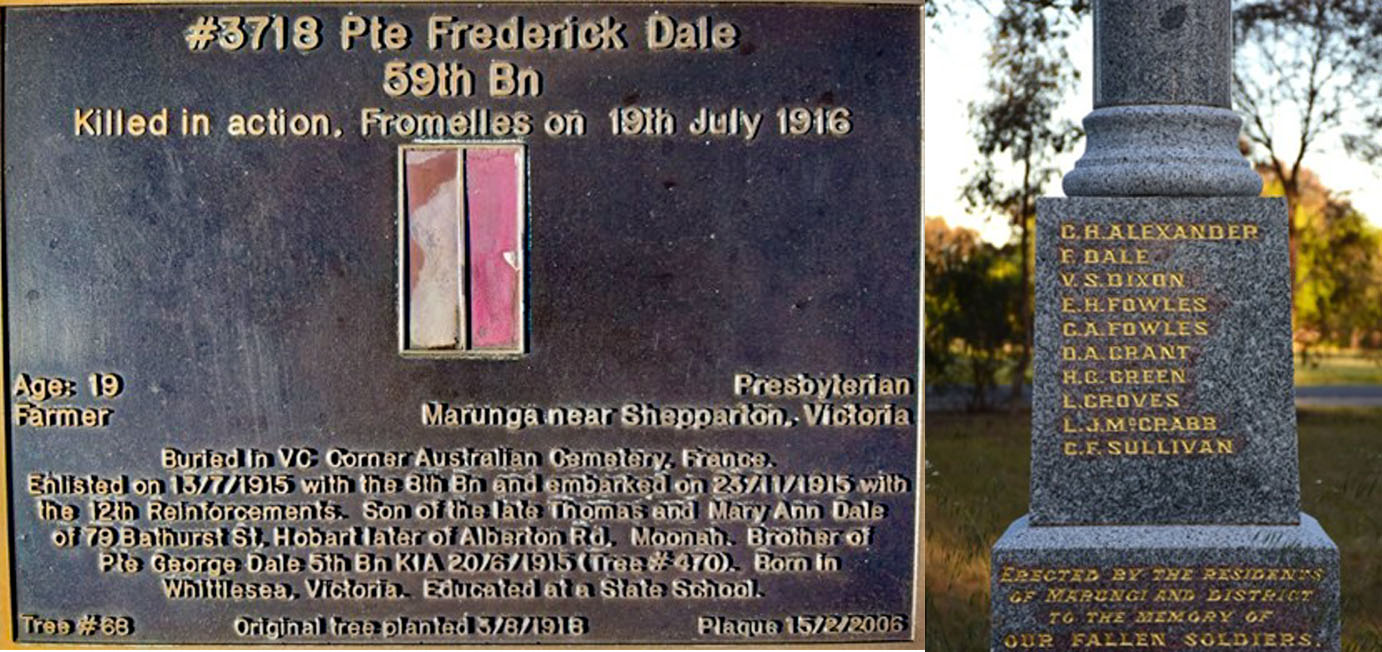
Fred was awarded the 1914–15 Star, the British War Medal and the Victory Medal and a Memorial Plaque and a Memorial Scroll, which were issued to his ‘mother’ Mary Ann. Fred is commemorated at:
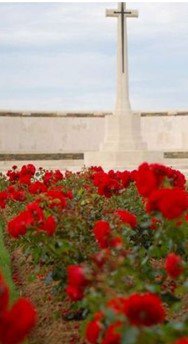
- V.C. Corner Australian Cemetery and Memorial, Fromelles, France (Panel 16)
- Australian War Memorial, Canberra (Panel 167)
- Marungi War Memorial, Victoria
- The Soldiers’ Avenue of Honour, Hobart, Tasmania (Tree 68)
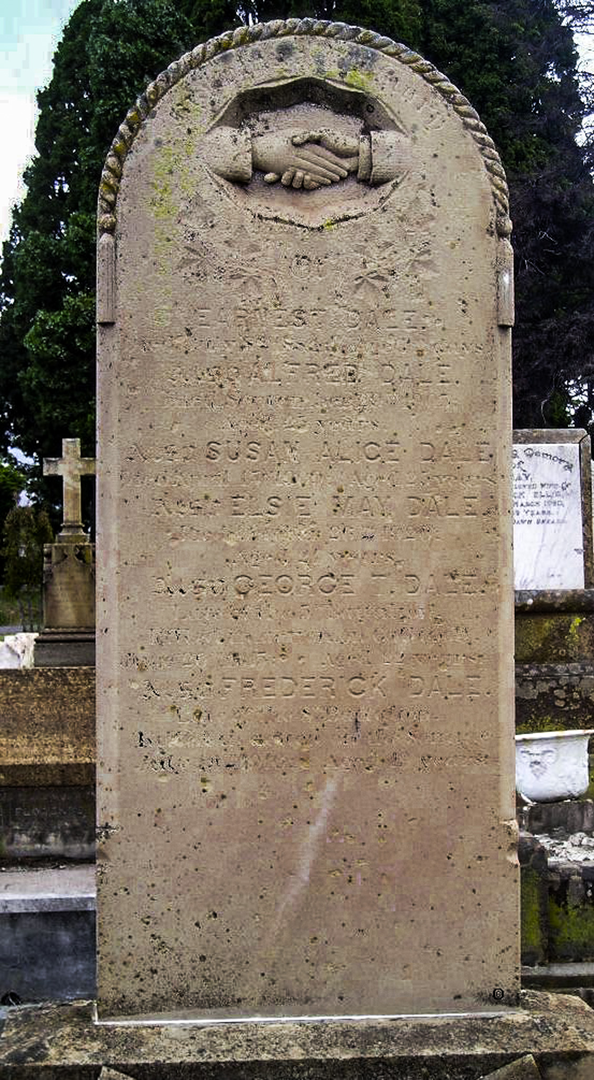
An In Memoriam notice published in The Mercury (Hobart) in 1918 captures the enduring grief of the loss of two of Mary Ann’s sons:
“In loving memory of Private G. T. Dale, killed Gallipoli June 28, 1915… Also killed in action, France, Private F. J. Dale, July 19, 1916, loving brother of May Dale, and grandson of the above.
Immaculate heart of Mary,Your prayers for them extol;O Sacred Heart of Jesus,Have mercy on their souls.”`
(note - May Dale is Fred’s Aunt Elsie May, two years younger than Fred.)
Finding Fred
Fred’s remains were not recovered, he has no known grave. After the battle, the Germans recovered 250 Australian soldiers and placed them in a burial pit at Pheasant Wood. This grave was discovered in 2008 and since then efforts have been underway to identify these soldiers by DNA testing from family members. As of 2024, 180 of the soldiers have been identified, including one of the 239 unidentified soldiers from the 59th Battalion.
We welcome all branches of Fred’s family to come forward to donate DNA to help with his identification, particularly those from Hobart, Tasmania and areas around Melbourne and Shepparton, Victoria. If you know anything of family contacts, please contact the Fromelles Association. We hope that one day Fred will be named and honoured with a known grave.
Please visit Fromelles.info to follow the ongoing identification project and Fred’ story.
DNA samples are being sought for family connections to
| Soldier | Frederick Dale (1896–1916) |
| Parents | Ellen Bridget nee Jones (known as Dale) (1876–1909), b New Norfolk, Tasmania, d East Melbourne. Father – not on records. Ellen married Thomas Elsegood in 1900 |
| Siblings | (half sibling) Edith Florence Elsegood (1904–1987) buried as Edith Florence Bonsor – married 1. Charles George Bonsor, 2. George Joseph Crowley/West |
| Grandparents | ||||
| Paternal | Unknown | |||
| Maternal | John Jones (1848-1883) b Tasmania and Mary Ann Bishop (1856–1943), b Tasmania, d Moonah, Tasmania. They had 4 children. Mary Ann then married Thomas Dale (1834-1915) and they had 10 children |
The Fromelles Association would love to hear from you

Contacts
(Contact: carla@fromelles.info or geoffrey@fromelles.info).
(Contact: army.uwc@defence.gov.au or phone 1800 019 090).
Donations
If you are able, please contribute to the upkeep of this resource.
(Contact: bill@fromelles.info ).