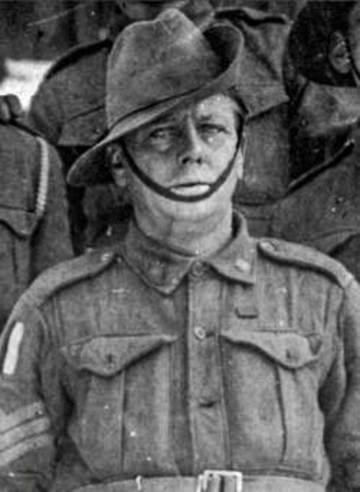
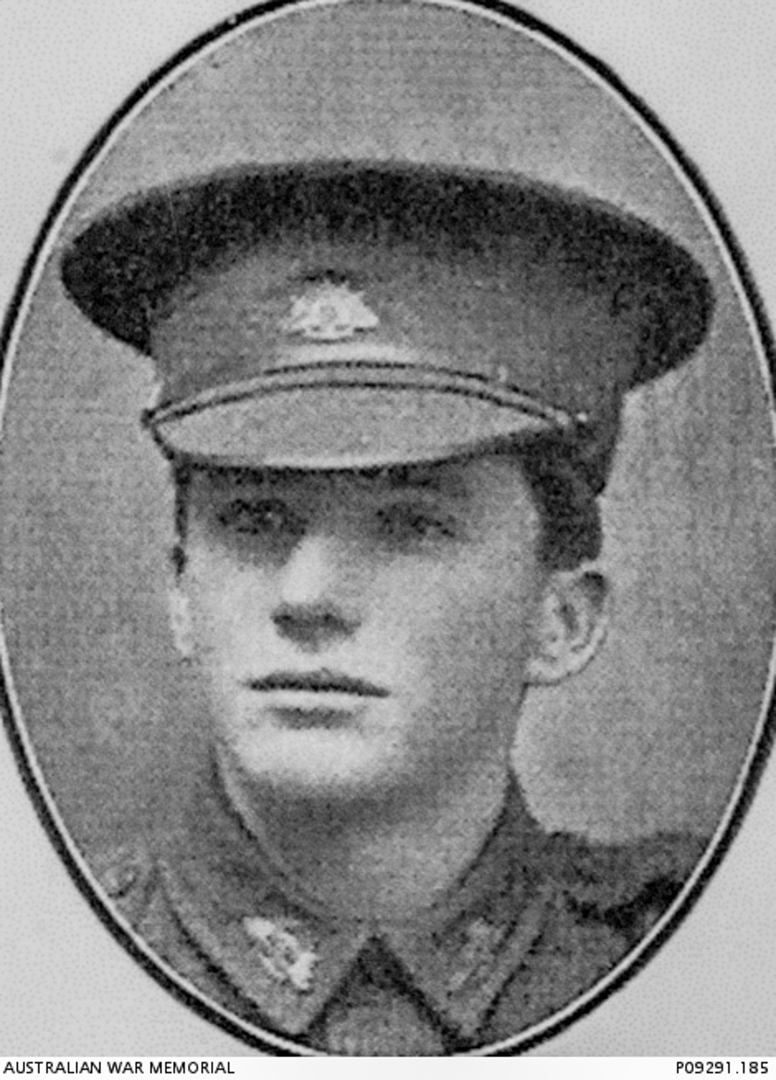
Arthur William Edgar ERRINGTON
Eyes grey, Hair brown, Complexion fair
Sergeant Arthur William Edgar Errington – A Veteran of Two Wars and a Recipient of the US DSC
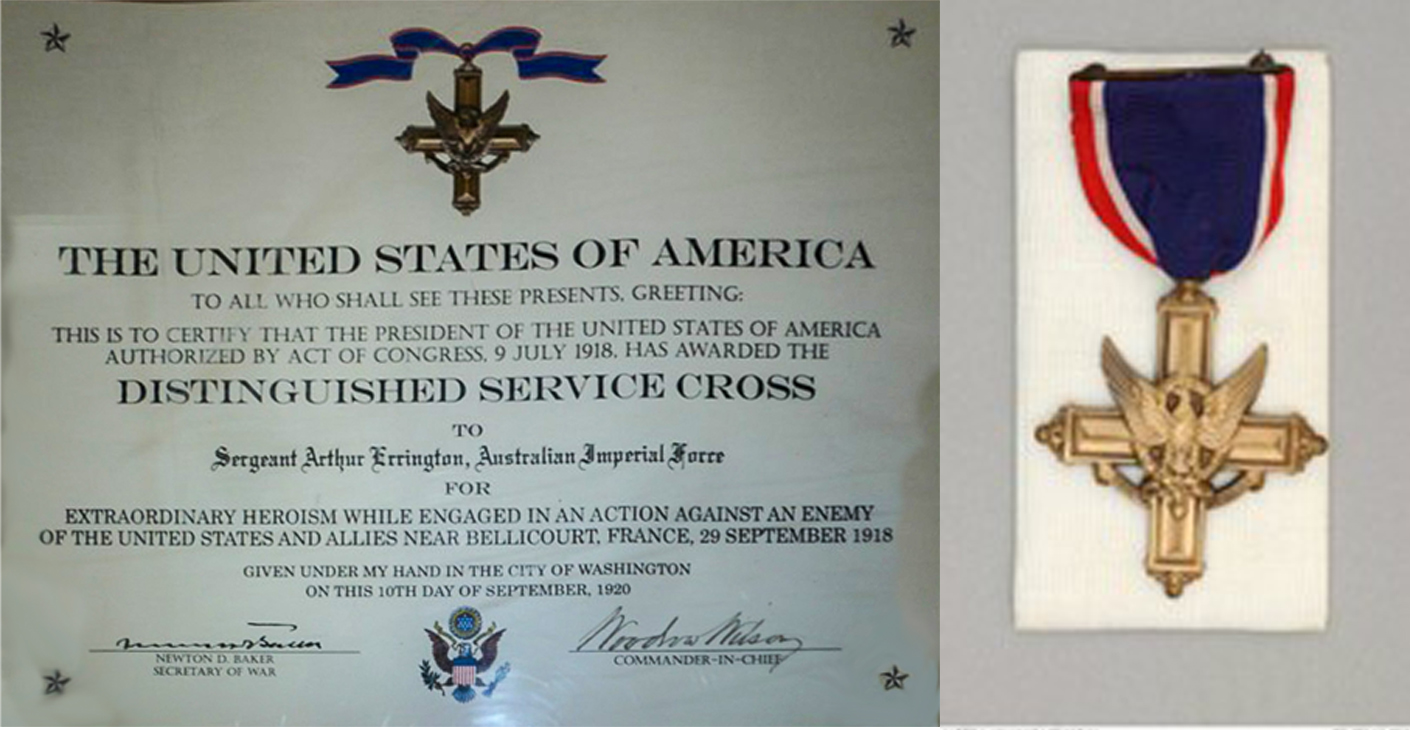
Arthur was a decorated soldier, who served in the Boer war, WW1 at Fromelles and went on to further heroism with the 32nd Battalion at Bellicourt, where his actions earned him the US Distinguished Service Cross.
Early Life
Arthur William Edgar Errington was born on 30 January 1880 in Kooringa, South Australia. He was the eldest surving son of George Cornelius Errington and Mary Anne Seamen’s twelve children that stretched across almost two decades of births:
- Maude Ann Keziah (1874-1876)
- Albert Thomas Samuel (1876-1876)
- Lillian Olive Violet (1877-1956)
- Arthur William Edgar (1880-1934) – AIF 91, US DSC
- Herbert George Edward (1882-1954)
- Winifred May Gertrude (1884-1970)
- Sydney Frank Godfrey (1886-1969)
- Clarence Cyril John (1889-1957)
- Gladys Helene Muriel (1891-1936)
- Hazel Annie Theresa (1894-1972)
- Claude Ernest Harold (1897-1934) - 6744 AIF WW1
- Harold Foulsham (1902-1986) - AIF WW2 staff Sergeant
Both of Arthur’s parents were early settlers in South Australia. His father George had both sets of grandparents and many aunts and uncles around him. George Errington was born in Harrold, Bedfordshire, England and arrived on the Omega, in South Australia in 1851 when he was five years old, along with his parents and siblings, the Errington Grandparents and four of their teenage children. His mother Anne gave birth during the voyage but the infant died. Mary Anne was born in Aylsham/Foulsham Norfolk, England and arrived in South Australia in 1856 with parents Samuel and Sarah, and five older siblings when she was two years old. Grandmother Sarah Seaman outlived many of her descendants as she died in Adelaide at 102 years.
Arthur’s childhood was spent in the Plympton and Kooringa districts, where his father worked in labouring and trade roles and his mother kept the family home running. His schooling is not yet discovered, but by early adulthood Arthur had trained as a hairdresser, a steady and respected trade that he would return to after his years of military service. Arthur married Lilian May Stephens at Plympton on 9 August 1904. Lilian, born in 1882, came from another large South Australian family, and the couple began their married life close to both of their parents’ homes. They lived in the western suburbs of Adelaide, later settling at Wayville and Brompton.
A Decorated Soldier in the Boer War 1899–1902
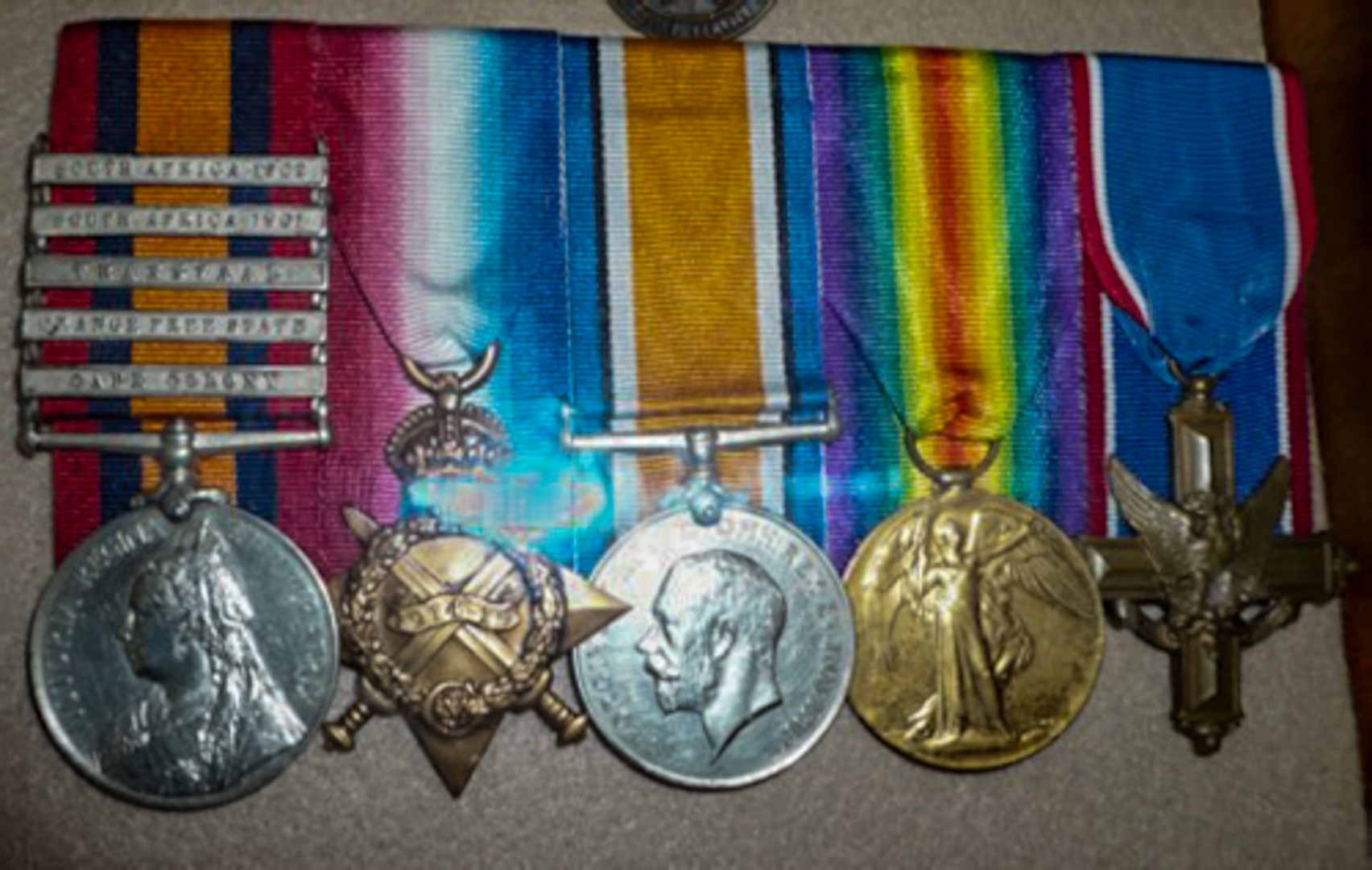
Arthur’s life before the First World War was already marked by commitment to service. In his twenties he enlisted in the 5th South Australian Imperial Bushmen and fought in the South African War, serving for 1 year and 110 days. The experience shaped him; he returned home as a seasoned soldier well before most of his generation had ever worn a uniform. Arthur saw hard campaigning during the South African (Boer) War, earning the Queen’s South Africa Medal with clasps for Cape Colony, Orange Free State, Transvaal, South Africa 1901, and South Africa 1902.
Arthur wrote home during the campaign, and one of his letters, published in The Register in July 1901, reads like a diary of continuous movement, skirmishes, and narrow escapes - a forced march beginning at Kroonstad, long days of riding, night bivouacs, and sudden engagements:
“We were fighting from 9 in the morning till 2 in the afternoon… The engagement cost us the life of one man, while six were wounded.”
After a dramatic ambush and charge during the pursuit of a Boer convoy - “There was only one thing left… a charge, and with a gallop of five miles before us, we duly reached our quarry… We captured nine wagons without firing a shot.”
Arthur wrote of close quarters combat, accidental separations from his unit, enemy fire striking the ground beside his boots and the grim aftermath of a fierce Boer counterattack - “Dead and wounded men were lying all over the place, to say nothing of the horses and bullocks which had been shot.”
By the end of the march he described, his contingent had captured wagons, livestock, prisoners, and arms — and had endured casualties of their own. His letter ended with a matter-of-fact tally typical of veteran Bushmen -“Ten of our men have been killed in action… and nine have been wounded.” .”
For his service he received the Queen’s South Africa Medal with Clasps. Arthur returned home in 1902 with solid experience of mounted warfare, long-range patrolling, and rapid-action combat — experience that would contribute to his leadership in the trenches of the First World War.
Off to War - Again
In July 1915, with recruitment surging across South Australia, the 35 year old, married, employed and already a veteran Arthur Errington stepped forward once more, enlisting at Keswick, SA. He was taken into A Company, 32nd Battalion. Given his experience, he entered the AIF as a Lance Sergeant.
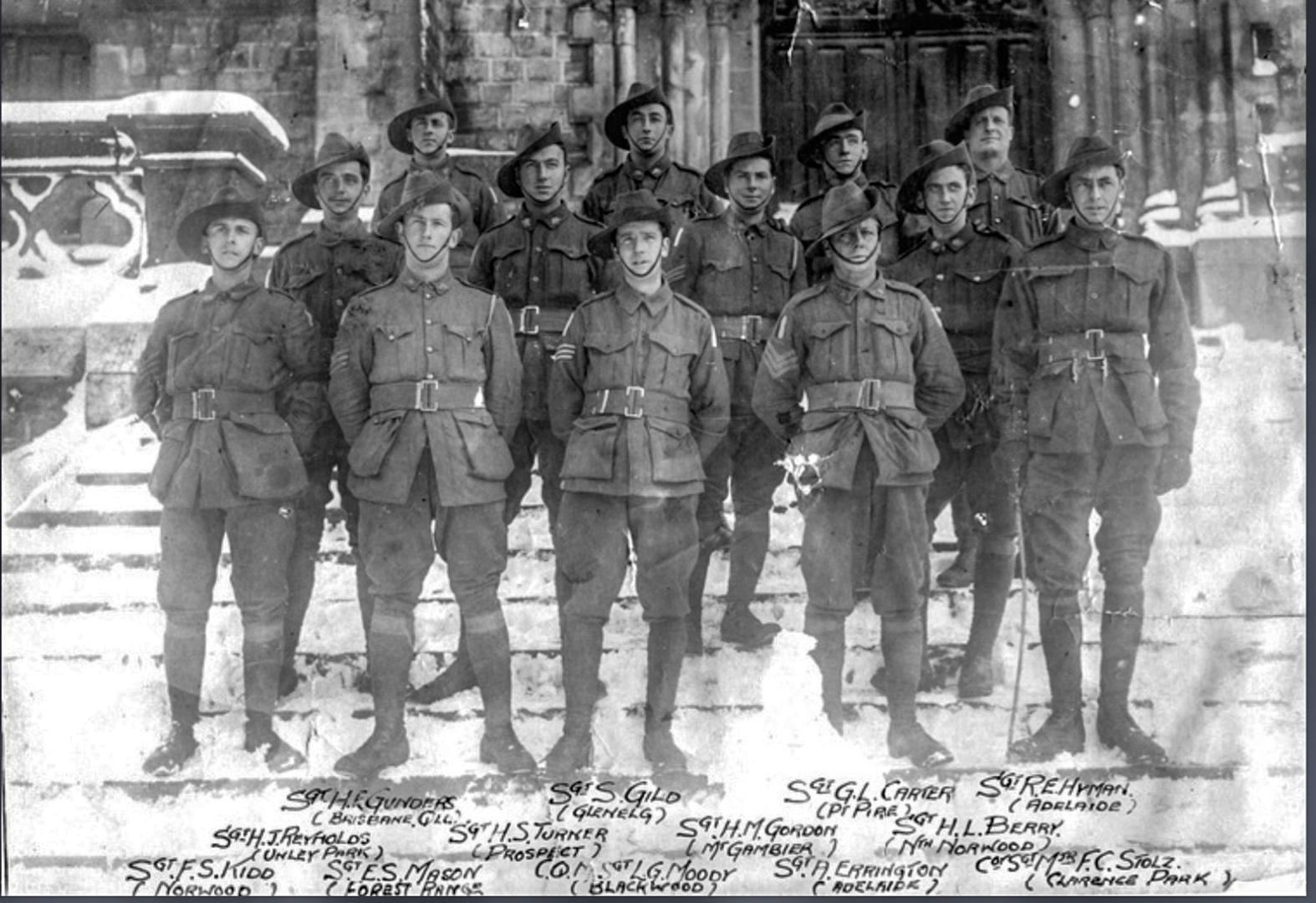
The 32nd Battalion was formed at Mitcham, South Australia on 9 August 1915. A and B Companies were made up of recruits from South Australia and C and D Companies came from Western Australia. There was much fanfare about this new battalion in South Australia, with gatherings, community support, such as the Cheer-up Society and reviews of the troops by the Premier.
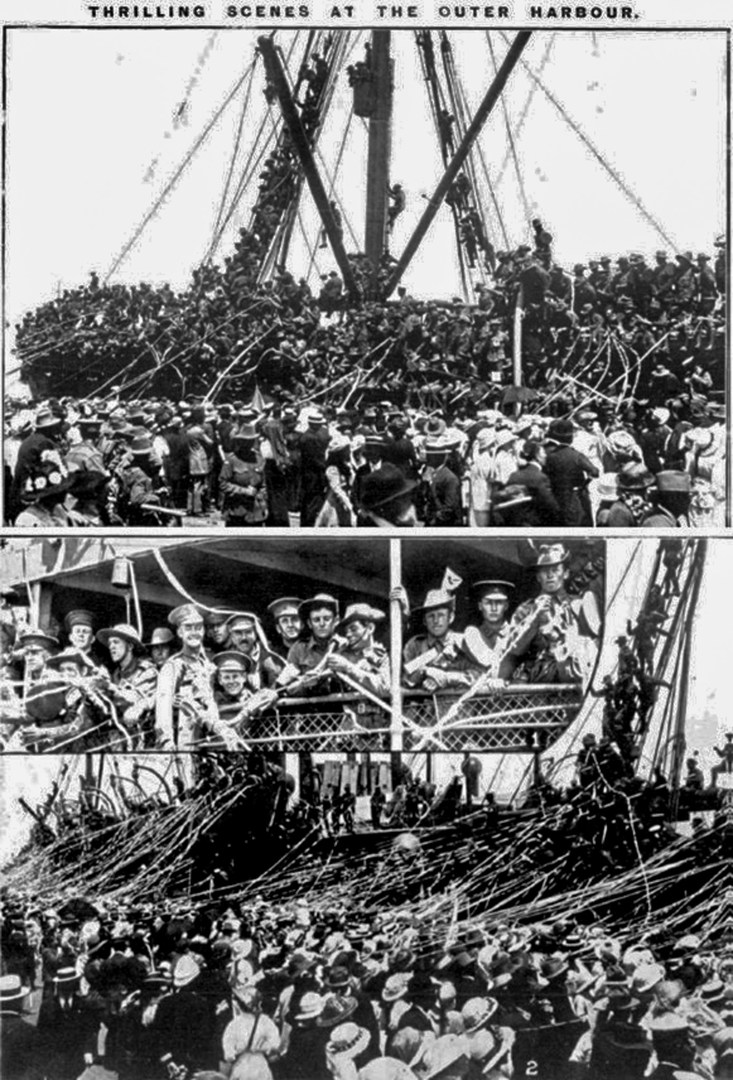
The men from WA who had been at the Blackboy Hill Camp near Perth arrived in Adelaide at the end of September and the whole battalion was assembled at the Cheltenham Racecourse Camp. Training continued until the battalion departed for Egypt on 18 November 1915, with the unit being split between two troop ships HMAT A2 Geelong and HMAT A13 Katuna. As reported in The Adelaide Register:
“The 32nd Battalion went away with the determination to uphold the newborn prestige of Australian troops, and they were accorded a farewell which reflected the assurance of South Australians that that resolve would be realized.”
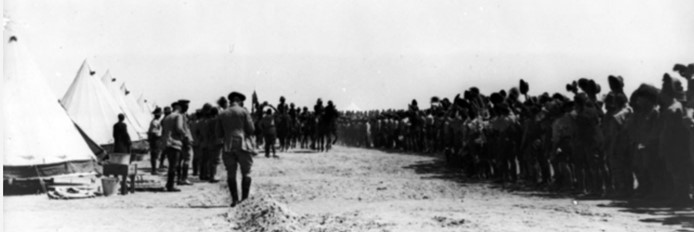
The 32nd arrived in Suez on 14 December 1915 and moved to El Ferdan just before Christmas. A month later they marched to Ismailia and then to the major camp at Tel-el-Kebir where they stayed for February and most of March. Tel-el-Kebir was about 110 km northeast of Cairo and the 40,000 men in the camp were comprised of Gallipoli veterans and the thousands of reinforcements arriving regularly from Australia. Their next stop was at Duntroon Plateau and then at Ferry Post until the end of May where they trained and guarded the Suez Canal. Their last posting in Egypt was a few weeks at Moascar.
One soldier’s diary complained of being “sick up to the neck of heat and flies”, of the scarcity of water during their long marches through the sand and he described some of the food as “dog biscuits and bully beef”. He did go on to mention good times as well with swims, mail from home, visiting the local sights and the like. Source AWM C2081789 Diary of Theodor Milton PFLAUM 1915-16, page 29, page 12 During their time in Egypt the 32nd had the honour of being inspected by H.R.H. Prince of Wales.
After spending six months in Egypt, the call to support the British Expeditionary Force on the Western Front came in mid-June. The 32nd left from Alexandria on the ship Transylvania on 17 June 1916, arriving at Marseilles, France on 23 June 1916 and they then immediately entrained for a three-day train trip to Steenbecque. Their route took them to a station just out of Paris, within sight of the Eiffel Tower, through Boulogne and Calais, with a view of the English Channel, before disembarking and marching to their camp at Morbecque, about 30 kilometres from Fleurbaix. Theodor Pflaum (No. 327) and Wesley Choat (No. 68) wrote about the trip:
“The people flocked out all along the line and cheered us as though we had the Kaiser as prisoner on board!!” – Theodore Pflaum
“The change of scenery in La Belle France was like healing ointment to our sunbaked faces and dust filled eyes. It seemed a veritable paradise, and it was hard to realise that in this land of seeming peace and picturesque beauty, one of the most fearful wars of all time was raging in the ruthless and devastating manner of "Hun" frightfulness”. – Wesley Choat
They were headed to the area of Fleurbaix in northern France which was known as the ‘Nursery Sector’ – a supposedly relatively quiet area where inexperienced Allied troops could learn the harsh realities of Western Front trench warfare against the Germans. But the quiet times did not last long. Training continued with a focus on bayonets and the use of gas masks, assuredly with a greater emphasis, given their position near the front. The 32nd moved to the Front on 14 July and Arthur was back into battle in the trenches on 16 July, only three weeks after arriving in France.
The Battle of Fromelles
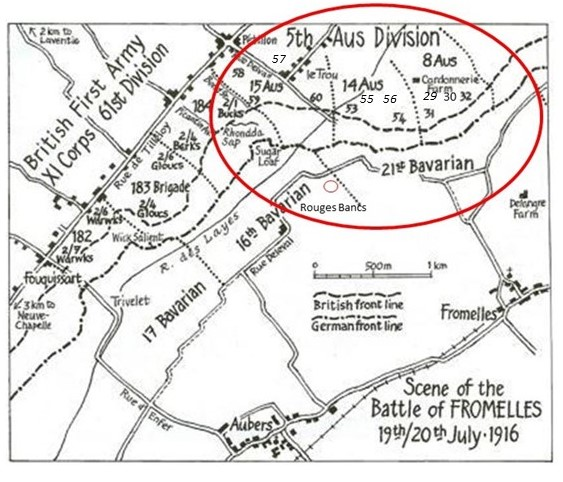
On the 17th they were reconnoitering the trenches and cutting passages through the barbed wire, preparing for an attack, but it was delayed due to the weather.
D Company’s Lieutenant Sam Mills’ letters home were optimistic for the coming battle:
“We are not doing much work now, just enough to keep us fit—mostly route marching and helmet drill. We have our gas helmets and steel helmets, so we are prepared for anything. They are both very good, so a man is pretty safe.”
The overall plan was to use brigades from the Australian Fifth Division to conduct a diversionary assault on the German trenches at Fromelles. The 32nd Battalion’s position was on the extreme left flank, with only 100 metres of No Man’s Land to get to the German trenches. As they advanced, they were to link up with the 31st Battalion on their right. However, their position made the job more difficult, as not only did they have to protect themselves while advancing, but they also had to block off the Germans on their left, to stop them from coming around behind them.
On the morning of the 18th, A Company and C Company went into the trenches to relieve B and D Companies, who rejoined the next day. Lieutenant Frederick Stolz described the calm before the storm:
The fellows were wonderfully cool and not during the whole time did I see anyone get excited or do anything silly, and such a lot were only young boys of between 18 to 20.
The Zero Hour for advancing from their front-line trenches was to be 5.45 PM, but the Germans knew this attack was coming and were well-prepared. They opened a massive artillery bombardment on the Australians at 5.15 PM, causing chaos and many casualties. The charge over the parapet began at 5.53 PM. A and C Company were in the first and second waves to go, B & D were in the third and fourth. They were successful in the initial assaults and by 6.30 PM were in control of the German’s 1st line system (map Trench B), which was described as “practically a ditch with from 1 to 2 feet of mud and slush at the bottom”.
Source AWM4 23/49/12, 32nd Battalion War Diaries, July 1916, page 11
Unfortunately, with the success of their attack, ‘friendly’ artillery fire caused a large number of casualties because the artillery observers were unable to confirm the position of the Australian gains. The 32nd were able to take out a German machine gun in their early advances, but were being “seriously enfiladed” from their left flank.
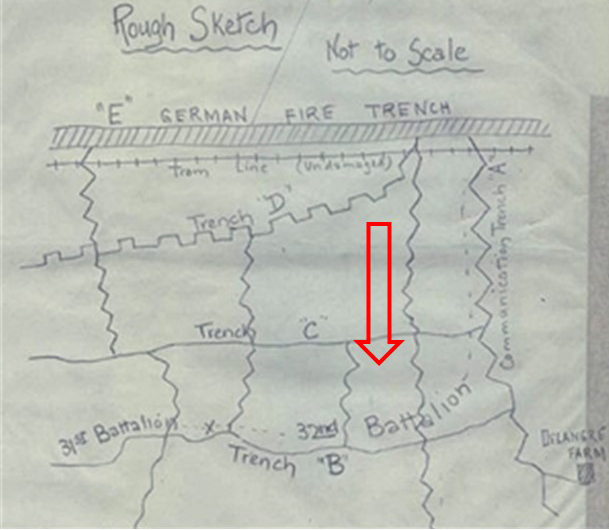
By 8.30 PM their left flank had come under heavy bombardment with high explosives and shrapnel. Return bombardment support was provided and the 32nd were told that “the trenches were to be held at all costs”.
Source - AWM4 23/49/12, 32nd Battalion War Diaries, July 1916, page 12
Fighting continued through the night. The Australians made a further charge at the main German line beyond Trench B, but they were low on grenades, there was machine gun fire from behind them from the emplacement at Delangre Farm and they were so far advanced that they were getting shelled by both sides. In the early morning of the 20th, the Germans began a counterattack from the Australian’s left flank, bombing and advancing into Trench A (map). Given the Australian advances that had been made earlier, the rear Trench E had been left almost empty, which then enabled the Germans to regain that trench and envelop the men of the 32nd. At 5.30 AM the Germans attacked from both flanks in force and with bombing parties.
Having only a few grenades left, the only resistance they could offer was with rifles:
“The enemy swarmed in and the retirement across No Mans’ Land resembled shambles, the enemy artillery and machine guns doing deadly damage.”
What was left of the 32nd had finally withdrawn by 7.30 AM on the 20th. The initial roll call count was devastating – 71 killed, 375 wounded and 219 missing. To get some perspective of the battle, when Charles Bean, Australia’s official war historian, attended the battlefield two and half years later, he observed a large quantity of bones, torn uniforms and Australian kit still on the battlefield. The final impact was that 228 soldiers of the 32nd Battalion were killed or died from wounds sustained at the battle and, of this, 166 were unidentified. Lieutenant Sam Mills survived the battle. In his letters home, he recalls the bravery of the men:
“They came over the parapet like racehorses……… However, a man could ask nothing better, if he had to go, than to go in a charge like that, and they certainly did their job like heroes."
Memories of fallen comrades
Arthur was one of the few senior NCOs still standing after the battle. His Red Cross statements, recorded months and years later, show a man who remembered exactly who he had seen, where he had seen them and what he had done to try to help them. Arthur had witnessed the fate of his friend Private Percy William Mortimore (22), who had advanced as far as the German third line. Arthur was more than twice Percy’s age and was a steady and protective presence for Percy, with a promise he had made to Percy’s mother Mary Mortimore. His Red Cross witness statement about Percy read:
” Blood was running out through his puttee. I tried to make him go back, but he refused and went on filling sand bags.”
“His mother put him in my keeping when we came away from Australia.”
“There is plenty of hope he is a prisoner.”
He found Private Raymond Pflaum (161) desperately wounded - “He had been badly wounded in the stomach, and on the night of July 19th, ’16, during the charge at FleurBaix, witness helped to place him in a dug-out.”
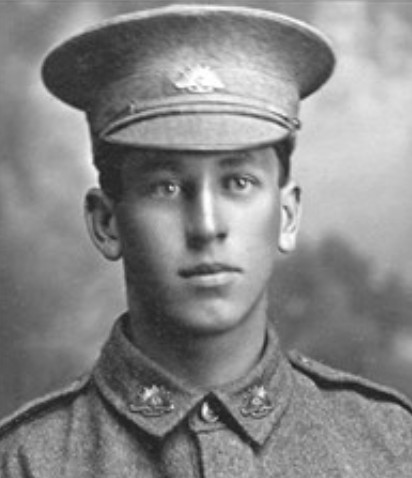
And he also saw the last known moments of another comrade, Private John Crocker (79) – “...Just previously he had been up on the parapet firing his rifle. He was shot off it and rolled onto his back in the trench. I am prepared to swear he was dead.”
Source - AWM Australian Red Cross Wounded and Missing Files – John Edwin Crocker, pp. 3 Those memories — Mortimore bleeding in the third line, Pflaum in the dugout and Crocker fallen in the retirement — stayed with him long after the battalion left the fields of Fromelles.
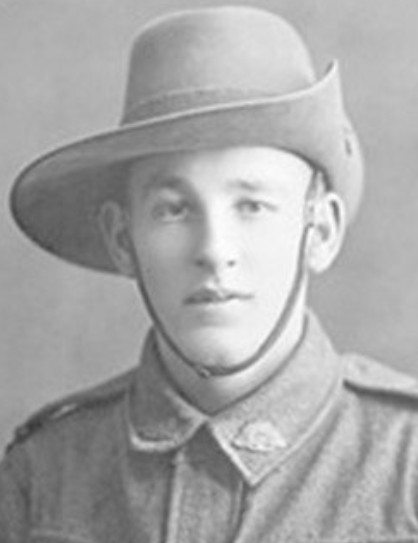
Back Into Battle – Distinguished Service Cross from the US
In the months after Fromelles, Arthur remained with the 32nd Battalion through a difficult winter on the Western Front. He was briefly hospitalised with influenza in late 1916 before rejoining the unit, and much of 1917 was spent in training, reinforcement, and instructional duties. He served at Etaples, Wareham, and Perham Downs, detached at times to specialist schools and training brigades and the 70th Battalion as the AIF rebuilt itself after the enormous losses of 1916. By the end of 1917 he was back with the 32nd Battalion, steady, experienced, and ready for the final campaigns that would take the AIF into 1918.
Two years after Fromelles, the 32nd Battalion was on the brink of another decisive moment — the assault on the Hindenburg Line, the strongest defensive system on the Western Front. On 29 September 1918, the Australians attacked side-by-side with the United States’ 30th Division, advancing through the shattered village of Bellicourt and over the St Quentin Canal tunnel.
For the 32nd Battalion, it was a final, brutal push in a war that was rapidly approaching its end. The fighting was close, fast, and violent, with German machine guns positioned to sweep the attacking waves as the Australians tried to break through some of the most heavily defended ground in France. Amid this chaos, Arthur distinguished himself in a way that would echo far beyond the Australian lines. The official recommendation recorded his actions with striking clarity:
“…this NCO was in command of a platoon during the attack when his Coy. was held up by fire of an enemy M.G. and suffering heavy casualties. Taking 2 men he immediately rushed the gun (and) personally accounted for 3 of the enemy and capturing the remainder together with the gun thereby allowing his Coy. to continue the advance.
Later in the day his Coy. was aagin held up by M.G. fire when he immediately rushed the gun alone killing 2 of the enemy and capturing the remaining 3 together with the gun. This action again allowed his Coy. to continue the advance.”
“Throughout the operation he handled his platoon with great skill and displayed fine initiative. His personal bravery set a wonderful example to all ranks and his work was of the utmost value to his Coy. Commander.”
“Sgt. Errington has served continuously with the Bn. and on several occasions displayed the geratest courage and has always shown greatest devotion to duty.”
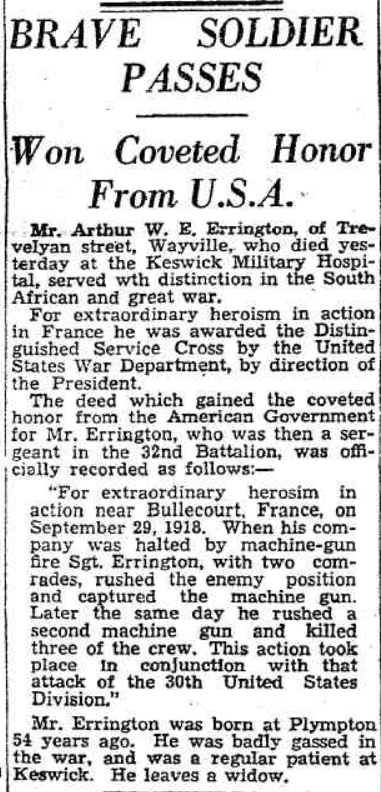
These actions took place during a joint attack with the 30th U.S. Division, whose own reports and citations would later mirror the AIF’s description of his courage. Although Arthur’s deeds did not result in an Imperial decoration, the United States took notice. The U.S. War Department, acting on the battlefield records and supported by witness accounts, awarded him the Distinguished Service Cross — America’s second-highest award for gallantry in combat.
It was an extraordinary honour for an Australian NCO and a powerful indication of how critical his actions were on that day. The attack on the Bellicourt tunnel was one of the decisive blows that shattered Germany’s final defensive line. Amid this turning point of the war, Arthur Errington’s courage stood out. He had survived Fromelles, the Somme, Flanders and the advance on the Hindenburg Line and in doing so, carved his own place in the history of both nations.
After the War
After the Armistice was declared on 11 November 1918, Arthur embarked from Liverpool on 13 April 1919 aboard the Wyreema, arriving in Adelaide on 27 May. His discharge from the AIF was completed on 20 July 1919. In July 1921, Arthur was formally presented with the United States Distinguished Service Cross during a ceremony at Keswick Military Headquarters.
The Governor of South Australia, Sir Archibald Weigall, attended in person, accompanied by a cadet guard of honour. After presenting the awards, the Governor called for three cheers for the recipients, which were answered enthusiastically. The citation read out for Arthur praised his “great bravery near Bellicourt” on 29 September 1918, noting how he twice rushed enemy machine-gun positions — actions carried out alongside the U.S. 30th Division.
Source: GALLANT SOLDIERS, The Express and Telegraph, 29 July 1921, p.1. http://nla.gov.au/nla.news-article210652868
Arthur did not return home unscathed however. His service record and later repatriation papers show repeated admissions for breathing difficulties and ongoing effects of gas exposure, conditions that continued long after his return. Throughout the 1920s and early 1930s he was regularly treated at the Keswick Repatriation Hospital. Arthur and his wife Lilian lived at 2 Trevelyan Street, Wayville and he maintained strong ties with his wartime comrades. He became a member of the Returned Sailors and Soldiers Imperial League of Australia (RSL) and was active within the Unley Sub-Branch.
His health deteriorated sharply in 1934. On 7 June 1934, Arthur died at the Keswick Repatriation Hospital, aged 54. His death was formally attributed to war service.
The tributes that followed reflected how deeply he was respected. In 1935, his widow Lilian placed a moving notice on the first anniversary of his death:
“Today as I look at your photo…Do you wonder my heart is breaking and longing for you?”
Arthur was buried in the AIF Section of West Terrace Cemetery, in plot LO 4S 27, a place reserved for returned soldiers whose service shaped and shortened their lives.
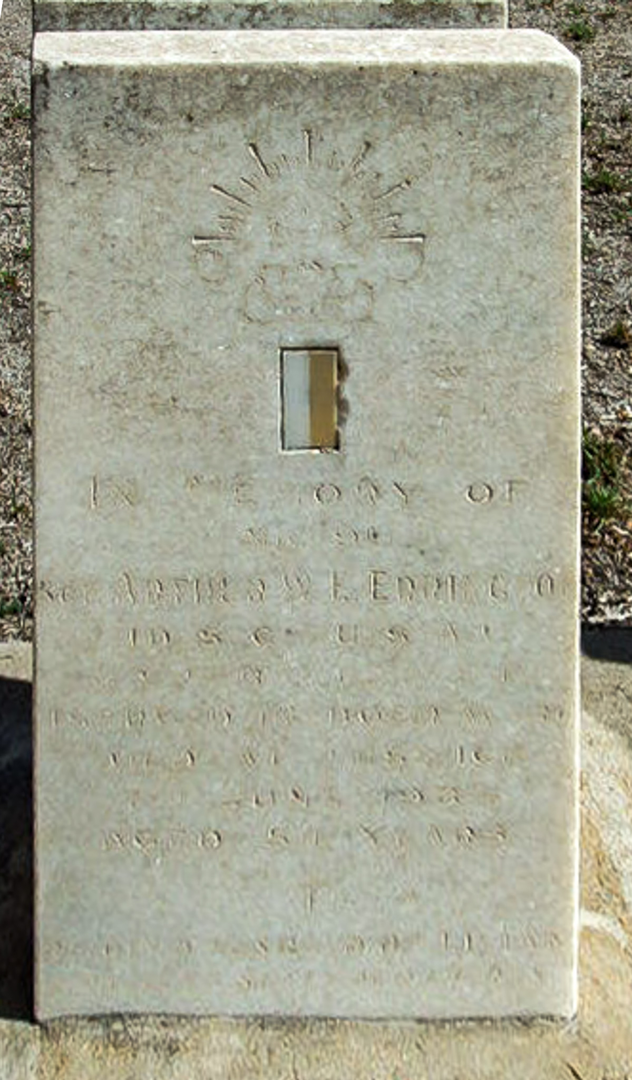
Arthur’s younger brother Claude (6744 10th Battalion) also passed in 1934 from war related injuries he received in May 1917- multiple fractures from gun shot wounds, elbow, leg and scapula. Arthur Errington served Australia across two wars and was recognised by two nations for his courage. For the men of the 32nd Battalion, and for the families to whom he gave truthful, compassionate witness statements after Fromelles, he remained a figure of loyalty, bravery, and responsibility long after the fighting ended.
Links to Official Records
The Fromelles Association would love to hear from you

Contacts
(Contact: carla@fromelles.info or geoffrey@fromelles.info).
(Contact: army.uwc@defence.gov.au or phone 1800 019 090).
Donations
If you are able, please contribute to the upkeep of this resource.
(Contact: bill@fromelles.info ).