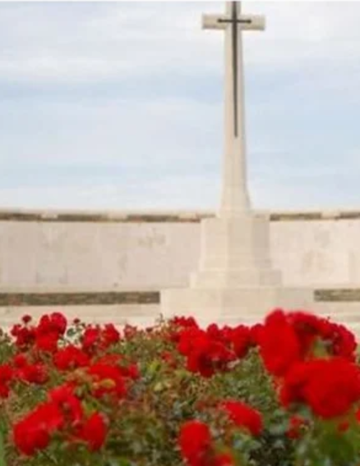
John Bowman CLARKE
Eyes blue, Hair fair, Complexion fair
Private John “Jack” Bowman Clarke – A Murchison Son Lost at Fromelles
Can you help find Jack?
Jack’s body was never found after the Battle of Fromelles and there are no records of his burial.
A mass grave was found in 2008 at Fromelles, a grave the Germans dug for 250 Australian soldiers they recovered after the battle. As of 2024, 180 of these soldiers have been able to be identified via DNA testing.
Jack may be among these remaining 70 unidentified men. There is still a chance to identify him — but we need help. We welcome all branches of his family to come forward to donate DNA to help with his identification, especially those with Clarke family connections to Murchison, Rushworth, Shepparton, the wider Goulburn Valley and Durham, England, and his mother’s Long and Kelly side from Ireland. His siblings left large families across Victoria and New South Wales, and these descendants may hold the key to giving Jack back his name.
See the DNA box at the end of the story for what we do know about his family.
If you know anything of contacts for Jack please contact the Fromelles Association.
Early Life
John Bowman “Jack” Clarke was born in June 1891 at Murchison, Victoria to John Bowman Clarke and Cecilia (Celia) nee Long, the sixth of their ten children. They were all born in Murchison:
- Sarah Alice Clarke (1881–1928)
- Catherine Mary “Kit” Clarke (1882–1974)
- James Henry Clarke (1884–1961) – Reg. No. 2353, 14th Battalion - Gallipoli, Egypt France. He was wounded
- Margaret Clarke (1885–1934)
- Adelaide Clarke (1889–1970)
- John Bowman “Jack / Nobby” Clarke (1891–1916) – Reg. No. 3224, 53rd Battalion, Killed at Fromelles
- William Clarke (1894–1963) Citizens Military Forces WW2
- Cecilia Maud Clarke (1896–1986)
- George Ponsonby Clarke (1897–1984)
- Robert James Clarke (1900–1942)s – WW2 Reg. No. VX23989AIF, 2/22nd Battalion. Died at sea on Montevideo Maru.
Jack’s paternal grandparents William James Clarke and Margaret (nee Gargett) and their six children had arrived in Victoria from Durham, England in 1859, on the Donald McKay and settled in Murchison, Victoria, where they had relatives. William was a carpenter. Celia Long’s parents Michael Long and Catherine Kelly were from Ireland. In 1902 Jack’s father was listed as a stonemason in Murchison and there is also a grocer, Robert Bowman Clarke, probably Jack’s uncle.
The family lived on Station Street, Murchison. Jack attended Murchison State School, one of the oldest schools in the state, which began with a school attached to the Goulburn Aboriginal Protectorate. Two more schools replaced it, until the 1871 school was built.
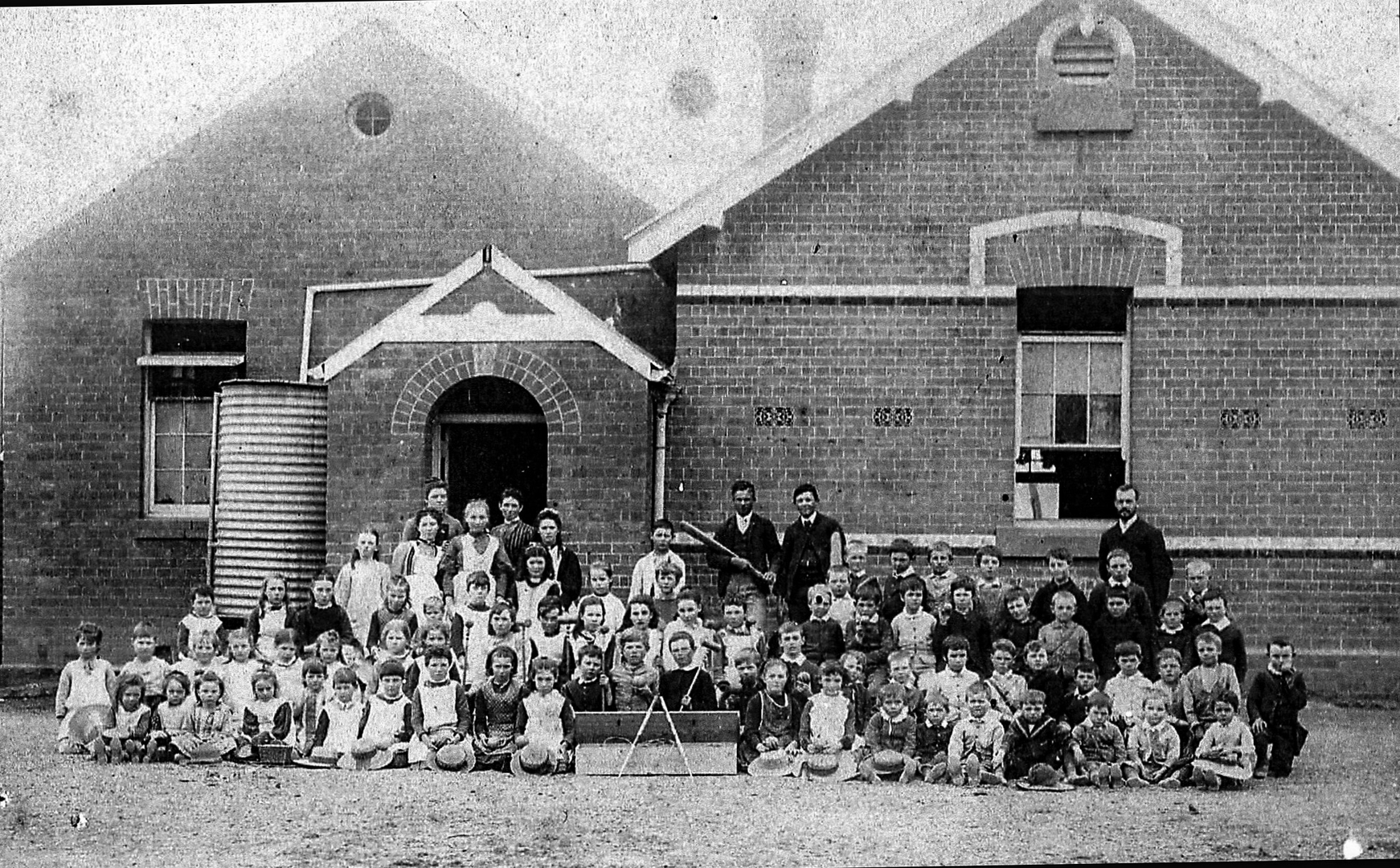
Unfortunately, Jack’s father died on 29 August 1904, leaving Celia widowed with six children under 15 years old. Sarah, 23 at the time but unmarried, likely stepped in to help. James was already working. The family stayed at their Station Street address for nearly another 30 years. In his teens and early twenties Jack moved between Victoria and the New South Wales Riverina area, taking labouring jobs on the railways and in local quarries. By 1913 he was living at Mangoplah, NSW and later at The Rock, where fellow soldiers would later recall having met him.
Off to War
By mid-1915, Jack, known as “Nobby” by his fellow soldiers, was living and working at The Rock in the Riverina. Like many young men of the district, he had watched the casualty lists grow, and had seen his brother James and mates go to war and he finally decided it was his turn. Jack enlisted on 28 July 1915 at Cootamundra, giving his mother as his next of kin. A few weeks later he was assigned to the 4th Battalion, 11th Reinforcement. After his initial military training in Australia, he sailed from Sydney on 13 October 1915 aboard HMAT A17 Port Lincoln, headed to the AIF camps in Egypt.
With the ‘doubling of the AIF’ at this time as it expanded from two infantry divisions to five, major reorganisations were underway. The 53rd Battalion was formed on 16 February 1916 and was made up of Gallipoli veterans from the 1st Battalion and the new recruits from Australia and Jack was reassigned here. The Gallipoli soldiers in the 53rd were not slow in pointing out to whoever would listen that they were the “Dinkums” and the new recruits were the “War Babies”. Source: - AWM4 23/70/1, 53rd Battalion War Diaries, Feb-July 1916, page 3
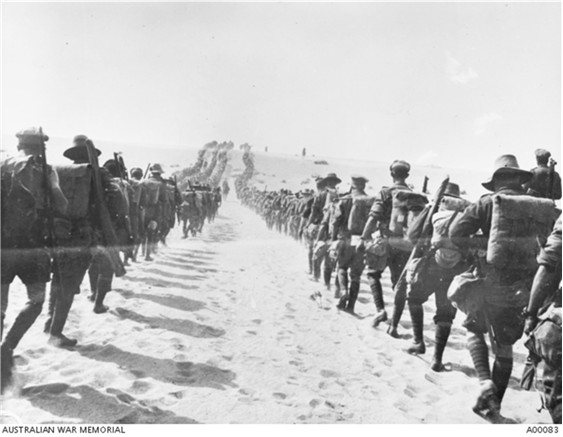
Training for all continued. In March they were sent to Ferry Post, on foot, a trip of about 60 km that took three days. It was a significant challenge, walking over the soft sand in the 38°C heat with each man carrying their own possessions and 120 rounds of ammunition. Many of the men suffered heat stroke.
Once there, they remained at Ferry Post guarding the Suez Canal from any potential threats posed by the Ottoman Army and continuing their training. On 16 June they began the move to the Western Front. 32 officers and 958 soldiers of the 53rd left Alexandria on 19 June on the troopship HMT Royal George, bound for Marseilles, France to become part of the British Expeditionary Force on the Western Front. They arrived in Marseilles on 28 June and were immediately entrained for a 62-hour journey north to Hazebrouck before finally marching into the camp at nearby Thiennes in northern France. During their trip it was noted that their “reputation had evidently preceded them”, as they were well received by the French at the towns all along the route.
Source - AWM4 23/70/2 53rd Battalion War Diaries February - June 1916, p. 4
This area near Fleurbaix was known as the ‘Nursery Sector’ – a supposedly relatively quiet area where inexperienced Allied troops could learn the harsh realities of Western Front trench warfare against the Germans. But the quiet times and the training period did not last long. On 8 July they began a 30 km march to Fleurbaix and on 10 July, the 53rd entered trenches for the first time. The front near Fleurbaix was anything but calm. Rain flooded the communication trenches, artillery fire harassed supply lines, and the soldiers dug in amid the mud and barbed wire of No-Man’s-Land.
The Battle of Fromelles
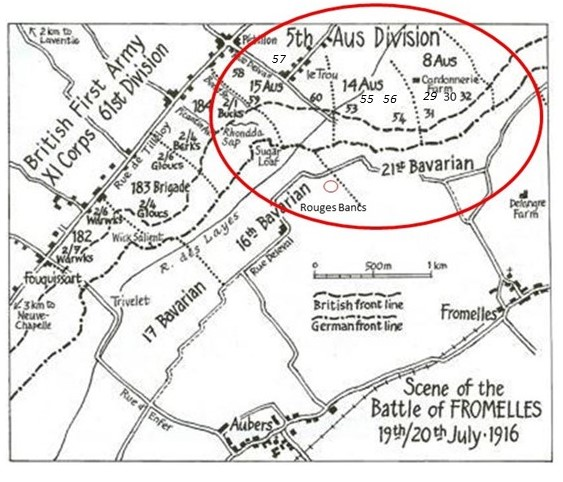
The main objective for the 53rd was to take the trenches to the left of a heavily armed, elevated German defensive position, the ‘Sugar Loaf’, which dominated the front lines. If the Sugar Loaf could not be taken, the 53rd and the other battalions would be subjected to murderous enfiladed fire from the machine guns and counterattacks from that direction. As they advanced, they were to link up with the 60th and 54th Battalions on their flanks. The men knew something was coming. They rehearsed attacks in replica trench systems, inspected bayonets and watched as huge guns rolled into place behind the lines. Then on 16 July, they moved up for an attack—only to have it postponed due to weather.
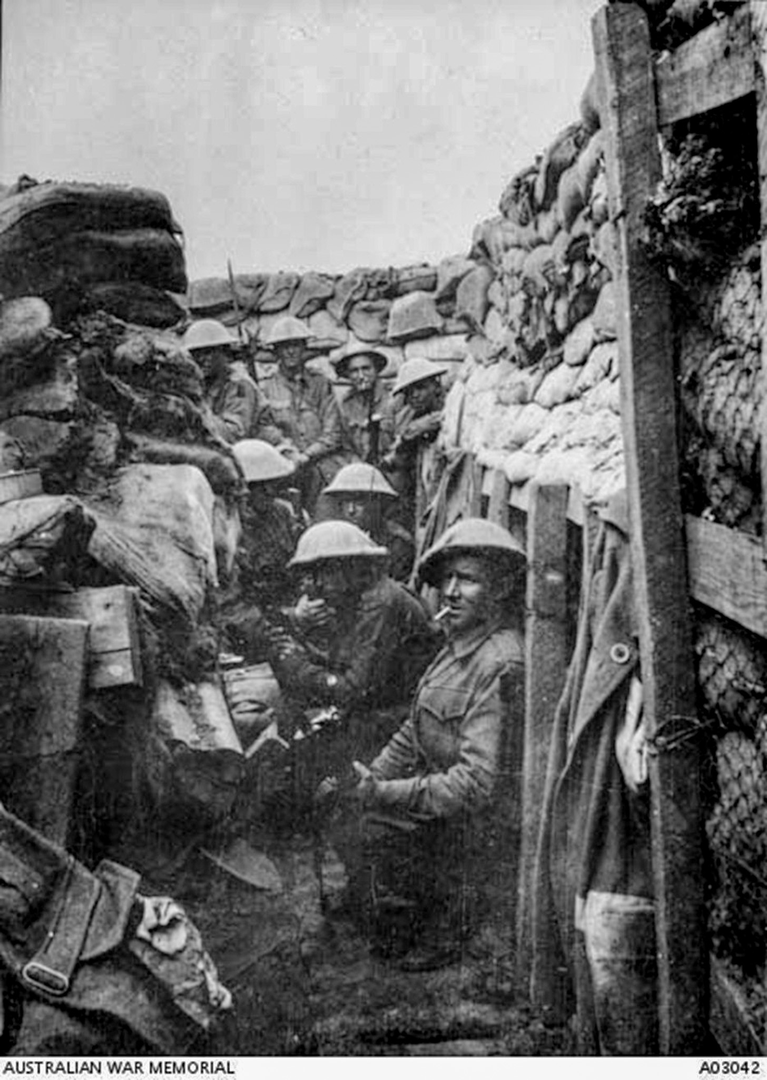
The delay proved torturous. Private Jim Granger (4784), a young Dorrigo soldier, described the tension in his dugout:
“We were held in suspense for three days… like a criminal waiting to hear the verdict. We had no dugouts where we were in the supports and shrapnel was bursting all round.”
On the 19th, heavy bombardment was underway from both armies by 11.00 AM. At 4.00 PM the 54th Battalion rejoined on their left. All were now in position for battle. Zero Hour for advancing from their front-line trenches was to be 5.45 PM, but the Germans knew this attack was coming and were well-prepared. They opened a massive artillery bombardment on the Australians at 5.15 PM, causing chaos and many casualties. The Australians went on the offensive at 5.43 PM.
They moved forward in four waves – half of A & B Companies in each of the first two waves and half of C & D in the third and fourth. Jack was in the second wave. They did not immediately charge the German lines, they went out into No-Man’s-Land and lay down, waiting for the British bombardment to lift. Private Arthur Crewes (4755) wrote of the time:
“At 5.43 pm the signal for the charge sounded, and over the top we went into the face of death, shells bursting, machine guns rattling and rifles crackling.”
At 6.00 PM the German lines were rushed. The 53rd were under heavy artillery, machine gun and rifle fire, but were able to advance rapidly. Corporal J.T. James of C Company (3550) reported:
“At Fleurbaix on the 19th July we were attacking at 6 p.m. We took three lines of German trenches”
As below, the 14th Brigade War Diary notes that the artillery had been successful and “very few living Germans were found in the first and second line trenches”, BUT within the first 20 minutes the 53rd lost ALL the company commanders, ALL their seconds in command and six junior officers.
Source - AWM C E W Bean, The AIF in France, Vol 3, Chapter XII, pg 369
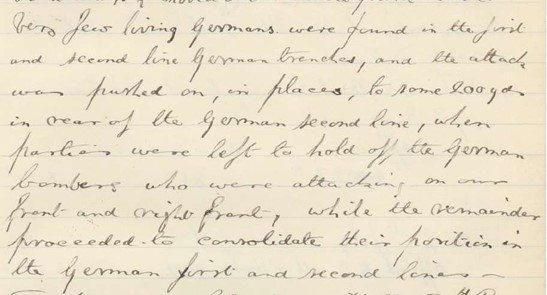
Some of the advanced trenches were just water filled ditches, which needed to be fortified by the 53rd to be able to hold their advanced position against future attacks. They were able to link up with the 54th on their left and, with the 31st and 32nd, occupied a line from Rouges Bancs to near Delangre Farm, but the 60th on their right had been unable to advance due to the devastation from the machine gun emplacement at the Sugar Loaf. They held their lines through the night against “violent” attacks from the Germans from the front, but their exposed right flank had allowed the Germans access to the first line trench BEHIND the 53rd, requiring the Australians to later have to fight their way back to their own lines. By 9.00 AM on the 20th, the 53rd received orders to retreat from positions won and by 9.30 AM they had “retired with very heavy loss”.
Source - AWM4 23/70/2 53rd Battalion War Diaries July 1916 page 7
Of the 990 men who had left Alexandria just weeks before, the initial count at roll call was 36 killed, 353 wounded and 236 missing:
“Many heroic actions were performed.”
To get some perspective of the battle, when Charles Bean, Australia’s official war historian, attended the battlefield two and half years later, he observed a large quantity of bones, torn uniforms and Australian kit still on the battlefield. The final impact of the battle on the 53rd was 245 soldiers were killed or died from their wounds and, of this, 190 were not able to be identified.
Jack’s Fate
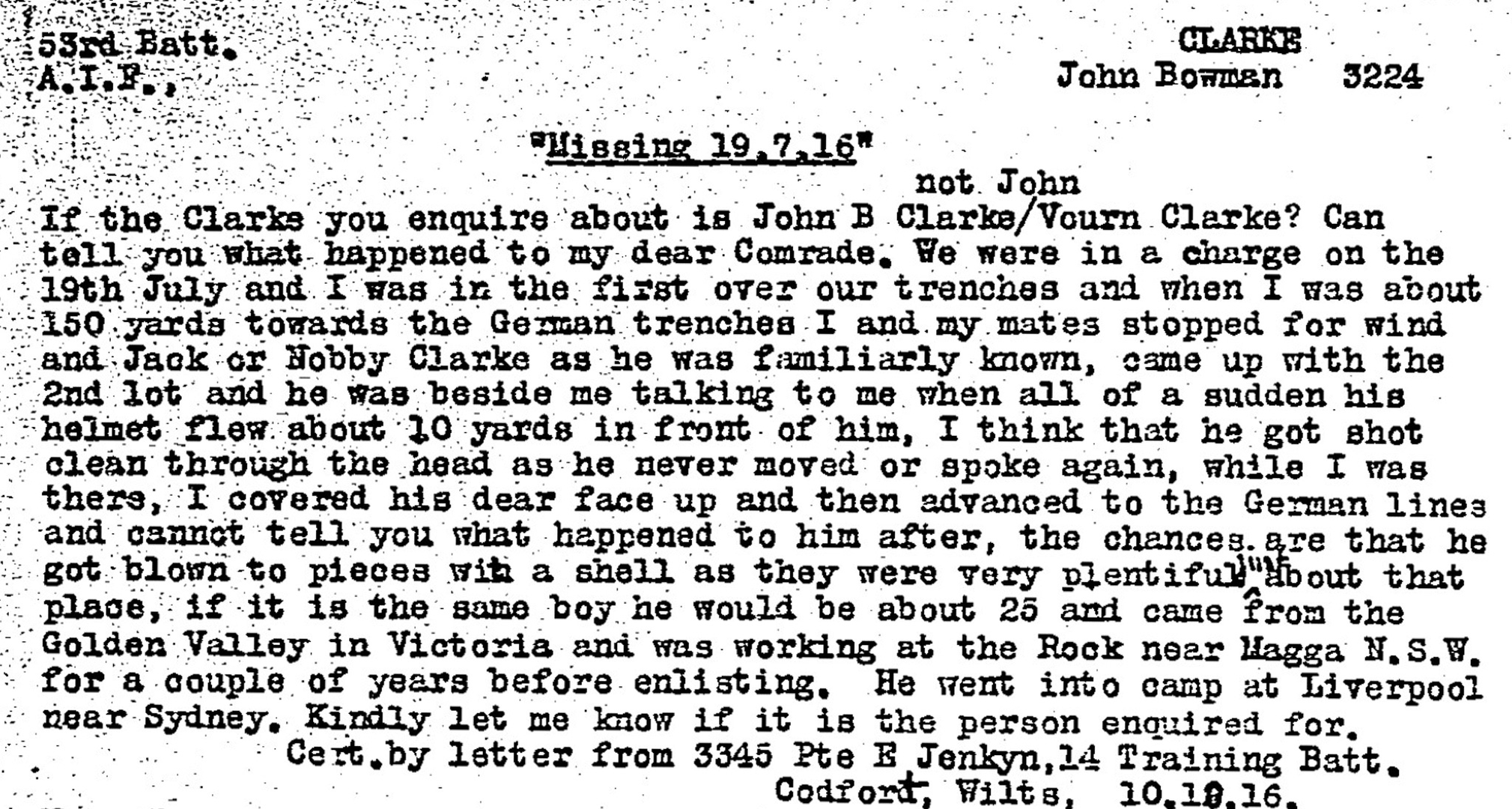
For many men - among them Jack Clarke - No-Man’s-Land became deadly. On the flat ground, the Sugar Loaf’s machine-guns raked the right of the attack, artillery shells were heavy and casualties were severe. Jack was seen falling during the charge at about 150 yards out. Private Edwin Jenkyn (3345), who obvioiusly knew Jack well, was the most descriptive:
“I and my mates stopped for wind and Jack or Nobby Clarke as he was familiarly known, came up with the 2nd lot and he was beside me talking to me when all of a sudden his helmet flew about 10 yards in front of him, I think he got shot clean through the head as he never moved or spoke again…”
“…I covered his dear face up and then advanced to the German lines…”
“…chances are that he got blown to pieces by a shell as they were very plentiful about that place…”
Nicholas Alexander Cusack (3278) confirmed this -
“…he was about 5 yards ahead of me. I heard him sing out – saw him killed – probably by shrapnel - then he fell. He could not have been taken prisoner.”
Source - AWM Red Cross Missing and Wounded Files – John Bowman Clarke, p4
After the Battle
In the days and weeks after the Battle of Fromelles, Jack was first listed simply as “Missing.” His last letter home was sent on 14 July. Like hundreds of families across Australia, Celia Clarke waited for news that never seemed to come. Yet, without a body having been brought in, the Army could not confirm his death. More than a year passed while the Army and the Red Cross worked through their files, hospitals, witnesses and the information from the Germans before the inevitable truth was finally acknowledged.
A Court of Enquiry, held in the field on 29 August 1917, ruled that Jack had been killed in action on the night he was reported missing — 19 July 1916. Celia received the official notification shortly afterwards. The Shepparton Advertiser captured the painful wait -
“Only on Tuesday last official intimation was conveyed… that her soldier son was killed in action in France at about the time he was reported missing.”
Source: Pte. John B. Clarke. (27 September 1917). Shepparton Advertiser (Vic. : 1887–1953), p.5. http://nla.gov.au/nla.news-article92107169
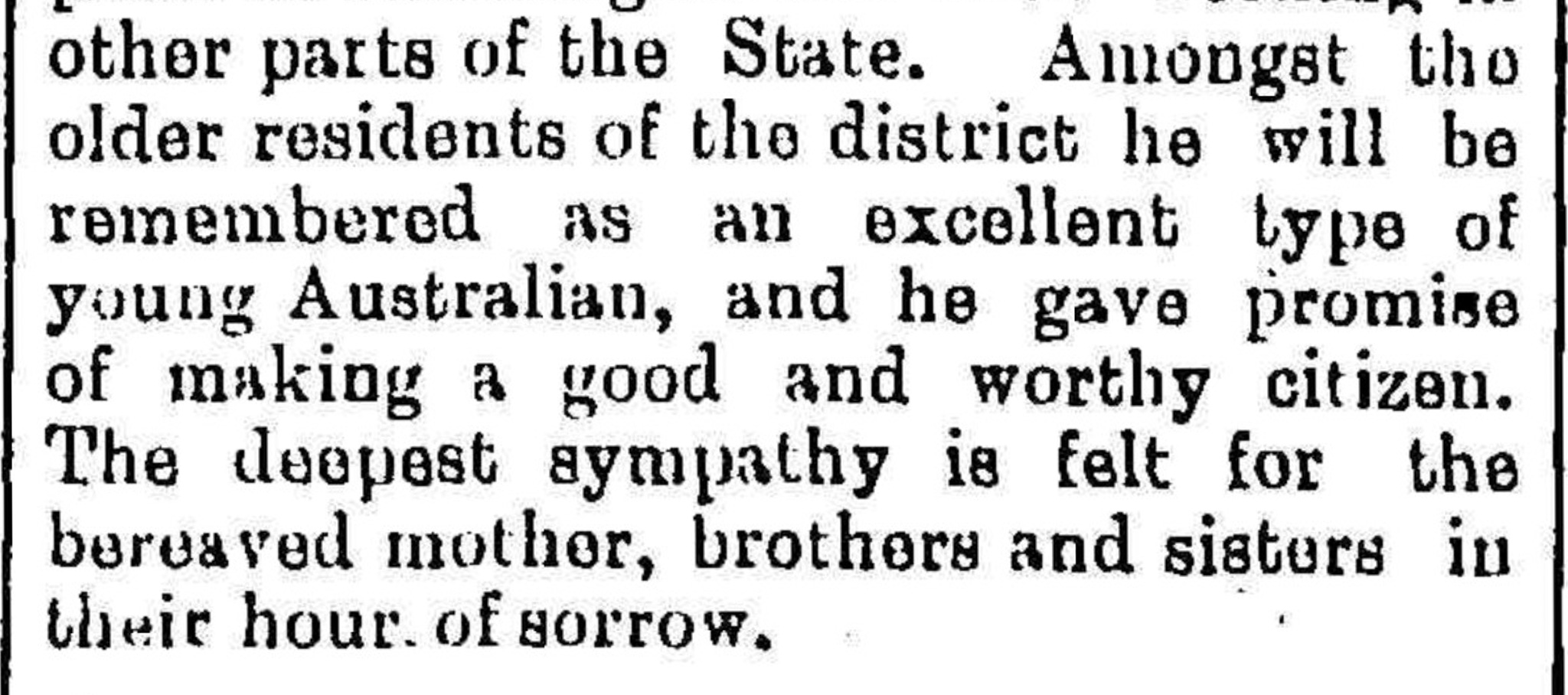
The Murchison Advertiser reflected the community’s grief -
Like so many other families, there was never any closure – his body was never found and no personal effects were returned. Jack was awarded the 1914-15 Star Medal, the British War Medal, the Victory Medal, a Memorial Plaque and a Memorial Scroll. However, as Army protocol was to send the medals to a male of the family even though she was on record as next of kin, Celia had to show them that she, in fact, was eligible. She simply wrote - “there is no nearer blood than me.”
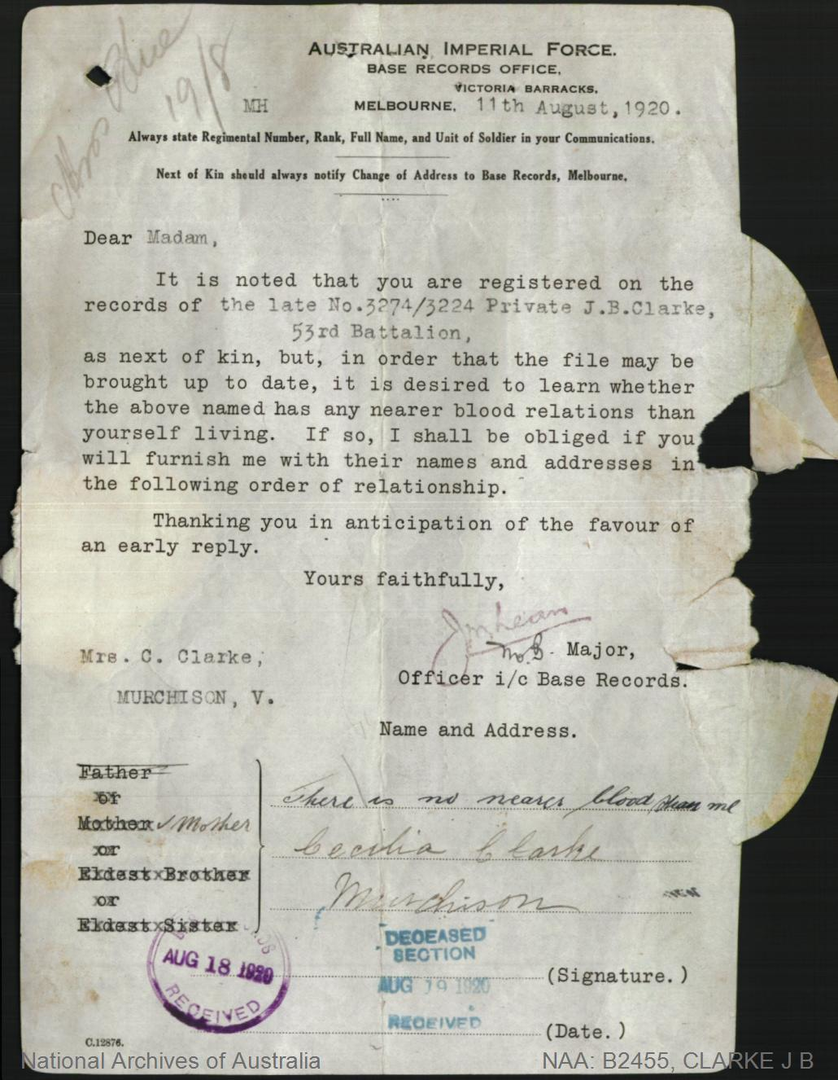
The Clarke Family at War – Three Sons, Only One Came Home
The Clarke family carried a heartbreak that stretched across two world wars. James had enlisted in May 1915 and Jack followed in July. Their younger brother Robert was too young, but enlisted WW2. Three sons of Cecilia Clarke in uniform, serving in two different global conflicts. Only one came home.
James
Jack’s eldest brother, enlisted in May 1915 and was assigned to the14th Battalion. He was enroute to Gallipoli in late October, but he was hospitalised at Mudros, Malta, Cairo and Alexandria with enteric fever and influenza. He returned to duty in June 1916, but then was back in hospital in England until November. In April 1917 he rejoined his 14th Battalion who were in northern France, but he continued to be in and out of hospital. By September the 14th had moved to Belgium and James was with them. During an attack on 26 September at China Wall near ‘Hellfire Corner’, a busy and dangerous junction near Ypres in Belgium, James was blown over by a shell. While he survived, he suffered shell shock (“subjected to an exceptional exposure of shell fire”) and likely dazed from this, he went ‘missing’ and was noted as Absent Without Leave. He did return, but needed to be treated for tremors and pains in his back.
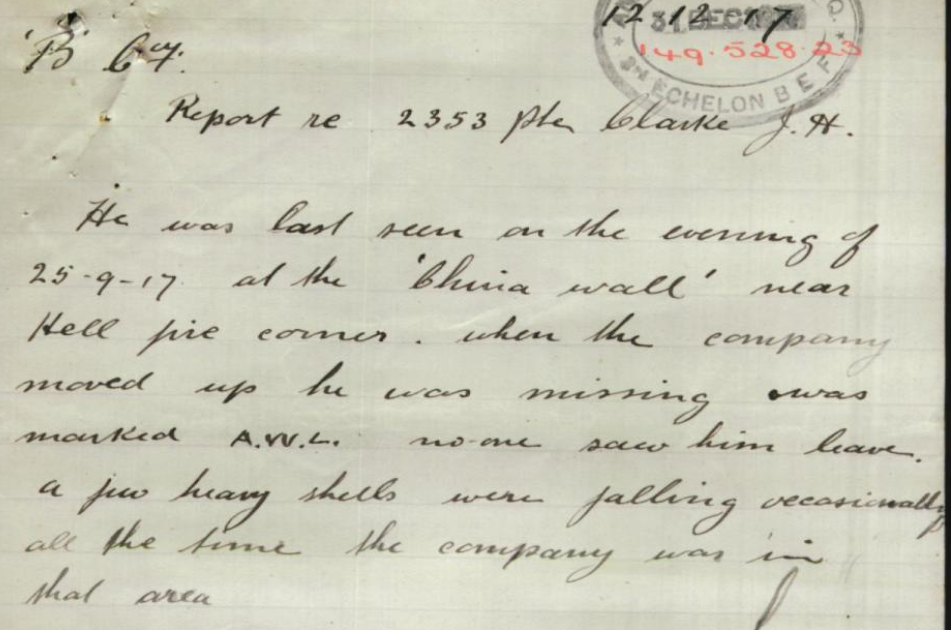
After four long years of war, James returned to Australia in March 1919, carrying the memories of the trenches and the grief of losing his younger brother at Fromelles. He lived out the rest of his days in Murchison, passing away in 1961, and is buried in the local cemetery. The family’s wartime sorrows did not end with Jack.
Robert
Their youngest brother, Lance Sergeant Robert James Clarke, served in the 2/22nd Battalion during the Second World War. While posted in Rabaul, Papua New Guinea (New Britain), he was among the Australian soldiers and civilians taken prisoner after the Japanese invasion in January 1942. In July 1942, Robert was one of 1,053 Australian prisoners - soldiers and civilians - aboard the Montevideo Maru who were to be transferred to Hainan Island.
Before dawn on 1 July 1942, the vessel, which was unmarked and travelling without escort, was sunk by the American submarine USS Sturgeon, which did not know it carried Allied prisoners. The ship went down in eleven minutes. All were lost. Robert was 42. The sinking of the Montevideo Maru remains Australia’s worst maritime disaster. (See the story of Thomas Herket, a Fromelles survivor, for additional information)
For Celia Clarke, who had already endured a year of agonising silence before learning Jack had been killed at Fromelles, the loss of Robert in the Pacific war was a second blow no mother should ever have had to bear. Three sons gone to two different wars; only one came home.
Gone, but not forgotten
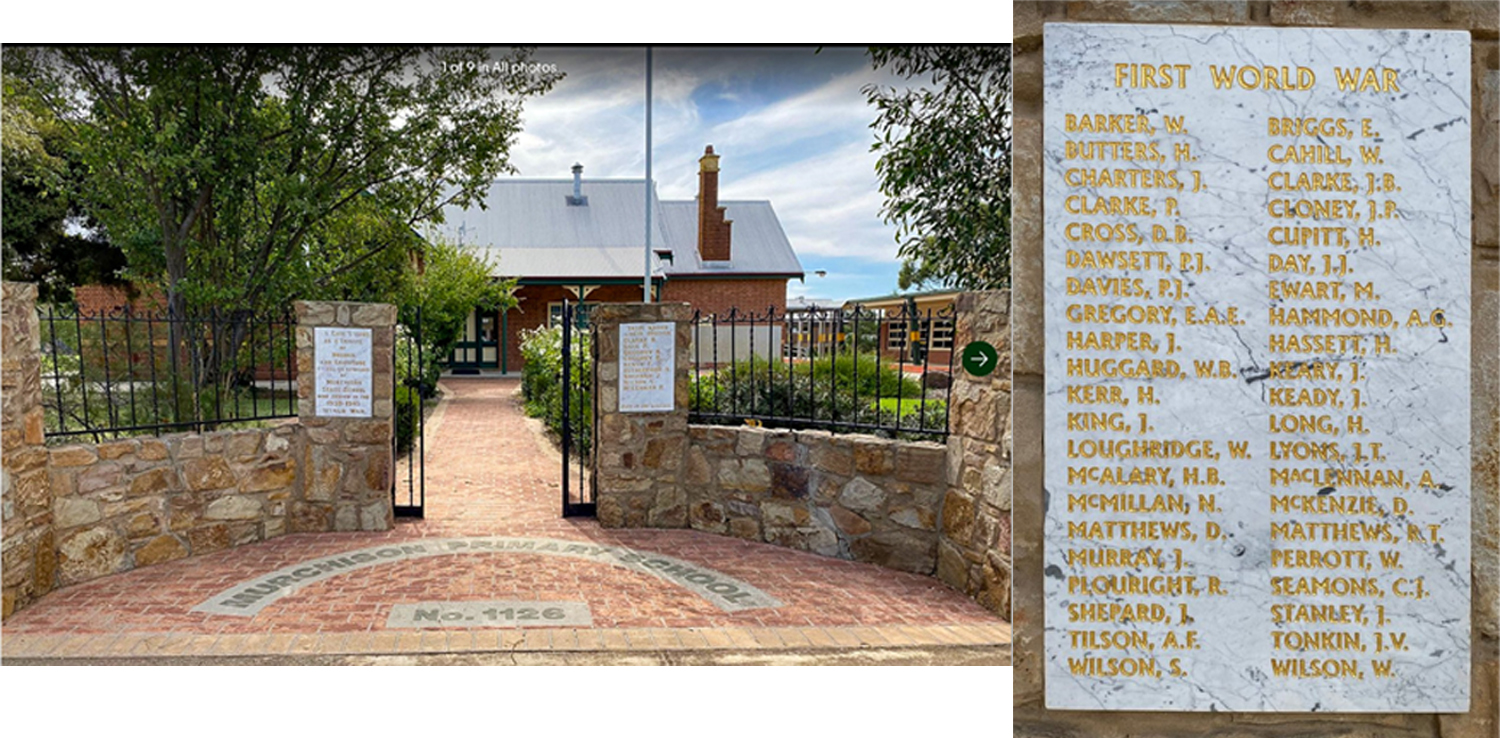
The Clarke family is remembered across Murchison and beyond—names carved on honour rolls, memorial gates, and war memorials—each one a reminder of the sacrifice made not just by the men who served, but by the families who waited, hoped, feared, and grieved. Jack is commemorated at:
- VC Corner Australian Cemetery and Memorial, Fromelles, France
- Australian War Memorial Roll of Honour, Canberra
- Haymarket NSW Government Railway & Tramway Honour Board
- Murchison & District Honour Roll (Boer War & WW1)
- Murchison Primary School No.1126 Memorial Gates
- Murchison War Memorial
- Rushworth War Memorial Clock Tower
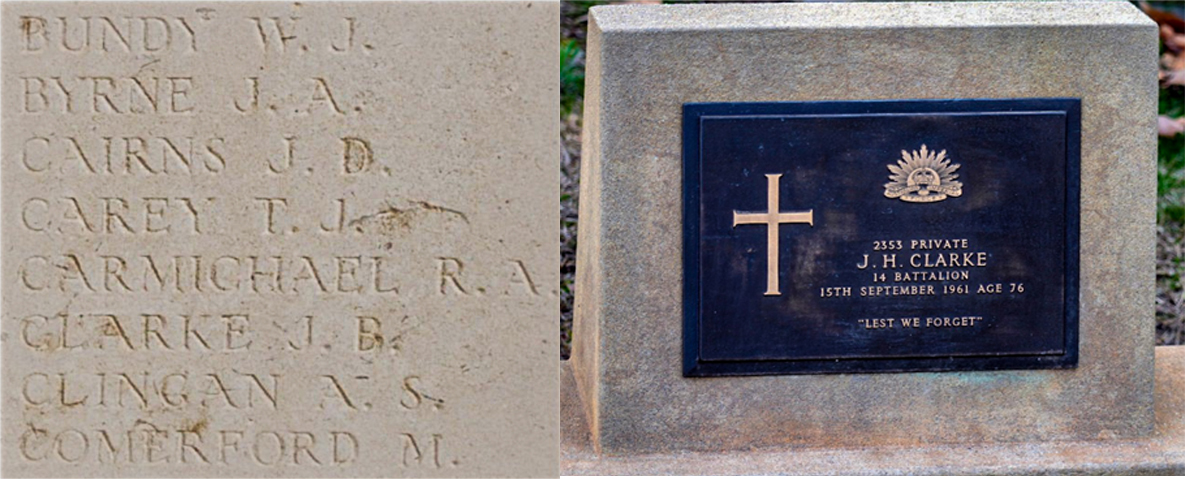
James’ grave at Murchison, Victoria
Finding Jack
Jack’s remains were not recovered; he has no known grave. After the battle, the Germans recovered 250 Australian soldiers and placed them in a burial pit at Pheasant Wood. This grave was discovered in 2008 and since then efforts have been underway to identify these soldiers by DNA testing from family members. As of 2024, 180 of the soldiers have been identified, including 15 of the 190 unidentified soldiers from the 53rd Battalion. We welcome all branches of Jack’s family to come forward to donate DNA to help with his identification. If you are related to the Clarke family of Murchison, or to the Long family of Victoria — especially those with connections to Murchison, Rushworth, Shepparton, or the wider Goulburn Valley — your DNA could help identify him.
Further back, the Clarkes were from Durham, England and his mother’s Long and Kelly side were from Ireland. His siblings left large families across Victoria and New South Wales, and descendants may hold the key to giving Jack back his name. If you know anything of family contacts, please contact the Fromelles Association. We hope that one day Jack will be named and honoured with a known grave.
Please visit Fromelles.info to follow the ongoing identification project and Jack’s story.
DNA samples are being sought for family connections to
| Soldier | John Bowman “Jack” Clarke (1891–1916) |
| Parents | John Bowman Clarke (1838–1904), born Durham, England – died Murchison, Victoria and Cecilia Long (c.1858–1943), Victoria, Australia |
| Siblings | Sarah Alice Clarke (1881–1928) | ||
| Catherine Mary “Kit” Clarke (1882–1974) | |||
| James Henry Clarke (1884–1961) | |||
| Margaret Clarke (1885–1934) | |||
| Adelaide Clarke (1889–1970) | |||
| William Clarke (1894–1963) | |||
| Cecelia Maud Clarke (1896–1986) | |||
| George Ponsonby Clarke (1897–1984) | |||
| Lance Sergeant Robert James Clarke (1900–1942) |
| Grandparents | |||
| Paternal | William James Clarke (1815–1866) and Margaret Gargett (1815–1884) - Durham, England | ||
| Maternal | Michael Long and Catherine Kelly, Ireland |
Links to Official Records
Seeking DNA Donors

Contacts
(Contact: carla@fromelles.info or geoffrey@fromelles.info).
(Contact: army.uwc@defence.gov.au or phone 1800 019 090).
Donations
If you are able, please contribute to the upkeep of this resource.
(Contact: bill@fromelles.info ).