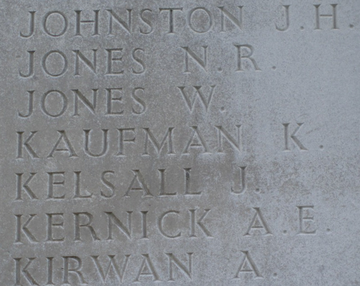
Joseph KELSALL
Eyes brown, Hair fair, Complexion fresh
Joseph Kelsall – A Lancashire Farmer Who Fell at Fromelles
Early Life - Lancashire to Africa to Australia
Joseph Kelsall was born in December 1880, and the April 1881 UK census lists him alongside his parents and older sister at just 4 months old. He was baptised 21 March 1881 in Rufford, St Mary, Lancashire.
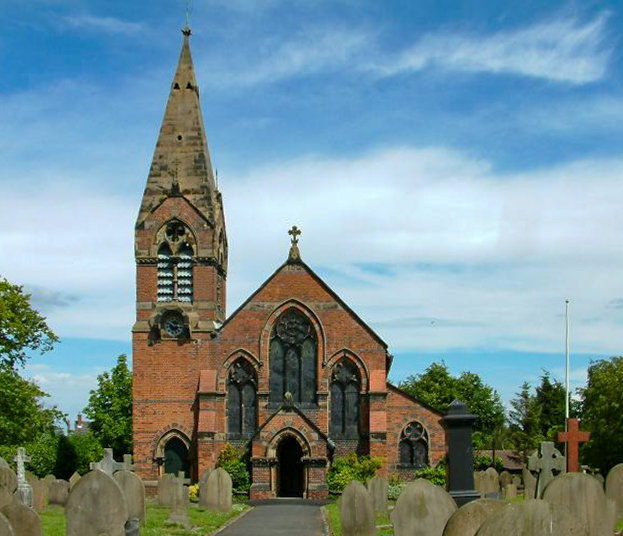
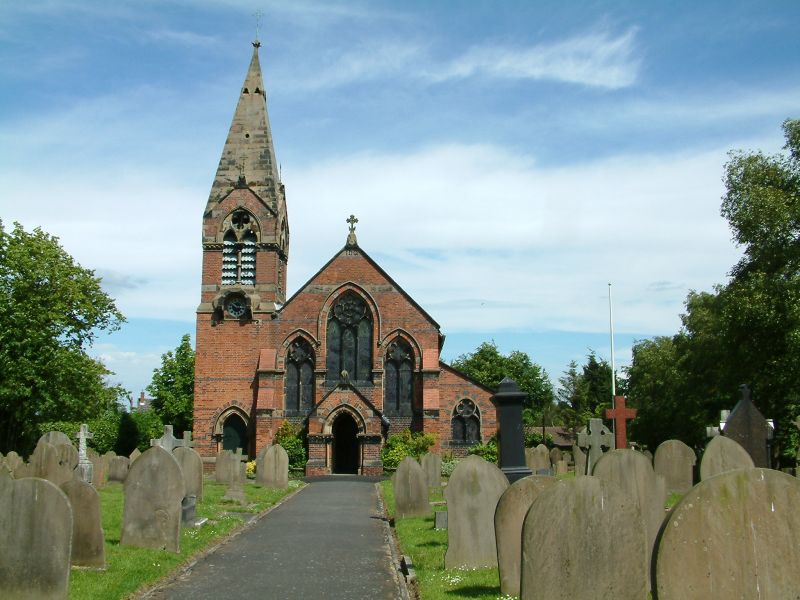
He was the second child of Margaret (nee Sanderson) and Thomas Kelsall’s five children:
- Evelyn (1879–1972)
- Joseph (1880-1916)
- Thomas (1883–1942)
- James (1885– )
- Raymond (1888– )
The family was living at Rufford Hall Farm, Lancashire, England, part of a very grand estate. Thomas was a substantial farmer, managing over 230 acres and employing several workers. Both the Kelsall and Sanderson families from this area of Lancashire were experienced farmers. Grandfather Kelsall was also the manager of a large farm with many employees. Today Rufford Hall Farm land now belongs to the National Trust where they are restoring peatland over 60 acres.
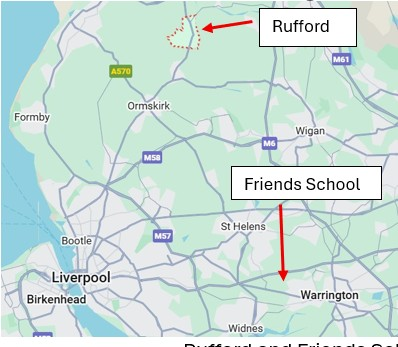
Joseph attended the Friends School, a Quaker run school in Penkeith, North Warrington. Although very rural, there are train lines from Rufford to Friends Lane. But the main education would have been the land itself, with all of the sons being assistants to their father. All four boys became farmers. As the children grew, only Evelyn was to remain in England. The four boys used their farming background to seek opportunities in Africa and Australia. Joseph’s brother Thomas married Janet Singleton Smethurst in 1887 and later emigrated to South Africa, where he farmed at Lydenburg, Transvaal.
This is probably where Joseph was in 1901 at age 21, as he was not in the UK for the 1901 census. While there, he did two years of service in the South African Constabulary (SAC) police service, which he noted on his AIF enlistment papers. There is a record of a Joseph Kelsall - ‘Description -1901-02 -Record of Conduct and Service of Joseph Kelsall, transferred to reserve.’ https://www.nationalarchives.gov.za/node/6020439
The SAC was a mounted force created in August 1900 by Lord Baden-Powell, combining military and police duties across the former Boer republics. Their role was to maintain security, protect supply routes, and restore order in newly occupied areas. It was organised into small, mobile squads led by corporals, with an emphasis on self-reliance, discipline, and initiative. The men were expected to be practical “handy men,” skilled in scouting, horse-handling, and local policing. Many, like Joseph, gained experience that would later serve them in civilian life or in future military service.
Source - https://en.wikipedia.org/wiki/South_African_Constabulary
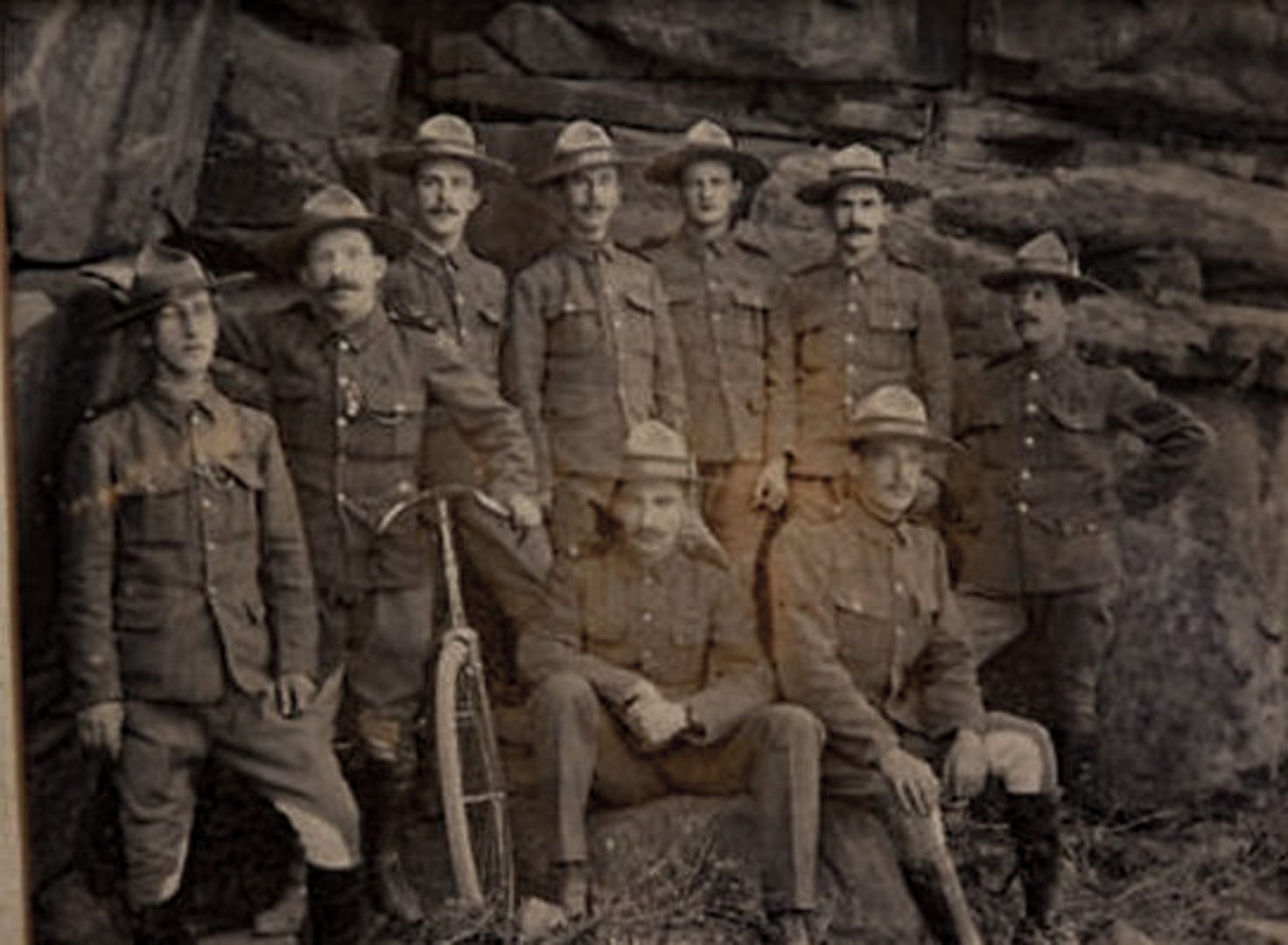
In 1901 the rest of the family was living in Hitchen, Hertfordshire - Thomas a dairyman, Evelyn a milliner, Thomas Jr a carpenter, James a butcher’s assistant and Raymond was at school. But the family moves to Africa continued – James migrated to Barberton, Transvaal, South Africa and Raymond to Uganda. James was Joseph’s next of kin on his Australian enlistment papers, so Joseph may have spent considerable time with James. Raymond, served in the Uganda Transport Corps, the East African Labour Corps, and the East African Forces during the First World War. Joseph returned to England before his decision to go even further afield to Australia, as in 1908 he sailed from from London to Victoria, Australia on the SS Oruba.

In the 1914 electoral rolls there is a Joseph Kelsall living in Railway Boarding house Footscray, but he also may have been farming/living with the Thexton family in Bairnsdale, who had four sons in the AIF, two of whom fought at Fromelles. After the battle, Mrs. Elizabeth Thexton was in contact with the Army seeking information about Joseph. Joseph’s experience as both a soldier and a farm worker made him a valuable recruit when he enlisted in the Australian Imperial Force in 1915, this time as part of Australia’s effort on the Western Front.
Off to War
Joseph enlisted in on 12 July 1915 at Melbourne, Victoria, aged 34. He listed his occupation as farmer and named his brother James Kelsall of Barberton, Transvaal, South Africa, as his next of kin. His attestation papers noted his previous service — two years with the South African Constabulary during the Boer War. He was allocated to the 22nd Battalion, 8th Reinforcements and after several months of training in Victoria, he embarked from Melbourne on 5 January 1916 aboard the HMAT A19 Afric, bound for Egypt. With the ‘doubling of the AIF’ as it expanded from two infantry divisions to five, major reorganisations were underway. Joseph was initially assigned to the newly formed 57th Battalion, but shortly afterwards was moved to the 58th.
Roughly half of the soldiers were Gallipoli veterans from the 6th Battalion and the other half were fresh reinforcements from Australia. The two groups were joined on 21 February while at the at the 40,000-man training camp at Tel-el-Kebir, about 110 km northeast of Cairo. After a month of training they were sent to Ferry Post, on foot, a trip of about 60 km that took three days. It was a significant challenge, walking over the soft sand in the 38°C heat with each man carrying their own possessions and 120 rounds of ammunition. Many of the men suffered heat stroke. Once there, the continued their training and were guarding the Suez Canal from any potential threats posed by the Ottoman Army.
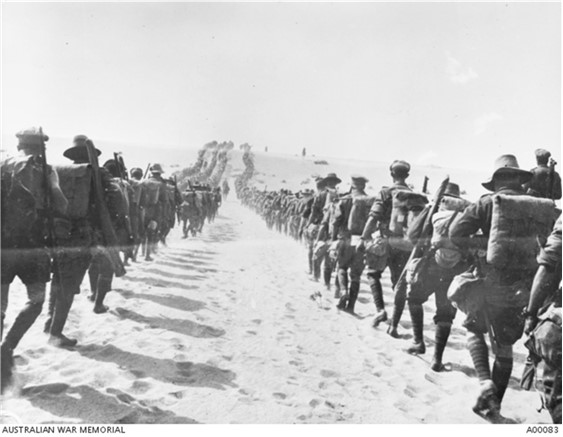
By early June 1916 the Battalion was at a total strength of over 1000 men. On 13 June they were in Moascar and orders were received to head to the Western Front. They boarded the H7 Transylvania in Alexandria on 17 June, arrived in Marseilles on the 23rd and immediately entrained for a three-day train ride to Steenbecque, 35 km from Fleurbaix in northern France. This area near Fleurbaix was known as the “Nursery Sector” – a supposedly relatively quiet area where inexperienced Allied troops could learn the harsh realities of Western Front trench warfare against the Germans. But the quiet times and the training period did not last long. After marching to Fleurbaix, with their training now including the use of gas masks, they were into the trenches for the first time on 11 July.
the lead up to Fromelles
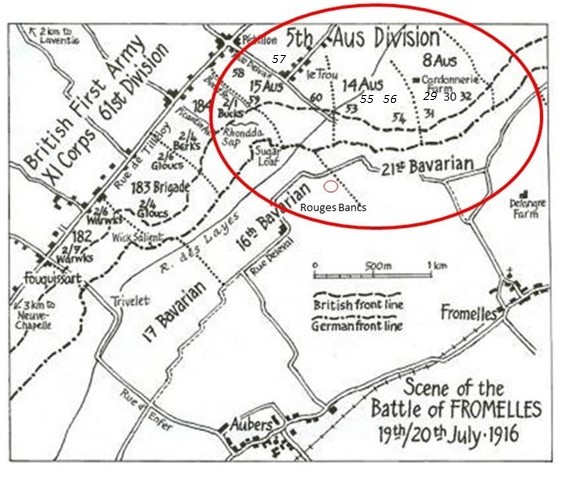
The battle plan had the Joseph’s 15th Brigade located just to the left of the British Army. The 59th and 60th Battalions were to be the lead units for this area of the attack, with the 58th and 57th as the ‘third and fourth’ battalions, in reserve. The main objective for the 15th Brigade was to take the trenches to the left of a heavily armed, elevated German defensive position, the ‘Sugar Loaf’, which dominated the front lines. If the Sugar Loaf could not be taken, the other battalions would be subjected to murderous enfilade fire from the machine-guns and counterattacks from that direction. As they advanced, they were to link up with the 60th and 54th Battalions on their flanks.
The 58th Battalion’s role was to be carrying ammunition, digging the communication trenches for area gained in No Man’s Land and into battle for fighting relief as needed.
On the morning of 15 July, the 58th were near the front lines, ahead of the 300 yard line (see below) when heavy shelling began, killing a number of soldiers and causing significant damage to the parapet and the communication trenches.
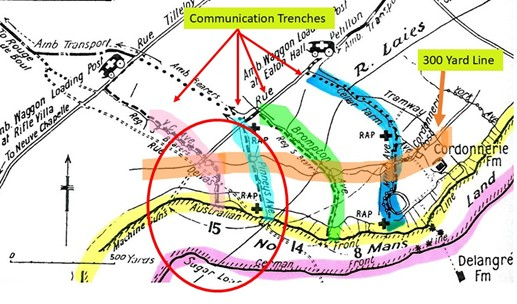
[[Source: CEW Bean Chapter III Trench Warfare – The Battle of Fromelles Page 45
Internet reference: chrome-extension://efaidnbmnnnibpcajpcglclefindmkaj/https://s3-ap-southeast-2.amazonaws.com/awm-media/collection/RCDIG1069509/document/5519006.PDF, edited]]
Further, a German raiding party made it into the Australian lines and was able to capture a Lewis Gun from the 58th.
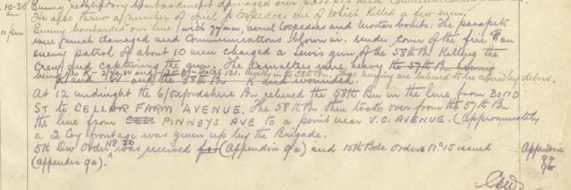
The 15th Brigade and 58th Battalion War diaries state the shelling resulted in:
“Great difficulty in evacuating killed and wounded…”
“Those missing are believed to be covered by debris.”
A and B Companies bore the brunt of the bombardment and between the shelling and the raid, 42 soldiers were killed, 103 were wounded and 5 were missing. Joseph’s record entry, written immediately after the major battle on the 21st, states that he was wounded on the 15th.
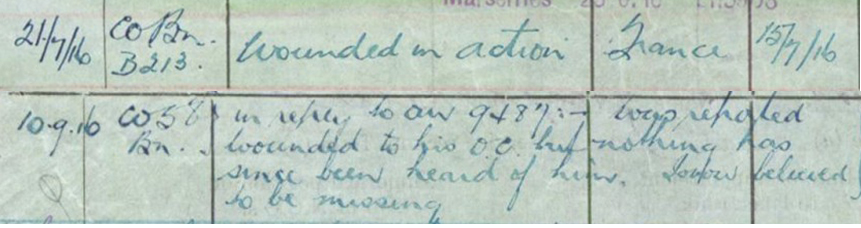
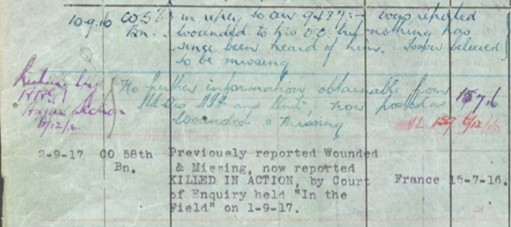
However, as the Battalion worked through sorting out individual’s details, Joseph went from wounded, but as no one had heard of him since the 15th, to wounded and missing and finally to Killed in Action. Other soldiers such as Victor Quinn and George Challis were also killed on the 15th, four days before the battle proper, with over 160 casualties recorded from a German raid supported by a severe bombardment.
Source: Tony De Bolfo - The Great Fallen: George Challis - Carlton Media, Apr 20, 2015
In the main battle on 19/20 July, the 59th and 60th went over the parapet at 5.45 PM on the 19th and there was immediate and intense fire from rifles and the Sugar Loaf machine guns, just a short distance away. As documented in the messages sent back to HQ just after the attacks began:
“cannot get on the trenches as they are full of the enemy”
“every man who rises is shot down”
With the severity of the German’s defence, the 58th A and B Companies were brought forward for fighting support at 9.00 PM. The 15th Brigade notes on the battle captures the intensity of this part of the attack – “they were enfiladed by machine guns in the Sugar Loaf and melted away.”

At 11.15 PM the rest of the 58th were brought forward to try digging in at 100 yards from the German trench, but no further progress was reported. By 2.52 AM all of the 58th were withdrawn and replaced by the 57th. They remained under heavy shelling until 10.00 AM on the 20th when the firing ceased. The next several days were spent trying to recover the wounded, under continuing heavy rifle and machine gun fire, and burying the dead. Of the 1002 men of the 58th that left Egypt, for a Battalion supposed to be ‘in reserve’, the roll call after the battle reflected 27 killed, 167 wounded and 53 missing.
Ultimately the impact was that 154 soldiers of the 58th were killed or died from wounds and 64 remain unidentified.
After the Battle
Joseph’s file shows no correspondence from his immediate family, however, his Australian contact, Mrs. Elizabeth Thexton, did contact the Army about Joseph. Elizabeth’s sons, John and James were in the 59th Battalion. John was wounded in the battle, but after recovering he returned to Australia in January 1917. James was initially reported as wounded, but being treated at the 2nd Canadian Stationary Hospital. However, in mid-September 1916 this was rescinded and he, also, had now joined Joseph as being among ‘missing’.
With both Joseph and James now missing, but with NO details available about either of them, Elizabeth wrote to Base Records in early January 1917 seeking information about whether Joseph had been just wounded or then wounded again and missing (and unstated, what DID happen to him?).
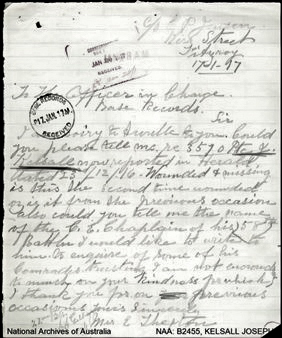
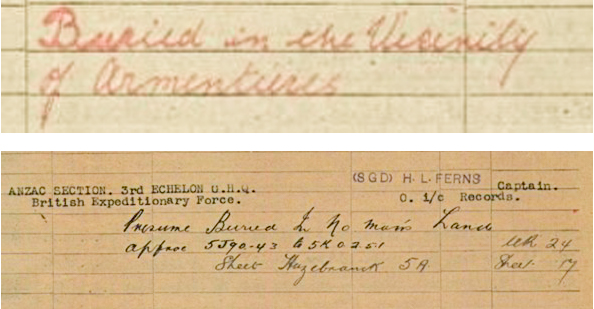
The Army’s response was polite, but they had no details to offer. It wasn’t until late August/early September 1917 that both were formally declared as having been killed in action, a very long wait with no closure for Elizabeth Thexton. Neither of their bodies have ever been found, but, curiously, both have an annotation in their files of being “buried”, but no details. This likely reflects the reality of being buried by shell fire in the field, not a proper burial.
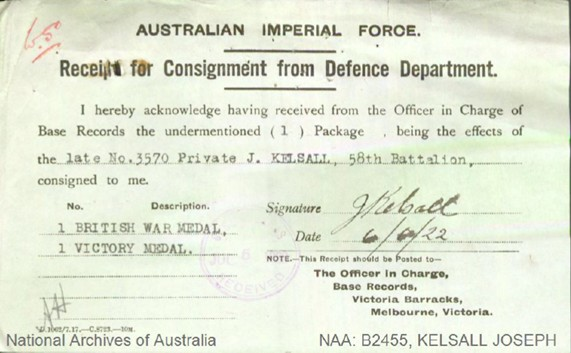
Joseph’s brother James Kelsall, still living in South Africa, was in contact with the AIF and his service medals — the British War Medal and the Victory Medal — were issued to James.
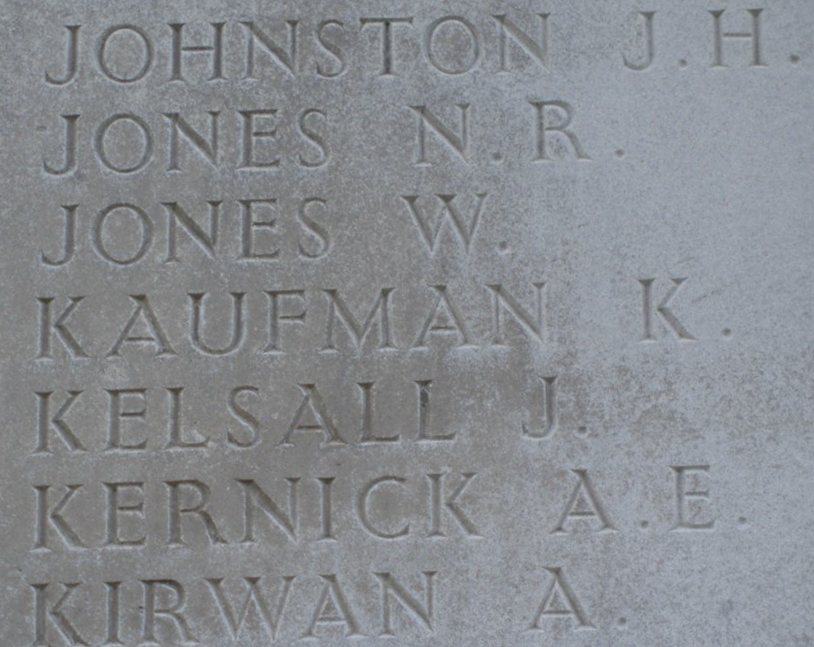
No trace of Joseph’s body was ever recovered and he has no known grave. As he was not killed during the 19/20th, his name is among the thousands carved into the Villers-Bretonneux Memorial, rather than at the VC Corner Memorial at Fromelles. Villers-Bretonneux honours the other Australians who fell in France and have no known resting place.
Finding Joseph
Joseph’s remains were not recovered, but even more than 100 years after the battle soldier identification efforts are continuing, with relatives contributing DNA to aid in this effort. We welcome all branches of Joseph’s family or the Thexton family to come forward to help with identifications.
If you know anything of family contacts in England or South Africa or Bairnsdale, Victoria, please contact the Fromelles Association. What we do know Joseph’s family is in the table below. We hope that one day Joseph can be named and honoured with a known grave.
Please visit Fromelles.info to follow the ongoing identification project and Joseph’s story.
DNA samples are being sought for family connections to
| Soldier | Joseph Kelsall (1880–1916) |
| Parents | Thomas Kelsall (1846–1901) & Margaret Sanderson (1847–1932) |
| Siblings | Evelyn Kelsall (1879–1972) – remained in England | ||
| Thomas Kelsall (1883–1942) – farmer in Lydenburg, Transvaal, South Africa; m. Janet Singleton Smethurst; six children: Mary, Annie, Emily, Janet Rosemund, Millicent, and Edith | |||
| James Kelsall (1885– ) – Barberton, Transvaal, South Africa | |||
| Raymond Kelsall (1888– ) – served 1914–1920 with Uganda Transport Corps, East African Labour Corps, East African Forces |
| Grandparents | |||
| Paternal | Joseph Kelsall (1813–1904) & Jane Cragg (1824–1881) | ||
| Maternal | James Sanderson (1803–1888) & Margaret Kitchen (1809–1882) |
Seeking DNA Donors

Contacts
(Contact: carla@fromelles.info or geoffrey@fromelles.info).
(Contact: army.uwc@defence.gov.au or phone 1800 019 090).
Donations
If you are able, please contribute to the upkeep of this resource.
(Contact: bill@fromelles.info ).