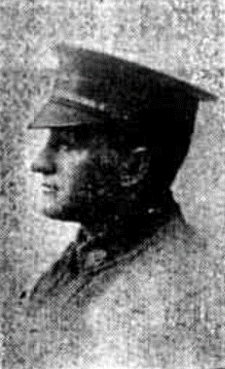
(1887-1916)
Livingstone Thomas FISK
Eyes blue, Hair dark, Complexion dark
Tom Fisk – A Fireman Who Served his Community and His Country
Can you help us identify Tom?
Tom Fisk killed in action at Fromelles, but his body was never found after the Battle and there are no records of his burial.
A mass grave was found in 2008 at Fromelles, a grave the Germans dug for 250 Australian soldiers they recovered after the battle. As of 2026, 181 of these soldiers have been able to be identified via DNA testing.
Tom may be among these remaining 69 unidentified men. There is still a chance to identify him — but we need help. We welcome all branches of his family to come forward to donate DNA to help with his identification, especially those with roots in Adelaide or England.
See the DNA box at the end of the story for what we do know about his family.
If you know anything of contacts for Tom, please contact the Fromelles Association.
With thanks to Josh Byerlee, a Senior Firefighter in the South Australian Metropolitan Fire Service, for his contributions to this story.
Early Life
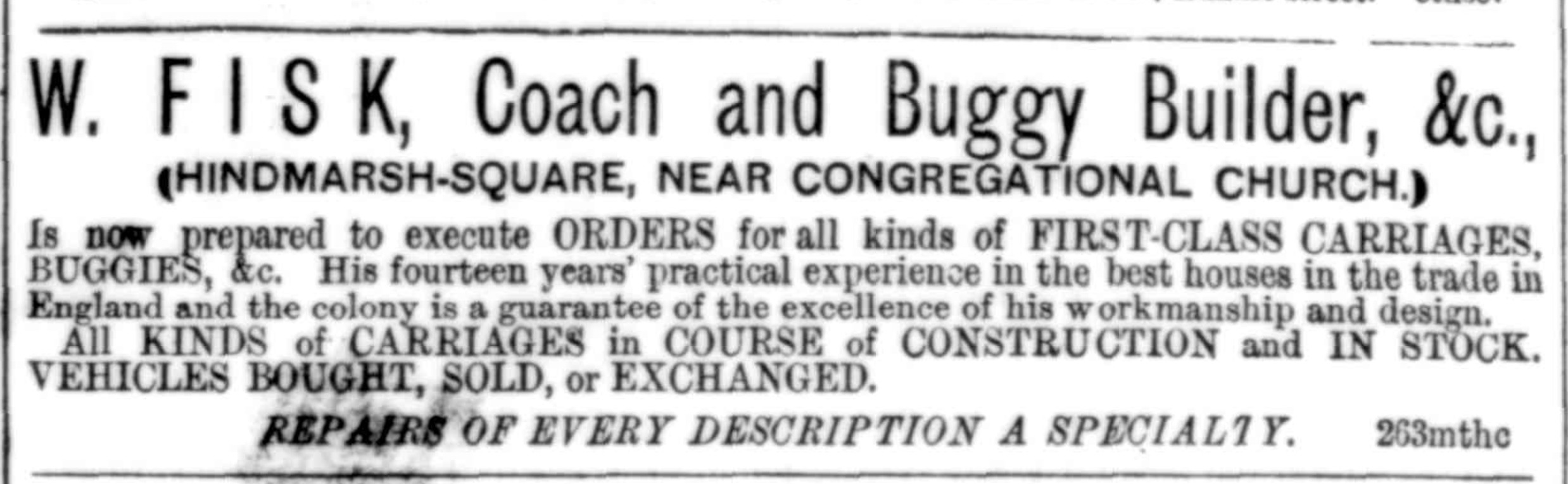
Livingstone Thomas Fisk (known as Tom) was born in Parkside, Adelaide, on 12 January 1887, the second son of William and Ellen Elizabeth (nee Thomas) Fisk. William Fisk was a coach body builder who arrived in Adelaide from London in December 1877, on the Stad Amsterdam. By 1882 he had his own Coach and Buggy Building business in central Adelaide.
Tom’s mother, Ellen Thomas, was the daughter of Frederick Augustus Thomas and Elizabeth Hamley. Frederick and Elizabeth had married in Cornwall, England in November 1848 and arrived in Adelaide on the Pakenham in March 1849. Frederick was a bootmaker and then a gardener in Adelaide. Ellen was the youngest of their three children who survived infancy, but was only two years old when her mother died. Her father remarried and Ellen had seven half siblings. William Fisk and Ellen Thomas married in Adelaide in 1884 and had 4 children - John (Jack) (1885-), Livingstone Thomas (Tom) (1887-1916), Sarah Ida (known as Ida) (1889-1976) and Stella Doris (1892-1978).
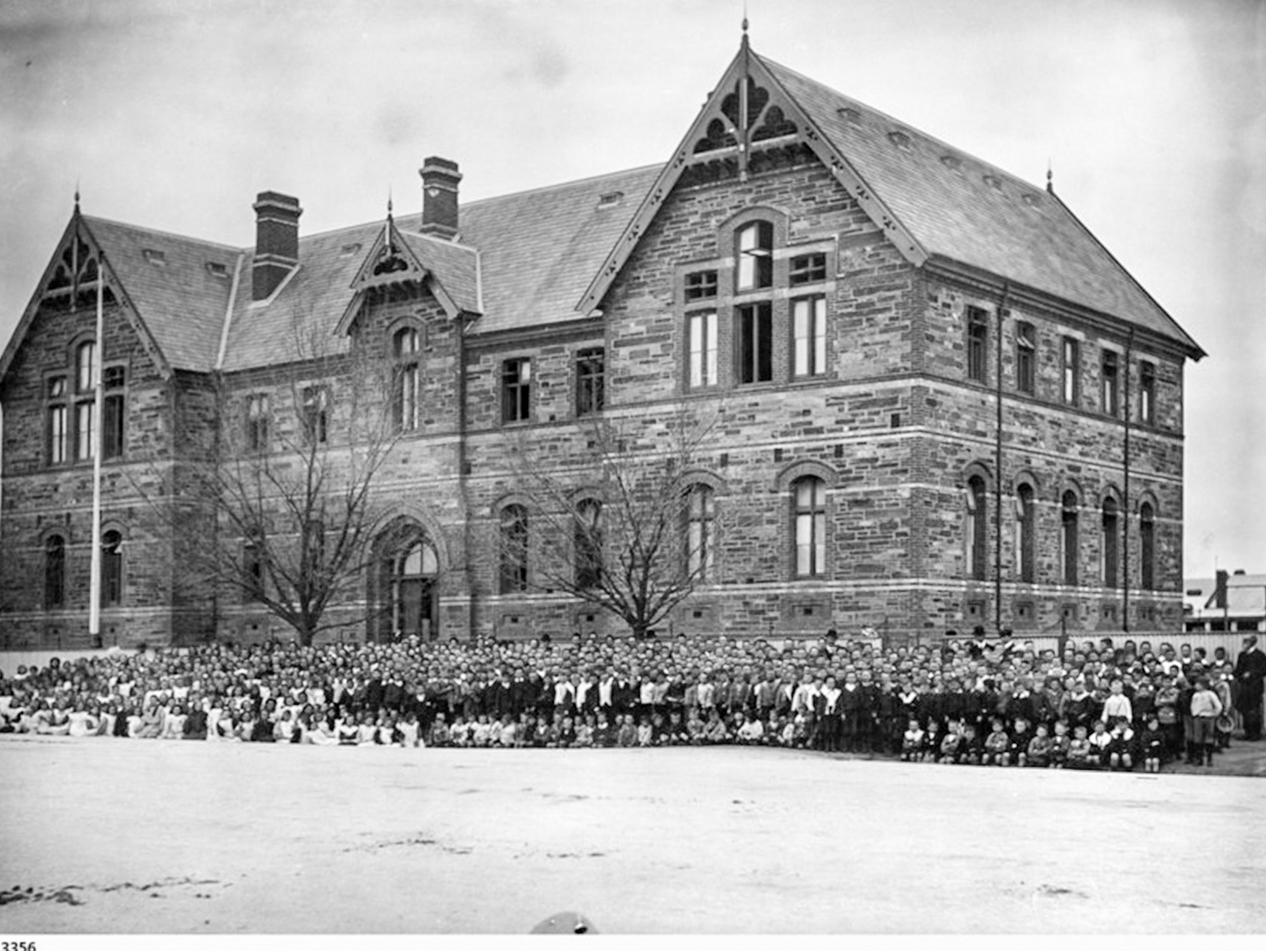
Although William continued his coach-building business in central Adelaide until the end of the century, there were financial difficulties. In 1886, just before Tom was born, there was a forced sale of his stock and his workshop equipment. The family had to regularly change their residential address and this is shown in the schools that the children attended. Information from Sturt St School has Tom was being enrolled there in February 1897, having previously attended Plympton School. The next year he moved again, to Flinders St School in central Adelaide. Although his brother and sisters also attended Sturt St at around the same time, their previous schools, dates of enrolment and length of stay varied.
Tom Fisk the fireman
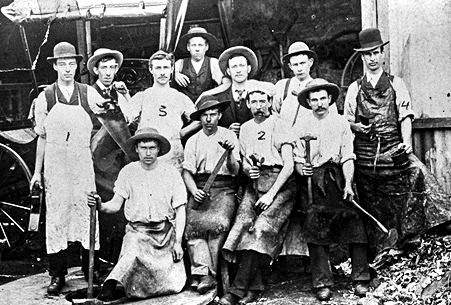
Tom joined the South Australian Fire Brigade in September 1907 when he was 20 years old. His service record states that his previous occupation was a Seaman – most fireman at the time had previous experience in the merchant navy, but the nature of Tom’s seagoing experience is unknown. Tom was initially stationed at the Head Station in Wakefield St, Adelaide, but spent periods at the Port Adelaide, Unley and Norwood stations before moving back to the Head Station in 1910. Fireman, needing to be available at short notice, lived at their station.
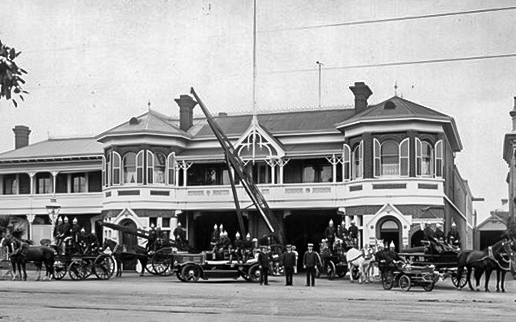
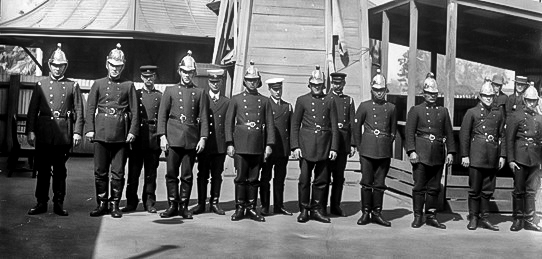
It was a life of long hours of duty, irregular bursts of activity and inevitable hazards, all of which would have later assisted Tom to adjust to a life in the military. Similarly, military expectations, discipline and punishment would have been familiar to him. Tom’s disciplinary record with the fire service shows only one offence – in November 1912, he was absent without leave from 9.45pm to 11.30pm. For this, he lost three months seniority and one short leave was stopped. Early in Tom’s career, a new Superintendent instituted a strict regime of physical exercise and gymnastics, as well as the development of proficiency by intensive firefighting drills. Every Friday at Head Station there was a public display of their skills.
They also had to be handymen, as all the smithing of horses and carpentering was done by them. Tom was also involved in the beginning of the transition from horse-drawn to motor fire appliances. Recreation was encouraged and tennis was a popular game. A drama company was also formed, which included Tom. In 1911, the Adelaide Lyric Club accepted an invitation to visit the Fire Brigade Headquarters in Wakefield St. After a demonstration of fire-fighting skills, the visitors were treated to a musical programme which included a song by Tom, followed by a sketch in which he played one of the characters. Tom passed his First Aid Examination in 1911 and participated in fire brigade teams at St John Ambulance demonstrations and competitions.
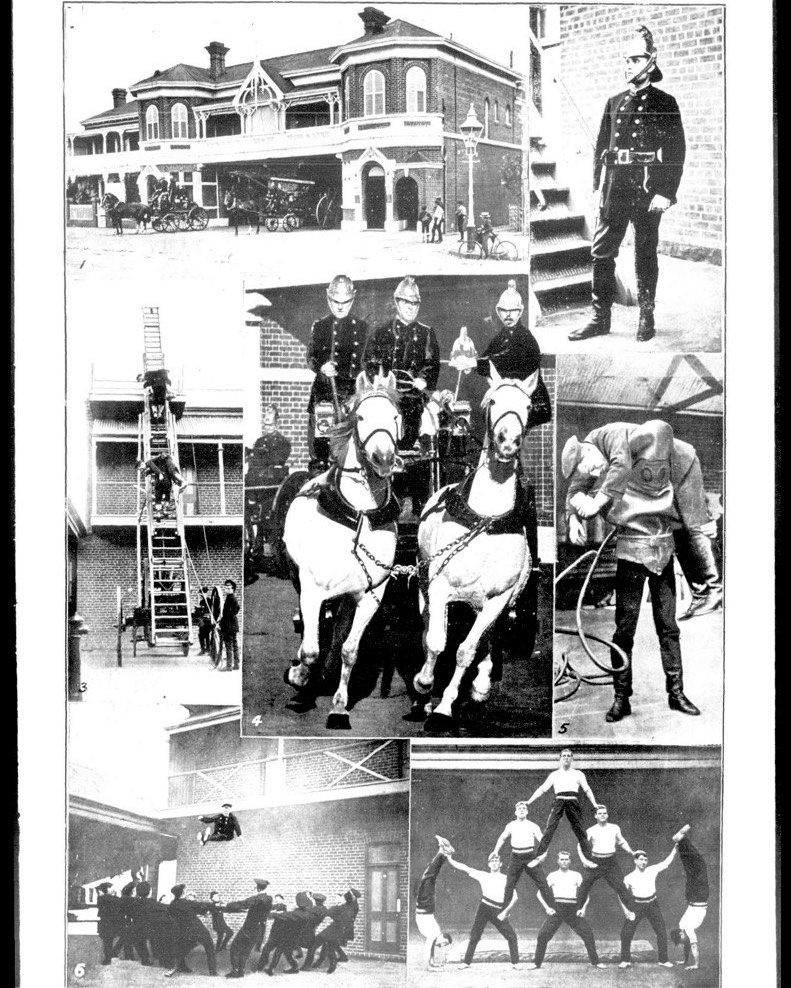
1. The Metropolitan Fire Station. 2. A Typical South Australian Fireman. 3. Practising Rescue Work. 4. Responding to a Call. 5. The Smoke Jacket and Helmet 6. Rescue Work; Jumping into a Tarpaulin. 7. Recreation and Exercise
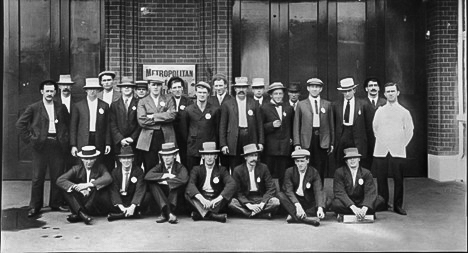
Tom would also have been involved in a dramatic standoff in 1912 between the firemen and the Fire Brigade Board. The men had formed a union and wanted the right to affiliate with the Trades and Labor Council — something the board refused to allow. The men were given an ultimatum to abandon the union or be dismissed. Their response was to turn up for duty — but without their uniforms. Wearing their civilian clothes, they declared they would attend every fire as unpaid volunteers, but would not perform station duties (other than feed the horses) until the board recognised their rights. That same day, when a fire broke out in a city hardware store, the engine roared down Gouger Street with most of its crew wearing ordinary jackets and trousers. Eventually compromises were made on both sides and the men returned to duty.
Source - Page, M. & Bryant, M. 1983, Muscle and pluck forever! - the South Australian fire services, 1840-1982 South Australian Metropolitan Fire Service pp 279-283
During 1914, Tom was twice involved in events which demonstrated the hazards of the fire-fighting career. In February, Tom was fighting a phosphorus fire when a splash of phosphorus hit him in the eye. In November, he had a lucky escape when fighting a widely reported city fire. He had carried a hose up a ladder to the third storey. When the water was turned on, its force made him lose his footing and he fell to the ground. His fall may have been broken by guy ropes and hoses on the ground and he was lucky to escape with relatively minor injuries. He was able to leave hospital the following day.
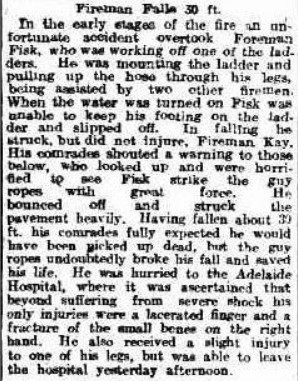
In 1912, Tom had passed an examination to be a Foreman and in April 1914 he was promoted to this position at Head Station. The foreman, unless a senior officer was there, had control of a fire station and command of men at a fire. Promotion in the brigade was on merit, so Tom must have been an efficient and well-regarded fireman.
###Off to War
When the war began in 1914, it was decided that firemen who volunteered for active service would be reinstated on their return with no loss of seniority. But the Fire Service was an essential service and there was concern that the patriotic decision to enlist could lead to a shortage of fireman. At the request of the Fire Service, military authorities agreed not to enlist any more firemen. But the pressure of patriotism after the Gallipoli landings swept such agreements aside and Tom was one of those who decided that fighting ‘for the empire’ should take priority over his fire service responsibilities.
On 25 June 1915, Tom was granted leave by the Fire Service to join the Expeditionary Force He enlisted at Keswick Barracks in Adelaide. He was 28 years old. He named his mother as his next of kin. His father had died and she had remarried and was now Ellen Edmunds, the wife of the publican of the well-known Brecknock Hotel in King William St, Adelaide. Tom entered Mitcham Camp on July 12. In the middle of August, he was assigned to the newly formed 32nd Battalion and became a member of B Company. A and B Companies were made up of recruits from South Australia, and C and D Companies came from Western Australia.
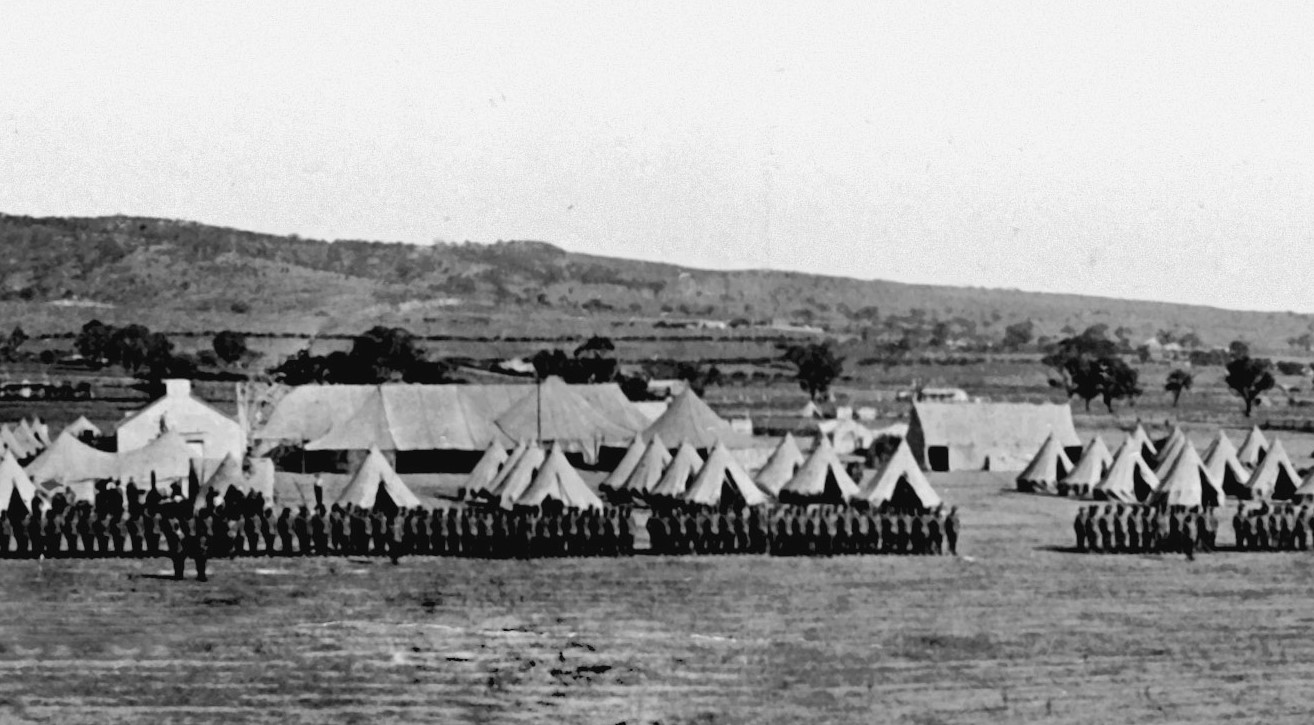
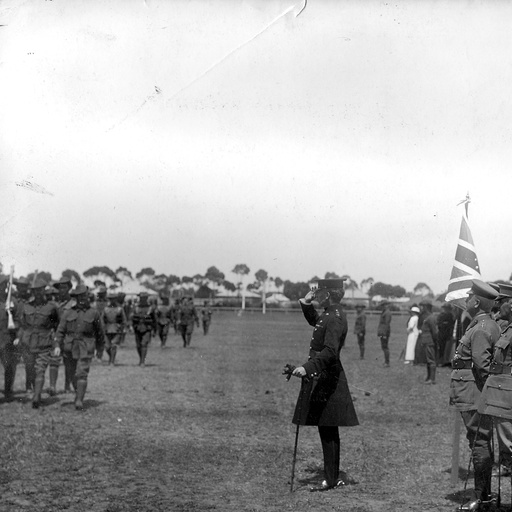
There was much fanfare about this new battalion in South Australia, with gatherings, community support, Cheer-up Society activities, reviews of the troops by the governor, and parades through the streets of Adelaide. On 16 September, the South Australian members of the Battalion moved to a new camp at Cheltenham Racecourse and they were joined at the end of September by the West Australians, who had begun their training at Blackboy Hill near Perth. Training continued at Cheltenham until their departure.
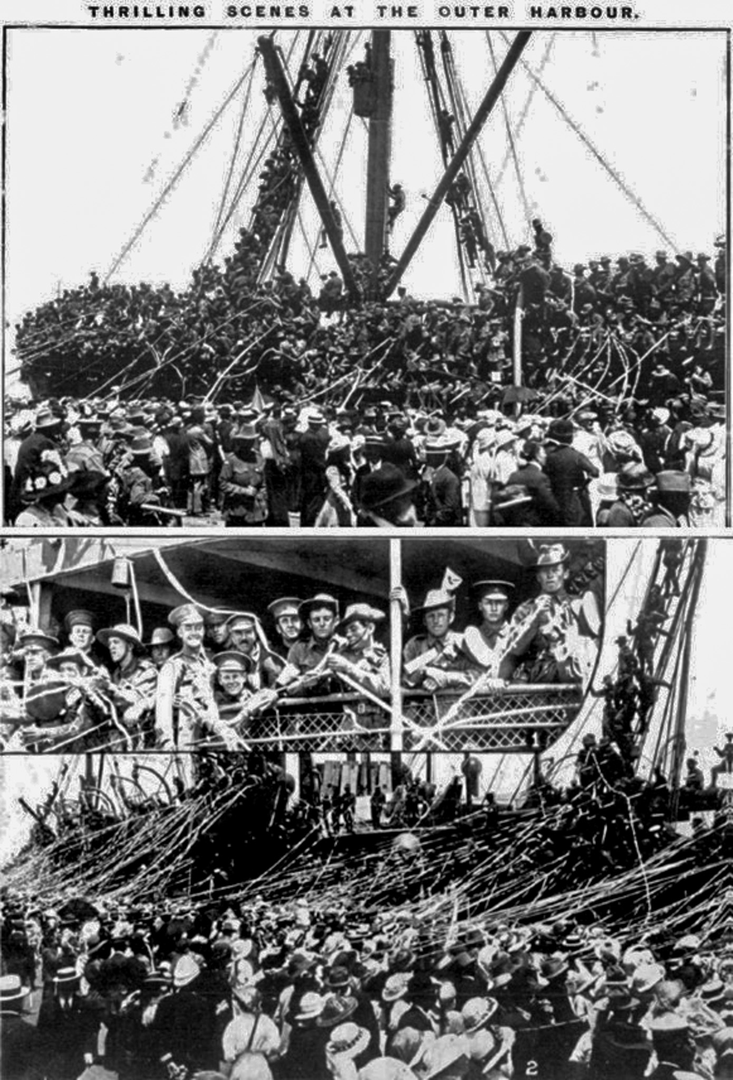
Most of the Battalion, including Tom, departed for Egypt on 18 November 1915, HMAT A2 Geelong, the transport section had left ten days earlier on HMAT A13 Katuna. As reported in The Adelaide Register:
“The 32nd Battalion went away with the determination to uphold the newborn prestige of Australian troops, and they were accorded a farewell which reflected the assurance of South Australians that that resolve would be realized.”
Egypt and France
The 32nd arrived in Suez on 14 December 1915 and moved to El Ferdan just before Christmas. A month later they marched to Ismailia and then to the major camp at Tel-el-Kebir where they stayed for February and most of March. Tel-el-Kebir was about 110 km northeast of Cairo and the 40,000 men in the camp were comprised of Gallipoli veterans and the thousands of reinforcements arriving regularly from Australia.
Tom must have adapted well to military life, and on 12 February, while at Tel-el-Kebir, he was promoted to Lance Corporal. The battalion’s next stop was at Duntroon Plateau and then at Ferry Post until the end of May, where they trained and guarded the Suez Canal. Their last posting in Egypt was a few weeks at Moascar. One soldier’s diary complained of being “sick up to the neck of heat and flies”, of the scarcity of water during their long marches through the sand and he described some of the food as “dog biscuits and bully beef”. He did go on to mention good times as well with swims, mail from home, visiting the local sights and the like.
Source - AWM C2081789 Diary of Theodor Milton PFLAUM 1915-16, page 29, page 12
While at Moascar, on 3 June, in the waiting period before the battalion sailed for France, Tom became a Temporary Corporal, standing in a man who was in hospital, He retained this rank as the men went into battle at Fromelles. During their time in Egypt the 32nd had the honour of being inspected by H.R.H. Prince of Wales.
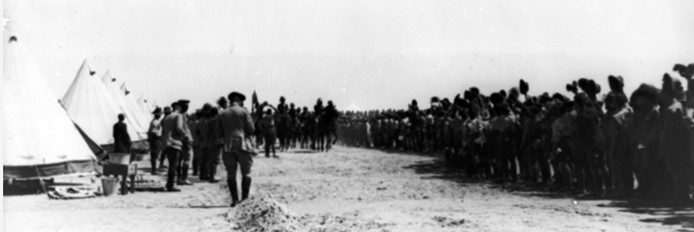
After spending six months in Egypt, the call to support the British Expeditionary Force on the Western Front came in mid-June. The 32nd left from Alexandria on the ship Transylvania on 17 June 1916, arriving at Marseilles, France on 23 June 1916 and they then immediately entrained for a three-day train trip to Steenbecque. Their route took them to a station just out of Paris, within sight of the Eiffel Tower, through Boulogne and Calais, with a view of the English Channel, before disembarking and marching to their camp at Morbecque, about 30 kilometres from Fleurbaix. Theodor Pflaum (No. 327) and Wesley Choat (No. 68) wrote about the trip:
“The people flocked out all along the line and cheered us as though we had the Kaiser as prisoner on board!!” – Theodore Pflaum
“The change of scenery in La Belle France was like healing ointment to our sunbaked faces and dust filled eyes. It seemed a veritable paradise, and it was hard to realise that in this land of seeming peace and picturesque beauty, one of the most fearful wars of all time was raging in the ruthless and devastating manner of "Hun" frightfulness”. – Wesley Choat
They were headed to the area of Fleurbaix in northern France which was known as the ‘Nursery Sector’ – a supposedly relatively quiet area where inexperienced Allied troops could learn the harsh realities of Western Front trench warfare against the Germans. But the quiet times did not last long. Training continued with a focus on bayonets and the use of gas masks, assuredly with a greater emphasis, given their position near the front. The 32nd moved to the Front on 14 July and Tom was into the trenches for the first time on 16 July, only three weeks after arriving in France.
The Battle of Fromelles
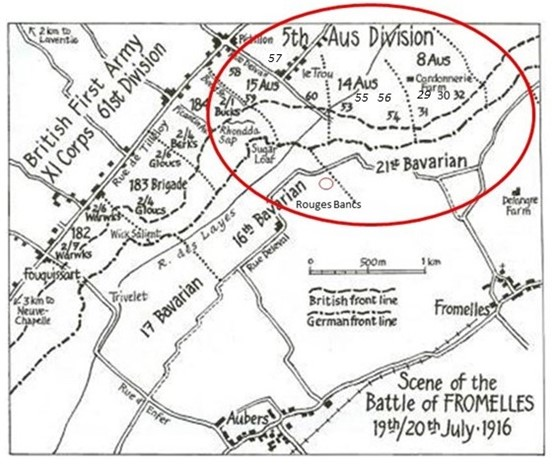
D Company’s Lieutenant Sam Mills’ letters home were optimistic for the coming battle:
“We are not doing much work now, just enough to keep us fit—mostly route marching and helmet drill. We have our gas helmets and steel helmets, so we are prepared for anything. They are both very good, so a man is pretty safe.”
On the 17th the battalion were reconnoitring the trenches and cutting passages through the barbed wire, preparing for an attack, but it was delayed due to the weather. The overall plan was to use brigades from the Australian Fifth Division to conduct a diversionary assault on the German trenches at Fromelles. The 32nd Battalion’s position was on the extreme left flank, with only 100 metres of No Man’s Land to get the German trenches. As they advanced, they were to link up with the 31st Battalion on their right. However, their position made the job more difficult, as not only did they have to protect themselves while advancing, but they also had to block off the Germans on their left, to stop them from coming around behind them. On the morning of the 18th, A Company and C Company went into the trenches to relieve B and D Companies, who rejoined the next day. The Zero Hour for advancing from their front-line trenches was to be 5.45 PM, but the Germans knew this attack was coming and were well-prepared. They opened a massive artillery bombardment on the Australians at 5.15 PM, causing chaos and many casualties. The charge over the parapet began at 5.53 PM. A and C companies were in the first and second waves to go. Tom’s B company, along with D company were in the third and fourth. They were successful in the initial assaults and by 6.30 PM were in control of the German’s 1st line system (map, Trench B), which was described as “practically a ditch with from 1 to 2 feet of mud and slush at the bottom”. Source - AWM4 23/49/12, 32nd Battalion War Diaries, July 1916, page 11 Unfortunately, with the success of their attack, ‘friendly’ artillery fire caused a large number of casualties because the artillery observers were unable to confirm the position of the Australian gains. They were able to take out a German machine gun in their early advances, but were being “seriously enfiladed” from their left flank.
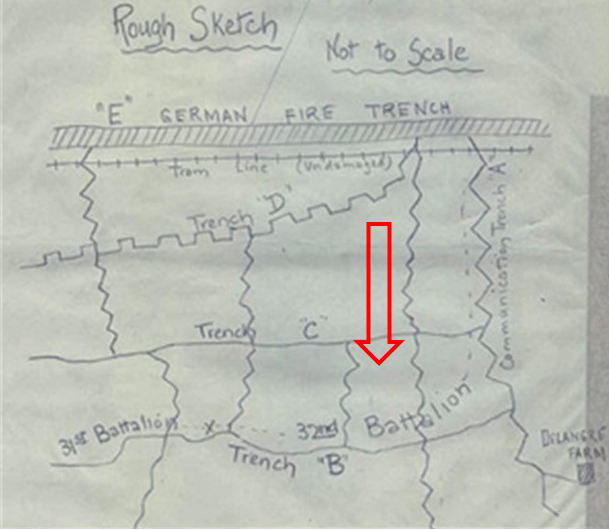
By 8.30 PM their left flank had come under heavy bombardment with high explosives and shrapnel. Return bombardment support was provided and the 32nd were told that “the trenches were to be held at all costs”.
Source - AWM4 23/49/12, 32nd Battalion War Diaries, July 1916, page 12
Fighting continued through the night. The Australians made a further charge at the main German line beyond Trench B, but they were low on grenades, there was machine gun fire from behind them from the emplacement at Delangre Farm and they were so far advanced that they were getting shelled by both sides. In the early morning of the 20th, the Germans began a counterattack from the Australian’s left flank, bombing and advancing into Trench A (map). Given the Australian advances that had been made earlier, the rear Trench E had been left almost empty, which then enabled the Germans to regain that trench and envelop the men of the 32nd. At 5.30 AM the Germans attacked from both flanks in force and with bombing parties. Having only a few grenades left, the only resistance they could offer was with rifles:
“The enemy swarmed in and the retirement across No Mans’ Land resembled shambles, the enemy artillery and machine guns doing deadly damage.”
What was left of the 32nd had finally withdrawn by 7.30 AM on the 20th. The initial roll call count was devastating – 71 killed, 375 wounded and 219 missing, including Tom. To get some perspective of the battle, when Charles Bean, Australia’s official war historian, attended the battlefield two and half years late, he observed a large quantity of bones, torn uniforms and Australian kit still on the battlefield. The final impact was that 225 soldiers of the 32nd Battalion were killed or died from wounds sustained at the battle and, of this, 166 were unidentified. Lieutenant Sam Mills survived the battle. In his letters home, he recalls the bravery of the men:
“They came over the parapet like racehorses……… However, a man could ask nothing better, if he had to go, than to go in a charge like that, and they certainly did their job like heroes."
After the Battle
Tom Fisk was killed during the Battle of Fromelles. No records or eye-witness accounts survive to give any indication about what might have happened to him during the battle. Although he was reported killed (rather than missing), he has no known grave.

In the middle of August, the notification of his death was sent to the Military Commandant in Adelaide and Tom’s mother was quickly informed. His death notice appeared in Adelaide newspapers from 16 August, followed ten days later by an expression of thanks for all the expressions of sympathy his family had received. A further small insertion, mentioning his service with the Metropolitan Fire Brigade and including Tom’s photo, appeared in papers from late August.
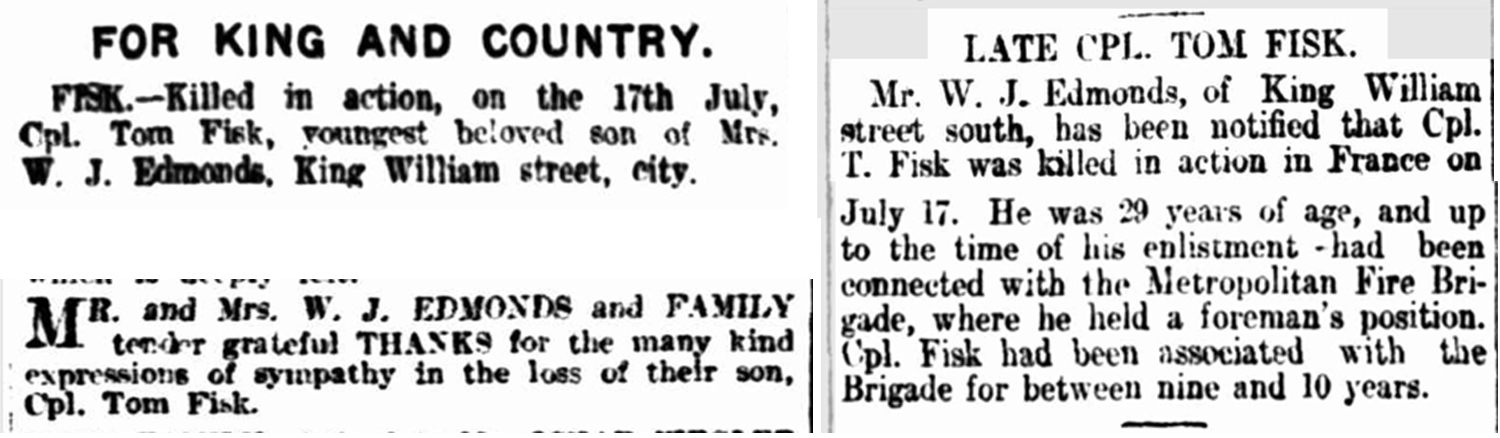
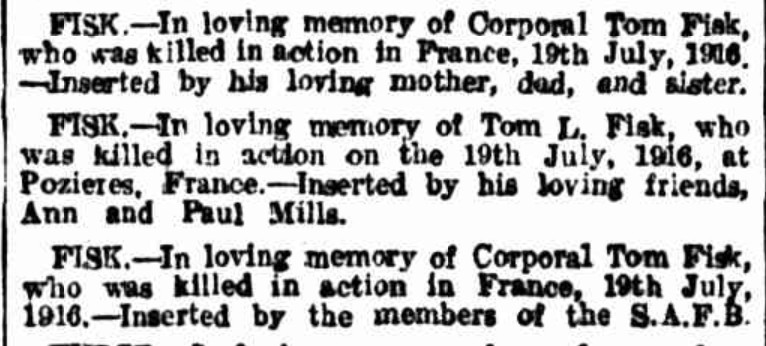
In the following years, among the memorials from many others of the 32nd battalion who had died at Fromelles, were memorial articles from his family, friends and his workmates at the Fire Brigade.
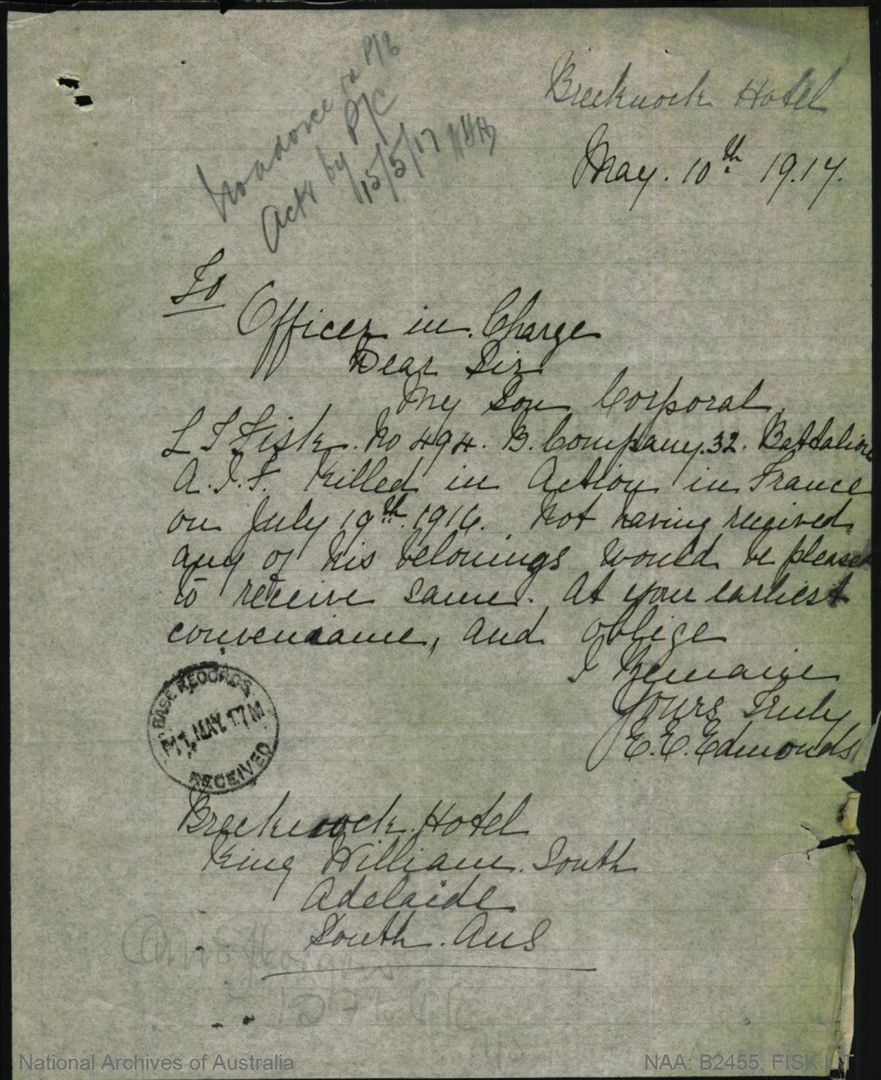
Tom’s mother wrote to the military in May 1917 requesting that Tom’s ‘belongings’ be returned to her. There is no record in his file of a response and there is also no record of any belongings being returned to her. It is likely that Ellen, like the families of many men lost at Fromelles, longed to have something returned which had belonged to her son, but received nothing.
As next of kin, Ellen had received all communication from the military. But when it came to distribution of Tom’s medals and other mementos, she was not the automatic recipient. She was no doubt upset when she received a letter in 1921 which asked her whether Tom had ‘any nearer blood relations than yourself’. The letter then asked whether Tom’s father was alive, Ellen did not respond and military headquarters in Adelaide was asked to make enquiries, Eventually Ellen tersely responded:
”I, being his mother, am next of kin. From the time of his embarkation, I have been in receipt of any benefits, he having left everything to me.”
As this still did not answer the question about Tom’s father, the military in Adelaide was asked to make further enquiries. It eventually declared that it had been ascertained that Tom’s father was deceased and Ellen received Tom’s medals.
Remembering Tom
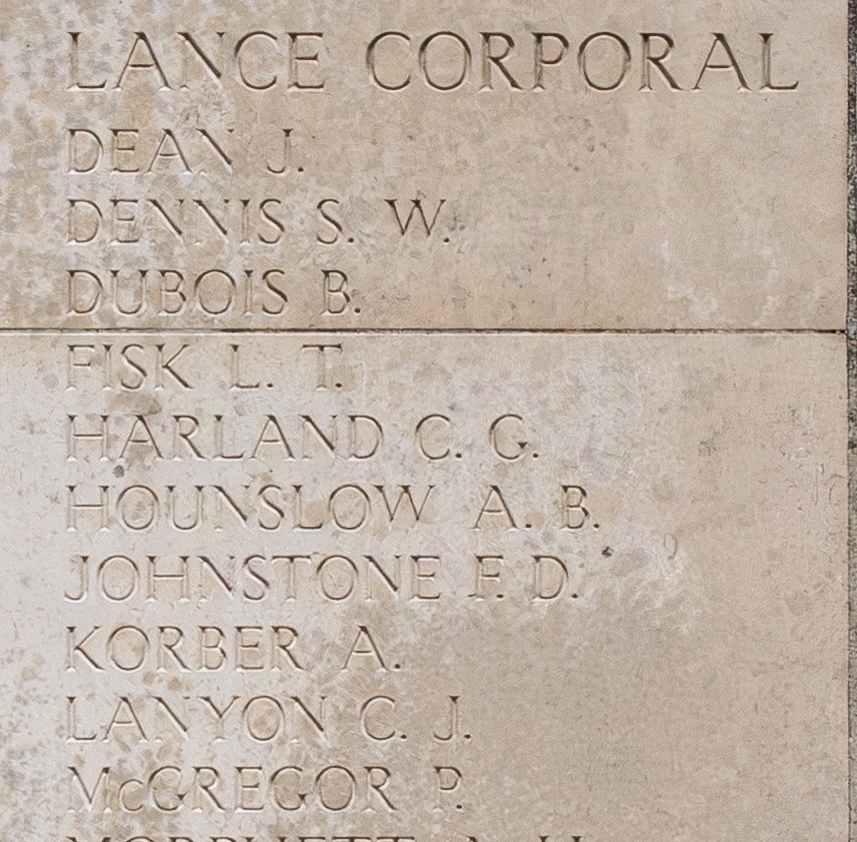
Lance Corporal L.T. Fisk’s name is inscribed on Panel 4 of the V.C. Corner Australian Cemetery Memorial at Fromelles, which commemorates all the Australians killed at Fromelles whose bodies were not recovered after the battle.
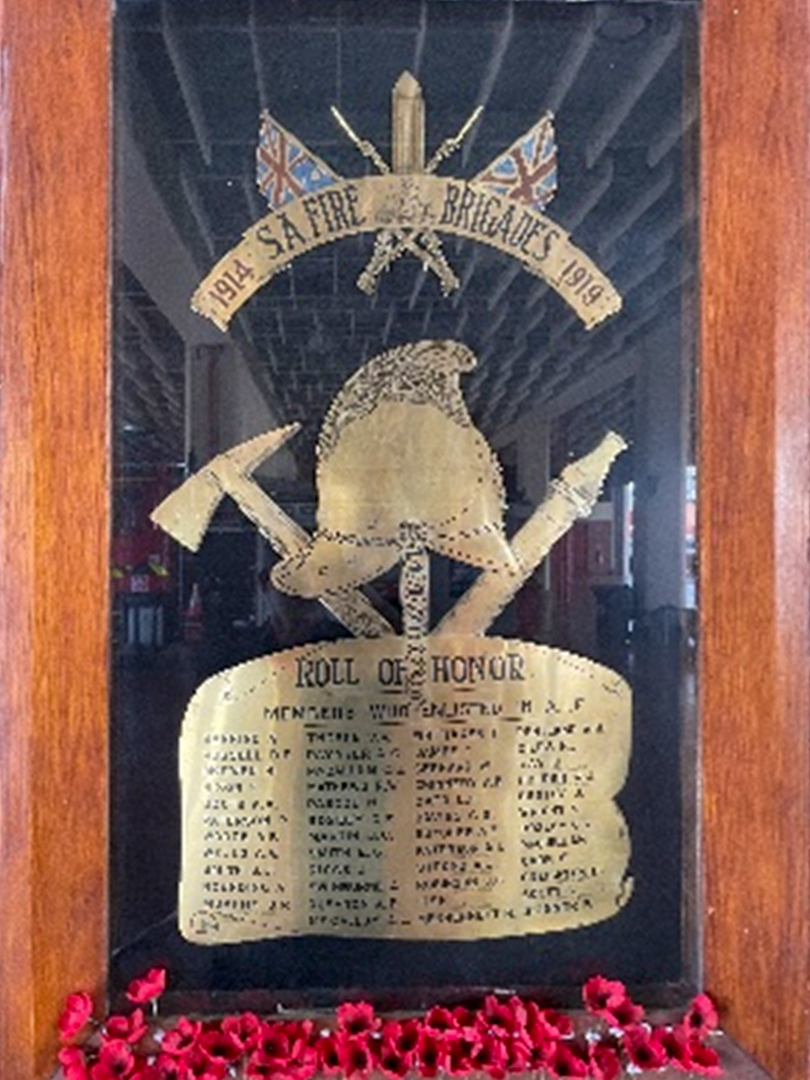
Tom is honoured by the South Australian Metropolitan Fire Service on the Memorial Honour Roll at its Headquarters, the Australian War Memorial Roll of Honour, Canberra and the South Australian National War Memorial.
Finding Tom
Tom’s remains were not recovered; he has no known grave. After the battle, the Germans recovered 250 Australian soldiers and placed them in a burial pit at Pheasant Wood. This grave was discovered in 2008 and since then efforts have been underway to identify these soldiers by DNA testing from family members. As of 2026, 181 of the soldiers have been identified, including 41of the 166 unidentified soldiers from the 32nd Battalion.
We welcome all branches of Tom’s family to come forward to donate DNA to help with his identification. If you know anything of family contacts from Adelaide or England, please contact the Fromelles Association. We hope that one day Tom will be named and honoured with a known grave.
Please visit Fromelles.info to follow the ongoing identification project and Tom’s story.
DNA samples are being sought for family connections to
| Soldier | Livingstone Thomas Fisk (1887-1916) |
| Parents | William Fisk (c1852-?) born England, arrived in SA in 1877, and Ellen Elizabeth Thomas (1859-1940) born and died in Adelaide |
| Siblings | |||
| John (Jack) Fisk (1885- ) born Adelaide, lived in India | |||
| Sarah Ida Fisk - known as Ida - (1889 -1976) Born and died in Adelaide, SA. Married Charles Francis Duffield in Peterborough in 1916. | |||
| Stella Doris Fisk (1892-1978) born and died in Adelaide, never married |
| Grandparents | |||
| Paternal | William Fisk (no confirmed details) and grandmother unknown) | ||
| Maternal | Frederick Augustus Thomas (1821-1897) Born Penzance, Cornwall, England, died Adelaide) and Elizabeth Hamley (1820 – 1861) Born Cornwall, England, died Adelaide. Both arrived in South Australia in 1849 |
Seeking DNA Donors

Contacts
(Contact: carla@fromelles.info or geoffrey@fromelles.info).
(Contact: army.uwc@defence.gov.au or phone 1800 019 090).
Donations
If you are able, please contribute to the upkeep of this resource.
(Contact: bill@fromelles.info ).