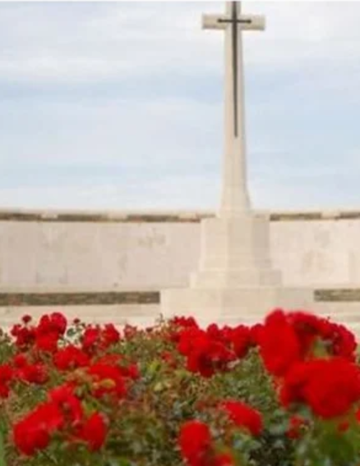
William Whyte Stuart OWEN
Eyes blue, Hair brown, Complexion fair
William Whyte Stuart Owen — The Prodigal Son Who Never Returned
Can you help find Bill?
William “Bill” Whyte Stuart Owen’s body was never found after the Battle of Fromelles, and there are no records of his burial.
A mass grave was found in 2008 at Fromelles, a grave the Germans dug for 250 Australian soldiers they recovered after the battle. As of 2026, 181 of these soldiers have been able to be identified via DNA testing.
Bill may be among these remaining 69 unidentified men. There is still a chance to identify him — but we need help. We welcome all branches of his family to come forward to donate DNA to help with his identification, especially those with roots in Ayrshire, Scotland, SCO
See the DNA box at the end of the story for what we do know about his family.
If you know anything of contacts for Bill, please contact the Fromelles Association.
Early Life
William Whyte Stuart Owen, known as Bill to his family, was born on 31 October 1889 in Dreghorn, Ayrshire, Scotland, the youngest child of William John Owen and Elizabeth Stuart Whyte Vass. Elizabeth and William married in 1873. She had two children before her marriage:
- David Owen Vass (c.1871–)
- Jessie (Jean) (1873–1968)
- Martha (c.1876–1952)
- John Owen (c.1878–)
- Alexander (c.1880–)
- Elizabeth Stewart (c.1883–)
- Isabella McCreath (1885–1906)
- Agnes (c.1887– )
- William Whyte Stuart (31 Oct 1889–1916), KIA Fromelles
All the children were raised in the Owen household near Dundonald, Ayrshire, about 50 km south of Glasgow. Bill grew up in the miners’ rows of Dreghorn on the now-vanished Cuninghame/Cunningham Green Terrace, not far from Dundonald Castle. These rows, once home to coal-mining families, no longer exist on modern maps. Bill’s father was a colliery overman, as shown in the 1891 Scotland census.
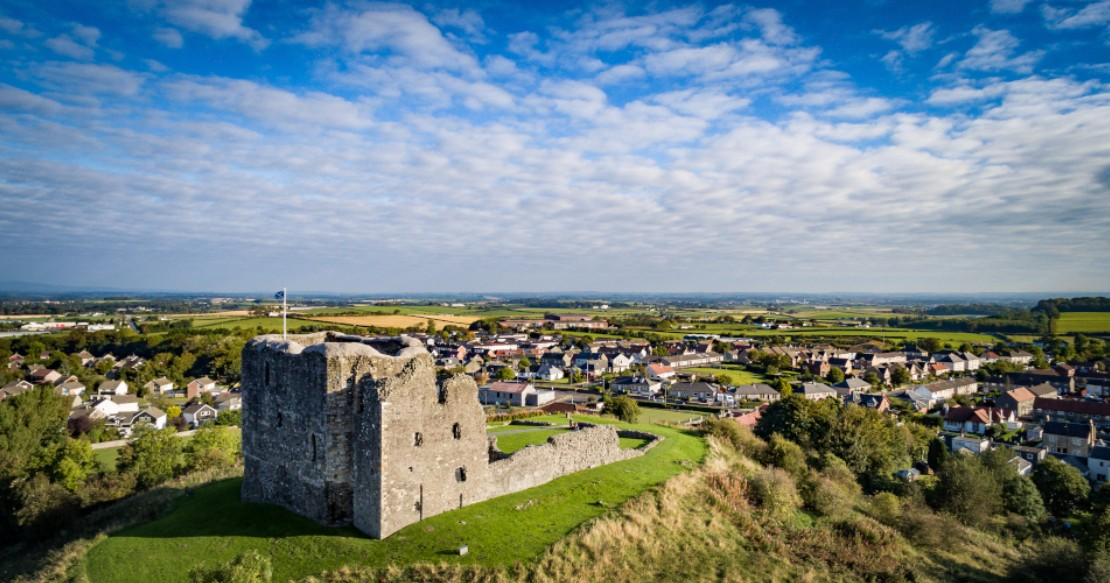
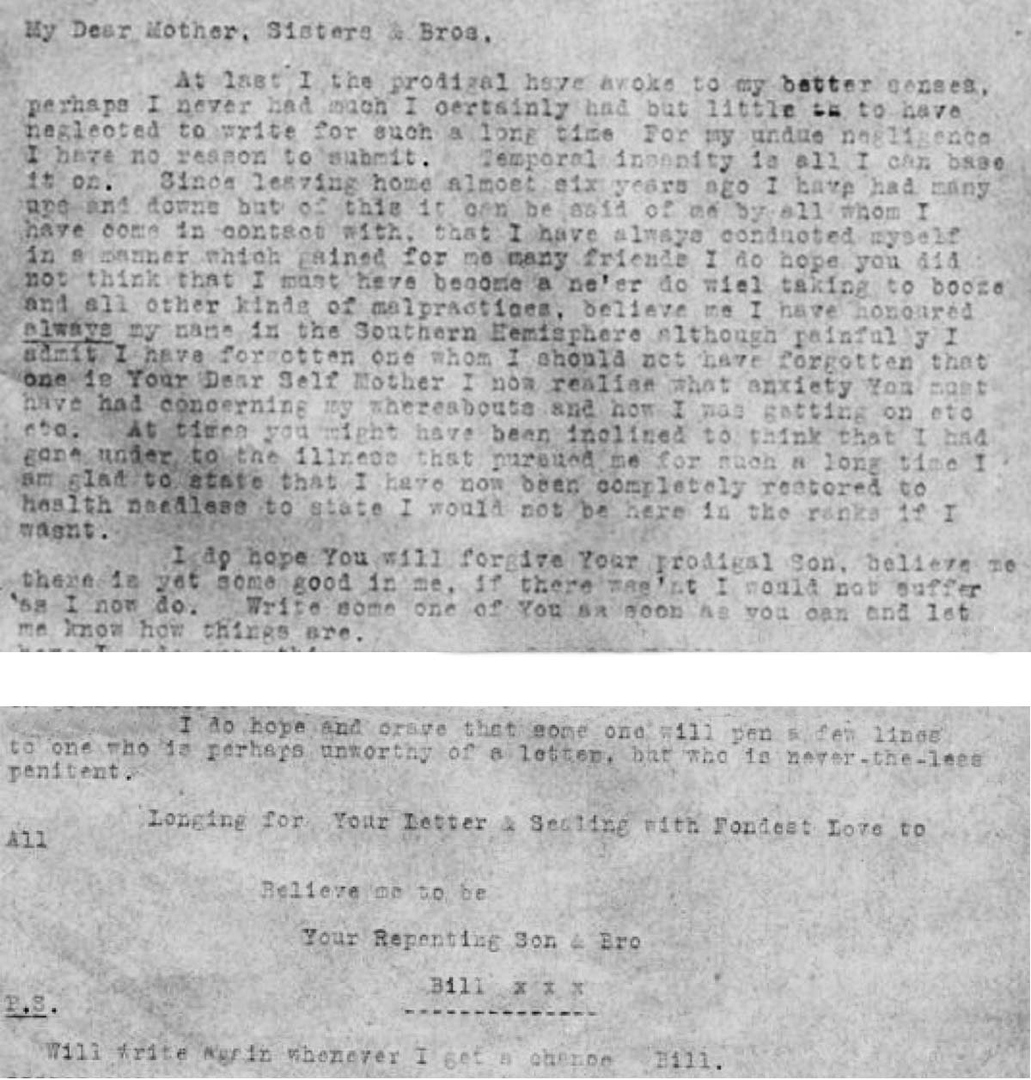
Bill emigrated to Australia as a young adult and settled at Muscle Creek, a small locality south of Muswellbrook in the Hunter Region of New South Wales. He was an overseer on one of the sheep or cattle properties in the area, supervising stockmen and shearers and looking after large number of sheep and cattle in the higher country around Muswellbrook. After he had enlisted, he wrote a long, reflective letter home that included insights about his background. It reads as if it must have been his first communication home after he left Scotland, as he refers to himself as a “prodigal son”.
He also mentions an “illness that pursued me for such a long time”, from which he recovered, but no details are provided. It is a surviving glimpse into his inner life, revealing a man determined to rebuild trust and honour with his family despite the distance between them.
Off to War
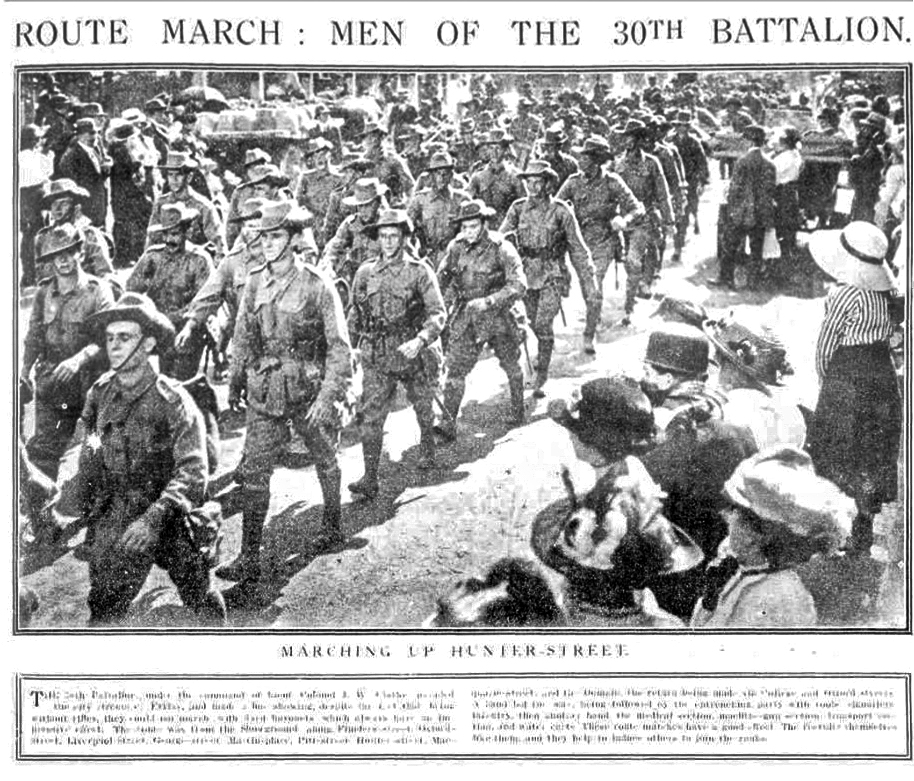
Bill, like many British migrants in rural New South Wales, would have followed the war news closely. On 28 August 1915, at the age of 25, he travelled to Sydney by steam train and enlisted in the AIF. He was posted to C Company, 30th Battalion, part of the newly raised 5th Division. His training commenced in the Liverpool camp, but in September they moved to the Royal Agricultural Show Grounds in Moore Park, Sydney. There were numerous reports of their activities in the papers.
Bill left Sydney for the training camps in Egypt aboard HMAT A72 Beltana at 3.30 PM on 9 November 1915. The trip was uneventful and they disembarked in Egypt on 11 December. His first seven weeks were spent at Ferry Post guarding the Suez Canal from any potential threats posed by the Ottoman Army and continuing his training. February and March were spent at the 40,000 man camp at Tel-el-Kebir, 110 km northeast of Cairo. Bill was treated for gastric enteritis for a short period but returned quickly to duty. While at Tel-el-Kebir, the 30th were inspected by H.R.H. the Prince of Wales.
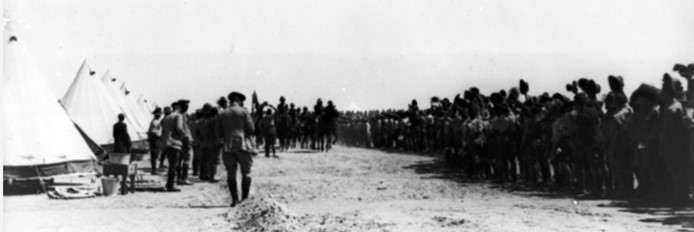
For much of April and May the 30th were back in Ferry Post, including some time in the front-line trenches there. There were the usual complaints of the heat, water supplies and flies. On 16 June 1916, Bill left Egypt for the Western Front on HMAT Hororata, arriving in Marseilles on 23 June. After landing, the 30th were immediately entrained for a 60+ hour train ride to Hazebrouck, 30 km from Fleurbaix. They arrived on 29 June and then encamped in Morbecque. Private F.R. Sharp (2154) wrote home about this experience:
“From the time we left Marseilles until we reached our destination was nothing but one long stretch of farms and the scenery was magnificent.” “France is a country worth fighting for.”
The area near Fleurbaix was known as the “Nursery Sector” – a supposedly relatively quiet area where the inexperienced Allied troops could learn the harsh realities of Western Front trench warfare against the Germans. But the quiet times and the training period did not last long. Training now included the use of gas masks and they also would have heard the heavy artillery from the front lines. On 8 July they were headed to the front lines, first to Estaires, 20 km and the next day 11 km to Erquinghem, where they were billeted at Jesus Farm. They got their first ‘taste’ of being in the front lines at 9.00 PM on 10 July.
Battle of Fromelles
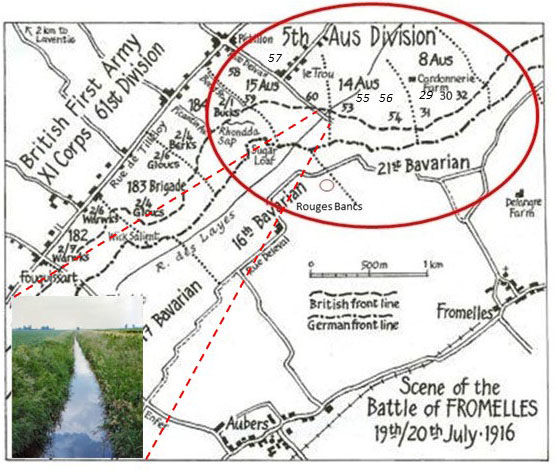
The overall plan was to use brigades from the Australian Fifth Division to conduct a diversionary assault on the German trenches at Fromelles. The 30th Battalion’s role was to provide support for the attacking 31st and 32nd Battalions by digging trenches and providing carrying parties for supplies and ammunition. They would be called in as reserves if needed for the fighting. The attack was initially planned for 17 July, but it was postponed due to the weather. In his final letter home Charles Albert Woods (2194 30th Bn) summed up the situation he found himself in:
“Since writing last we have shifted from ‘somewhere in France’ to ‘somewhere else in France,’ and are now in the trenches. Whilst writing this the shells are whistling over our heads a ‘treat.’ We are all provided with steel helmets to lessen the danger of being hit in the head with shrapnel, and also with gas helmets, to put on while a gas attack is being made on us.”
Then, on 19 July, the 29 officers and 927 other ranks of the 30th Battalion were into battle. Zero Hour for advancing from their front-line trenches was to be 5.45 PM, but the Germans knew this attack was coming and were well-prepared. They opened a massive artillery bombardment on the Australians at 5.15 PM, causing chaos and many casualties. The 32nd’s charge over the parapet began at 5.53 PM and the 31st’s at 5.58 PM. There were machine gun emplacements to their left and directly ahead at Delrangre Farm and there was heavy artillery fire in No-Man’s-Land.
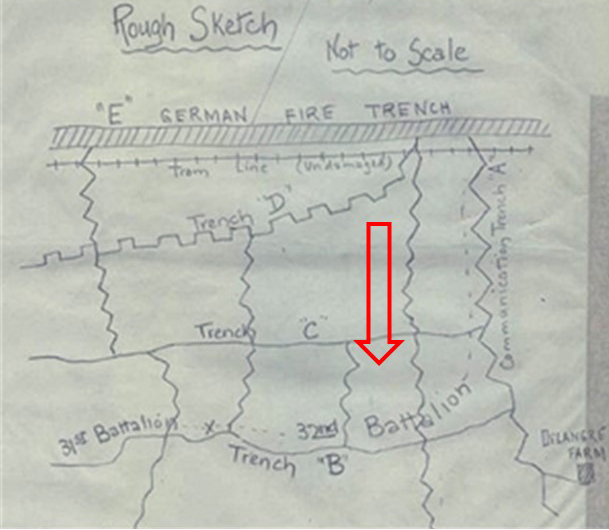
While not in the initial rush, the 30th was close behind, digging trenches, carrying ammunition and repairing communication trenches, all while under fire. While suffering significant losses, the initial assaults were successful and by 6.30 PM the Aussies were in control of the German’s 1st line system (Trench B in the diagram below), which was described as “practically a ditch with from 1 to 2 feet of mud and slush at the bottom”.
Source - AWM4 23/49/12, 32nd Battalion War Diaries, July 1916, page 11
While their role was to be in support, commanders on scene made the decision to use the 30th as much-needed fighting reinforcements. A necessary act, but it had consequences as it interfered with the planned flow of supplies. Bill’s C Company and B Company were the first to be brought in.
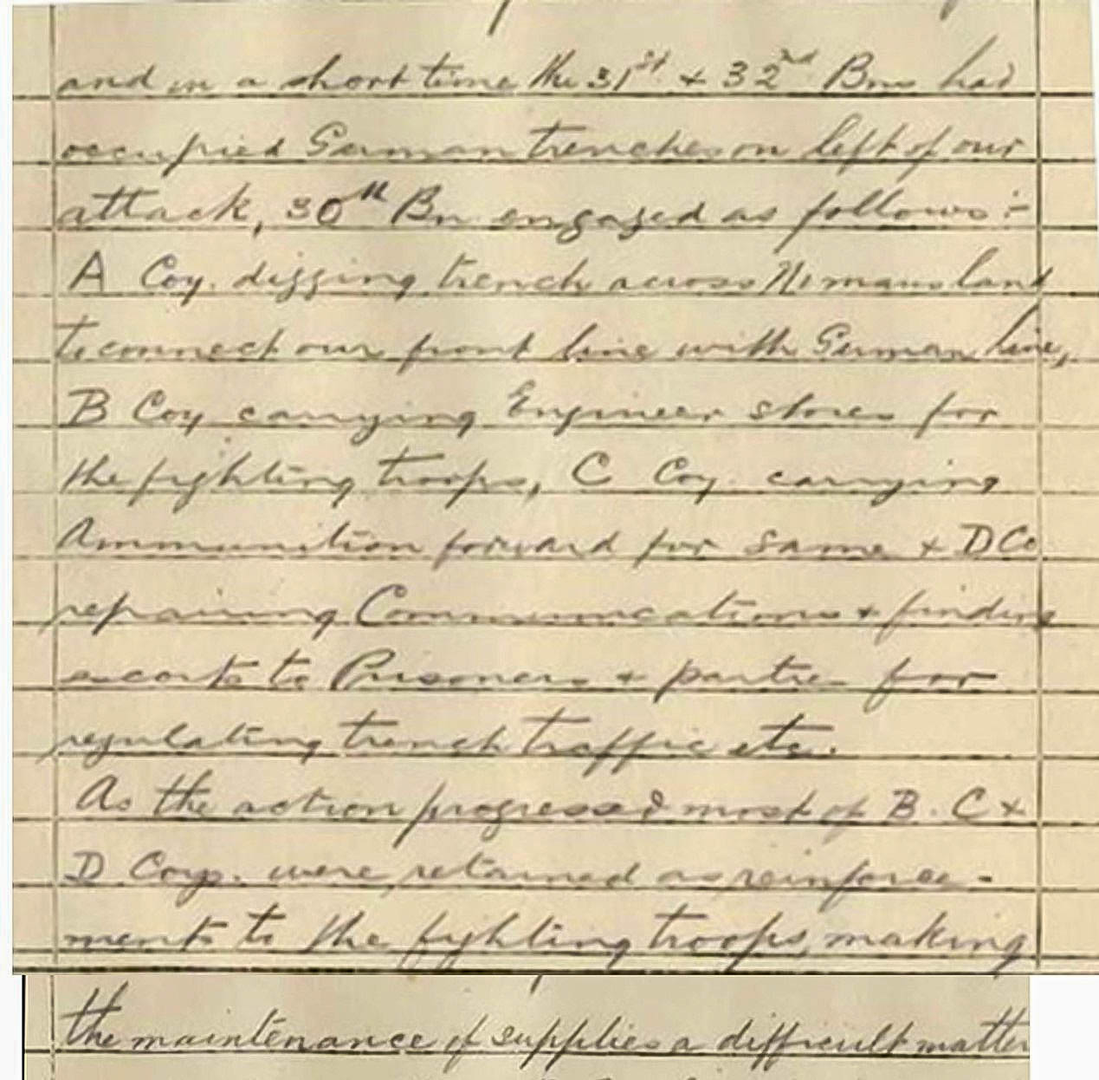
By 8.30 PM the Australians’ left flank had come under heavy bombardment with high explosives and shrapnel. Return bombardment support was provided and they were told that “the trenches were to be held at all costs”.
Source - AWM4 23/49/12, 32nd Battalion War Diaries, July 1916, page 12
When the 30th was formally called to provide fighting support at 10.10 pm, Lieutenant-Colonel Clark of the 30th reported:
“All my men who have gone forward with ammunition have not returned. I have not even one section left.”
Fighting continued through the night. The Australians made a further charge at the main German line beyond Trench B, but they were low on grenades, there was machine-gun fire from behind from the emplacement at Delangre Farm and they were so far advanced that they were getting shelled by both sides. At 4.00 AM the Germans began an attack from the Australian’s left flank, bombing and advancing into Trench A (map). Given the Australian advances that had been made earlier, portions of the rear Trench E had been left almost empty, which then enabled the Germans to be in a position to surround the soldiers.
At 5.30 AM the Germans attacked from both flanks in force and with bombing parties. Having only a few grenades left, the only resistance they could offer was with rifles:
“The enemy swarmed in and the retirement across No Mans’ Land resembled shambles, the enemy artillery and machine guns doing deadly damage.”
By 10.00 AM on the 20th, the Germans had repelled the Australian attack and the 30th Battalion were pulled out of the trenches. The nature of this battle was summed up by Private Jim Cleworth (784) from the 29th:
"The novelty of being a soldier wore off in about five seconds, it was like a bloody butcher's shop."
Initial figures of the impact of the battle on the 30th were 54 killed, 230 wounded and 68 missing. To get some perspective of the battle, when Charles Bean, Australia’s official war historian, attended the battlefield two and half years later, he observed a large quantity of bones, torn uniforms and Australian kit still on the battlefield. The ultimate total was that 120 soldiers of the 30th Battalion were either killed or died from wounds and of this total 80 were missing/unidentified.
To date (2026), 27 of those missing have been later identified and are buried in the Pheasant Wood Cemetery.
After the Battle
When the survivors of the 30th Battalion withdrew from the line on the morning of 20 July 1916, Bill was reported to be missing.

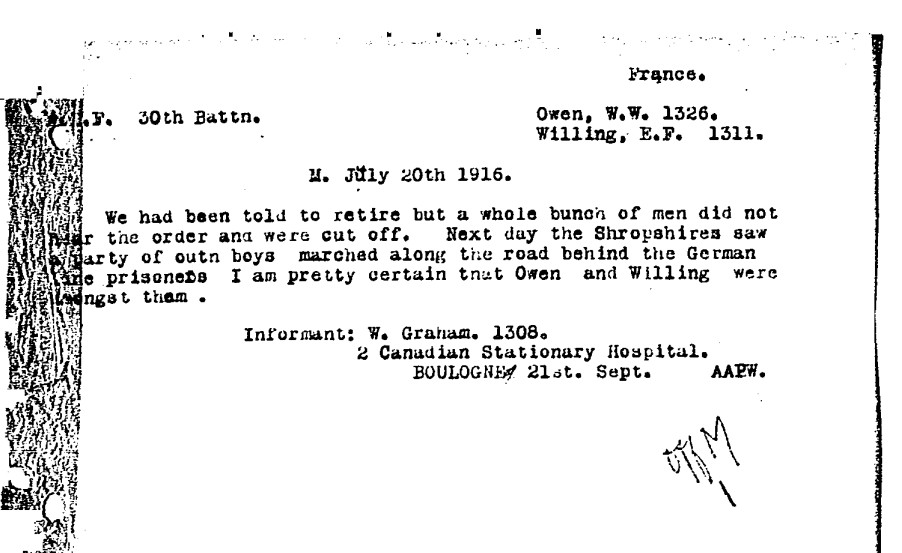
With so many soldiers having been killed, wounded or taken prisoner during the battle, there was much confusion and great difficulty in working out what had happened to each man. Major efforts were undertaken to find the missing soldiers, but often weeks and months passed with no answers, only uncertainty. Witness statements taken by the Red Cross give two separate accounts for Bill. Private William Charles Graham (1308) was “pretty certain” that Bill and ‘Willing’ (correctly, Ernest Frank Welling #1131) were seen marching as German prisoners. Ern Welling was also in C Company and he had enlisted about the same same timee as Bill.
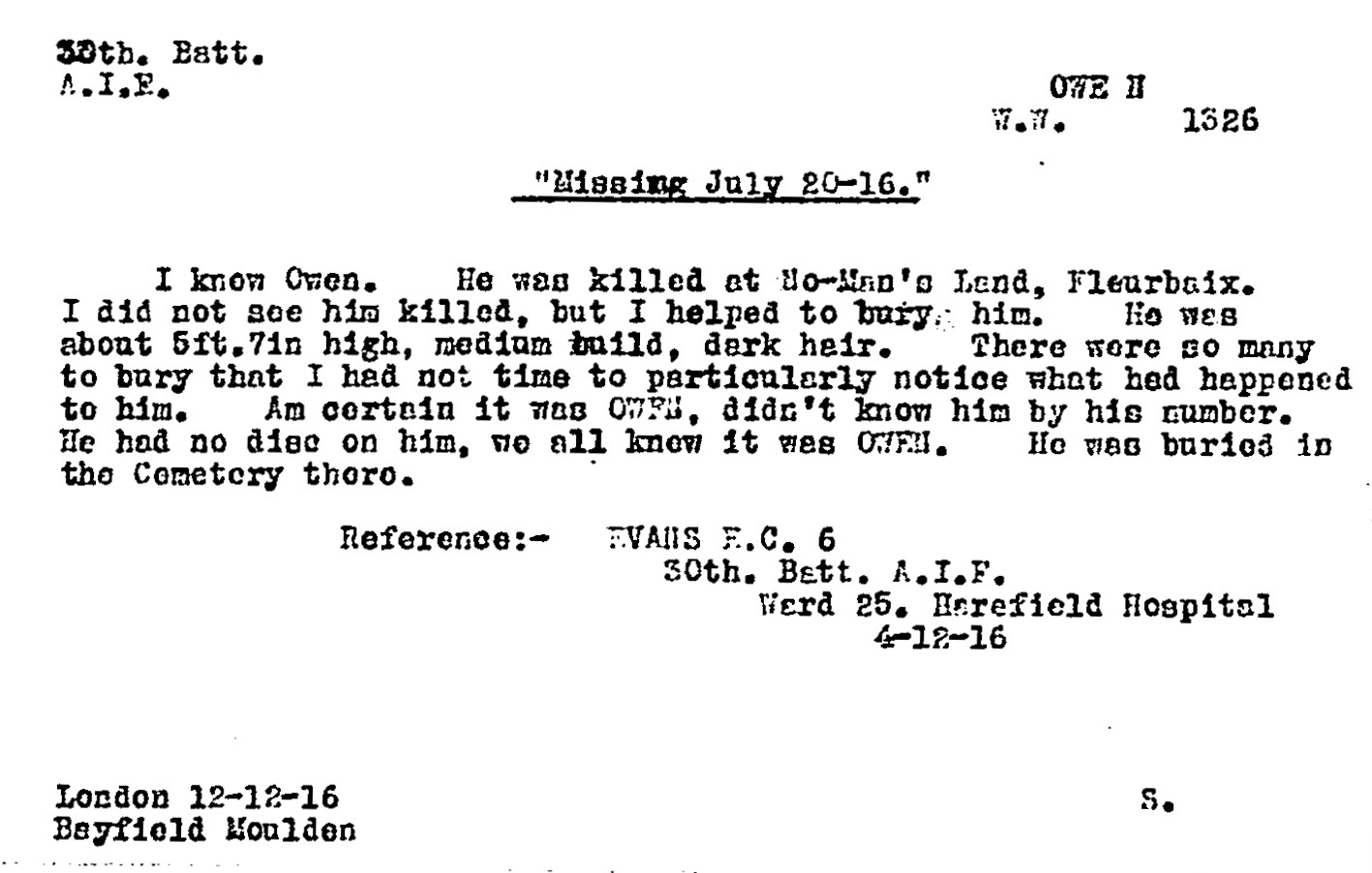
Another account by Private Edgar Charles Evans (6) said Bill had been killed in No Man’s Land and that he had helped to bury him.
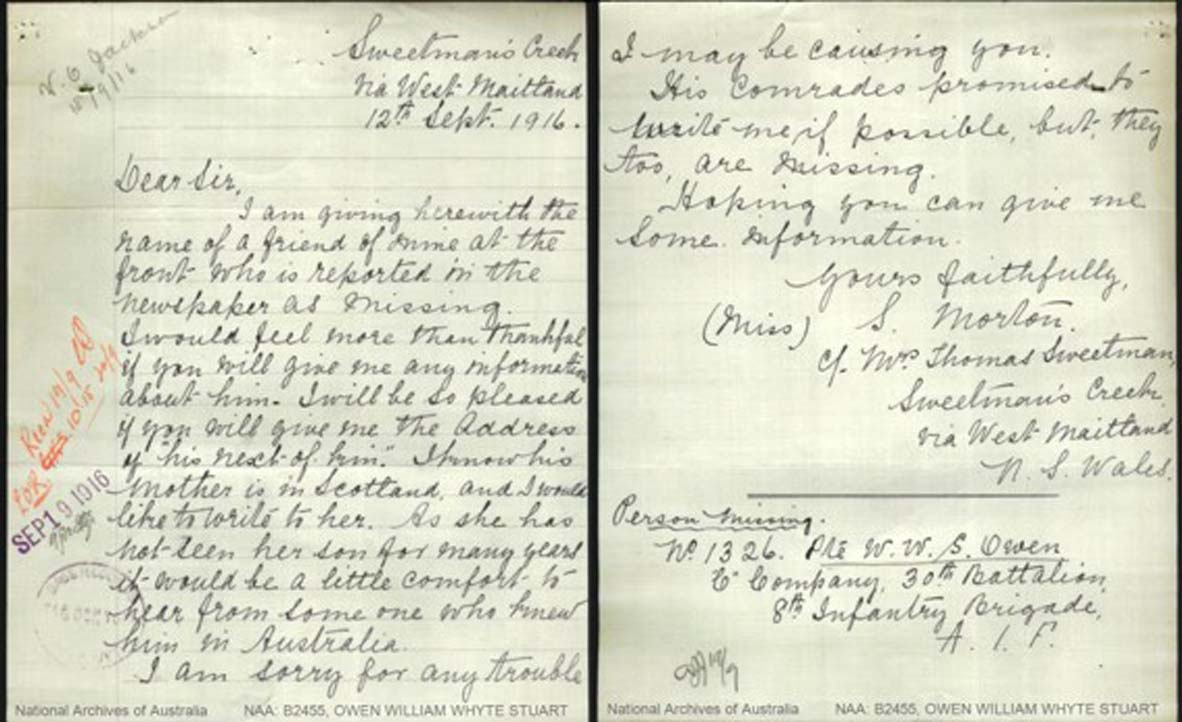
Back in New South Wales, concern for Bill surfaced quickly. Miss S. Morlon of Sweetman’s Creek near West Maitland wrote to the Defence Department in September and again in December 1916 after seeing Bill’s name listed as missing. She explained that Bill was “a friend of mine at the Front,” that his letters had stopped, and that she hoped to contact his mother in Scotland. Her enquiries show that Bill had personal ties in the Hunter region as well as in Sydney.
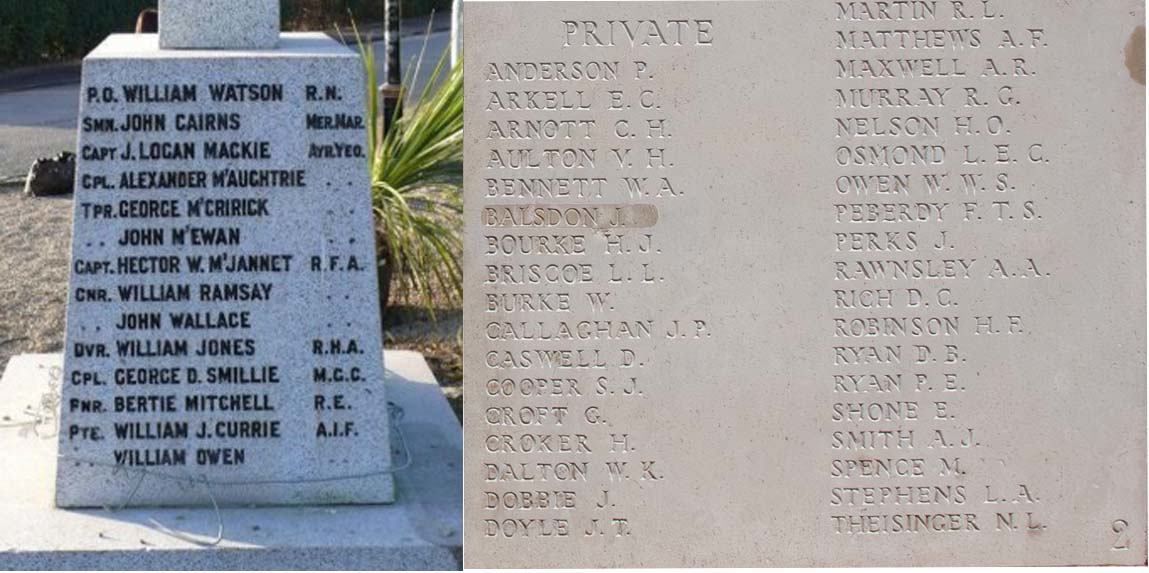
However, with no records of capture from the Germans, no eyewitness accounts that could be relied on and no physical evidence of his fate, a Court of Inquiry finally declared him killed in action on 20 July1916 — a full year after the battle. He was 26 years old. Bill’s mother, Elizabeth, waited in Ayrshire for confirmation that never came. She passed away in 1920. While Bill had no family of his own, his name endures in the places that now carry his memory:
- V.C. Corner Australian Cemetery Memorial, Panel 2, Fromelles — the memorial reserved solely for men with no known grave
- Australian War Memorial Roll of Honour, Panel 117
- Dundonald War Memorial in Ayrshire, Scotland
Finding Bill
Bill’s remains were not recovered; he has no known grave. After the battle, the Germans recovered 250 Australian soldiers and placed them in a burial pit at Pheasant Wood. This grave was discovered in 2008 and since then efforts have been underway to identify these soldiers by DNA testing from family members. As of 2026, 181 of the soldiers have been identified, including 27 of the 80 unidentified soldiers from the 30th Battalion.
One of these soldiers who has been identified is Ernest Frank Welling, whom Private W. Graham had linked to Bill in his witness statement. Ern was positively identified in 2024. While Ern was not taken prisoner, it is very possible that Ern and Bill were killed fighting together in the area were Ern’s body was recovered by the Germans and that Bill could very well be among the remaining unidentified bodies.
We welcome all branches of Bill’s family to come forward to donate DNA to help with his identification. If you are related to the Whyte, Vass or Owens of Dreghorn, Dundonald, or the Cunningham–Kilmaurs district — or know someone who is — your DNA may help finally confirm Bill’s resting place and ensure he is remembered by name.
Please contact the Fromelles Association. We hope that one day Bill will be named and honoured with a known grave. Please visit Fromelles.info to follow the ongoing identification project and Bill’s story.
DNA samples are being sought for family connections to
| Soldier | William Whyte Stuart Owen (1889–1916) |
| Parents | William John Owen (1855–1908), Dundonald, Ayrshire and Elizabeth Stuart Whyte Vass (1849–1920), Dundonald, Ayrshire |
| Siblings | Jane “Jessie” (1873-1968), married Samuel English and later Harry Hill, they moved to Canada in 1906 | |||
| Martha (1876-1952), m Ilmo Thomas Hind | ||||
| John (1878 - ), married Margaret McMillan | ||||
| Alexander (1880 - ) | ||||
| Elizabeth Stewart (c 1883 - ) married Robert Osborne | ||||
| Isabella McCreath (1885-1906) married William Grierson in 1905 | ||||
| Agnes Owen (c. 1887 - ) |
| Grandparents | |||
| Paternal | John Alexander Owens (1807–1883), Kilmarnock/Dreghorn and Martha Brown (1810–1899), Kilmarnock/Dreghorn | ||
| Maternal | David Vass and Jean Anderson |
Links to Official Records
Seeking DNA Donors

Contacts
(Contact: carla@fromelles.info or geoffrey@fromelles.info).
(Contact: army.uwc@defence.gov.au or phone 1800 019 090).
Donations
If you are able, please contribute to the upkeep of this resource.
(Contact: bill@fromelles.info ).