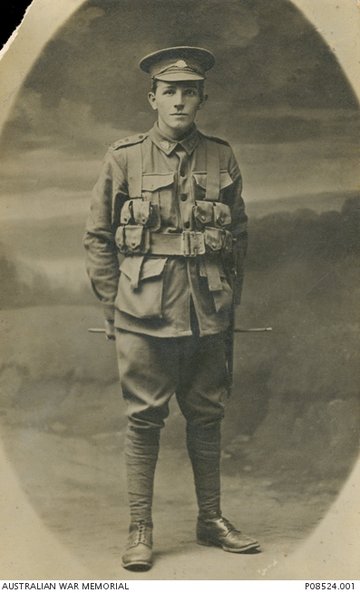
Colin Henry ARNOTT
Eyes blue, Hair brown, Complexion fair
The Arnott Brothers – Colin and Kenneth “Lost and Found”
Early Life
Col was born on 14 August 1894 at Laurieton, New South Wales, the son of Colin Henry Arnott (1866–1948) and Alice Susannah Jane Gill (1869–1958). He grew up in the Camden Haven district alongside his older brother Ken in a well-known local family connected to Laurieton and the Manning River region. Their father, Colin Arnott Snr, was born in the Ovens district of Victoria and came to Laurieton as a young man, where he spent almost sixty years living and working in the district. He was widely respected in the community and was involved with the School of Arts, the Grand United Order of Oddfellows, local sport, and community affairs. Their mother, Alice Susanah Jane Gill, was born at Cundletown on the Manning River and came from another long-established local family.
Children of Colin Henry Arnott and Alice Susanah Jane Gill:
- Maude Lenna (1890–1981)
- Kenneth Alfred (1892–1930) Served with the 30th at Fromelles
- Colin Henry (1894–1916) Killed in Action at Fromelles
- Alice Adell (1897–1977)
- Arthur Edwin (1903–1978)
Col attended Laurieton Public School and worked as a labourer before the war. Ken also worked as a labourer prior to enlistment before later becoming a well-known motor service man at Kew.
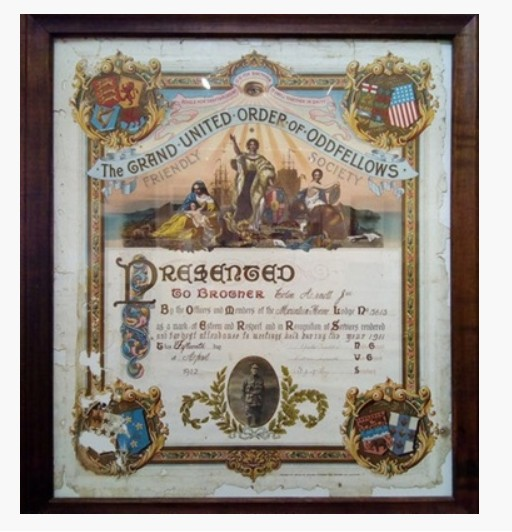
One insight into Col's character comes from his involvement with the Mountain Home Lodge No. 5615 of the Grand United Order of Odd Fellows (GUOOF), a friendly society established at Laurieton in 1903. His father, Colin Arnott Snr, was a founding member of the local lodge, and Col followed him into the organisation while still a young man. On 15 April 1912, aged just 17, Col was presented with a Certificate of Merit by the officers and members of the lodge "as a mark of esteem and respect" in recognition of his service and for the best attendance at meetings during 1911. At the time, friendly societies played an important role in country communities, providing members with medical care, financial assistance during illness, funeral benefits, and social support long before government welfare systems existed. For working families such as the Arnotts, membership represented both security and a commitment to community service.
Off to War
When war came, brothers Kenneth Alfred and Colin Henry Arnott answered the call together. They enlisted at West Maitland, New South Wales, on 27 September 1915, joining the 3rd Reinforcements for the newly raised 30th Battalion. Leaving behind their family at Laurieton, the brothers became part of the thousands of young Australians volunteering to serve overseas.The 30th Battalion had been raised in New South Wales in August 1915, drawing its recruits from Sydney and country districts across the state. Following training at Liverpool Camp, the original battalion marched through the streets of Sydney before embarking aboard HMAT Beltana in November 1915. Colin and Kenneth joined the battalion several months later as reinforcements, embarking from Sydney aboard HMAT Ballarat on 16 February 1916.
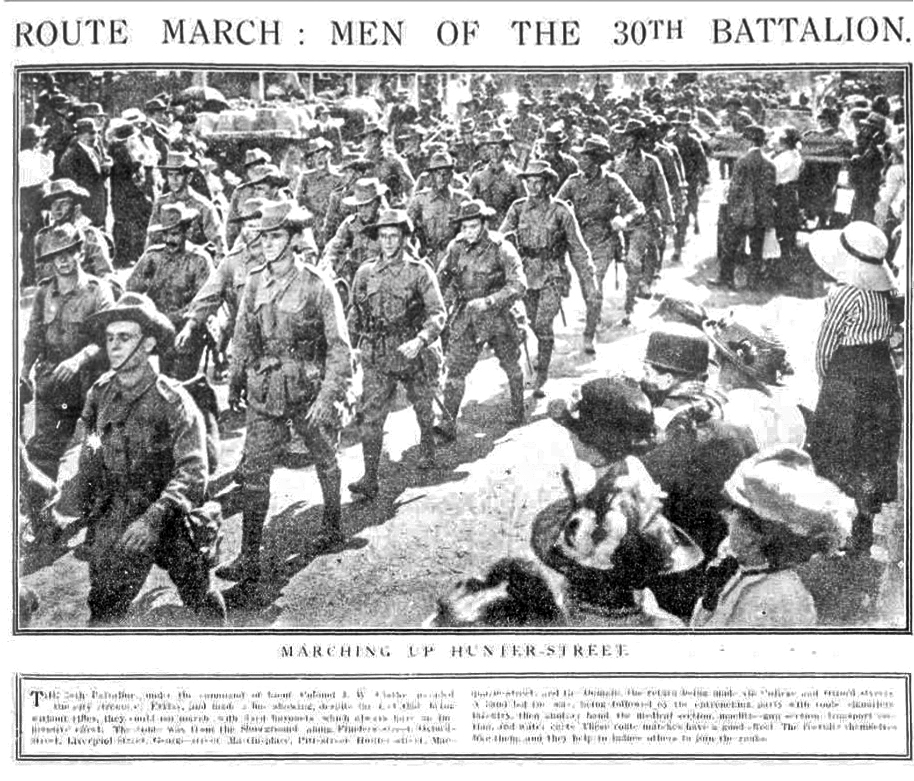
After arriving in Egypt on 23 March 1916, the brothers undertook further training with the 8th Training Battalion at Zeitoun before joining the 30th Battalion at Ferry Post on 1 April. They became part of the newly formed 8th Brigade of the 5th Australian Division alongside the 29th, 31st and 32nd Battalions. Life in Egypt was demanding. The men spent long days route marching across the desert, practising musketry, bayonet fighting, bombing, trench construction, signalling and field manoeuvres while adapting to the heat, dust and unfamiliar conditions. Stationed first around Heliopolis and later at Serapeum on the Suez Canal, they guarded one of the British Empire's most important strategic waterways while preparing for active service.
Signaller J.F.M. Johnston later recalled the journey and arrival in Egypt. Although he joked that the voyage aboard Beltana was "like a Quaker's meeting, excepting the food," Cairo left a lasting impression:
"Cairo... was a sight for sore eyes to see—a real number-one-sided town full of excellent hostelries and restaurants, and streets swarming with soldiers."
Later, while camped beside the Suez Canal, Johnston wrote that "all the boys are in great nick," capturing the confidence and enthusiasm shared by many of the Australians before they experienced the realities of the Western Front.By June 1916, the Australians were ordered to France. On 16 June the 30th Battalion embarked from Alexandria, arriving at Marseilles a week later before travelling north by crowded troop trains to northern France. For Ken and Col, France was unlike anything they had known. Around Fleurbaix they experienced their first trench rotations, working parties, wiring duties, and nightly patrols. Here they learned the routines of trench warfare while living under the constant threat of shellfire and snipers.
The battalion's introduction to the Western Front was intended to be in what became known as the "Nursery Sector," where inexperienced troops could gain experience in relatively quiet conditions. That expectation proved short-lived. Less than a month after arriving in France, the Arnott brothers and the rest of the 30th Battalion were ordered to take part in the Battle of Fromelles—the first major action fought by Australian troops on the Western Front.
The Battle of Fromelles
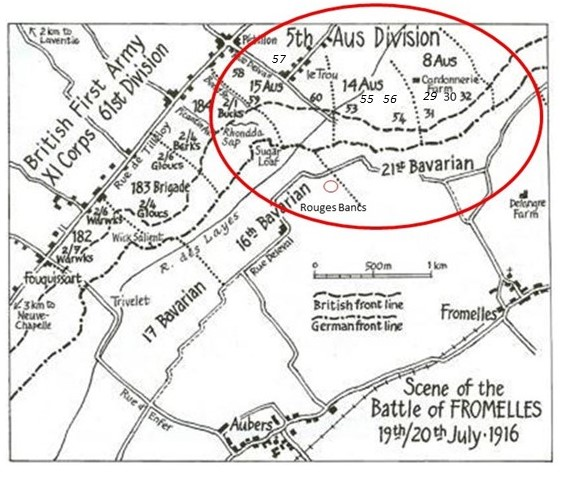
On 19 July 1916, 29 officers and 927 other ranks of the 30th Battalion went into battle. Their initial role was to provide support for the attacking 31st and 32nd Battalions by digging trenches and carrying supplies and ammunition. They were to be called in as reserves if needed. Privates Ken and Col Arnott were among the reinforcements who arrived in France only weeks earlier. Like many young soldiers of the 30th Battalion, Fromelles would be their first major battle on the Western Front. The 32nd Battalion’s charge over the parapet began at 5.53 pm, followed by the 31st at 5.58 pm. Machine gun emplacements at Delangre Farm and heavy artillery fire swept No Man’s Land. By 6.30 pm, the Australians had captured the German first-line system, described as:
“practically a ditch with from 1 to 2 feet of mud and slush at the bottom.”
Though scheduled to remain in support, commanders committed the 30th Battalion as fighting reinforcements to help hold the captured trenches. This necessary move disrupted the supply chain and drew Chester’s C Company into direct combat. By 8.30 pm, the Australians’ left flank came under heavy bombardment. The 32nd Battalion was ordered that: “the trenches were to be held at all costs.”
Source: AWM4 23/49/12 – 32nd Battalion War Diary, July 1916, p.12
At 10.10 pm, when the 30th Battalion was formally called forward, Lieutenant-Colonel Clark reported:
“All my men who have gone forward with ammunition have not returned. I have not even one section left.”
During the night, the Australians attempted a further push beyond the captured line, but with dwindling grenades, enfilade fire from Delangre Farm, and shells falling from both sides, the position became increasingly impossible to hold. At 4.00 am, German bombing parties attacked the Australian left, infiltrating the trenches. By 5.30 am, they struck from both flanks in force. With only a handful of grenades left, resistance was largely limited to rifle fire. The 31st Battalion war diary later recorded:
The enemy swarmed in and the retirement across No Mans' Land resembled shambles, the enemy artillery and machine guns doing deadly damage.”
Private Jim Cleworth of the 29th Battalion later summed up the brutality of the fighting:
The novelty of being a soldier wore off in about five seconds, it was like a bloody butcher’s shop.
By 10.00 am on 20 July, the attack had collapsed and the survivors of the 30th Battalion withdrew. Though intended only as a support battalion, the 30th suffered devastating casualties: 54 killed, 230 wounded, and 68 missing. Ultimately, 125 men of the battalion were killed or died of wounds, with many left unidentified on the battlefield. Amidst the confusion, darkness and relentless shellfire, the Arnott brothers were separated. Col was killed during the fighting on 20 July 1916. Ken survived the battle and the long withdrawal back to the Australian lines. When Charles Bean revisited the battlefield more than two years later, he still found a large amount of bones, torn uniforms and Australian kit scattered across the battlefield.
Source: C.E.W. Bean, Official History of Australia in the War of 1914–1918, Vol III, The AIF in France: 1916, Angus & Robertson, Sydney, 1929, p.615
After the Battle – Ken
Ken survived the Battle of Fromelles, but returned from the battlefield without his younger brother, Col, who was killed during the fighting on 20 July 1916. While Col's war had ended after only a few weeks in France, Ken's would continue for almost three more years. Remaining on the Western Front, Ken continued serving with the 30th Battalion before attending the Machine Gun School and transferring to the 8th Machine Gun Company in early 1917.
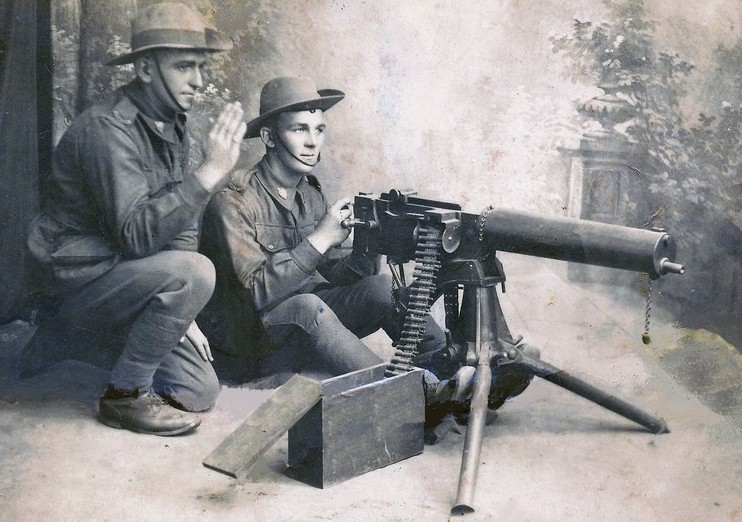
Equipped with the Vickers medium machine gun, the company provided specialist fire support for the 8th Brigade, protecting Australian infantry with devastating enfilade fire and supporting attacks with sustained long-range fire. On 20 March 1918, the 8th Machine Gun Company became part of the newly formed 5th Machine Gun Battalion, which combined the machine gun companies of the 5th Australian Division under a single command. With the battalion, Ken served during the German Spring Offensive before taking part in the Allied Hundred Days Offensive, the series of battles that ultimately forced Germany to seek an armistice. His service record reflects the strain of almost four years overseas, recording periods of illness and hospitalisation for pyrexia, influenza, shell concussion and debility before eventually returning to duty.
Ken returned to Australia on 15 May 1919 after almost four years of overseas service. The following year, on 16 June 1920, he married Lillian Marguerite Hogan at Laurieton. They settled at nearby Kew, where Ken became a well-known motor service man. Together they raised two children, Nancy Lillian Arnott (1921–1998) and Kenneth Arnott (1924–1988).
Sadly, Ken's health deteriorated in later years. Suffering from Bright's disease, he was admitted to Mayo Hospital, Taree. Although he briefly returned home, he was readmitted a fortnight later and died on 18 May 1930, aged just 37. His obituary remembered him as:
“One of the finest types of Australian manhood that one could meet. He was particularly upright in all his dealings, a good friend, and his bigness of heart was proverbial. … He and his brother Col. enlisted for service in the Great War at an early stage. The latter was killed in France but deceased went right through the war returning to Australia when it was over.”
After the Battle – Col
Following the disastrous attack at Fromelles, Col was listed as killed in action on 20 July 1916. He was only 21 years old. Like many families across Australia, the Arnotts endured weeks and months of uncertainty as casualty lists slowly filtered home from France. Col’s body was never formally identified on the battlefield and for decades he was commemorated among the missing at VC Corner Memorial, where hundreds of Australians killed at Fromelles have no known grave. Kenneth survived the battle, but the war’s impact on the family was immense. While still serving overseas, he and the Arnott family mourned the loss of Col from afar.
One year after Col’s death, the family placed a memorial notice in The Daily Telegraph:
“For many years our family chain Was closely linked together; But, oh! that chain is broken now— Our dear one has gone for ever. ... No one knows how much we miss him, Friends may think the wound is healed, But they little know the anguish That is within our hearts concealed.”
Col’s father later remained active within the Laurieton community and local returned soldiers’ causes. For almost ninety years Col remained one of the missing of Fromelles.
Discovered at Pheasant Wood
For almost ninety-four years, Col was one of the missing of Fromelles. His body had never been recovered from the battlefield and, like hundreds of other Australians, he was commemorated on the VC Corner Memorial to the Missing. Everything changed in 2008 when archaeologists uncovered the Pheasant Wood mass burial site near Fromelles, containing the remains of 250 Australian and British soldiers buried by German troops after the Battle of Fromelles. The discovery followed years of meticulous research by Lambis Englezos, Ward Selby and John Fielding, whose determination led to one of Australia's most significant military and archaeological investigations. Read Harry Willis' story to find out more
The recovery of the soldiers marked the beginning of an extraordinary identification program. Every set of remains was carefully excavated, examined and documented before specialists combined archaeological evidence, forensic anthropology, military records, family history and DNA analysis to restore names to the men who had lain unknown for almost a century. Thousands of descendants from Australia and around the world volunteered DNA samples, hoping to help identify their lost relatives and return them to their families by name. For the Arnott family, that hope became reality. Col was formally identified, bringing immense joy and relief after generations of uncertainty. Nearly a century after leaving Laurieton, he had finally been found.
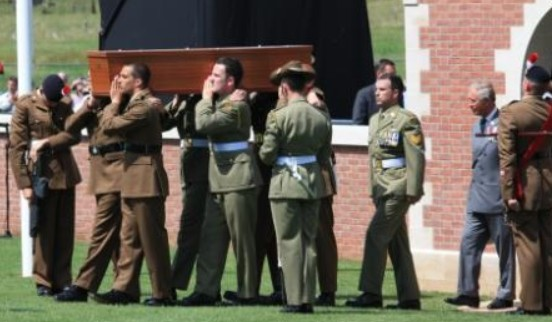
On 19 July 2010, in the presence of His Royal Highness The Prince of Wales, Australian Governor-General Quentin Bryce, and Australian, British and French dignitaries, Col was reburied with full military honours during the dedication of Fromelles (Pheasant Wood) Military Cemetery. It was a deeply moving occasion, restoring not only his name but also his place among his comrades.
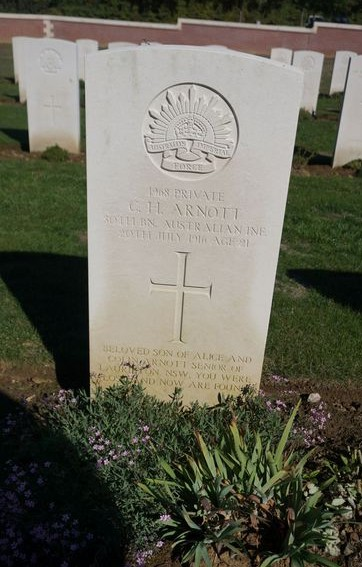
“Beloved son of Alice and Colin Arnott Senior of Laurieton, NSW. You were lost but now are found.”
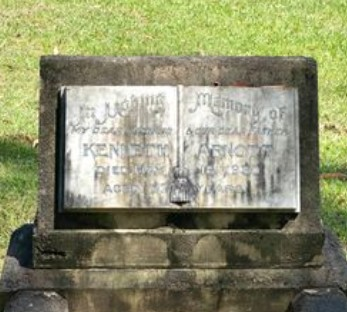
The Arnott brothers are commemorated on the Laurieton Honour Roll and the Laurieton ANZAC War Memorial, honouring the men of the Camden Haven district who served during the First World War.
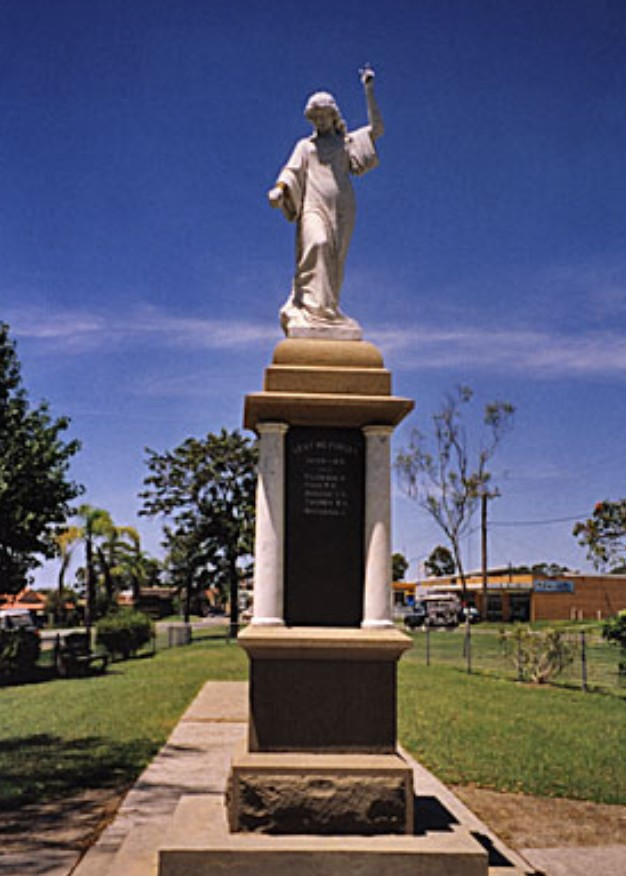
Although separated by half a world in death, the brothers remain forever connected by their shared journey. They enlisted together, trained together, sailed to Egypt together, fought side by side at Fromelles, and were separated only by the battle that claimed Col's life. Today, Col rests among his comrades at Fromelles (Pheasant Wood) Military Cemetery in France, while Ken lies at Laurieton General Cemetery, close to the family and community they both left behind in 1916.
Nearly a century after Col's death, his identification at Pheasant Wood restored not only his name, but also completed the Arnott family's story, ensuring that the two brothers from Laurieton who answered Australia's call together will always be remembered.
The Fromelles Association would love to hear from you

Contacts
(Contact: carla@fromelles.info or geoffrey@fromelles.info).
(Contact: army.uwc@defence.gov.au or phone 1800 019 090).
Donations
If you are able, please contribute to the upkeep of this resource.
(Contact: bill@fromelles.info ).