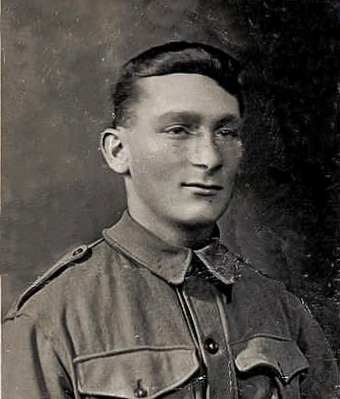
Leslie Albert CARTLEDGE
Eyes blue, Hair fair, Complexion fair
Les Cartledge – From the Melbourne Racetracks to the French Trenches
Early Life
Leslie Albert Cartledge, known as Les, was born in Ballarat, Victoria in 1895, the eldest child of Albert Cartledge (1874–1949) and Ellen McFee Elizabeth Taylor (1877–1908):
- Leslie Albert (1895–1916) – died of wounds, France 17 July 1916
- Victor Everard (1896–1896)
- Percy Roy (1898–1898)
- Rita May (1899–1914)
- Alfred Ernest (1901–1902)
- Nellie Eileen e (1903–1903)
- Doris Irene (1903–1988)
- Marjory (1908–1981)
Les attended Golden Point State School and, like many local boys, he grew up around the mining district and the racing stables that ringed the town.
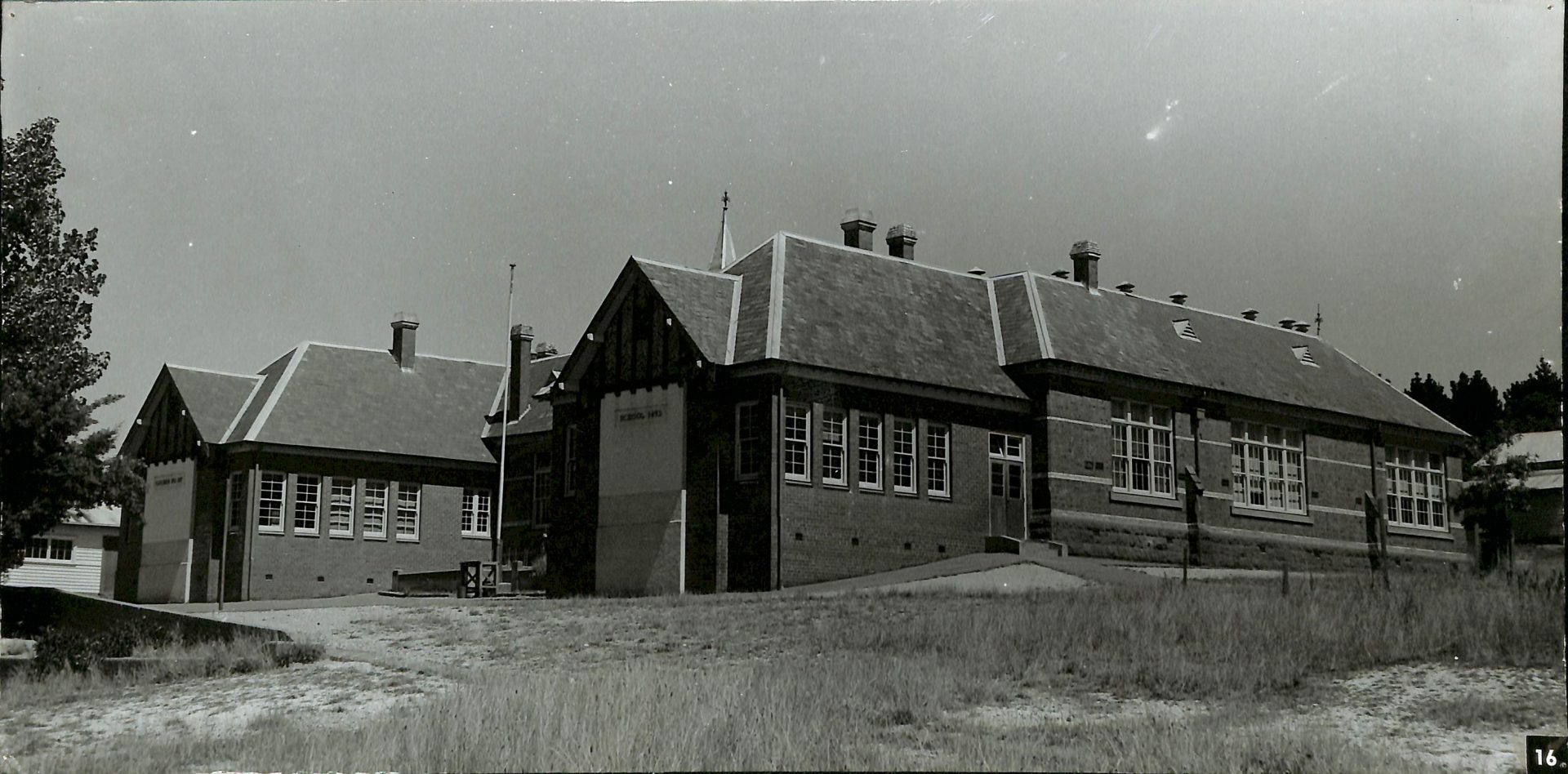
Les’s childhood was unfortunately marked by tragedy. On the night of 19 September 1908, when Les was thirteen, his mother Ellen was shot and killed in their home at 88 Grant Street, Ballarat East. His father, Albert Cartledge, was charged with her murder after what newspapers described as “a shocking domestic tragedy.”:
“A shocking domestic tragedy occurred on Saturday evening in Grant Street, Ballarat East, when Albert Cartledge, a miner employed at the South Ballarat Mine, shot his wife, Ellen Cartledge, with a revolver. The wound was fatal… The boy Leslie, aged thirteen, was in the house and saw his father with the revolver in his hand. His uncle, Sydney Taylor, was also present.”
At the inquest, young Les was called as a witness. His testimony moved the court:
“I am thirteen years of age. Dadda came home very drunk on Saturday evening. Mamma was sitting in the dining-room with baby in her arms… She said, ‘Mind baby,’ and sprang out of his way. Mamma and my uncle Sydney Taylor and I then went out to the back of the house… I saw Dadda come out of the kitchen with a revolver in his hand… I heard a revolver shot, and on going in I saw Dadda with his arms around Mamma. He said to me, ‘Go for a doctor.’”
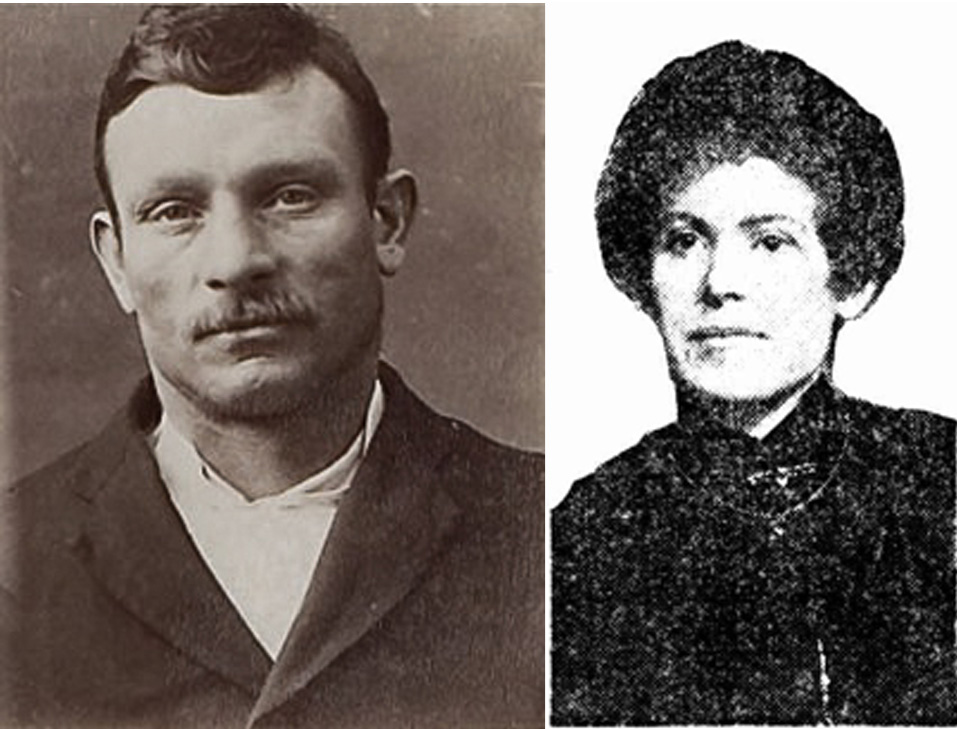
His uncle Sydney Victor Taylor, Ellen’s 16-year-old brother and later a private in the AIF who was killed at Ypres in 1917, also gave evidence about the cause of the quarrel. Albert had mortgaged his cottage to a Ballarat money lender that day and when he lost a small sum of money betting, he wasn’t going to be able to make the payments due.
Source - The Story of Two Lads. (21 September 1908). The Age (Melbourne, Vic. : 1854–1954), p. 5. http://nla.gov.au/nla.news-article202183792
Albert was convicted of manslaughter and sentenced to four years imprisonment. A year later, he was declared insane and was removed from the gaol to the Sunbury Lunatic Asylum.
Source - Ballarat – Prisoner Becomes Insane. (14 February 1910). Geelong Advertiser (Vic.)
After their mother’s death and their father’s imprisonment, the Cartledge children were raised by their grandmother, Mary G. Cartledge, at 141 Malvern Road, Malvern. She seemed to be the strength the children required and was the nominated person in Les’ will when he went to war.
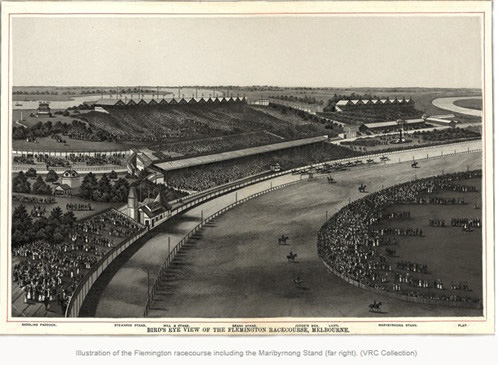
While Les’s early years were shadowed by grief, by his twenties he had built a new life working as a promising jockey, riding for Flemington trainers H. Harrison and E. Finn. He had built a steady reputation for skill and courage on the track. A quiet, determined young man from Ballarat whose endurance would soon be tested on the battlefields of France.
Off to War
When enlistment fever swept through the Victorian racing community, Les was among the first to answer the call:
“More than 45 young men attached to Caulfield racing stables have enlisted in the Australian Expeditionary Forces in the past fortnight. L. Cartledge, the Flemington cross-country rider, has joined the Expeditionary Forces.”
But where were the new recruits to be accommodated? The wide open spaces of a city racecourse had an immediate appeal, but tents were in short supply. The solution was the agricultural pavilions at the Royal Agricultural Society Showgrounds on the other side of the railway to the racecourse. They called it ‘the Flemington Camp’. By July, 4000 men were accommodated there.
Les enlisted at Melbourne on 17 July 1915, aged twenty. On his attestation papers, he listed his sister Rita Cartledge of 171 Main Road, Ballarat, as his next of kin and it was noted that his parents were deceased (although his father was actually alive). It is unclear whether Les knew that Rita had died the previous year, in 1914, aged just sixteen and living in Ballarat at that time, or whether he listed her because he did not want to list his father. Her name remained on his forms, perhaps through habit or affection, a small trace of family he wished to keep close. Les was described on his enlistment as 5 feet 2 inches tall, 129 pounds, a good size for a jockey, but just at the limits of the physical requirements for the AIF. He began training at Broadmeadows Camp, joining the 6th Reinforcements of the 24th Battalion.
Off to War
After several months of military training, Les embarked from Melbourne on 27 October 1915 aboard HMAT A38 Ulysses headed for the camps in Egypt. Like thousands of young Australians, he spent Christmas 1915 at sea, bound for an unfamiliar world and a war far from his previous life. With the ‘doubling of the AIF’ as it expanded from two infantry divisions to five, major reorganisations were underway at the time Les arrived in Egypt. Shortly after his arrival, Les was transferred to the 60th Battalion and then a month later to the 58th Battalion, A Company.
The 58th Battalion was raised in Egypt on 17 February 1916. Roughly half of the soldiers were Gallipoli veterans from the 6th Battalion and the other half were fresh reinforcements from Australia. The two groups were joined on 21 February at the 40,000-man training camp at Tel-el-Kebir, about 110 km northeast of Cairo. After a month of training, they were sent to Ferry Post, on foot, a trip of about 60 km that took three days. It was a significant challenge, walking over the soft sand in the 38°C heat with each man carrying their own possessions and 120 rounds of ammunition. Many of the men suffered heat stroke. Once there, they continued their training and were guarding the Suez Canal from any potential threats posed by the Ottoman Army.
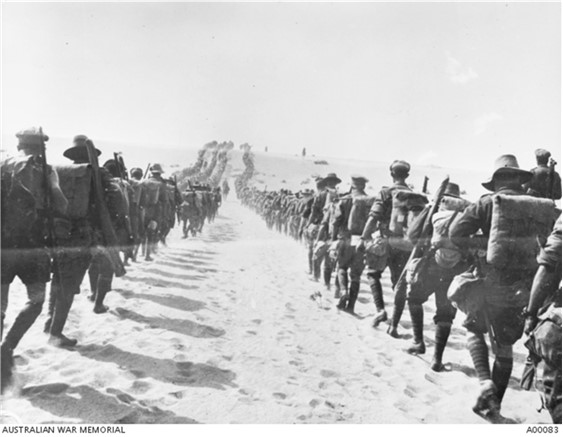
By early June 1916 the Battalion was at a total strength of over 1000 men. On 13 June they were in Moascar and orders were received to head to the Western Front. They boarded the H7 Transylvania in Alexandria on 17 June, arrived in Marseilles on the 23rd and then were immediately entrained for a three-day train ride to Steenbecque, 35 km from Fleurbaix in northern France.
This area near Fleurbaix was known as the “Nursery Sector” – a supposedly relatively quiet area where inexperienced Allied troops could learn the harsh realities of Western Front trench warfare against the Germans. But the quiet times and the training period did not last long. After marching to Fleurbaix, with their training now including the use of gas masks, they were into the trenches for the first time on 11 July. In his memoirs, Bill Boyce (3022) of the 58th summed the situation up well, “What have I let myself in for?”
Source - Australian War Memorial Collection C386815
Lead up to the Battle of Fromelles
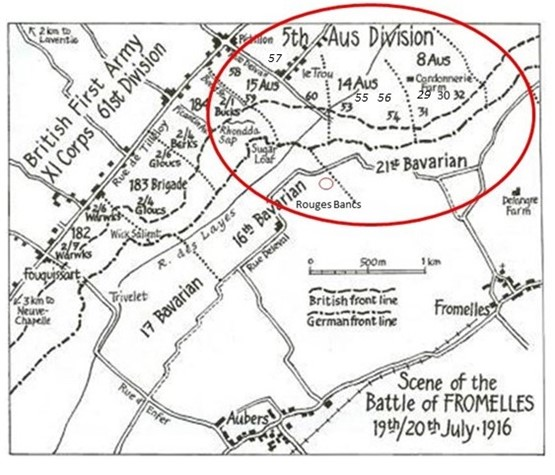
The battle plan had the 15th Brigade located just to the left of the British Army. The 59th and 60th Battalions were to be the lead units for this area of the attack, with Les’ 58th and 57th as the ‘third and fourth’ battalions, in reserve. The main objective for the 15th Brigade was to take the trenches to the left of a heavily armed, elevated German defensive position, the ‘Sugar Loaf’, which dominated the front lines. If the Sugar Loaf could not be taken, the other battalions would be subjected to murderous enfilade fire from the machine-guns and counterattacks from that direction. As they advanced, they were to link up with the 60th and 54th Battalions on their flanks.
The 58th Battalion’s role was to be carrying ammunition, digging the communication trenches for area gained in No Man’s Land, all while under fire themselves, and if needed, to join into attack for fighting relief. On 15 July Les got his ‘baptism of fire’. The 58th were in the front lines preparing for the upcoming attack, when a sudden and intense German shelling began at mid-morning, pounding the parapets, destroying communication lines, and burying men in the collapsed trenches. The 15th Infantry Brigade War Diary recorded:
“Great difficulty in evacuating killed and wounded… Those missing are believed to be covered by debris.”
These attacks continued into the early morning of the 16 July. A total of 42 soldiers were killed, further 102 were wounded and 5 were missing. Les was among the wounded. He was struck in the arm, by either shrapnel or a stray bullet as the Germans had pounded the Australian positions for hours. He was initially taken to the 15th Field Ambulance and then to 1st Australian Casualty Clearing Station at Estaires, one of the frontline medical units supporting the Australian divisions in northern France.
The clearing stations were makeshift hospitals positioned just behind the lines, where surgeons and nurses worked under canvas and constant strain to treat the wounded flooding in from Fromelles. Despite the best efforts of the medical staff, Les succumbed to his injuries the next day, 17 July 1916.
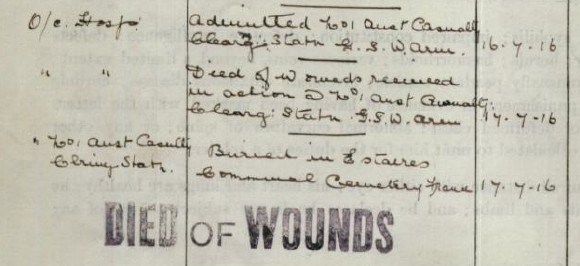
News of Les’ death made its way into the Melbourne papers:
“Word has been received that the cross-country jockey Leslie Cartledge… has died from wounds received on the front.”
For his sisters Doris and Marjory, both still teenagers at the time, the telegram would have added to their unbearable memories of the earlier family tragedy. He was buried in the Estaires Communal Cemetery, Plot 3, Row C. His grave remains one of the earliest Australian burials linked to the Battle of Fromelles.
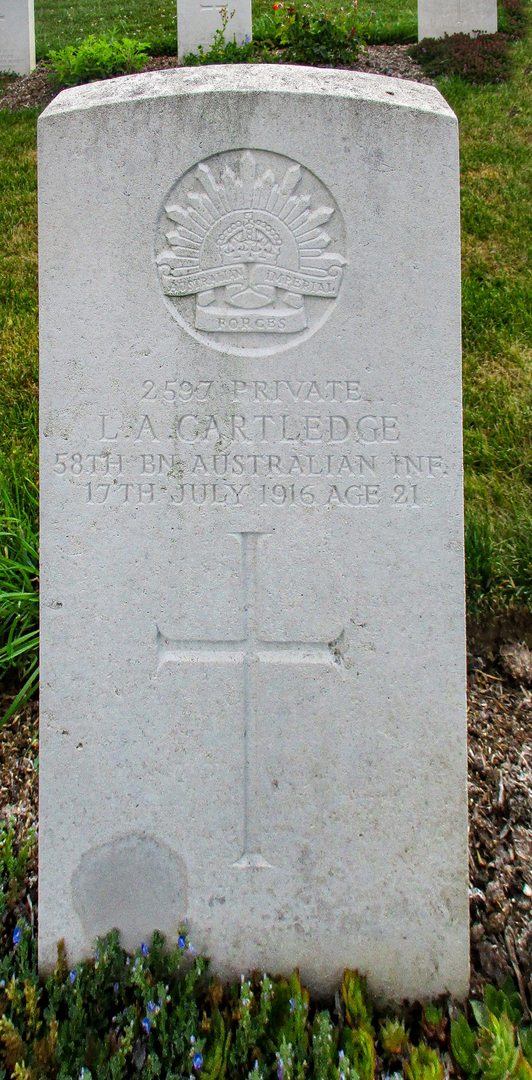
Estaires Communal Cemetery
Also among the dead from the 15/16 July attack are Sergeant George Challis, a popular Carlton footballer, who was killed instantly when a shell landed directly in his trench, Private Victor Quinn, a timber worker from Beech Forest and Joseph Kelsall, who had also served in South Africa before migrating to Australia.
After the Battle
After Leslie’s death was confirmed, official correspondence began to flow between the Army and the family regarding payment of pensions and the distribution of Les’ medals. The trustee for the sisters’ pension was their grandmother, Mary Cartledge, of 141 Malvern Road, Malvern, who had taken them in as children after the tragedy in Ballarat. In 1920, Les’ sister Doris, age 15 ½ at the time, wrote to the authorities from that same address, regarding a request from the Army to confirm her as the next eldest relative. Her letter was carefully worded in a young hand:
“In answer to your enquiry, I am the oldest sister left.There are no brothers. He was the only one we had.There were only four of us. My brother and older sister Rita (both deceased),That leaves me next oldest and my youngest sister Marjory, twelve and a half years, and myself fifteen and a half.”
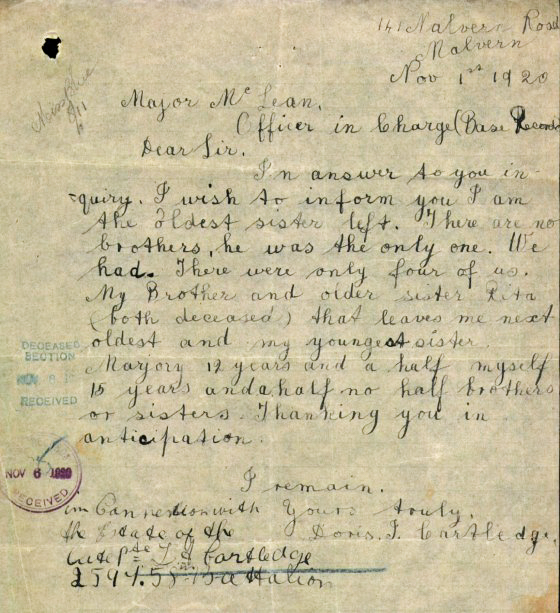
For her honesty and resilience, Doris was granted a small pension of five shillings per fortnight, a modest recognition for a young girl who had already borne so much. Also among the files are letters from their estranged father, Albert Cartledge, who wrote to the Department seeking information and asking for his son’s medals and effects. The officials responded that they could not release details or property to him. His claim was formally rejected - the Army noting that he “did not maintain his children.”
Source - NAA, B2455, Cartledge, Leslie Albert, p. 20
The medals and memorial plaque were instead issued through Les’ grandmother, Mary, to be held in trust for Doris and Marjory. In 1923, Doris signed the receipt for Leslie’s Victory Medal, the final token of his service. Both sisters went on to live their adult lives in Victoria, surviving well into the post-war years. For Doris and Marjory, he was not just a name on a headstone, he was their brother, the boy who once helped protect them,
Les is commemorated at:
- Estaires Communal Cemetery and Extension, France (Plot II, Row C, Grave 22)
- Australian War Memorial Roll of Honour, Canberra
- Ballarat Golden Point State School Honour Roll, Victoria
- Ballarat Avenue of Honour, Victoria
Leslie’s uncle, Sydney Victor Taylor (3249), also served with the AIF. Born in Ballarat in 1892, Sydney had lived with the Cartledge family as a teenager and gave evidence at the 1908 inquest into his sister Ellen’s death. He married Alice Maud Hutchison in 1914 and they had two children. He enlisted two years later, serving with the 21st Battalion on the Western Front. Sydney was reported missing, later confirmed killed in action, on 13 October 1917 during the fighting at Passchendaele. His name is recorded on the Menin Gate Memorial, Ypres, Belgium.
Still Rembered by Family
Bron Stanley recalls:
“Les was my first cousin three times removed. I knew from family research that he was killed in the First World War, but had not realised his connection to Fromelles until I travelled to France in 2024. My aunt and I spent many hours tracing the family tree to locate relatives and piece together the Cartledge story.
Years ago, I visited the grave of his mother, Ellen in Ballarat. A simple headstone marked only Cartledge, with little to hint at the tragedy behind it.
In July 2024, my family and I had the privilege of travelling to France with the FFFAIF and the Fromelles Association for the 19 July commemoration at Pheasant Wood. A light-bulb moment came upon realising that Les’s battalion, the 58th, had fought at Fromelles and that the date they were on the battlefield matched his death. It really hit home. We made a quick detour to Estaires Communal Cemetery, where we found his headstone and were finally able to pay our respects.As a volunteer researcher and story writer, standing at his grave made all the names and dates come alive. It was no longer just history — it was family. To finally find Les, to see where he rests, and to know he is remembered, felt like closing a small but precious circle in our family’s story.”
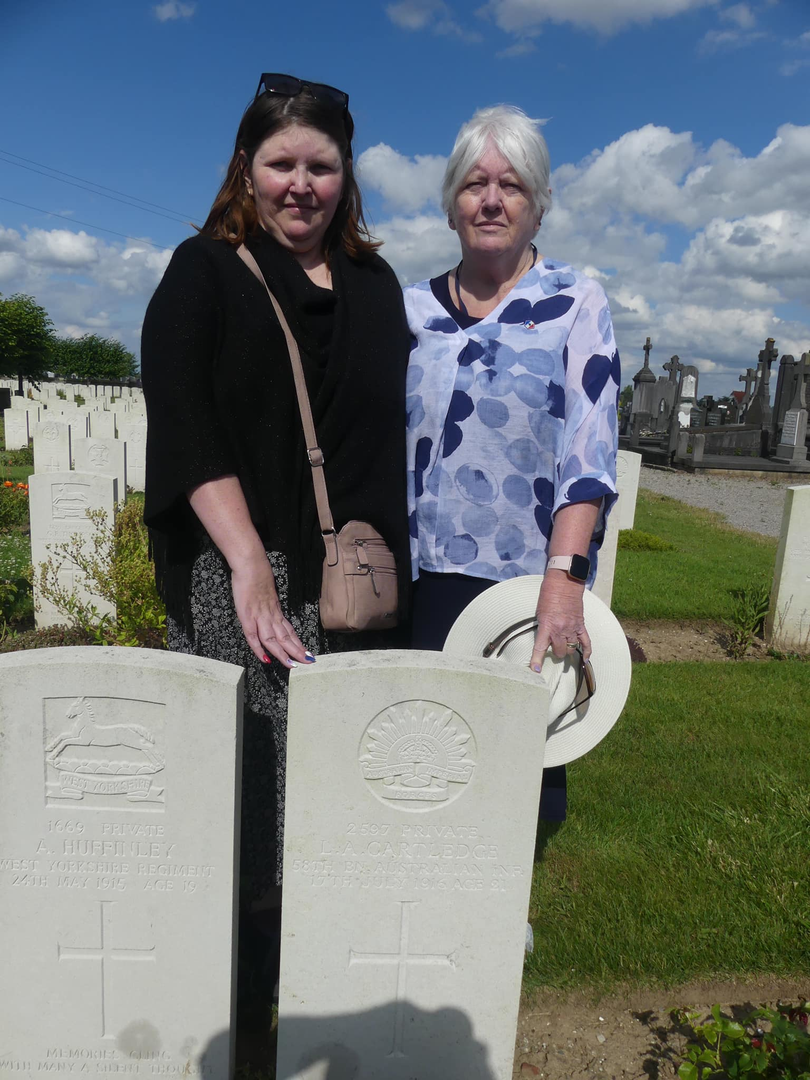
Lest we forget.
The Fromelles Association would love to hear from you

Contacts
(Contact: carla@fromelles.info or geoffrey@fromelles.info).
(Contact: army.uwc@defence.gov.au or phone 1800 019 090).
Donations
If you are able, please contribute to the upkeep of this resource.
(Contact: bill@fromelles.info ).