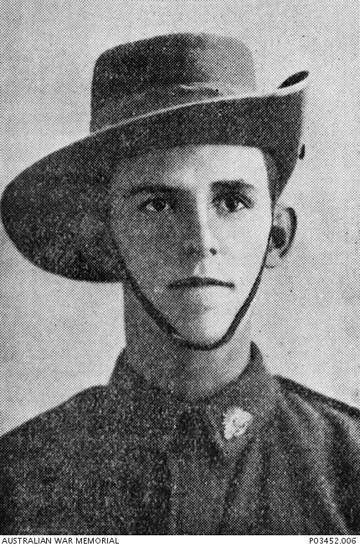
Norman Harry SAUNDERS
Eyes brown, Hair black, Complexion dark
Harry Saunders — A Roma boy, wounded at Fromelles, but killed in action three months later near Armentieres.
With thanks to Toowoomba Grammar School for this story.
Early Life
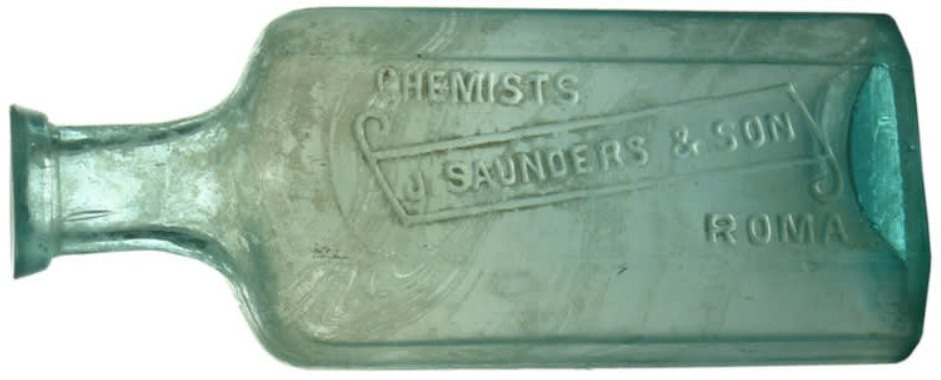
Norman Harry Saunders, known to his family as Harry, was born on 23 February 1897 at Roma, Queensland, the third child of Harry Hine Saunders, a chemist in Roma, and Elizabeth Jane (“Janie”) Mather. Tragically, his mother died the year he was born. His father did remarry and Harry grew up in a blended family - his older brother and sister, Claude and Muriel, and half-siblings Leila, Florence, Katie, Beryl, Ronald, and Jim. The Saunders family were well known in Roma. Harry’s grandfather, James Saunders, had established a chemist shop in the town in 1868, carrying on business for over fifty years, with Harry’s father continuing the line of Roma chemists and Harry’s brother Claude was preparing to step in.
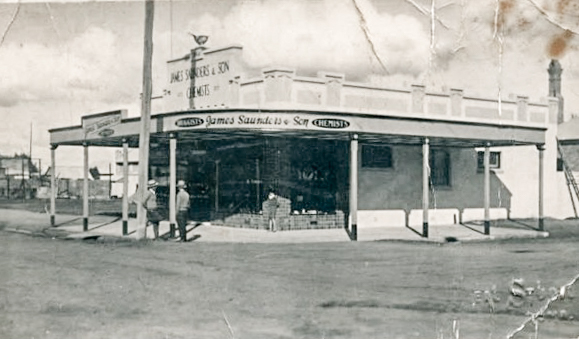
The enterprise became a landmark in Roma’s main street. As one newspaper later recalled:
“…the business is being conducted by Mr. Harry Saunders, and he is looking forward to his eldest son, Claude, assisting him next year. It may be mentioned that Mr. Claude Saunders completed his apprenticeship on 1st June, 1915, and enlisted in the A.I.F. on that date, being badly wounded while on active service and for some time a prisoner of war in Germany.”
Harry was educated at Toowoomba Grammar School from 1912 to 1915. He excelled both academically and in sport, representing the school in the First XV rugby team (1914–15) and the First XI cricket team (1915). He was also made a school prefect in 1915 and took part in concerts and public events.
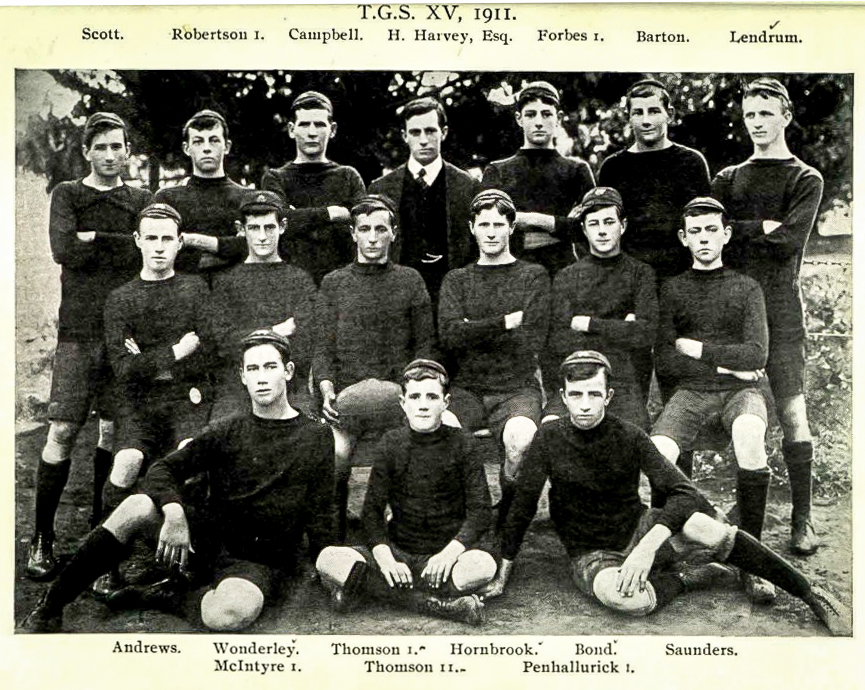
From a young age Harry had a strong military grounding. At Toowoomba Grammar, he rose to Lieutenant in the Senior Cadets in his final school year, gaining valuable training that prepared him for service in the A.I.F.
Off to War
When war broke out, the Saunders family gave two sons to the cause. Claude enlisted first, in June 1915, Regimental No. 1661. With his training as a chemist, he was initially assigned to the Australian General Hospital and sent to Mudros Island in September to support the Gallipoli campaign. Harry enlisted soon after, leaving his studies behind. Harry was only 18 when he enlisted at Brisbane on 21 August 1915. He was posted to A Company, 31st Battalion, part of the newly raised 5th Division. A local Roma newspaper recorded the departure of the latest group of recruits:
“Eight more volunteers left Roma for the encampment by the mail train, on Monday night. The volunteers were: Arthur Miscamble (Roma), Norman H. Saunders (Roma, and the second son of Mr. H. Saunders to volunteer)….”
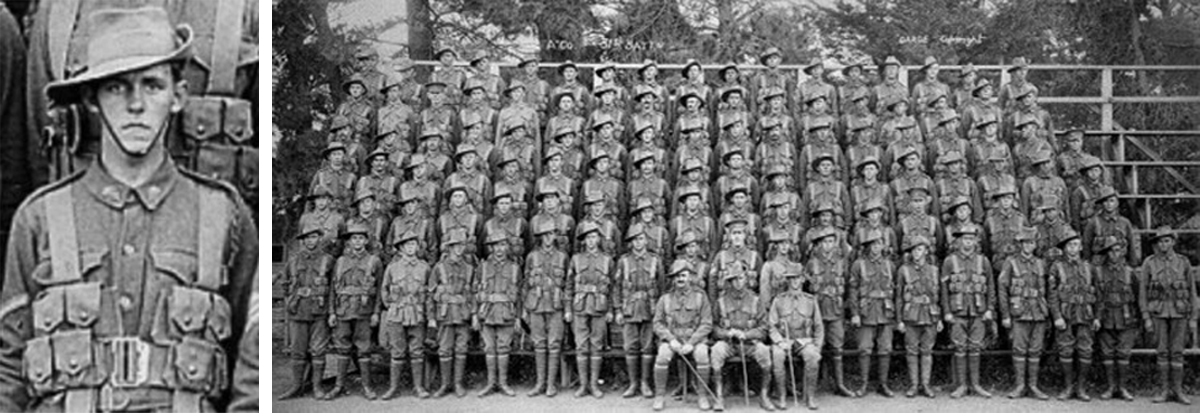
The 31st Battalion was formed in August 1915, drawing half its recruits from Queensland and half from Victoria. Harry’s A Company was among the Queenslanders. After completing their initial training, which was at the Rifle Range Camp in Enoggera, outside of Brisbane. the battalion embarked from Melbourne on 9 November 1915 aboard HMAT Wandilla, while other companies sailed on HMAT Bakara. Before sailing, the 991 soldiers of the 31st had been on parade in Melbourne in front of a good crowd. The Minister for Defence, H.F. Pearce said:
“I do not think I have ever seen a finer body of men.”
In Egypt, the 31st joined the rest of the 8th Brigade for training near Serapeum on the Suez Canal. Here they marched through the desert and spent long days building trenches and defensive works, adjusting to the harsh conditions of camp life. Near the end of February, they moved to the large camp at Tel-el-Kebir , which was about 110 km northeast of Cairo. The 40,000 men in the camp were comprised of Gallipoli veterans and the thousands of reinforcements arriving regularly from Australia. The 60 km trip must have been unpleasant, as it was reported that they were moved in “dirty horse trucks.”
Source - AWM4 23/48/7, 31st Battalion War Diaries, Feb 1916, page 5 I
n May 1916, the battalion was sent to Moascar, and here Harry was promoted to Corporal. A few weeks later, they embarked from Alexandria for France, arriving at Marseilles in June. The months passed in training and sightseeing, but by the time the 31st Battalion was transferred to France, the men were all heartily sick of Egypt. Private Les Smith’s (934) letter home pretty well sums it up - “We are eating dust and sand pretty near all day. It is couple of few feet deep and not a tree to be seen for miles. We are drilling in this and the heat of the sun which is about 100 in the shade.”
Source - SOLDIER'S LETTER. (1916, April 28). Maryborough and Dunolly Advertiser (Vic. 1857 - 1867 ; 1914 - 1918), p. 4. http//nla.gov.au/nla.news-article90591462
On 15 June, the 31st Battalion began to make their way to the Western Front, first by train from Moascar to Alexandria and then sailing to Marseilles. A, B and D companies were aboard the troopship Hororata and C company aboard the Manitou. After disembarking on 23 June, they were immediately boarded onto trains to Steenbeque and then marched to their camp at Morbecque, 35 km from Fleurbaix in northern France, arriving on 26 June.
The battalion strength was 1019 soldiers. The area near Fleurbaix was known as the “Nursery Sector” – a supposedly relatively quiet area where inexperienced Allied troops could learn the harsh realities of Western Front trench warfare against the Germans. But the quiet times and the training period did not last long. Training continued, now with how to handle poisonous gas included in their regimen. They began their move towards Fromelles on 8 July and by 11 July they were into the trenches for the first time. This was their introduction to trench warfare — mud, lice, fatigue duty, and the constant rattle of enemy artillery. Within days, orders came for their baptism of fire - the 31st would take part in the Battle of Fromelles, the first major action for the 5th Division on the Western Front.
The Battle of Fromelles
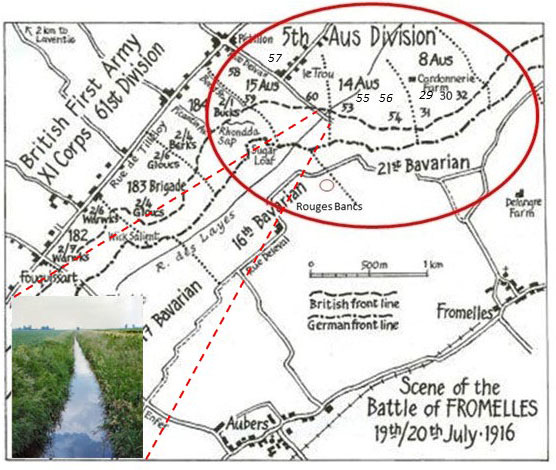
The overall plan was to use brigades from the Australian Fifth Division to conduct a diversionary assault on the German trenches at Fromelles. The main attack was planned for the 17th, but bad weather caused it to be postponed. On the 19th they were back into the trenches and in position at 4.00 PM. The Zero Hour for advancing from their front-line trenches was to be 5.45 PM, but the Germans knew this attack was coming and were well-prepared:
“Just prior to launching the attack, the enemy bombardment was hellish, and it seemed as if they knew accurately the time set.”
At 5.58 p.m. on 19 July, the attack commenced. Harry’s A Conpany and C Company led the first two waves, followed by B and D Companies. There were machine gun emplacements to their left and directly ahead at Delrangre Farm and there was heavy artillery fire in No-Man’s-Land.
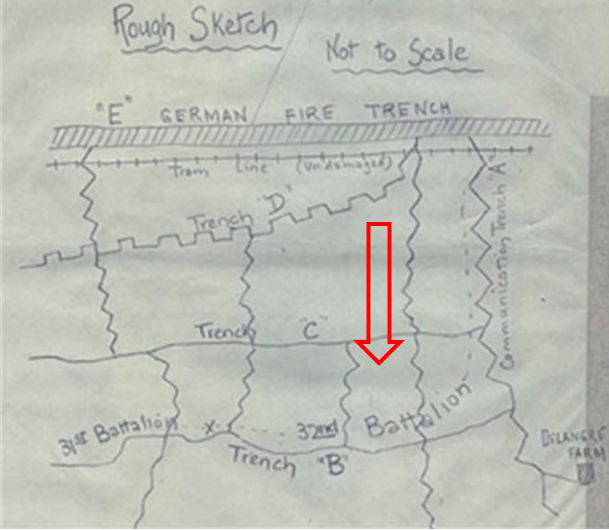
Some men from the 31st managed to reach and enter the German front line, but machine-gun fire and counter-attacks inflicted heavy losses. Those who crossed the open ground came under withering fire, while isolated groups that dug in overnight were cut off from reinforcements. By dawn on 20 July, the survivors had no choice but to withdraw:
“The enemy swarmed in and the retirement across No Mans’ Land resembled a shambles, the enemy artillery and machine guns doing deadly damage.”
From the 1019 soldiers who left Egypt, the initial impact was assessed as 77 soldiers killed or died from wounds, 414 wounded and 85 missing. The ultimate total was that 162 soldiers of the 31st were either killed or died from wounds and of this total 82 were missing/unidentified. The bravery of the soldiers of the 31st was well recognised by their own Battalion commanders.
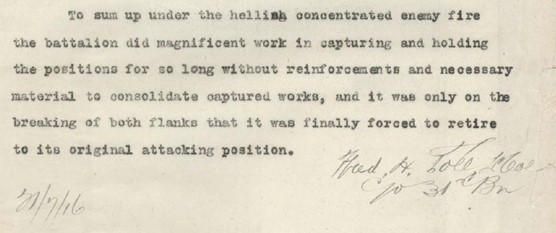
After the Battle
Harry was among the casualties. He was wounded in action on 20 July, suffering injuries to his hand, leg, and chest. He was evacuated through Calais to Boulogne, where he spent several weeks in hospital and at convalescent depots before being discharged to rejoin his unit. The news about Harry reached Roma and Toowoomba in early September.
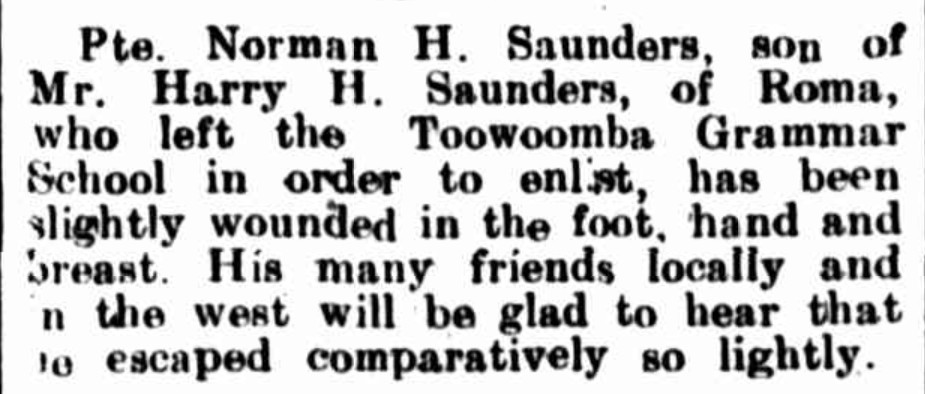
Out of One Battle and Right Into Another
In late September 1916, Harry had recovered enough to be to rejoin the 31st. The battalion was then holding the line near Houplines, outside Armentières, when orders came for a trench raid – Harry was back into battle. On the night of 12 October 1916, at 7.30pm, a 31st Battalion raiding party of five officers and one hundred men crept across No Man’s Land to assault the German front line. They climbed over the parapet in the darkness and moved forward to attack the Chicken Run again. With careful planning and good leadership, the raiders were able to cross No Man’s Land quickly under cover of the Brigade’s mortars.
After thirteen minutes they dropped down into the Chicken Run, and stayed in the German line for forty minutes, entirely clearing the sector. Dugouts were bombed, first with smoke-bombs and then with mortars. The raid was successful from a military point of view - a number of Germans were killed, three prisoners (Bavarian Guards) were captured and a machine gun taken - but the cost was heavy. In the chaos of the withdrawal, Harry did not return. His personal file simply states “Reported wounded and missing”. Eight days later, he was officially declared as having been killed in action. He was only 19 years old.
And the War Continues for the Family – Claude
Harry’s news was devastating and to add to this there were similar worries in the Saunders household of Roma about his older brother Claude. Claude had enlisted in June 1915. With his training as a chemist, he first served with the Australian Medical Corps, but by Septmber 1916 he had been reassigned to the infantry, 14th Battalion, and sent to France. While fighting at Bullecourt in April 1917, Claude was struck by a bullet which fractured his thigh. He was taken prisoner and endured months in German prison camps.
Claude returned to Australia on 6 July, 1918, but with a permanent disability from his wound. Despite his injuries, Claude carried on the family chemist business in Roma and later became President of the Roma Returned Soldiers’ League, working tirelessly for the welfare of veterans. He died in 1950 at Greenslopes Military Hospital.
Harry’s Father - Seeking Closure
Harry (senior) took pride of his sons’ service, but the grief at losing Harry and concerns over Claude and the paucity of news available from the Army was an ongoing frustration with military authorities. Initially he wrote to Base Records on 20 September, 1917, enquiring as to when he would be receiving Harry’s personal effects to provide him with some degree of closure. Then, three months later, on 14 January, 1918, nearly thirteen months after his Harry’s death, he wrote a scathing letter to Base Records.
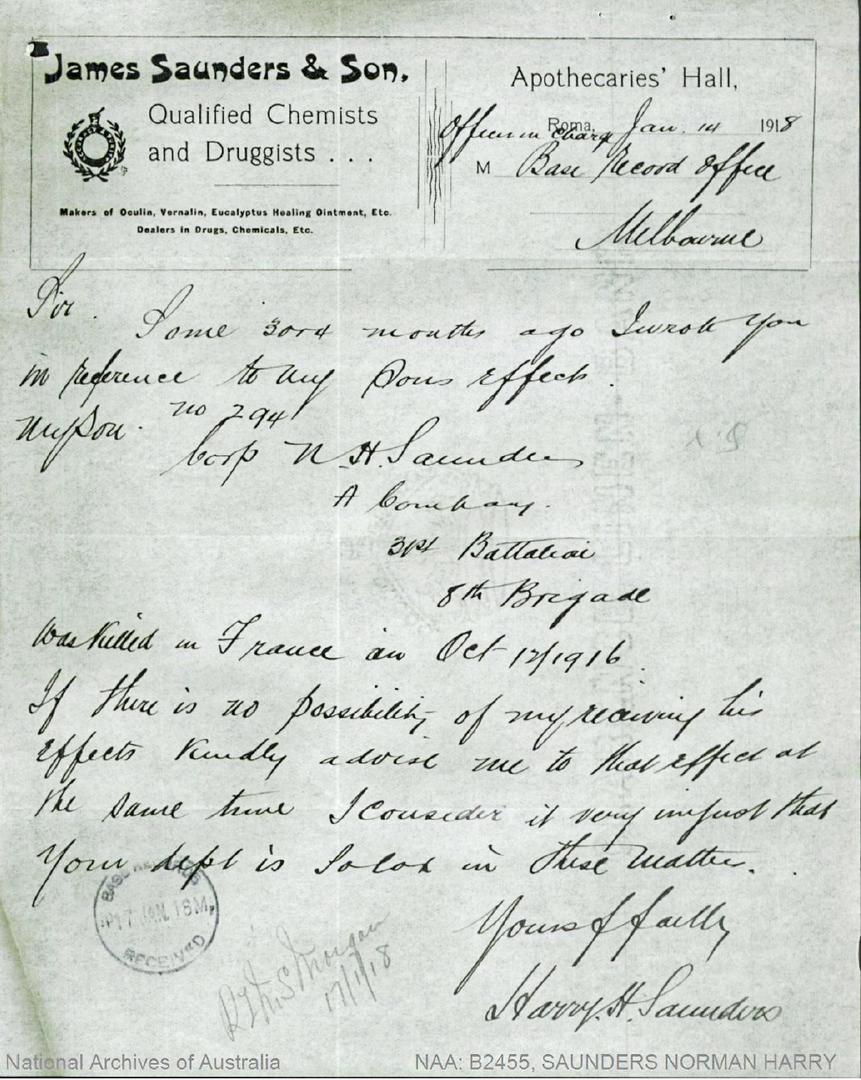
As is the case with many, many soldiers and, given the chaos of the Western Front, none of Harry’s personal effects were ever returned. Harry was awarded the 1914-15 Star Medal, the Victory Medal, the British War Medal, a Memorial Plaque and a Memorial Scroll. His body was never recovered and, like many of his compatriots, his file contains an undated, handwritten ‘buried in the vicinity’ note, a blunt statement of the truth of the matter.

Rememberance
Harry’s obituary in the November 1917 school magazine remembered him warmly:
“Norman H. Saunders was just as we went to press, reported killed in France. He was a prefect here only last year and a member of the XV. He will be remembered, too, as corner man in the minstrel concerts, and in this, as in all other things, he always showed the keenest public spirit. His father, Mr. H. H. Saunders, of Roma, is also an old boy, and so is his brother Claude who served in Gallipoli, and is now in France.”
In September 1918, the Roma community gathered to plant trees in honour of the district’s fallen soldiers. Twenty-seven bottle trees were planted along Wyndham and Bungil Streets, each bearing a plaque for a local man who had died. The first tree was planted for Harry:
“The first tree which was to the memory of Norman Saunders was then planted…”
That tree still stands today in Wyndham Street, opposite the Roma Post Office, marked with a plaque to Harry’s name. The tree is now known as the Tree of Knowledge. The rest of the avenue was planted by 1920. Today there are 140 bottle trees planted along the streets of Roma, collectively known as Heroes Avenue. They honour the service of 140 individuals who did not return from the First World War.
A panel adjacent to Harry’s bottle tree memorial contains the inscription: "On the 20th of September 1918 the people of the Roma District gathered to pay tribute to their sons who fell in WW1. In their honour, a bottle tree was planted for each soldier as a living memorial to their duty to their nation. The gathered citizens pledged that ‘their lives would live on. As long as Roma existed they would never be forgotten.’"
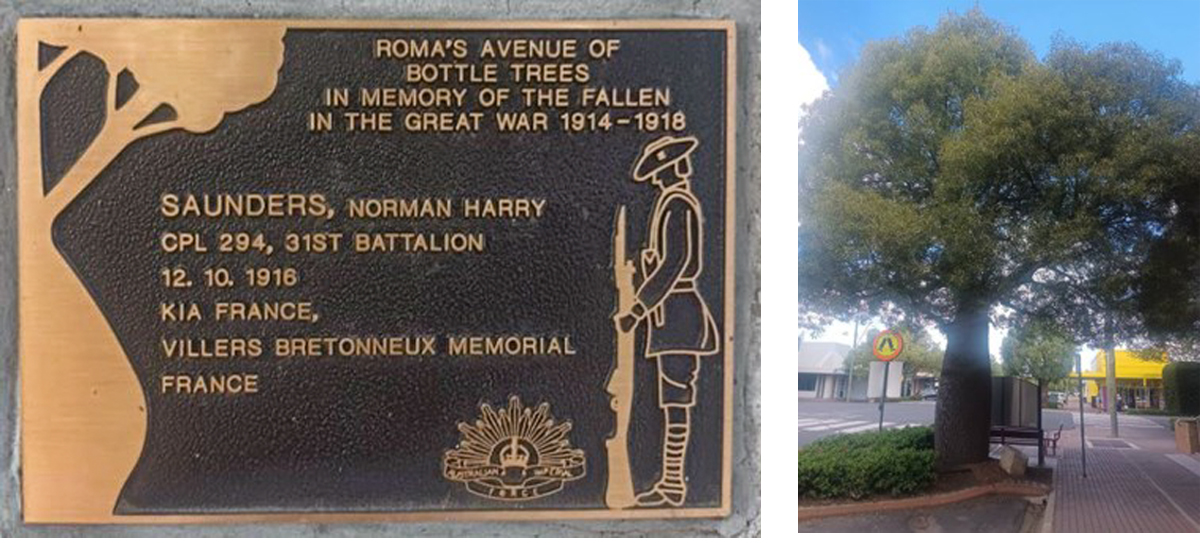
Harry is also remembered on many Australian memorials:
- The Australian War Memorial Roll of Honour, Canberra
- The Toowoomba Grammar School Roll of Honour and the In Memoriam Board
- The Toowoomba Mothers’ Memorial
- The Roma Cenotaph and the Town of Roma and Shire of Bungil Honour Board
- The Roma Heroes Avenue of Bottle Trees
Harry’s name was later placed on the Villers-Bretonneux Memorial, among the many Australians from the Western Front with no known grave.
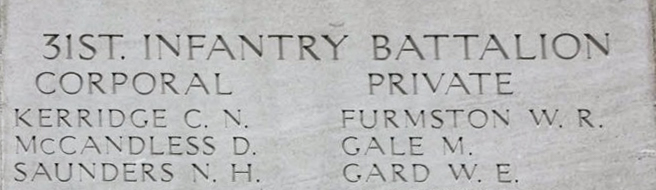
Through these memorials, in both France and Australia, Norman Harry Saunders is remembered not just as a soldier of the 31st Battalion, but as a much-loved son of Roma, a prefect and sportsman of Toowoomba Grammar, and the first of his town’s “Heroes Avenue” boys.
The Fromelles Association would love to hear from you

Contacts
(Contact: carla@fromelles.info or geoffrey@fromelles.info).
(Contact: army.uwc@defence.gov.au or phone 1800 019 090).
Donations
If you are able, please contribute to the upkeep of this resource.
(Contact: bill@fromelles.info ).