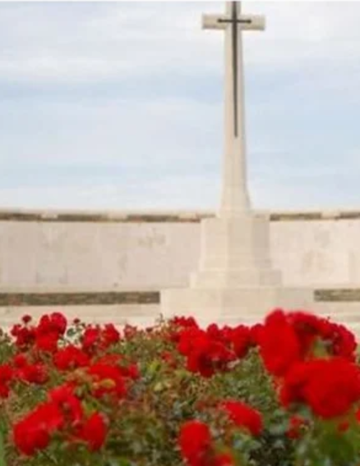
David Joseph GLEESON
Eyes brown, Hair dark brown, Complexion fresh
David Joseph GLEESON — A Queenslander Lost at Fromelles
Can you help find Dave?
David Joseph Gleeson’s body was never found after the Battle of Fromelles, and there are no records of his burial.
A mass grave was found in 2008 at Fromelles, a grave the Germans dug for 250 Australian soldiers they recovered after the battle. As of 2026, 181 of these soldiers have been able to be identified via DNA testing.
Dave may be among these remaining unidentified men. There is still a chance to identify him — but we need help. We welcome all branches of his family to come forward to donate DNA to help with his identification, especially those with roots in Rockhampton, QLD
See the DNA box at the end of the story for what we do know about his family.
If you know anything of contacts for Dave, please contact the Fromelles Association.
Please contact the Fromelles Association of Australia to find out more.
Early Life
David Vincent “Joseph” Gleeson, known as Dave, was born in Rockhampton 27 March 1891, the first surviving child of John Gleeson and Bridget Fagan. His birth records show David Vincent, but "Joseph" seems to be a later informal choice that he used for the rest of his life and is the name on his army records. John and Bridget’s children were:
- Margaret Gleeson (1889–1889) – died in infancy
- David Vincent “Joseph” Gleeson (1891–1916)Ellen Elizabeth Mary “Nellie” Gleeson (1894–1946) – married Walter George Poulsen
- John William “Jack/Jock” Gleeson (1899–1960)
Both of Dave’s parents were Irish immigrants who arrived in North Queensland. John came from Glenworth, County Cork, and Bridget from Navan, County Meath. They married in St Joseph’s Catholic Church Rockhampton in 1888, but John had to go where work opportunities took him, so they did not stay in Rockhampton long. By the time Dave’s younger sister Ellen was born on 19 February 1894 the family had moved to Croydon, followed by a further move to the mining town of Charters Towers, where younger brother John William “Jack” was born on 5 February 1899.
But mid-year 1899 brought a shocking event to change the very fabric of this little family. On 21 July John Gleeson died in Charters Towers aged just 41, leaving Bridget a widow with a babe in arms, Ellen a five-year-old, and Dave, now aged 8. The In Memoriam notices Bridget placed in these Northern newspapers a year later show her abiding sorrow for the loss to herself and the children of her beloved John.
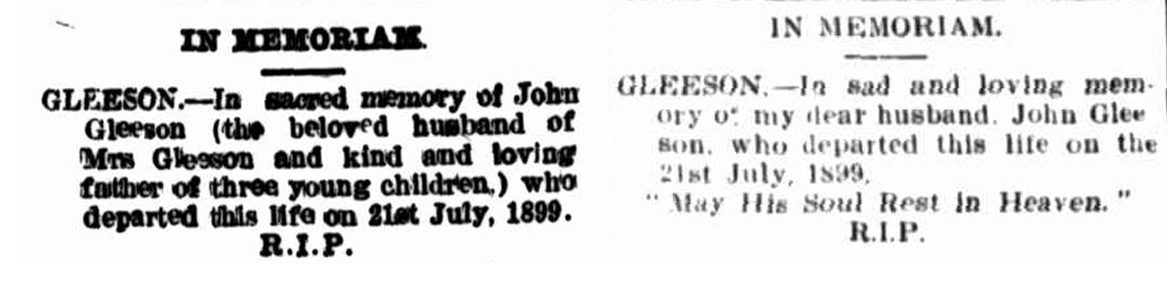
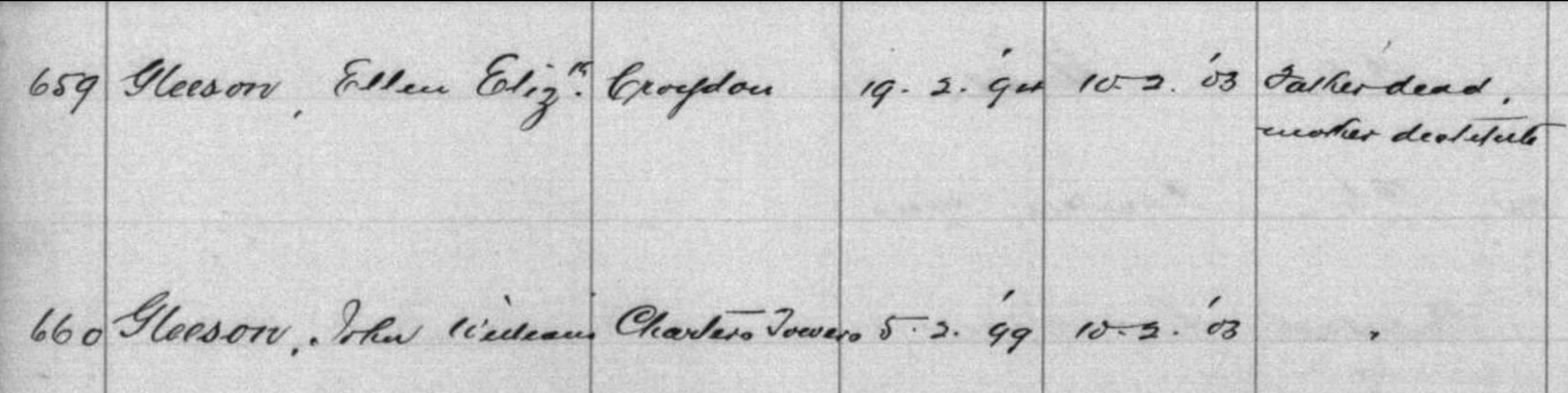
Somehow, with a further move to Townsville, Bridget managed to support her young family and keep the children together for the next few years, but by 1903 the hardship had become overwhelming and she was forced to place the two youngest children, Ellen and Jack, into care at St Joseph’s Meteor Park Orphanage back in Rockhampton.
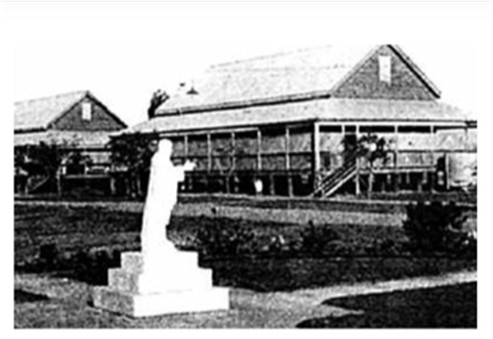
Their admission notes were brutally stark in their brevity – “father dead, mother destitute”.
Fortunately the children were there for only a few months berfore being discharged back into Bridget’s care in July 1903. From this point the family made their home in Townsville but once again their story was marked by loss, bereavement and sorrow when Bridget, the linchpin of the family, died on July 12, 1915 at the Townsville Hospital aged 52.
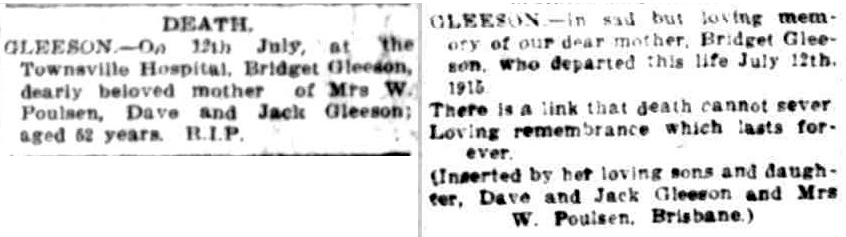
Bridget’s early death meant, sadly, the dispersal of her now orphaned children. Recently married Ellen, now with a baby of her own, had moved to Brisbane with her husband Walter Joseph Poulsen. Jack, now 16 and possibly already working as a labourer lists his next address as North Sydney, where he was close to a cousin. And Dave? Within a fortnight of his mother’s death, 24-year-old Dave had left his job and, following the example of his father, who had served as a Private in the 60th Foot, the King’s Royal Rifle Corps, joined the armed forces. Dave was off to war.
Off to War
Dave enlisted on 28 July 1915 in Melbourne, naming his 16-year-old brother in Sydney as next of kin. He was first assigned to B Company No. 20 Castlemaine Training Battalion, then to the 11th Reinforcements of the 7th Battalion. On 11 October he sailed from Melbourne on HMAS Nestor for the large camps in Egypt. With the ‘doubling of the AIF’ as it expanded from two infantry divisions to five, major reorganisations were underway. In early February 1916 he was transferred to the 59th Battalion and then to the 60th on 15 March.
The 60th Battalion was raised on 24 February 1916 and it consisted of a blend of half experienced Gallipoli veterans from predominantly the Victorian 8th battalion and half fresh inexperienced reinforcements from Australia, of whom Dave was one. After a month of training at Tel el Kebir these soldiers had a long march lasting over two days in scorching heat across the Egyptian sand to Ferry Post near the Suez Canal with only a half pint of water per bottle to slake their thirst on the way.
Source- AWM4 23/15/1 15th Brigade War Diaries Feb-Mar 1916 p 6.
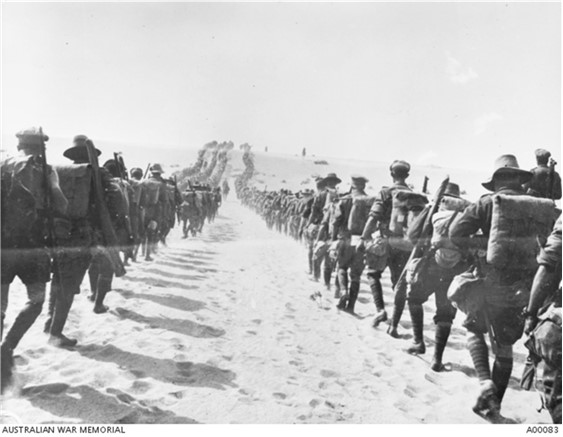
They remained at Ferry Post until 1 June continuing their training and guarding the Suez Canal from any potential threats posed by the Ottoman Army. Their time in Egypt was not all work, however. A 5th Division Sports Championship was held on 14 June, which was won by the 60th’s 15th brigade. On 17 June they received orders to begin the move to the Western Front and were on trains to Alexandria. On 18 June 1916 the majority of the Dave’s Battalion, 30 officers and 948 other ranks, embarked from Alexandria aboard the transport ship Kinfauns Castle to join the British Expeditionary Force. After a stop in Malta, they arrived in Marseilles on 29 June and thus began the long arduous train journey north through the length of France finally to the Western Front, arriving in Steenbecque in Northern France, 35 km from Fleurbaix on 2 July.
The area near Fleurbaix was known as the “Nursery Sector” – a supposedly relatively quiet area where inexperienced Allied troops such as Dave’s could learn the harsh realities of Western Front trench warfare. against the well trained and well equipped Germans. But the quiet times and the training period did not last long. On the 7 July they began their move to the front, arriving in Sailly on the 9th. Now just a few kilometres from the front, their training intensified as they moved closer to to Fleurbaix. By 14 July the 60th were in the trenches, against the formidable 6th Bavarian Reserve Division, who not only knew the terrain but had the advantage of higher ground and clear lines of fire.
The Battle of Fromelles
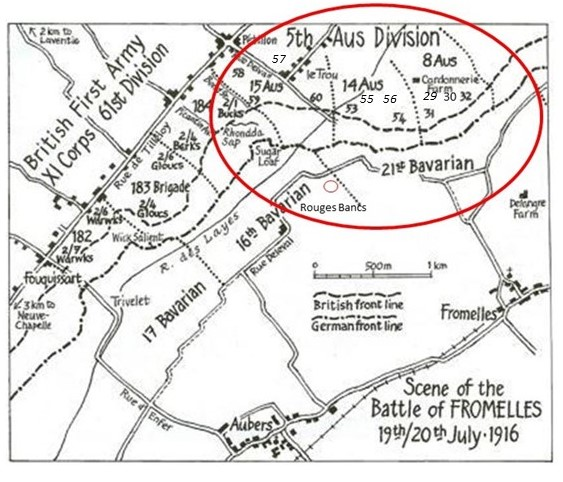
The battle plan had the 15th Brigade located just to the left of the British army. The 59th and 60th Battalions were to be the lead units for this area of the attack, with the 58th and 57th as the ‘third and fourth’ battalions in reserve. The main objective of the 15th Brigade was to take the trenches to the left of the heavily armed, elevated German defensive position, the ‘Sugar Loaf’, which dominated the front lines. If the Sugar Loaf could not be taken, the other battalions would be subjected to murderous enfilade fire from the machine-guns and counterattacks from that direction. As they advanced, they were to link up with the 59th and 53rd Battalions on their flanks. The 60th battalion faced an especially difficult position in the assault, directly opposite the Sugar Loaf and having to traverse No-Man’s-Land at its widest point - 365 yards across.
On 17 July, they were in position for the major attack against the Sugar Loaf position, but it was postponed due to unfavourable weather. Two days later, with No-Man’s-Land now being water-logged and muddy, Zero Hour for advancing from their front-line trenches was to be 5:45 pm but with Allied movement now having gone on for days, the Germans knew the attack was coming. ‘For the first time in the War,’ it would be recorded by Charles Bean, ‘an Australian attacking force was actually meeting the contingency most dreaded by commanders - its intention had been discovered, and the enemy barrage was crashing upon its assembly position with the object of destroying the attack.’
Source Charles Bean, Chapter XII, The Battle of Fromelles, p 358
The first of four waves of Aussies went over the parapet at 5.45 PM and then each wave followed at 5-minute intervals, but then lay down to wait for the support bombardment to end at 6.00 PM. A & B Companies were in the first two waves, C & D in the next two. Casualties were immediate and heavy. Dave, serving with B Company, was positioned in the central sector where the ground sloped gently down towarads the German lines, offering no cover at all. The first two waves were cut down before reaching the German wire. Very few men from the later waves advanced beyond 100 yards. Survivors spoke of a hail of bullets sweeping the flat ground, the noise of the guns overwhelming all sense of direction or order. Corporal Willian Holtham, one of the machine gunners, later wrote that the men showed incredible courage as they left the trench:
“Not a man flinched, not a single chap hung back when his turn came. They were just up and over.”
Shortly after 7.00 PM Brigadier General Harold “Pompey” Elliott learned the attack had collapsed. The ground between the trenches was littered with the dead and wounded. In a report to the divisional commander at 7.18 PM Elliott wrote:
”The trenches are full of enemy. Every man who rises is shot down. Support from wounded indicates the attack is failing from want of support.”
The 15th Brigade War diaries capture the intensity of the early part of the attack, “they were enfiladed by machine guns in the sugar Loaf and melted away.”

The British 184th Brigade just to the right of the 59th met with the same resistance, but at 8:00 pm they got orders that no further attacks would take place that night. However the salient between the troops limited communications, leaving the Australians to continue without British support from their now exposed right flank. In all the horror and confusion of the battle that day there was no witness report of Dave falling. His absence was noticed however, and his name was among those listed as missing at roll call the next morning. In the ‘Official History of the War’, Charles Bean said , “of the 60th Battalion, which had gone into the fight with 887 men, only one officer and 106 men answered the call.”
Source – Official History of Australia in the War of 1914 – 1918, Vol III, Chap XIII page 442
To get some perspective of the battle, when Charles Bean, Australia’s official war historian, attended the battlefield two and a half years later, he observed a large quantity of bones, torn uniforms and Australian kit still on the battlefield. The final impact of the battle on the 60th was that 394 soldiers were killed or died of wounds, of which 313 were not able to be identified.
After the Battle
A hand written field report of September 24, 1916 indicates that Dave ‘appears missing’ and would probably be the subject of an enquiry.
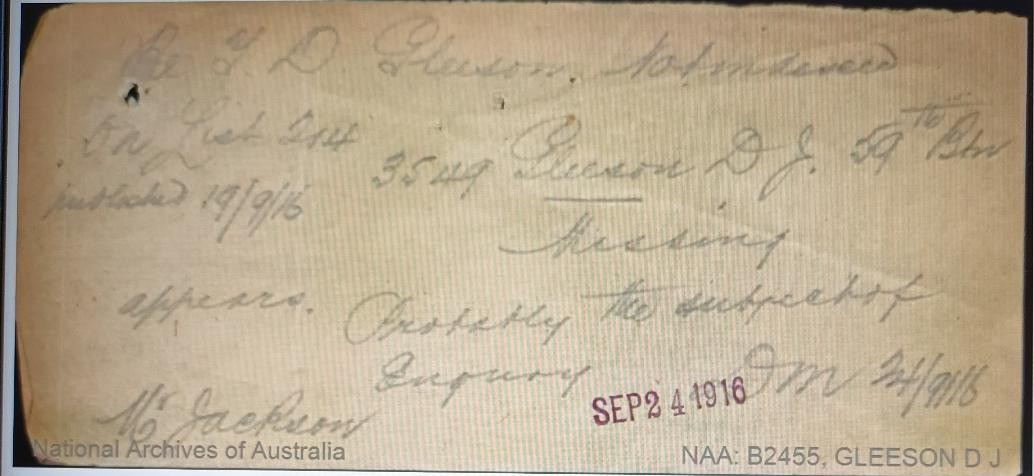
Unfortunately for his anxious siblings waiting for news at home, that enquiry was still a year away. When the remnants of the 60th Battalion withdrew from the battlefield at dawn on 20 July, Dave was missing. No one had seen him fall, and no survivor could say where he had last been sighted. Like so many men from B Company who had advanced into the deadliest part of the Sugar Loaf position, he simply did not return. Months passed with no further information; Dave was still listed as missing. A year almost to the day after Bridget’s death, the anxiety of his family at home for some definite news of his fate is palpable in their polite letters to Base Records. The first recorded enquiry came from Annie Lenehan, his cousin in North Sydney, who wrote on 26 December 1916.
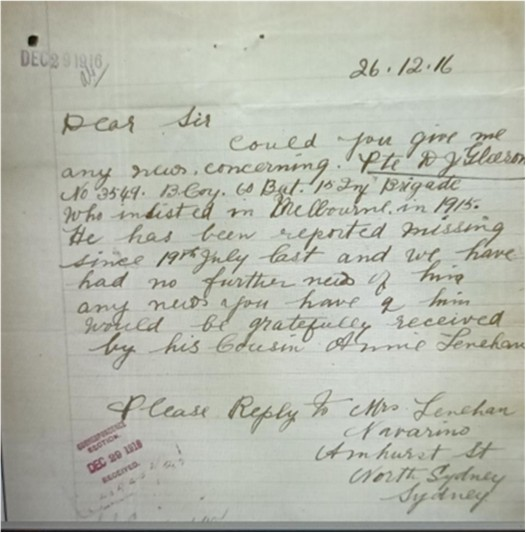
The prompt reply brought the inevitable response:
”‘I beg to state no report other than Missing 19/7/16 has been received in respect of No. 3549 Private D.J. Gleeson, 60th (late 59th) Battalion.
It is understood the overseas authorities are doing their utmost to trace members of the force reported ‘missing’ ……”
Source: NAA, B2455 - Gleeson, D.J. p 37
Dave’s young brother, Jack, now Sapper Gleeson of the 10th Field Engineers at the Enoggera camp in Brisbane, wrote in March 1917 explaining that Dave was still missing and he (Jack) was next of kin. With both parents being dead and Jack, himself, expecting to be leaving shortly for the front, he was quite unsure as to what he needed to be doing as Dave’s next of kin.
Source - NAA, B2455 - Gleeson, D.J. p 36
Life was inexorably moving on for Jack’s siblings, with constant changes of address and circumstances, but simultaneously time was standing still with the continuous waiting for updates of Jack’s fate, with the hope that mail would catch up with them at the right address.
In July 1917 Ellen, now with two young children, but also having to assume the role of ‘parent’ for both of her brothers, began her own series of letters, showing the strain of still not having definite news of Jack, and now being responsible for looking after the interests of both Dave and Jack, ‘I beg to ask you if you would let me know if there is any further news of my missing brother Pte D.J. Gleeson……’
Source – NAA, B2455, Gleeson, D.J., page 34
Ever vigilant for their welfare, and trying respectfuly to meet bureaucratic requirements, she worked with the Army to confirm Jack’s wishes from his previous letter that she, as their only sister and sibling left, is now next of kin for them both. The Army accepted this.
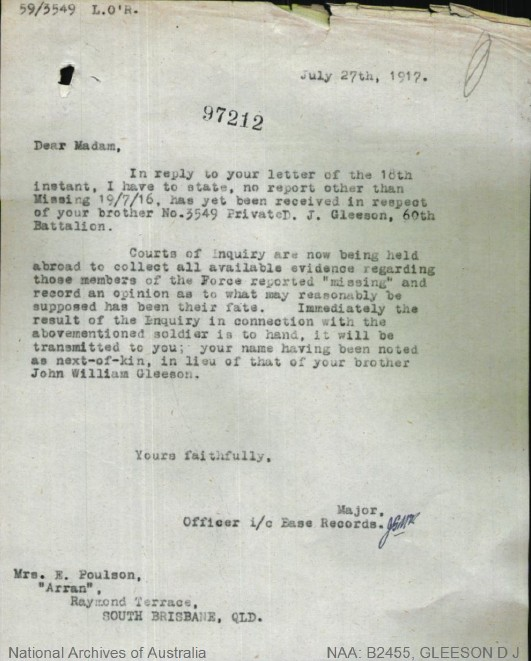
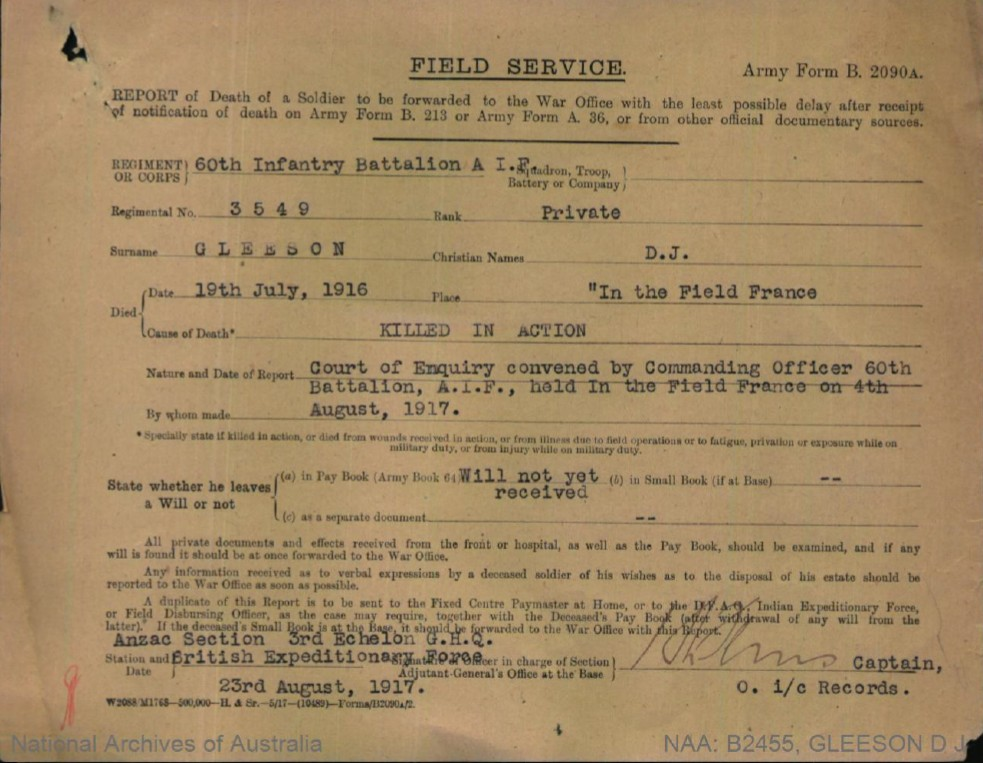
Finally, closure came from two sources. A Court of Enquiry held in the field 4 August 1917 concluded that Dave had indeed been killed in action that terrible day 19 July 1916.
And later, after months of checks against German lists and prisoner-of-war records, their file notes certified by Capt Mills read – “No trace Germany.” This meant that the Germans had not recovered his body, and had not listed him as a prisoner, and had no record of him at all. For families, there was no more final verdict than this.
Source - : Australian Red Cross Wounded and Missing files – Private David Joseph Gleeson. P3
In an extract from Ellen’s last letter, in her usual polite dutiful style, trying to do her best by her brothers, she shows both resignation and acceptance; at last she knows the truth.
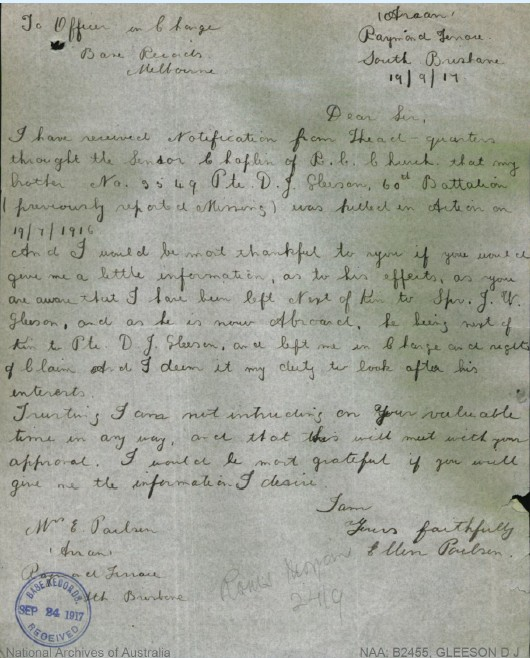
Dave has no known grave. Like so many from the 60th Battalion who fell in front of the Sugar Loaf, his resting place is lost in No-Man’s-Land at Fromelles. His name is listed on the VC Corner Australian Cemetery Memorial . Dave was posthumously awarded the1914 – 15 Star Medal, the British War Medal, the Victory Medal, a Memorial Plaque and a Memorial Scroll.
Family at War
Father – John Gleeson
Dave came from a family with a tradition of military service. His father, John Gleeson, had served as a Private in the 60th Foot, the King’s Royal Rifle Corps, appearing in the UK Royal Hospital Chelsea pension records as admitted for pension in Cork and later transferred to Dover. Long before Dave was born, his father had already worn a uniform and carried a rifle in imperial service.
Brother – John William Gleeson (7257)
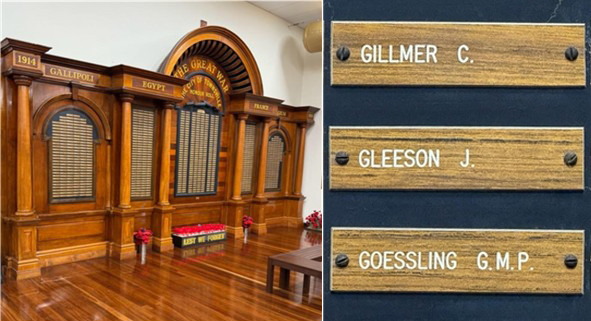
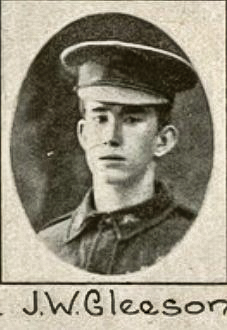
Still not knowing the fate of his elder brother Dave when he enlisted on 22 November 1916, John William “Jack’ Gleeson, aged just 17, put his age up to 18 so he could meet the minimum age requirements for enlistment at the time. He served as Sapper 7527 with the 1st Tunnelling Company, working in some of the most dangerous underground operations on the Western front. Jack survived the war, returning to Australia on the Nestor on 4 July 1919 to live for a time with Ellen and her family in Brisbane, He died in 1960. Jack’s service is remembered on the Honour Board at the Jezzine Barracks in Townsville.
Postscript
The war had an impact on the civilians in the Gleeson family as well as its soldiers. Ellen’s letters show clearly her devotion to her brothers as a reliable stand-in for their deceased parents. Sadly she passed away in 1946 at 52, the same age as her mother Bridget had been when she died in 1915. But there is another example of history repeating itself for this family. Ellen named her second son, born 22 April 1916, David Joseph (Poulsen) after her brother, who was at that time at the training camp at tel el Kebir in Egypt, yet to be transported to the Western Front.
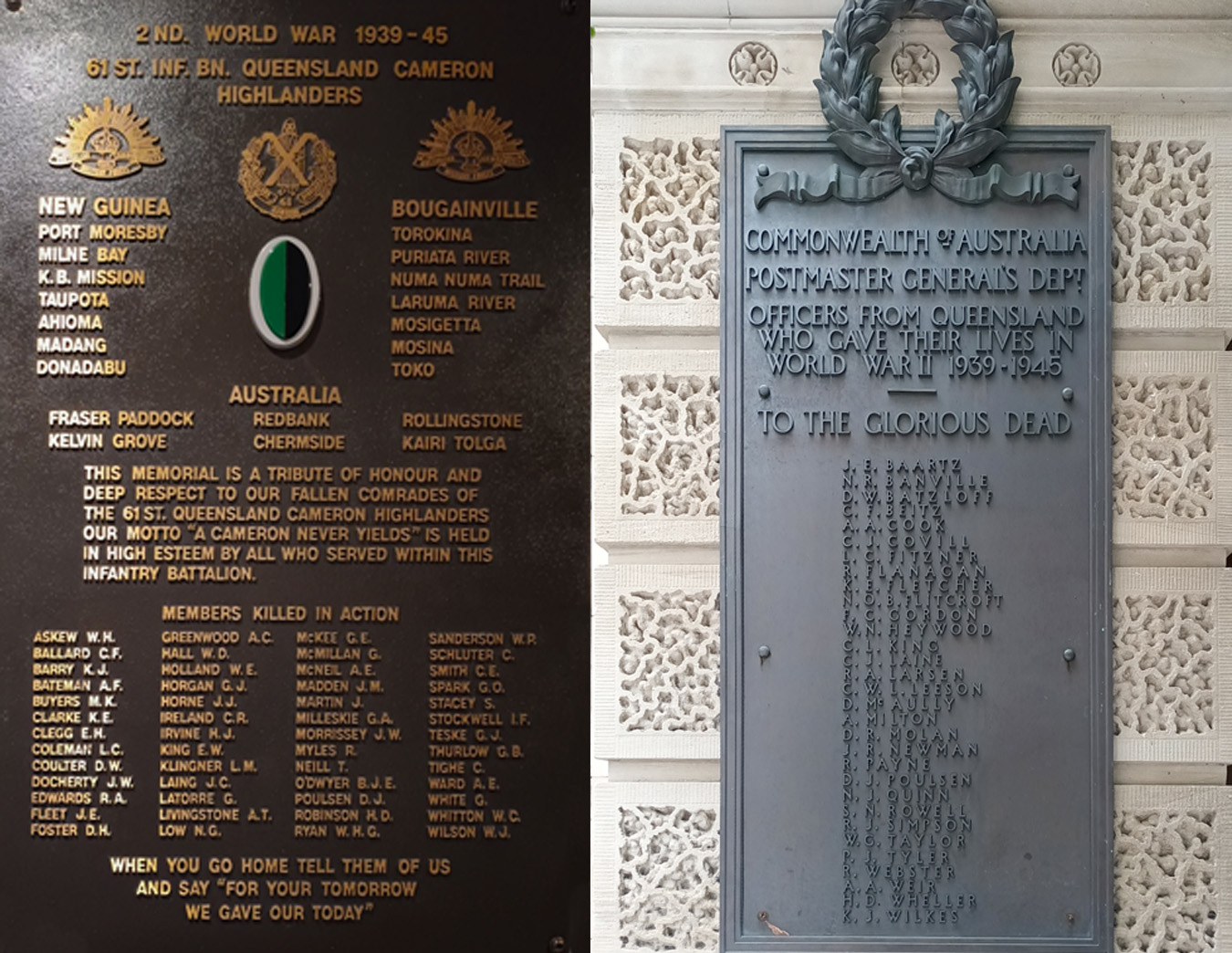
This David Joseph also grew up to become a soldier, serving in D Company, 61st Battalion, Australian Military Forces in World War 2. In a cruel postscript to the Gleeson story, he too was killed in action while serving in New Guinea in 1942 with the Queensland division of the Cameron Highlanders. He was 26 years of age, approximately the same age as his uncle had been.
Finding Dave
Dave’s remains have not been recovered; he has no known grave. After the battle, the Germans recovered 250 Australian soldiers and placed them in a burial pit at Pheasant Wood. This grave was discovered in 2008 and since then efforts have been underway to identify these soldiers by DNA testing from family members. As of 2026, 181 of the soldiers have been identified, including two of the 313 unidentified soldiers from the 60th Battalion. We welcome all branches of Dave’s family to come forward to donate DNA to help with his identification, particularly from the Gleeson or Fagan lines.
Dave’s father, John Gleeson, was born in County Cork, Ireland, and his mother, Bridget Fagan, came from Navan, County Meath, Ireland. Their descendants may be found across Queensland, New South Wales and Ireland, especially around Rockhampton, Charters Towers, Townsville, Sydney, and Cork and Meath. If you know anything of family contacts, please contact the Fromelles Association. We hope that one day Dave will be named and honoured with a known grave.
Please visit Fromelles.info to follow the ongoing identification project and Dave’s story.
DNA samples are being sought for family connections to
| Soldier | David Joseph Gleeson (1891–1916) |
| Parents | John Gleeson (1858–1899), born Glenworth, County Cork, Ireland; died Charters Towers, QLD and Bridget Fagan (1863–1915), born Navan, County Meath, Ireland; died Townsville, QLD |
| Siblings | Margaret Gleeson (1889–1889) | ||
| Ellen Elizabeth Mary “Nellie” Gleeson (1894–1946), m Walter George Poulsen | |||
| John William “Jack/Jock” Gleeson (1899–1960) |
| Grandparents | |||
| Paternal | John Gleeson, Ireland and Ellen Donovan, Ireland | ||
| Maternal | Stephen Fagan, Ireland and Margaret Comosky, Ireland |
Links to Official Records
Seeking DNA Donors

Contacts
(Contact: carla@fromelles.info or geoffrey@fromelles.info).
(Contact: army.uwc@defence.gov.au or phone 1800 019 090).
Donations
If you are able, please contribute to the upkeep of this resource.
(Contact: bill@fromelles.info ).