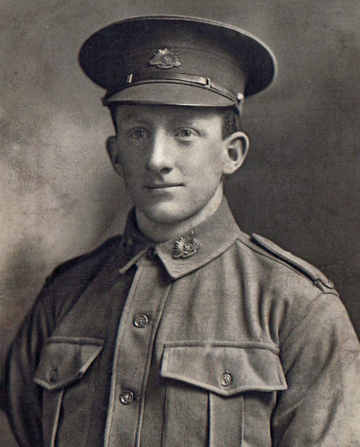
Edgar Briton PENALUNA
Eyes blue, Hair red, Complexion fresh
Edgar "Eddie" Penaluna and his mates, an impact on the whole community
Can you help find Eddie?
Edgar "Eddie" Briton Penaluna’s body was never found after the Battle of Fromelles, and there are no records of his burial.
A mass grave was found in 2008 at Fromelles, a grave the Germans dug for 250 Australian soldiers they recovered after the battle. As of 2026, 181 of these soldiers have been able to be identified via DNA testing.
Eddie may be among these remaining 69 unidentified men. There is still a chance to identify him — but we need help. We welcome all branches of his family to come forward to donate DNA to help with his identification, especially those with roots in Bendigo, VIC
See the DNA box at the end of the story for what we do know about his family.
If you know anything of contacts for Eddie, please contact the Fromelles Association.
Early Life
Edgar Briton Penaluna, known as Eddie, was born on 24 August 1892 at Eaglehawk, Victoria, the son of William Henry Penaluna and Mary Ellen Nancarrow. He was the fifth surviving child in a large Cornish-Australian family.
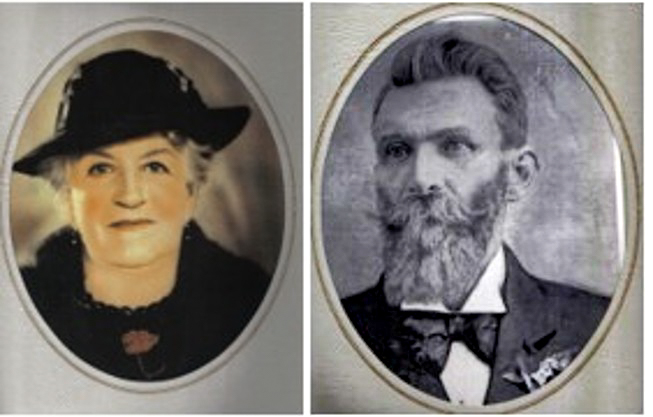
William and Mary’s children were:
- Alexander (1882–1962)
- Ellen Jane (1884–1972)
- William Alfred (1886–1979)
- Lavina (1888–1980)
- Edgar Briton (1892–1916)
- Herbert Victor (1894–1894) – died in infancy
- Walter Richard (1896–1902) – died in childhood
- Wesley John (1899–1977)
- James Francis "Jim" (1901–1975)
The Penaluna and Nancarrow families were among the many Cornish mining families who settled in the Bendigo district during the Victorian gold rush. Eddie's father was one of Bendigo's best-known musicians and had been associated with Northcott's Band for more than twenty years. Unfortunately, he died on 28 July 1904, when Eddie was just eleven years old. William was widely mourned throughout the district. More than 120 bandsmen representing six local bands led the funeral procession to Eaglehawk Cemetery, while an estimated 2,000 people gathered to pay their respects, a remarkable tribute to his standing as both a musician and a citizen.
Source - "Obituary", Bendigo Advertiser (Vic.), 1 August 1904, p. 6
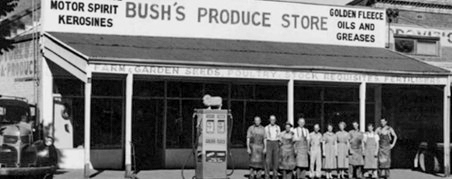
Following his father's death, Eddie was raised by his mother at Early Street, California Gully. He attended California Gully State School before obtaining employment as a grocer with G.R. Bush's Produce Store in Williamson Street, Bendigo. Established in 1857, Bush's was one of Bendigo's oldest family businesses, supplying produce, seed and farming goods throughout the district. Eddie became well known in the local community.
Outside of work Eddie was actively involved in the local Methodist community, serving for several years as Secretary of the California Gully Brotherhood and was also a member of Cobden Tent of the Independent Order of Rechabites. Before volunteering for the Australian Imperial Force, he completed three years' service with the Bendigo Senior Cadets, reflecting his early commitment to military training and community service.
Off to War
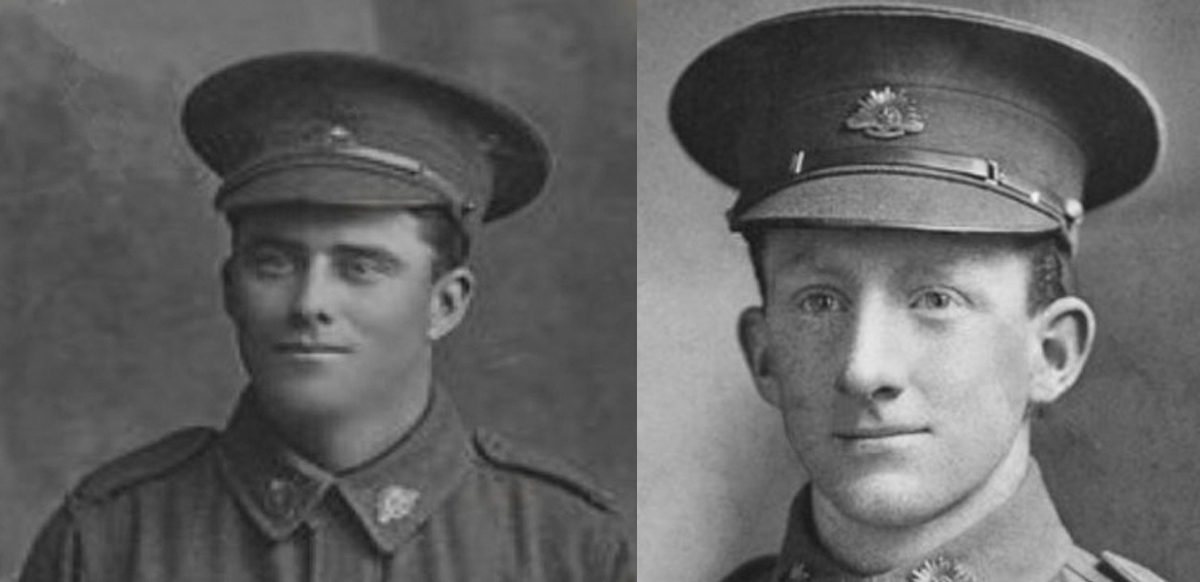
Eddie enlisted at Bendigo on 9 July 1915, aged twenty-two. He was assigned to the 8th Reinforcements for the 21st Battalion. After a short period of military training, he embarked from Melbourne aboard HMAT Demosthenes (A64) on 29 December 1915. He was with several mates from the Eaglehawk and California Gully districts who would remain closely connected throughout their service - William Alfred Rowe (Fred), John Brown (Jack), John William Murton (Jack), John Yarrow (Jack), Richard Henry Bone (Harry) and Eddie's cousin, Raymond Gowrie Nancarrow (Ray).
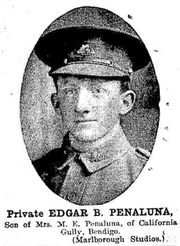
Edgar Briton Penaluna
Source: The Bendigonian
John William Murton
Source: The Bendigonian
Richard Henry Bone
Source: The Bendigonian
William Alfred Rowe
Source: The Bendigonian
Jack Yarrow
Source: The Bendigonian
Raymond Gowrie Nancarrow
Source: The Bendigo Independent
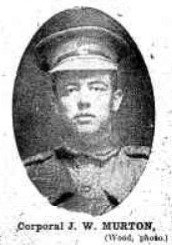
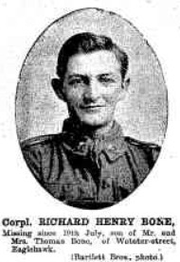
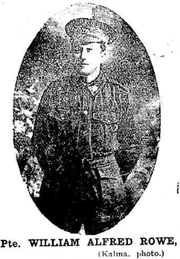
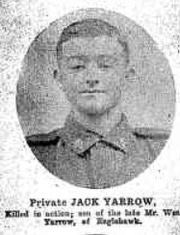
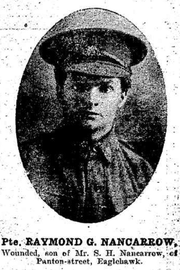
After arriving in Egypt, Eddie wrote home assuring his mother that he had arrived safely. He praised the standard of food supplied to the troops and remarked that the YMCA was "doing a lot for the soldiers in the way of picture shows, skating rinks, etc."
Source - PRIVATE E. G. PENALUNA. (1916, March 11). Bendigo Advertiser (Vic. : 1855 - 1918), p. 8. from http://nla.gov.au/nla.news-article89944667
Not long after their arrival, most of Eddie's group were transferred to the newly formed 60th Battalion, where they would serve side by side on the Western Front. With the ‘doubling of the AIF’ as it expanded from two infantry divisions to five, major reorganisations were underway.
The 60th Battalion was raised in Egypt on 24 February 1916 at the 40,000-man training camp at Tel-el-Kebir, about 110 km northeast of Cairo. Eddie was transferred to the 60th on 26 February and became a signaller with C Company. Roughly half of the soldiers were Gallipoli veterans from the 8th Battalion, a predominantly Victorian unit, and the other half were fresh reinforcements from Australia. Their training continued, necessary to build the bonds necessary for the fighting to come. In mid-March they were inspected by H.R.H the Prince of Wales.
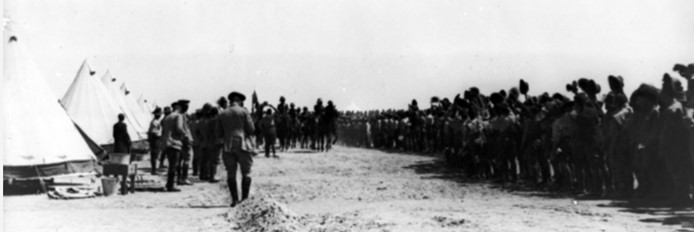
After a month of training at the large camp at Tel el Kebir, they had a two+ day, 50 km march in thermometer-bursting heat across the Egyptian sands from Tel el Kebir to Ferry Post, near the Suez Canal. Prior to marching, only ½ pint of water per bottle was available.
Source- AWM4 23/15/1 15th Brigade War Diaries Feb-Mar 1916 p 6.
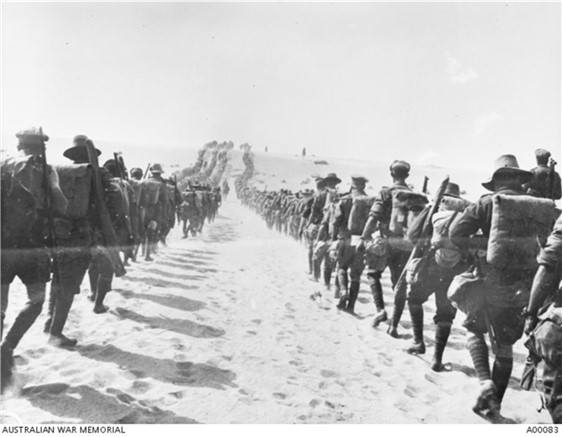
They remained at Ferry Post until 1 June continuing their training and guarding the Suez Canal from any potential threats posed by the Ottoman Army. Their time in Egypt was not all work, however. A 5th Division Sports Championship was held on 14 June, which was won by the 60th’s 15th brigade. Then on 17 June they received orders to begin the move to the Western Front and they were put on trains to Alexandria. The majority of the battalion, 30 officers and 948 other ranks, embarked in Alexandria on the transport ship Kinfauns Castle on 18 June 1916. After a stop in Malta, they disembarked in Marseilles on 29 June and immediately boarded trains headed north, arriving in Steenbecque in northern France, 35 km from Fleurbaix on 2 July.
This area near Fleurbaix was known as the “Nursery Sector” – a supposedly relatively quiet area where inexperienced Allied troops could learn the harsh realities of Western Front trench warfare against the Germans. But the quiet times and the training period did not last long. On 7 July they began their move to the front, arriving in Sailly on the 9th. Now just a few kilometres from the front, their training continued, although with a higher intensity, I’m sure. For Eddie and his Bendigo mates, the months in Egypt and the camaraderie they had built together were about to be tested were into the trenches at Fleurbaix for the first time on 14 July. Only weeks after arriving in France, they would soon enter their first battle on the Western Front.
The Battle of Fromelles
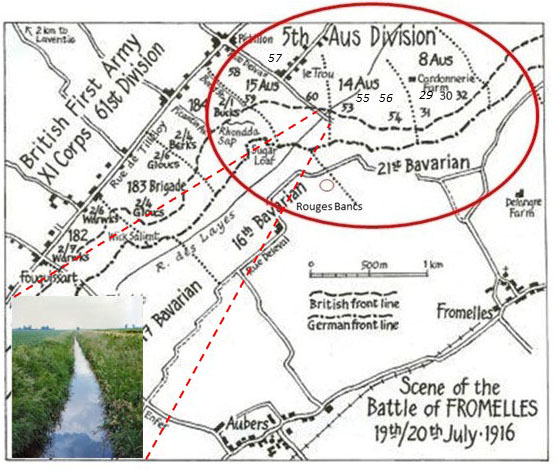
The battle plan had the 15th Brigade located just to the left of the British Army. The 59th and 60th Battalions were to be the lead units for this area of the attack, with the 58th and 57th as the ‘third and fourth’ battalions, in reserve. The main objective for the 15th Brigade was to take the trenches to the left of a heavily armed, elevated German defensive position, the ‘Sugar Loaf’, which dominated the front lines. If the Sugar Loaf could not be taken, the other battalions would be subjected to murderous enfilade fire from the machine-guns and counterattacks from that direction. As they advanced, they were to link up with the 59th and 53rd Battalions on their flanks.
The 60th Battalion faced an especially difficult position in the assault, right across from the ‘Sugar Loaf’. On 17 July, they were in position for the major attack against the Sugar Loaf position, but it was postponed due to unfavourable weather. There was a gas alarm, but luckily it was just that. Two days later, Zero Hour for advancing from their front-line trenches was to be 5.45 PM, but the Germans knew this attack was coming and were well-prepared. They opened a massive artillery bombardment on the Australians at 5.15 PM, causing chaos and many casualties. A fellow soldier, Private Bill Boyce (3022, 58th), summed the situation up well:
“What have I let myself in for?”
Eddie entered the battle as a signaller with C Company, one of the more dangerous roles on the battlefield. Company signallers were responsible for carrying messages between the front line and headquarters whenever telephone lines were cut, often requiring repeated journeys under heavy fire. Before the assault, Eddie was among his Bendigo mates. Fellow signaller "Jack" Brown (3468) volunteered for dispatch-carrying duty. His place in the platoon was taken by Eddie, while "Fred" Rowe (3598) also stepped forward to replace another volunteer. Brown later recalled that before Zero Hour he and Eddie "said good bye in case anything happened." Eddie and Fred were then instructed to remain with Lieutenant Simpson to carry messages during the attack.
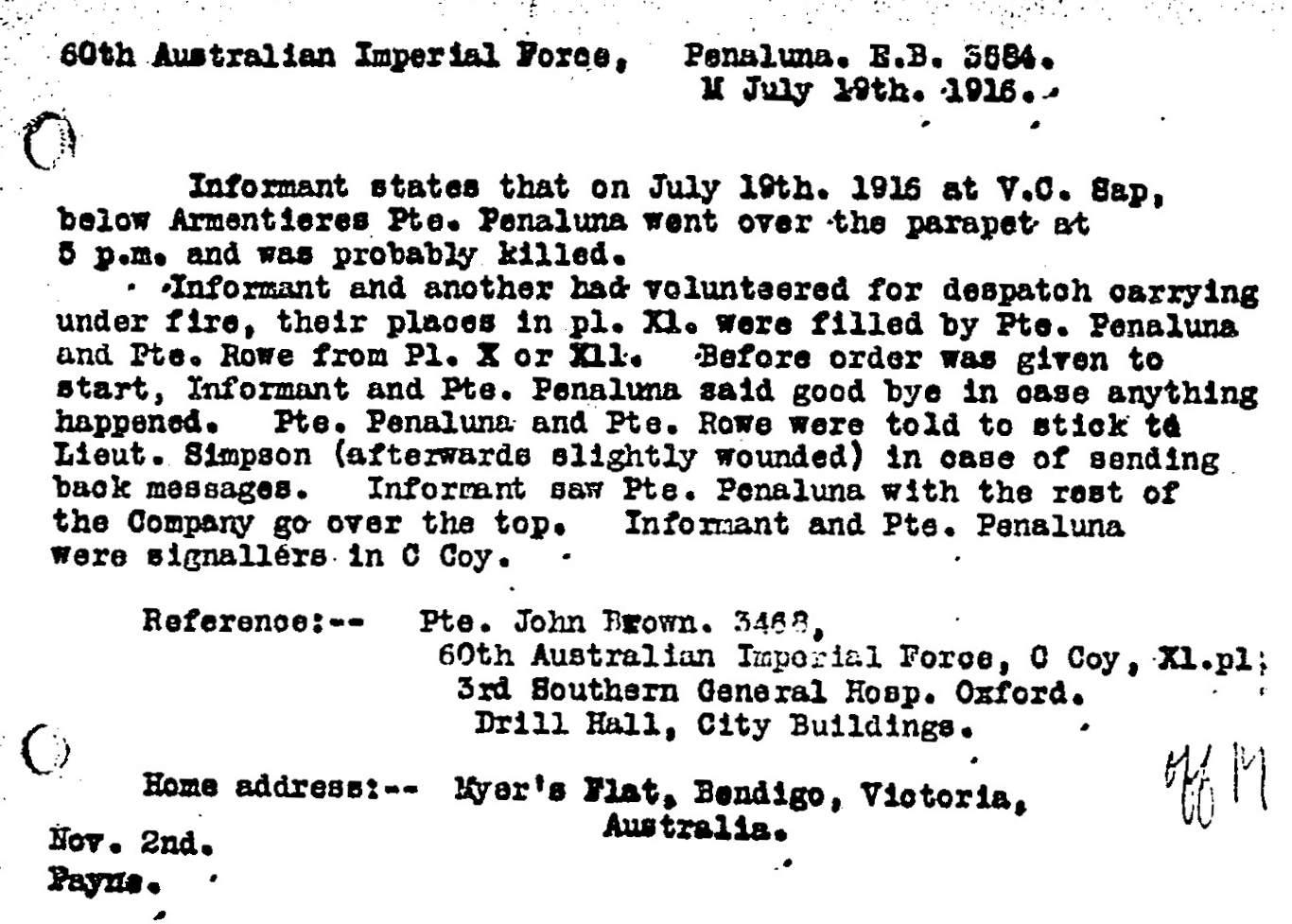
Jack Brown watched his friend go over the parapet with the rest of C Company and never saw him again. The Aussies went over the parapet at 5.45 PM in four waves at 5 minute intervals, but then lay down to wait for the support bombardment to end at 6.00 PM. A and B Companies were in the first two waves, Eddie’s C and D in the next two. Casualties were immediate and heavy, but Corporal William Holtham (4801), a machine gunner with the battalion, later wrote of the men’s courage as they stepped into the open:
“Not a man flinched, not a single chap hung back when his turn came. They were just up and over.”
The 15th Brigade War Diaries captures the intensity of the early part of the attack – “they were enfiladed by machine guns in the Sugar Loaf and melted away.”
Source: AWM4 23/15/5, 15th Brigade War Diary, July 1916, p. 56

The British 184th Brigade just to the right of the 59th met with the same resistance, but at 8.00 PM they got orders that no further attacks would take place that night. However, the salient between the troops limited communications, leaving the Australians to continue without British support from their now exposed right flank. It was reported that some got to within 90 yards of the enemy trenches. One soldier said he “believed some few of the battalion entered enemy trenches and that during the night a few stragglers, wounded and unwounded, returned to our trenches.”
Source - AWM4 23/77/6, 60th Battalion War Diaries, July 1916, page 3.
Fighting continued through the night. With known high casualties in the 60th, they were relieved by the 57th Battalion at 7.00 AM. Roll call was held at 9.30 AM. In the ‘Official History of the War’, C.W. Bean said “of the 60th Battalion, which had gone into the fight with 887 men, only one officer and 106 answered the call.” Eddie was not among them.
Source - Chapter XIII page 442
To get some perspective of the battle, when Charles Bean attended the battlefield two and half years later, he observed a large quantity of bones, torn uniforms and Australian kit still on the battlefield. The final impact of the battle on the 60th was that 394 soldiers were killed or died of wounds, of which 313 were not able to be identified.
After the Battle
Eddie was initially reported as missing following the battle, leaving his mother, Mary Ellen Penaluna, and the family at California Gully enduring weeks of uncertainty as the Army sorted through all the chaos from the battle. In the only direct eyewitness statement collected by the Red Cross, Private R. J. Jones (1709) reported simply:
"Signaller Penaluna... was buried by a shell."
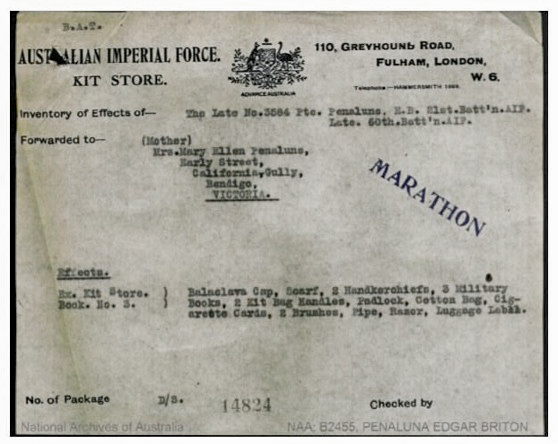
On 25 August 1916, his service record was officially amended from missing to Killed in Action, 19 July 1916 and in September 1916, the local newspapers reported that he had died of wounds. Eddie's body was never recovered or identified. His personal effects, including his identity disc, watch, military wallet, pipe, notebook, two letters and other belongings, were eventually returned to his mother at California Gully, the only means of closure she would ever have.
Fromelles – an impact on the whole community
The Battle of Fromelles devastated the small group of Eaglehawk and California Gully men who had enlisted and trained together. Writing home after Eddie's cousin, Ray Nancarrow, had been wounded, Jack Yarrow reflected on the cost of the battle:
"There were eight Eaglehawk boys in our battalion when we charged, Ray (Nancarrow) was wounded and I am the only one still going strong... Jack Brown and Jack Murton were wounded, Eddie Penaluna was killed, and Fred Rowe and Harry Bone are missing."
Although Jack only names 6 of his mates, the brief summary captured the devastating impact of Fromelles on one small Victorian community. Of the group, Edgar "Eddie" Briton Penaluna, William Alfred "Fred" Rowe and Richard Henry "Harry" Bone were killed. John "Jack" Brown survived a gunshot wound to the spine; John William "Jack" Murton returned home after the amputation of a leg. Raymond "Ray" Gowrie Nancarrow sent home with shrapnel to his leg, arm and back and bayonet wounds to the shoulder. Jack Yarrow, was the only one to escape Fromelles without physical injury, but sadly was killed during the Battle of Polygon Wood on 25 September 1917.
His brief summary captured the terrible toll that Fromelles had taken on one small Victorian community, where friends, neighbours and relatives had gone to war together. Eddie's death was deeply mourned throughout California Gully. On 15 October 1916, members of the California Gully Brotherhood gathered at the Mechanics' Institute to honour the memory of their former secretary. During the service, he was remembered as "a fine specimen of manhood, and one in whom the greatest confidence could be placed." Those gathered also recalled that he "was well liked and popular with everybody," adding that the Brotherhood "will suffer a distinct loss by his death."
Source "Late Private Edgar Penaluna", The Bendigo Independent (Vic.), 16 October 1916, p. 7.
Two years later, on the anniversary of the Battle of Fromelles, Eddie was remembered alongside his close friend William Alfred "Fred" Rowe in a moving family notices published in the Bendigo Advertiser:
"Two noble boys, good and true,They were comrades through and through,And in death they are not divided."
The tribute concluded
"They gave their country all—their body's might,Their lives, success, home, love, their splendid youth...May we be worth the gloryAnd immortal sacrifice."
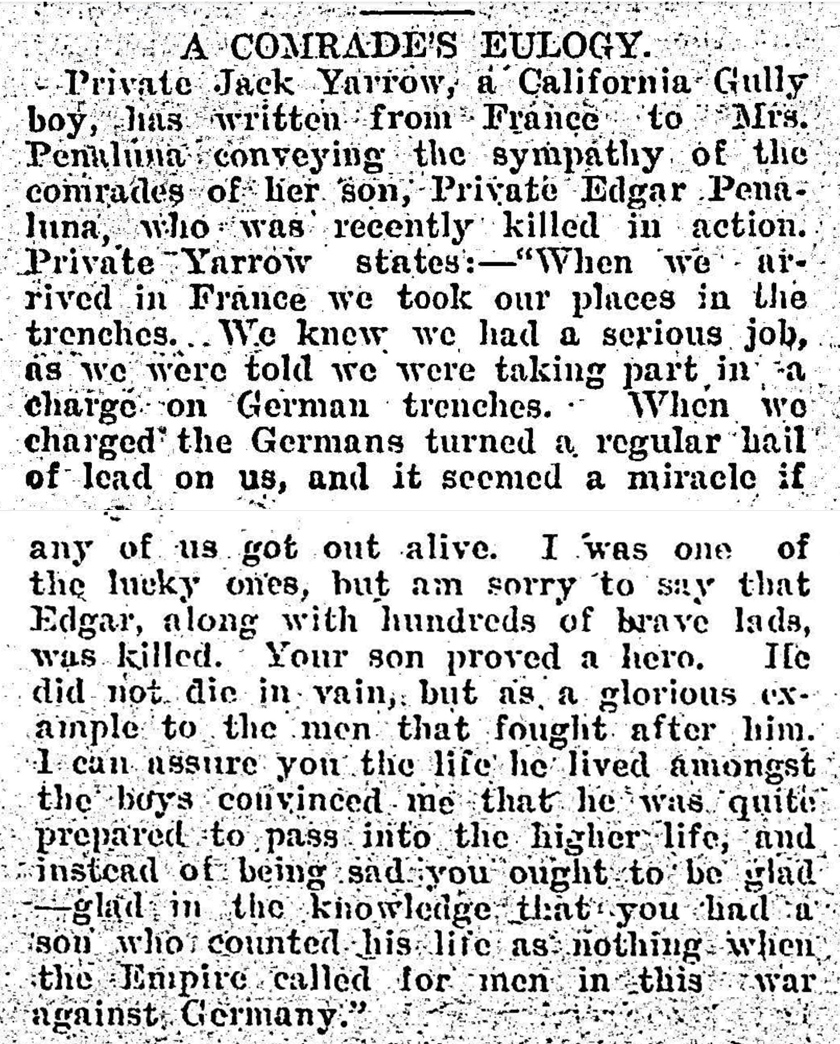
In a November 1916 letter to Eddie's mother, Jack Yarrow later described the attack at Fromelles, along with a stirring message about Eddie’s heroism.
Today Eddie is commemorated at:
- VC Corner Australian Cemetery Memorial at Fromelles
- Australian War Memorial Roll of Honour
- Bendigo Great War Roll of Honour
- The Penaluna family headstone at Eaglehawk Cemetery, where his name stands alongside those of his parents and brothers
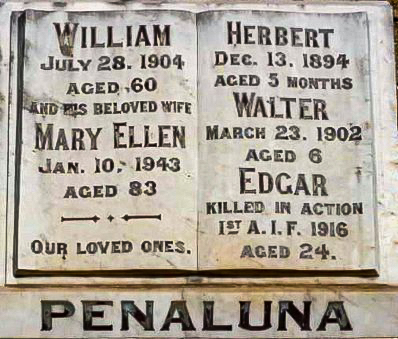
Finding Eddie?
Eddie’s remains were not recovered; he has no known grave. After the battle, the Germans recovered 250 Australian soldiers and placed them in a burial pit at Pheasant Wood. This grave was discovered in 2008 and since then efforts have been underway to identify these soldiers by DNA testing from family members. As of 2026, 181 of the soldiers have been identified, including two of the 313 unidentified soldiers from the 60th Battalion. It remains possible that Eddie could be among the soldiers recovered from the Pheasant Wood mass grave who are yet to be identified. Identification may still be possible through DNA provided by living relatives. We welcome all branches of Eddie’s family to come forward, especially those descended from the Penaluna, Nancarrow, Pryor or Trevillian family lines, to donate DNA to help with his identification. If you know anything of family contacts, please contact the Fromelles Association. We hope that one day Eddie will be named and honoured with a known grave. Please visit Fromelles.info to follow the ongoing identification project and Eddie’s story.
DNA samples are being sought for family connections to
| Soldier | Edgar Briton Penaluna (1892–1916) |
| Parents | William Henry Penaluna (1843–1904) and Mary Ellen Nancarrow (1859–1943) |
| Siblings | Alexander (1882–1962) | ||
| Ellen Jane (1884–1972) | |||
| William Alfred (1886–1979) | |||
| Lavina (1888–1980) | |||
| Herbert Victor (1894–1894) – died in infancy | |||
| Walter Richard (1896–1902) – died in childhood | |||
| Wesley John (1899–1977) | |||
| James Francis "Jim" (1901–1975) |
| Grandparents | |||
| Paternal | Alexander Penaluna (1817–1880) and Charity Pryor (1819–1891) | ||
| Maternal | John Nancarrow (1830–1896) and Jane Trevillian (1832–1893) |
DNA connections may also be found through descendants of Eddie's aunts and uncles from the Penaluna, Nancarrow, Pryor and Trevillian families.
Seeking DNA Donors

Contacts
(Contact: carla@fromelles.info or geoffrey@fromelles.info).
(Contact: army.uwc@defence.gov.au or phone 1800 019 090).
Donations
If you are able, please contribute to the upkeep of this resource.
(Contact: bill@fromelles.info ).