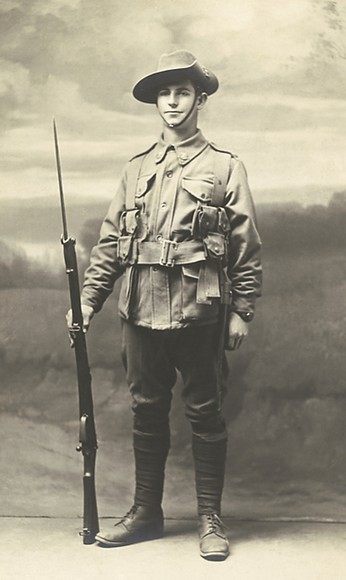
Victor John BACKHOUSE
Eyes blue, Hair brown, Complexion fair
Victor John BACKHOUSE - Remembering a Young Soldier Lost at Fromelles
With thanks to Ken Waterfield for his major contribution in writing this story.
Can you help find Victor?
Victor‘s body was never found after the Battle of Fromelles, and there are no records of his burial.
A mass grave was found in 2008 at Fromelles, a grave the Germans dug for 250 Australian soldiers they recovered after the battle. As of 2024, 180 of these soldiers have been able to be identified via DNA testing.
Victor may be among these remaining unidentified men. There is still a chance to identify him — but we need help. We welcome all branches of his family to come forward to donate DNA to help with his identification, especially those with roots in Braidwood, NSW
See the DNA box at the end of the story for what we do know about his family.
If you know anything of contacts for Victor, please contact the Fromelles Association.
Please contact the Fromelles Association of Australia to find out more.
Early Life
Victor John Backhouse was born on 27 April 1896 at Braidwood, New South Wales, the son of John Backhouse (1866–1961) and Maud Mary Isley (1866–1955). The family lived at Currowan Creek, between Nelligen and Braidwood, in the bush and farming districts of the New South Wales South Coast. His parents married in Braidwood in the early 1890s and went on to raise a large family in the district. Victor grew up surrounded by the close-knit farming and timber communities of the area.
Children of John and Maud:
- Arthur (1892–1977)
- Robert William (1894–1980)
- Victor John (1896–1916) – killed at Fromelles
- Leslie James (1897–1972) – served in both World War I and World War II
- Isabella Gladys Nellie (1899–1985)
- Mary Elizabeth (1901–1983)
- Lily Maud (1903–1927)
- Cecil George (1905–1996)
- Nellie May (1907–1993)
Victor attended Nelligen Public School and was remembered as a country boy accustomed to outdoor work from a young age. Before the war he worked as a labourer and later as a sawmill hand, occupations common throughout the timber districts surrounding Currowan Creek and Nelligen.
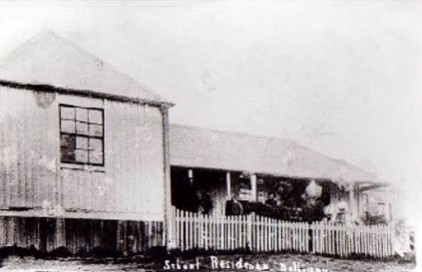
The Currowan Creek and Nelligen districts of Victor’s childhood were small bush communities connected by timber work, farming, river trade, and rough bush roads leading towards Batemans Bay and Braidwood.
Off to War
Victor enlisted in the Australian Imperial Force at Holsworthy, New South Wales, on 23 August 1915, aged 19. After initial training he was allocated to the 13th Battalion, 14th Reinforcements. On 16 February 1916 he embarked from Sydney aboard HMAT A70 Ballarat, bound for Egypt. Like thousands of young Australian recruits, Victor was entering a rapidly expanding AIF following the Gallipoli campaign. With the ‘doubling of the AIF’ as it expanded from two infantry divisions to five, major reorganisations were underway. The 54th Battalion was formed in mid-February 1916 at the Tel-el-Kebir camp, about 110 km northeast of Cairo. It contained about 40,000 men, Gallipoli veterans and the thousands of reinforcements arriving regularly from Australia.
Victor arrived in Egypt on 22 March 1916 and, on 1 April, was transferred to the newly formed 54th Battalion at Ferry Post. The 54th was made up of Gallipoli veterans from the 2nd Battalion, most of whom were from New South Wales, along with newly arrived reinforcements from New South Wales. By the end of March, much of the basic training in musketry and bayonet use had been completed for the new soldiers and they were sent to Ferry Post on foot, a journey of about 60 km that took three days. It was a significant challenge, walking over soft sand in 38°C heat with each man carrying his own possessions and 120 rounds of ammunition.
After arriving at Ferry Post they were rewarded with the opportunity to swim in the Canal. During the march, H.R.H. the Prince of Wales visited the troops and they greeted him with “enthusiastic cheers”.
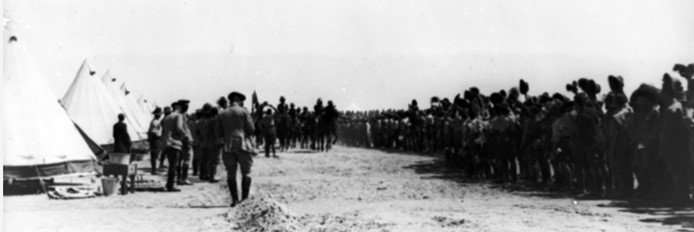
The troops spent all of May occupying front-line trenches at Katoomba Heights, eight miles from the Suez Canal, guarding against any potential threat posed by the Ottoman Army. During this time they took turns occupying trenches, wiring defences, carrying out patrols, and continuing their training in preparation for service on the Western Front.
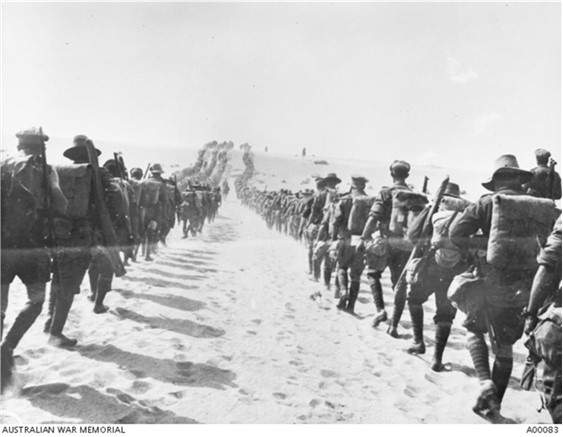
The call to the Western Front to join the British Expeditionary Force came on 20 June and the 982 soldiers of the 54th Battalion left Egypt. They sailed aboard the Caledonian for the ten-day voyage to Marseilles via Malta. After disembarking in France they immediately entrained for a three-day train journey to Hazebrouck, 30 km west of Fleurbaix in northern France. The long trip north took them through the lush French countryside, a stark contrast to the sands of Egypt. By 2 July the battalion was billeted in barns, stables, and private houses in nearby Thiennes. Training now included gas mask drills and exposure to artillery shelling. It was hoped these exercises would “inspire the men with great confidence”.
Source: AWM4 23/71/6 – 54th Battalion War Diary, July 1916, p. 2
On 10 July they moved to Sailly-sur-la-Lys and on 11 July entered the trenches at Fleurbaix for the first time. The health and spirits of the troops were reported as good. After several days becoming accustomed to the routines of trench life, the battalion rotated back to billets at Bac-St-Maur. The area around Fleurbaix was known as the “Nursery Sector”, supposedly a relatively quiet area where inexperienced Allied troops could learn the realities of trench warfare against the Germans. But the training period did not last long.
On 15 July, Major Roy Harrison wrote home with a sense of foreboding:
“The men don’t know yet what is before them, but some suspect that there is something in the wind. It is a most pitiful thing to see them all, going about, happy and ignorant of the fact, that a matter of hours will see many of them dead; but as the French say ‘C’est la guerre’.”
The Battle of Fromelles
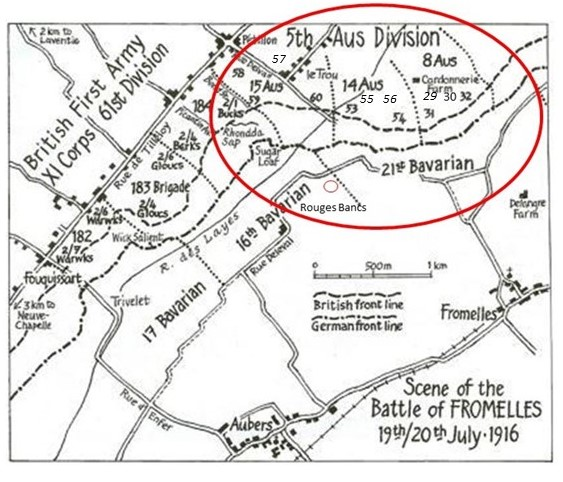
The overall plan was for brigades of the Australian 5th Division to conduct a diversionary assault on the German trenches at Fromelles. The main objective for the 54th Battalion was to capture the trenches to the left of the heavily defended and elevated German strongpoint known as the “Sugar Loaf”, which dominated the battlefield. If the Sugar Loaf could not be taken, the 54th and neighbouring battalions would be subjected to devastating enfilade fire from German machine guns and vulnerable to counterattack. As they advanced, the 54th was to link up with the 31st and 53rd Battalions.
The attack was originally planned for 17 July, but heavy rain delayed the operation. The weather improved and by 2.00 PM on 19 July the battalion was back in the trenches, preparing for its first major action on the Western Front. Among the young reinforcements waiting for the attack was 20-year-old Victor John Backhouse from Currowan Creek near Nelligen. Like many men of the battalion, Fromelles would be his first major battle. Zero Hour was set for 5.45 PM, but the Germans were well aware that an attack was imminent.
At 5.15 PM they unleashed a massive artillery bombardment on the Australian lines, causing chaos and heavy casualties before the assault had even begun. At 5.50 PM the men of the 54th began leaving their trenches. The battalion advanced in four waves — half of A and B Companies forming the first two waves, with half of C and D Companies in the third and fourth. The leading waves moved into No-Man’s-Land and lay down, waiting for the British barrage to lift.
At 6.00 PM the German trenches were rushed. Despite intense artillery, machine-gun, and rifle fire, the 54th advanced rapidly. The 14th Brigade War Diary later recorded that the bombardment had been highly effective and that:
“very few living Germans were found in the first and second line trenches”.
The battalion pressed forward nearly 600 yards, linking with the 53rd Battalion on the right and the 31st and 32nd Battalions on the left, holding a line stretching from Rouges Bancs to near Delangre Farm. Some of the forward positions were little more than water-filled ditches that had to be fortified quickly to withstand the inevitable German counterattacks. But on the right flank the situation had collapsed. The 60th Battalion had been unable to advance due to devastating machine-gun fire from the Sugar Loaf, leaving the 54th dangerously exposed. By 2.20 a.m. the Germans were attacking along the road past Rouge Bancs. After a counterattack, the 53rd Battalion was apparently unaware that their flank was no longer protected, allowing German troops to move behind the Australian positions and capture men in the trenches.
Cass sent a party of 54th Battalion soldiers forward to stabilise the line:
“They ran forward with the bayonet and drove the enemy back about 50 yards.”
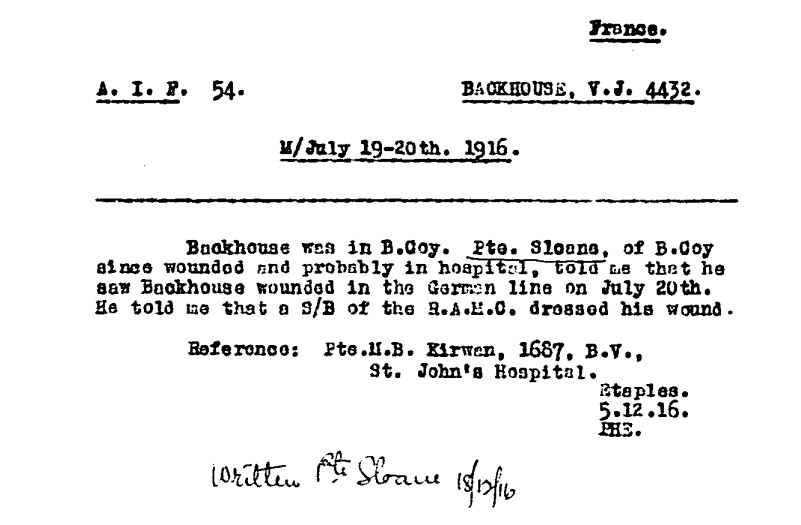
Despite repeated appeals for artillery support, the position became impossible to hold. At 6.30 a.m. on 20 July, orders were received to withdraw. The retreat was chaotic and exposed to fire, with many wounded left behind in No-Man’s-Land. During the fighting Victor was reported missing. Later witness statements collected by the Australian Red Cross suggested that he had reached the German trenches and been wounded during the fighting. 1687 Private Mortimer B. Kirwan of the 54th Battalion later stated:
“[Pte.] Sloane, of B. Coy since wounded and probably in hospital, told me that he saw Backhouse wounded in the German line on July 20th. He told me that a S/B [Stretcher Bearer] of the R.A.M.C. dressed his wound.”
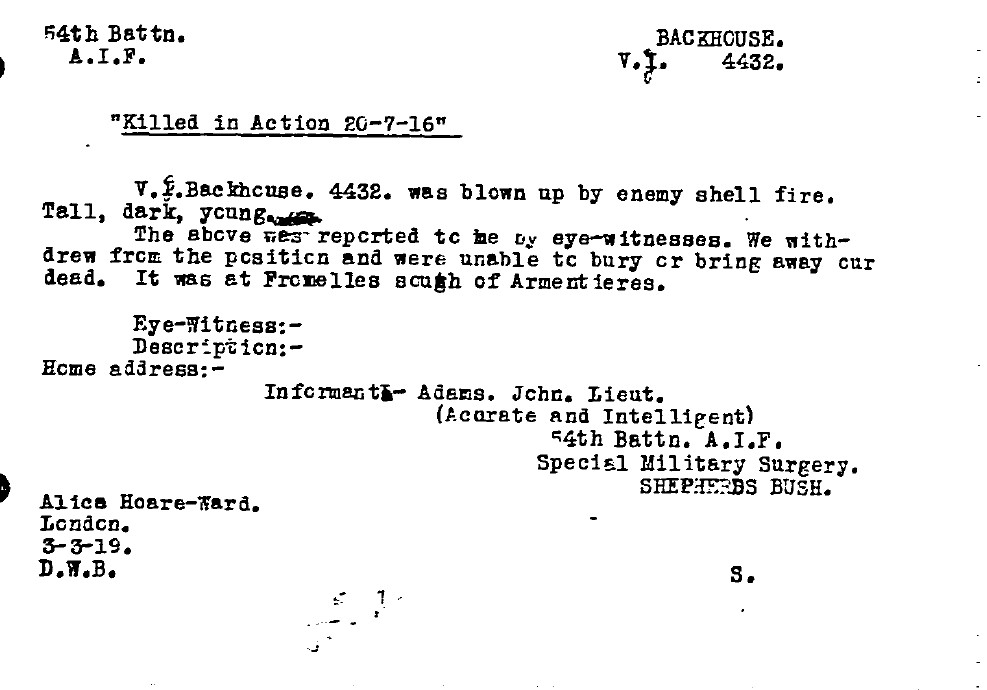
Luietenant John Adams later reported:
“V.J. Backhouse, 4432, was blown up by enemy shell fire. Tall, dark, young.”
With heavy losses and German troops now behind them due to the exposed flank, the Australians were eventually forced back towards their own lines. By 7.30 AM on 20 July the 54th Battalion had withdrawn all the way to Bac-St-Maur, about five kilometres from the front. In an extraordinarily short period of time, of the 982 soldiers who had left Egypt with the battalion, the initial roll call recorded 73 killed, 288 wounded, and 173 missing. When Charles Bean, Australia’s official war historian, visited the battlefield two and a half years later, he observed large quantities of bones, torn uniforms, and Australian equipment still scattered across the ground.
Ultimately, 172 soldiers of the 54th Battalion were killed in action or died of wounds. Of these, 102 were originally listed as missing. As of April 2024, 28 of those men have since been identified and formally buried at Pheasant Wood Cemetery. Victor John Backhouse was never recovered from the battlefield. He was later officially declared killed in action on 19 July 1916.
After the Battle
In the aftermath of the Battle of Fromelles, Victor was initially listed as missing. Like many Australian families, the Backhouse family endured months of uncertainty while military authorities attempted to determine the fate of the men who had disappeared during the fighting. On 29 May 1917, Victor’s father John Backhouse wrote to military authorities after learning that Victor’s brother Leslie had been wounded in France. In the same letter he pleaded for any further information regarding Victor:
“Also have you had any further news of my other son 4432 Pte Victor John Backhouse, who was reported as missing about the beginning of last August.”
A Court of Enquiry held in the field on 4 August 1917 formally determined that Private Victor John Backhouse had been killed in action on 19/20 July 1916. The news reached the Braidwood district later that year, “Pte. Victor John Backhouse, of Braidwood, reported missing on 20th July, 1916, is now reported as having been killed in action.”
Source - LATEST WAR NEWS. (5 October 1917). The Braidwood Dispatch and Mining Journal p. 7. From http://nla.gov.au/nla.news-article120699719
Despite later investigations, Victor’s body was never recovered or identified. A notation on his file eventually recorded as `“No trace Germany[.] Cert. by Captain Charles Mills 10-10-19.” `
Source: Australian Red Cross Wounded and Missing File – Victor John Backhouse
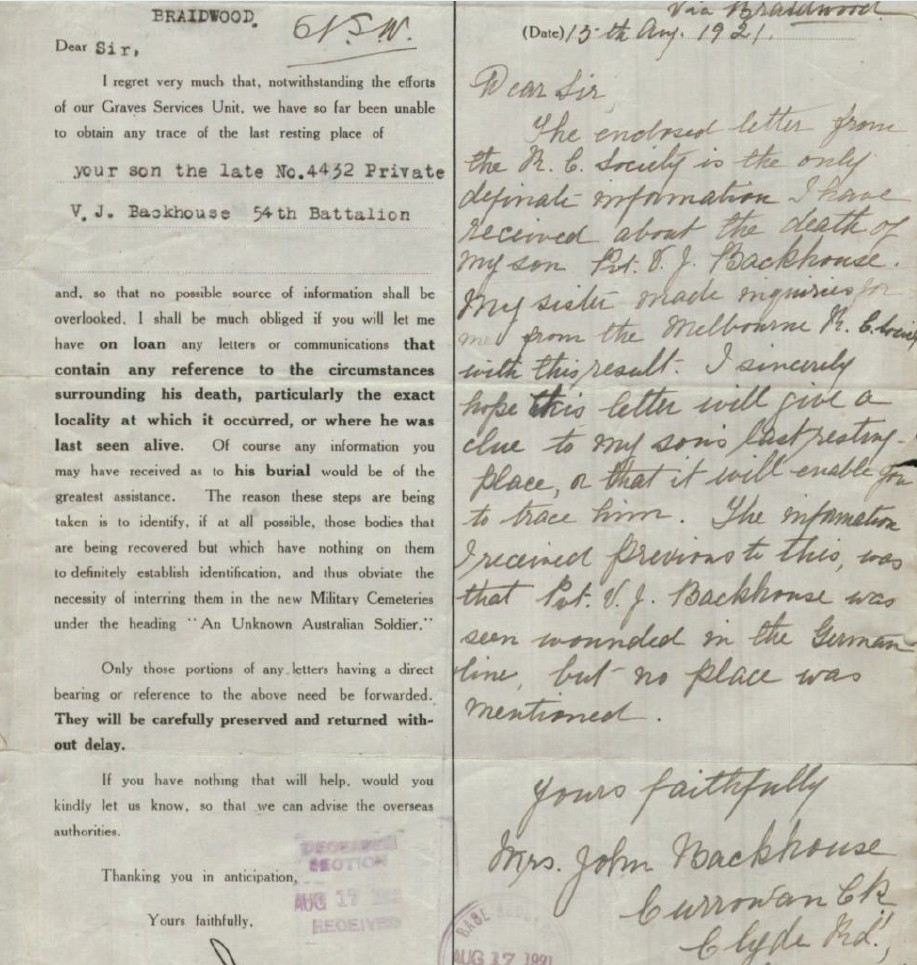
Years later, Victor’s mother Maud Mary Backhouse was still hoping answers might be found. In August 1921 she wrote to Base Records after receiving additional Red Cross information:
“I sincerely hope this letter will give a clue to my son’s last resting place, or that it will enable you to trace him. The information I received previous to this was that Pte. V. J. Backhouse was seen wounded in the German line, but no place was mentioned.”
This letter is particularly poignant because it was written five years after Victor was killed, and despite all that time his mother was still hoping that some new piece of information might reveal where he lay.
Victor has no known grave.
Victor is commemorated at:
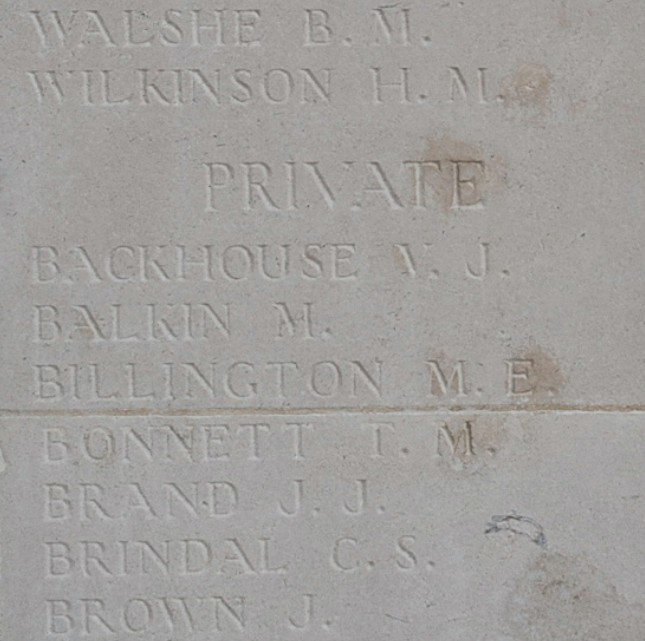
- VC Corner Australian Cemetery Memorial, Fromelles, France
- Australian War Memorial Roll of Honour, Canberra
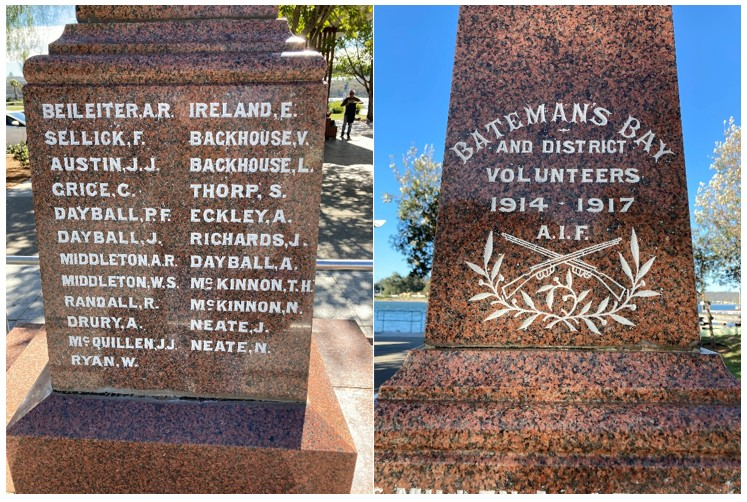
- Batemans Bay War Memorial, New South Wales
- Nelligen War Memorial, New South Wales
- Batemans Bay Old Courthouse Museum – where his photograph and Memorial Plaque (“Dead Man’s Penny”) are displayed alongside those of his brother Leslie Backhouse
- Australian War Memorial Last Post Ceremony, Canberra (commemorative ceremony held in his honour) Last Post Ceremony video https://www.youtube.com/watch?v=6FqfXFO0ADo
Family at War
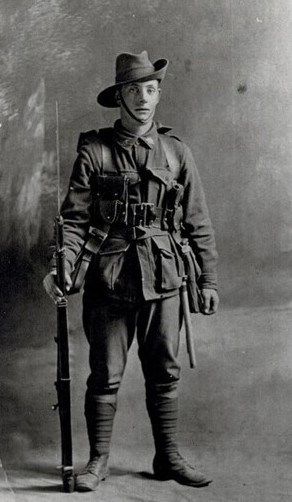
Victor was not the only member of the Backhouse family to serve during wartime. His younger brother, Leslie James Backhouse, also enlisted in the Australian Imperial Force during the First World War.
Leslie James Backhouse was born at Nelligen, New South Wales, on 28 August 1896 and grew up with Victor at Currowan Creek near Braidwood. Before enlistment he worked as a farmer.He enlisted at Goulburn on 8 May 1916, less than a year after Victor had joined the AIF. At the time he was only 18 years old. Leslie embarked from Sydney aboard HMAT A11 Ascanius on 25 October 1916 as part of the 55th Battalion, 7th Reinforcements. He later served with the 17th Battalion on the Western Front.
Unlike Victor, Leslie survived the war, although he was wounded by gunshot to the right leg. He returned to Australia aboard HT Orsova on 8 January 1919 and was discharged medically unfit on 10 April 1919. The family endured the pain of one son never returning from Fromelles, while another came home carrying the physical scars of war. Remarkably, Leslie later served again during the Second World War under service number Q203763.
Victor’s Roll of Honour Circular also mentions a 2nd Cousin Patrick Cahill of Guildford and A Backhouse of Ryde, Sydney as cousins who fought in WW1.
Rememberance
Victor John Backhouse's loss was felt deeply within the Backhouse family for generations. Although he was killed at Fromelles in July 1916 at just 20 years of age, his memory continued to be preserved through family stories, photographs, memorials and treasured wartime keepsakes.
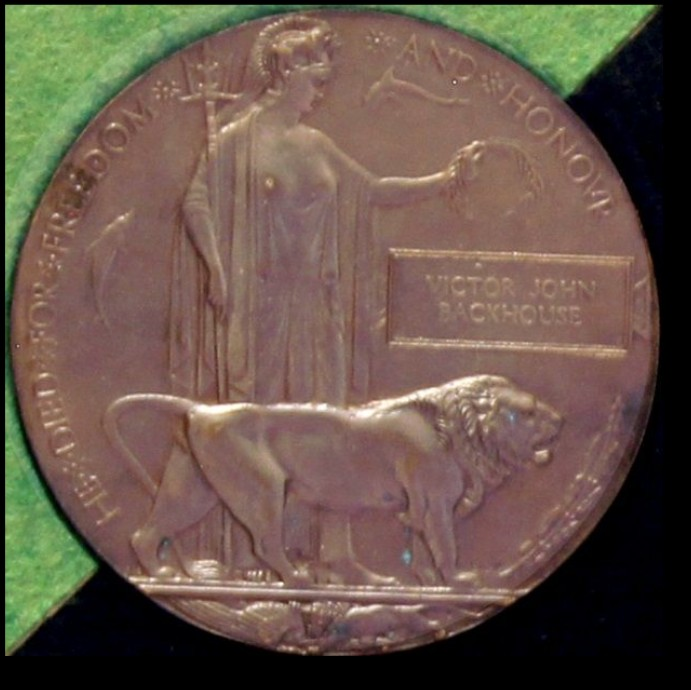
Among the items carefully kept by the family was Victor's Memorial Plaque, commonly known as the "Dead Man's Penny", presented to the next of kin of soldiers who died during the First World War. His plaque, together with enlarged studio portraits of Victor and his brother Leslie, was later donated by the Backhouse family to the Batemans Bay Old Courthouse Museum, where they remain on display. Researcher Myfanwy Thompson later reflected on the importance of telling Victor's story beyond the museum artefacts:
“It particularly pleases me that I have been able to deepen Victor’s story from a captioned artefact, to an honoured personal narrative. This young man now has a real presence in our Lest We Forget Room.”
Even decades after the war, Victor remained part of the family's story. When his parents, John and Maud Backhouse, celebrated their diamond wedding anniversary in 1951, the newspaper report acknowledged the son they had lost:
“One son, Victor, was killed in World War I.”
Family Recollection
More than a century after Victor John Backhouse was killed at Fromelles, his memory continues to live on through his family.
His nephew, K.J. (Ken) Waterfield, reflected on the uncle he never had the opportunity to know. Ken writes The search continues — maybe one day? I never knew Victor John Backhouse personally. I did however know him as my mother’s elder brother. A photograph of a young Victor, resplendent in uniform, adorned a page of the family photo album. Killed in action at Fromelles on the 19th July, 1916. Just 20 years of age. Victor has no known resting place. It was my mother’s dearest wish that one day, Victor’s remains be found and that he be given a formal, eternal, resting place. Not so! Not as yet! Victor is memorialised in Batemans Bay. His name is etched on the memorial on the town’s esplanade. His photograph, together with that of his brother Les and his ‘Dead Man’s Penny’, is on display within the Batemans Bay Old Courthouse Museum. In March 2009 my sisters Fay (Jordan) and Glenys (Kriticos) visited the Australian War Cemetery at Fromelles, France.”
Ken then shared Glenys's powerful recollection of that visit:
“I was standing there, in a deep state of reflection, looking at the name Victor John Backhouse etched in stone at VC Corner. It was a beautiful sunny day but I suddenly felt a chill and became aware of the presence of mum (many years deceased). I cried. I said to mum, ‘We are very close to finding Victor.’”
For the Backhouse family, the hope of finally bringing Victor home has never faded. Like many families of the missing from Fromelles, they continue to hope that one day his remains may be identified through ongoing historical research and DNA matching.
Finding Victor
Victor’s body was never recovered after the Battle of Fromelles and he has no known grave. Like many of the men of the 54th Battalion listed as missing after the battle, it is possible he was among those buried by the Germans in mass graves behind their lines. In 2008, a mass grave containing 250 Australian and British soldiers was discovered at Pheasant Wood near Fromelles. Since then, more than 180 soldiers have been positively identified through a combination of historical research, forensic anthropology, and DNA provided by descendants.
Victor John Backhouse may still be among the unidentified soldiers from Fromelles. More than a century after the battle, the search for Victor continues. DNA connections through the Backhouse and Isley family lines may still help identify him should his remains be among those yet to be named at Pheasant Wood Cemetery.
DNA samples are being sought for family connections to
| Soldier | Victor John Backhouse (1896–1916) |
| Parents | John Backhouse (1866–1961), born Braidwood, NSW, and Maud Mary Isley (1866–1955), born Braidwood, NSW |
| Siblings | Arthur Backhouse (1892–1977) | ||
| Robert William Backhouse (1894–1980) | |||
| Leslie James Backhouse (1897–1972) – served WWI & WWII | |||
| Isabella Gladys Nellie Backhouse (1899–1985) | |||
| Mary Elizabeth Backhouse (1901–1983) | |||
| Lily Maud Backhouse (1903–1927) | |||
| Cecil George Backhouse (1905–1996) | |||
| Nellie May Backhouse (1907–1993) |
| Grandparents | |||
| Paternal | William Hall Backhouse (1839–1919) and Ellen Roughley (1843–1926) | ||
| Maternal | William Alfred Isley (1835–1926) and Mary Elizabeth Sullivan (1838–1926) |
Links to Official Records
Seeking DNA Donors

Contacts
(Contact: carla@fromelles.info or geoffrey@fromelles.info).
(Contact: army.uwc@defence.gov.au or phone 1800 019 090).
Donations
If you are able, please contribute to the upkeep of this resource.
(Contact: bill@fromelles.info ).