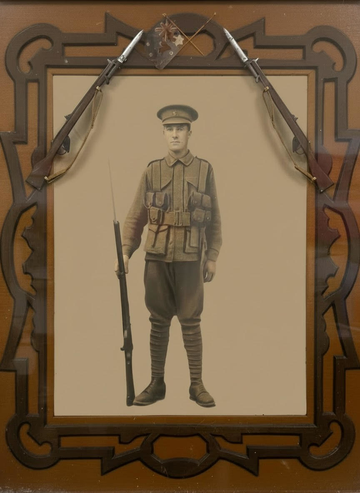
Charles Thomas Pickering SMITH
Eyes brown, Hair black, Complexion dark
Charles Thomas Pickering Smith - "He Answered His Country's Call."
We are grateful to family member Sue Walker and the Greta Museum for their contribution.
Early Life
Charles Thomas Pickering Smith was born in 1894 at Merewether, New South Wales, the son of William Louis Richardson Smith (1862-1937) and Margaret Lawson née Dixon (1857-1941). His father was born at Morpeth, Northumberland, England, his mother also emigrated from England. They married in Queensland in 1884 before following work through the coalfields of Queensland and New South Wales. William was a skilled master shaft sinker, employed in developing coal mines throughout the region. The family lived at various times in Queensland, Helensburgh, Merewether, Cardiff, Maitland and Woonona before settling in Greta, New South Wales, where William worked in the local coal industry.
By the time Charles was a young man, the family home was in Wyndham Street, Greta, a thriving mining township in the Hunter Valley where William was a mine deputy..
Charles grew up with two sisters (three siblings dying in their first year):
- Jane Hannah (1885–1885)
- Mary Jane Hannah (1886–1968), married William Hodgkiss
- William Lewis (1890–1891)
- Florence A. R. (1892–1892)
- Charles 1894-1916 KIA Fromelles
- Alice Gertrude Maud (1901–1944), married William John Leonard 1919.
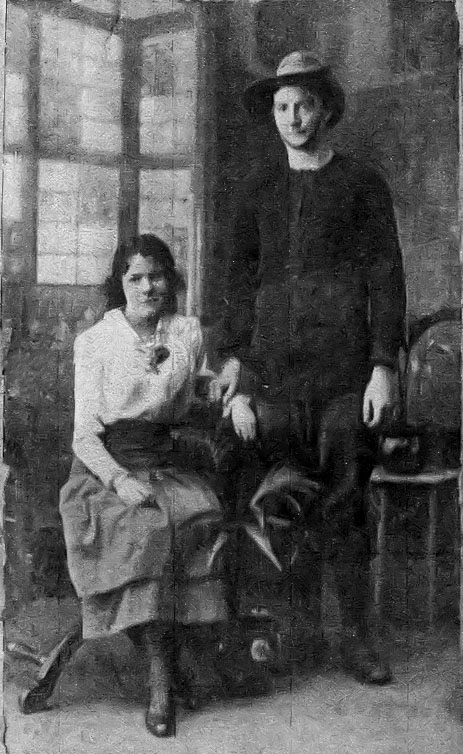
Mary was 8 years older and Alice 7 years younger than Charles. As the family's only surviving son, Charles was raised in the close-knit mining community where neighbours knew one another and local sporting clubs, churches, sport and community organisations played an important role in daily life. Following in his father's footsteps, Charles became a miner and labourer. He was also active in local sport, particularly cycling. In November 1910 he competed in a five-mile road race between Greta and Branxton and back, finishing second behind fellow Greta cyclist Leo Briscoe:
The local cyclists held a five-mile road race from Greta to Branxton and back last Saturday evening. There were 14 competitors. The winner was L. Briscoe... C. Smith was second...
Before volunteering for overseas service, Charles completed two years' service with the 14th Infantry, Citizen Military Forces, gaining valuable military experience before joining the Australian Imperial Force. By the time war engulfed Europe, he was a well-known young miner in Greta whose sense of duty would soon lead him to answer his country's call.
Off to War
Having already completed two years' service with the 14th Infantry, Citizen Military Forces, Charles was well prepared when he volunteered for overseas service. He enlisted as ‘Charles Smith’ in the Australian Imperial Force at Warwick Farm, New South Wales, on 13 September 1915, joining as Private 4884. As his departure approached, the people of Greta gathered to farewell one of their own. On 14 January 1916, a public send-off was held in the Central Hall for Charles and Signaller W. Hatcher, who were both on final leave:
A send-off was tendered on Friday evening to Private C. Smith and Signaller W. Hatcher, who were on final leave. The function took place in the Central Hall... Private Smith was presented, on behalf of the citizens, with an inscribed gold medal and, on behalf of Miss W. Pryor, with a Balaclava cap... Both recipients responded.
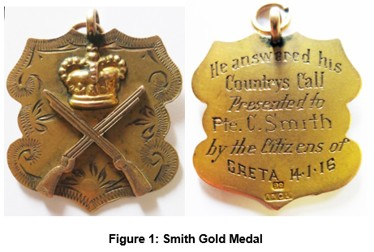
The gold medal carried a simple but powerful inscription:
"He Answered His Country's Call."Presented to Private C. Smith by the Citizens of Greta.14 January 1916.
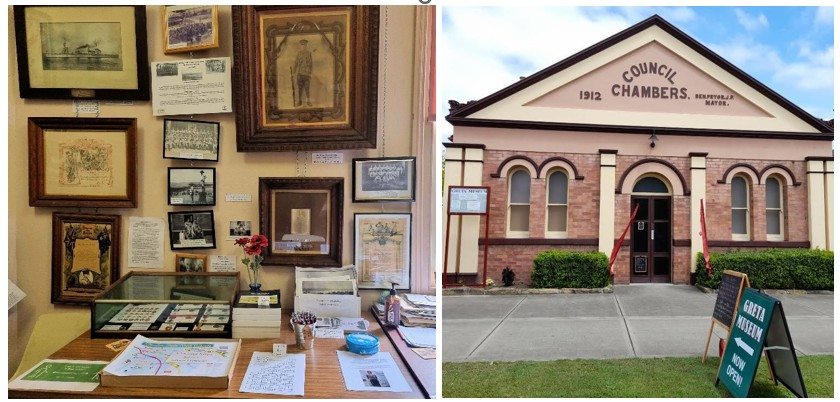
Relative Sue said in her letter that she used to see the large photograph of Charles, in the garage of her cousin Richard. The medal was found in the grounds of the Hodgkiss home and later presented to the Museum at Greta. Family photos were also passed on to the museum.
On 8 March 1916, Charles departed Sydney aboard HMAT A15 Star of England with the 15th Reinforcements for the 2nd Battalion. After arriving in Egypt, he joined the newly formed 54th Battalion at Ferry Post on 20 April 1916. With the expansion of the Australian Imperial Force following the Gallipoli campaign, the 54th Battalion was formed in Egypt on 16 February 1916. Half of its strength came from experienced Gallipoli veterans of the 2nd Battalion, while the other half consisted of reinforcements recently arrived from Australia, including Charles. Together they formed part of the 14th Brigade of the 5th Australian Division under Major General James McCay.
The battalion spent several months training in Egypt, undertaking route marches, musketry, bayonet fighting, field exercises and brigade manoeuvres while forging the cohesion needed for modern warfare. Although many of the officers and non-commissioned officers were experienced veterans, hundreds of reinforcements like Charles had never seen active service. The training was designed to prepare them for the vastly different conditions they would soon encounter on the Western Front.
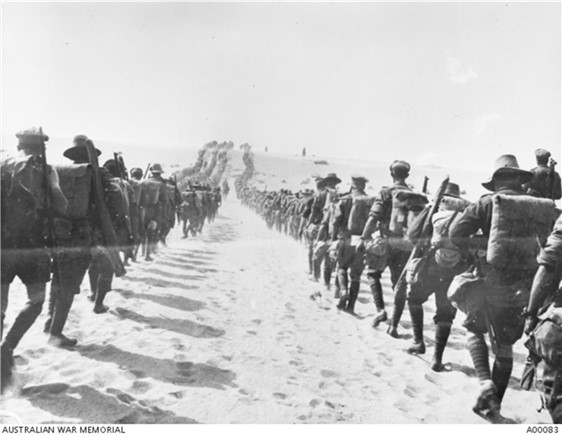
On 19 June 1916, the battalion embarked at Alexandria for France aboard the transport Caledonia, arriving at Marseilles on 29 June. From there the men travelled north by train through the French countryside before marching into the Armentières sector. Their first weeks in the line were spent learning trench routine under relatively quiet conditions, repairing parapets, carrying supplies, wiring defences and becoming accustomed to shellfire, sniping and nightly patrols. Major Roy Harrison later recalled the contrast between the heat of Egypt and the unfamiliar conditions awaiting them in France. The men quickly learned that life on the Western Front demanded constant vigilance, endurance and teamwork as they adapted to the realities of trench warfare.
Within only a few weeks of arriving in France, the 54th Battalion was moved south to the Fleurbaix sector. There, opposite a heavily defended German position known as the Sugar Loaf Salient, the battalion prepared for what would become its first major battle. For Charles and the men of the 54th Battalion, their introduction to large-scale fighting on the Western Front would come at Fromelles on the evening of 19 July 1916.
The Battle of Fromelles
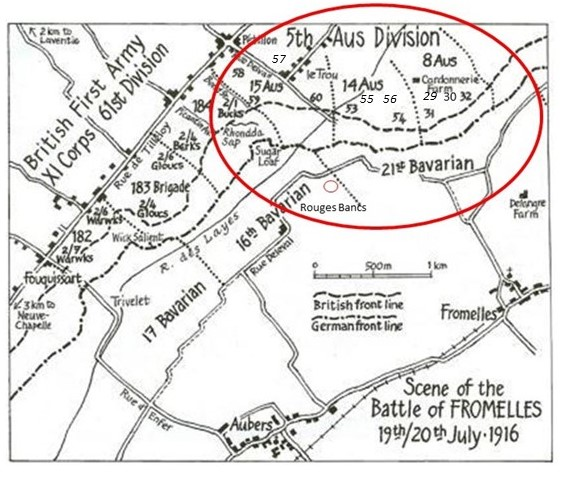
Less than three weeks after arriving in France, Charles Thomas Pickering Smith found himself preparing for his first major action on the Western Front. Like hundreds of other reinforcements who had joined the newly formed 54th Battalion in Egypt, he had little time to acclimatise to trench warfare before being called upon to take part in what would become one of the darkest days in Australian military history. The overall plan was for brigades of the Australian 5th Division to conduct a diversionary assault on the German trenches at Fromelles. The main objective for the 54th Battalion was to capture the trenches to the left of the heavily defended and elevated German strongpoint known as the “Sugar Loaf”, which dominated the battlefield.
If the Sugar Loaf could not be taken, the 54th and neighbouring battalions would be subjected to devastating enfilade fire from German machine guns and vulnerable to counterattack. As they advanced, the 54th was to link up with the 31st and 53rd Battalions. The attack was originally planned for 17 July, but heavy rain delayed the operation. The weather improved and by 2.00 PM on 19 July the battalion was back in the trenches, preparing for its first major action on the Western Front. Zero Hour was set for 5.45 PM, but the Germans were well aware that an attack was imminent.
At 5.15 PM they unleashed a massive artillery bombardment on the Australian lines, causing chaos and heavy casualties before the assault had even begun.
At 5.50 PM the men of the 54th began leaving their trenches. The battalion advanced in four waves — half of A and B Companies forming the first two waves, with half of C and D Companies in the third and fourth. The leading waves moved into No-Man's-Land and lay down, waiting for the British barrage to lift. Charles was among the men who climbed from the trenches that evening, advancing across No-Man's-Land under intense enemy fire towards the German positions. At 6.00 PM the German trenches were rushed. Despite intense artillery, machine-gun, and rifle fire, the 54th advanced rapidly. The 14th Brigade War Diary later recorded that the bombardment had been highly effective and that:
“very few living Germans were found in the first and second line trenches”.
The battalion pressed forward nearly 600 yards, linking with the 53rd Battalion on the right and the 31st and 32nd Battalions on the left, holding a line stretching from Rouges Bancs to near Delangre Farm. Some of the forward positions were little more than water-filled ditches that had to be fortified quickly to withstand the inevitable German counterattacks. But on the right flank the situation had collapsed. The 60th Battalion had been unable to advance due to devastating machine-gun fire from the Sugar Loaf, leaving the 54th dangerously exposed.
Lt-Col Walter E. H. Cass later reported that by 2.20 a.m. the Germans were attacking along the road past Rouge Bancs. After a counterattack, the 53rd Battalion was apparently unaware that their flank was no longer protected, allowing German troops to move behind the Australian positions and capture men in the trenches. Cass sent a party of 54th Battalion soldiers forward to stabilise the line:
“They ran forward with the bayonet and drove the enemy back about 50 yards.”
Despite repeated appeals for artillery support, the position became impossible to hold. At 6.30 a.m. on 20 July, orders were received to withdraw. The retreat was chaotic and exposed to fire, with many wounded left behind in No-Man's-Land. “I saw scores of men badly wounded and no help at hand to bind them up.”
Source AWM4 23/14/4 – 14th Infantry Brigade War Diary, July 1916, Appendix N:321/15
With heavy losses and German troops now behind them due to the exposed flank, the Australians were eventually forced back towards their own lines. By 7.30 AM on 20 July the 54th Battalion had withdrawn all the way to Bac-St-Maur, about five kilometres from the front. In an extraordinarily short period of time, of the 982 soldiers who had left Egypt with the battalion, the initial roll call recorded 73 killed, 288 wounded, and 173 missing. When Charles Bean, Australia's official war historian, visited the battlefield two and a half years later, he observed large quantities of bones, torn uniforms, and Australian equipment still scattered across the ground. Ultimately, 172 soldiers of the 54th Battalion were killed in action or died of wounds.
Of these, 102 were originally listed as missing. As of April 2024, 28 of those men have since been identified and formally buried at Pheasant Wood Cemetery.
After the Battle

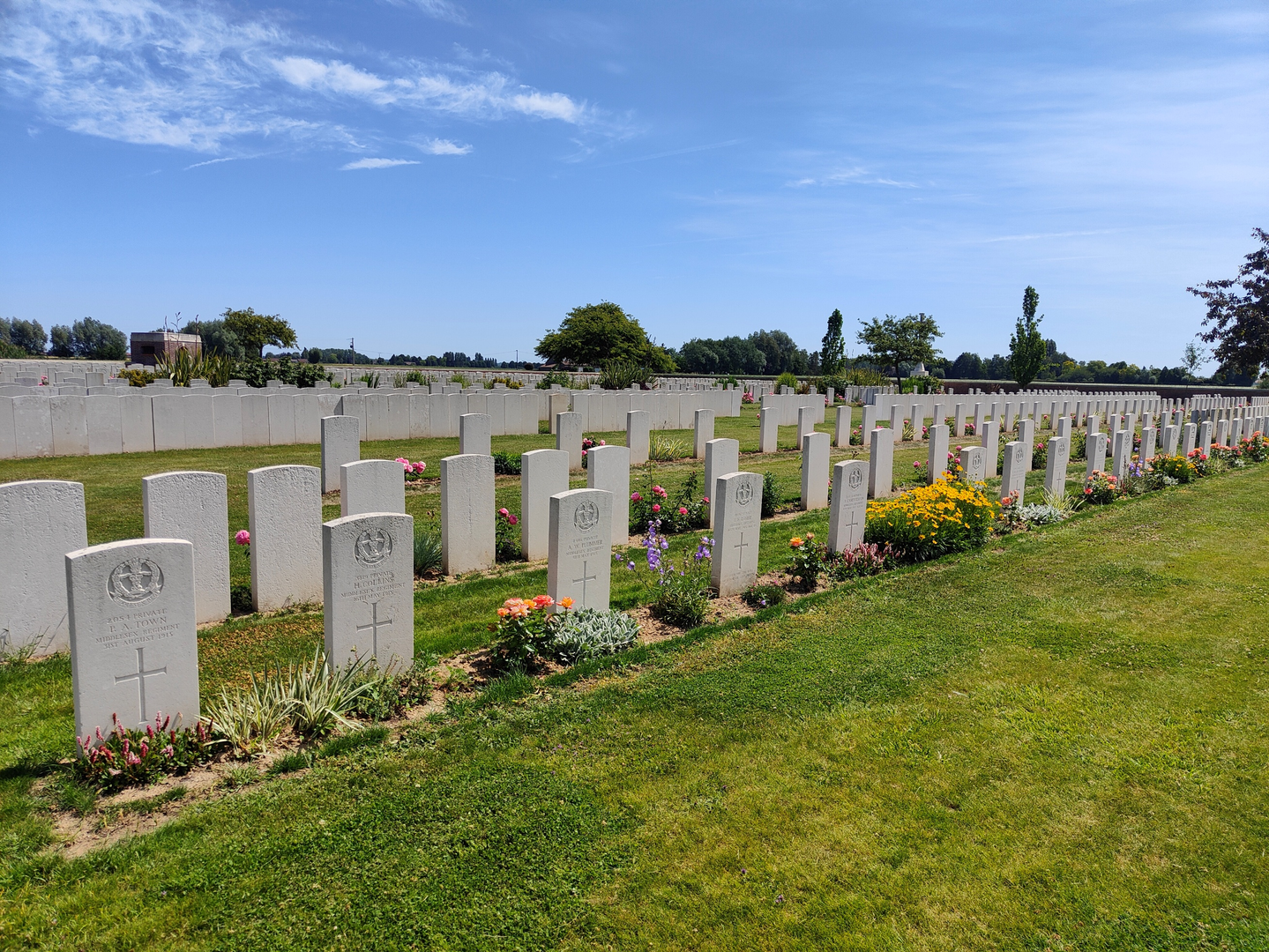
Charles was killed in action during the fighting at Fromelles on 19–20 July 1916. He was 22 years old. Unlike many of his comrades whose bodies could not be recovered from the battlefield, Charles was buried the following day in Rue-Pétillon Military Cemetery.
News of Charles' death soon reached Greta. On 9 August 1916, the Newcastle Morning Herald and Miners' Advocate reported:
Mr. W. L. R. Smith received a message from the Minister for Defence that his son, Private C. Smith, had been killed at the front in France.
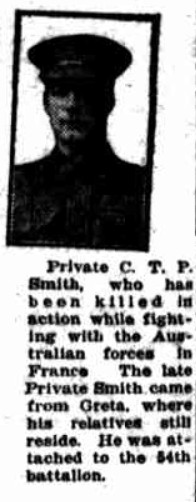
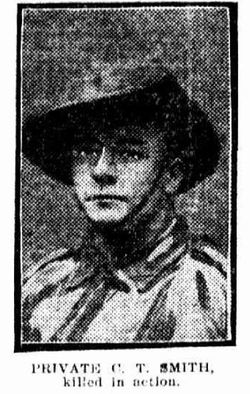
Less than two weeks later, the Greta community gathered to honour Charles and fellow local soldier Corporal Leo Briscoe, who had also been killed in France. Years earlier they had raced bicycles on the roads around Greta. They enlisted within ten days of each other, both were killed in action at the Battle of Fromelles in July 1916, and were remembered side by side at a memorial service in Greta's Church of England after news of their deaths reached home.
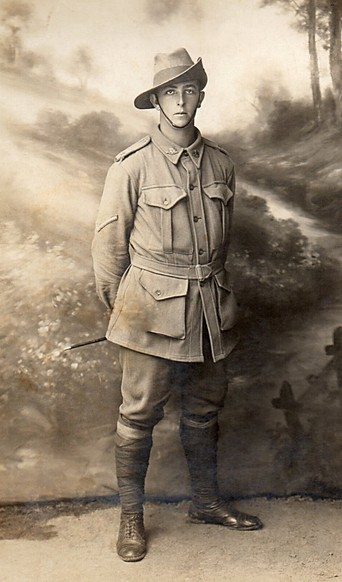
As noted in the Newcastle Herald and Miner's Advocate:
A memorial service was held at the Church of England, Greta, on Sunday afternoon for
Private C. Smith and Corporal Leo Briscoe, who were killed in action last month.
The Rev. H. H. Hobart... took for his text -
”Greater love hath no man than this, that a man lay down his life for his friends”
After the benediction, The Dead March was played... and the Last Post sounded...
There was a large congregation.
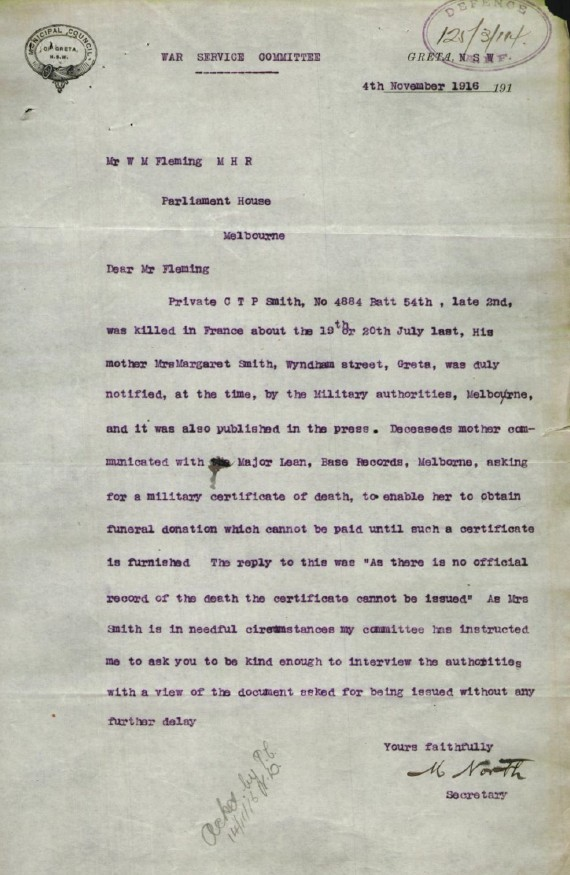
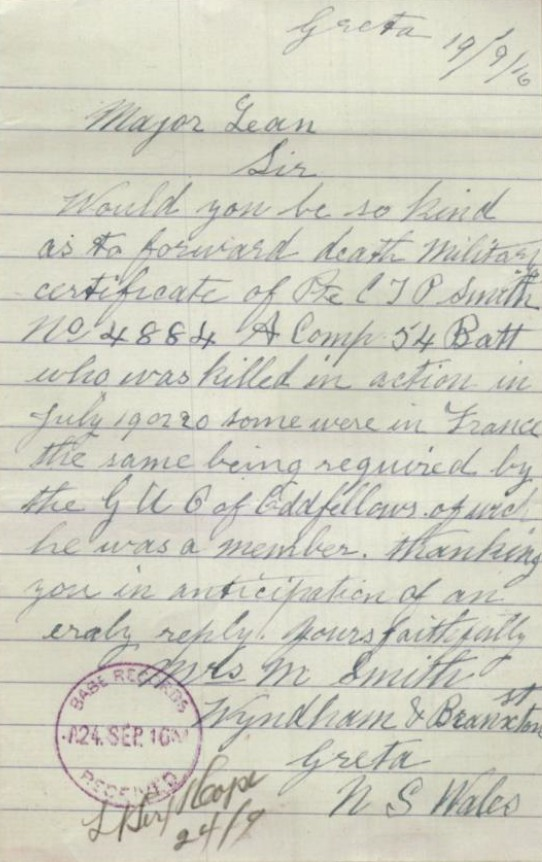
For Charles' mother, Margaret, the sorrow of losing her only surviving son was compounded by official delays. Although the family had been notified that Charles had been killed, she was unable to obtain the official death certificate needed to claim a funeral benefit from the Grand United Order of Oddfellows, of which Charles had been a member. In September 1916 she appealed for assistance, explaining that the certificate was required by the society. The Greta War Service Committee took up her cause, writing to Federal Member for Robertson, William Fleming, explaining that Mrs Smith was "in needful circumstances" and asking that a certificate be issued without further delay.
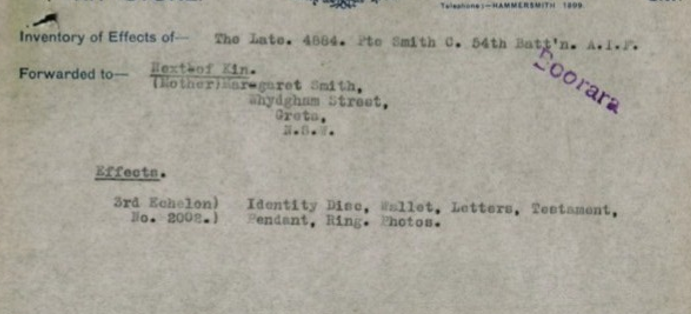
The committee pointed out that although the family had received official notification of Charles' death, the necessary paperwork had not yet been provided. Eventually, once formal confirmation of Charles' death had been received from overseas, Base Records advised that the required certificate would be issued to Mrs Smith. Some months later, Charles' few personal belongings were returned to his mother in Greta. They consisted of his identity disc, letters, postcards, a notebook, a Testament and a photograph, the simple possessions that had accompanied him from Australia to Egypt, France and finally the battlefield at Fromelles.
The pain of losing Charles remained with his family long after the war. On the second anniversary of his death, his parents and sister published an "In Memoriam" notice in The Daily Telegraph:
SMITH.—In loving memory of our dear son and brother, Private C. T. P. Smith, 54th Battalion, killed in action in France 19–20th July, aged 22 years and 6 months.
We have lost him, who loved him,And, like others must be brave;And we know that he is sleepingIn a British soldier's grave.
Inserted by his mother, father, sister, W. L. R. Smith and Alice Smith, Wyndham and Branxton Street, Greta.
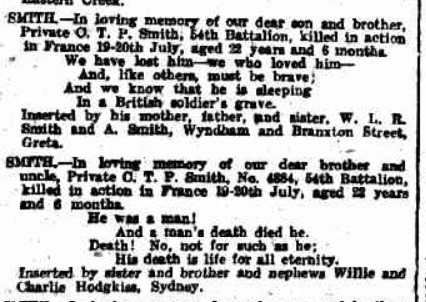
A second notice appeared alongside it from Charles' older sister Mary and family in Sydney.:
SMITH.—In loving memory of our dear brother and uncle, Private C. T. P. Smith, No. 4884, 54th Battalion, killed in action in France 19–20th July, aged 22 years and 6 months.
He was a man!And a man's death died he.Death! No, not for such as heHis death is life for all eternity.
Inserted by his sister (Mary) and brother (in law) and nephews Willie and Charlie Hodgkiss, Sydney.
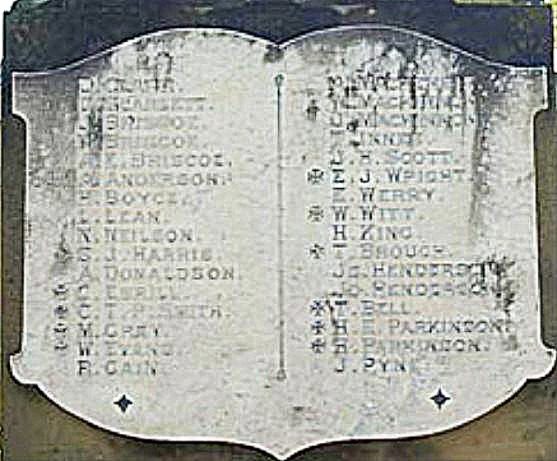
Today, Charles rests in Rue-Pétillon Military Cemetery, Fromelles, France. He is commemorated on the Australian War Memorial Roll of Honour, Canberra (Panel 160) and the Greta War Memorial ensuring that the young miner who answered his country's call continues to be remembered both in Australia and on the battlefield where he gave his life.
Family Reflection by Sue Walker
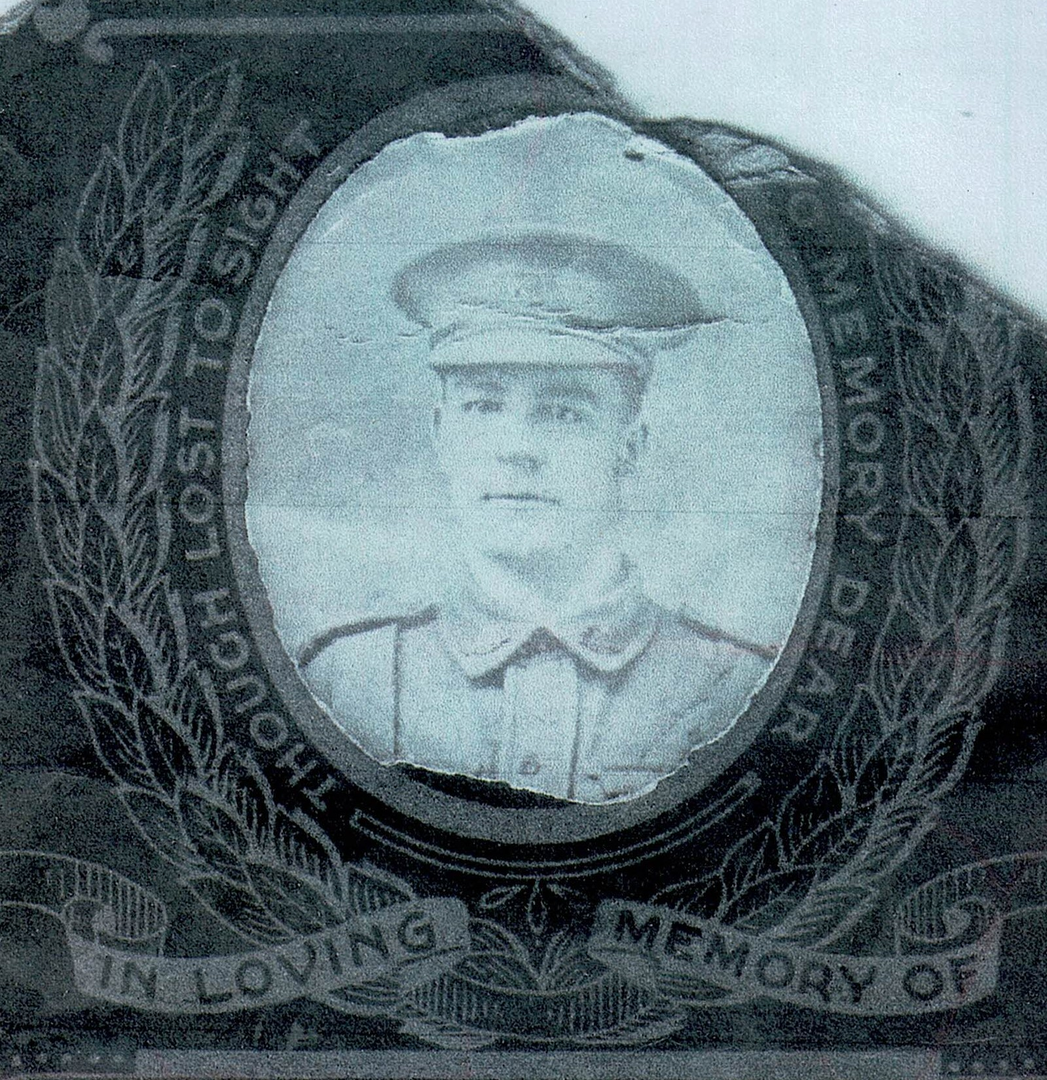
Many years ago, I remember looking at an old First World War photograph that had been stored in the garage. Eventually I found out that the soldier was Charles Thomas Pickering Smith, my cousin's relative, who was tragically killed in France at the Battle of Fromelles. When I travelled to France in 2014, I didn't know Charles' details, so I never made it to Rue-Pétillon Military Cemetery where he is buried. My aim has always been to travel back to France and have a photograph taken at his grave.
Unfortunately, my health is not too good now and maybe I won't get there. If not, I would be so grateful just to have a photograph of his grave. Some years ago, I visited the Greta Museum to donate Charles' original framed photograph so it could be displayed with the gold medallion presented to him by the citizens of Greta before he left for war. It means a great deal to know that these important pieces of his story are now together in the town he called home. Curiosity still surrounds that gold medallion. Was it the one Charles received at his farewell? Did he take it with him to France and was it returned with his belongings after his death? Or was it left behind in Greta before he sailed away? The medal was later found buried in the dirt at Greta before eventually being presented to the museum, where it now has pride of place.
I often wonder what story it could tell if it could speak. Charles was one of the lucky ones from that dreadful battle to have a known grave. More than one hundred years later, it brings great comfort to know exactly where he rests, and that his photograph, his medal and his story continue to be cared for and remembered.
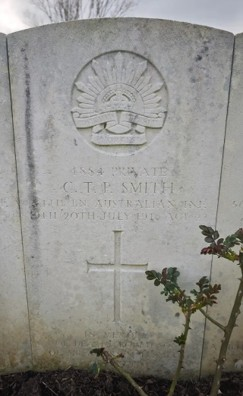
Personal Inscription
IN MEMORY OF DEARLY LOVED SON OF MR. & MRS.W.L. SMITH OF GRETA
Links to Official Records
The Fromelles Association would love to hear from you

Contacts
(Contact: carla@fromelles.info or geoffrey@fromelles.info).
(Contact: army.uwc@defence.gov.au or phone 1800 019 090).
Donations
If you are able, please contribute to the upkeep of this resource.
(Contact: bill@fromelles.info ).