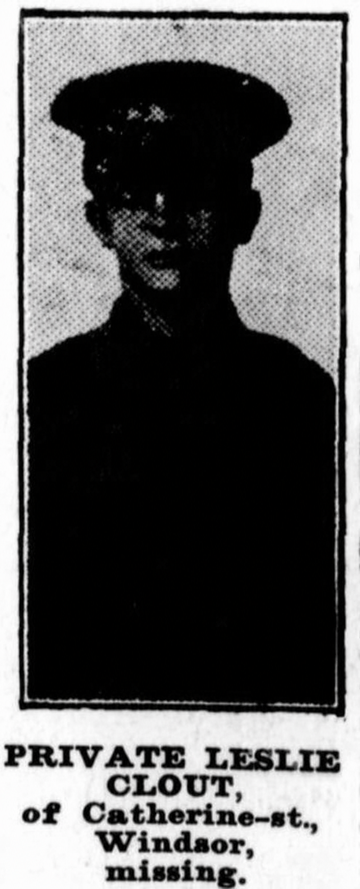
Leslie Walter Francis CLOUT
Eyes grey, Hair light brown, Complexion sallow
Only 17 - The Story of Private Leslie Clout
Can you help find Leslie?
Leslie Walter Francis Clout’s body was never found after the Battle of Fromelles, and there are no records of his burial.
A mass grave was found in 2008 at Fromelles, a grave the Germans dug for 250 Australian soldiers they recovered after the battle. As of 2024, 180 of these soldiers have been able to be identified via DNA testing.
Leslie may be among these remaining unidentified men. There is still a chance to identify him — but we need help. We welcome all branches of his family to come forward to donate DNA to help with his identification, especially those with roots in Windsor, NSW
See the DNA box at the end of the story for what we do know about his family.
If you know anything of contacts for Leslie, please contact the Fromelles Association.
Please contact the Fromelles Association of Australia to find out more.
Early Life
Leslie Walter Francis Clout was born on 13 September 1898 at Windsor, New South Wales, the son of William Edward Francis Clout (1872–1942) and Mary Jane Hayes (1875–1946), who married at Windsor in 1893.
William was born at Rouse Hill and spent almost his entire life in the Hawkesbury district. Mary Jane was born on 23 February 1875 at Yulgilbar Station, Richmond River, New South Wales, and was baptised later that year at St Matthew's Church of England, Windsor. Together they raised a large family of eleven children to adulthood, although one son died in infancy. Leslie was the fifth of their eleven children and the eldest surviving son.
The family first lived in George Street before later moving to Catherine Street, Windsor. Leslie attended Windsor Public School and, after leaving school, trained as a machinist. He also worked on the composing staff of the Windsor and Richmond Gazette, contributing to the newspaper produced in the heart of his hometown.
Children of William Edward Francis and Mary Jane Hayes:
- Amanda Clara Violet (1889 - 2010/1889 NSW)
- Vera Ellen (1893–1945) m James Clark
- Ernest William (1895–1895) died infancy
- Irene Muriel (1896–1962) m Henry Cleary
- Leslie Walter Francis (1898–1916) KIA Fromelles
- Stanley Edward (1900–1958) m Nellie Arnold
- Mary Jane (1903–1943) m William Turner
- Alice Elizabeth (1907–1981)m Albert Douglass
- Marjorie May (1910–1966) m Thomas Henderson
- Kenneth Bruce (1912–1966) m Edith Small
- Myrtle Joyce (1915–1999) m Marshall J Cartwright
- William John (1921–1991) WW2 NX 143558
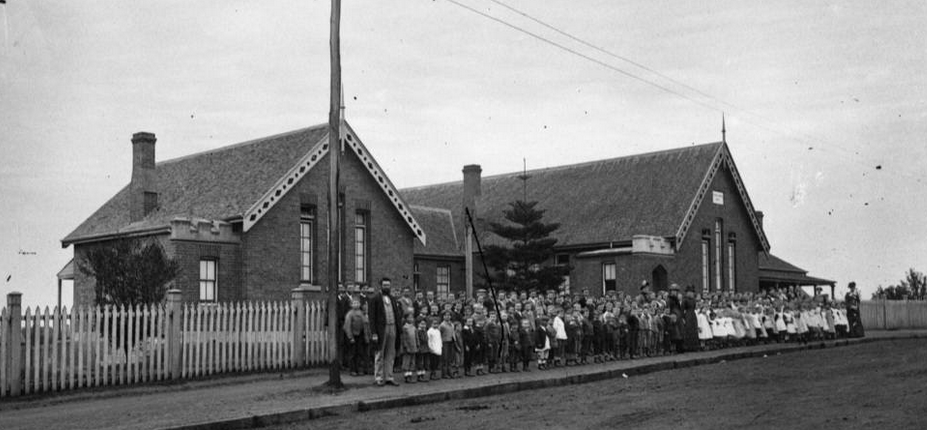
From an early age, Leslie was known locally for his courage. In January 1910, at just 11 years of age, he rushed to help George Brown, who had suffered a catastrophic spinal injury after diving into shallow water at Ben’s Point on the Hawkesbury River:
“George Brown, aged 17, son of Mrs. W. Armoar, of Fitzgerald-street, while bathing in the Hawkesbury above Ben’s Point yesterday, dived into 2 ft. of water and struck the bottom with his head. His spine was injured, and he is now in a critical condition. A little fellow named Leslie Clout, about 12 years of age, bravely went to Brown’s help.”
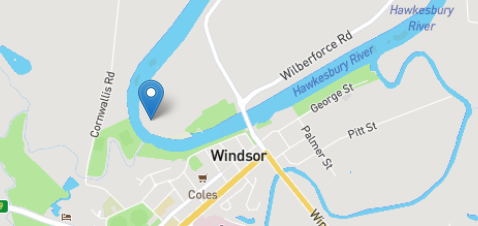
The Windsor community moved quickly to recognise his bravery. A public meeting was convened by the Deputy Mayor to determine how best to reward the boy who had “so pluckily tried to save the life” of another:
“…he had been asked by several gentlemen to see if anything could be done to recognise the boy who so pluckily tried to save the life of the late George Brown. He thought it only right that the townspeople should give some recognition — something that would serve to remind him in later years, and spur him on to other brave acts.”
Funds were raised to provide Leslie with clothing and to place money in the Savings Bank for his future. The success of the appeal was later confirmed:
“A sum of £1, 1s has been subscribed at Windsor to reward Leslie Clout, 11, who rescued George Brown from drowning in the Hawkesbury River.”
By his mid-teens, Leslie was already contributing to the support of his large family through his work in printing and machining. When he later enlisted at just 17 years of age, local newspapers would describe him as the sole support of his invalid father, mother, brothers and sisters, a heavy responsibility for a boy not yet out of his teens.
Off to War
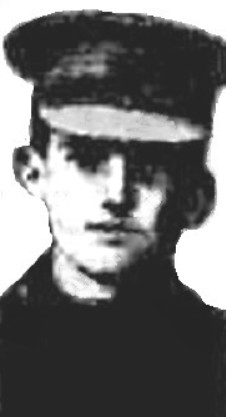
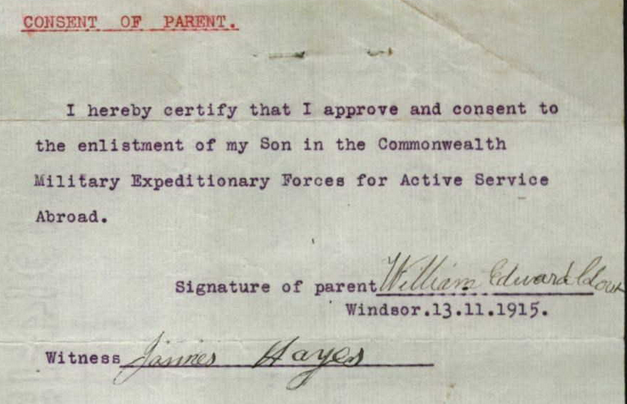
Leslie was only 17 when he made the decision to enlist. Because he was legally a minor, his father, William, signed a formal Consent of Parent at Windsor on 13 November 1915, giving permission for his son to serve overseas. Just over two weeks later, on 29 November 1915, Leslie formally enlisted at Casula, New South Wales.
His departure was noted with pride in the local press alongside other young men from the district preparing to leave for camp:
“Messrs. A. J. H. and W. S. T. Lindsay, sons of Mr. John Lindsay, of Cattai, have been accepted, and go into camp tomorrow. Mr. Roland White, also of Cattai, went into camp on Wednesday. Messrs. James W. Moses, Samuel Hancheti, Roland Potts, and Leslie Clout, have also enlisted from Windsor, and will go into camp in a few days.”
Leslie embarked from Sydney on 8 March 1916 with the 4th Battalion, 15th Reinforcements, aboard the HMAT A15 Star of England and arrived in Egypt soon after. There he completed final training for service on the Western Front. While in Egypt, Leslie remained in close contact with home. In August 1916, the Windsor and Richmond Gazette reported that his parents had received a treasured bundle of postcards from him:
“Mr. and Mrs. W. J. Clout, of Catherine-street, Windsor, have received a fine collection of photo postcards from their son, Private Leslie Clout, now in Egypt. They depict Egyptian life and customs, and embrace many fine views of Cairo and its environs.”
On 20 April 1916, Leslie was taken on strength with the 56th Battalion at Ferry Post, before being transferred to the 60th Battalion, B Company, on 18 May 1916. With his new unit, he embarked from Alexandria on 18 June 1916, disembarking at Marseilles, France, on 29 June 1916. Within three weeks of landing in France, Leslie and the men of the 60th Battalion would be ordered into their first major battle.
The Battle of Fromelles
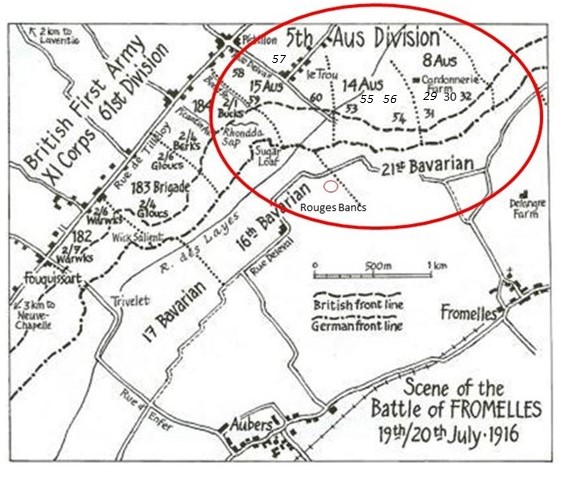
The 60th Battalion, part of Brigadier-General Harold “Pompey” Elliott’s 15th Brigade, had only recently arrived in France after being formed in Egypt from Gallipoli veterans and new recruits from Victoria. On 19 July 1916, the battalion entered its first major action on the Western Front, the disastrous attack at Fromelles. Leslie Walter Francis Clout had been with the battalion only weeks when he entered his first and only battle. The 60th held the centre of the brigade’s front, directly opposite the Sugar Loaf salient, one of the most heavily fortified German positions. The ground in front of them was flat and open, offering no cover. For two days prior, Australian artillery had bombarded the German lines in preparation for the assault.
By midday on 19 July, the men moved into their forward trenches, waiting under constant shellfire for the order to attack. At 6.45 p.m., the 60th Battalion went over the top in four assault waves, each numbering around 220 men. Almost immediately, they were met with devastating machine-gun and artillery fire. The first two waves were cut down before reaching the German wire. Very few men from the later waves advanced beyond 100 yards. Survivors later described the advance as a “hail of bullets”, with the thunder of shell bursts drowning out all orders and cries for help.
4801 Corporal William Holtham, wounded at Fromelles, one of the battalion’s machine gunners, later recalled the moment the men left the trench:
“Not a man flinched, not a single chap hung back when his turn came. They were just up and over.”
By 7.15 p.m., the attack had collapsed. The ground between the trenches was littered with the dead and wounded. Some men lay helpless in No Man’s Land for hours, unable to move. Those who could crawl back did so under cover of darkness, often passing the bodies of mates who had fallen beside them. Many later described the scene as “awful” and “beyond belief.” It was during this opening advance that Leslie was killed. A fellow soldier, 2347 Corporal Orrell Eastman. later gave this eyewitness account:
“He went over with me the July 19th, about 5.30 p.m. in the afternoon. About 50 yards over, a shell exploded amongst us, and blew Clout literally to pieces. He was only two yards from me at the time.”
By dawn on 20 July, stretcher-bearers attempted to reach the wounded under relentless sniper fire. Roll call soon revealed the scale of the disaster:
“Of the 60th Battalion, which had gone into the fight with 887 men, only one officer and 106 answered the call.”
In a single night, the 60th Battalion lost nearly 90 percent of its fighting strength, a level of destruction it would never fully recover from. For Leslie Clout, still just a teenager, Fromelles was both the beginning and the end of his war.
After the Battle
In the days following the Battle of Fromelles, Leslie was officially listed as missing. Back in Windsor, his family were plunged into agonising uncertainty. In October 1916, the Evening News published a notice that captured both the fear and the sudden shock felt at home:
“Private Leslie Clout, who, while living with his parents in Catherine Street, Windsor, is reported missing since July 19. He was employed on the composing staff of the Windsor and Richmond Gazette, is only 18 years of age and the sole support of his invalid father, mother, brothers and sisters. He wrote a letter to his parent on July 17 stating that he was having an enjoyable time in France and they received a cable stating that he was missing on July 19.”
For almost nine months, nothing further was known. Then, on 8 June 1917, the Windsor and Richmond Gazette recorded the moment the Red Cross report finally reached the Clout family:
“About nine months ago Mr. and Mrs. W. Clout, of Windsor, were notified that their son, Private Leslie W. Clout, was missing in France. Inquiries were instituted through the Red Cross Society, and yesterday morning the parents received the a report from the Red Cross.”
A Court of Enquiry held in the field on 4 August 1917 formally recorded his fate as “Killed in Action, 19 July 1916.” Leslie’s body was never recovered. Leslie has no known grave and is listed among the missing at the VC Corner Australian Cemetery and Memorial, Fromelles, France ( MR 7), a site where 410 Australians lie in unnamed graves following the battle. He is recorded as “Known Unto God.”
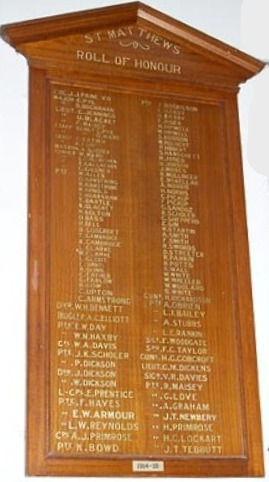
Leslie is also commemorated on the Australian War Memorial Roll of Honour in Canberra. At home in Windsor, he is remembered on the St Matthew’s Anglican Church World War I Roll of Honour, placing his name permanently within the spiritual and community heart of the town where he was born, raised, and from which he enlisted.
Legacy
Before the war, Windsor had known Leslie as the courageous schoolboy who leapt into the Hawkesbury River in an attempt to save another child's life. A few years later, the same town watched him march away to war alongside other local lads, never imagining he would not return.
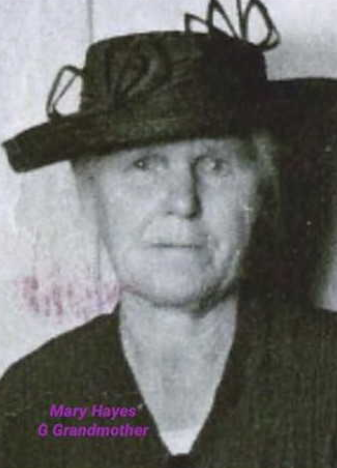
For almost a year, his parents lived with the agony of not knowing what had become of their 17-year-old son. Friends and neighbours shared their burden. Among the most moving documents in Leslie's service file is a private letter written to the Australian Red Cross by Mrs W. J. Cross, appealing for any news that might ease his mother's suffering:
"His mother is quite brokenhearted over him... She is under the impression he is in a hospital with loss of memory. But I quite know that if so she would have been notified... The poor soul is heartbroken."
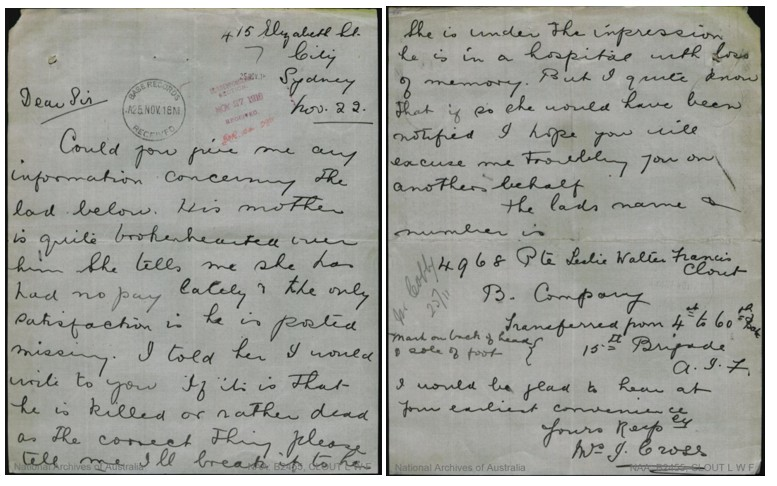
The letter captures the cruel uncertainty endured by so many Australian families after Fromelles. Long before official confirmation arrived, those closest to Leslie were already trying to prepare his mother for the truth while still holding on to the faintest hope that he might somehow be alive. Although Leslie has no known grave, his story has endured through the memories of his family, the records they left behind, and the memorials that bear his name. More than a century later, he is remembered not only as one of the fallen of Fromelles, but as a brave Windsor boy whose courage was recognised long before he went to war.
Family Reflection
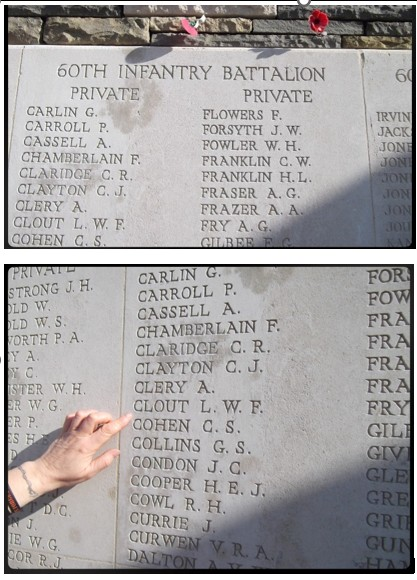
Mike Edwards became interested in Leslie back in 2014 when he and his wife Elaine visited VC Corner and the town of Fromelles:
“Some of this I already knew from researching my wife’s family tree. We found Leslie Walter Francis Clout when we visited VC Corner back in 2014. My wife spotted his name on the memorial and asked if we could be related. After a bit of digging, we discovered that Leslie was my wife Elaine’s third cousin, twice removed.
Their nearest common ancestor is John Clout, born on 11 February 1764. It was one of John’s sons who emigrated from Kent, England, to Australia, and it is through that branch of the family that Leslie is descended.
Finding that connection made seeing Leslie’s name on the memorial all the more personal. He was no longer just another name among the missing at Fromelles, he had become part of our own family story.”
Finding Leslie
Leslie’s remains have not been recovered, and he has no known grave. It is possible he was among those buried by the Germans in the mass grave at Pheasant Wood, discovered in 2008. As of 2025, over 180 soldiers from that grave have been identified using DNA from living relatives. Leslie may still be among the unidentified. To confirm this, DNA donors are needed from his Clout or Hayes family lines, particularly those with roots in Windsor, the Hawkesbury region, or Greater Sydney. If you are related or know someone who may be connected to the Clout , Hayman or Hayes families, your DNA could help finally identify Leslie.
DNA samples are being sought for family connections to
| Soldier | Leslie Walter Francis Clout (1898–1916) |
| Parents | William Edward Francis Clout (1872–1942), Windsor, NSW and Mary Jane Hayes (1875–1946), born Richmond River, NSW; died Windsor, NSW |
| Siblings | Amanda Clara Violet (b1889 - 2010/1889 NSW) | ||
| Vera Ellen Clout (1893–1945) m James Clarke | |||
| Ernest William Clout (1895–1895) died infancy | |||
| Irene Muriel Clout (1896–1962) m Henry Cleary | |||
| Stanley Edward Clout (1900–1958) m Nellie Arnold | |||
| Mary Jane Clout (1903–1943) m William Turner | |||
| Alice Elizabeth Clout (1907–1981) m Albert Douglass | |||
| Marjorie May Clout (1910–1966) m Thomas Henderson | |||
| Kenneth Bruce Clout (1912–1966) m Edith Small | |||
| Myrtle Joyce Clout (1915–1999) m Marshall Cartwright | |||
| William John Clout (1921–1991) WW2 NX 143558 |
| Grandparents | ||||
| Paternal | George Hayman 1849-1908 and Eleanor “Ellen” Clout (1852–1922), born Castle Hill, NSW; died Rydalmere, NSW | |||
| Maternal | John Malcolm Hayes (1842–1933) and Mary Hayman (1855–1922), NSW |
Links to Official Records
Seeking DNA Donors

Contacts
(Contact: carla@fromelles.info or geoffrey@fromelles.info).
(Contact: army.uwc@defence.gov.au or phone 1800 019 090).
Donations
If you are able, please contribute to the upkeep of this resource.
(Contact: bill@fromelles.info ).