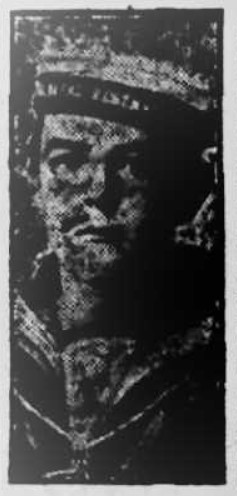
Peter ANDERSON
Eyes brown, Hair black, Complexion dark
Peter Anderson — “Ever Thoughtful and much loved”
Can you help find Peter?
Peter Anderson’s body was never found after the Battle of Fromelles and there are no records of his burial.
A mass grave was found in 2008 at Fromelles, a grave the Germans dug for 250 Australian soldiers they recovered after the battle. As of 2026, 181 of these soldiers have been able to be identified via DNA testing.
Peter may be among these remaining 69 unidentified men. There is still a chance to identify him — but we need help. We welcome all branches of his family to come forward to donate DNA to help with his identification, especially those with roots in Sydney, NSW
See the DNA box at the end of the story for what we do know about his family.
If you know anything of contacts for Peter, please contact the Fromelles Association.
Early Life
Peter was born on 12 May 1896 in Balmain, New South Wales, the youngest child of Peter Anderson, a Scottish-born patternmaker, and Maria Josephine Anderson (née Newling). Peter had four siblings:
- Charlotte Alice “Lottie” Anderson (1891–1956)
- Blanche Isobel Anderson (1893–1974)
- Thomas Anderson (1894–1964)
- Margaret May “Maggie” Anderson (1898–1990)
Peter’s paternal roots trace back to Glasgow, where his grandfather Thomas Anderson worked as a ship carpenter. His maternal family were long-established Sydneysiders from the Newling and Murphy families. When Peter was just three, his mother died on 15 August 1899 after accidentally ingesting Rough-on-Rats, a household poison commonly mistaken for other powders. Contemporary newspaper reports describe the frantic attempts to save her, the neighbours who came running and her final admission to hospital where she told nurses she had taken the powder in error.
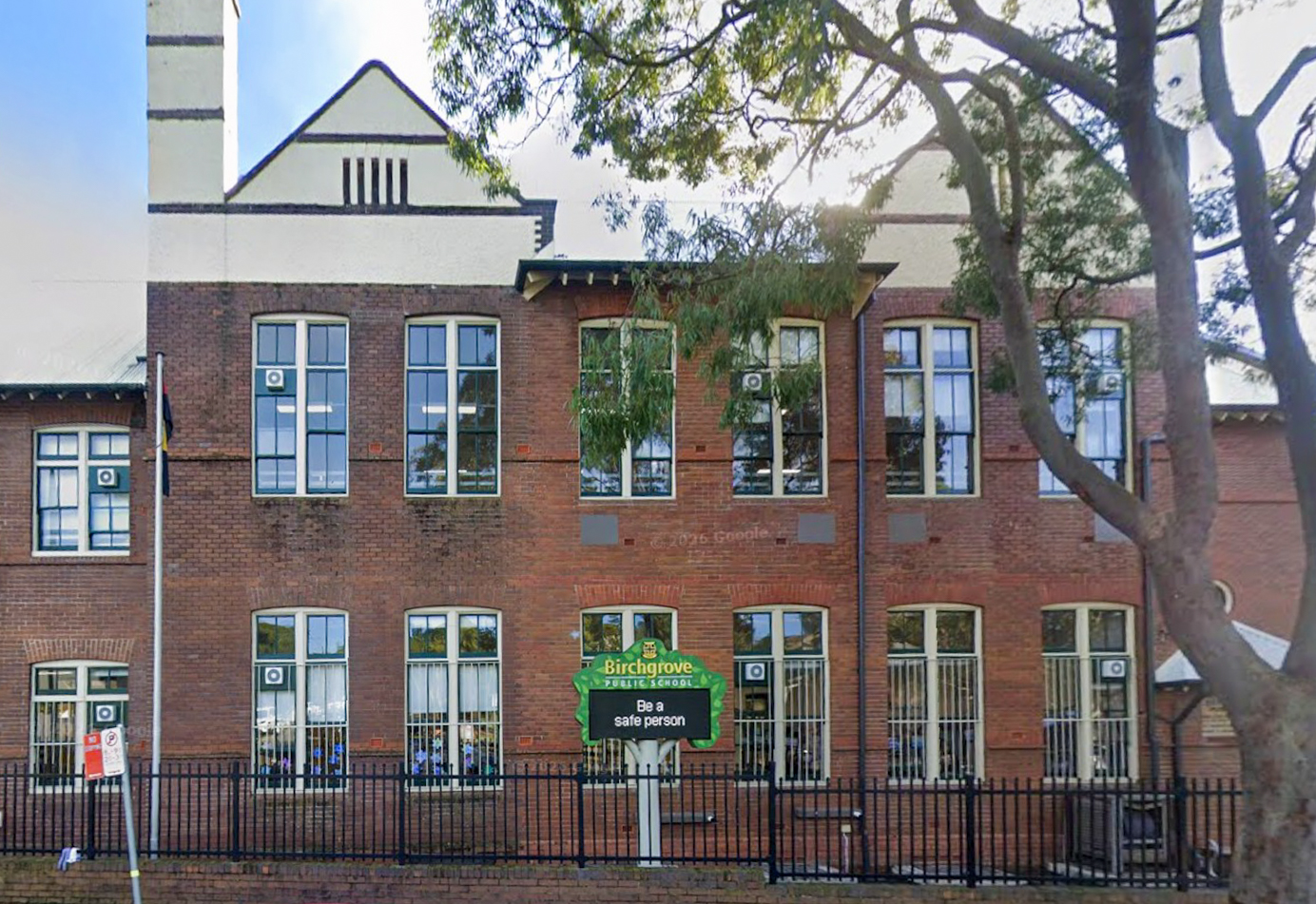
Compounding the family’s grief, his grandmother Julia Murphy died only a few months after Peter’s mother. With Maria gone and Peter (senior) working long hours at Mort’s Dock, the Anderson children were separated for practical care. Peter was taken in by family friends Margaret and Edward Windsor, who raised him as a foster-son. The Windsor home, 279 Botany St, Kensington, was a close suburb to Balmain and his father’s workplace at Mort’s Dock and also to Rushcutters Bay Naval Reserve. The siblings, despite living apart, remained closely connected throughout their lives — something clearly seen later in the heartfelt Roll of Honour notices they placed for him. Peter attended Birchgrove Public School, one of the local Balmain district schools serving the families of dockworkers, shipwrights and labourers.
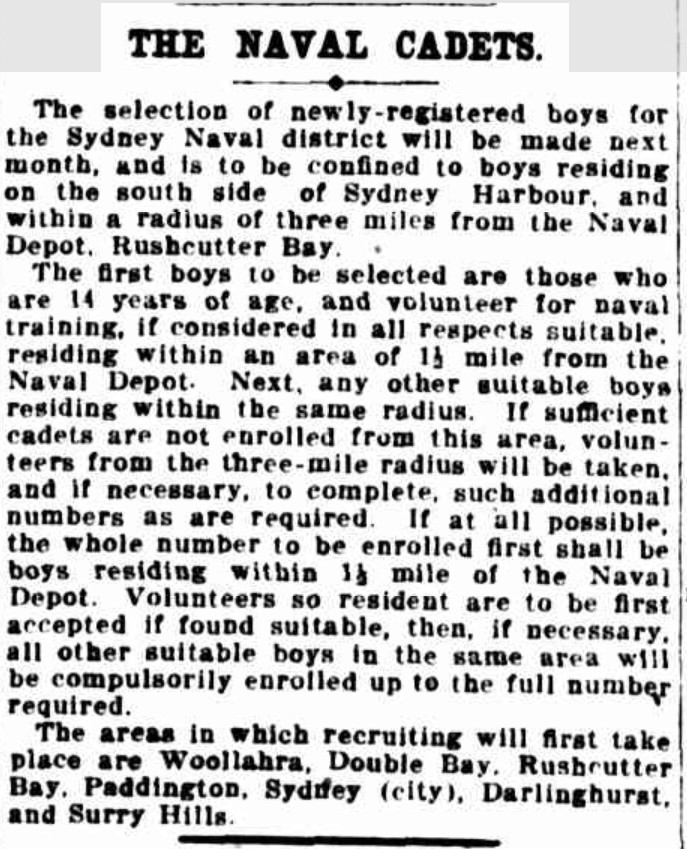
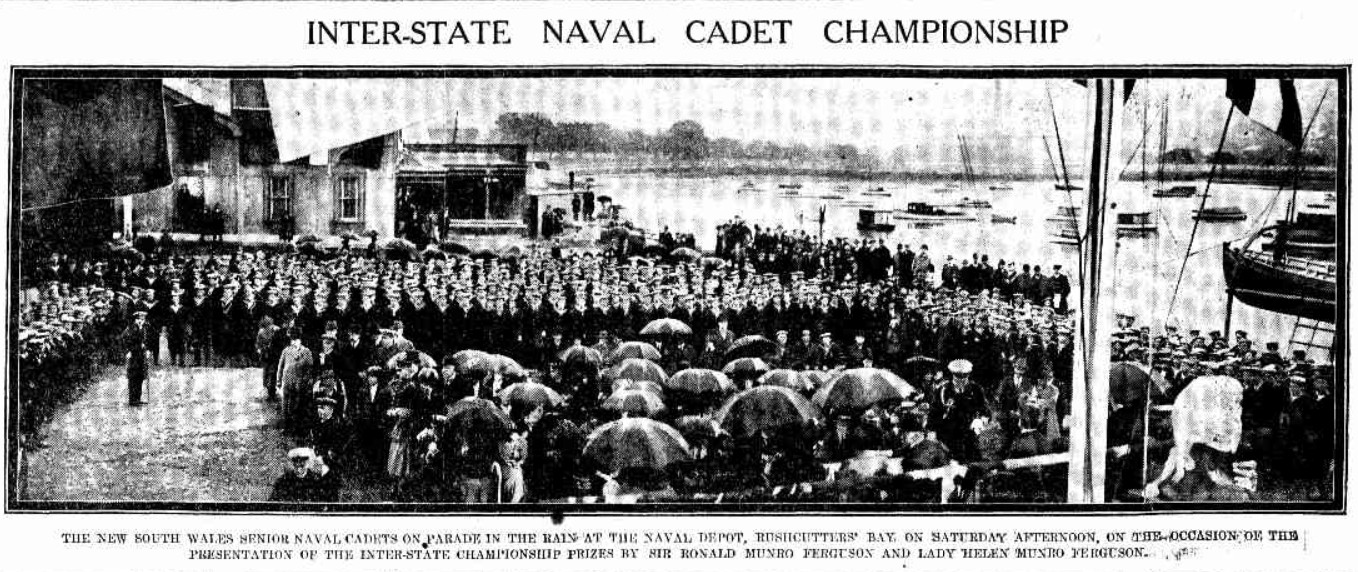
With his father having a background as a patternmaker, after his schooling, Peter trained as a “paper ruler”, a trade requiring steady hands and precision. When he was about 14, Peter joined the Royal Australian Naval Reserve, training at Rushcutters Bay. Records indicate he was one of the “Naval Reserve lads” of A Company — a tight-knit group who would stand beside him at Fromelles. This would include his best mate from Mosman, Frank Dodds (149), known as Tommy, who was with him when he died at Fromelles. Their enlistments are one day apart.
Off to War
By the time Peter enlisted in the AIF, he was already familiar with military discipline. His years in the Royal Australian Naval Reserve had given him drill experience, confidence, and the kind of close friendship circle that would follow him into A Company of the 30th Battalion. Many of the “Naval Reserve lads” enlisted together, trained together, and would ultimately face Fromelles side by side. Peter enlisted on 19 July 1915 at Liverpool, New South Wales, giving his foster-mother Mrs Margaret Windsor as his next of kin.
He was nineteen, slight in build at 5 feet 6 inches and 126 pounds, but he carried himself with the ease and fitness that came from years of cadet training and manual work. The 30th Battalion was formed on 1 August 1915 at Liverpool, New South Wales. Training commenced in the Liverpool camp, but in September they moved to the Royal Agricultural Show Grounds in Moore Park, Sydney. There were numerous reports of their activities in the papers.
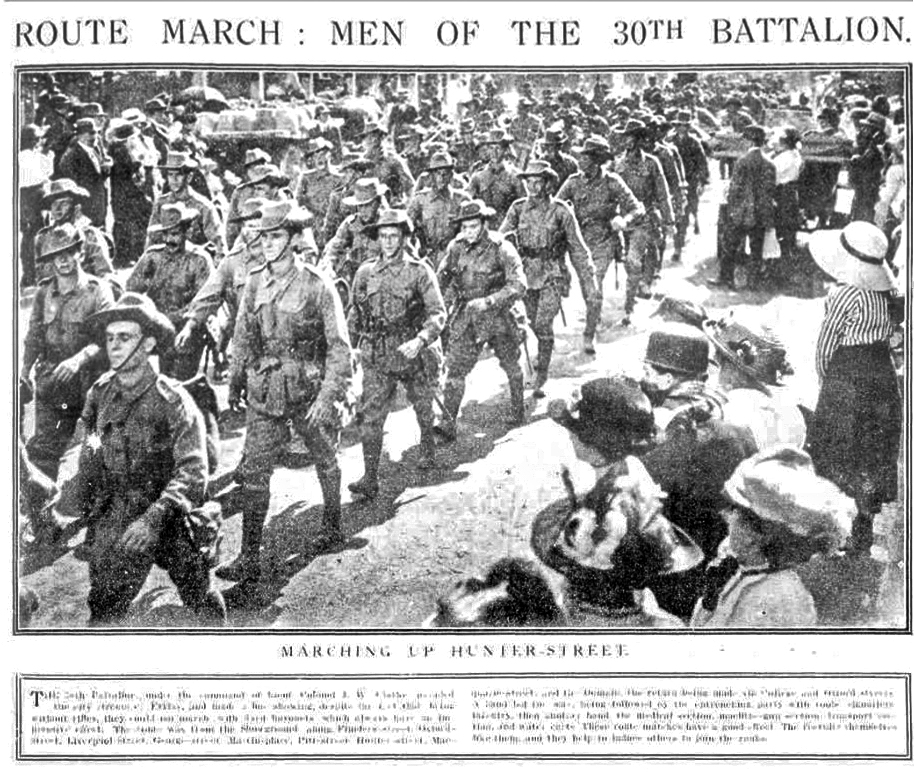
After training at Liverpool and in camp with the Battalion, Peter embarked from Sydney on 9 November 1915 aboard HMAT A72 Beltana, headed for the camps in Egypt, arriving at Suez on 11 December. Egypt became their temporary home, the men settling into a routine of long marches, musketry, bayonet practice, fatigue duties, and endless sand. It was a period of transition for the whole AIF. The Gallipoli evacuation had just taken place, and the newly created 5th Division, including the 30th Battalion, was preparing for service in France.
Through early 1916 the battalion trained in the desert, rotating between camp duties and manoeuvres as the Australian forces reorganised. Their first seven weeks were spent at Ferry Post guarding the Suez Canal from any potential threats posed by the Ottoman Army and continuing their training. February and March were spent at the 40,000 man camp at Tel-el-Kebir, 110 km northeast of Cairo. While there, they were inspected by H.R.H. Prince of Wales.
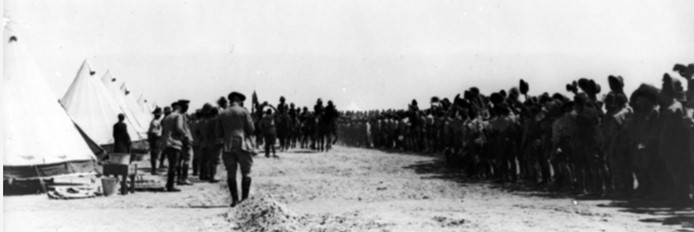
For much of April and May they were back in Ferry Post, including some time in the front-line trenches there. There were the usual complaints of the heat, water supplies and flies. Peter’s battalion left Egypt for the Western Front on 16 June 1916 on HMAT Hororata and arrived in Marseilles on 23 June. After landing, they were immediately entrained for a 60+ hour train ride to Hazebrouck, 30 km from Fleurbaix. They arrived on 29 June and then encamped in Morbecque. Private F.R. Sharp (2154) wrote home about this experience:
“From the time we left Marseilles until we reached our destination was nothing but one long stretch of farms and the scenery was magnificent.” “France is a country worth fighting for.”
The area near Fleurbaix was known as the “Nursery Sector” – a supposedly relatively quiet area where the inexperienced Allied troops could learn the harsh realities of Western Front trench warfare against the Germans. But the quiet times and the training period did not last long. Training now included the use of gas masks and they also would have heard the heavy artillery from the front lines. On 8 July they were headed to the front lines, first to Estaires, 20 km and the next day 11 km to Erquinghem, where they were billeted at Jesus Farm. They got their first ‘taste’ of being in the front lines at 9.00 PM on 10 July.
The Battle of Fromelles
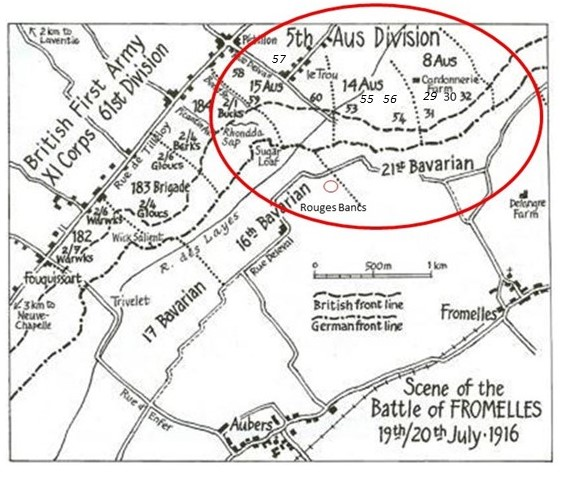
The overall plan was to use brigades from the Australian Fifth Division to conduct a diversionary assault on the German trenches at Fromelles. The 30th Battalion’s role was to provide support for the attacking 31st and 32nd Battalions by digging trenches and providing carrying parties for supplies and ammunition. They would be called in as reserves if needed for the fighting. The attack was initially planned for 17 July, but it was postponed due to the weather. In his final letter home Charles Albert Woods (2194 30th Bn) summed up the situation he found himself in:
“Since writing last we have shifted from ‘somewhere in France’ to ‘somewhere else in France,’ and are now in the trenches. Whilst writing this the shells are whistling over our heads a ‘treat.’ We are all provided with steel helmets to lessen the danger of being hit in the head with shrapnel, and also with gas helmets, to put on while a gas attack is being made on us.”
Then, on 19 July, the 29 officers and 927 other ranks of the 30th Battalion were into battle. Zero Hour for advancing from their front-line trenches was to be 5.45 PM, but the Germans knew this attack was coming and were well-prepared. They opened a massive artillery bombardment on the Australians at 5.15 PM, causing chaos and many casualties. The 32nd’s charge over the parapet began at 5.53 PM and the 31st’s at 5.58 PM.
There were machine gun emplacements to their left and directly ahead at Delrangre Farm and there was heavy artillery fire in No-Man’s-Land. While not in the initial rush, the 30th was close behind digging trenches, carrying ammunition and repairing communication trenches all while under fire. While suffering significant losses, the initial assaults were successful and by 6.30 PM the Aussies were in control of the German’s 1st line system (Trench B in the diagram below), which was described as “practically a ditch with from 1 to 2 feet of mud and slush at the bottom”.
Source - AWM4 23/49/12, 32nd Battalion War Diaries, July 1916, page 11
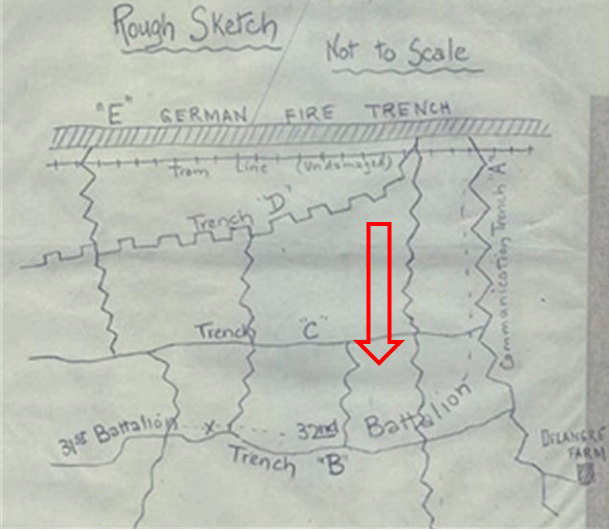
While their role was to be in support, commanders on scene made the decision to use the 30th as much-needed fighting reinforcements. A necessary act, but it had consequences as it interfered with the planned flow of supplies. B and C Companies were the first to be brought in.
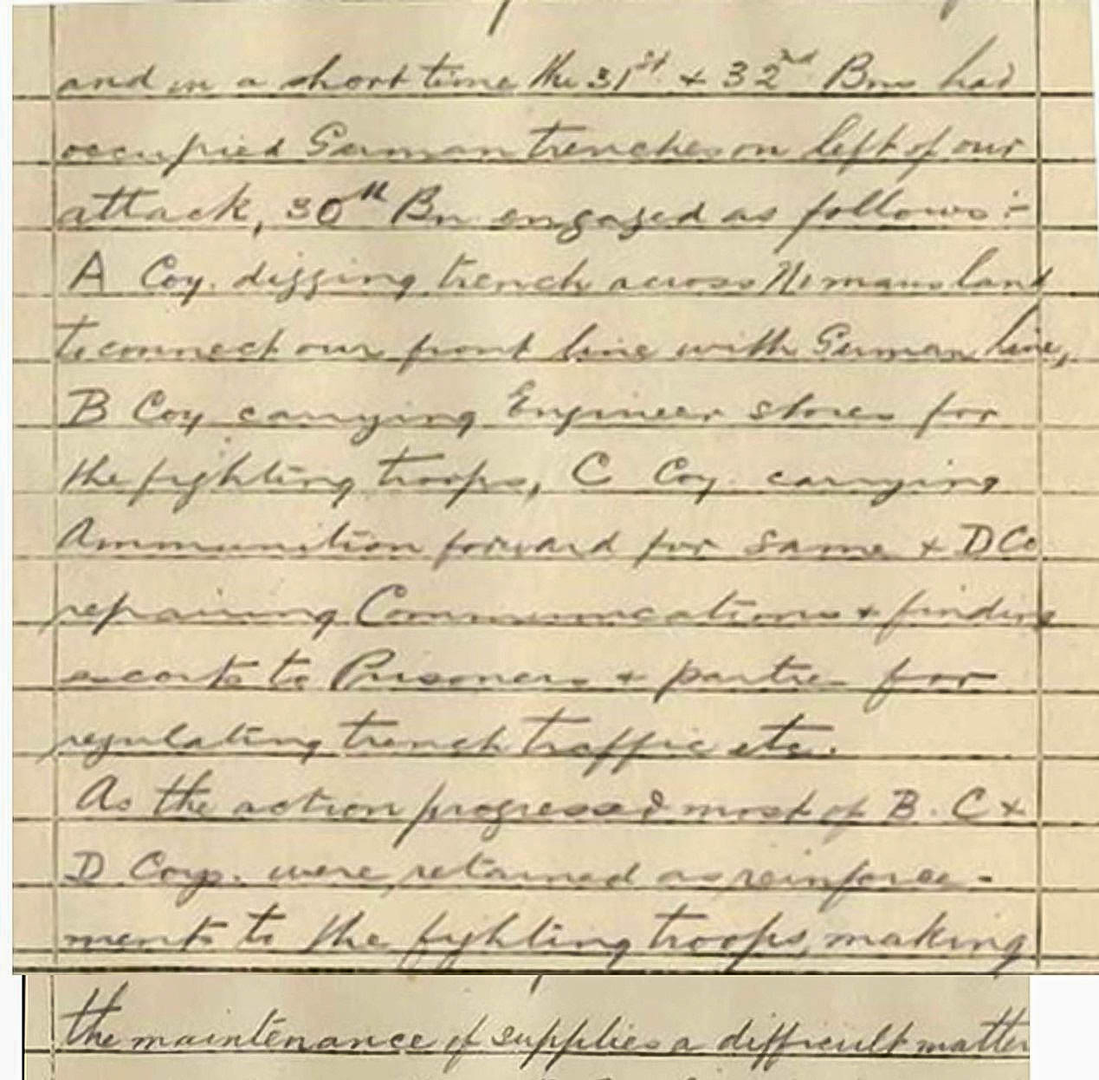
By 8.30 PM the Australians’ left flank had come under heavy bombardment with high explosives and shrapnel. Return bombardment support was provided and they were told that “the trenches were to be held at all costs”.
Source - AWM4 23/49/12, 32nd Battalion War Diaries, July 1916, page 12
When the 30th was formally called to provide fighting support at 10.10 pm, Lieutenant-Colonel Clark of the 30th reported:
“All my men who have gone forward with ammunition have not returned. I have not even one section left.”
Fighting continued through the night. The Australians made a further charge at the main German line beyond Trench B, but they were low on grenades, there was machine-gun fire from behind from the emplacement at Delangre Farm and they were so far advanced that they were getting shelled by both sides. At 4.00 AM the Germans began an attack from the Australian’s left flank, bombing and advancing into Trench A (map).
Given the Australian advances that had been made earlier, portions of the rear Trench E had been left almost empty, which then enabled the Germans to be in a position to surround the soldiers. At 5.30 AM the Germans attacked from both flanks in force and with bombing parties. Having only a few grenades left, the only resistance the 31st could offer was with rifles:
“The enemy swarmed in and the retirement across No Mans’ Land resembled shambles, the enemy artillery and machine guns doing deadly damage.”
By 10.00 AM on the 20th, the Germans had repelled the Australian attack and the 30th Battalion were pulled out of the trenches. The nature of this battle was summed up by Private Jim Cleworth (784) from the 29th:
"The novelty of being a soldier wore off in about five seconds, it was like a bloody butcher's shop."
Initial figures of the impact of the battle on the 30th were 54 killed, 230 wounded and 68 missing. To get some perspective of the battle, when Charles Bean, Australia’s official war historian, attended the battlefield two and half years later, he observed a large quantity of bones, torn uniforms and Australian kit still on the battlefield. The ultimate total was that 120 soldiers of the 30th Battalion were either killed or died from wounds and of this total 80 were missing/unidentified, including Peter.
Peter’s Fate
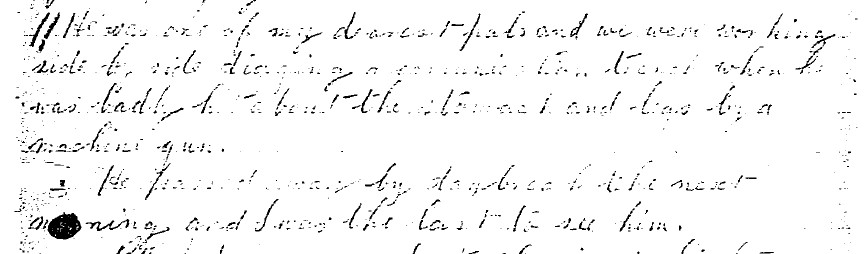
Multiple Red Cross witness statements confirmed that Peter was seriously wounded during the night, but unable to be moved back to the Australian lines because of the intensity of the German artillery barrage. Eventually he had to be left behind on the battlefield as the men were forced to withdraw. Peter had been fighting alongside his long-time friend Tommy Dodds:
“He was one of my dearest pals… he was badly hit in the stomach and legs by a machine gun. He passed away by daybreak the next morning and I was the last to see him.”
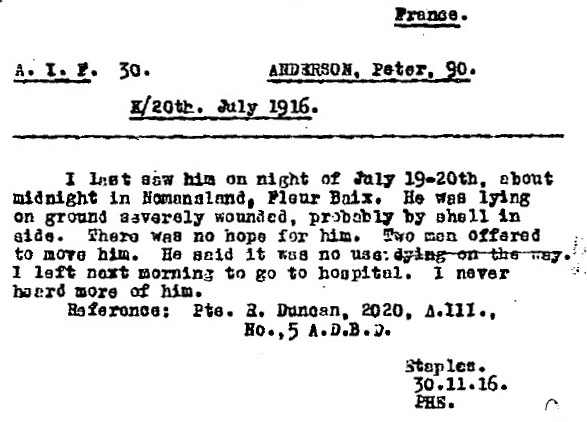
Private Robert G. Duncan (1060) also spoke with him around midnight, severely wounded in No Man’s Land:
“There was no hope for him. Two men offered to move him. He said it was no use.”
Private Peter Baillie (1043) and Private John E. Penrose (265) were in search parties to try and bring in the wounded and they saw Peter lying dead in No Man’s Land.
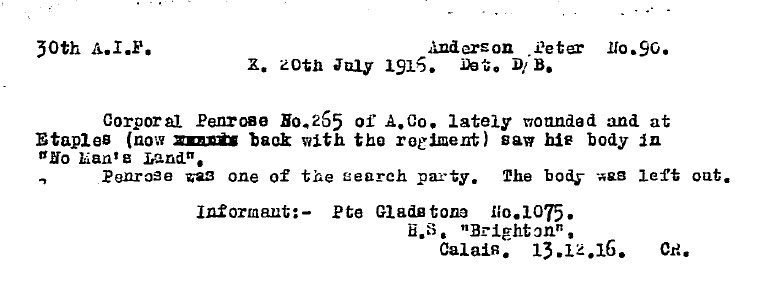
By dawn on 20 July, the ground between the lines was littered with the dead. Search parties had moved across the shattered ground, but they came under fire and only a handful were brought in. Most remained where they had fallen or buried by the shell fire. Peter was among them. A Court of Enquiry was held later in 1916, formally declaring that Peter had been Killed in Action on 20 July 1916.
The Family Back Home
Given the scale of the losses and chaos from the battle as the Army worked through the details on individual soldiers, official uncertainty continued for months. However, in October 1916, two of his mates, Tommy Dodds and Private Arthur D. Burns (1567) (ed -corrected from Bures) wrote to his Peter’s sister Blanche to explain how he died and why his comrades held him in such affection.
The letter described how the men had already charged and taken the German trench, and how Peter and others were digging communication trenches across No Man’s Land when the machine-gun fire intensified. They went on to say that Peter was attempting to assist a wounded comrade when he was struck by a sniper and that his loss was deeply felt among the Naval Reserve boys.
"One consolation I can give is that he went out brave and unflinchingly… and having made sufficient cover from the enemy, he went out again into the open to assist one who had fallen.”
Source - GAVE HIS LIFE FOR OTHERS. (1916, October 2). Evening News (Sydney, NSW 1869 - 1931), p. 4. http://nla.gov.au/nla.news-article114369767
His foster-mother, Margaret Windsor, was told at one point that two of Peter’s comrades had buried him and taken items from his pockets for safe return. She did receive his identity disc and some of his personal effects. His Army file contains and undated, handwritten remark about ‘believe buried in Rue Petillion Military Cemetery, which near to the battle site.
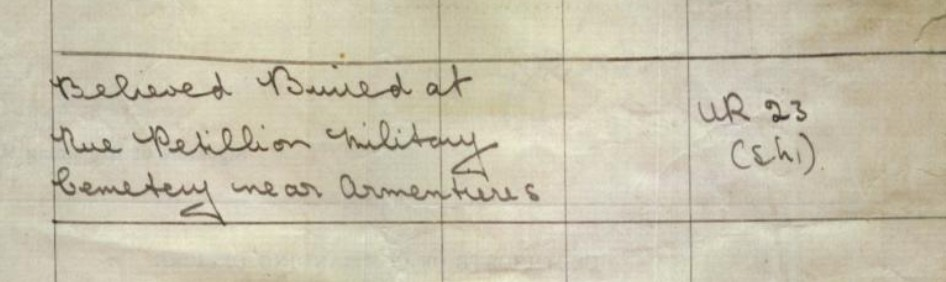
However, the Army often recorded missing soldiers as “believed buried” in the nearest known cemetery, even when no grave had actually been located. Later correspondence from the Australian Graves Services (1921–1922) confirmed that no evidence could be found to support this and his file was officially marked “No Trace on Research.”
Source: NAA: B2455, ANDERSON P, pg 16
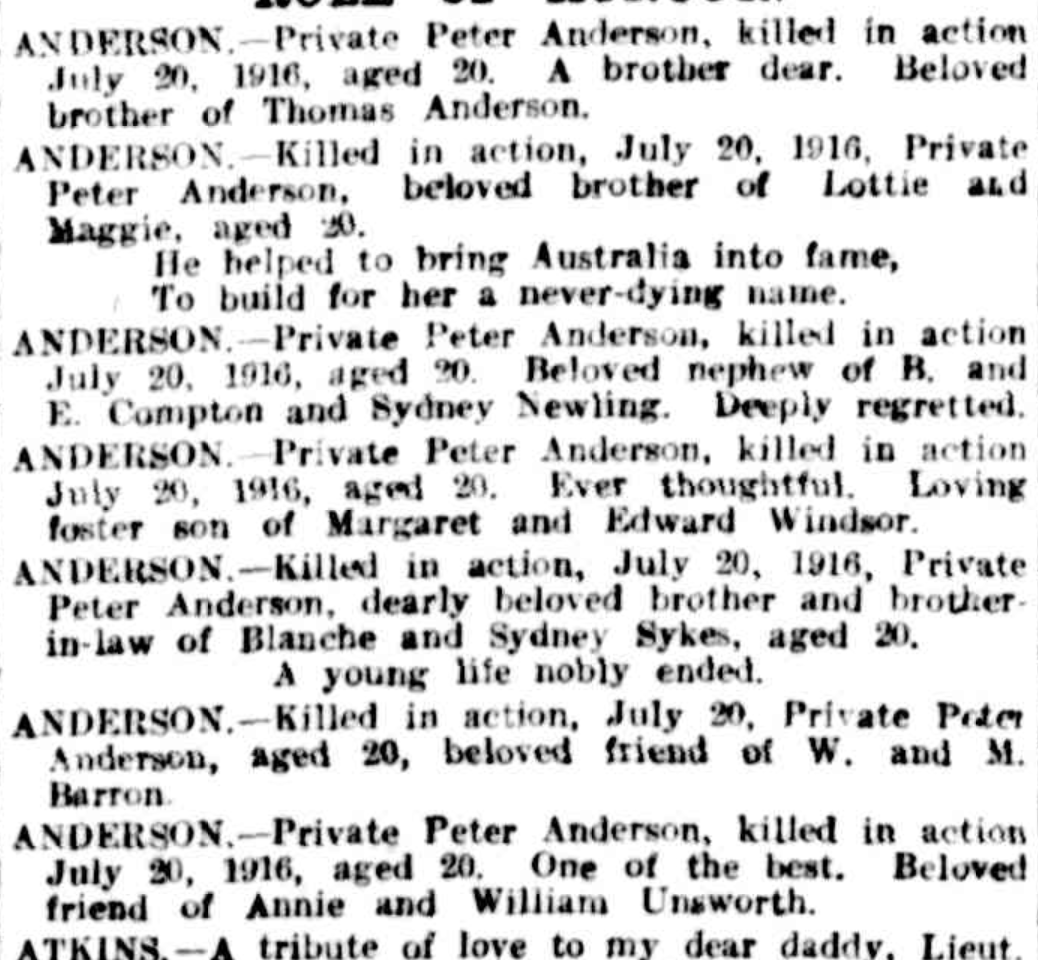
For his siblings who had remained close to Peter despite their separation in childhood, grief was expressed repeatedly in the Roll of Honour notices they placed across 1916 and 1917 — from Blanche and Sid Sykes, from Lottie and Maggie, from Thomas and Ivy, and even from his aunt and uncle, Blanche and Ernest Compton. His foster-parents, Margaret and Edward Windsor, placed their own tribute as well, calling him their “ever thoughtful, loving foster-son.”
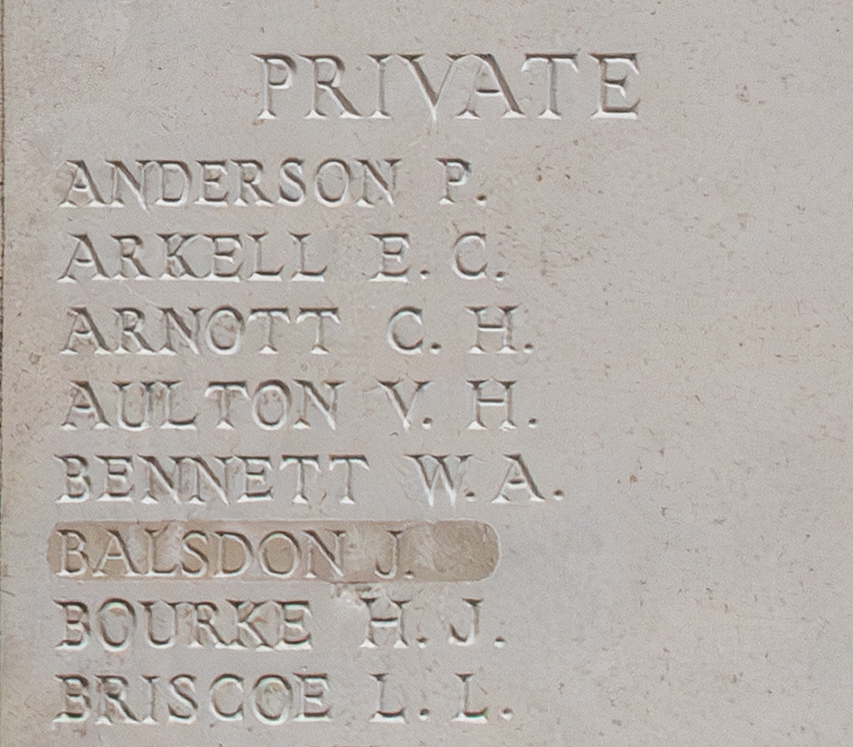
Peter was awarded the 1914-15 Star Medal, the British War Medal, the Victory Medal, a Memorial Plaque and a Memorial Scroll. He is commemorated at the VC Corner Cemetery and Memorial, Fromelles and on Panel 116 at the Australian War Memorial in Canberra.
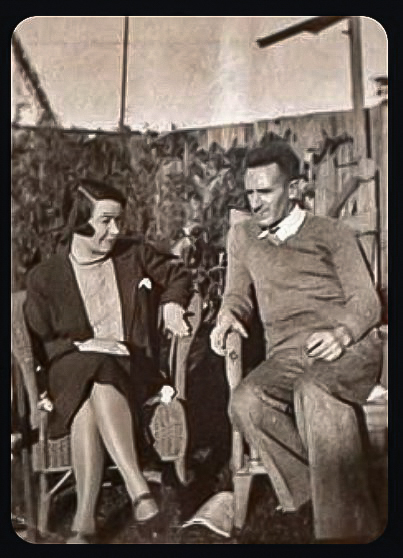
Peter’s father lived to see the war end, but not to see closure for his son. In August 1920 he was involved in a tragic street incident in Sydney. Knocked down during an altercation in Park Street, he suffered a fractured skull and died shortly afterwards. Peter’s best mate Tommy Dodds survived the war, married and has a son, he passed away in 1968.
Finding Peter
Peter’s remains were not recovered; he has no known grave. After the battle, the Germans recovered 250 Australian soldiers and placed them in a burial pit at Pheasant Wood. This grave was discovered in 2008 and since then efforts have been underway to identify these soldiers by DNA testing from family members. As of 2026, 181 of the soldiers have been identified, including 27of the 80 unidentified soldiers from the 30th Battalion. We welcome all branches of Peter’s family, especially from the Anderson, Newling, Farnie, and Murphy lines to come forward to donate DNA to help with his identification. If you know anything of family contacts particularly those with roots in Balmain, South Kensingon, Randwick, Woolloomooloo or the wider Sydney region, please contact the Fromelles Association. Your DNA could help identify him at last. We hope that one day Peter will be named and honoured with a known grave. Please visit Fromelles.info to follow the ongoing identification project and Peter’s story.
DNA samples are being sought for family connections to
| Soldier | Peter Anderson (1896–1916) |
| Parents | Peter Anderson (1859–1920), born Glasgow, Scotland – died Sydney, NSW | ||
| Maria Josephine Newling (1867–1899), born Sydney, NSW – died Balmain, NSW |
| Siblings | Charlotte Alice “Lottie” Anderson (1891–1956), married William Henry Horton | ||
| Blanche Isobel Anderson (1893–1974), married Sydney Richard Sykes | |||
| Thomas Anderson (1894–1964), married Ivy A. Whetton | |||
| Margaret May “Maggie” Anderson (1898–1990), married Samuel John Joseph Graham |
| Grandparents | |||
| Paternal | Thomas Anderson (1831–1911), born Glasgow, Scotland – died Glasgow, Scotland | ||
| Charlotte Farnie (1837–), born Kilrenny, Fife, Scotland | |||
| Maternal | Peter Newling (dates unknown), born NSW or arrived Plantagenet 1857 | ||
| Julia Murphy (1843–1899), born Parramatta, NSW – died Woolloomooloo, NSW |
Links to Official Records
Seeking DNA Donors

Contacts
(Contact: carla@fromelles.info or geoffrey@fromelles.info).
(Contact: army.uwc@defence.gov.au or phone 1800 019 090).
Donations
If you are able, please contribute to the upkeep of this resource.
(Contact: bill@fromelles.info ).