Sydney William DENNIS
Eyes grey, Hair brown, Complexion fair
Sydney William Dennis - One of the best
Can you help us find Sydney?
Sydney Dennis was killed during the Battle of Fromelles. His identity disc was recovered by the Germans, but there are no records identifying where they buried him.
A mass grave was found in 2008 at Fromelles, a grave the Germans dug for 250 soldiers they recovered after the battle. As of 2026, 181 of these soldiers have been identified through DNA testing.
Sydney may be among the remaining unidentified men. There is still a chance to identify him, but we need help. We welcome all branches of his family to come forward to donate DNA, especially descendants of the Dennis and Dinnis families of Week St Mary, Cornwall, and the Jewell and Treathick families of Poughill.
See the DNA box at the end of the story for what we know about Sydney’s family.
If you know of any family connections to Sydney, please contact the Fromelles Association.
Please contact the Fromelles Association of Australia to find out more.
Early Life
Sydney William Dennis was born in Balham, Surrey, in 1886, the only son of William Dennis and Elizabeth Broad Jewell. He was baptised at St Mary’s Church, Balham, on 6 June 1886. Sydney’s father, William Dennis, was born about 1853 at Braycott, North Petherwin, Devon. He was the eldest son of Thomas Dennis and Elizabeth Ann “Betsy” Turner and grew up at Week St Mary, Cornwall.
William later moved to London, where he worked as a draper. On 17 September 1878, he married Elizabeth Broad Jewell at Poughill, Cornwall. Elizabeth, born at Poughill about 1854, was the second daughter of William Jewell and Elizabeth Bernez Treathick. By 1881, William and Elizabeth were living at Marylebone in London with their young family. They had seven children.
Sydney’s six sisters were:
- Ethel Beatrice Dennis, born 1879
- Mabel Marian Jewell Dennis, born 1881
- Constance May Dennis, born 1882
- Adeline Bertha Dennis, born 1885
- Hilda Marie Dennis, born about 1889
- Dorothy Jewell Dennis, born about 1890
In 1891, the family was living at Peckham in the Camberwell district of London. Sydney was then about five years old.
William died in November 1903, when Sydney was about seventeen. Rather than enter his father’s trade, Sydney trained as a butcher. Several members of the wider Dennis family worked in that trade, including Sydney’s paternal uncles Charles Claude Dennis and John Turner Dennis.
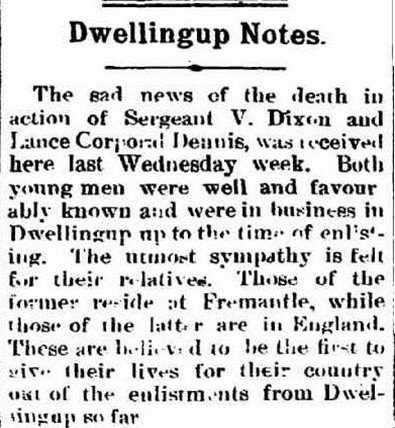
By 1911, Sydney was working as a butcher’s assistant and living in the household of his uncle John Turner Dennis. Later that year, Sydney left England for Australia. On 26 May 1911, he departed aboard the Otway, bound for Fremantle. Sydney settled at Dwellingup, south of Perth, where he worked as a master butcher until he enlisted for service in the Australian Imperial Force. The local paper recorded that 21 local Dwellingup lads, including Sydney, were given a civic reception to bid them farewell before leaving Australia for the war in Europe.
Off to war
Sydney enlisted at Perth on 21 July 1915 and was allotted regimental number 1252. He joined D Company of the newly formed 32nd Battalion, which was part of the 8th Brigade.
The 32nd Battalion had been formed at Mitcham, South Australia, on 9 August 1915. A and B Companies were composed of recruits from South Australia, while C and D Companies came from Western Australia.
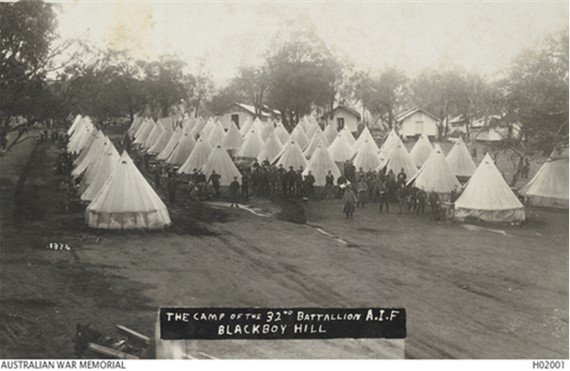
The Western Australian recruits trained at Blackboy Hill Camp near Perth before sailing for Adelaide at the end of September. With their arrival, the entire battalion assembled at Cheltenham Racecourse Camp and continued training in preparation for overseas service.
Before leaving Western Australia, Sydney was among 21 men from the Dwellingup district honoured at a civic farewell. Many of these men subsequently served alongside him in the 32nd Battalion.
The battalion departed South Australia on 18 November 1915, with the men divided between the HMAT A2 Geelong and the HMAT A13 Katuna. Sydney embarked from Adelaide aboard the Geelong. The departure attracted considerable public attention. The Register later reported:
“The 32nd Battalion went away with the determination to uphold the newborn prestige of Australian troops, and they were accorded a farewell which reflected the assurance of South Australians that that resolve would be realized.”
Source: “The 32nd Battalion”, The Register, 16 December 1915, p. 6. http://nla.gov.au/nla.news-article59988928
Sydney disembarked at Suez on 18 December 1915. Shortly before Christmas, the 32nd Battalion moved to El Ferdan. A month later, the men marched to Ismailia and then continued to the large training camp at Tel el Kebir, where they remained through February and most of March.
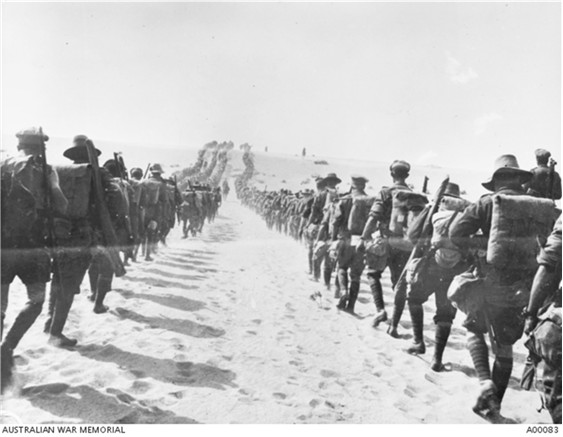
- From Tel el Kebir, the battalion moved to Duntroon Plateau and Ferry Post. The men continued training while also helping to defend the Suez Canal. Sydney was appointed Lance Corporal at Ferry Post on 26 May 1916. The battalion’s final posting in Egypt was at Moascar.
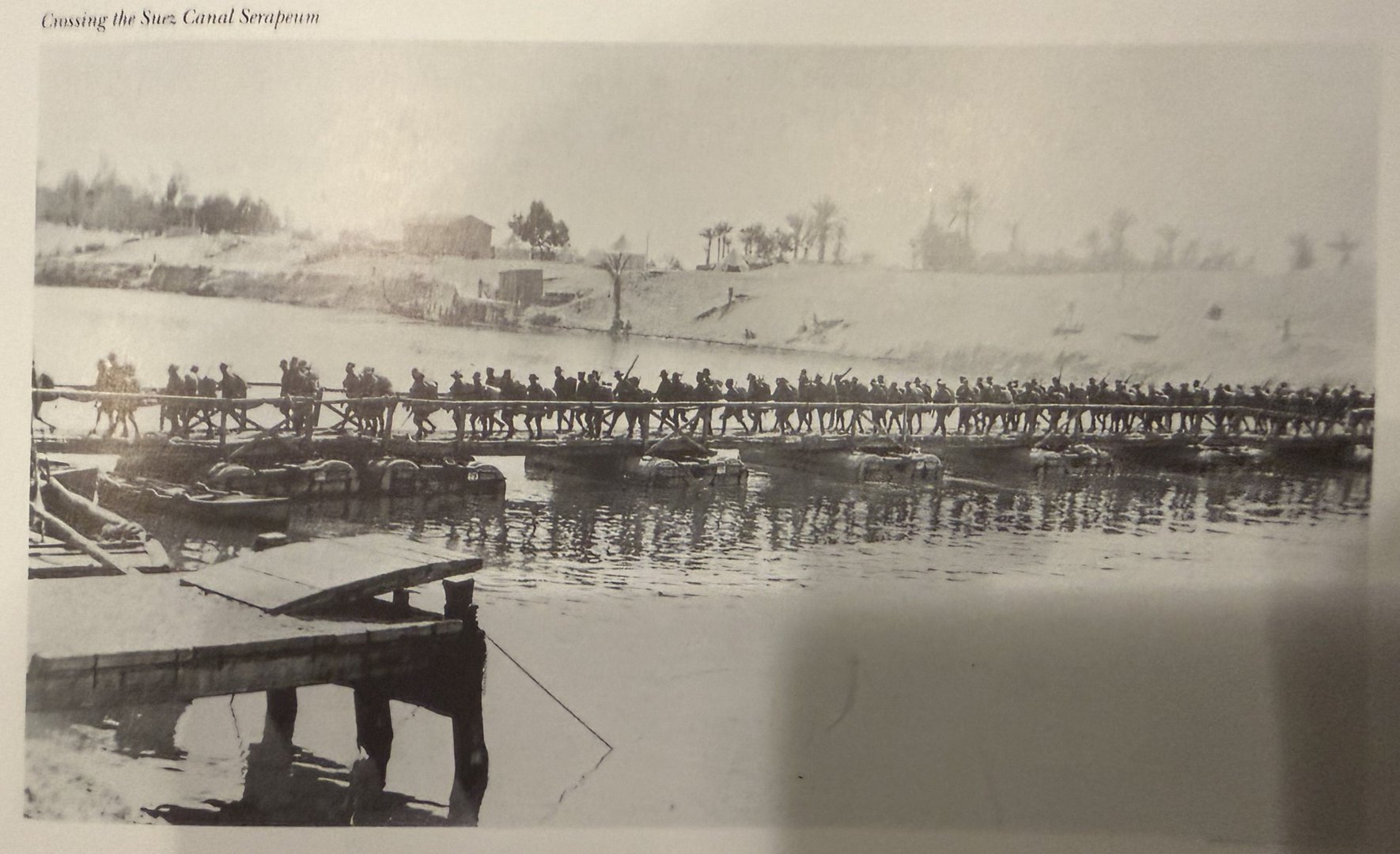
The heat, long marches through the sand, shortage of water and monotonous food left a lasting impression on the men. Private Theodor Pflaum complained in his diary that he was "sick up to the neck of heat and flies” and some of their rations as “dog biscuits and bully beef”.
Source: Australian War Memorial, C2081789, Diary of Theodor Milton Pflaum 1915–16, p. 12.
Theodore Pflaum also recorded the more welcome moments of their time in Egypt, including swimming, receiving mail from home and visiting local sights. During their time there, the battalion was inspected by H.R.H. the Prince of Wales.
To France
In mid June, orders arrived for the 32nd Battalion to join the British Expeditionary Force on the Western Front. Sydney and the battalion left Alexandria aboard the Transylvania on 17 June 1916 and arrived at Marseilles on 23 June.
From Marseilles, they began a three day train journey north to Steenbecque. Their route took them to a station near Paris, within sight of the Eiffel Tower, and then through Boulogne and Calais, where they caught a glimpse of the English Channel. After leaving the train, they marched to camp at Morbecque, about 30 kilometres from Fleurbaix.
Private Theodor Pflaum recorded the enthusiastic welcome they received along the way:
“The people flocked out all along the line and cheered us as though we had the Kaiser as prisoner on board!!”
Source: Australian War Memorial, C2081791, Diary of Theodor Milton Pflaum, 1916, p. 8.
Private Wesley Choat was equally struck by the contrast between Egypt and France:
“The change of scenery in La Belle France was like healing ointment to our sunbaked faces and dust filled eyes. It seemed a veritable paradise, and it was hard to realise that in this land of seeming peace and picturesque beauty, one of the most fearful wars of all time was raging in the ruthless and devastating manner of ‘Hun’ frightfulness.”
Source: Mitchell Library, W.P. Choat, A Bold Bid for Blighty, 1919, p. 7.
The battalion was sent towards the Fleurbaix area of northern France. This was regarded as a “Nursery Sector”, a supposedly quieter part of the front where inexperienced Allied troops could be introduced to the realities of trench warfare. Training continued, with particular attention given to bayonet fighting, gas helmets and steel helmets.
D Company’s Lieutenant Sam Mills wrote home confidently about their preparations:
“We are not doing much work now, just enough to keep us fit mostly route marching and helmet drill. We have our gas helmets and steel helmets, so we are prepared for anything. They are both very good, so a man is pretty safe.”
On 14 July, the 32nd Battalion moved into the front area. Two days later, Sydney and his comrades entered the trenches in the Bois Grenier sector for the first time, only three weeks after arriving in France. What had been intended as an introduction to the Western Front was about to become the battalion’s first major battle.
Battle of Fromelles
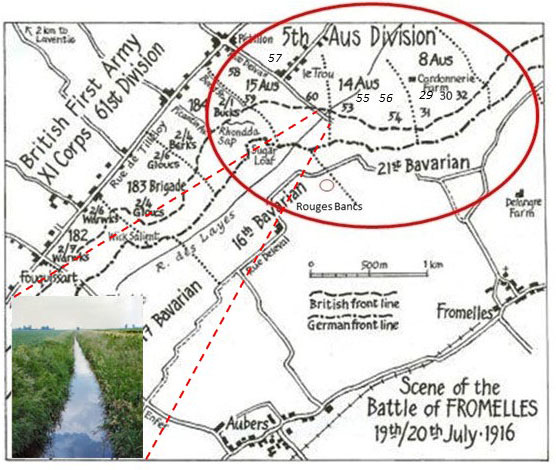
Inset - River Layes from the Australian Front Line looking towards the Sugar Loaf
On 17 July 1916, the men of the 32nd Battalion were reconnoitring the German trenches and cutting passages through the barbed wire in preparation for an attack. The assault was delayed because of the weather. The overall plan was for brigades of the Australian 5th Division to conduct a diversionary assault against the German trenches at Fromelles.
The 32nd Battalion was positioned on the extreme left flank of the Australian attack, with approximately 100 metres of No Man’s Land between them and the German trenches. As they advanced, they were to link with the 31st Battalion on their right. Their exposed position made the task particularly difficult. Not only did they have to capture and defend the German trenches, they also had to prevent German troops on their left from moving around behind them.
On the morning of 18 July, A and C Companies went into the trenches to relieve B and D Companies, who rejoined them the following day. Sydney was serving as a Lance Corporal in D Company.
Lieutenant Frederick Stolz described the calm among the men before the attack:
“The fellows were wonderfully cool and not during the whole time did I see anyone get excited or do anything silly, and such a lot were only young boys of between 18 to 20.”
Zero Hour for the advance was to be 5.45 PM on 19 July, but the Germans were well prepared and at 5.15 PM opened a massive artillery bombardment on the Australian positions, causing chaos and casualties. The charge over the parapet began at 5.53 PM. A and C Companies formed the first and second waves, followed by B and D Companies in the third and fourth. Sydney advanced with D Company in the fourth wave.
Despite the fire, the initial assault succeeded. By 6.30 PM, the 32nd Battalion had gained control of the first German trench system, identified as Trench B on the battalion’s maps. The condition of the captured trench was described in the 32nd Battalion War Diary described the captured trench as “practically a ditch with from 1 to 2 feet of mud and slush at the bottom”.
Source: AWM4 23/49/12, 32nd Battalion War Diary, July 1916, p. 11.
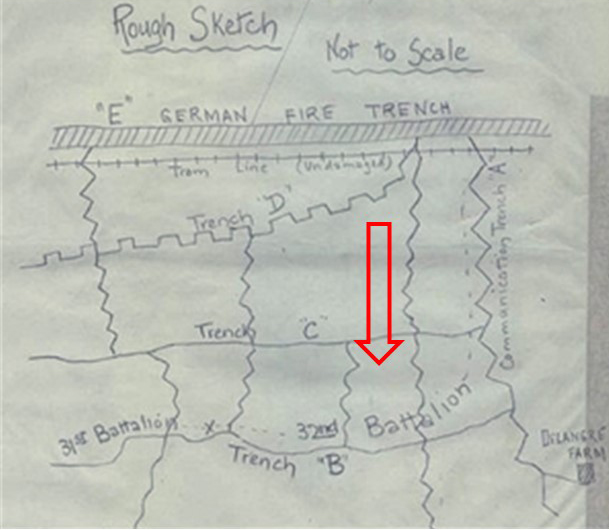
Success brought new dangers. Australian artillery observers were unable to confirm how far the troops had advanced and friendly artillery fire caused further casualties. The 32nd Battalion succeeded in taking out a German machine gun during its early advance but was being “seriously enfiladed” from the left flank. By 8.30 PM, the left flank was under heavy bombardment from high explosives and shrapnel. Artillery support was requested and the men were informed that “the trenches were to be held at all costs”. [[Source: AWM4 23/49/12, 32nd Battalion War Diary, July 1916, p. 12.]]
Fighting continued throughout the night. The Australians attempted a further advance towards the main German line beyond Trench B, but grenades were running low. Machine gun fire from the German position at Delangre Farm was coming from behind them and the Australians had advanced so far that they were being shelled by both sides.
Bombing parties fought their way along the captured trenches as the Australians tried to hold their position. Sydney’s sister Dorothy later recorded that he was leading a bombing party when he was killed by a shell during the attack. His precise movements and the location of his death were not recorded.
In the early hours of 20 July, the Germans began a counterattack from the Australian left, bombing their way into Trench A. The earlier Australian advance had left the rear Trench E almost empty. The Germans were therefore able to regain it and begin enveloping the men of the 32nd Battalion.
At 5.30 AM, the Germans attacked both flanks in force with bombing parties. With only a few grenades remaining, the Australians were largely reduced to defending themselves with rifles. The 31st Battalion War Diary recorded what followed:
“The enemy swarmed in and the retirement across No Mans’ Land resembled shambles, the enemy artillery and machine guns doing deadly damage.”
What remained of the 32nd Battalion had finally withdrawn by 7.30 AM on 20 July. The initial roll call revealed the scale of the disaster, with 71 killed, 375 wounded and 219 missing. Sydney was among those who did not return.
The devastation remained visible long after the fighting had ended. When Australia’s official war historian Charles Bean visited the battlefield two and a half years later, he observed bones, torn uniforms and Australian equipment still scattered across the ground. The final impact on the 32nd Battalion was devastating. A total of 225 soldiers were killed or died from wounds sustained at Fromelles, of whom 166 were unidentified. Lieutenant Sam Mills survived the battle. In a letter home, he recalled the courage of the men as they went into the attack:
“They came over the parapet like racehorses……… However, a man could ask nothing better, if he had to go, than to go in a charge like that, and they certainly did their job like heroes.”
With about 85 per cent of the 32nd Battalion killed, wounded or taken prisoner, there was enormous confusion in determining what had happened to individual soldiers. For many families, weeks and months passed without definite news. Some of the missing had been killed in the German lines and buried by the Germans, while others had been wounded and taken prisoner.
Sydney was recorded among the missing until information obtained from German authorities confirmed that he had fallen near Fromelles on 19 July 1916. His identity disc had been recovered, but no burial location was recorded.
For some families, answers would not come for generations. Following the discovery of the mass graves at Pheasant Wood in 2008, 250 soldiers were recovered. Through historical research and DNA provided by their descendants, 181 have now been positively identified as of 2026, restoring names to men who had remained missing since Fromelles. Sydney has not yet been positively identified.
After the Battle
In the confusion following the Battle of Fromelles, Sydney was initially reported missing. His mother, Elizabeth, was later informed that he had been killed in action on 19 July 1916 and was granted a military pension following his death.
Elizabeth did not live long after losing her only son. She died on 20 December 1916, only five months after Sydney. His father, William, had died in November 1903, leaving Sydney’s six sisters to continue the search for information about what had happened to their brother.
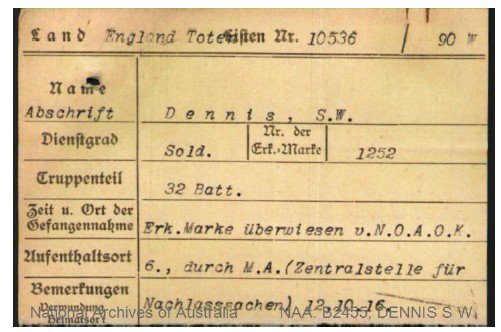
Sydney’s name appeared on a German death list dated 4 November 1916. His identity disc had been recovered by the Germans and passed through the German 6th Army authorities and the Central Office for Deceased Estates. It was received from Germany and forwarded to Sydney’s next of kin on 11 May 1917.
The recovery of the identity disc confirmed that German troops had found Sydney’s body, but it did not reveal where he had been buried. A German death voucher later provided the clearest official statement about his fate
“The Australian soldier Dennis, S. W. 1252, 32nd Battalion fell in the neighbourhood of Fromelles on 19/7/16.”
Source: Australian War Memorial, Australian Red Cross Wounded and Missing File, Sydney William Dennis, 1252, 32nd Battalion
Sydney’s youngest sister, Dorothy Brown, became one of the family’s principal contacts with the Australian military authorities. On 20 February 1920, she wrote from her home at 20 Guildersfield Road, Streatham, asking Base Records for Sydney’s service number and any information held by Graves Registration Headquarters which might help her locate his grave.
Base Records replied on 16 April 1920 that no burial particulars had been received. Sydney therefore continued to be recorded as having no known grave.
Dorothy also completed Sydney’s Roll of Honour Circular. She recorded that he had been killed by a shell while leading a bombing party during the attack and added a deeply personal tribute to her brother:
He was killed by shell while leading bombing party 19/7/16. May I just add his life was one of [the] straightest & best and he gave it willingly.
Sydney’s eldest sister, Ethel Beatrice Dennis, also corresponded with Australian authorities. Ethel had been born on 19 July 1879, meaning Sydney was killed on her thirty-seventh birthday. In a letter written many years later, she reflected: “Rather an incident, my brother was killed I believe on my birthday 19th July 1916.”
Source: National Archives of Australia, B2455, DENNIS Sydney William, letter from Ethel B. Dennis, 29 June 1941.
By 1941, Dorothy had died and Ethel described herself as the eldest surviving member of the family and Sydney’s next of kin. She confirmed that Sydney had no brothers and continued corresponding with Base Records about the pension which had originally been paid to their mother.
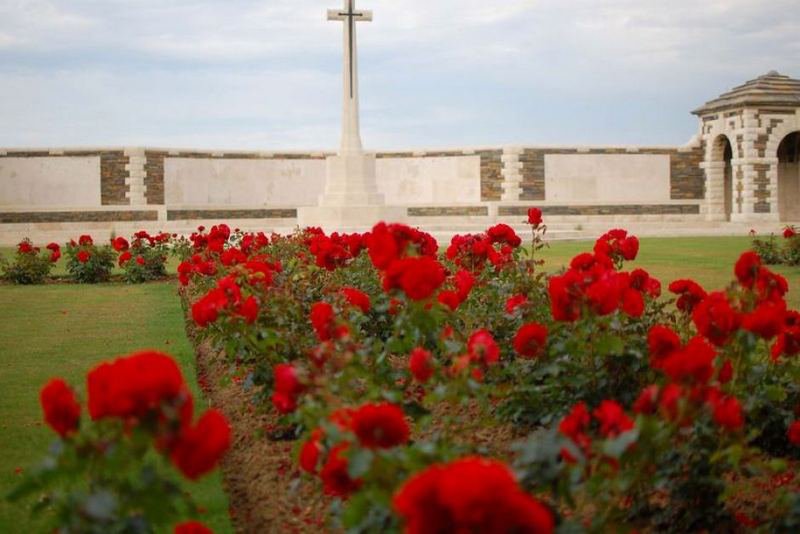
Sydney is commemorated on Panel 4 at VC Corner Australian Cemetery and Memorial, Fromelles. His name also appears on the Western Australian State War Memorial at Kings Park and on Panel 120 of the Roll of Honour at the Australian War Memorial in Canberra.
Searching for Sydney
The recovery of Sydney’s identity disc and his appearance on the German Death List indicate that his body was recovered behind the German lines. It is possible that he was among the Australian soldiers buried by German forces near Pheasant Wood, but no surviving record connects him conclusively with the mass graves.
Following the discovery of the graves at Pheasant Wood in 2008, the remains of 250 Australian and British soldiers were recovered. Historical and genealogical research has traced descendants of Sydney’s sisters for mitochondrial DNA testing. Finding a suitable Y chromosome DNA donor was more difficult because Sydney was the only son in his family, requiring researchers to trace male descendants through the wider Dennis and Dinnis family of Week St Mary.
Although Sydney was born in Balham Surrey, our search to identify him has taken us to Week St Mary in Cornwall. Both Sydney’s parents came from this Cornwall-Devon border area and this is where Sydney directed his letters home.
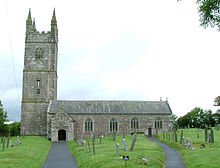
With six sisters it was never going to be difficult to find a donor on his mother’s side but finding a Y DNA donor was much more difficult. With no brothers, we needed to go back a further generation so we sent a letter to the local newspaper seeking help:
… trying to find a branch of the family tree with the male Y DNA that runs through the Dennis family. Week St Mary is a place where we have found one branch with several sons, who hopefully have sons down to the present day. I wonder if your readers can help?
Thomas George DINNIS married Ann Baker GUBBIN in 1886 and had six boys in Week St Mary - John, Arthur, Reginald, Walter, Cyril, Claude. We would very much like to make contacts with any descendants of these boys.
The Week St Mary editor of the local paper in fact did the heavy lifting. He was a keen genealogist and sent us many huge trees of the family where the name was sometimes spelt DINNIS and DENNIS. It was from the Dinnis Y line that he pointed us toward a potential donor who, it turned out, was most keen to help.
No identification has been made to date. We request family to contact the Fromelles Association if they no more.
DNA is still being sought for family connections to
| Soldier | Sydney William DENNIS 1886-1916 | |
| Parents | ||
| William DENNIS 1853-1903 | ||
| Elizabeth Broad JEWELL 1854-20 Dec 1916 | ||
| Siblings | ||
| Ethel Beatrice DENNIS 1879-1948 | ||
| Mabel Marian Jewell DENNIS born 1881 | ||
| Constance May DENNIS 1882-1953 | ||
| Adeline Bertha DENNIS 1885-1950 | ||
| Hilda Marie DENNIS born about 1889 | ||
| Dorothy Jewell DENNIS born about 1890 | ||
| Grandparents | ||
| Paternal | Thomas DENNIS 1829-1878 Elizabeth Ann “Betsy” TURNER 1829-1917 |
|
| Maternal | William JEWELL born about 1820 Elizabeth Bernez TREATHICK born about 1820 |
|
Links to Official Records
Seeking DNA Donors

Contacts
(Contact: carla@fromelles.info or geoffrey@fromelles.info).
(Contact: army.uwc@defence.gov.au or phone 1800 019 090).
Donations
If you are able, please contribute to the upkeep of this resource.
(Contact: bill@fromelles.info ).