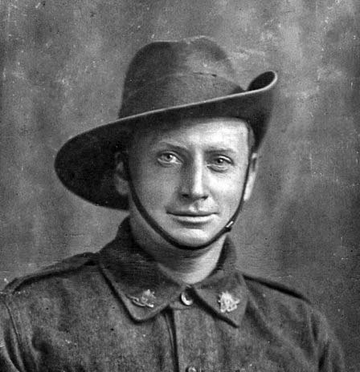
Robert Arthur DEWAR
Eyes blue, Hair dark, Complexion fair
Robert Arthur Dewar – “Never Forgotten” - a Life Cut Short at Fromelles
Early Life
Robert Arthur “Bob” Dewar was born on 9 January 1886 at Poplar, London, the eldest child of Robert Mitchell Dewar and Kate Elizabeth Hallett. He was baptised on 11 March 1886 at Cubitt Town St John, London.
Bob was the eldest of five brothers, the youngest two were twins:
- Robert Arthur (1886-1916), KIA Fromelles
- Lionel (James Masterton Lionel) (1888– 1982)
- Harold John (1890–1890)
- Maurice George (1892– ), engineer, Hunter Valley NSW
- Victor Alexander (1892–1958), served in the Merchant Navy
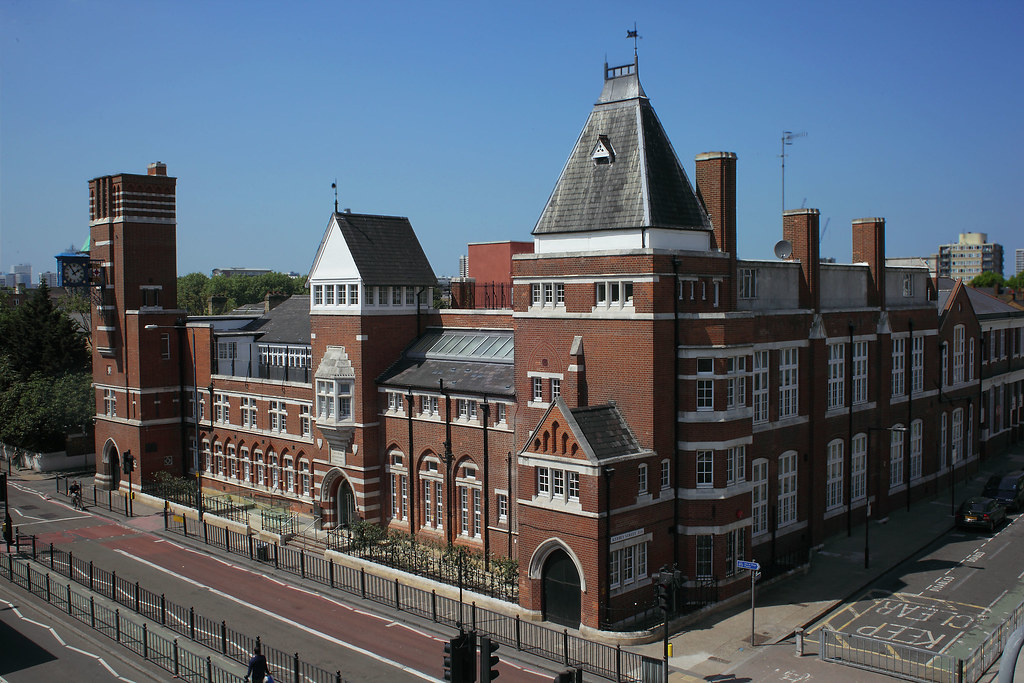
During Bob’s early childhood, the Dewar family lived at 106 East Ferry Road, Poplar and by 1901 they had moved to 50 Knox Road, West Ham, Essex. Census records list Bob as “son,” living with his parents and siblings. His father worked as the chief engineer on steam ships and was serving on the SS Volturno in 1913. Bob attended George Green’s School in London, where his enrolment is recorded in the London School Admissions and Discharges register.
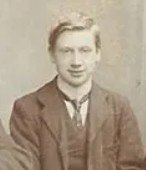
Bob emigrated to Australia, sailing on SS Cheniston, from London in November 1904 and settled in Sydney. He lived at Hillview Road, Kogarah, New South Wales and worked as a tram conductor.
Off to War
In August 1915, Bob left his position with the Sydney Tramways to enlist in the Australian Imperial Force, signing up on 12 August 1915. He named his mother as his next of kin. Bob was allocated to the 17th Battalion, 7th Reinforcement. After a short period of military training, his unit embarked from Sydney on 20 December 1915 aboard the HMAT Suevic, headed for the large training camps in Egypt. With the ‘doubling of the AIF’ as it expanded from two infantry divisions to five, major reorganisations were underway.
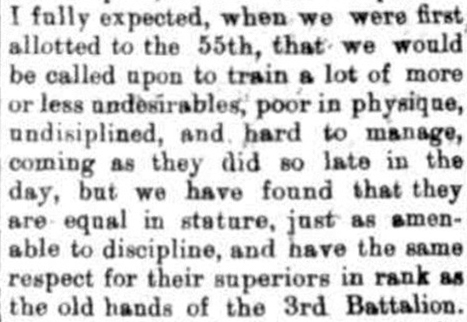
The 55th Battalion was raised in Egypt on 12 February 1916 as part of this expansion and Bob was transferred to the 55th on 16 February. Roughly half of its recruits were Gallipoli veterans from the 3rd Battalion and the other half were fresh reinforcements, predominantly from New South Wales. The new recruits seemed to fit in well with the veterans.
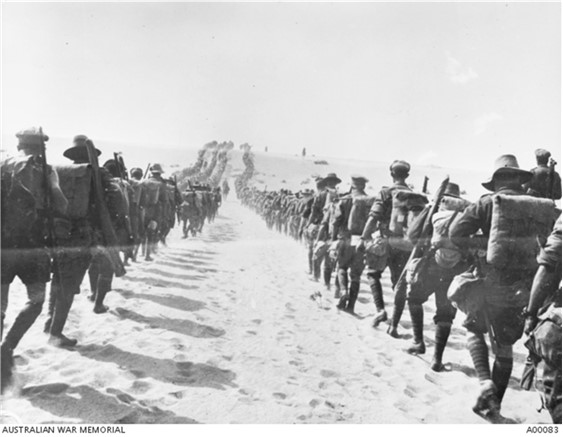
Training in Egypt’s desert heat was hard - trenching, marches, musketry and bayonet drills. After six weeks of training at the 40,000 man camp at Tel-el-Kebir, they had a three-day march in the to get to Ferry Post for further training and guarding of the Suez Canal from any potential threats posed by the Ottoman Army. As they marched out, they were reviewed by H.R.H. the Prince of Wales.
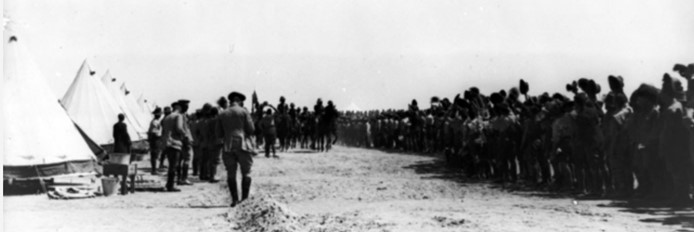
The trip was a significant challenge, however, marching over the soft sand in the 38°C heat with each man carrying their own possessions and 120 rounds of ammunition. When they got to Ferry Post they were rewarded with a swim in the Nile.
Life was not just training, however. In early June, a ‘Smoking Concert’ was “attended by a very vociferous, but well conducted crowd of men” and on 14 June there was a Divisional Sports Contest.
Source - Australian War Memorial 55th Battalion War Diary 23/72/4 June 1916 page 3
On 19 June they began their move to the Western Front, heading to Alexandria to board the HMT Caledonian. They sailed on 22 June and, after a short stop in Malta, arrived in Marseilles on the 29th and were immediately entrained for a three-day train ride to Thiennes in northern France, 30 km from Fleurbaix. Finally a chance to see what they were fighting for.
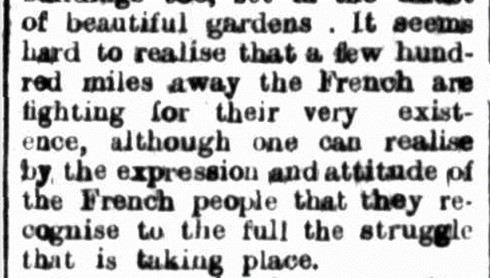
This area near Fleurbaix was known as the “Nursery Sector” – a supposedly relatively quiet area where inexperienced Allied troops could learn the harsh realities of Western Front trench warfare against the Germans. But the quiet times and the training period did not last long. Training continued, now with practicing for a gas attack added in. They then marched to Estaires on the 9th and were into the trenches for the first time on 11 July.
Battle of Fromelles
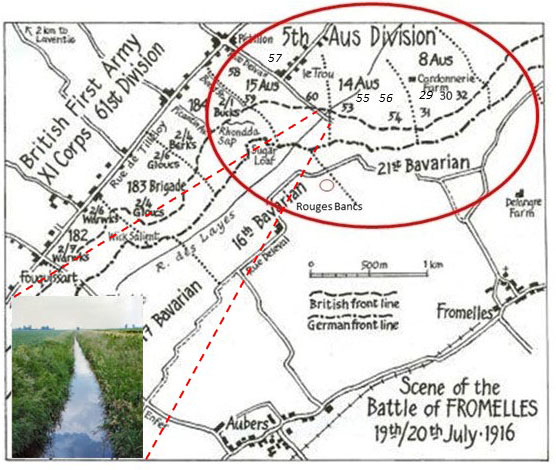
The main objective for the 14th Brigade was to take the trenches to the left of a heavily armed, elevated German defensive position, the ‘Sugar Loaf’, which dominated the front lines. If the Sugar Loaf could not be taken, the Australians would be subjected to murderous enfilade fire from the machine guns and counterattacks from that direction. As they advanced, they were to link up with the 31st and 60th Battalions. The 55th’s role was to provide support for the attacking 53rd and 54th Battalions by digging trenches and providing carrying parties for supplies and ammunition.
They would be called in as the ‘third battalion’ if needed for the fighting. On the 16th, the 55th were carrying supplies, readying the main attack the next day, but that was postponed due to the weather. Heavy bombardment was underway from both armies by 11.00 AM on the 19th and by 4.00 PM, all were in position for the battle. Zero Hour for advancing from their front-line trenches was to be 5.45 PM, but the Germans knew this attack was coming and were well-prepared. They opened a massive artillery bombardment on the Australians at 5.15 PM, causing chaos and many casualties.
C and D Companies’ carrying parties were in position 300 yards from the front line and A and B Companies were ready to move forward after the first waves of the 53rd and 54th had gone forward. The 53rd and 54th went on the offensive from 5.43 PM. They did not immediately charge the German lines, but went out into No-Man’s-Land and laid down, waiting for the British bombardment to lift. At 6.00 PM the German lines were rushed with the 55th’s C and D Company’s working parties following in support. There was heavy artillery, machine gun and rifle fire, but they were able to advance rapidly. At 7.24 PM the remainder of the 55th battalion moved to the front lines but were ordered to not leave their front line.
Not long after however, help was needed. At 8.55 PM, A Company was into the fighting to support the 53rd and B Company to support the 54th. They were able to move forward with few casualties. The 53rd and 54th were able to link up with the 31st and 32nd, occupying a line from Rouges Bancs to near Delangre Farm. By 10.00 PM all of the 55th were past the front line. As they advanced, they found that their right flank was not protected by the 15th Brigade, who had not been able to progress due to the devastating defences at the Sugar Loaf. The 55th tried to shore up their flank defences, but:
“The Huns knew the country and trenches so perfectly that they succeeded time and again in bombing us back.”
A bayonet charge was made by about 50 men and they were able to advance about 60 yards. By 1.00 AM things had quietened down, but only for a short time. About 3.00 AM some ‘foolish orders’ were circulated that they were being bombed by their own side and were supposed to retreat. These were believed to be incorrect and they fought on.
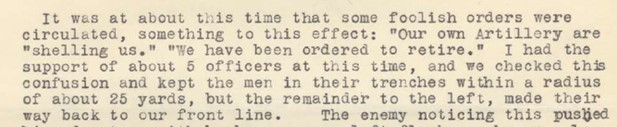
At 4.15 AM about 50 men of the 55th were ordered back to their own front line to defend against a rearguard action as the Germans were coming in from the exposed right flank:
“It was due to the very fine actions of these men that the garrison was able to get across No Man’s Land with comparatively few casualties.”
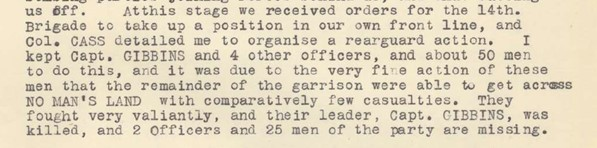
By 9.30 AM the Brigade had ‘retired with very heavy loss’.
Source - AWM4 23/14/4 14th Brigade July 1916 page 7
The artillery finally ceased at noon. The Commanding Officer of the 55th, Lieutenant Colonel David McFie McConaghy spoke proudly of his men:
“The losses were heavy, but the battalion, four-fifths or more of whom were strangers to battle, acquitted themselves honorably in its first engagement, and returned with 40 German prisoners.”
For a battalion that was to be in reserve as the ‘third battalion’, the initial count at roll call was 42 killed or died of wounds, 154 wounded and 143 missing. Ultimately the impact was that 78 soldiers were killed or died from wounds. Bob was among the missing.
After the Battle
With so many soldiers having been killed, wounded or taken prisoner during the battle, there was much confusion and great difficulty in working out what had happened to each man. Major efforts were undertaken to find the missing soldiers, but often weeks and months passed with no answers, only uncertainty. Bob’s records show him as missing, then as prisoner of war, and then corrected to missing. Witnesses statements taken by the Red Cross after the battle gave potentially conflicting accounts of Bob’s last moments, not surprising given the chaos of the battle. Private Amos John Ryder (3289) said Bob was hit during the early stages of the battle :
Dewar was knocked about a lot by the bursting of a shell when we were attacking at Fromelles stunt.
Lance-Corporal John Charters (3264) stated he had seen Bob left for dead in No Man’s land -
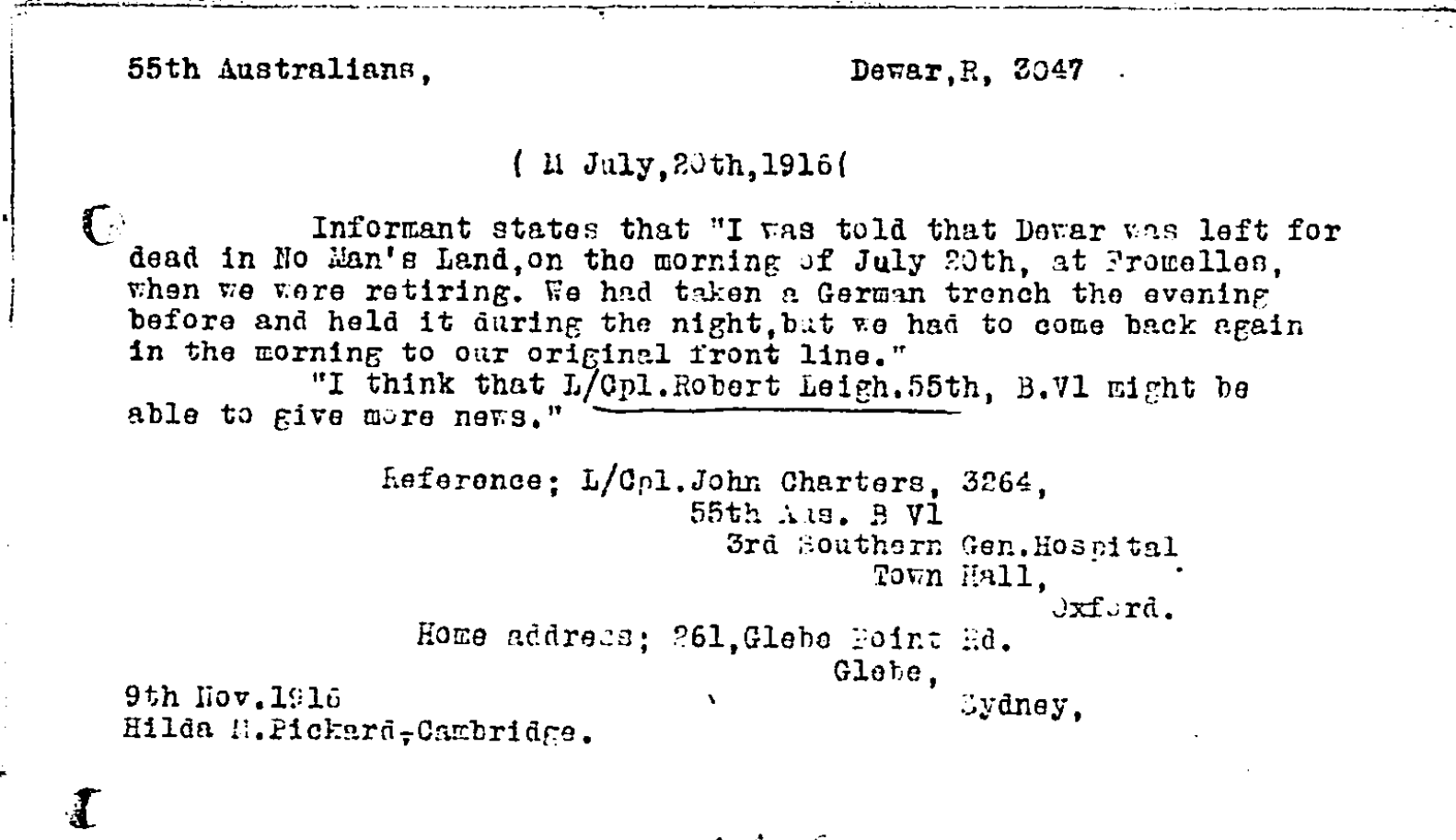
However, he had not actually seen Bob. John Charters made it into the advanced areas of the attack, before they were forced to retire. It is possible that Bob had been up in this area too. Another mate, Lance-Corporal Robert Leigh (741) loyally wrote – “I promise you I will do all in my power to find out what did become of him.”
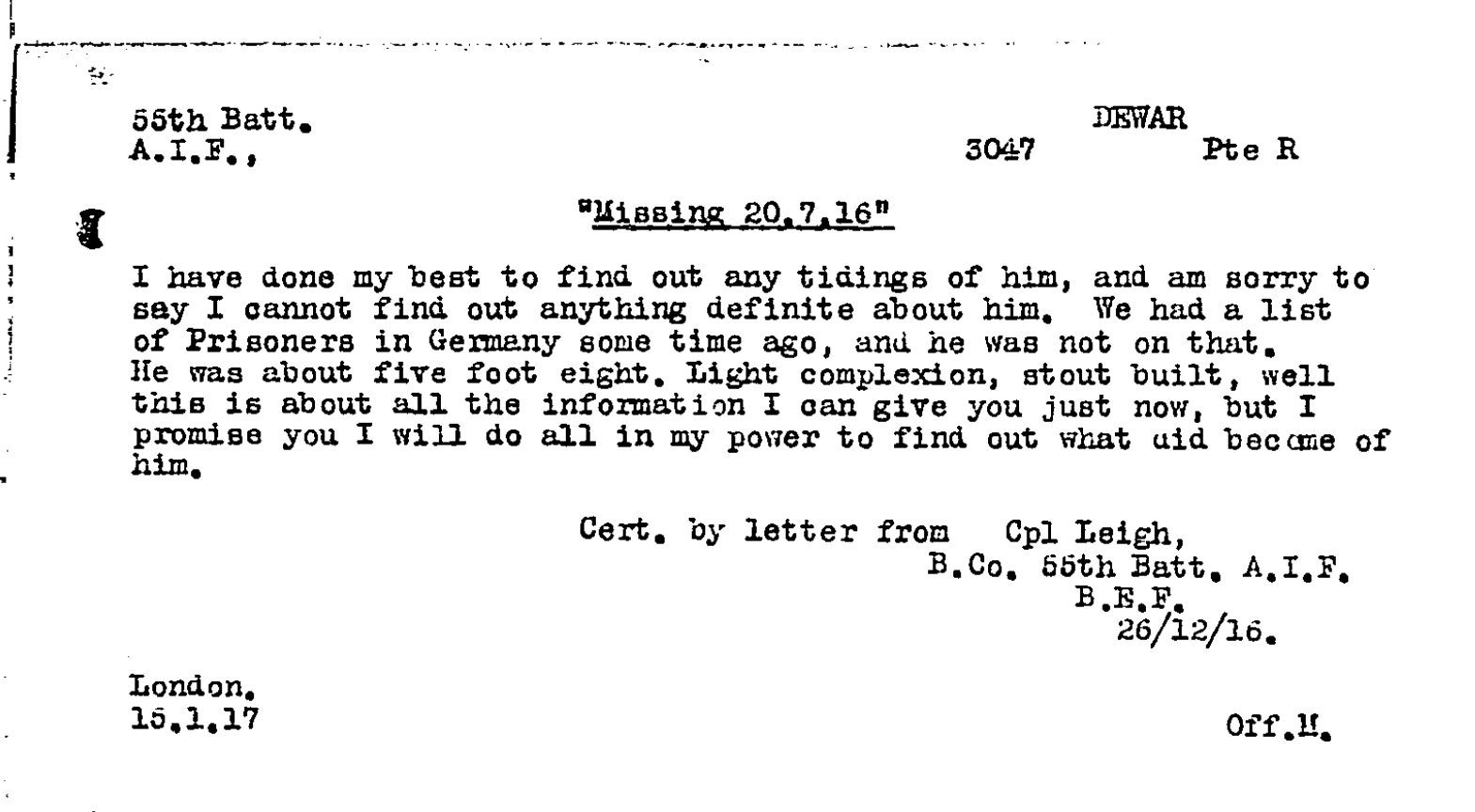
The truth pf Bob’s fate emerged slowly. Unbeknown by his friends at the time, the Germans recorded that Bob had “fallen in the vicinity of Fromelles” on 2 August and this information and his identity disc was sent to London in October 1916.
He had been killed while he was in the advanced area of the attack.
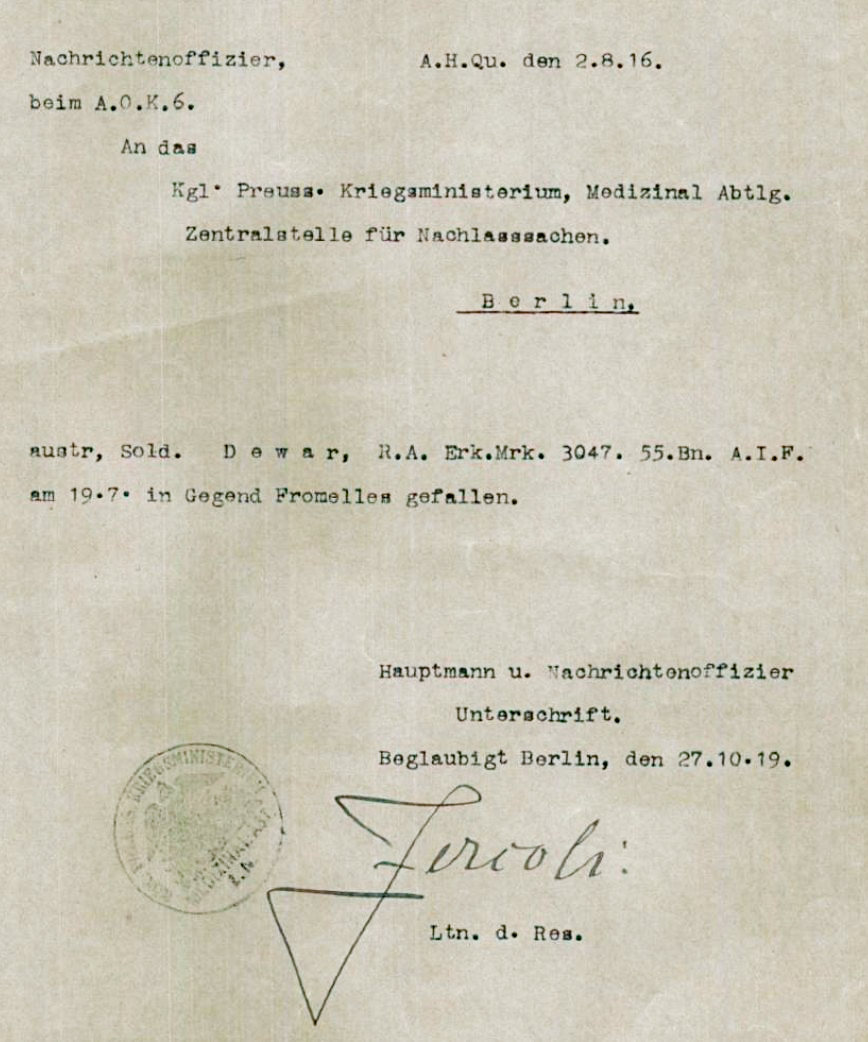
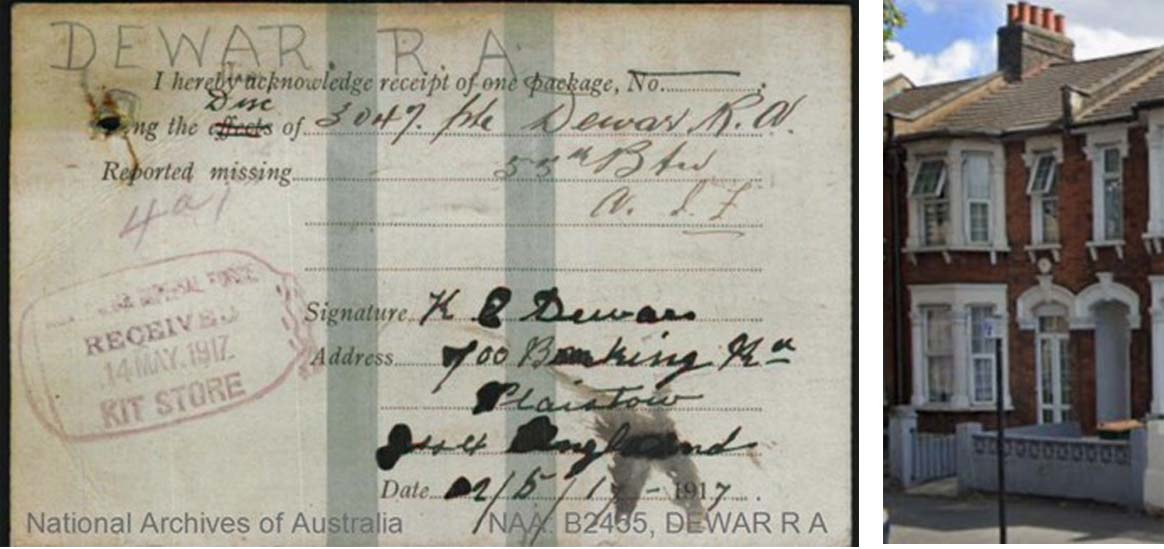
His identity disc was sent to his mother, who signed for the package. The only closure she would ever have for the loss of her son as there were no reccords of his burial.
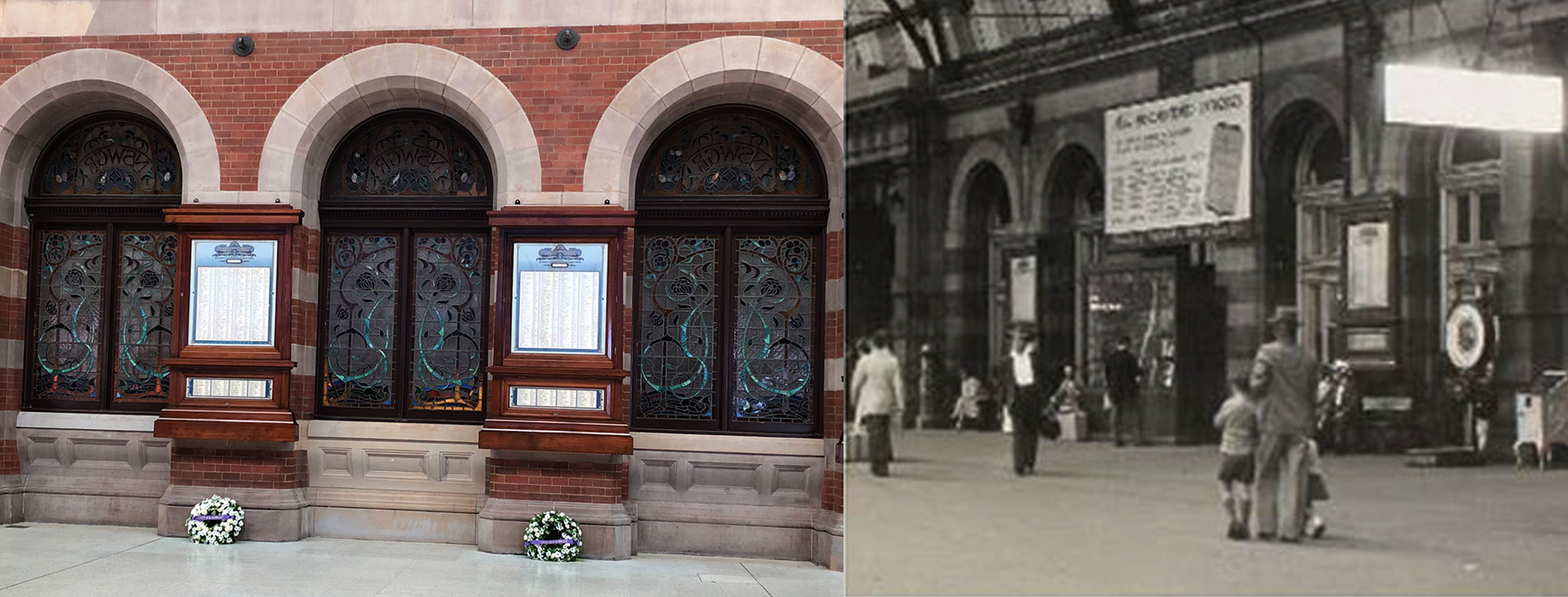
Bob has been commemorated at the VC Corner Australian Cemetery Memorial at Fromelles, on the Australian War Memorial Roll of Honour in Canberra and the Haymarket NSW Government Railway and Tramway Honour Board.
Bob is Finally Found! – DNA Research
In 2009, archaeologists excavated a mass grave at Pheasant Wood, not far from the advanced lines that the Austrailans had gotten to, and found the remains of 250 soldiers the Germans had collected and buried after the battle.The Unrecovered War Casualties Army department organsied DNA testing of these soldiers and found thousands of potential relatives to donate DNA, seeking ID matches. In 2010, 96 of the soldiers were successfully identfied, including Bob. This effort has continued with Fromelles Association of Australia efforts and Army support and to date (2026), DNA donations from family members have allowed a total of 181 of the 250 soldiers in this grave to be identified.
Seventeen of the 46 unidentified soldiers from the 55th have been found to have been in the grave.
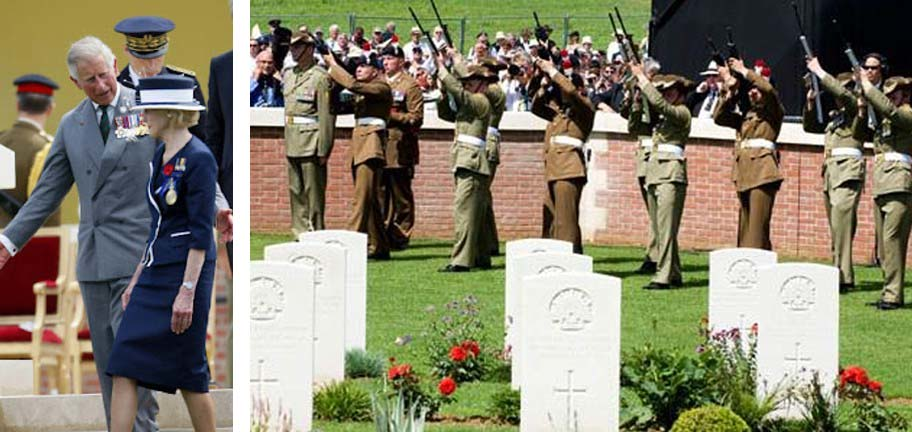
The 2010 dedication cermony for the Pheasant Wood Cemetery for the 250 soldiers was attended by Prince Charles and Quentin Bryce. Annual ceremonies continue to be held, with strong support from the French community.
Bob’s headstone bears the inscription chosen by his family:
“Never forgotten in God’s keeping forever”.
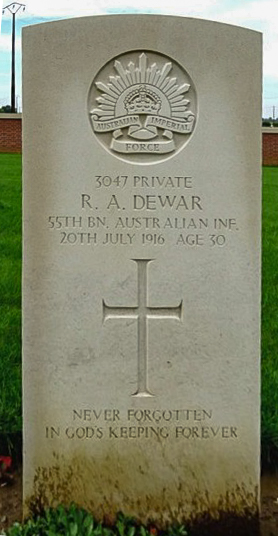
Today, Bob is remembered not only as one of the many lost at Fromelles, but as a young man from London’s East End who built a new life in Sydney, worked on the tramways, and gave his life in the service of his adopted country.
His recovery and identification nearly a century after the battle ensured he was no longer “missing,” but finally laid to rest with his name and story restored.
Links to Official Records
The Fromelles Association would love to hear from you

Contacts
(Contact: carla@fromelles.info or geoffrey@fromelles.info).
(Contact: army.uwc@defence.gov.au or phone 1800 019 090).
Donations
If you are able, please contribute to the upkeep of this resource.
(Contact: bill@fromelles.info ).