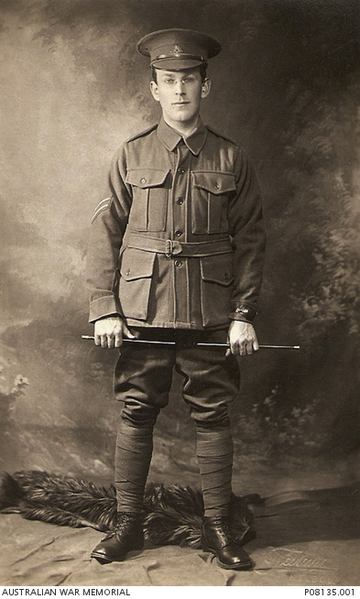
Shrewsbury Frederick KINGSFORD
Eyes blue, Hair brown, Complexion sallow
Shrewsbury Frederick “Fred” Kingsford – A New Zealander at Fromelles
Can you help find Fred?
Fred’s body was never found after the Battle of Fromelles, and there are no records of his burial.
A mass grave was found in 2008 at Fromelles, a grave the Germans dug for 250 Australian soldiers they recovered after the battle. As of 2024, 180 of these soldiers have been able to be identified via DNA testing.
Fred may be among these remaining unidentified men. There is still a chance to identify him — but we need help. We welcome all branches of his family to come forward to donate DNA to help with his identification, especially those with roots in Christchurch, NZ
See the DNA box at the end of the story for what we do know about his family.
If you know anything of contacts for Fred (Shrewsbury Frederick), please contact the Fromelles Association.
Please contact the Fromelles Association of Australia to find out more.
Early Life
Fred was born in 1891 at Christchurch, New Zealand, the third of five children of Shrewsbury Frederick (Fred) Kingsford (born Buckland, Kent, 1861) and Mary Ann Williams (born Christchurch, 1863). Fred senior had emigrated from England in the early 1880s and worked variously in Christchurch and Victoria, while his mother came from a long-established Canterbury family. Fred grew up in the Riccarton–Christchurch area with his brothers and sisters:
- Albert (1883–1923)
- Sydney James (1889–1967)
- Fred Shrewsbury
- Mary Rosaline (1893–1970)
- Hypatia Phyllis (1900–2000)
The Kingsford family lived at Durham Street, Christchurch, and Shrewsbury attended local schools in the district. His parents’ marriage later ended, with divorce proceedings finalised in 1912. Fred remained close to his father, who continued to be listed as his next of kin throughout the war. After completing his schooling, Fred worked as a clerk, a profession that later took him to Australia, where he lived in Melbourne and worked first with the State Savings Bank, and later in the office of J. P. Jones, M.L.C., at the Victorian State Parliament.
By mid-1915 he was living in Middle Park, Melbourne, and working as a young clerk when he made the decision to enlist. Friends and colleagues described him as modest, reliable and well-spoken, very much the sort of young man the city’s public offices valued.
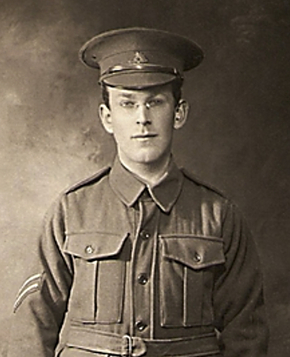
Off to War
On 17 July 1915, at the age of twenty-three, he enlisted in the AIF at Melbourne and was posted to the 7th Reinforcements of the 23rd Battalion. He sailed with this group on 26 November 1915, embarking from Melbourne aboard HMAT A73 Commonwealth. His service record notes him as single, with his father in Christchurch listed as his next of kin. Fred arrived in Egypt during the reorganisation of the AIF following the Gallipoli campaign. Like many reinforcements from late 1915, he was soon transferred due to the expansion and redistribution of battalions.
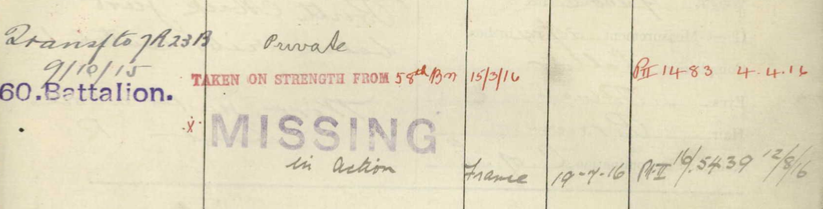
On 23 February 1916, he was taken on strength of the 58th Battalion, formed largely from Gallipoli veterans of the 6th Brigade and reinforcements such as himself. A second transfer followed on 15 March 1916, when he moved to the newly raised 60th Battalion, part of the 15th Brigade of the 5th Australian Division. The battalion trained at Tel el Kebir, continued their preparations at Ferry Post and along the Suez Canal, then marched to the staging camps near Alexandria in June.
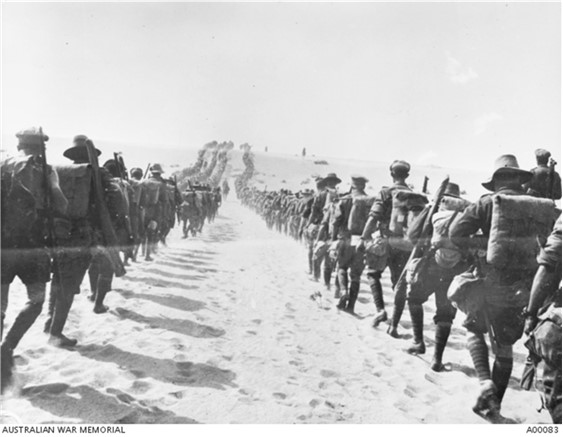
On 18 June 1916, the 60th Battalion sailed for France, disembarking at Marseilles on 29 June. The men travelled north by train through the French countryside and entered the nursery sector near Fleurbaix in early July. It was here, less than three weeks later, that Fred faced his first major action of the war, the Battle of Fromelles.
The Battle of Fromelles
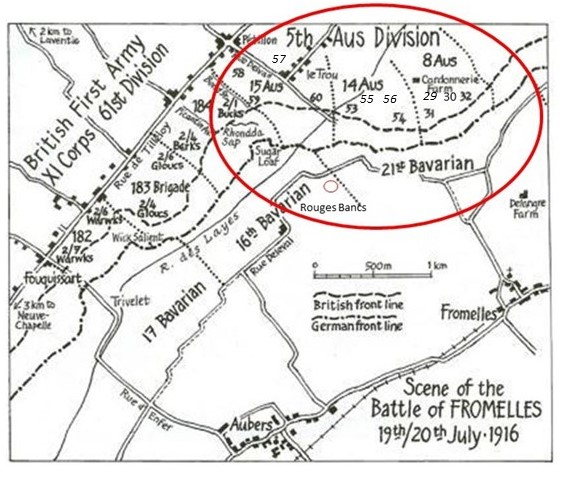
The 60th Battalion, part of 15th Brigade commanded by Harold 'Pompey' Elliott, had only recently arrived in France after being formed in Egypt from Gallipoli veterans and new Victorian recruits. Fred had joined the battalion four months earlier and was experiencing the Western Front for the first time. On 19 July 1916, the 60th took part in its first major action, the disastrous attack at Fromelles. The battalion held the centre of the brigade’s frontage opposite the Sugar Loaf salient, one of the strongest German defensive positions. The ground ahead was flat and open, offering no cover.
At 6.45 p.m., the battalion went over the top in four waves of roughly 220 men each. Fred was among the men ordered forward into the field of fire that swept the front as soon as the first wave climbed the parapet. Almost immediately, the men were met by devastating machine-gun and artillery fire. The first waves were struck down before reaching the German wire; only a handful of men from the later waves advanced more than a hundred yards.
William Holtham, a machine-gunner with the battalion, later wrote:
“Not a man flinched, not a single chap hung back when his turn came. They were just up and over.”
By 7.15 p.m., the attack had collapsed. The ground between the trenches was littered with the dead and wounded. Many men lay in No-Man’s-Land through the night. Fred was one of those who did not return — last seen going forward with his company in the opening waves. No eyewitness account describing his fate survived. By dawn, stretcher-bearers attempted rescues under sniper fire, but few of the missing could be recovered. When roll call was taken on 20 July, the scale of the disaster became clear:
“Of the 60th Battalion, which had gone into the fight with 887 men, only one officer and 106 answered the call.”
Fred was listed as missing and later declared killed in action. Like hundreds of his comrades in the battalion, he vanished in the killing ground before the Sugar Loaf. His body was never recovered.
After the Battle
Fred disappeared in the chaos of the 60th Battalion’s assault on the evening of 19 July 1916. Like so many of Elliott’s men, he never returned to the Australian lines, and no burial was ever recorded. His name first appeared among the missing in Australian casualty lists published in mid-September 1916, including in New Zealand newspapers, prompting a wave of confusion and worry at home. His father, Fred Snr wrote repeatedly to Base Records in Melbourne and later directly to the New Zealand Minister of Defence, desperate for clarity and struggling to understand why he had no official notification. His letters reveal both grief and bewilderment:
“We have never heard even the name of the place nor have we ever received his pay book… I would esteem it a favour if you could let me know in what action & where he died. Posted missing July 19 1916.”
Although the battalion had reported him missing almost immediately, no eyewitness statements were ever found. With no Australians reaching the German trenches and few surviving the approach over open ground, the fate of many of the 60th Battalion’s missing remained unrecorded. Fred’s employer, J. P. Jones M.L.C., Member of the Victorian Parliament, also wrote to Base Records seeking information:
“He was a clerk in my office and I see he is reported ‘Missing’… I would be glad if you would let me know.”
By 1917, with no updates forthcoming, the family appealed again:
“As 12 months has now elapsed… he wishes some definite reply, as many things have to be attended to…”
In July 1918 the official position finally hardened: a Court of Inquiry had ruled him killed in action as of the night of the Fromelles attack
“No information other than that he was killed in action in France on 19/7/16… Proceedings of the Court have not yet reached here.”
Source NAA: B2455, KINGSFORD SHREWSBURY FREDERICK – Base Records reply, 25/7/1918
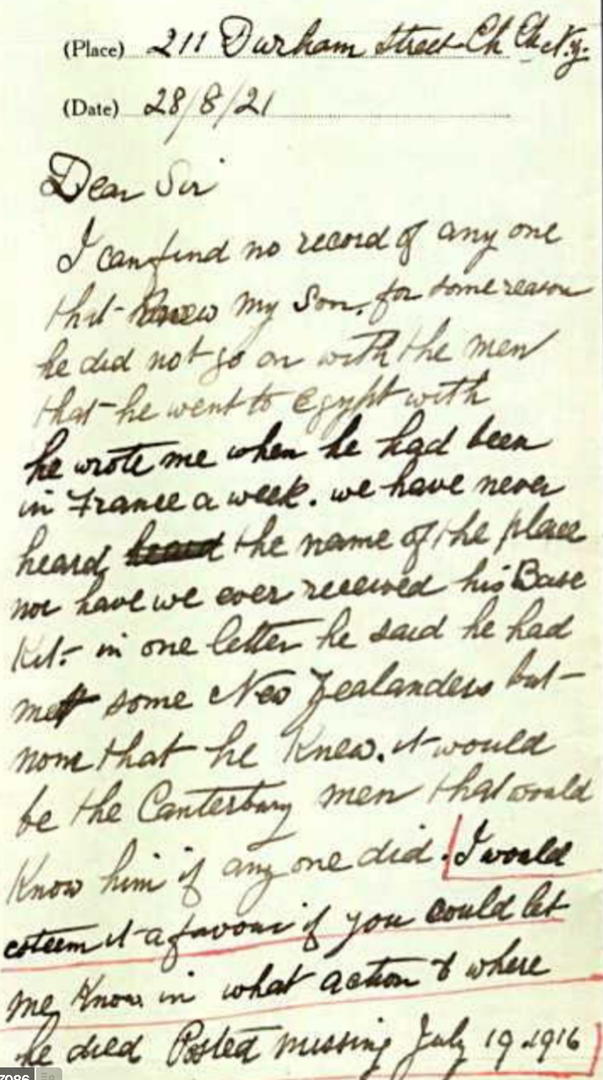
Referring to the fact that he was transferred from the 23rd Battalion to 58th Battalion and finally to the 60th, Fred Snr wrote:
“…for some reason he did not go on with the men that he went to Egypt with. He wrote me he had been in France a week… We have never heard the name of the place.”
Another New Zealand correspondent, Mrs J. H. Osborne, also wrote on behalf of a concerned relative in Melbourne, a sign of how widely his loss reverberated:
“Having a brother in Melbourne who has not written to any of his family for 3 or 4 years, we were anxious to know who the aforesaid Private had left as his next-of-kin.”
Despite every inquiry, no trace was ever found. The battlefield where the 60th Battalion advanced was swept by machine-gun fire from the Sugar Loaf; even locating the dead after the armistice proved almost impossible. Fred has no known grave, and like the vast majority of the 60th Battalion’s missing, he is commemorated at VC Corner Cemetery, where 410 Australians lie unnamed.
Finding Fred
Fred’s remains have not been recovered, and he has no known grave. It is possible he was among those buried by the Germans in the mass grave at Pheasant Wood, discovered in 2008. As of 2025, over 180 soldiers from that grave have been identified using DNA from living relatives. Fred may still be among the unidentified, but to confirm this, we need DNA donors from his extended family — especially from the Kingsford and Williams lines.
If you are related or know someone who might be connected to his family — particularly those with roots in Christchurch or wider Canterbury, New Zealand, please contact the Fromelles Association
DNA samples are being sought for family connections to
| Soldier | Shrewsbury Frederick Kingsford (1891–1916) |
| Parents | Shrewsbury Frederick Kingsford (1861–1925) & Mary Ann Williams (1863–1925) |
| Siblings | Albert Kingsford (1883–1923) | |||
| Sydney James Kingsford (1889–1967) | ||||
| Mary Rosaline Kingsford (1893–1970) | ||||
| Hypatia Phyllis Kingsford (1900–2000) |
| Grandparents | |||
| Paternal | Shrewsbury Frederick Kingsford (1837–1902) & Laura Jane Munro (1836–1912) | ||
| Maternal | John Trevithick Williams (1839–1901) & Susan (Trevithick) Hensley (1840–1919) |
Links to Official Records
Seeking DNA Donors

Contacts
(Contact: carla@fromelles.info or geoffrey@fromelles.info).
(Contact: army.uwc@defence.gov.au or phone 1800 019 090).
Donations
If you are able, please contribute to the upkeep of this resource.
(Contact: bill@fromelles.info ).