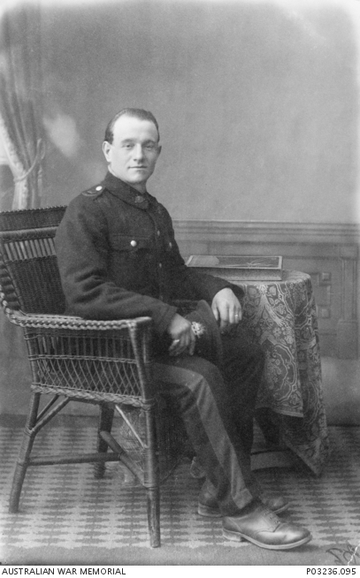
Herbert Sampson THARME
Eyes grey, Hair brown, Complexion fair
Herbert Sampson Tharme – “I Shall Live in Hopes of Again Arriving in Dear Old Sydney”
Early Life
Herbert Sampson Tharme, known as Sam, was born on 29 April 1886 at Wolverhampton, Staffordshire, England, the son of Sampson Wanmore Tharme and Ann Evans. He was baptised on 3 October 1886 in Staffordshire. Sam came from a Midlands family deeply connected to horses, transport and livestock. His paternal grandfather, Sampson Tharme (1823–1872) of Stone, Staffordshire, was a horse dealer. His father later worked as a hackney carriage proprietor, managing horse-drawn vehicles for hire. Horses were not just an occupation, they were the family trade.
The wider Tharme family also had a long history as innkeepers in Staffordshire, while the Australian branch became proprietors of Melbourne's Mitre Tavern in Bank Place, one of the city's oldest hotels. Established when much of Melbourne still consisted of tents along the Yarra River, the tavern catered for ship captains, newly arrived passengers and the growing settlement.
Children of Sampson Wanmore Tharme and Ann Evans of Wolverhampton:
- Annie May Tharme (1889–1893)
- Archer Raymond Tharme (1890–1890)
- Herbert Sampson Tharme (1886–1948)
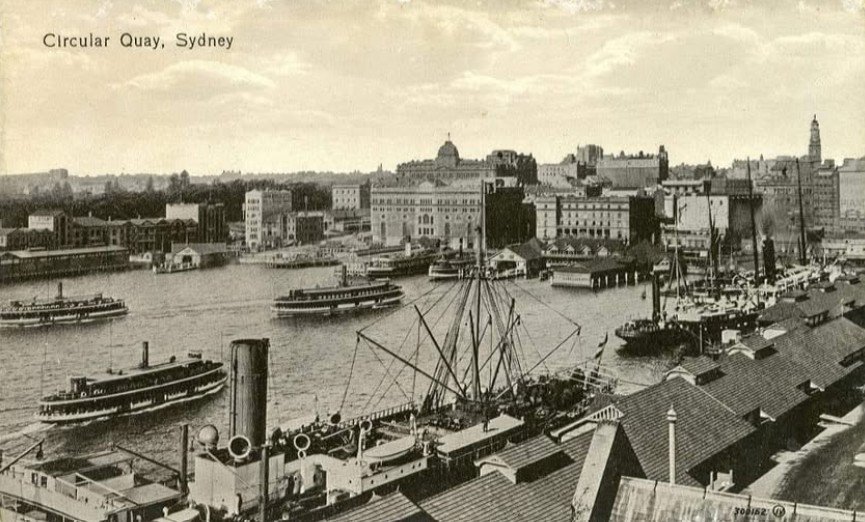
Both of Sam's siblings died in childhood, leaving him the only surviving child. The loss of two young children would have shaped the household in which he grew up. He appears in the 1891 England Census at Wolverhampton aged five. By 1901, aged fifteen, he was living at Walsall, Staffordshire, recorded as a boarder, suggesting he had already begun making his own way in the world as a young working man. Around 1911, Sam emigrated to Australia. Like many young Englishmen of the period, he sought opportunity abroad. He settled in Sydney's inner west and found employment with the Sydney tramways, working from the Rozelle Tramway Depot.
The depot became one of the largest contributors of public service employees to the Australian Imperial Force. By 1915, Sam was living at "Kia Ora", 300 Norton Street, Leichhardt, New South Wales. Although his occupation was later recorded as horseman, his employment at Rozelle placed him firmly within the tramway workforce that would answer the call to serve. On 21 September 1915, his name appeared in the press among the growing list of Rozelle tramway employees who had enlisted:`"Probably no single section of the public service, either in the railways, tramways, or other branches, has contributed a larger proportion of the staff to the ranks of the recruits than the Rozelle Tramway Depot.
Source: ROZELLE TRAMWAYMEN'S EXAMPLE. (21 September 1915). The Daily Telegraph (Sydney, NSW : 1883–1930), p. 8. Retrieved 23 February 2026, from http://nla.gov.au/nla.news-article239111984
From Staffordshire horse yards to Sydney's tramways, Sam had already crossed half the world before the war began. In August 1915, he would take another step, from tramwayman to soldier.
Off to War
On 12 August 1915, Sam enlisted in the Australian Imperial Force in Sydney. He was 28 years and eight months old, single, and employed as a horseman. He nominated his father, Sampson Tharme of Worcester, England, as his next of kin. Sam was allotted to the 17th Battalion, 7th Reinforcement. On 20 December 1915, he embarked from Sydney aboard HMAT Suevic. After futher training, Sam was transferred to the newly formed 55th Battalion in early 1916. The 55th had been created in Egypt following the evacuation from Gallipoli as part of the expansion of the AIF, drawing together experienced men and reinforcements into the 14th Brigade of the 5th Division.
In June 1916, the 55th Battalion moved to France and took up positions in the Fleurbaix sector on the Western Front. What had been described as a “quiet” front would soon become the scene of one of the most costly actions in Australian military history. Within seven months of leaving Sydney, Sam was in the trenches in northern France.
The Battle of Fromelles
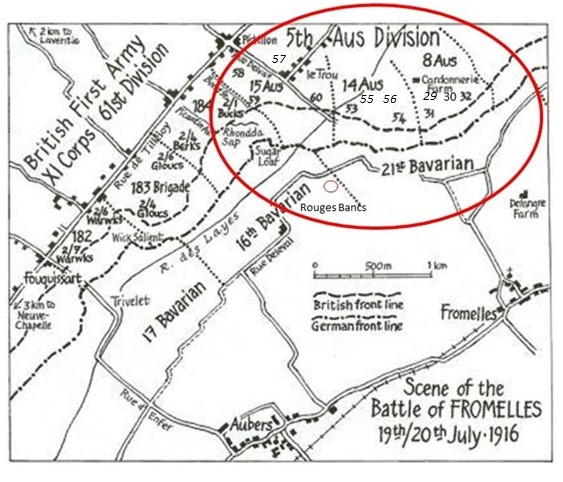
The 55th Battalion, part of the 14th Brigade, was in billets at Bac St. Maur in the days leading up to the assault. On 19 July 1916, they were assigned primarily to support and reinforcement roles during the brigade’s attack on the German lines near Fromelles. At 6:00 pm, working parties moved forward to the old 300-yard line and supply points such as Lays Dump and Ruby Dump. At 7:24 pm, orders were received to move two companies and Battalion Headquarters quietly into the front line. At 8:55 pm, further instructions directed that one company support the 53rd Battalion and another the 54th, both of which had already suffered heavily.
Lieutenant Colonel David McFie McConaghy later recorded:
“B Company got across without a casualty, whilst the casualties in A Company were very slight... They were able to render support where it was most needed, and their work through trying circumstances was of very high order.”
By 9:30 pm, the supporting companies were engaged. Mixed groups of men from several battalions held isolated stretches of trench under intense bombing and machine-gun fire. Communication with Brigade broke down as telephone lines were cut and runners were killed.
McConaghy described the confusion:
"About this time some foolish orders were circulated, something to this effect:
Our own Artillery are shelling us. We have been ordered to retire."
Private Bert Bishop later recalled the conditions as ammunition was carried forward:
“I was pushed forward. I stepped over dead bodies, I stepped over live and smashed bodies, I stepped over pieces of what had been bodies. Wounded were crying out in agony… No-man’s land was littered with dead and wounded.”
Sam later gave his own account of the battle after repatriation. In his official statement he recorded:
“My Battalion took part in the assault on the enemy positions near Fleurbaix on the evening of July 19th (1916). We reached the enemy second line, after suffering casualties on the way across. During the night we dug in and consolidated our position in that line. In the morning we found that the enemy had in some way managed to regain possession of his first line. I was captured, with others at about 10.30 a.m. on the morning of the 20th. I had been slightly wounded in the left hand.”
By morning on 20 July, the position was collapsing under sustained German counter-attacks. The remnants of the battalion withdrew where they could. McConaghy later wrote:
“The remainder of the garrison that got back across No Man’s Land with comparatively few casualties. They had fought very valiantly…”
For Sam, there was no withdrawal. Wounded and surrounded in the recaptured trench system, he was taken prisoner at approximately 10:30 a.m. on 20 July 1916. The Battle of Fromelles was over for him, but his war was far from finished.
Prisoner of War
Captured during the German counter-attack on the morning of 20 July 1916, Sam entered more than two years of German captivity. After being taken from the battlefield near Fleurbaix, he passed through Lille, later writing about what he had endured:
“I had my share of the Black Hole of Lille.”
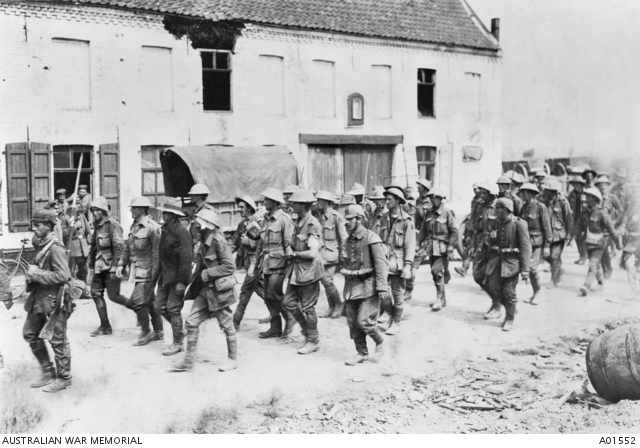
He was then interned in Germany, initially at Dülmen, and later at Schneidemühl (Camp No. 1). During his captivity he was sent “on kommando” , detached from the main camp for labour. He later recorded that he worked at a sugar factory and was also engaged in timber felling, in addition to periods of agricultural labour.
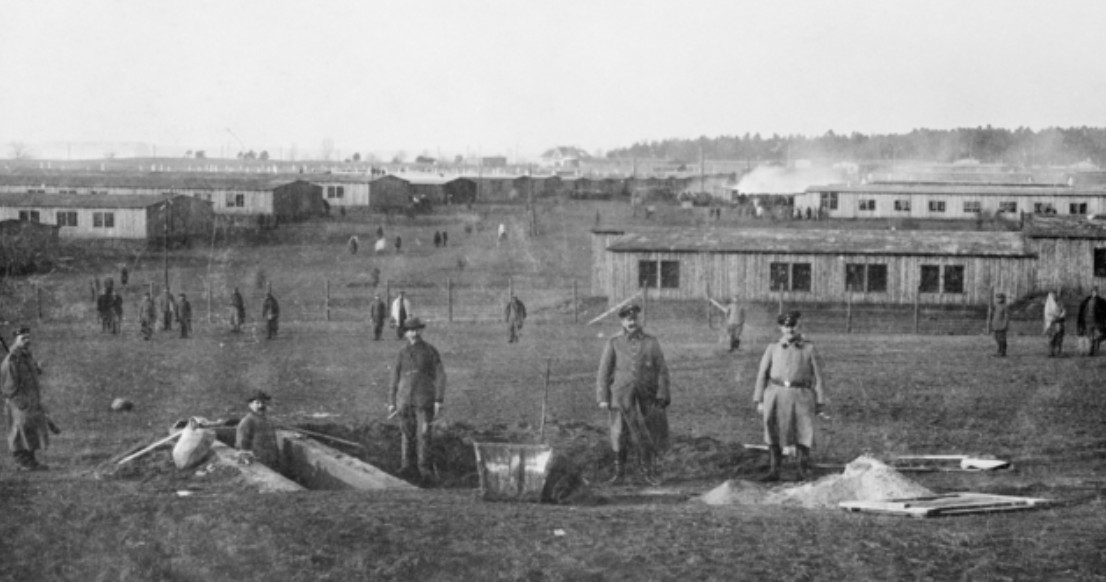
On 1 April 1918, fellow prisoner 6049 Private Peter Lorenzen wrote home from Schneidemühl "Pte S. Tharme has written this short note in my stead. We are both employed on the same farm."
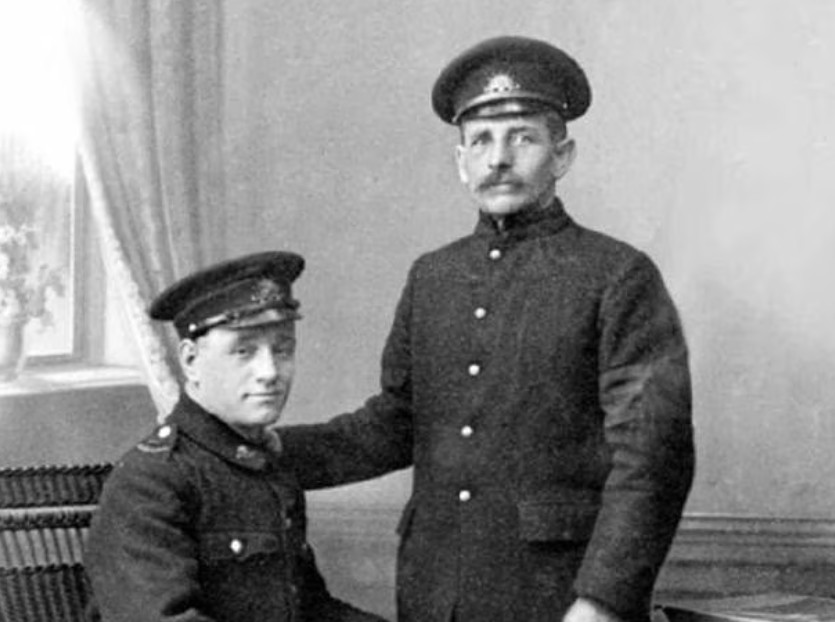
The two men were photographed together in captivity, one of more than 400 portraits sent by Australian prisoners to Miss M. E. Chomley of the Australian-British Red Cross Society in London.
Peter’s story appered in the Courier Mail:
On April 1 1918, Pte Lorenzen wrote home from POW Camp Schneidemuhl, Germany praising the Red Cross for its help.
"The food parcels we are receiving at present are absolutely A1," he said.
"At present I am suffering from a poisoned finger sustained whilst at work. Pte S. Tharme has written this short note in my stead. We are both employed on the same farm."
Pte Lorenzen was repatriated to England on December 1, 1918 and arrived back in Australia on June 2, 1919.
His friend (Sam) Herbert Sampson Tharme from Leichhardt NSW was captured at Fleurbaix, France in July 1916 and held as a POW until he was repatriated to London in December 1918.
In all, 3,850 Australians were captured on the Western Front between 1916 and 1918.
A total of 395 Australians died in captivity in the First World War.
When the first Australian prisoners of war were taken by the Germans in July 1916, a separate department of the Australian Red Cross Society (ARCS) was formed to take care of them. The ACRS despatched 395,695 food parcels and 36,339 clothing parcels.
Camp discipline could be severe. Sam recorded that he was punished for what German authorities termed “foul crank” (false sick report):
“When I was given seven days ‘strong arrest’ at Schneidemuhl for ‘Foul crank,’ an Imperial Sergeant Major known as ‘Spiky’ Stugess of the Coldstream, managed to get me another three days added. This additional three days I had to do on water alone, no bread.”
Despite hardship, he kept contact with home when permitted. In December 1916, a letter from “Sam Tharme, a Rozelle tramway soldier,” was published in Sydney appealing for parcels:
“Since July 1 with three other Rozelle boys, I have been interned here in Germany as a prisoner of war. I am as well as can be expected. I had a nasty wound in the hand, but am pleased to say it is well again now… On behalf of the four boys here, I want you to knock round Rozelle, and see if you can send us weekly parcels… Believe me, I shall live in hopes of personally thanking you when I again arrive in dear old Sydney.” — Sam.
In November 1918, as the war ended, Sam left Germany via Danzig. He sailed on the S.S. Russe and arrived in Britain in early December 1918 after more then two years in captivilty.
After the War
Less than a year later, on 4 September 1919, he married Jessie Frances Breeze (1894–1974) at the Parish Church of Sutton Veney, Wiltshire. At the time of his marriage, his occupation was recorded as Soldier A.I.F. His father was listed as Sampson Tharme, Hackney Carriage Proprietor, and Jessie’s father as Francis William Breeze, Cattle Dealer, another family connected to livestock and rural trade. Sam eventually returned to Australia on 10 December 1920 and his beloved Sydney, resuming civilian life after five years shaped by war and imprisonment. He finally got to see his beloved Sydney again. He lived in New South Wales in the decades that followed.
Sam died on 29 April 1948 at Cremorne, New South Wales, aged 62.
A plaque commemorates him in the New South Wales Garden of Remembrance.
Family Recollections
More than a century after the Battle of Fromelles, Sam's story resurfaced in an extraordinary way.
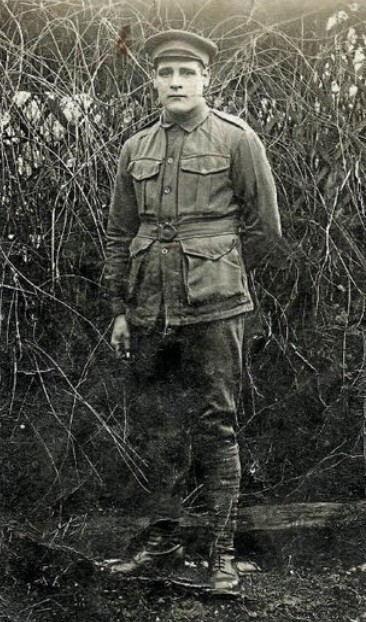
In 2020, Marg O'Leary, Soldier Stories Team Leader for the Fromelles Association of Australia, was preparing a story about 4921 Henry Westerway of the 55th Battalion, who had also been captured at Fromelles on 20 July 1916. While searching the Australian War Memorial collection for photographs to accompany Henry's story, she was astonished to discover a prisoner-of-war portrait of 3188 Private Herbert Sampson Tharme.
The name immediately caught her attention. Sampson Tharme was a traditional family name that had been passed down through several generations of her Staffordshire family.
"Henry was a POW from 20 July 1916 Fromelles, so I was searching for any pics to add to the story, when up popped a picture of a prisoner Herbert Sampson Tharme and I immediately knew he was my cousin from Staffordshire, England. We had no idea he had come to Australia, and joined the AIF."
Marg contacted Henry Westerway's grandson, Warren Smith, who sent her a copy of a prisoner-of-war list. There, only a few lines apart, were the names of Henry Westerway and Herbert Tharme, both captured in the same action at Fromelles:
"I told Warren, who immediately sent me the copy of a list of the POWs and there was Henry Westerway and Herbert Tharme on the same page. We were both stunned by this coincidence."
Marg subsequently contacted her Tharme cousins in England. The family had long known that one young relative had emigrated to Australia around 1911, but over the generations his story had been lost. With no children from Sam's marriage to Jessie Frances Breeze, and the passing of those who had known him personally, knowledge of his Australian life and war service had gradually disappeared from the family. The research also uncovered another family connection to the AIF.
Sam's cousin, 2010 Private Charles Skead, served in the 55th Battalion as one of the reinforcements who joined after the Battle of Fromelles. While Sam endured captivity in Germany, Charles continued to serve on the Western Front until he was killed at the Battle of Polygon Wood in October 1917.
Like many soldiers' stories, Sam's continued to unfold long after his death. At some stage his campaign medals left the family and eventually appeared at public auction.:
Lot 5366 – Sale 85: Important Australian & World Coins, Medals & Banknotes
British War Medal 1914–1918Victory Medal 1914–1919
3188 Pte. H.S. Tharme. 17 Bn. A.I.F.
The pair realised $800 at auction, well above the pre-sale estimate of $300.
The rediscovery of Sam's story reunited an English family with a long-lost Australian relative more than one hundred years after he left home.
Links to Official Records
The Fromelles Association would love to hear from you

Contacts
(Contact: carla@fromelles.info or geoffrey@fromelles.info).
(Contact: army.uwc@defence.gov.au or phone 1800 019 090).
Donations
If you are able, please contribute to the upkeep of this resource.
(Contact: bill@fromelles.info ).