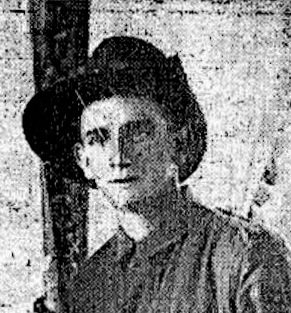
Harold Albert BRYANT
Eyes brown, Hair brown, Complexion dark
Syd and Hal Bryant – Brothers at Fromelles
Can you help find Syd?
Thomas Sydney Bryant’s body was never found after the Battle of Fromelles, and there are no records of his burial.
A mass grave was found in 2008 at Fromelles, a grave the Germans dug for 250 Australian soldiers they recovered after the battle. As of 2026, 181 of these soldiers have been able to be identified via DNA testing.
Syd may be among these remaining unidentified men. There is still a chance to identify him — but we need help. We welcome all branches of his family to come forward to donate DNA to help with his identification, especially those with roots in Sydney, NSW
See the DNA box at the end of the story for what we do know about his family.
If you know anything of contacts for Syd, please contact the Fromelles Association.
Please contact the Fromelles Association of Australia to find out more.
Early Life
Thomas Sydney Bryant, known as Syd, was born on 9 July 1895 at Alexandria, Sydney. His younger brother Harold Albert Bryant, known as Hal, followed on 8 May 1897. They were the sons of Albert Edward Bryant and Elizabeth Robinson. Both parents had been born in Victoria in 1865. Albert was born at Collingwood, the son of Frederick Jeffery Bryant and Caroline Badman, while Elizabeth was the daughter of Thomas Robinson and Helena Mabel Caroll. Albert and Elizabeth married in Victoria in 1891, and their eldest son, Edward William, known as Ted, was born there that year. The family subsequently moved to New South Wales.
Syd and Hal grew up as part of a large family that also included Ellen Elizabeth, Myra Helena, Albert Edward and Florence Helena. Myra died in 1901 while still a small child. By the years before the First World War, the Bryant family was living on Kurraba Road at Neutral Bay on Sydney's lower North Shore. Syd attended the Public School at Neutral Bay and later worked as a wool roller. One of his schoolmates was George H. Barry, and the two also worked together. Barry would later recall:
“I knew Bryant well - his initials were T.S. His second name was Sydney. We were at school together and worked together.”
Hal worked as a labourer before the war. Both brothers were closely associated with Neutral Bay and their names are recorded on the Neutral Bay Superior Public School Honour Roll. Their elder brother Ted had married Catherine Mary and was living at Clegg Street, Gore Hill, North Sydney, where he worked as a house painter. The three brothers were soon to have something else in common - each would serve in the Australian Imperial Force.
Off to War
Syd was the first of the two brothers to enlist, joining the AIF at Liverpool on 20 July 1915, only eleven days after his twentieth birthday. Hal followed at Holsworthy on 3 August, aged eighteen. Their service numbers were just five apart - Syd became 3249 and Hal 3244. Both were allocated to the 11th Reinforcements of the 1st Battalion and, on 5 October 1915, left Sydney together aboard HMAT A32 Themistocles.
After reaching Egypt, they were taken on strength of the 1st Battalion at Tel-el-Kebir in January 1916. With the ‘doubling of the AIF’ as it expanded from two infantry divisions to five, major reorganisations were underway. The 53rd Battalion was formed on 16 February 1916 and was made up of Gallipoli veterans from the 1st Battalion and the new recruits from Australia. Both Syd and Hal were assigned to the new Battalion. The Gallipoli soldiers in the 53rd were not slow in pointing out to whoever would listen that they were the “Dinkums” and the new recruits were the “War Babies”.
Source: - AWM4 23/70/1, 53rd Battalion War Diaries, Feb-July 1916, page 3
In March they were sent to Ferry Post, on foot, a trip of about 60 km that took three days. It was a significant challenge, walking over the soft sand in the 38°C heat with each man carrying their own possessions and 120 rounds of ammunition. Many of the men suffered heat stroke.
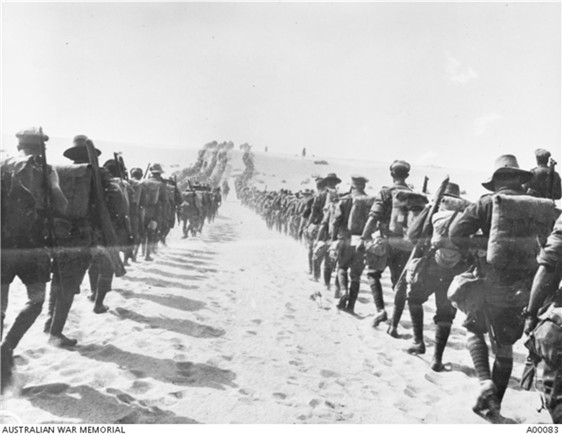
Once there, they remained at Ferry Post guarding the Suez Canal from any potential threats posed by the Ottoman Army. Their elder brother Ted had also enlisted by this time. He joined the AIF on 14 December 1915 and was allocated to the 14th Reinforcements of the 19th Battalion. Unlike Syd and Hal, Ted remained in Australia while his younger brothers prepared to leave Egypt for the Western Front. By mid-June, the 53rd was preparing to leave Egypt. On 19 June 1916, Syd and Hal embarked with the battalion from Alexandria aboard the transport Royal George, bound for France.
Disembarking at Marseilles on 28 June, the battalion travelled north by crowded troop trains, eventually reaching Fleurbaix, just west of the front line opposite German-held Aubers Ridge. During their trip it was noted that their ‘reputation had evidently preceded them’, as they were well received by the French at the towns all along the route.
Source - AWM4 23/70/2 53rd Battalion War Diaries February - June 1916, p. 4
On 10 July, the 53rd entered trenches for the first time. Though nominally in a “quiet sector”, the front near Fleurbaix was anything but calm. Rain flooded the communication trenches, artillery fire harassed supply lines, and the soldiers dug in amid the mud and barbed wire of No-Man’s-Land.
The Battle of Fromelles
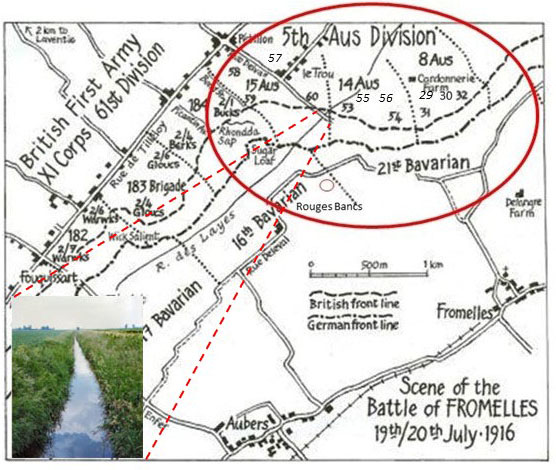
The main objective for the 53rd was to take the trenches to the left of a heavily armed, elevated German defensive position, the ‘Sugar Loaf’, which dominated the front lines. If the Sugar Loaf could not be taken, the 53rd and the other battalions would be subjected to murderous enfiladed fire from the machine guns and counterattacks from that direction. As they advanced, they were to link up with the 60th and 54th Battalions on their flanks. From 8 to 16 July, the 53rd rotated between billets and the line. The men knew something was coming. They rehearsed attacks in replica trench systems, inspected bayonets, and watched as huge guns rolled into place behind the lines. Then on 16 July, they moved up for an attack, only to have it postponed due to weather.
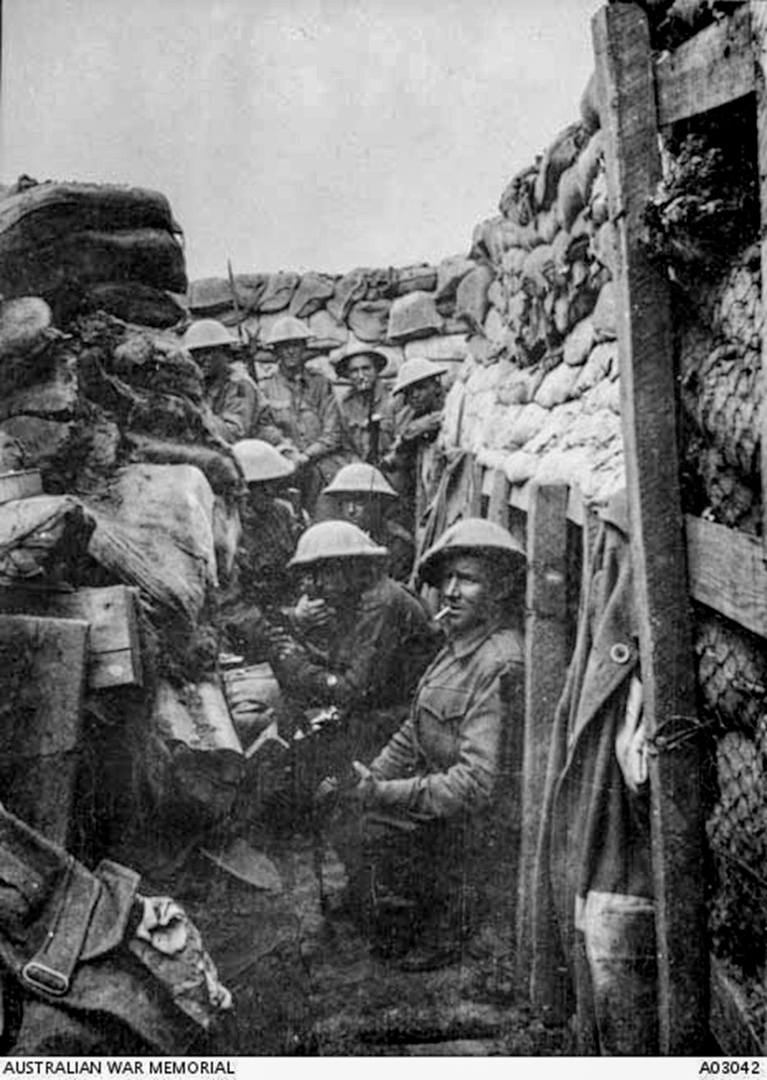
The delay proved torturous. Private Jim Granger, a young Dorrigo soldier, described the tension:
We were held in suspense for three days… like a criminal waiting to hear the verdict. We had no dugouts where we were in the supports and shrapnel was bursting all round.”
On the 19th, heavy bombardment was underway from both armies by 11.00 AM. At 4.00 PM the 54th Battalion rejoined on their left. All were now in position for battle. Among them were Syd and Hal Bryant of C Company. From Neutral Bay to Egypt and then France, the brothers had travelled almost every step of their war together. They were about to go into battle together as well. At 5.15 PM, before the Australians could leave their trenches, a devastating German bombardment tore through their lines. Zero hour came at 5.43 PM.
The 53rd advanced in four waves across No-Man’s-Land under murderous artillery, rifle and machine-gun fire:
“At 5.43 pm the signal for the charge sounded, and over the top we went into the face of death, shells bursting, machine guns rattling and rifles crackling.”
— Pte. Arthur Norton Crewes, 53rd Battalion
Despite the heavy fire, elements of the battalion succeeded in capturing sections of the German front and second-line trenches. Corporal J.T. James (3550) later told the Red Cross:
“At Fleurbaix on the 19th July we were attacking at 6 p.m. We took three lines of German trenches.”
But the gains came at terrible cost. Within twenty minutes, the 53rd had lost all company commanders, all seconds-in-command, and six junior officers. The captured trenches proved little more than water-filled ditches offering almost no protection from German counterattacks. For Syd and Hal, the battle soon became intensely personal. During the fighting, Hal was wounded in the scalp. He survived the battlefield and was evacuated for medical treatment, bringing his part in the fighting at Fromelles to an end. His service record traces his evacuation following the wound.
Syd remained somewhere in the shattered ground between the lines. His old schoolmate and workmate, Private George H. Barry (3477A) of C Company, was himself wounded and lying in a shell hole in No-Man’s-Land when he saw Syd pass close by. Barry later gave the Red Cross a detailed account of what happened:
“I knew Bryant well - his initials were T.S. His second name was Sydney. We were at school together and worked together. He came from 10th Reinforcements to 1st Battalion. His people live at Neutral Bay and I have told his mother all I know, which is, that on the night of 19.7.16 at Fleurbaix, I was lying wounded in a shell hole, in No Man's Land, between the front and the German lines, when Bryant passed close by and just then a shell came over and burst there, and when the smoke cleared, there was no sign of Bryant. I feel sure that he was killed at once.”
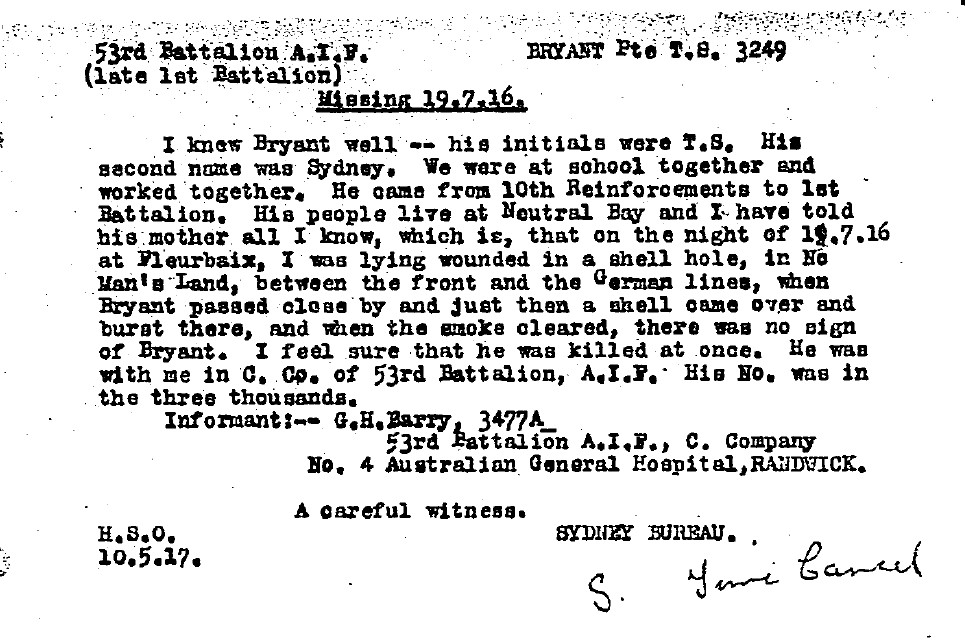
The Red Cross interviewer added a telling assessment beneath Barry’s statement - “A careful witness.” Syd was reported missing in action on 19 July. At that stage, however, his family had no confirmation of his death. Hal had survived Fromelles wounded; Syd had simply disappeared. Around them, the battle continued. Throughout the night, the 53rd fought desperately to hold its ground while the exposed right flank collapsed near the Sugar Loaf. German troops worked their way behind the battalion’s position, forcing the Australians to fight their way back towards their own lines. The 53rd Battalion War Diary recorded:
“Many heroic actions were performed.”
The battalion was finally ordered to withdraw on the morning of 20 July. The scale of the destruction was staggering. Of the 990 men who had left Alexandria just weeks before, the initial count at roll call was 36 killed, 353 wounded and 236 missing. Fromelles was the 53rd Battalion’s brutal introduction to the Western Front and its bloodiest day of the war. Of the battalion’s 246 dead, 190 men have no known grave.
For Syd and Hal Bryant, who had enlisted within weeks of each other and travelled together from Sydney to Egypt and then France, Fromelles was where their shared wartime journey finally divided. Hal came out of the battle with a scalp wound. Syd did not come back. As Major O. M. Croshaw later acknowledged, even reconstructing what had happened to the battalion’s missing men was difficult:
“A great many details are necessarily gathered second hand as those who were in the best position to know are no longer with the Battalion.”
After the Battle - Syd
After the fighting at Fromelles, Syd was reported missing in action. For his family at Neutral Bay, there was no certainty about what had happened to him. George Barry’s eyewitness account provided a likely explanation for his disappearance, but officially Syd remained among the missing. That uncertainty continued for more than a year. In April 1917 she still had no definite answer about what had happened to Syd:
“I would also be glad if you would give me any information concerning my other son Private T.S. Bryant (3249) 53rd Battalion who has been missing since July 19th 1916.”
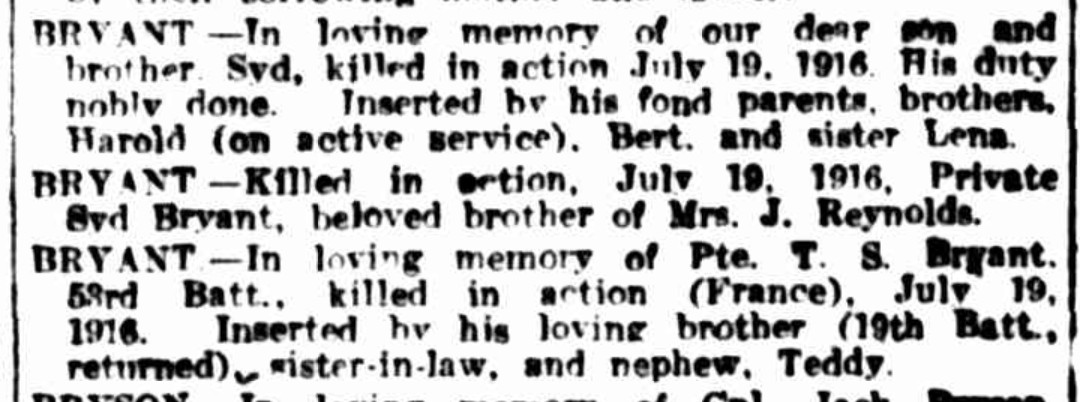
It was not until 2 September 1917, when a Court of Enquiry was held in the field, that Syd’s fate was formally determined as killed in action on 19 July 1916. His military record was subsequently amended accordingly. For Albert and Elizabeth Bryant, the finding confirmed that their son would not return, but they still had no grave at which to mourn him. On the second anniversary of the battle, 19 July 1918, the family remembered Syd in the Sydney Morning Herald.
While extensive searches to find the missing were undertaken, the end of the war brought no answer about where Syd had been buried. His parents continued corresponding with the military authorities in the years that followed. In March 1920, Base Records wrote to Elizabeth at “Balmoral”, Kurraba Road, Neutral Bay, seeking confirmation that Syd’s father was still alive so that his nearest blood relation could be established. The question of Syd’s burial remained unresolved. In August 1921, Base Records informed Elizabeth that, despite enquiries and searches of available records, including German information, they had been unable to establish where her son had been buried. With no known grave, Syd is commemorated at:
- Panel 7 of the V.C. Corner Australian Cemetery and Memorial at Fromelles.
- Australian War Memorial Roll of Honour, Panel 156,
- The Neutral Bay Superior Public School Honour Roll,
- and the Coonamble Municipality and Wingadee Shire Honour Roll.
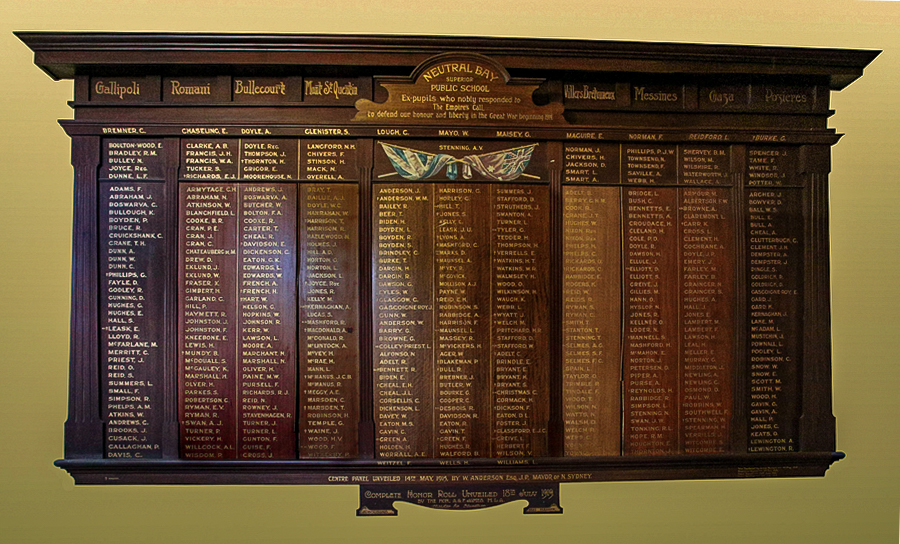
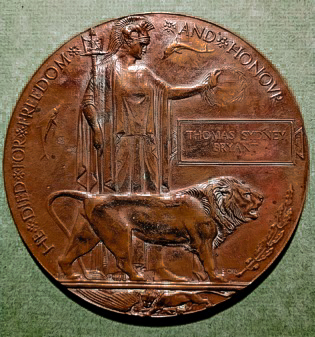
Albert died in 1939 and Elizabeth in 1942, never knowing where their son lay. Syd was only 21 when he was killed at Fromelles, and more than a century later, his remains have still not been formally identified.
After the Battle – Hal
After treatment and recovery, Hal returned to duty, rejoining the 53rd Battalion in France on 12 August 1916. While the Bryant family waited desperately for news of Syd, Hal's own war continued. He returned to the Western Front and remained with the 53rd Battalion through the latter part of 1916, but his health increasingly interrupted his service. In 1917, Hal suffered a prolonged bout of influenza which lasted about five weeks. He was also recorded as suffering from debility, a term then used for severe physical weakness and exhaustion. His condition was serious enough for him to be evacuated from France to England aboard the hospital ship St David on 10 February 1917.
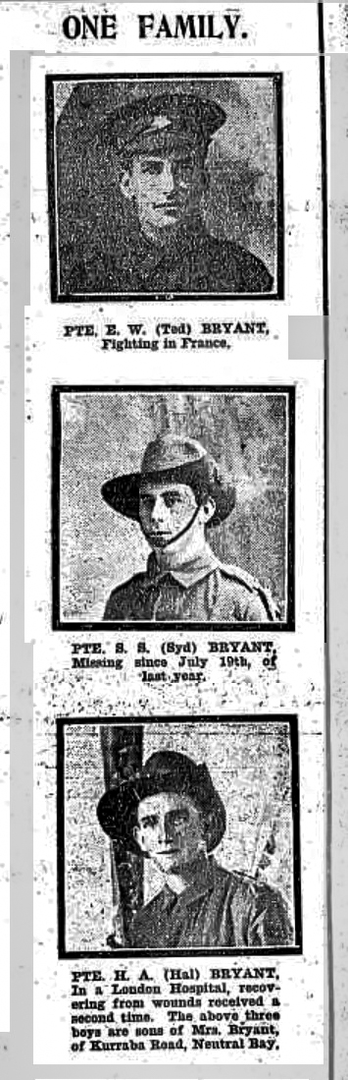
Two days later he was admitted to the 1st Birmingham War Hospital at Selly Oak. At home, however, reports of Hal's condition were confused. In March 1917, The Mirror of Australia Ted was described as “in a London Hospital, recovering from wounds received a second time.”
Source- “Heroes All.” The Mirror of Australia (Sydney, NSW : 1915–1917), 24 March 1917, p.1. http://nla.gov.au/nla.news-article103826902
For Elizabeth Bryant, the contrast could hardly have been greater. Hal was ill but able to write home from hospital; Syd's fate remained unknown. Hal eventually recovered sufficiently to return to active service. He went back to France later in 1917 and rejoined the 53rd Battalion, continuing to serve on the Western Front. His periods of illness meant that he was absent for some of the battalion's major operations, but his service continued into 1918. Illness struck again in March 1918 when Hal was admitted to hospital suffering from mumps. He recovered and returned to duty.
By the latter part of 1918 he was again serving in France as the Allied armies advanced towards the Hindenburg Line. After surviving his wound at Fromelles, influenza, debility, mumps and more than three years of overseas service, Hal finally returned to Australia on 8 April 1919. Back in civilian life, Hal married Winifred Eileen Mayne in Queensland on 11 July 1925. Their son, Sydney Albert “Bill” Bryant, was born in 1928, followed by daughter Shirley Eileen in 1929, who sadly died the following year.
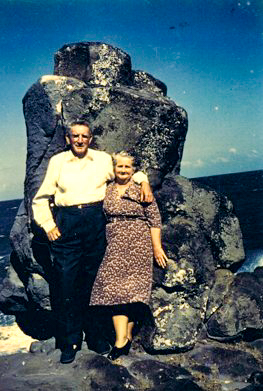
Hal lived for more than half a century after the war. He died in Sydney on 4 December 1973, aged 76, and was buried at Rookwood Cemetery. The two brothers who had sailed from Sydney together in October 1915 had shared Egypt, the 53rd Battalion and the battlefield at Fromelles. Hal survived and eventually came home. Syd remained one of the missing.
Ted joins his brother on the Western Front
The war reached deeply into the Bryant family. While Syd and Hal had enlisted within weeks of each other and served together in the 53rd Battalion, their elder brother Edward William “Ted” Bryant also joined the AIF. A married man and house painter living at Clegg Street, Gore Hill, Ted enlisted on 14 December 1915 and was allocated to the 14th Reinforcements of the 19th Battalion. By the time Ted embarked from Sydney aboard HMAT Wiltshire on 22 August 1916,
Fromelles had already changed the family. Syd was missing and Hal had been wounded. Ted nevertheless sailed for the same Western Front where his two younger brothers had fought only weeks earlier. By March 1917, the three brothers were scattered by the war. Their circumstances were captured in a feature published by The Mirror of Australia under the heading “Heroes All.” Photographs of all three appeared together - Ted was fighting in France, Syd remained missing after Fromelles, and Hal was in hospital in England.
For Albert and Elizabeth Bryant at home, the photograph brought their three serving sons together on a single page, even though the war had separated them across Europe.
Ted survived his service and returned to Australia on 27 September 1917. Hal remained overseas until April 1919. Syd never returned. The Bryant family's war had begun with three brothers volunteering for the AIF - two eventually came home, one remained at Fromelles.
Finding Syd
Syd’s remains have never been formally identified, and he has no known grave. Like many men of the 53rd Battalion who were killed at Fromelles, it is possible that he was among those buried by German troops after the battle in mass graves near Pheasant Wood. In 2008, a mass burial site containing 250 Australian and British soldiers was discovered at Pheasant Wood, near Fromelles.
As of 2026, DNA testing and historical research have led to the identification of 181 of the missing men from the battle, including fifteen of the 190 missing soldiers from the 53rd have been identified. Syd had surviving brothers and sisters, including Edward William “Ted” Bryant, Harold Albert “Hal” Bryant, Ellen Elizabeth Bryant, Albert Edward Bryant and Florence Helena M. Bryant.
If you know any of the descendants for these connections, please contact the Fromelles Association.
DNA samples are being sought for family connections to
| Soldier | Thomas Sydney Bryant (1895–1916) |
| Parents | Albert Edward Bryant (1865–1939), born Collingwood, Victoria and Elizabeth Robinson (1865–1942), born Victoria |
| Siblings | Edward William (Ted) Bryant (1891–1959) | ||
| Ellen Elizabeth Bryant (1892–1977) | |||
| Harold Albert (Hal) Bryant (1897–1973) m Winifred Eileen Mayne | |||
| Myra Helena Bryant (1899–1901) | |||
| Albert Edward Bryant (1902–1973) | |||
| Florence Helena M. Bryant (1905–1960) |
| Grandparents | |||
| Paternal | Frederick Jeffery Bryant (1833–1895) and Caroline Badman (1835–1886) | ||
| Maternal | Thomas Robinson (1820–1893) and Helena Mabel Caroll (1840–1909) |
The Fromelles Association would love to hear from you

Contacts
(Contact: carla@fromelles.info or geoffrey@fromelles.info).
(Contact: army.uwc@defence.gov.au or phone 1800 019 090).
Donations
If you are able, please contribute to the upkeep of this resource.
(Contact: bill@fromelles.info ).