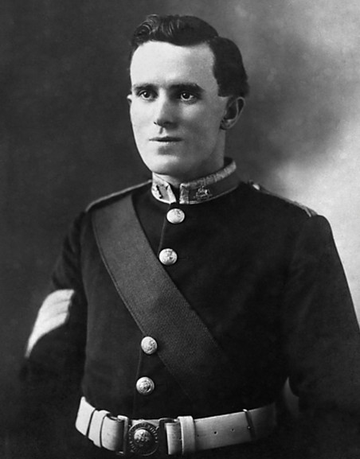
Reginald PIKE
Eyes brown, Hair black, Complexion florid
Reginald and Arthur Pike – Brothers at Fromelles
Can you help find Reg?
Reginald Pike’s body was never found after the Battle of Fromelles, and there are no records of his burial.
A mass grave was found in 2008 at Fromelles, a grave the Germans dug for 250 Australian soldiers they recovered after the battle. As of 2026, 181 of these soldiers have been able to be identified via DNA testing.
Reg may be among these remaining unidentified men. There is still a chance to identify him — but we need help. We welcome all branches of his family to come forward to donate DNA to help with his identification, especially those with roots in Rockdale, NSW
See the DNA box at the end of the story for what we do know about his family.
If you know anything of contacts for Reg, please contact the Fromelles Association.
Please contact the Fromelles Association of Australia to find out more.
Early Life – The Boys fro Petersham
John James Reginald Pike, known as Reg, and his younger brother Arthur Rupert Pike grew up as part of a large family in Sydney’s inner west. They were the sons of John James Philip Pike and Mary Elizabeth Burke, who had married in Sydney on 6 January 1876. Their father had been born in Victoria in 1857, while their mother was Sydney-born, the daughter of Thomas Burke and Alice Williams.
The Pike family included:
- George David (1877–1943)
- Albert Edward (1881–1882) – died in infancy
- Alice Maud Everline (1883–1958)
- Herbert Daniel (1884–1959)
- Mona Frances (1887–1888) – died in infancy
- Reginald (1889–1916)
- Edna May M. (1892–1963)
- Arthur Rupert (1893–1934)
- Ivy Annie Estelle (1897–1957)
Reg was born at Rockdale in 1889, while Arthur was born at Redfern in 1893. Arthur’s military record confirms Redfern as his birthplace. The family eventually became closely associated with Petersham. Their mother Mary died there on 19 March 1905, aged only 49, leaving John to raise the younger members of the family. Reg was about fifteen and Arthur about twelve when they lost their mother.
As young men, the brothers followed different trades. Reg worked as a blacksmith’s striker, while Arthur became a painter. Reg was closely associated with the Gillespie family of Railway Street, Petersham. When he later enlisted, he gave his address as c/o Mrs Gillespie, 49 Railway Street. The friendship was evidently a close one and continued to be remembered long after his death.
Reg also had another important change in his life during 1915, he married Rose Geraghty at Newtown. Rose was only about nineteen when Reg enlisted. His service record gives her address as the corner of Smedmore Street and Edgeware Road, Marrickville. Arthur was still single and living at 248 Parramatta Road, Petersham.
Off to War
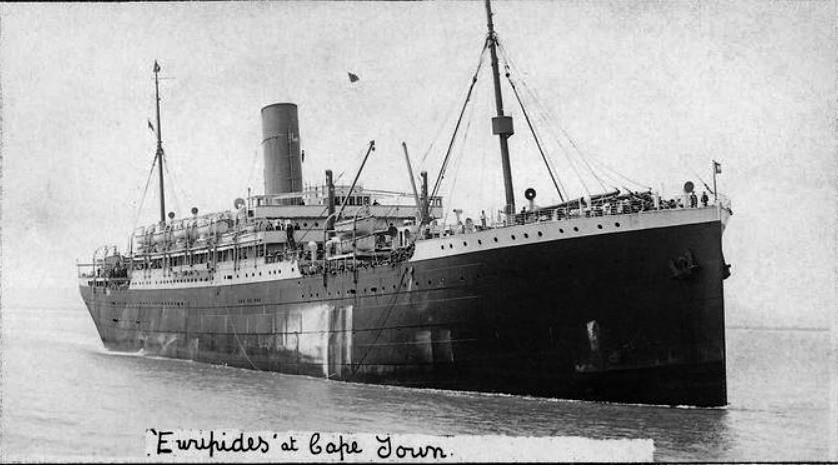
By the end of 1915, the Pike family was feeling the effects of the war. Reg and Arthur enlisted in the AIF within weeks of one another in 1915. Arthur was the first to enlist, joining at Liverpool on 2 August 1915. A painter by trade, he was allotted the service number 3398 and assigned to the 11th Reinforcements of the 3rd Battalion. He left Sydney aboard HMAT A14 Euripides on 2 November 1915, bound for Egypt. Their brother Herbert enlisted and set sail in 1914.
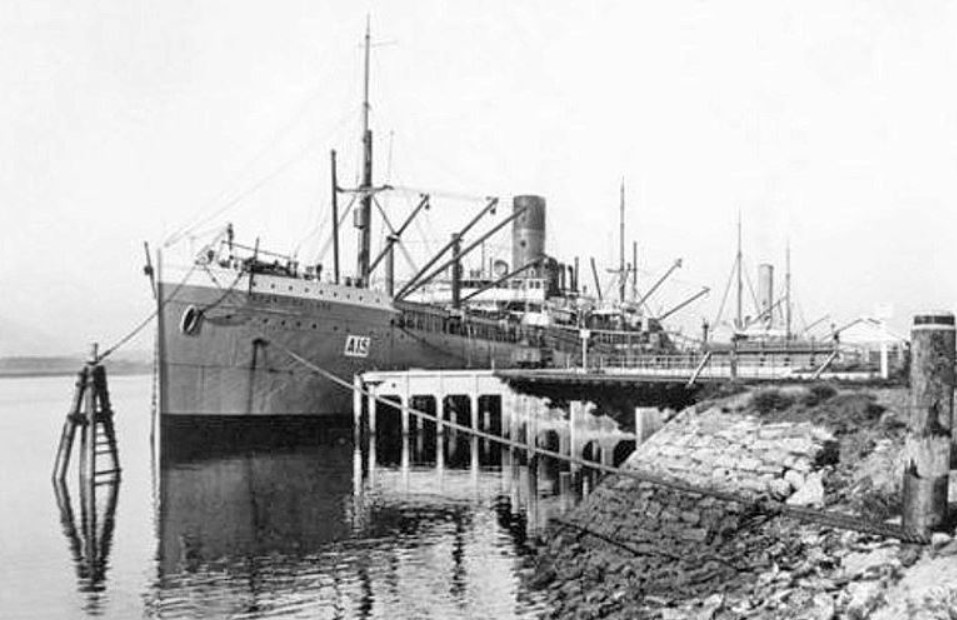
Reg followed on 15 September 1915, enlisting at Warwick Farm. He was allotted the service number 4840 and assigned to the 15th Reinforcements of the 1st Battalion. Reg remained in Australia for several months after Arthur’s departure, eventually leaving Sydney aboard HMAT A15 Star of England on 8 March 1916 for the monthlong trip to Egypt.
Although the brothers had embarked with reinforcements for different battalions, the reorganisation of the AIF in Egypt brought them together again. With the ‘doubling of the AIF’ as it expanded from two infantry divisions to five, major reorganisations were underway. The 53rd Battalion was formed on 16 February 1916 and was made up of Gallipoli veterans from the 1st Battalion and the new recruits from Australia. Arthur was assigned to the new Battalion when it was formed and Reg in mid-April. The Gallipoli soldiers in the 53rd were not slow in pointing out to whoever would listen that they were the “Dinkums” and the new recruits were the “War Babies”.
Source: - AWM4 23/70/1, 53rd Battalion War Diaries, Feb-July 1916, page 3
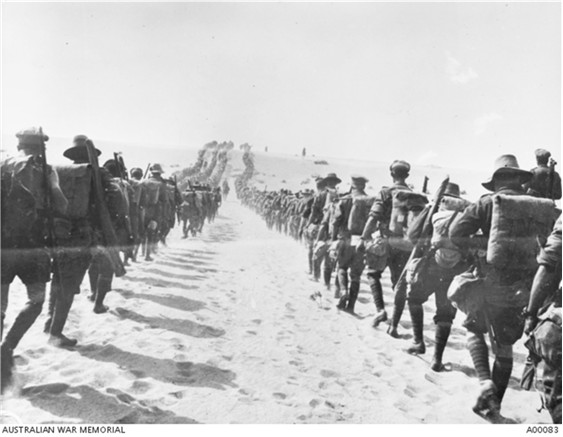
The 53rd’s initial training took place at Tel-el-Kebir. In March Arthur made a march to Ferry Post on the Nile, a trip of about 60 km that took three days. It was a significant challenge, walking over the soft sand in the 38°C heat with each man carrying their own possessions and 120 rounds of ammunition. Many of the men suffered heat stroke.
Reg was transferred to the 53rd in mid-April at Ferry Post, now joined with his brother as they prepared for move to the Western Front. By mid-June, the 53rd was preparing to leave Egypt. On 19 June 1916, Reginals and Arthur embarked with the battalion from Alexandria aboard the transport Royal George, bound for France. Disembarking at Marseilles on 28 June, the battalion travelled north by crowded troop trains, eventually reaching Fleurbaix, just west of the front line opposite German-held Aubers Ridge. During their trip it was noted that their ‘reputation had evidently preceded them’, as they were well received by the French at the towns all along the route.
Source - AWM4 23/70/2 53rd Battalion War Diaries February - June 1916, p. 4
This area near Fleurbaix was known as the “Nursery Sector” – a supposedly relatively quiet area where inexperienced Allied troops could learn the harsh realities of Western Front trench warfare against the Germans. But the quiet times and the training period did not last long. On 10 July, the 53rd entered trenches for the first time. Though nominally in a “quiet sector”, the front near Fleurbaix was anything but calm. Rain flooded the communication trenches, artillery fire harassed supply lines, and the soldiers dug in amid the mud and barbed wire of No-Man’s-Land.
The Battle of Fromelles
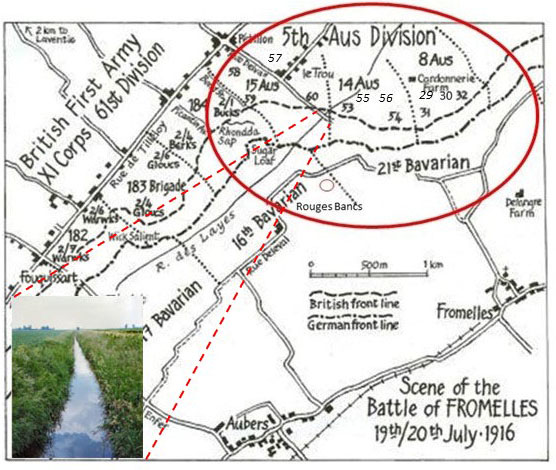
Inset – River Layes from the Australian Front Line looking towards the Sugar Loaf
The main objective for the 53rd was to take the trenches to the left of a heavily armed, elevated German defensive position, the ‘Sugar Loaf’, which dominated the front lines. If the Sugar Loaf could not be taken, the 53rd and the other battalions would be subjected to murderous enfiladed fire from the machine guns and counterattacks from that direction. As they advanced, they were to link up with the 60th and 54th Battalions on their flanks. From 8 to 16 July, the 53rd rotated between billets and the line. The men knew something was coming. They rehearsed attacks in replica trench systems, inspected bayonets, and watched as huge guns rolled into place behind the lines. Then on 16 July, they moved up for an attack, only to have it postponed due to weather.
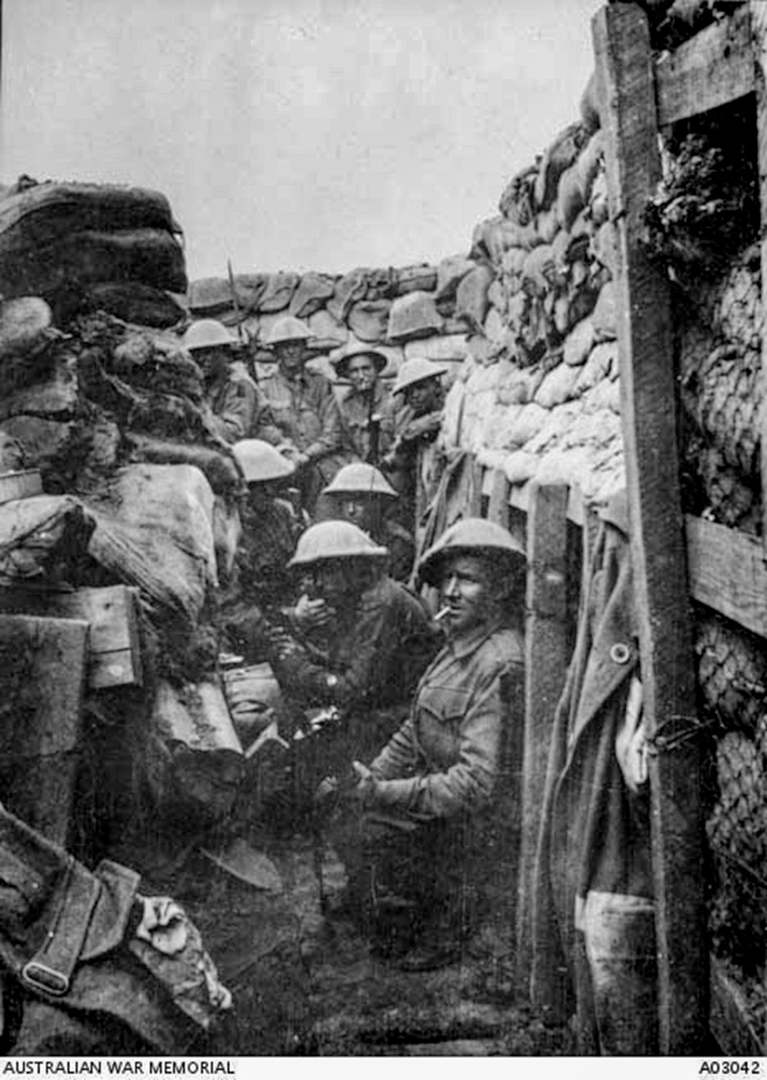
The delay proved torturous. Private Jim Granger, a young Dorrigo soldier, described the tension:
We were held in suspense for three days… like a criminal waiting to hear the verdict. We had no dugouts where we were in the supports and shrapnel was bursting all round.”
On the 19th, heavy bombardment was underway from both armies by 11.00 AM. At 4.00 PM the 54th Battalion rejoined on their left. All were now in position for battle. For brothers Reg and Arthur Pike, who had enlisted separately but had been brought together in the 53rd Battalion, it would be a devastating day. At 5.15 p.m., before the Australians could leave their trenches, a massive German bombardment tore through their lines. Zero hour came at 5.43 p.m. The 53rd advanced in four waves across No-Man’s-Land under murderous artillery, rifle and machine-gun fire:
“At 5.43 pm the signal for the charge sounded, and over the top we went into the face of death, shells bursting, machine guns rattling and rifles crackling.”— Pte. Arthur Norton Crewes, 53rd Battalion
Reg and Arthur went forward into the thick of the fighting. Despite the heavy fire and casualties, elements of the battalion succeeded in capturing sections of the German front and second-line trenches. Corporal J.T. James (3550) later told the Red Cross:
“At Fleurbaix on the 19th July we were attacking at 6 p.m. We took three lines of German trenches.”
The 14th Brigade War Diary noted - “Very few living Germans were found in the first and second line trenches.”
Source - Bean, Official History of Australia in the War of 1914–1918, Vol III, Ch XII, p.369
But the gains came at terrible cost. Within twenty minutes, the 53rd had lost all company commanders, all seconds-in-command, and six junior officers. The captured trenches proved little more than water-filled ditches offering almost no protection from German counterattacks. Throughout the night, the battalion fought desperately to hold its ground while the exposed right flank collapsed near the Sugar Loaf. German troops worked their way behind the 53rd’s position, forcing the Australians to fight their way back towards their own lines:
“Many heroic actions were performed.”
The battalion was finally ordered to withdraw on the morning of 20 July. The scale of the destruction was staggering. Of the 990 men who had left Alexandria just weeks before, the initial count at roll call was 36 killed, 353 wounded and 236 missing. Ultimately 246 soldiers died and 190 men had no known grave.
Major O. M. Croshaw acknowledged how difficult it was even to reconstruct what had happened:
“A great many details are necessarily gathered second hand as those who were in the best position to know are no longer with the Battalion.”
For the Pike brothers, the outcome was stark. Arthur was wounded and Reg was among those missing.
After the Battle – Reg
Reg was listed as missing - for Rose and the Pike family in Sydney, there was initially no certainty whether he had been killed, wounded or taken prisoner. Information was slow and often unreliable. The confusion was made worse by reports concerning another soldier named Pike. One informant told the Australian Red Cross that he had seen and spoken to “a Pike” in London in October 1916, and that that man had been wounded in both legs. He believed the soldier belonged to the 53rd Battalion, but did not know his initials. For a family waiting for news, such reports could offer hope while enquiries continued.
A Court of Enquiry held in the field on 2 September 1917 formally determined that Reginald had been killed in action on 19 July 1916. While the Army and the Red Cross were trying to do what they could to locate the missing, it wasn’t until mid-1919 that the details about Reg’s death came out. One of the men who went forward beside Reg was Corporal John J. Pritchard (4839), a close friend who had known him since camp.
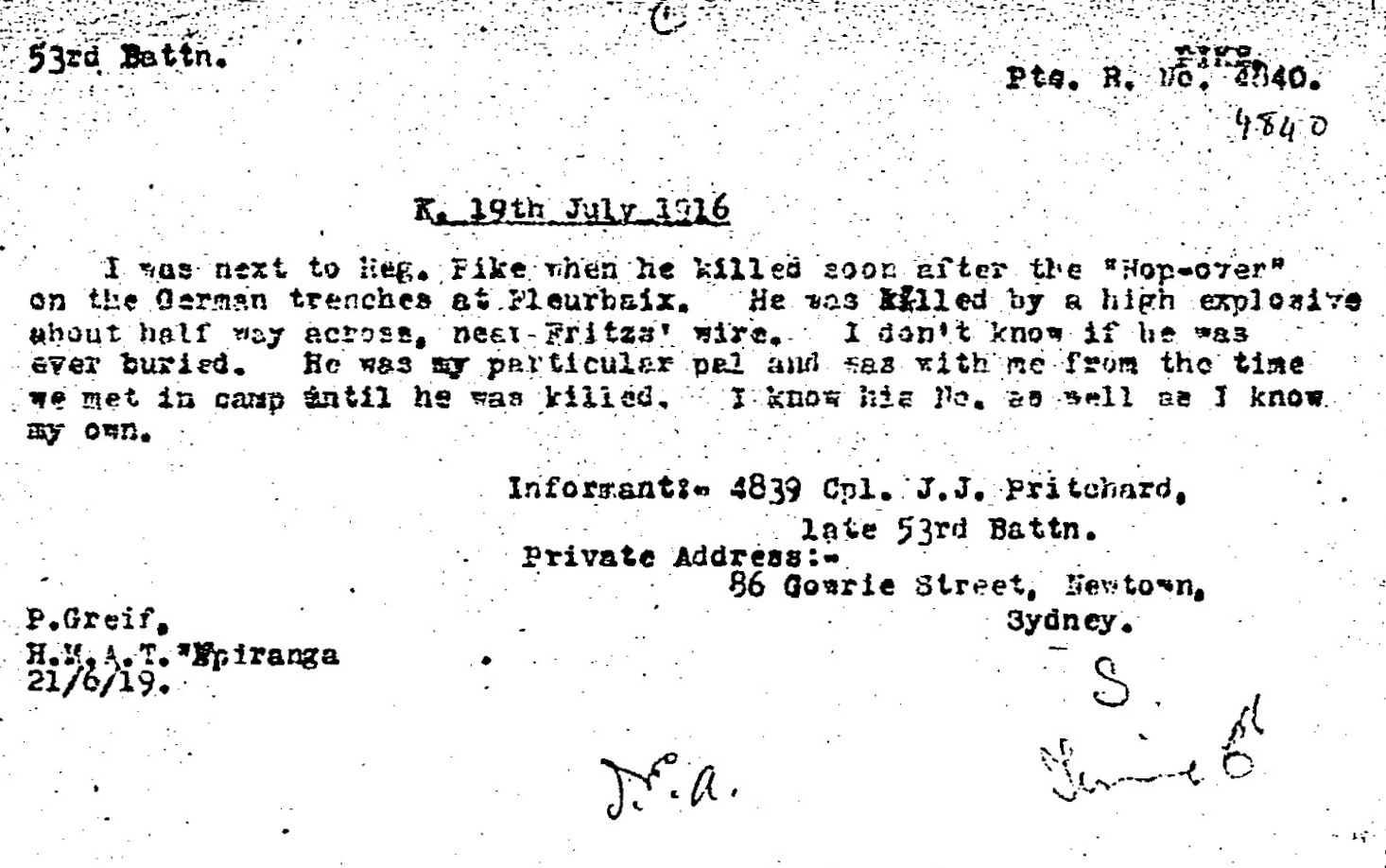
Pritchard gave the Red Cross a firsthand account of what happened to Reg:
“I was next to Reg. Pike when he was killed soon after the ‘hop-over’ on the German trenches at Fleurbaix. He was killed by a high explosive about half way across, near Fritz’s wire. I don’t know if he was ever buried.”
Pritchard’s statement also provides a rare glimpse of Reg as a man rather than simply another name among the missing:
“He was my particular pal and was with me from the time we met in camp until he was killed. I know his No. as well as I know my own.”
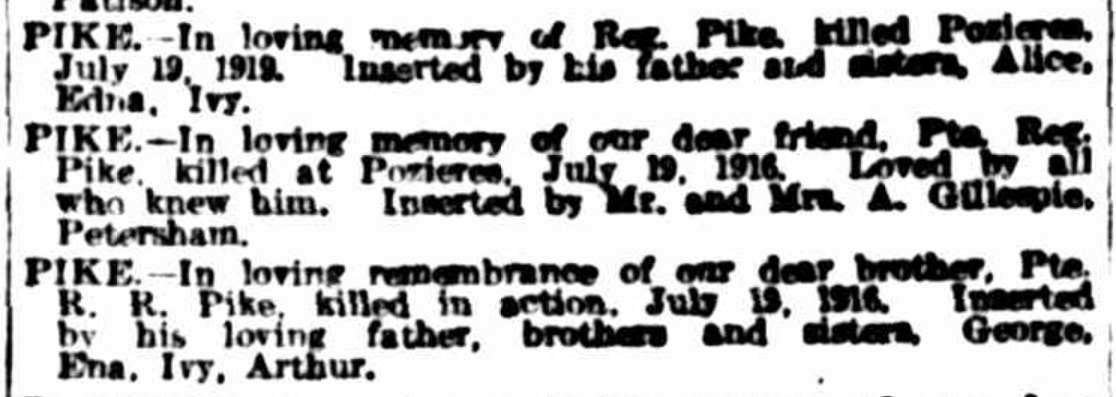
For Rose, all of this meant accepting that the husband she had married only the year before would not return and there was no grave to visit. His family and friends continued to remember him publicly. On the second anniversary of his death, A.W. and Mrs Gillespie of Petersham, with whom Reg had been closely associated before the war, placed a notice in the Sydney Morning Herald:
“In loving memory of our dear friend, Private Reg. Pike, killed in action in France, July 19, 1916, Loved by all who knew him.”
In 1919 his father and sisters Alice, Edna and Ivy placed another remembrance notice. A further notice came from his father, brothers and sisters, while the Gillespies again remembered their friend. Some of these notices mistakenly stated that Reg had been killed at Pozières rather than Fromelles (a common misunderstanding), but the family's continued remembrance was unmistakable.

The official tokens of Reg's service followed in the years after the war. His service file records the issue of his British War Medal, Victory Medal, Memorial Scroll and a Memorial Plaque. In 1922, his Memorial Plaque was sent to Rose, who was then living at 180 Woodlands Street, Marrickville. The accompanying letter explained that the bronze plaque had been issued as a memorial to those who had died in the war. Six years after Fromelles, it was one of the few tangible objects Rose received in remembrance of the husband who had left Australia in 1916 and never returned.
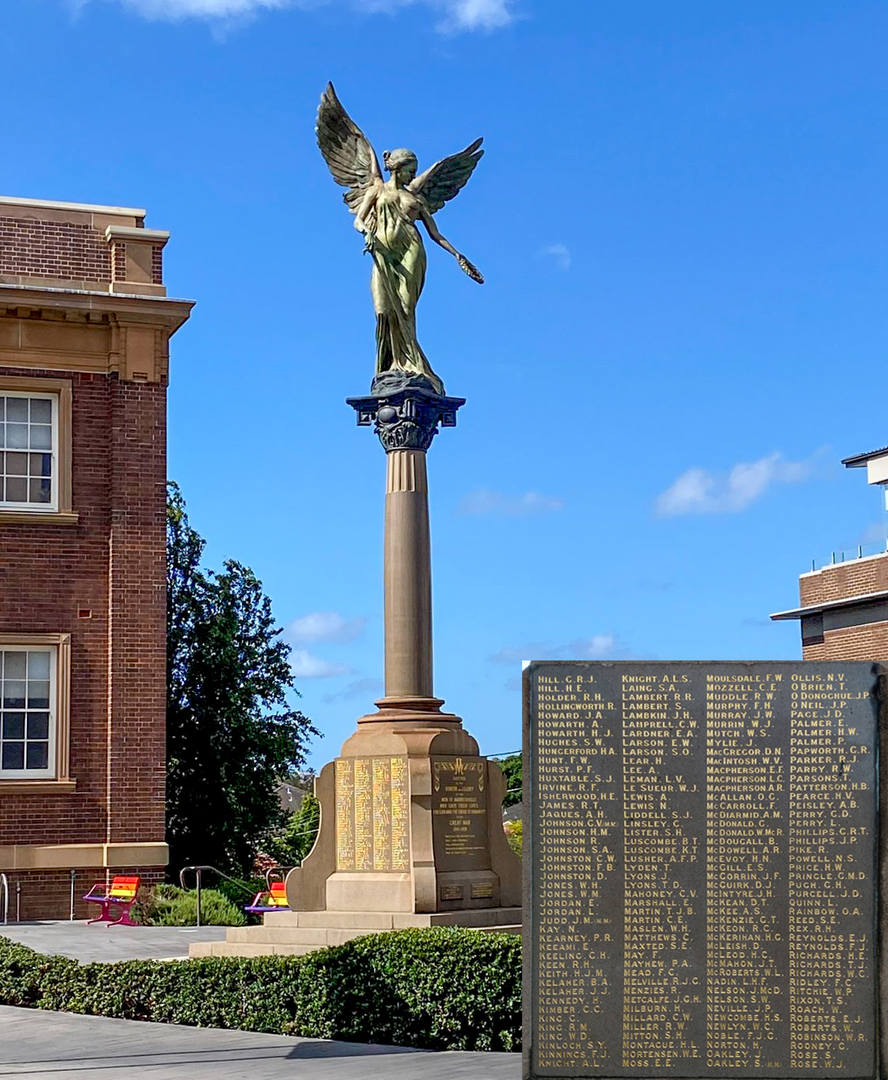
His name would eventually be recorded on the V.C. Corner Australian Cemetery Memorial at Fromelles and he is rememembered at Marrickville War Memorial.
After the Battle – Arthur
Arthur survived Fromelles, but in addition to his wounds, he was being treated for shell shock at Southend on Sea and Perham Downs. While in England, Arthur married Maud Rosa Adams in October 1916 at Acton. Maud was the daughter of George Adams, a retired plasterer. The marriage record gives both Arthur and Maud's address as 33 Cowper Road, Acton. Only weeks later, Arthur's military service took a dramatic turn. On 24 November 1916, while attached to No. 1 Command Depot at Perham Down, Arthur absented himself without leave. He did not return. For almost four months he remained away from the Army, until he was apprehended at Acton on 18 March 1917. His descriptive return records his address during this period as 33 Cowper Road.
Arthur was brought before a District Court-Martial on 19 March 1917, charged with “Absenting himself without leave”. The charge specified that he had absented himself from Perham Down on 24 November 1916 and remained absent until his apprehension at Acton on 18 March 1917. Arthur pleaded guilty. In mitigation, Arthur explained that he had been wounded at Fromelles and referred to his subsequent medical treatment. His court-martial papers recorded his previous military service and the circumstances placed before the court before sentence was passed. He was initially sentenced to six months' detention. The sentence was subsequently commuted to 83 days' detention.
After serving his punishment, Arthur returned to military service. The years that followed were marked by further postings and periods of medical treatment. The young painter who had enlisted in 1915 had survived Fromelles and the loss of his brother, but his own health was increasingly affected by his wartime experiences. By the end of the war Arthur was suffering from neurasthenia, and he was eventually found medically unfit for further service. He commenced his return to Australia aboard the Osterley on 11 January 1919 and was discharged in Sydney on 14 April 1919.
Arthur and Maud settled in Australia and raised three children, Phyllis Rosemary, Reginald Arthur George and Gwenneth Elsie Pike. The family later lived at Bankstown. Arthur died on 19 November 1934. His death was attributed to war service. His funeral notice gave the family home as 29 Highview Avenue, Bankstown, and members of the Bankstown Sub-Branch of the Returned Sailors and Soldiers Imperial League of Australia were invited to attend the funeral of their former comrade. Arthur was buried at Rookwood Necropolis.
He had survived the battlefield that claimed Reg, but the effects of his own war followed him long after he returned home.
Family at War
In August 1918, the Sydney Mail published a photograph of the three Pike brothers under the heading “The Pikes, of Petersham, Sydney.” Side by side were Reg, Arthur and Herbert Beneath their photographs, just a few words recorded how differently the war had treated each of them.
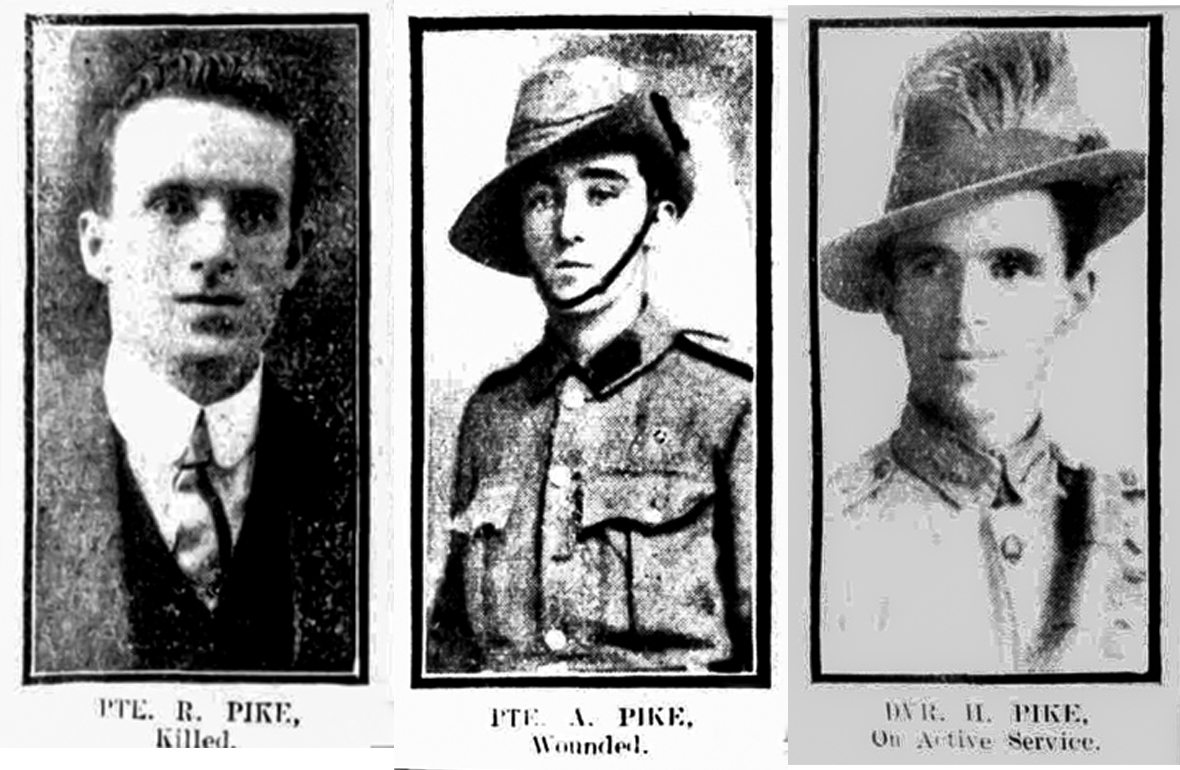
Published while Herbert was still overseas and Arthur was still serving, the photograph captured the wartime experience of the Pike family in a way that official records cannot. Three brothers had enlisted. One had been killed at Fromelles, one had been wounded there, and the third was still on active service. Herbert Daniel Pike (113) had been the first of the three brothers to enlist, joining on 20 August 1914, only weeks after the outbreak of war. A butcher by trade, he had been living in Queensland and enlisted as a Driver with the 5th Company, Australian Army Service Corps, 1st Light Horse Brigade Train. He embarked from Brisbane aboard the Omrah on 24 September 1914 and eventually rose to Lance Corporal.
Unlike Regi and Arthur, Herbert was not at Fromelles. He spent most of the war in England. He returned to Australia on 1 April 1919, eventually returning to England, marry Betty Wilson and living in Manchester and died on the 15 April 1959.
Finding Reg
Reg’s remains have never been formally identified, and he has no known grave. Like many Australian soldiers who fell at Fromelles, it is possible that he was buried by German troops after the battle and may be among the unidentified soldiers recovered from the mass graves at Pheasant Wood.
In 2008, the remains of 250 Australian and British soldiers were recovered from the mass graves at Pheasant Wood. Through historical research, family tracing and DNA testing, 181 soldiers have now been identified, but others remain unknown.
If you are related to Reginald or his wider family, please contact the Fromelles Association of Australia.
DNA samples are being sought for family connections to
| Soldier | John James Reginald Pike (1889–1916) |
| Parents | John James Philip Pike (1857–1920) and Mary Elizabeth Burke (1855–1905) |
| Siblings | George David (1877–1943) | ||
| Albert Edward (1881–1882) | |||
| Alice Maud Everline (1883–1958) | |||
| Herbert Daniel (1884–1959) | |||
| Mona Frances (1887–1888) | |||
| Edna May M. (1892–1963) | |||
| Arthur Rupert (1893–1934) | |||
| Ivy Annie Estelle (1897–1957) |
| Grandparents | |||
| Paternal John George Pike (1826–1898) and Ann Elizabeth Sawyer (1831–1919) | |||
| Maternal Thomas Burke (1828–1878) and Alice Williams (1827–1896) |
Seeking DNA Donors

Contacts
(Contact: carla@fromelles.info or geoffrey@fromelles.info).
(Contact: army.uwc@defence.gov.au or phone 1800 019 090).
Donations
If you are able, please contribute to the upkeep of this resource.
(Contact: bill@fromelles.info ).