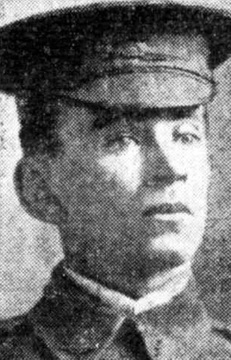
James Norman STEELE
Eyes blue, Hair brown, Complexion fair
James Norman Steele - “A promising young teacher lost to the War”
Can you help us identify Norm?
Norm’s body was never found after the Battle of Fromelles and there are no records of his burial.
A mass grave was found in 2008 at Fromelles, a grave the Germans dug for 250 Australian soldiers they recovered after the battle. As of 2026, 181 of these soldiers have been able to be identified via DNA testing from family member donors.
Norm may be among these remaining 69 unidentified men. There is still a chance to identify him — but we need help. We welcome all branches of his family to come forward to donate DNA to help with his identification, especially those with roots in South Australia.
See the DNA box at the end of the story for what we do know about his family.
If you know anything of contacts for Norm, please contact the Fromelles Association.
Early Life
James Norman Steele (known as Norm) was born on 18 February 1896 in Nackara, a small farming locality east of Peterborough, South Australia, about halfway between Adelaide and Broken Hill. He was the fourth of six children of James and Isabella (nee Paterson) Steele. Both of his paternal and maternal grandparents had arrived in South Australia during the 1850s. James (a bootmaker from Liverpool) and Ann (nee Hennessy) Steele and two children disembarked from the Shackamaxon in 1853. Four more children were born after their arrival.
They appear to have eventually settled in the Adelaide foothills near Golden Grove, where Norm’s father, James Havelock Steele, was born in 1858. Robert and Elizabeth Paterson came from Galston in Ayrshire, Scotland in 1856 on the Nabob with five children. They had more children in Australia, only two of whom survived infancy. The family lived in Burra where their youngest daughter Isabella was born in 1864. In 1876, Robert and Elizabeth with Isabella moved to live with their daughter Marion Bailey at Louden Brae homestead (named after the Patersons’ hometown in Scotland) on the Bailey property at Yongala, between Peterborough and Jamestown.
James Steele took up land in Nackara in the early 1880s when it was opened for closer settlement. In 1890 he married Isabella Paterson.
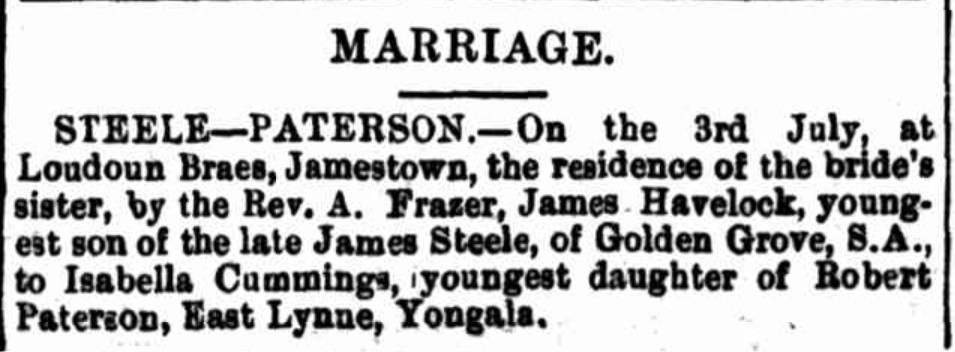
James and Isabella had six children:
- Katherine Blain (1891-1990)
- Robert Lindsay (Lin) (1891-1953)
- Annie Isabella (1893-1968)
- James Norman (1896-1916)
- Rosalie Edith (1898-1988)
- Christina (Crystal) Matilda Steele (1905- ? )
Many of the early families struggled to make a living in this agriculturally marginal region, but James and Isabella did well enough to continue to work on the farm - “Mr. Steele of Nackara has shown what can be done in dry districts. Young fruit trees are bearing heavily, the apples being large and sound, and the peaches will bear inspection and comparison.”
Source -NACKARA." Quorn Mercury 10 February 1914 p.3. http//nla.gov.au/nla.news-article213654837
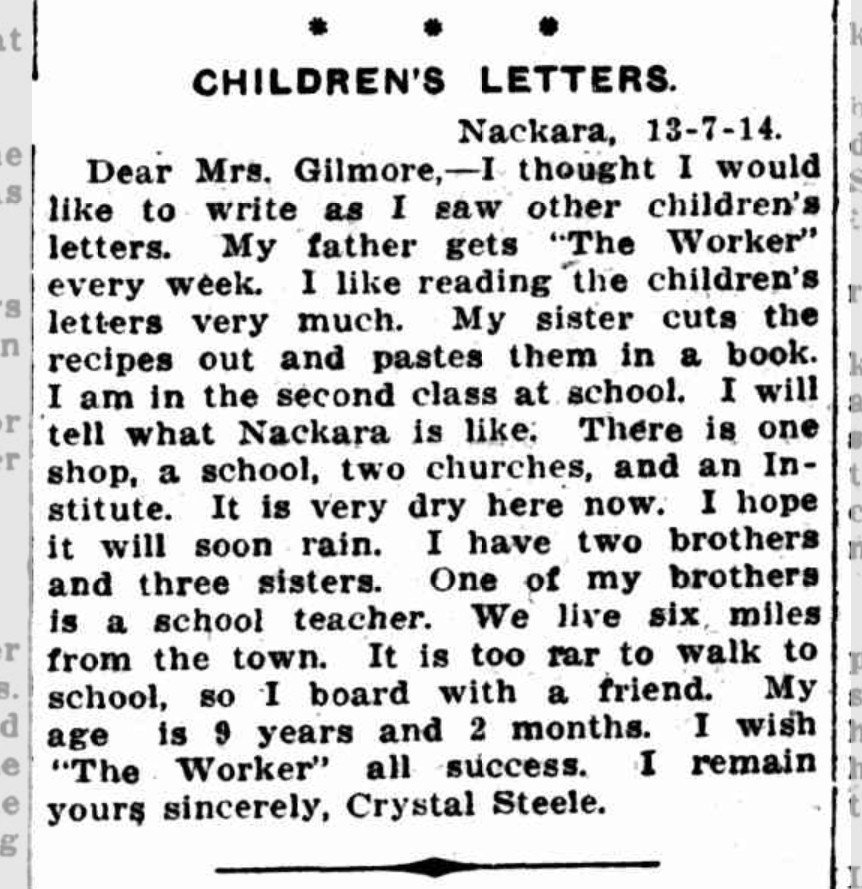
Despite their relative isolation, Norm grew up in a family which valued education. They all wrote letters to children’s and young people’s pages in newspapers, including ‘The Australian Worker’, a weekly Sydney publication of the Australian Worker’s Union. These letters, despite the youth of the writers, help to give an idea of their lives and what was important to them, often talking about other members of their family, daily incidents, their pets, and a revealing a preoccupation with the weather. An example is the letter from 9-year-old Crystal.
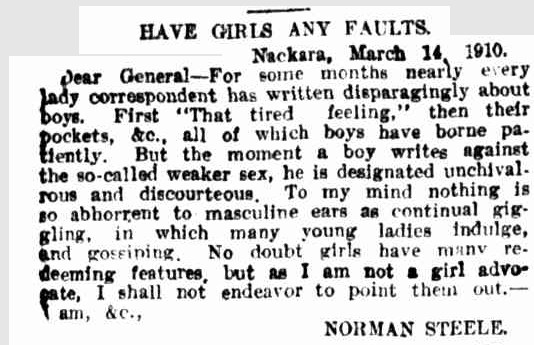
Norm also wrote, but less often. However, a 1910 letter from Norm just after his fourteenth birthday, probably written tongue in cheek, demonstrates intelligence, and a significant ability with the written word.
Norm attended Nackara School, and probably like his sister, boarded in Nackara during the week. The only record of his time at the school is of him winning the over 12s flat race at the Arbor Day Sports Day in 1910, but, as below, he did well academically. At the beginning of 1911, while still only fourteen, he was appointed as a ‘monitor’ at Oodla Wirra School, several miles south of Nackara, as part of the pupil-teacher system in place at the time.
The pupil-teacher system was an apprenticeship where bright students (as young as 14) taught younger students (on a very low wage) during the day and received tutoring from the head teacher before and after school. Many pupil-teachers failed to continue, often given high teaching loads at the expense of their own learning, but in July Norm passed an exam and became a registered candidate for pupil-teachership, still posted to Oodla Wirra.
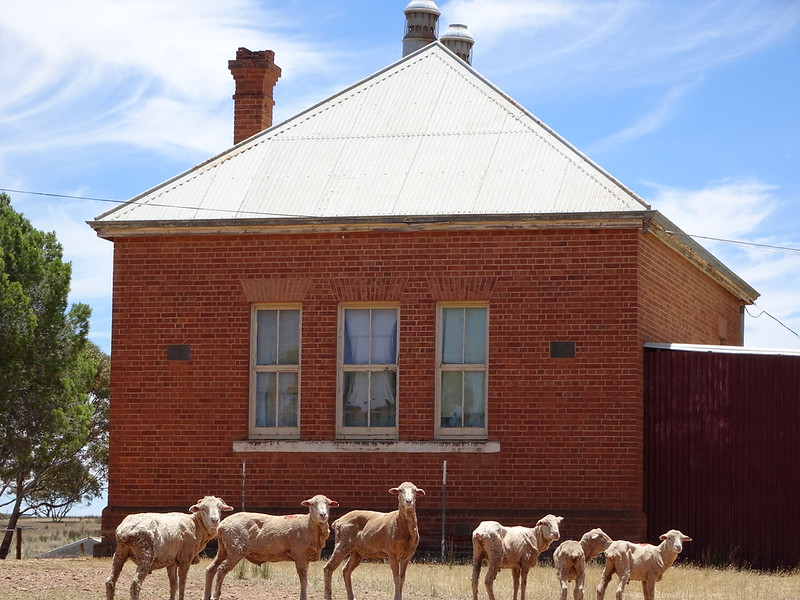
He went on to attend Muirden College in Adelaide, which had classes to prepare students for teaching exams. In 1914 he was appointed as an assistant teacher at Solomontown school in Port Pirie, where he was teaching when he enlisted. He was highly regarded as a teacher, being studious and devoted to his work. Norm must have developed an affinity with the Oodla Wirra community while he was there. In January 1913, he played for Oodla Wirra in a cricket match against Nackara, scoring two runs in each innings.
Off to War
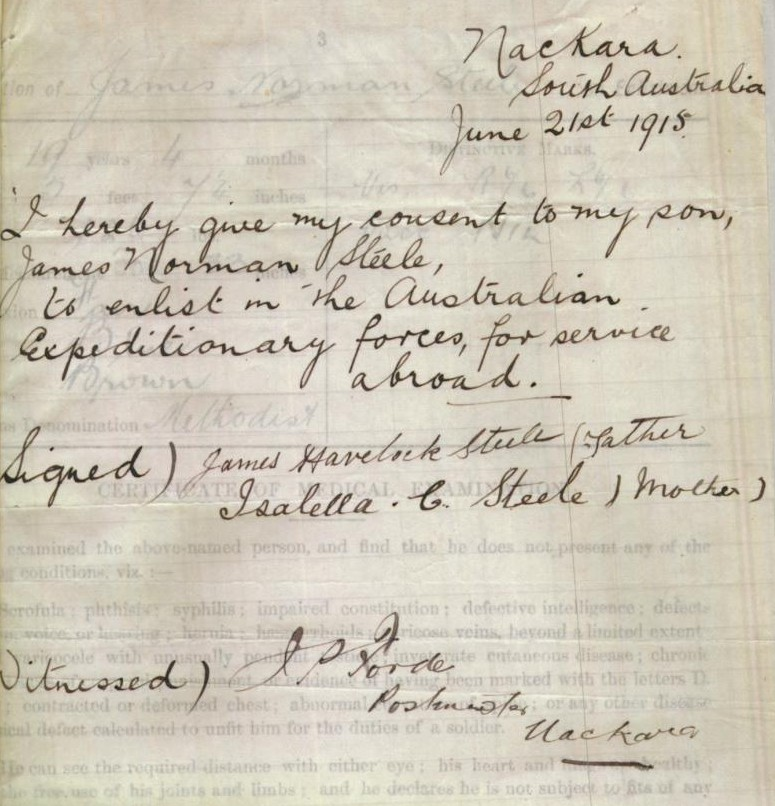
In July 1915 there was a surge in enlistment in the AIF as, in the wake of the landing at Gallipoli, men decided that it was their duty to fight ‘for the Empire’. Norm and his older brother, Robert Lindsay (Lin) Steele, enlisted together at the beginning of July. As Norm was not yet 21, he had to get his parents’ approval to enlist. Both brothers named their mother, Isabella, as their next of kin.
They reported to Mitcham Camp. Lin Steele was assigned to the Australian Medical Corps and Norm to the 32nd Battalion when it was formed in mid-August. He became a member of B Company. A and B Companies were men from South Australia, while C and D Companies were to be from Western Australia.
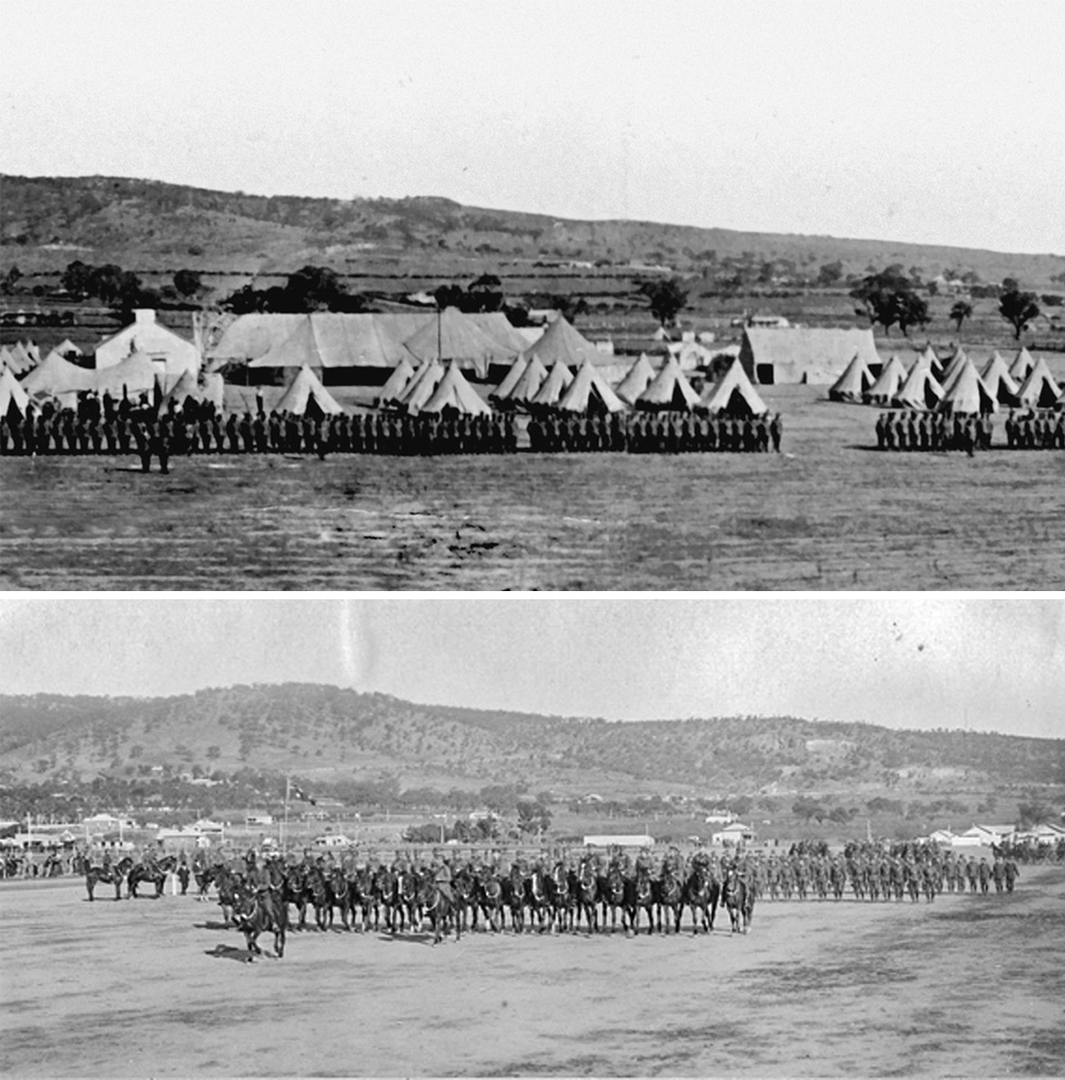
There was much fanfare about this new battalion in South Australia, with gatherings, community support, Cheer-up Society activities, reviews of the troops by the governor, and parades through the streets of Adelaide. On 16 September, the South Australian members of the Battalion moved to a new camp at Cheltenham Racecourse, and they were joined at the end of September by the West Australians who had begun their training at Blackboy Hill near Perth. Training for all continued at Cheltenham until departure.
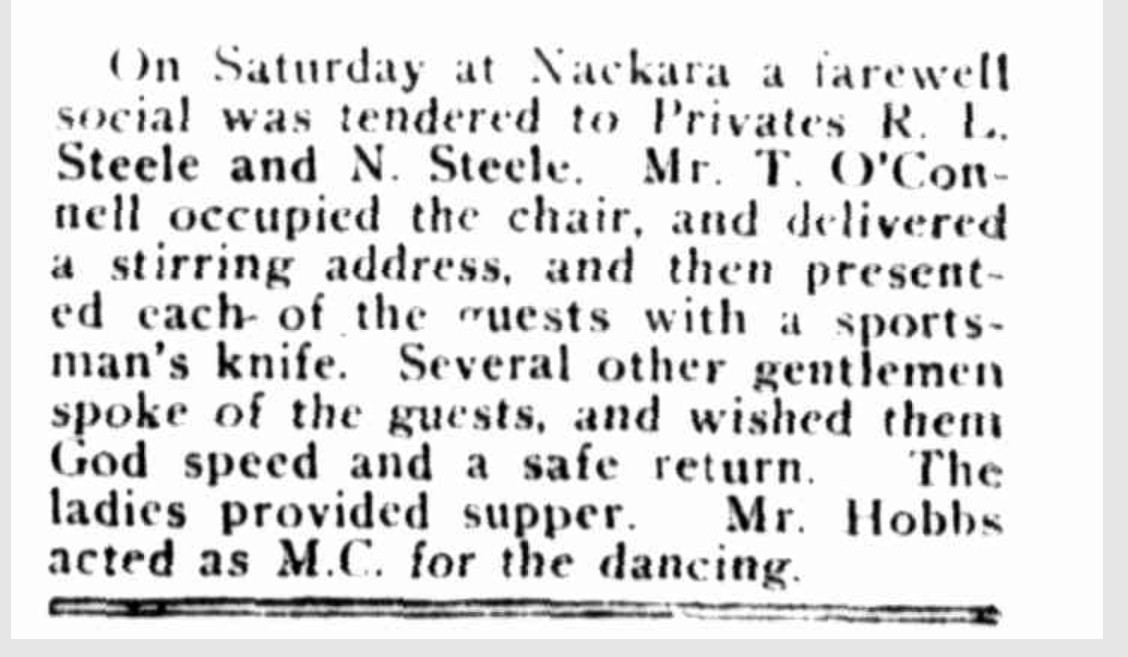
As the time approached for departure of the 32nd Battalion, many men were given leave so they could be farewelled by their local communities. On 9 October 1915, Norm and his brother were given a farewell social at Nackara.
Most of the Battalion, including Norm, departed for Egypt on 18 November 1915, HMAT A2 Geelong, the transport section had left ten days earlier on HMAT A13 Katuna.
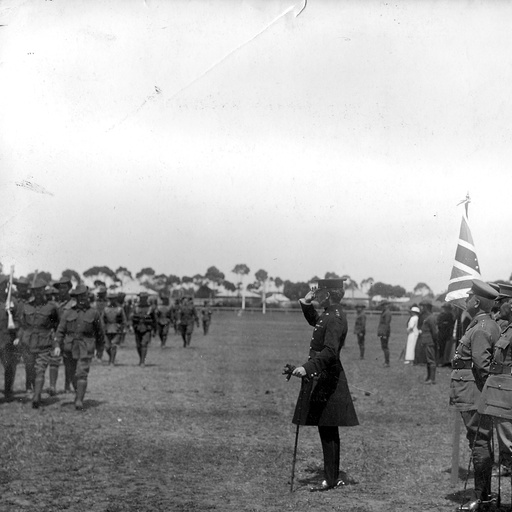
As reported in The Adelaide Register:
“The 32nd Battalion went away with the determination to uphold the newborn prestige of Australian troops, and they were accorded a farewell which reflected the assurance of South Australians that that resolve would be realized.”
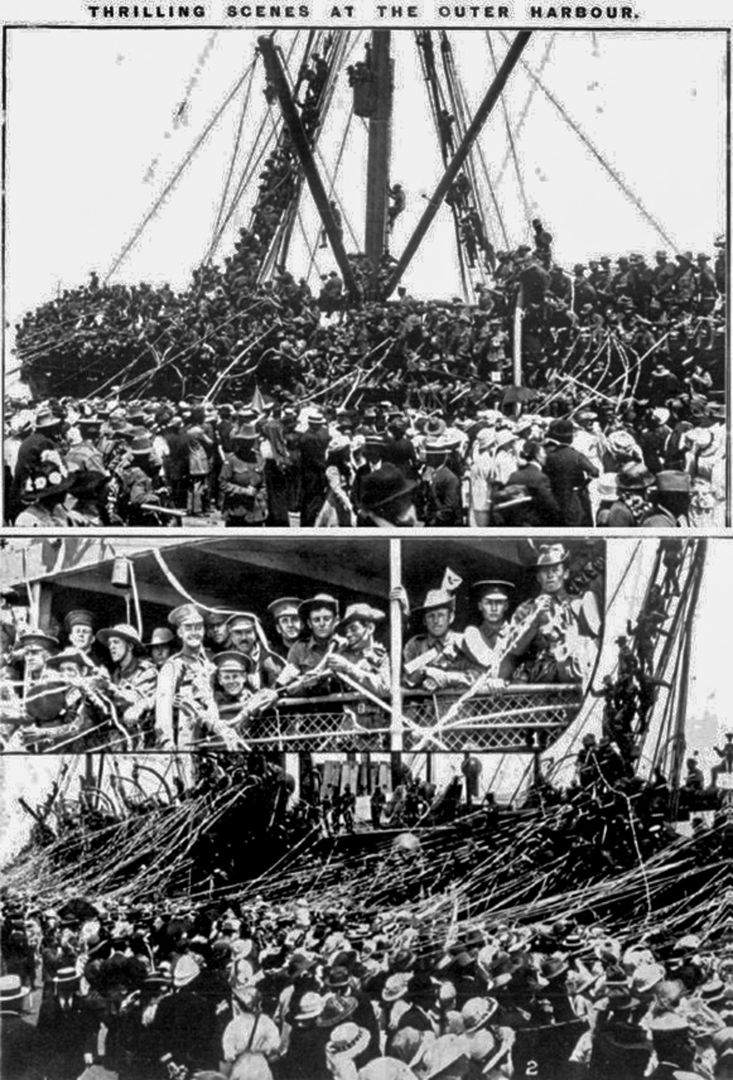
The 32nd arrived in Suez on 14 December 1915 and moved to El Ferdan just before Christmas to guard the east bank of the Suez Canal. A month later they marched to Ismailia and then to the major camp at Tel-el-Kebir where they stayed for February and most of March. Tel-el-Kebir was about 110 km northeast of Cairo and the 40,000 men in the camp were comprised of Gallipoli veterans and the thousands of reinforcements arriving regularly from Australia.
A tragic accident in Egypt
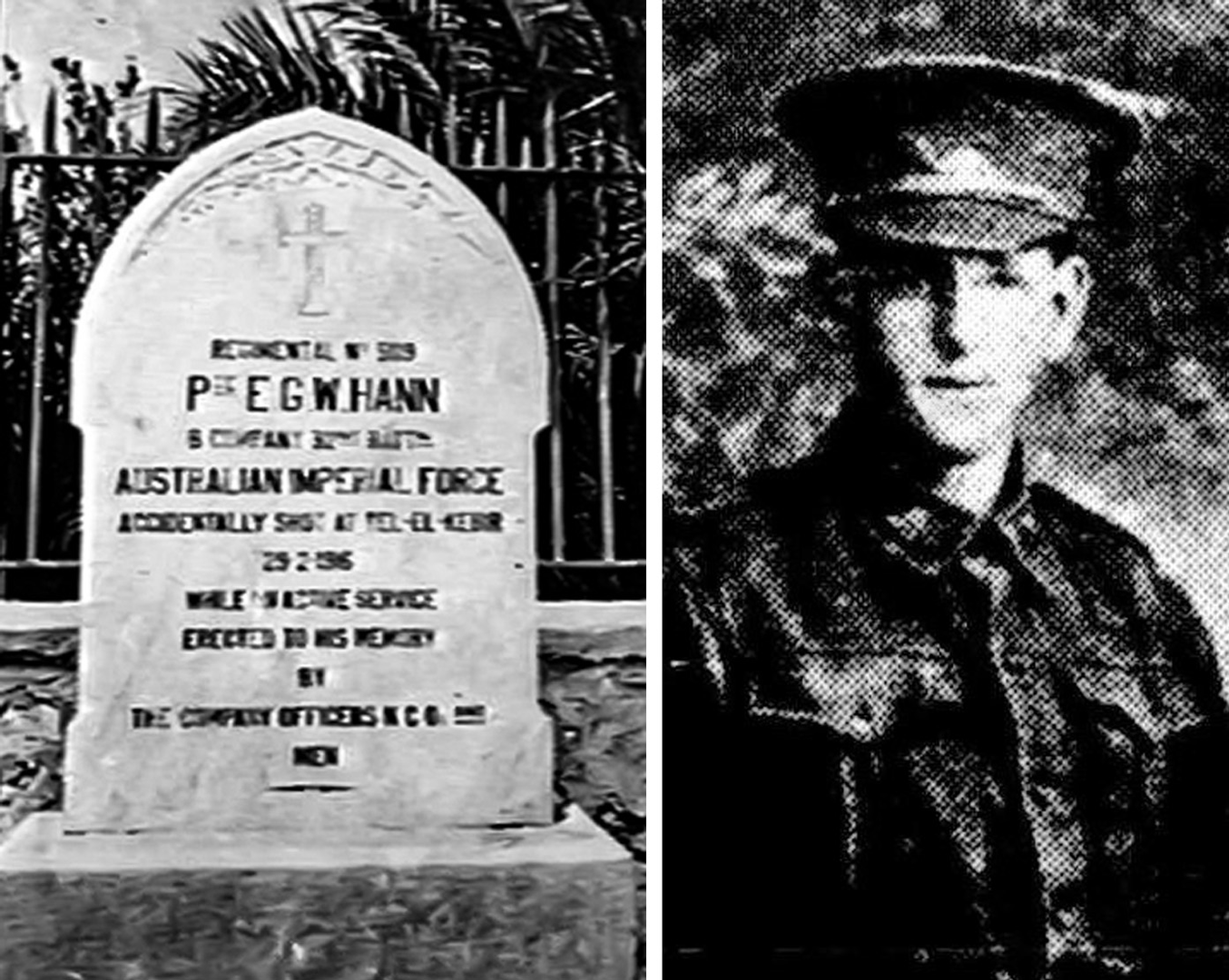
Early on 29 February 1916 at Tel-el-Kebir, an horrific training accident occurred which directly involved Norm Steele. Norm and the other men from 13 Section of Lt. Percy Hagan’s 8th platoon of B Company were training in rapid loading and aiming from a prone position, using blank ammunition. The men worked in pairs, observing each other’s fire at a distance of four paces with an aiming disc which was held up to the eye. Norm was paired with 509 Ernest George William Hann, a twenty-one-year-old dairyman from Magill. Somehow a live round was distributed to Norm, and George Hann was killed by a bullet through the eye.
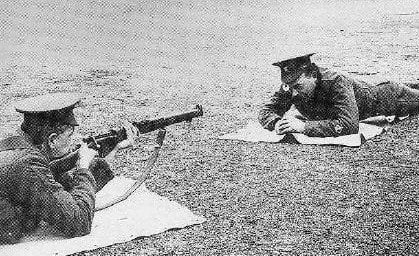
We can only try to imagine the effect that this tragedy had on Norm who had, through no fault of his own, not only shot one of his mates through the head, but witnessed the death from close range. A transcript of the Court of Enquiry (held on the same day as Hann’s death) is in Hann’s file. It is difficult to believe that Norm’s evidence was quite as calm and coherent as presented. In part, it reads:
“On the command ‘Five rounds, rapid fire’, I aimed at the disc held by Hann. After my first shot, Pte. Hann made some joking remark about my shooting and we both laughed. After my second shot I declared my point of aim. As I pressed, I found that this was a live cartridge. I realised that Pte Hann had been shot but felt quite dazed and I cannot remember what happened immediately after.”
‘Dazed’ is probably a very mild word to describe Norm’s feelings. The Court of Enquiry found that all necessary precautions had been taken and no blame could be attributed to anyone. This may have been scant relief for Norm Steele. No doubt he was treated with appropriate sympathy and reassurance, but there is no mention of the event in his file, and he would not have received the counselling, support and recovery time which would be given today. Norm’s brother, Lin, was also stationed at Tel-el-Kebir at the same time may have provided some extra support.
Unsurprisingly, in the words of fellow B Company man Vic Goldney, the tragic accident threw “a gloom over the whole company”. B Company practised the slow march and reversing arms before the whole battalion attended Hann’s burial with full military honours at Tel-el-Kebir. “Never before did the Last Post seem to have such meaning as when we stood and heard it played over the grave of a dead comrade.”
Source - World War 1 Diaries of Private Victor Goldney, privately published by D.V. Goldney, 2018 p.11
A headstone was erected over his grave by the officers, NCOs and men of B Company.
Off to the Western Front
The battalion’s next stop was at Duntroon Plateau and then at Ferry Post until the end of May where they trained and guarded the Suez Canal. Their last posting in Egypt was a few weeks at Moascar.
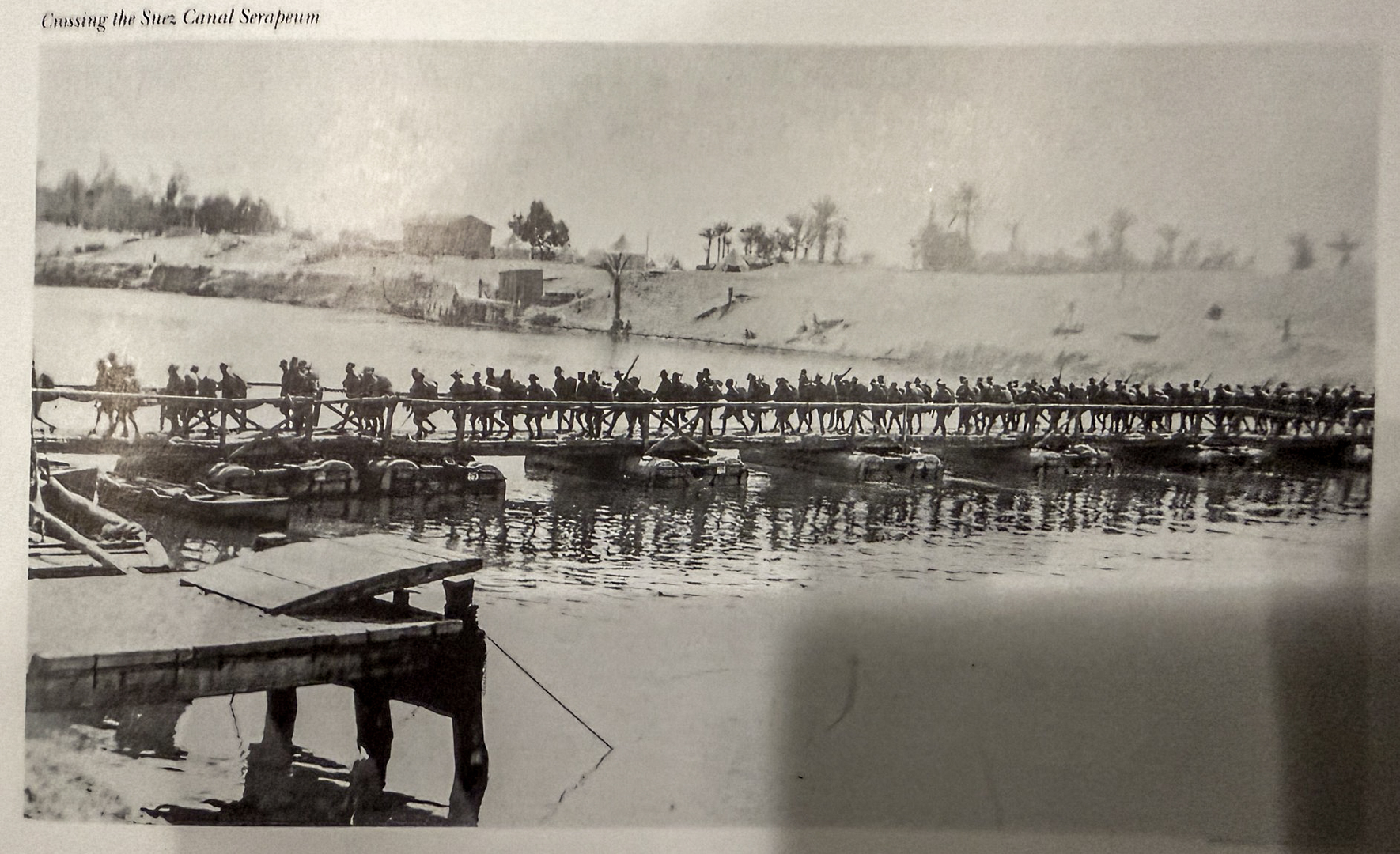
One soldier’s diary complained of being “sick up to the neck of heat and flies”, of the scarcity of water during their long marches through the sand and he described some of the food as “dog biscuits and bully beef”. He did go on to mention good times as well with swims, mail from home, visiting the local sights and the like.
Source - AWM C2081789 Diary of Theodor Milton PFLAUM 1915-16, page 29, page 12
During their time in Egypt the 32nd had the honour of being inspected by H.R.H. Prince of Wales.
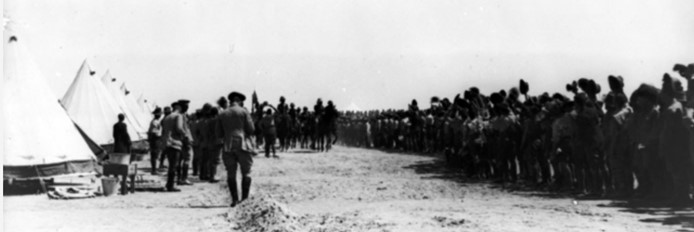
After spending six months in Egypt, the call to support the British Expeditionary Force on the Western Front came in mid-June. The 32nd left from Alexandria on the ship Transylvania on 17 June 1916, arriving at Marseilles, France on 23 June 1916 and they then immediately entrained for a three-day train trip to Steenbecque.
Their route took them to a station just out of Paris, within sight of the Eiffel Tower, through Boulogne and Calais, with a view of the English Channel, before disembarking and marching to their camp at Morbecque, about 30 kilometres from Fleurbaix. Theodor Pflaum (No. 327) and Wesley Choat (No. 68) wrote about the trip:
“The people flocked out all along the line and cheered us as though we had the Kaiser as prisoner on board!!” – Theodore Pflaum
“The change of scenery in La Belle France was like healing ointment to our sunbaked faces and dust filled eyes. It seemed a veritable paradise, and it was hard to realise that in this land of seeming peace and picturesque beauty, one of the most fearful wars of all time was raging in the ruthless and devastating manner of "Hun" frightfulness”. – Wesley Choat
They were headed to the area of Fleurbaix in northern France which was known as the ‘Nursery Sector’ – a supposedly relatively quiet area where inexperienced Allied troops could learn the harsh realities of Western Front trench warfare against the Germans. But the quiet times did not last long. Training continued with a focus on bayonets and the use of gas masks, assuredly with a greater emphasis, given their position near the front. The 32nd moved to the Front on 14 July and Tom was into the trenches for the first time on 16 July, only three weeks after arriving in France.
The Battle of Fromelles
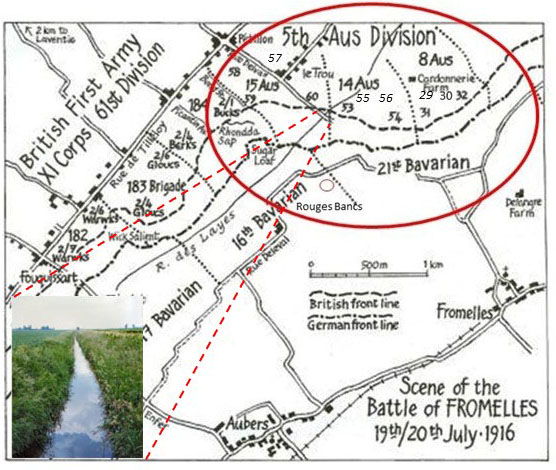
Inset - River Layes from the Australian Front Line looking towards the Sugar Loaf
The overall plan, as part of campaign in the Somme, was to use brigades from the Australian Fifth Division to conduct a diversionary assault on the German trenches at Fromelles. The 32nd Battalion’s position was on the extreme left flank, with only 100 metres of No Man’s Land to get to the German trenches. As they advanced, they were to link up with the 31st Battalion on their right. However, their position made the job more difficult, as not only did they have to protect themselves while advancing, but they also had to block off the Germans on their left, to stop them from coming around behind them. D Company’s Lieutenant Sam Mills’ letters home were optimistic for the coming battle:
“We are not doing much work now, just enough to keep us fit — mostly route marching and helmet drill. We have our gas helmets and steel helmets, so we are prepared for anything. They are both very good, so a man is pretty safe.”
On the 17th the battalion were reconnoitring the trenches and cutting passages through the barbed wire, preparing for an attack, but it was delayed due to the weather. On the morning of the 18th, A Company and C Company went into the trenches to relieve B and D Companies, who rejoined the next day. Lieutenant Frederick Stolz described the calm before the storm:
“The fellows were wonderfully cool and not during the whole time did I see anyone get excited or do anything silly, and such a lot were only young boys of between 18 to 20.”
The Zero Hour for advancing from their front-line trenches was to be 5.45 PM, but the Germans knew this attack was coming and were well prepared. They opened a massive artillery bombardment on the Australians at 5.15 PM, causing chaos and many casualties. The charge over the parapet began at 5.53 PM. A and C companies were in the first and second waves to go. Norm’s B company, along with D company were in the third and fourth.
They were successful in the initial assaults and by 6.30 PM were in control of the German’s 1st line system (map Trench B), which was described as “practically a ditch with from 1 to 2 feet of mud and slush at the bottom”.
Source - AWM4 23/49/12, 32nd Battalion War Diaries, July 1916, page 11
Unfortunately, with the success of their attack, ‘friendly’ artillery fire caused a large number of casualties because the artillery observers were unable to confirm the position of the Australian gains. They were able to take out a German machine gun in their early advances but were being “seriously enfiladed” from their left flank.
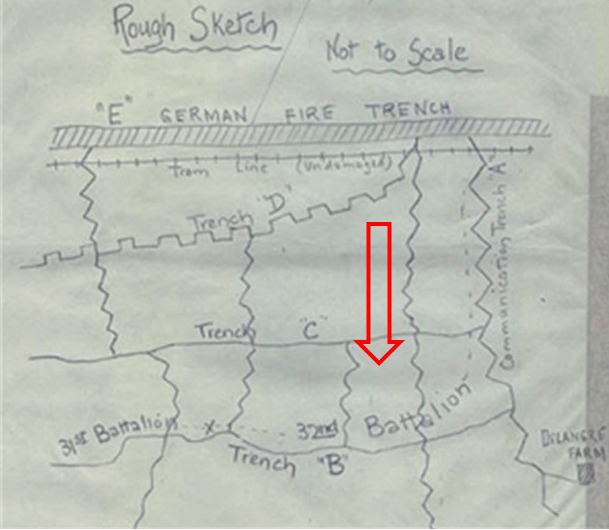
By 8.30 PM their left flank had come under heavy bombardment with high explosives and shrapnel. Return bombardment support was provided and the 32nd were told that “the trenches were to be held at all costs”.
Source - AWM4 23/49/12, 32nd Battalion War Diaries, July 1916, page 12
Fighting continued through the night. The Australians made a further charge at the main German line beyond Trench B, but they were low on grenades, there was machine gun fire from behind them from the emplacement at Delangre Farm and they were so far advanced that they were getting shelled by both sides. In the early morning of the 20th, the Germans began a counterattack from the Australian’s left flank, bombing and advancing into Trench A (map).
Given the Australian advances that had been made earlier, the rear Trench E had been left almost empty, which then enabled the Germans to regain that trench and envelop the men of the 32nd. At 5.30 AM the Germans attacked from both flanks in force and with bombing parties. Having only a few grenades left, the only resistance they could offer was with rifles:
“The enemy swarmed in and the retirement across No Mans’ Land resembled shambles, the enemy artillery and machine guns doing deadly damage.”
What was left of the 32nd had finally withdrawn by 7.30 AM on the 20th. The initial roll call count was devastating – 71 killed, 375 wounded and 219 missing, including Norm. The devastation remained visible long after the fighting had ended. When Charles Bean, Australia’s official war historian, attended the battlefield, two and half years later, he observed a large quantity of bones, torn uniforms and Australian kit still on the battlefield. The final impact was that 228 soldiers of the 32nd Battalion were killed or died from wounds sustained at the battle and, of these, 166 were unidentified.
Lieutenant Sam Mills survived the battle. In his letters home, he recalls the bravery of the men:
“They came over the parapet like racehorses……… However, a man could ask nothing better, if he had to go, than to go in a charge like that, and they certainly did their job like heroes."
After the Battle
About 85 of the 32nd Battalion were casualties at Fromelles, killed, wounded or taken prisoner. In the immediate aftermath, there was much confusion and great difficulty in working out what had happened to each man. No record or eye-witness account survives to give any indication about what might have happened to Norm during the battle. Although he has no known grave, there must have been sufficient evidence by 28 July for him to be declared as having been killed on 20 July, rather than being listed as missing.
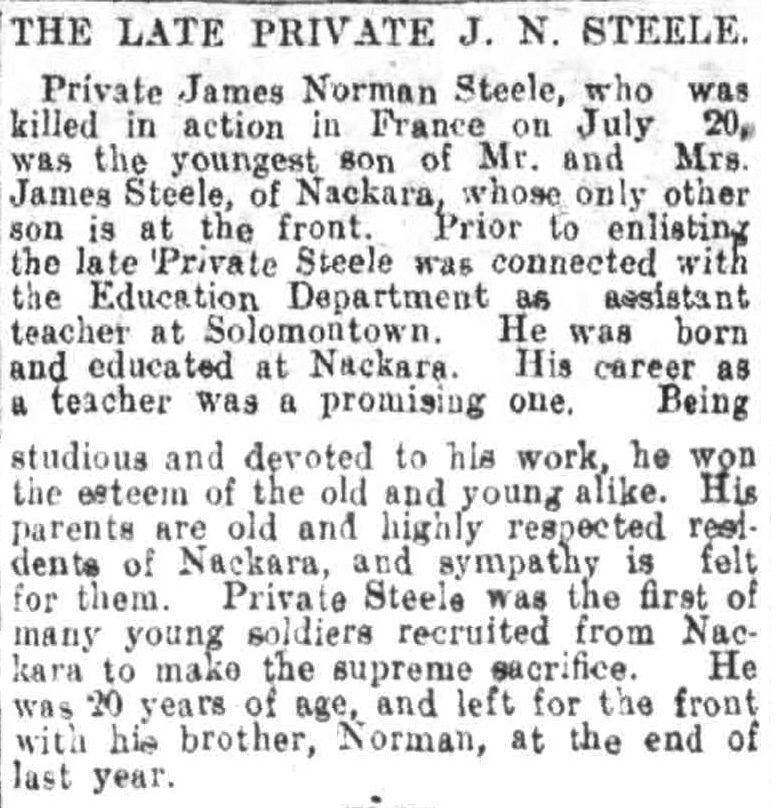
Many of his comrades were not formally declared as having been killed in action for up to a year after the battle. While declared as being killed in action on 28 July, it was not until the middle of September that Norm’s parents were informed of his death. They placed a death notice in Adelaide newspapers and followed it with Norm’s biographical details and a photograph.
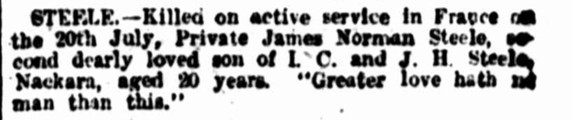
A newspaper article also noted his death.
A year after his pasing, his family inserted a memorial notice in the papers.
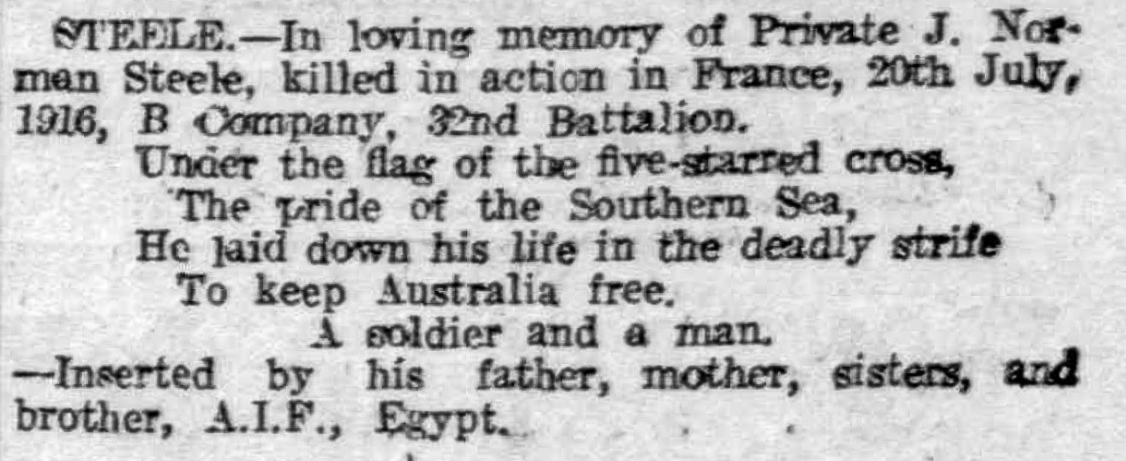
Norm was awarded the 1914-15 Star Medal, the British War Medal, the Victory Medal, a Memorial Plaque and a Memorial Scroll.
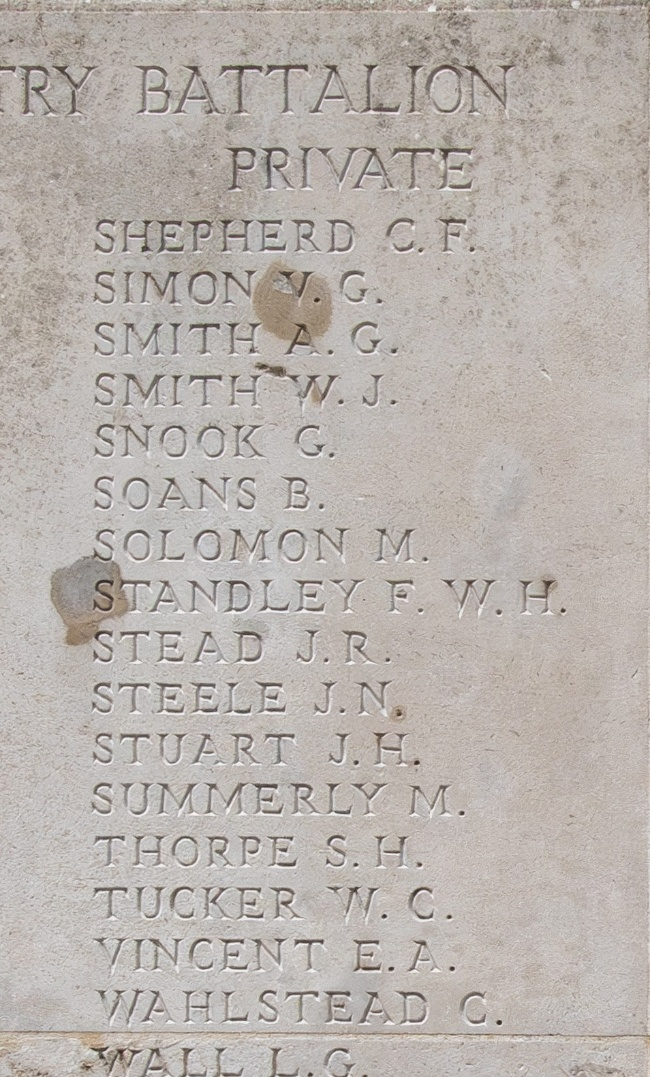
Norm is remembered on Panel 6 at the V.C. Corner Australian Cemetery which honours all Australians who died at Fromelles and who have no known grave, the Australian War Memorial Roll of Honour and the South Australian National War Memorial.
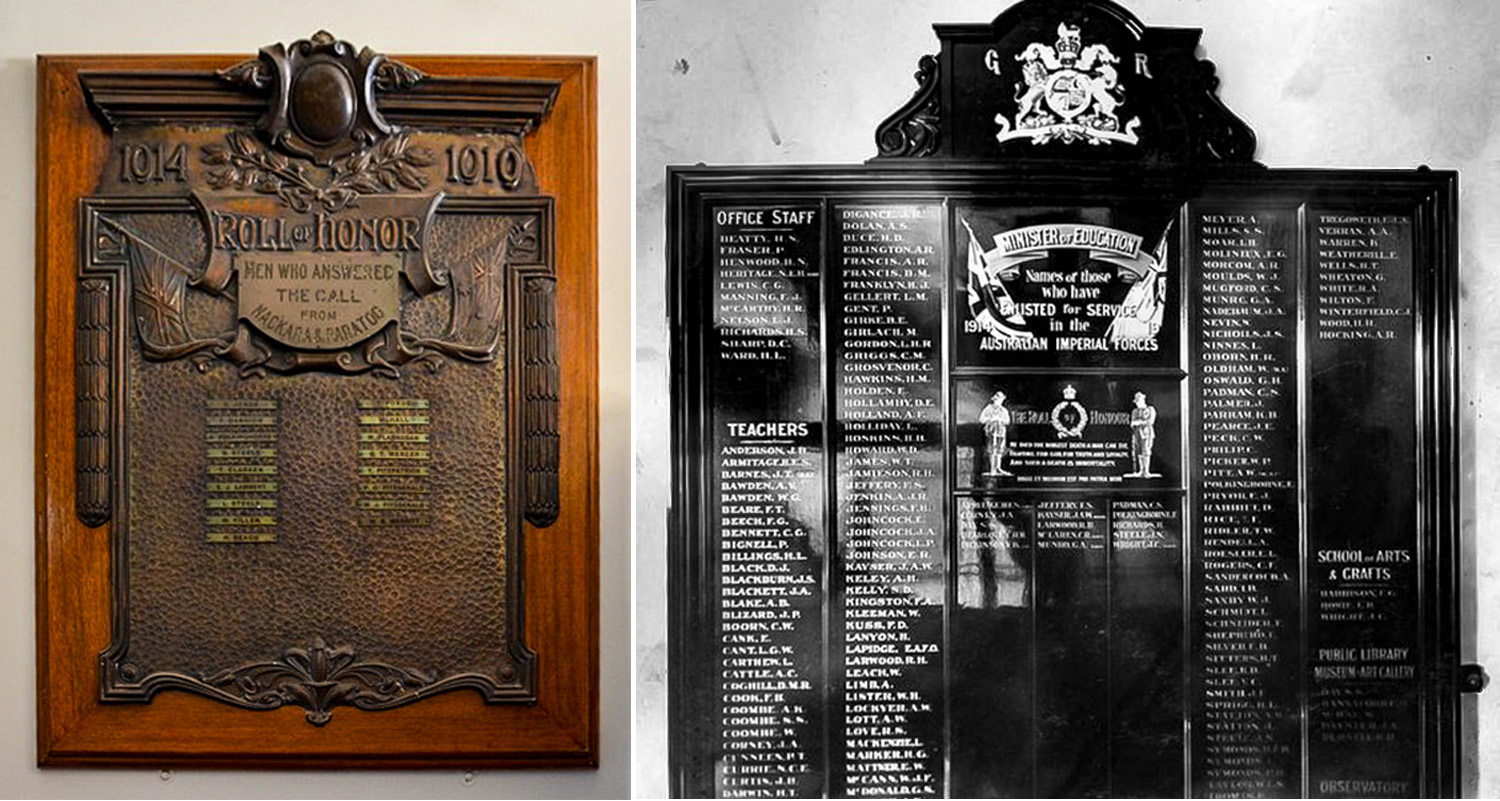
He also remembered by his local community on the Nackara and Paratoo Roll of Honour, which is now in the Peterborough Town Hall, the South Australian Education Department Roll of Honour and also at Muirden College.
Norm’s older brother, Lin (6253), who enlisted with Norm, was in the Australian Medical Corps. He served with the No. 2 Australian Stationary Hospital in Egypt until the end of the war, returning to Australia as a corporal.
Finding Norm
nNorm’s remains were not recovered; he has no known grave. After the battle, the Germans recovered 250 Australian soldiers and placed them in a burial pit at Pheasant Wood. This grave was discovered in 2008 and since then efforts have been underway to identify these soldiers by DNA testing from family members. As of 2026, 181 of the soldiers have been identified, including 41 of the 166 unidentified soldiers from the 32nd Battalion.
We welcome all branches of Norm’s family to come forward to donate DNA to help with his identification. If you know anything of family contacts in South Australia, please contact the Fromelles Association. We hope that one day Norm will be named and honoured with a known grave.
Please visit Fromelles.info to follow the ongoing identification project and Norm’s story.
DNA samples are being sought for family connections to
| Soldier | James Norman Steele (1896-1916) |
| Parents | James Havelock Steele (1858-1948) b. Old Shepherds Inn, SA d .Fullarton SA and Isabella Cummins Paterson (1865-1942) b. Copperhouse (Burra) SA d. Lower Mitcham SA |
| Siblings | Katherine Blain Steele (1891-1990) B. Nackara SA d. Fullarton SA never married | ||
| Robert Lindsay (Lin) Steele (1891-1953) b. Nackara SA d, Adelaide SA m. Rhoda Vera May Venning ((1893-1974) 2 children | |||
| Annie Isabella Steele (1893-1968) b. Yongala d. Fullarton , SA never married | |||
| Rosalie Edith Steele(1898-1988) b. Nackara, d. Mytrtle Bank SA never married | |||
| Christina Matilda (Crystal) (!905- ?) b. Nackara . d. unknown |
| Grandparents | |||
| Paternal | James Steele (1815-1863) b. Forfar, Scotland, d. Golden Grove and Ann Hennessy (c1818-) b. Cheshire, England | ||
| Maternal | Robert Paterson (1819-1908) b. Scotland d. Yongala SA and Elizabeth Paterson (1823-1895) b. Scotland, d. Yongala SA |
Seeking DNA Donors

Contacts
(Contact: carla@fromelles.info or geoffrey@fromelles.info).
(Contact: army.uwc@defence.gov.au or phone 1800 019 090).
Donations
If you are able, please contribute to the upkeep of this resource.
(Contact: bill@fromelles.info ).