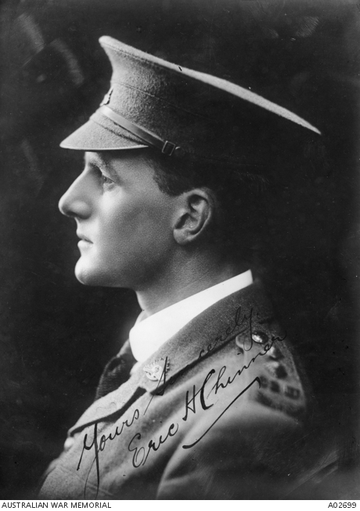
Eric Harding CHINNER
Eyes unknown, Hair dark, Complexion fair
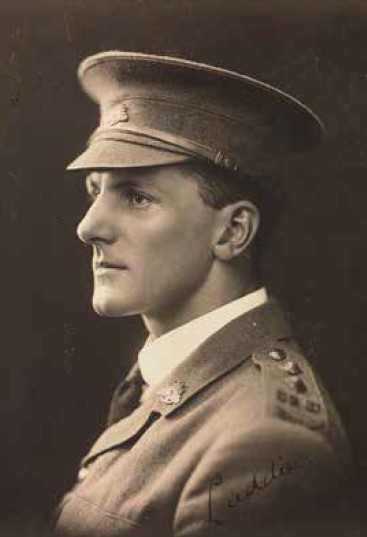
Eric Harding Chinner — "a better officer and a better man."
With thanks to Carew, Ann. “Matchless son and brother: Eric Harding Chinner.” The La Trobe Journal, No. 98, September 2016 and the State Library Victoria
Early Life
Eric Harding Chinner was born on 15 January 1894 at Petersburg (now Peterborough), South Australia, the son of Thomas Henry Chinner (1857–1938) and Sarah Thyer (1857–1947).
Children of Thomas and Sarah:
- Leslie Mervyn (1883–1964) married Alice Eveline Eakins
- Wilfred Clive (1884–1967) – Australian Army Ordnance Corps during WW1 married Linda Maude Cocking
- Cyril Henry (1887–1965) married Mrytle Betteridge
- Ivy Vivean Eleanor (1889–1983) married James Bills
- Ebenezer (1892–1892) died infancy
- Eric Harding Chinner (1894–1916) 32 Btn, KIA Fromelles
- Thomas Lloyd Chinner (1895–1976) married Vera Jane Matthew
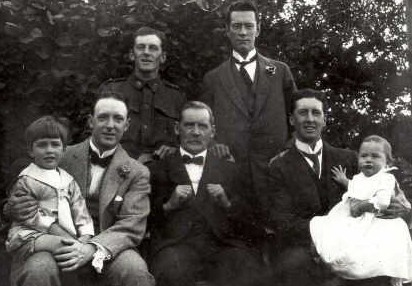
Eric came from a prominent South Australian Baptist family whose roots stretched back to early English settlers from Northamptonshire. Members of the Chinner family migrated to South Australia during the nineteenth century as part of the Baptist settlement movement encouraged by George Fife Angas. Over generations the family became closely associated with church life, music, education, and public service.
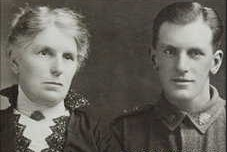
Eric’s father, Thomas Henry Chinner, was a respected businessman and civic leader in Petersburg. During the Boer War era he served as Mayor of Petersburg and remained heavily involved in Baptist church activities, choirs, Sunday schools, and charitable organisations throughout his life.
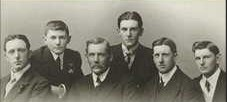
Front row Wilfred “Clive” Chinner , Thomas Henry Chinner (father) and Leslie Mervyn Chinner
Eric grew up in this deeply religious and community-minded environment. He was educated at Prince Alfred College in Adelaide, where he excelled academically and became well known in sport and school activities. In 1909 he passed the junior commercial examination and achieved first place in the honours list for bookkeeping. Eric was educated at Prince Alfred College in Adelaide, where he excelled academically and enthusiastically embraced school life. In 1909 he passed the Junior Commercial Examination, gaining first place in the honours list for bookkeeping. He also participated in sport, cadets and many school activities, and later remained proudly connected to the College as one of its "Old Reds".
After leaving school he joined the Bank of Adelaide as a clerk, where he met fellow employee Gladys Dunn. Their friendship gradually developed into a courtship, and before Eric left for war the young couple planned to marry. As a farewell gift, Eric presented Gladys with a gold locket engraved with his initials and the Prince Alfred College crest, containing a tiny hand-coloured portrait of himself. Gladys treasured the locket for the remainder of her life. Military service had already become part of Eric’s life long before 1914. As a young man he spent four years in the cadet movement and attained the rank of lieutenant.
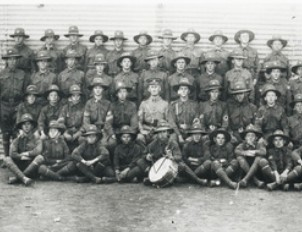
When war broke out in 1914, Eric was among the earliest volunteers from South Australia. Those who knew him remembered a cheerful, thoughtful and capable young man whose Christian faith, quiet confidence and genuine concern for others earned widespread respect. Years later, Eric's surviving letters would reveal an intelligent, observant young officer with an infectious sense of humour, an abiding love of his family, and an unwavering desire to become, in his own words, "a better officer and a better man."
Off to War
The 32nd Battalion was raised in August 1915 as part of the newly formed 8th Brigade, 5th Division. It was a composite unit, the right half of the battalion from South Australia, the left from Western Australia.
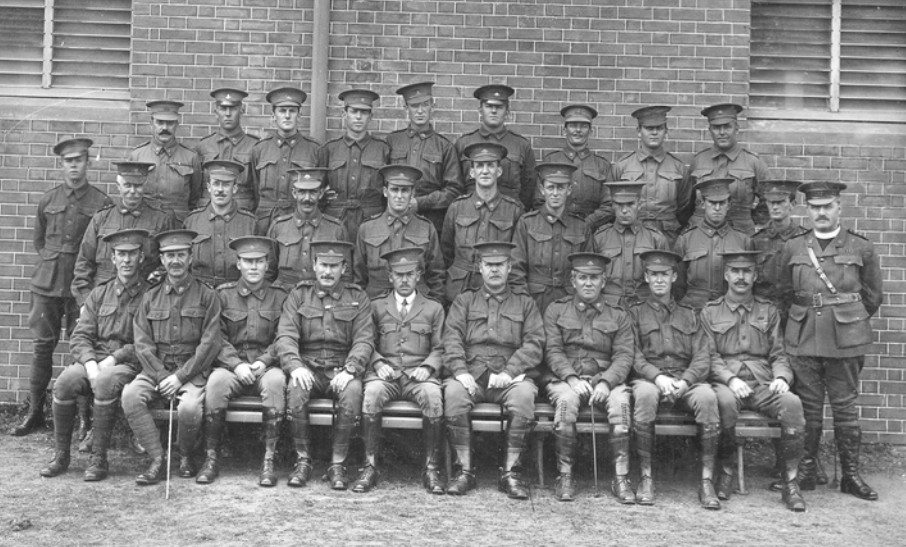
Training began at Mitcham Camp, Adelaide, where officers and recruits began to forge their identity as one fighting unit. Among the young officers appointed to the battalion was Eric., before joining the battalion, he completed officer training at Duntroon Military College and later attended the Machine Gun School at Randwick:
“A subaltern in the citizen forces when the war broke out, he was one of the earliest volunteers. His services were retained for training purposes. Later he was selected for a special course of two months at Duntroon Military College, and shortly after his return to Mitcham camp he was sent to Randwick (Sydney) machine gun school.”
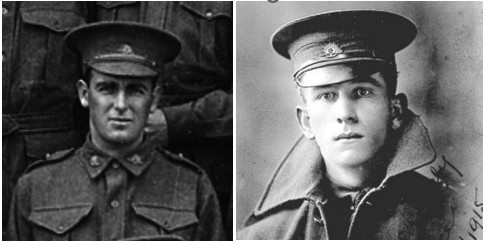
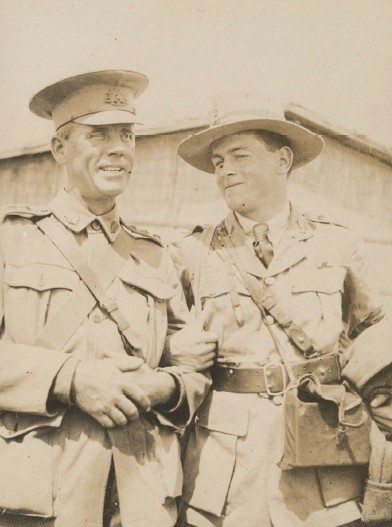
During training Eric formed a close friendship with fellow officer Lieutenant Thomas Percival (Perce) Hagan. The pair trained together at Duntroon and eventually served side by side in B Company of the 32nd Battalion:
“They were comrades before the war. They were chosen to go to Duntroon together, and they went to the front as close companions and fellow-officers in the same battalion.”
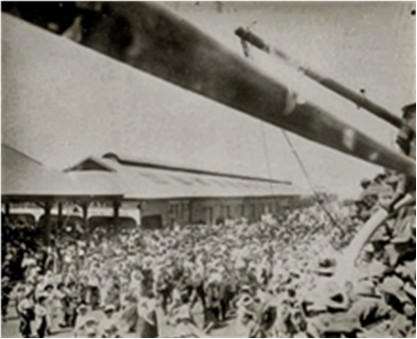
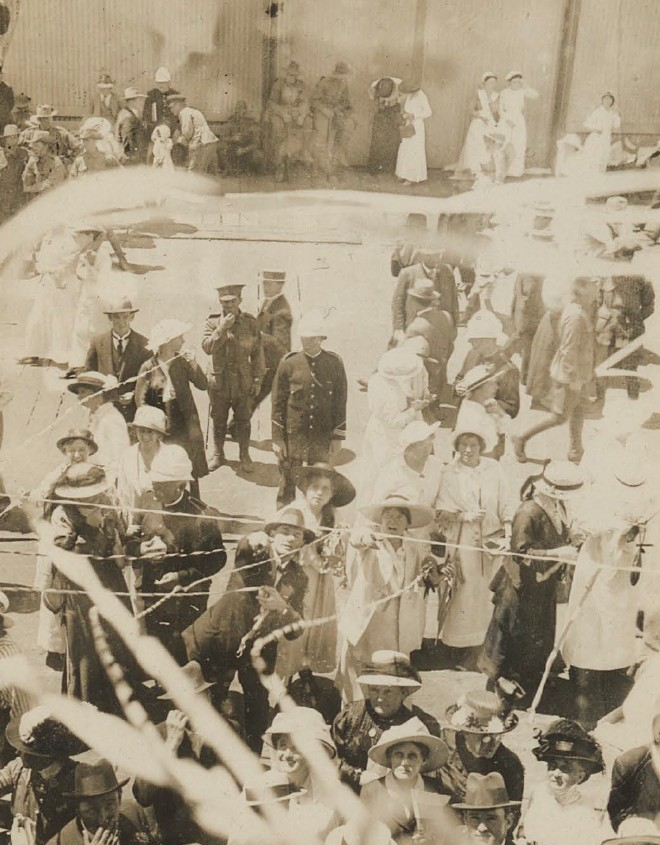
The battalion embarked from Outer Harbour, South Australia, on 18 November 1915 aboard HMAT A2 Geelong, disembarking at Suez a month later. Eric carried with him a Kodak camera which he used to photograph aspects of the voyage and military life overseas. Writing home during the journey, he reflected on finally seeing the wider world beyond Australia:
“On Wednesday we will see land. One of my boyhood’s dreams will come true. I shall see the coast of Africa. And then comes the Red Sea. Then the [Suez] Canal, and then well, I’ll have to wait and see, for that is all I know.”
“It is still hard for me to realise that I am to see other lands, other life, other nationalities, the wonders of this world. I’m lucky and I am thankful for the opportunity of seeing so much.”
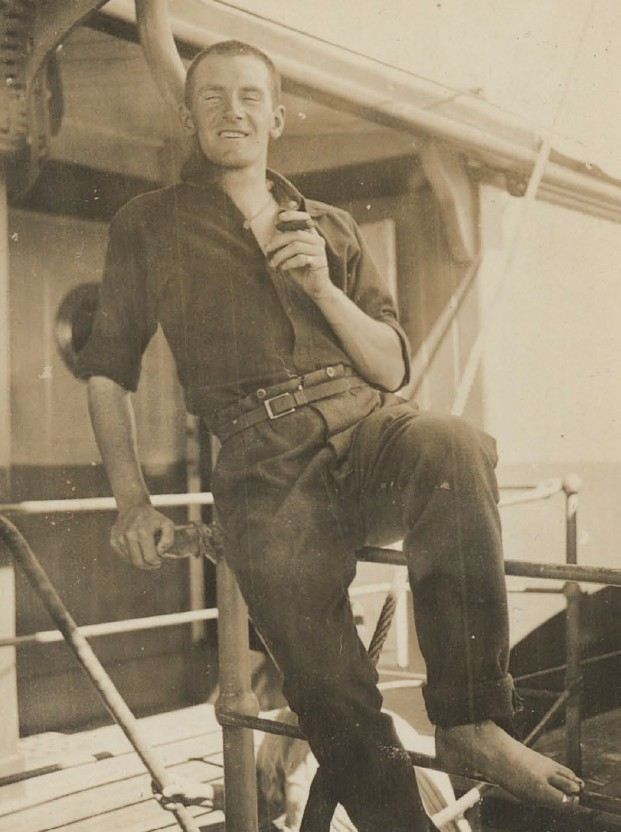
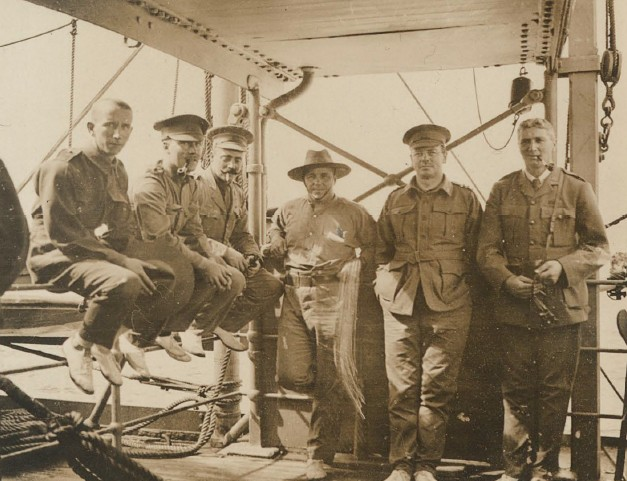
One constant throughout Eric's Egyptian letters was his friendship with Perce Hagan. The two had trained together before joining the 32nd Battalion and soon became tentmates. Writing during the voyage to Egypt, Eric affectionately described Perce as "the sunniest pal a chap could have." He laughed that whenever Perce was caught looking thoughtfully at a photograph from home, he would grin and say:
"Hard cheese, ain't it old man."
Separated briefly after arriving in Egypt, Eric was disappointed to find Perce exhausted after days of continuous duty "He has not had his clothes off for eight days and is completely exhausted." The two later enjoyed several days' leave together in Cairo, exploring the bazaars, the Pyramids, the Sphinx and Heliopolis before returning to camp. Their friendship was strengthened by shared values. Eric later wrote proudly:
"It's a great help to have a pal like Perce. We are very much support to each other because neither of us drinks, gambles or mixes with those who do."
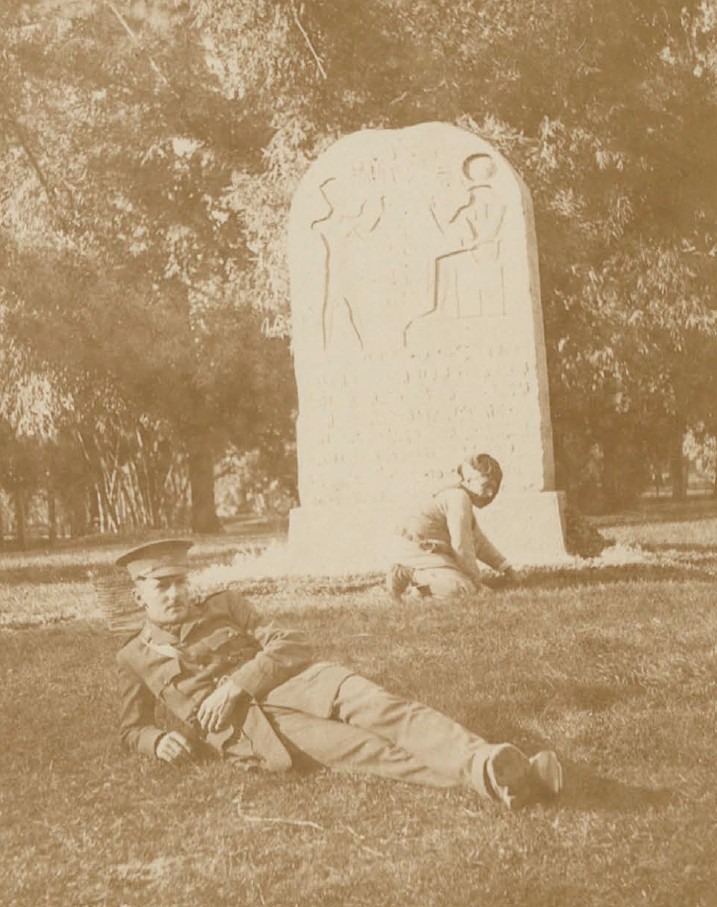
Egypt transformed Eric from an enthusiastic young officer into an accomplished platoon commander. He repeatedly attended specialist schools of instruction, achieving outstanding results. At Zeitoun he gained an overall mark of 96%, placing him amongst the highest-ranked officers in a class of more than 350. Promotion mattered to him, but responsibility mattered more. His letters reveal a remarkably modern philosophy of leadership. He believed officers should lead by example. He insisted on knowing every man personally.
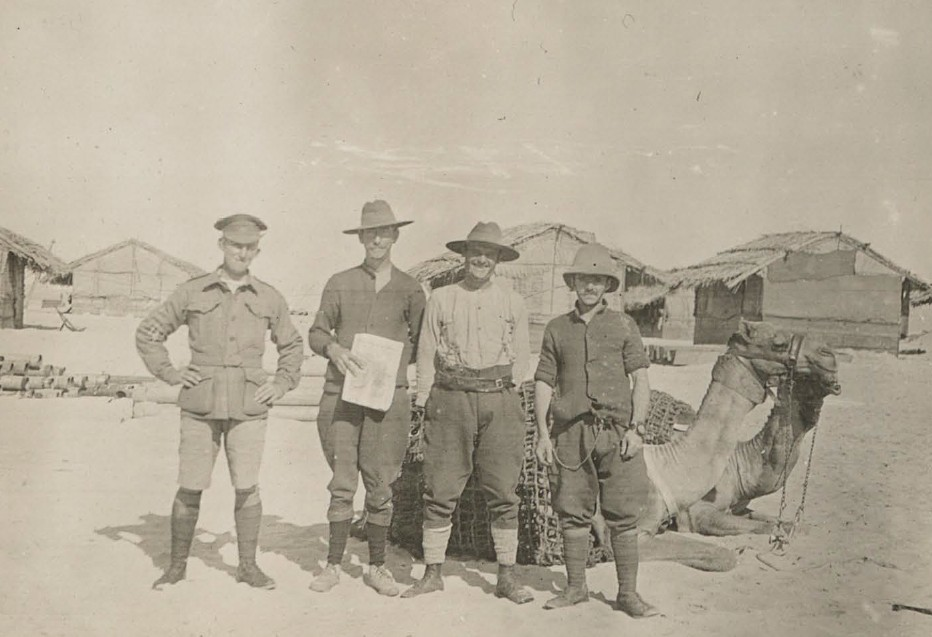
Describing his responsibilities as a platoon commander at Tel el Kebir, 16 May 1916:
I spend a great deal of time with my platoon.
I know every man by name.
I know who is sick.
I know who is worrying.
I know who needs encouragement.
I know who can be trusted with responsibility.
They are splendid boys.
I often think they deserve far more credit than they receive.
...The Australian soldier has faults. We all have. But when he is treated fairly he will do anything for you.
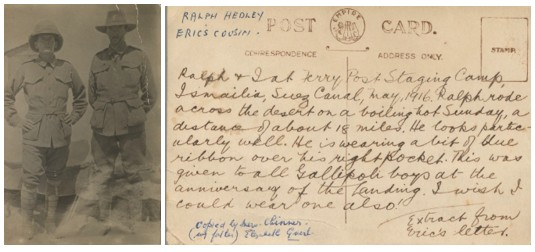
Eric also took a keen interest in the experiences of his cousin, Allan Ralph Hedley, who had served at Gallipoli. Writing from Terry Post near Ismailia in May 1916, Eric noted with pride that Ralph had ridden 18 miles across the desert and was wearing the blue ribbon presented to Gallipoli veterans on the first anniversary of the Anzac landing. "I wish I could wear one also," Eric confessed, reflecting his admiration for those who had already seen active service and his own eagerness to prove himself. Training in Egypt was relentless. Days commonly began before sunrise with physical training before long marches through deep sand, musketry, bayonet fighting, bombing practice, field engineering and tactical exercises.
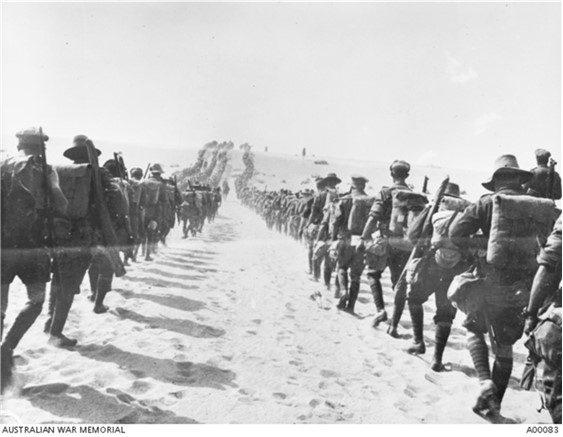
On one occasion Eric described marching nearly twenty miles in a single day. Writing to his brother he confessed:
"Dick old man, if they don't shift us out of this HELL very soon there won't be much of us left for them to shift."
Yet he rarely complained for long. Instead he marvelled at the beauty surrounding him. One evening he wrote "The moon... is shedding its soft light over the camp."
On another "The cool breeze will give place to a violent dust storm before the night is over." His letters constantly balanced hardship with wonder.
Source: Eric H. Chinner Papers, MS 11452, State Library Victoria.
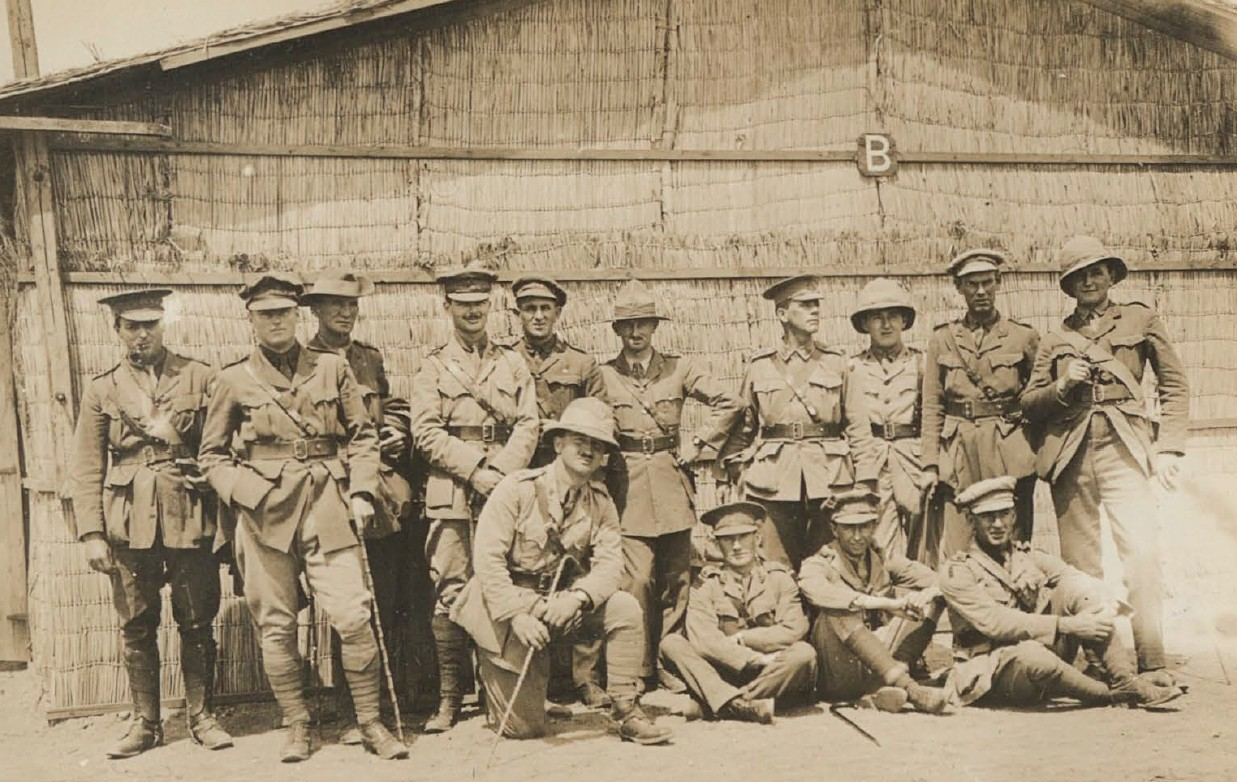
Eric took enormous pride in B Company. By the time the battalion prepared to leave Egypt he believed its officers had become an exceptionally close group. Writing home he described them with obvious affection "Capt Frank Lloyd is our boss (23), Capt Jack Hutchens... Lieut Jim O'Connor... Alan Campbell... Perce Hagan (21) and myself (22)." He joked that Captain Lloyd worked them so hard they were never allowed to eat until every man had been fed. Laughing with Perce, Eric recalled "Perce said that if we are torpedoed in the Mediterranean, the captain would want to know if our men are fed."
Source: Eric H. Chinner Papers, MS 11452, State Library Victoria. It was exactly the sort of humour that helped sustain morale.
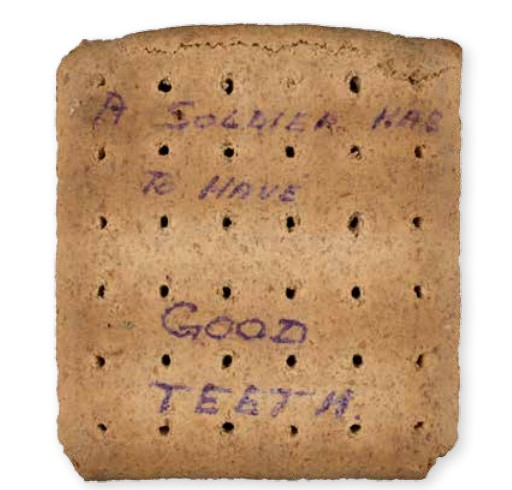
Despite the heat and monotony, Eric recognised that Egypt had prepared the battalion well. He admired commanders such as Birdwood and Tivey, celebrated the achievements of fellow officers, and wrote constantly of improving himself. When the order finally came to sail for France in June 1916, the battalion left Egypt confident, well trained and eager to prove itself.
France
In June 1916, the battalion boarded the Transylvania at Alexandria bound for France. After disembarking at Marseilles on 23 June 1916, the men travelled north by train through the French countryside where they were warmly welcomed by local civilians. Private Theodor Pflaum recorded:
The people flocked out all along the line and cheered us as though we had the Kaiser as prisoner on board!!
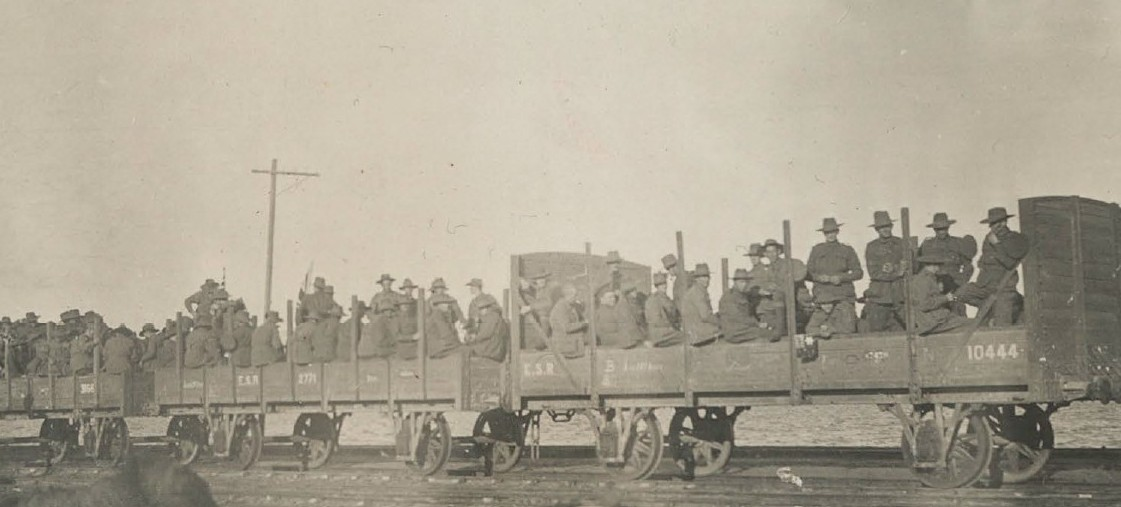
For many of the men, the change from the deserts of Egypt to the green countryside of France was unforgettable. Private Wesley Choat later wrote:
“The change of scenery in La Belle France was like healing ointment to our sunbaked faces and dust filled eyes. It seemed a veritable paradise, and it was hard to realise that in this land of seeming peace and picturesque beauty, one of the most fearful wars of all time was raging in the ruthless and devastating manner of 'Hun' frightfulness.”
By mid-July, the battalion had moved into billets near Estaires and Morbecque. On 14 July 1916 they entered the front area for the first time and on 16 July moved into the trenches at Bois Grenier opposite the German lines near Fromelles. While serving near the front, he attended an outdoor church parade where shells exploded nearby. The sermon left a lasting impression on him:
“The text was, ‘Yea, though I walk through the Valley of the Shadow of Death, I will fear no evil, for Thou art with me.’”
“Another land mine exploded during the padre’s sermon.”
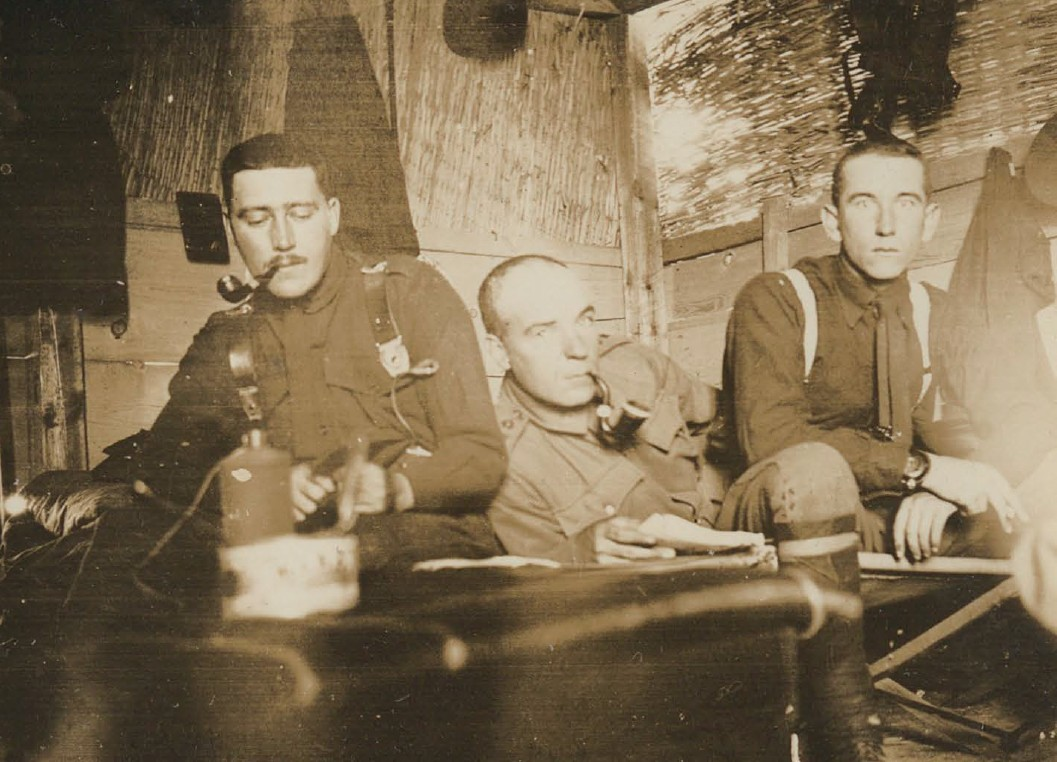
Writing home on 13 July 1916, Eric described the dangerous work of repairing trenches under shellfire:
“Yesterday Fritz was very annoying — smashed up our parapet, so today we have been patching up.” “Although I have been in the front line, I’ve done no fighting. Our battalion is the fatigue battalion for a week or so. That means we have to keep the trenches in good repair.” “The Tommies let them get very bad and we have a big job ahead of us to get them up to scratch.” “Goodbye darling parents. Fondest love from your soldier laddie.”
In another deeply personal last letter to his mother, Eric wrote:
“In your parcel there came a white carnation in my colours — they were what you wore on Mother’s Day.” “This book contains your photos. It is my treasure book and I always wear it over my heart”
Writing just days before the battle he wrote to his brother Clive:
"In a couple of days we are taking part in a great offensive. We are the first to go over the parapet, …Of course I'm a bit shaky but not very scared.”
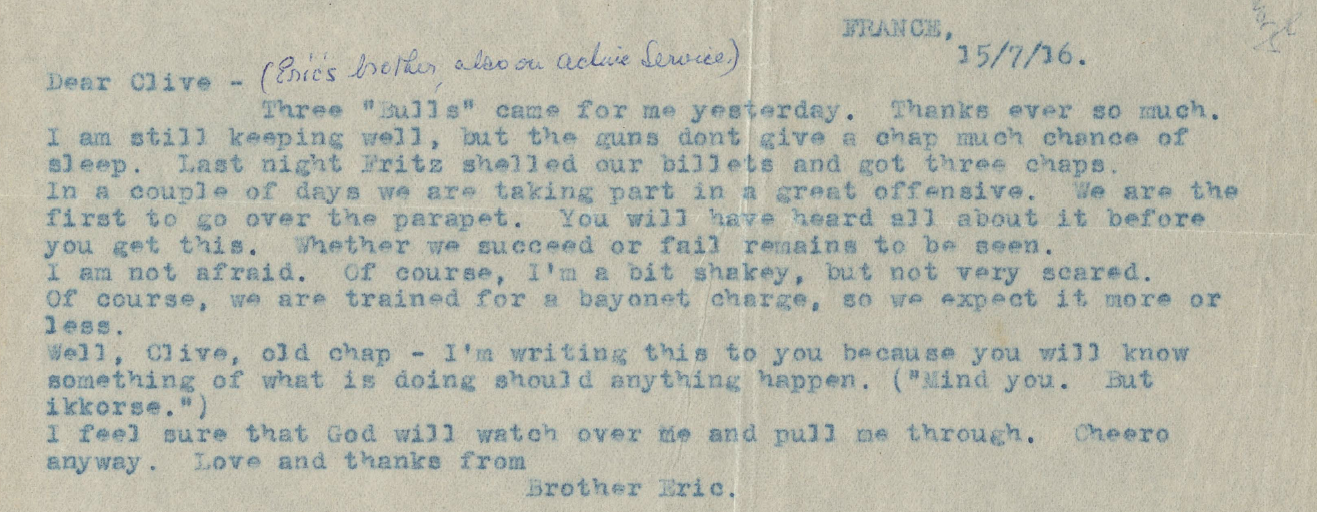
Those would be the last words Eric ever wrote to his family. Within forty-eight hours, he would lead his men into the 32nd Battalion's first battle on the Western Front.
The Battle of Fromelles
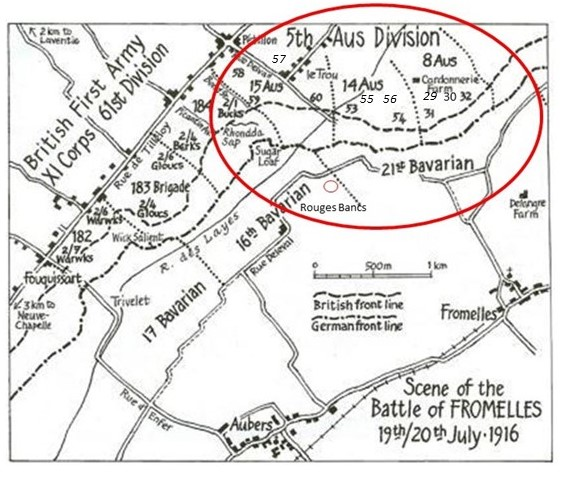
Only weeks after arriving in France, the 32nd Battalion was thrown into its first major action on the Western Front, the disastrous Battle of Fromelles on 19–20 July 1916. It would prove to be one of the bloodiest days in Australia's military history, and for the 32nd, a baptism of fire that decimated its ranks. The 32nd Battalion moved into the front area on 14 July and entered the trenches for the first time on 16 July in the Bois Grenier sector, just south of Armentières. The men began preparing for the planned attack by reconnoitring the German lines and cutting communication trenches through the wire. The assault was originally scheduled for 17 July but was delayed due to bad weather, leaving the men in position under increasing German shellfire.
Eric, serving with B Company, had recently completed specialist grenadier training and was appointed Brigade Bombing Officer shortly before the attack. The Australian 8th Brigade, including the 32nd Battalion was positioned on the extreme left flank of the attacking front. Their role was to advance across approximately 100 metres of No-Man's-Land, capture the German front-line system, and secure the left of the Allied line. Being on the flank added enormous risk: they would be exposed not only from the front, but also from the side and, ultimately, from behind. Private Frederick Stolz, later commissioned, remembered the composed attitude of the young soldiers around him just before the advance:
“The fellows were wonderfully cool and not during the whole time did I see anyone get excited or do anything silly, and such a lot were only young boys of between 18 to 20.”
At 5.45 PM on 19 July, the battalion was in position. The plan was for C and A Companies to move out first, followed by B and D Companies. Instead of charging immediately, the first two waves moved into No-Man’s-Land and lay down, waiting for the British artillery bombardment to lift. At 6.00 PM, the barrage lifted, and the order came to go forward. The 32nd rushed the German lines and encountered devastating machine gun and rifle fire from the front and left flank. Despite this, the battalion succeeded in capturing the first German trench system by 6.30 PM. Throughout the night, fighting continued as the Australians pressed on into the second line. However, the trenches were flooded and waist-deep in water, making movement and defence difficult. Private William Ludemann later wrote “They flooded it and the chaps were up to their waists in water all night.”
Source DIGGER 59, June 2017.
The situation rapidly deteriorated. As the 14th and 15th Brigades on the right failed to gain or hold ground, the 8th Brigade became dangerously isolated. Ammunition and grenades were running low. Enfilading machine gun fire from Delangre Farm raked the captured trenches. The 32nd was now under shellfire from both German and British artillery. During the fighting in the German trenches near Fleurbaix, Eric Chinner was killed while leading bombing parties. The exact circumstances remained unclear, with witnesses later giving differing accounts collected by the Australian Red Cross.
416 Orderly Room Sergeant Patrick.A. Ohlstrom later reported:
“Informant states that Lieut. Chinner was bombing Officer. A shell landed in the middle of the bombs at Fleurbaix on July 20th and he was blown to pieces.”
Private James Ballantyne of the 32nd Battalion gave another detailed account:
“I saw this officer killed by a high explosive shell in the first German line when we made the attack at Vermelles, South of Armentieres on the 19th July at 6 p.m.”
“He was killed just before it was dark at about 8.30 p.m. He must have been killed instantaneously. He seemed to fall down on his face.”
“We went on to the second line but we had to retire the next morning at daybreak to our own original line again, so his body was left out.”
“He was a very nice chap and much liked by his platoon. I knew him well because he was in next platoon to mine.”
1999 Private Basil John Cocking, Eric’s brother-in-law, later stated:
“This officer is my brother-in-law, and he went over with the Grenadiers.”
“A chap called Pte Morgan of the Grenadiers told me that he saw him severely wounded, and did not think he could possibly live.”
404 Lieutenant Frank Hardy later wrote directly to Eric’s father:
“Lieut. Chinner, in the act of throwing a bomb, received a bullet from the enemy through his wrist, which caused the bomb to fall, and he was killed instantly.”
At 4.00 AM on 20 July, the Germans launched a counterattack from the Australian left. The rear trench line, stripped of defenders to support the front, had been left almost empty. German forces exploited the gap and began to move in behind the 32nd’s forward position. By 5.30 AM, they attacked both flanks in force with bombing parties. Many men were trapped or cut off in the German trenches. Some attempted to hold out, while others tried to return under fire. One survivor, Private W.J. Martin of the 32nd, later gave this account to the Red Cross:
“Men were coming back any way they could, crawling, carrying mates on their backs. There were dead and wounded all over the ground; I never want to see such a sight again.”
The 32nd Battalion suffered 718 casualties out of approximately 800 men engaged, more than 90% of its front-line strength. It was one of the highest casualty rates of any Australian unit in a single day. Some companies were reduced to just a handful of survivors. Officers, NCOs, and men alike were killed, wounded, or missing. The losses reverberated across South Australia. Families in Jamestown, Laura, Clare, Gladstone, Mount Gambier and surrounding towns were devastated. The men of the 32nd had gone into their first major battle with determination and courage and paid the highest price.
After the Battle
In the days following the Battle of Fromelles, confusion surrounded Eric's fate. Like hundreds of other Australians lost during the fighting, he was initially listed as missing. On 31 July 1916, his father, the Reverend Thomas Henry Chinner received official notification:
Mr. T. H. Chinner received a telegram this afternoon from the military authorities at Melbourne, notifying him that his son, Lieut. Eric H. Chinner, had been posted as missing since July 20.
As reports slowly filtered back through hospitals, the Australian Red Cross, and official correspondence, conflicting accounts emerged. Some witnesses believed Eric had been killed instantly while leading bombing parties, while others believed he had been wounded before his death. German reports later suggested he had been wounded and died as a prisoner of war.
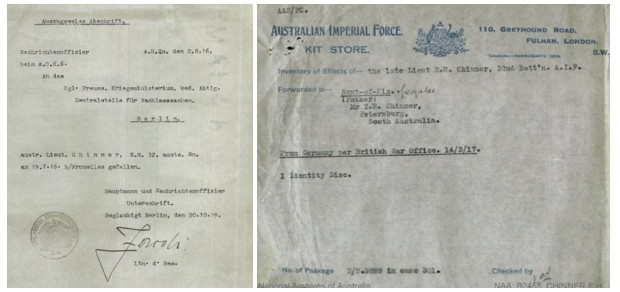
Correspondance from Germany started to filter through official channels:
“The Left Property Office reports that he died on 19.7.16 and was buried in the neighborhood of Fromelles, nothing further known.”
For the Chinner family, the uncertainty was heartbreaking. Weeks turned into months and then years with no grave, no confirmed burial place and no certainty about Eric's final hours. Although there was little doubt that he had fallen at Fromelles, where he lay remained one of the many unanswered questions left by the battle.
Family Grief and Remembrance
The loss of Eric reverberated deeply through his family, church community, and circle of friends across South Australia. Lieutenant Colonel Alfred Metters later wrote to Eric’s parents:
“Your dear one has just gone before. I shall cherish as one of my most prized memories the name of Eric Chinner. It means to me as true a gentleman, as brave a heart, as pure a mind, and as Christian a soul as I had ever met in my military associations. For King and Country your gallant son has laid down his own life, but he also fought for God.”
Captain Jack M. Hutchens also wrote to Eric’s fiancée, Gladys Dunn:
“While condoling with you, I know you will be proud indeed to know that your soldier boy died at the head of his men — a man’s and a soldier’s death.”
Mary Korber, whose son Andrew served under Eric in the 32nd Battalion, wrote to Mrs Chinner shortly after he was reported missing. Although she had never met Eric, she had come to know him through his letters and through her son's admiration:
"The boys when in camp loved Mr. Chinner for his kind and cheery actions, and Mr. Chinner spared no pains to make them comfortable and happy."
She recalled that Eric had personally written to tell her of Andrew's promotion to Lance Corporal and had expressed confidence that he "would do well and rise higher." She added that in almost every letter Andrew sent home he had "made some kind or loving reference" to his officer.
Another letter came from Florence Benson, whose husband, Lieutenant James Benson, was himself still reported missing after Fromelles. Despite her own uncertainty and grief, she wrote to comfort Eric's mother:
"Try and think, dear friend, he has brought honour to our King and country, and I know you must feel proud of your loved one… May God comfort you and sustain you."
The family continued to publicly remember Eric through memorial notices published in South Australian newspapers. One notice, published only weeks after the battle, read:
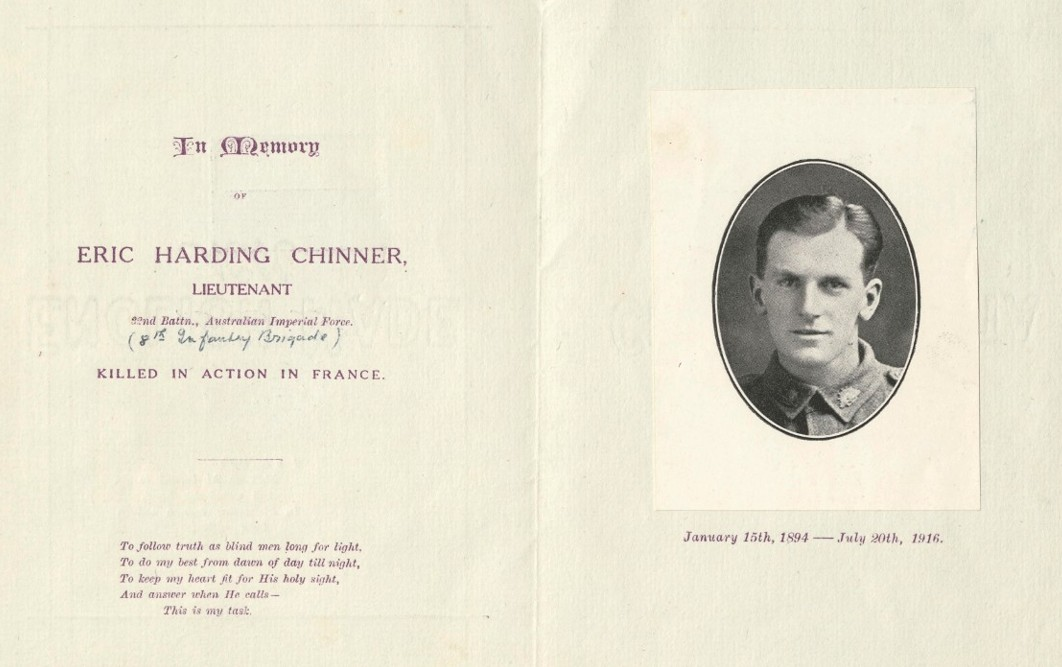
“CHINNER.—On the 20th July, killed in action in France, Lieut. Eric Harding Chinner, beloved son of T.H. and S. Chinner, Petersburg, aged 22 years.”
To do my best from dawn of day till nightTo keep my heart fit for His holy sightAnd answer when He callsThis is my task.”
Charles Bean and the Missing Grave
For decades after the Battle of Fromelles, Lieutenant Eric Harding Chinner was one of the missing. Although witness statements confirmed he had been killed during the fighting on 19 July 1916, uncertainty surrounded his final resting place. Some reports suggested he had died instantly during the attack near Fleurbaix, while German records later indicated he had died after being wounded and taken prisoner. For years the Chinner family searched for answers. In 1927, Eric’s brother Mervyn Chinner, who had spent years corresponding with military authorities in an effort to discover what had happened to his brother, received a significant letter from Charles Bean concerning the missing Australians of Fromelles. Charles Bean wrote:
“I am inclined to think that your belief is correct, and that he was buried in a common grave by the Germans at Fromelles.”
“As to obtaining any trace from the German side, the only course that I could suggest would be to search the cemeteries on the spot.”
“The history of the 21st Bavarian Infantry Regiment, which was opposed to him, says: ‘For the fallen enemy, mass graves behind Fasanen Wood were arranged.’ This means ‘Pheasant Wood’ or ‘Pheasant Copse’.”
“I think your brother would probably have been buried behind Pheasant Copse; whether this grave has been discovered by the British graves authorities, I do not know.”
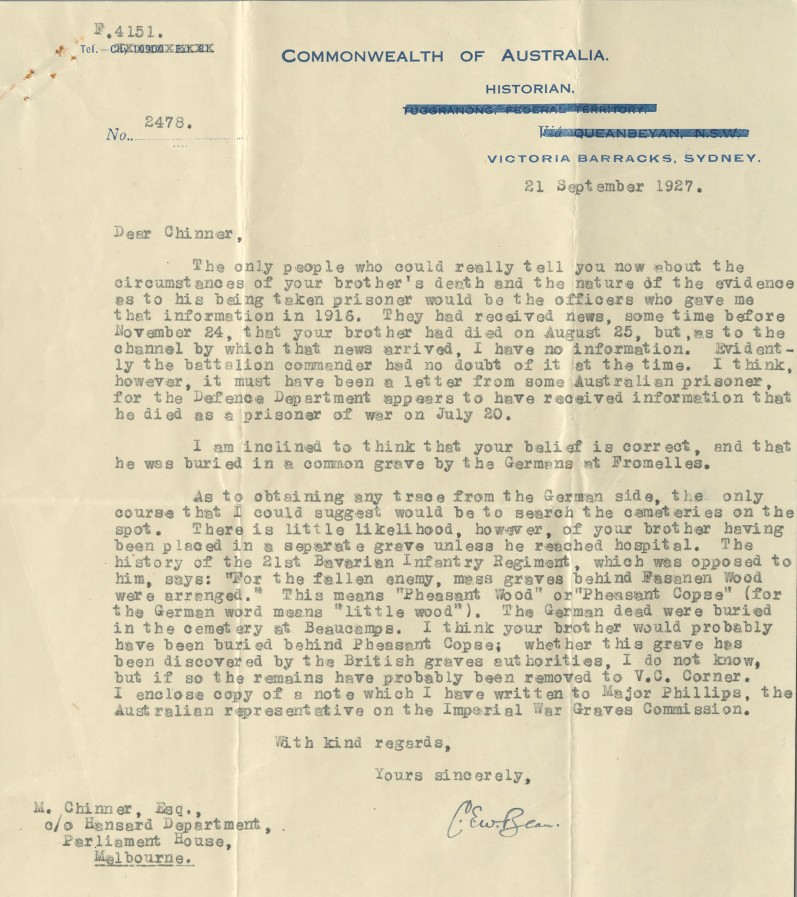
In later correspondence, Bean suggested that Eric's remains may have been recovered after the war and reinterred at V.C. Corner Australian Cemetery. That conclusion, shared by many at the time, ultimately proved incorrect. Bean's earlier assessment that Eric had been buried in a German mass grave behind Pheasant Wood was remarkably accurate.
For much of the twentieth century, however, nothing more was known. Eric continued to be commemorated among the missing on the V.C. Corner Australian Cemetery Memorial while the location of his grave remained a mystery.
Discovery at Pheasant Wood
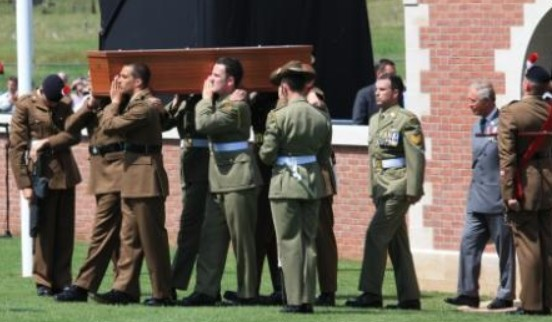
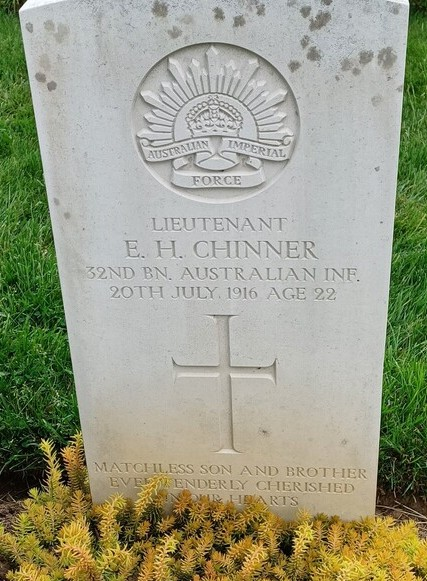
More than eighty years after Bean’s letter, his belief proved correct. In 2008, archaeologists excavated mass graves at Pheasant Wood near Fromelles. The graves contained the remains of 250 Australian and British soldiers buried by German troops after the battle. Among them was Lieutenant Eric Harding Chinner. Through DNA analysis, military records, forensic evidence, and family research, Eric was formally identified in 2010, ninety-four years after his death. He was reburied with full military honours at the new Fromelles (Pheasant Wood) Military Cemetery. His grave bears the family inscription:
“MATCHLESS SON AND BROTHER EVER TENDERLY CHERISHED IN OUR HEARTS”
Eric is commemorated at numerous memorials across Australia, including:
- Australian War Memorial Roll of Honour,
- Prince Alfred College “Nobly Striving, Nobly Fell” Roll of Honour,
- Peterborough War Memorial,
- Peterborough Baptist Church memorial window
- South Australian National War Memorial
- Unley Arch of Remembrance
- and the Port Adelaide Orpheus Society Roll of Honour.
Gladys and the Locket
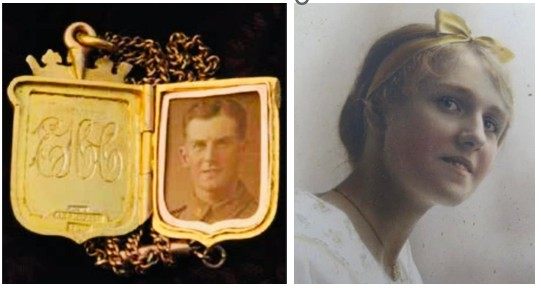
The identification of Eric’s remains also led to the remarkable rediscovery of one of the most personal stories connected to the battle. Before leaving Australia in 1915, Eric gave his fiancée, Gladys Dunn, a gold locket engraved with the Prince Alfred College crest and his initials, “EHC.” Inside was a tiny hand-coloured portrait of Eric. Gladys kept the locket for the rest of her life and never married. Family members later recalled that she rarely spoke about her fiancé, whom she affectionately called “Laddie,” but she carefully preserved the locket and photograph for decades.
After Gladys’ death, the locket passed to her nephew, John Leask. Following media coverage of the Pheasant Wood excavations, the family recognised the face in the tiny portrait as the same young officer whose remains had finally been identified in France. The official description accompanying the artefact later recorded:
“A few years ago the donor's brother John Guest was pictured on the front page of The Australian newspaper holding a portrait of Eric and John Leask then realised it was the same person as the photograph in the locket.”
Eric’s Artefacts
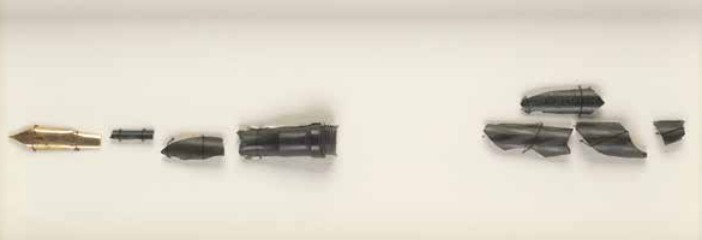
Other surviving artefacts connected Eric directly to the excavation at Pheasant Wood. Fragments of a pen recovered from his grave in 2009 were later returned to Australia. It is believed to have been the same pen Eric used to write letters home from Egypt and France. Eric’s Kodak camera also survived, still bearing the scratched words “ADELAIDE” and “SUEZ”, small physical traces of the extraordinary journey that had taken a young South Australian officer from Petersburg to the battlefields of France. Nearly a century after Eric Harding Chinner disappeared into the chaos of Fromelles, one of the missing men of the battle had finally been found.
Family at War
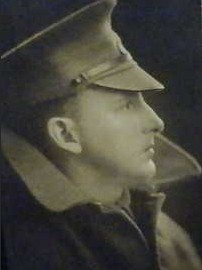
The First World War deeply affected the Chinner family. Eric’s brother, Wilfred Clive Chinner, also enlisted for service, joining the Australian Army Ordnance Corps in 1916.
The war also touched the wider family circle. Wilfred’s brother-in-law, Private Basil John Manning Cocking of the 32nd Battalion, was wounded at Fromelles and later provided testimony concerning Eric’s final moments.
His maternal cousin Allen Ralph Hedley who he met up with in Egypt also served with the 3rd and 9th Light Horse was mentioned in dispatches.
For the Chinner family, Eric’s death remained a lasting sorrow carried across generations until his identification at Pheasant Wood finally brought answers almost a century later.
Legacy
Although Lieutenant Eric Harding Chinner was only twenty-two years old when he was killed at Fromelles, his memory endured powerfully through his family, his school, his church community, and the many artefacts and letters he left behind. For decades Eric was remembered among the missing of Fromelles at VC Corner Australian Cemetery and Memorial. The connection between Eric and Gladys Dunn remained one of the most poignant legacies of his story. Gladys kept the gold locket and tiny portrait Eric gave her before the war for the rest of her life. She never married.
Many of Eric’s personal belongings and wartime letters are now preserved in public collections, including the State Library of Victoria. Among the surviving artefacts are his service medals, Kodak camera, personal correspondence, photographs, and the gold locket he gave to Gladys Dunn before leaving Australia in 1915. Eric’s surviving letters reveal a thoughtful and deeply affectionate young man devoted to his family, sustained by his Christian faith, and conscious of the dangers that lay ahead. In one of his final letters before the Battle of Fromelles he signed off simply:
Fondest love from your soldier laddie.
Links to Official Records
The Fromelles Association would love to hear from you

Contacts
(Contact: carla@fromelles.info or geoffrey@fromelles.info).
(Contact: army.uwc@defence.gov.au or phone 1800 019 090).
Donations
If you are able, please contribute to the upkeep of this resource.
(Contact: bill@fromelles.info ).