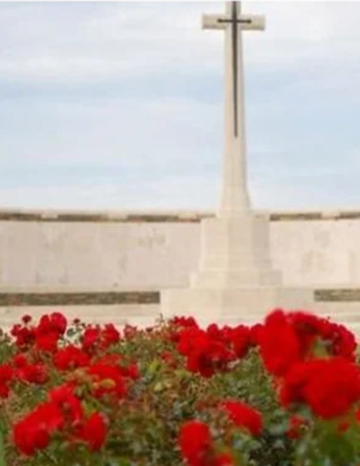
Thomas Norman BAKER
Eyes brown, Hair brown, Complexion brown
Thomas Norman Baker – A Mother's Search for Answers
Can you help find Thomas?
Thomas Norman Baker’s body was never found after the Battle of Fromelles, and there are no records of his burial.
A mass grave was found in 2008 at Fromelles, a grave the Germans dug for 250 Australian soldiers they recovered after the battle. As of 2026, 181 of these soldiers have been able to be identified via DNA testing from family member donors.
Thomas may be among these remaining 69 unidentified men. There is still a chance to identify him — but we need help. We welcome all branches of his family to come forward to donate DNA to help with his identification, especially those with roots in Sydney and Newcastle, NSW.
See the DNA box at the end of the story for what we do know about his family.
If you know anything of contacts for Thomas, please contact the Fromelles Association.
Early Life
Thomas was born in 1895 in Sydney, New South Wales, registered under the name Thomas Norman Cassidy. His mother, Ellen Catherine Cassidy, was not formally married at the time. She also had a second son, Leslie, born in 1898.
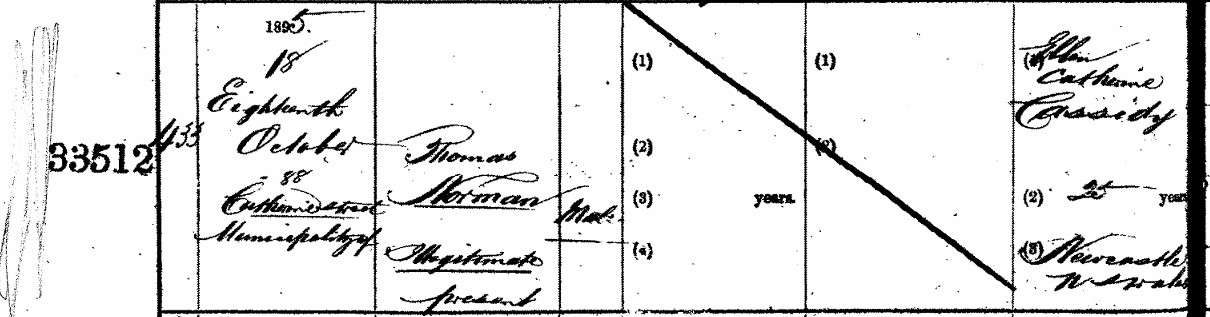
The family’s circumstances evolved as Thomas grew and by the time enlisted in the Australian Imperial Force in late 1915, he was using the surname Baker and naming his father as Thomas Baker. This same man appears later on his brother Leslie’s death certificate. Thomas Baker is recorded as a butcher. While no formal documentation survives to explain when or how the surname transition occurred, the consistent use of Baker in both of the boy’s records suggests their relationship With Thomas Baker had become well established.
In 1915 Thomas was living with his mother in Beckwith Street, Wagga Wagga, a growing regional centre that attracted labourers, railway workers, and tradesmen from across New South Wales. Nothing is yet known of his schooling, but like many boys of his generation, he likely entered the workforce early. He was working as a labourer when he enlisted. Thomas’s younger brother, Leslie, followed a similar path, born as a Cassidy, later known as Baker and raised within the same household.
Off to War
Thomas enlisted in the Australian Imperial Force at Wagga Wagga on 22 November 1915, using the name Thomas Norman Baker. He was allotted the regimental number 1623 and posted to the 55th Battalion, 2nd Reinforcement. After his initial military training in Australia, on 14 April 1916, he embarked from Sydney aboard HMAT A40 Ceramic. The transport reached Port Said, Egypt, on 16 May 1916, where the battalions of the 14th Brigade were completing training and consolidation prior to service overseas.

With the “doubling of the AIF”, as it expanded from two infantry divisions to five, major reorganisations were underway. The 53rd Battalion was formed at Tel-el-Kebir on 16 February 1916 and was made up of Gallipoli veterans from the 1st Battalion and newly arrived reinforcements from Australia. The Gallipoli veterans were not slow in pointing out that they were the “Dinkums”, while the new recruits were the “War Babies”.
Source: AWM4 23/70/1, 53rd Battalion War Diary, February 1916, p.3
Life in Egypt was not just military training. In early June a ‘Smoking Concert’ was “attended by a very vociferous. but well conducted crowd of men” from the 55th and on 14 June there was a Divisional Sports Contest.
Source - Australian War Memorial 55th Battalion War Diary 23/72/4 June 1916 page 3
Training took place at Tel-el-Kebir, where dust storms, disease, and relentless drills hardened the men. After his short time with the full 55th in Egypt, Thomas was transferred to the 53rd Battalion on 16 June 1916, just three days before sailing from Egypt for the Western Front. On 19 June 1916, 32 officers and 958 other ranks of the 53rd left Alexandria aboard HMT Royal George, bound for France. The battalion arrived at Marseilles on 28 June and was immediately entrained for the long journey north. After approximately 62 hours aboard crowded troop trains, they reached Hazebrouck and then marched to nearby Thiennes. During the journey through France, the battalion's war diary noted that its “reputation had evidently preceded them”, and the Australians received an enthusiastic welcome from the French people in towns along the route. Source AWM4 23/70/2, 53rd Battalion War Diary, June–July 1916, p.4
Thomas was now in northern France, close to the front near Fleurbaix. This area was commonly regarded as a “Nursery Sector”, where inexperienced troops could become accustomed to the realities of trench warfare. But the quiet times and the training period did not last long. On 8 July they began a 30 km march to Fleurbaix and on 10 July, Thomas entered trenches for the first time. The front near Fleurbaix was anything but calm. Rain flooded the communication trenches, artillery fire harassed supply lines, and the soldiers dug in amid the mud and barbed wire of No-Man’s-Land.
Battle of Fromelles
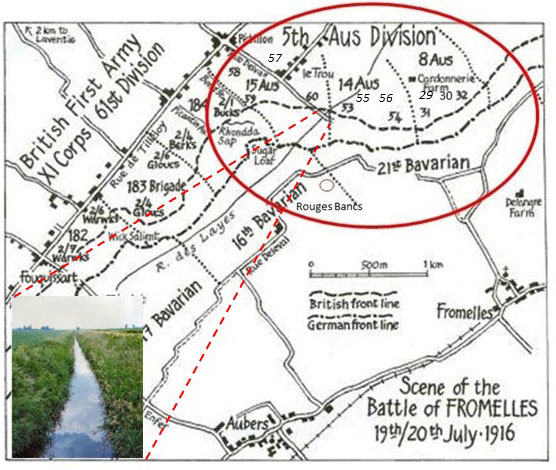
Inset - River Layes from the Australian Front Line looking towards the Sugar Loaf
The overall plan was to use brigades from the Australian Fifth Division and the British 61st Division to conduct a diversionary assault on the German trenches at Fromelles.
The main objective for the 53rd was to take the trenches to the left of a heavily armed, elevated German defensive position, the ‘Sugar Loaf’, which dominated the front lines. If the Sugar Loaf could not be taken, the 53rd and the other battalions would be subjected to murderous enfiladed fire from the machine guns and counterattacks from that direction. As they advanced, they were to link up with the 60th and 54th Battalions on their flanks. The men knew something was coming. They rehearsed attacks in replica trench systems, inspected bayonets and watched as huge guns rolled into place behind the lines. Then on 16 July, they moved up for an attack—only to have it postponed due to weather. The delay proved torturous. Private Jim Granger (4784), a young Dorrigo soldier, described the tension in his dugout:
“We were held in suspense for three days… like a criminal waiting to hear the verdict. We had no dugouts where we were in the supports and shrapnel was bursting all round.”
On 19 July, heavy bombardment was underway from both armies by 11.00 AM and by 3.00 PM the 53rd had already suffered about 50 casualties. At 4.00 PM the 54th Battalion joined them on their left. All were now in position for battle. Zero Hour for advancing from their front line trenches was to be 5.45 PM, but the Germans knew an attack was coming and were well prepared. At about 5.15 PM they opened a massive artillery bombardment on the Australian positions, causing chaos and further casualties.
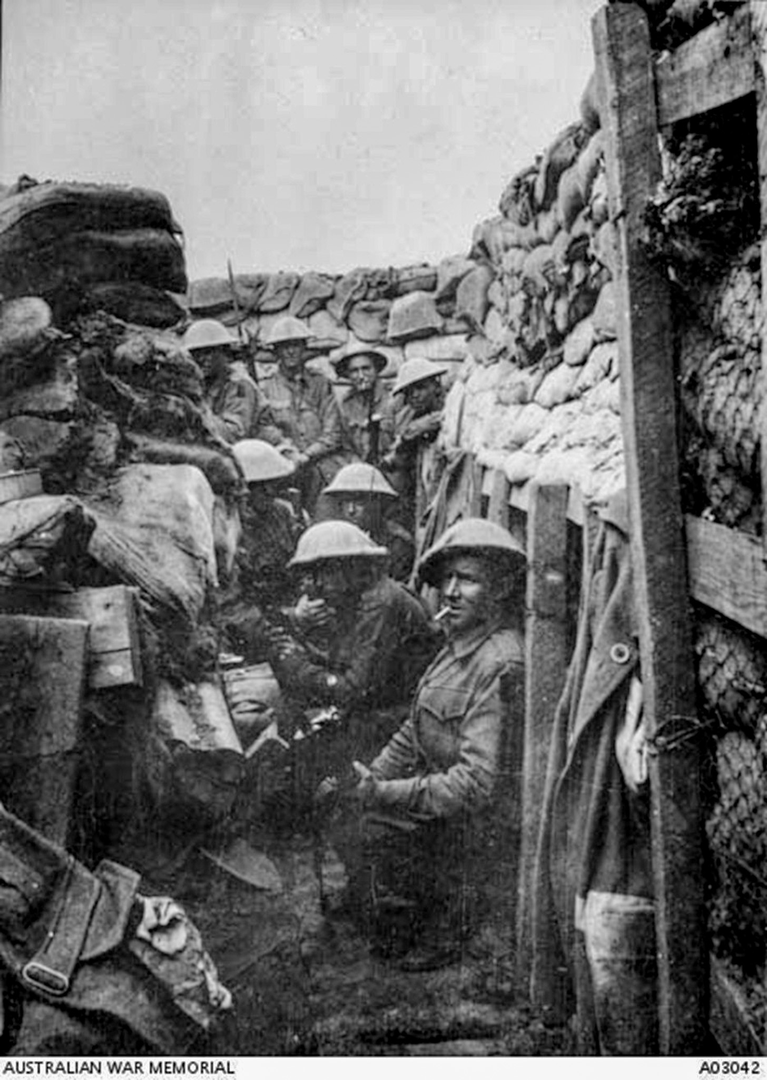
The Australians went on the offensive at 5.43 PM. The 53rd moved forward in four waves, half of A and B Companies in each of the first two waves and C and D Companies in the third and fourth. The first wave moved out into No-Man’s-Land and lay near the German wire, waiting for the British bombardment to lift. Private Arthur Norton Crewes (4755) later described the moment:
“At 5.43 pm the signal for the charge sounded, and over the top we went into the face of death, shells bursting, machine guns rattling and rifles crackling.”
At 6.00 PM the German lines were rushed. The 53rd came under heavy artillery, machine gun and rifle fire, but was able to advance rapidly. The battalion captured the German first and second line trenches, while parties pushed about 200 yards farther forward to hold off German bombers as the remainder attempted to consolidate their positions. Corporal John Thomas James of C Company (3550) later reported:
“At Fleurbaix on the 19th July we were attacking at 6 p.m. We took three lines of German trenches.”
Very few living Germans were encountered in the first and second line trenches, but the success came at a terrible cost. Within the first twenty minutes, the 53rd had lost all of its company commanders, all of their seconds in command and six junior officers.
Source C.E.W. Bean, The AIF in France, Vol. III, Chapter XII, p.369
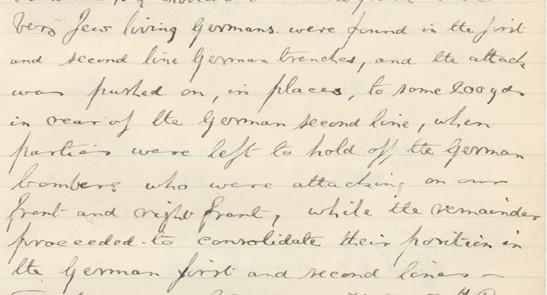
Some of the advanced positions were little more than water filled ditches and had to be fortified if the 53rd was to hold its gains against the expected German counterattack. The battalion linked with the 54th on its left, but there was no corresponding link on its right. The 60th Battalion had been unable to advance in the face of devastating machine gun fire from the Sugar Loaf, leaving the 53rd's right flank dangerously exposed.
Throughout the night, the 53rd held its positions against violent German attacks from the front. The exposed right flank, however, allowed German troops to work their way into their former front line behind the Australians. The 53rd was increasingly at risk of being surrounded and would eventually have to fight its way back towards its own lines.
By about 9.00 AM on 20 July, orders were received to evacuate the positions that had been won. At 9.30 AM the battalion had “retired with very heavy loss.”
Source AWM4 23/70/2, 53rd Battalion War Diary, July 1916, p.7.
Of the 990 men who had left Alexandria just weeks before, the initial count at roll call was 36 killed, 353 wounded and 236 missing, including Thomas. Amid the devastation, the war diary recorded:
“Many heroic actions were performed.”
To get some perspective of the battle, when Charles Bean, Australia’s official war historian, attended the battlefield two and a half years later, he observed a large quantity of bones, torn uniforms and Australian kit still on the battlefield. The final impact of the battle on the 53rd was 246 soldiers were killed or died from their wounds and of this, 190 were not able to be identified.
After the Battle
News that thomas was missing was reported back home in late August, however given the chaos of the battle, there was no information as to what has happened to him.
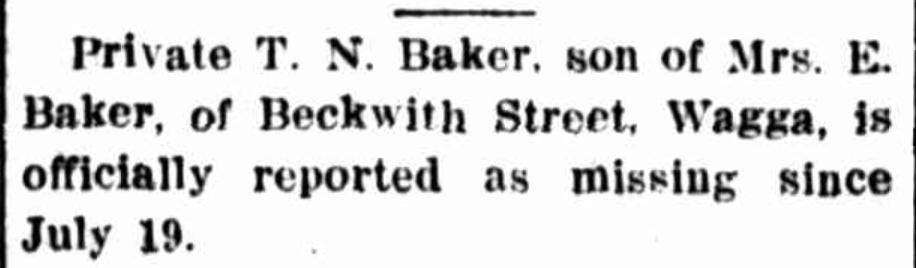
Major Croshaw-Danby, Acting Commanding Officer of the 53rd Battalion, attempted only days after the battle to piece together what had happened. His report captured the difficulty of reconstructing events after so many of those who had led and witnessed the fighting had been lost:
“A great many details are necessarily gathered second hand as those who were in the best position to know are no longer with the Battalion.”
Major efforts were undertaken by the Army and the Red Cross to find the missing soldiers, but often weeks and months passed with no answers, only uncertainty. In November 1916, Thomas’ mother, Ellen, had her minister write to the Army seeking details about Thomas, noting she was “very anxious” and “would be glad if you could tell her anything.”

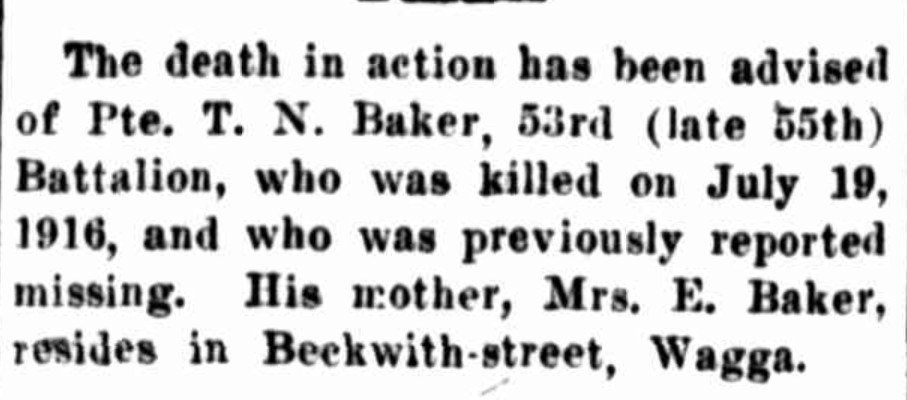
The Army promptly replied, but they had no information to offer to Ellen. For more than a year, Thomas remained officially listed as missing. With no evidence that Thomas had been captured or informaiton about his fate, on 2 September 1917, a Court of Enquiry held in the field concluded that he had been killed in action on 19 July 1916.
There are no witness statements on record about what happened to Thomas, but his identity disc had somehow been recoverd from the battlefield and it was returned to his mother in June 1920. Ellen wrote the Army again in 1920 after receiving the identity disc, and again in 1921, but the reply was the same. Thomas’ identity disc was the only closure Ellen for Thomas’ death that she would ever have. Thomas was awarded the British War Medal, the Victory Medal, a Memorial Plaque and a Memorial Scroll. He is commemorated at:
- V.C. Corner Australian Cemetery Memorial, Fromelles, France
- Australian War Memorial Roll of Honour, Canberra
- Wagga Wagga Methodist Church Roll of Honour, New South Wales
- Wagga Wagga Cenotaph, New South Wales
- Wagga Wagga Victory Memorial Arch, New South Wales
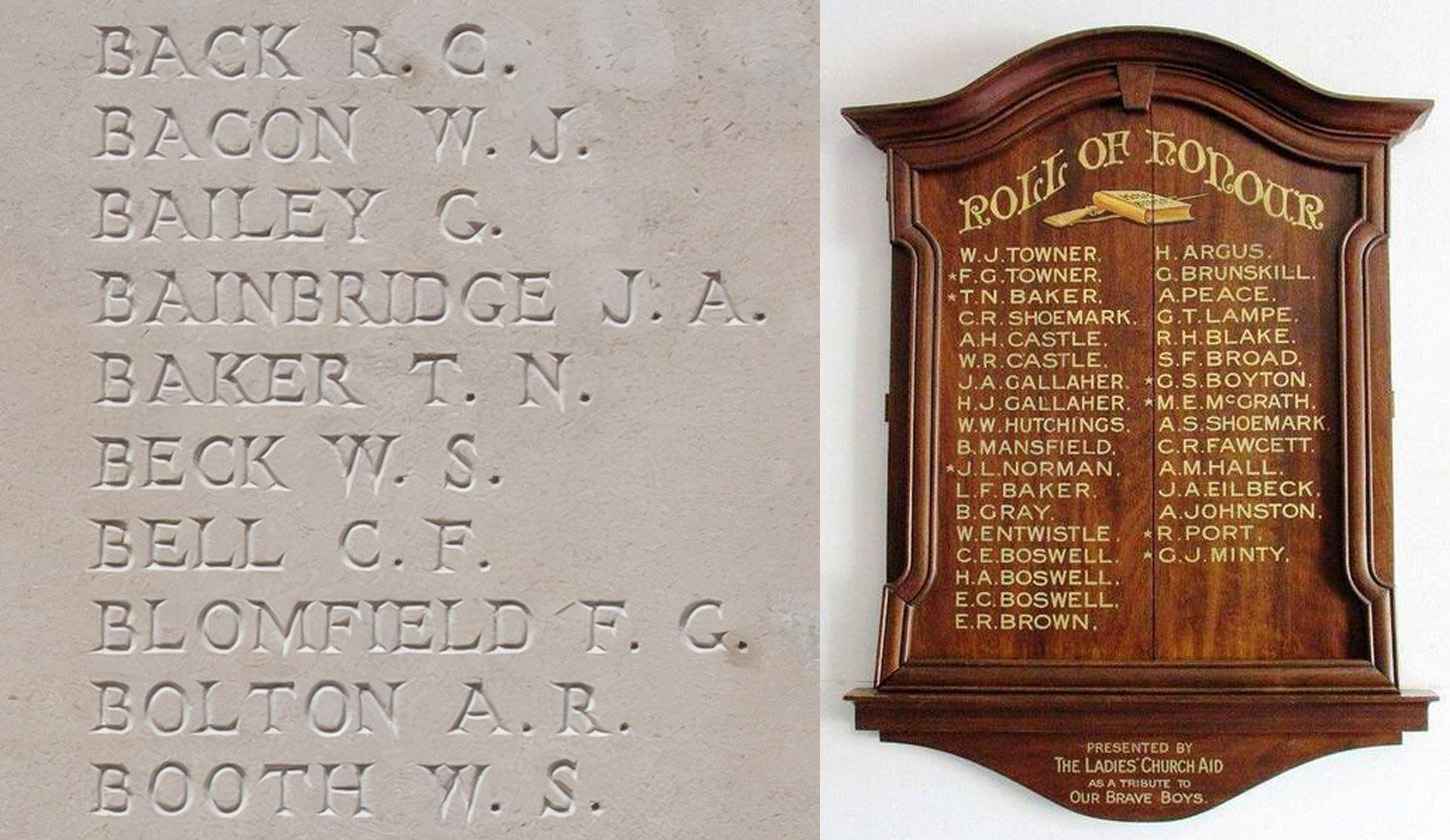
2 Wagga Wagga Methodist Church Roll of Honour
Leslie’s War
Thomas was not the only one in the Baker family to serve. His younger brother Leslie (4981, 30th Battalion), enlisted almost a year after Thomas was killed at Fromelles. Only nineteen when he volunteered at Wagga Wagga in April 1917, Leslie had been working as a draper and was living with their mother, Ellen Baker, in Beckwith Street. He embarked for England on the Marathon in May 1917 and trained at Hurdcott and Codford before joining the 30th Battalion in France in November of that year. His service was marked by long periods in and out of hospitals, first with acute rheumatism in early 1918, then later with recurring illness.
Despite this, Leslie returned to the front and remained with his battalion through to the end of the war. He sailed home in July 1919 and was discharged that September. Like many returned soldiers, Leslie’s health never fully recovered; his death in 1939 at just forty-one was attributed to war service. He is buried in Cessnock Cemetery. For Ellen Baker, the war brought both devastating loss and lasting hardship; one son killed at Fromelles, another returned broken in health.
Finding Thomas
Thomas’ remains were not recovered and he has no known grave. After the battle, the Germans recovered 250 Australian soldiers and placed them in a burial pit at Pheasant Wood. This grave was discovered in 2008 and since then efforts have been underway to identify these soldiers by DNA testing from family members. As of 2026, 181 of the soldiers have been identified, including 15 of the 190 unidentified soldiers from the 53rd Battalion.
We welcome all branches of Thomas’ family to come forward to donate DNA to help with his identification. If you know anything of family contacts, especially those from Sydney or Newcastle, NSW, please contact the Fromelles Association. We hope that one day Thomas will be named and honoured with a known grave.
Please visit Fromelles.info to follow the ongoing identification project and Thomas’ story.
DNA samples are being sought for family connections to
| Soldier | Thomas Norman BAKER (born Thomas Norman CASSIDY, 1895–1916) |
| Parents | Ellen Catherine CASSIDY and Thomas BAKER (recorded as a butcher on Leslie death certificate) |
| Siblings | Leslie Frederick CASSIDY / BAKER (1898–1939) |
| Grandparents | |||
| Paternal | Unknown | ||
| Maternal | John CASSIDY (born c.1835, died Australia) and Margaret LENEAGHAN (born 1844), married 1861, Newcastle NSW |
Seeking DNA Donors

Contacts
(Contact: carla@fromelles.info or geoffrey@fromelles.info).
(Contact: army.uwc@defence.gov.au or phone 1800 019 090).
Donations
If you are able, please contribute to the upkeep of this resource.
(Contact: bill@fromelles.info ).