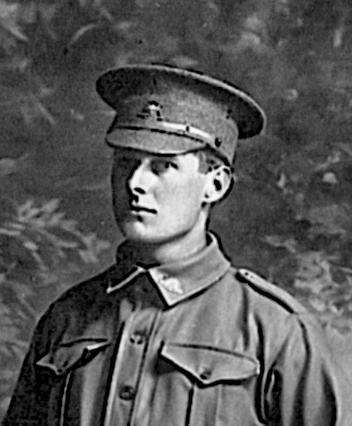
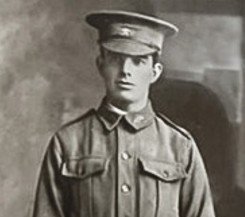
Howard Rupert WILSON
Eyes hazel, Hair brown, Complexion fair
Howard Rupert Wilson – A Mt. Gambier Preacher
Can you help us identify Rupert?
Howard Rupert Wilson’s body was never found after the Battle of Fromelles and there are no records of his burial.
A mass grave was found in 2008 at Fromelles, a grave the Germans dug for 250 Australian soldiers they recovered after the battle. As of 2026, 181 of these soldiers have been able to be identified via DNA testing from family member donors.
Rupert may be among these remaining 69 unidentified men. There is still a chance to identify him — but we need help. We welcome all branches of his family to come forward to donate DNA to help with his identification, especially those with roots in Mt Gambier, Adelaide and Yorkshire, England.
See the DNA box at the end of the story for what we do know about his family.
If you know anything of contacts for Rupert, please contact the Fromelles Association.
Background
Howard Rupert Wilson (known as Rupert) was born in Mt. Gambier, South Australia on 4 May 1892, the third child and eldest son of Howard Locke Dexter Wilson and Martha (nee Charlesworth) Wilson. Rupert’s paternal grandparents, Matthew and Mary (nee Palmer) Wilson had arrived in Melbourne from England in 1853, where they joined Matthew’s brother on a farm at One Tree Hill, north-east of Adelaide.
They both were active in the community, Matthew was appointed Clerk and Collector for the local Munno Para East Council and he and Mary became the ‘master’ and ‘mistress’ at a small school at Precolumb. The family moved to Mt Gambier in 1870 and there Matthew became Clerk of Mount Gambier East Council and surveyor for the town of Mt Gambier, a Justice of the Peace, a stalwart and lay preacher in the Methodist church and, for 25 years, secretary of the Mt. Gambier Agricultural and Horticultural Society.
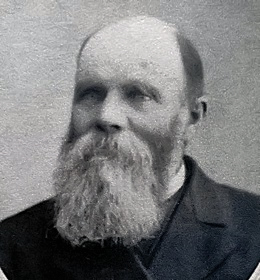
Mount Gambier pioneer
Rupert’s maternal grandparents, William and Martha (nee Helliwell) Charlesworth arrived in Adelaide from Yorkshire in 1854. They lived in Thebarton, near the centre of Adelaide where they were also were active in the community and the church. William, a carpenter/builder, was a member of the West Torrens District Council, serving a term as its chairman.
Rupert’s Early Life
Howard Wilson and Martha Charlesworth were married in the Thebarton Wesleyan Church in 1887 and lived at O.B. Flat, near Mount Gambier. They had seven children. Rupert’s siblings were:
- Martha Rita Mary Wilson (1889-1965)
- Violet Joy Wilson (1890-1902)
- Roland Cooper Wilson (1894-1984)
- Annie Coralie Crystal Rogers (1895-1989))
- Victoria May Agnew (1897-1972)
- Marjorie Fay Wilson (1899-1923)
Rupert’s father, Howard Wilson, had joined the militia in Mt Gambier in 1885, first with the infantry and then the mounted rifles. By 1888, he was a lieutenant, in command of the company. He was promoted to captain in 1891. In 1897, Captain Wilson was second in command of the twenty-five South Australians who were selected to attend Queen Victoria’s Diamond Jubilee celebrations in London. An illustrated article at the time described him as “a good horseman, is thoroughly versed in drill and all the requirements of an officer, and his men have perfect confidence in him.”
Source - "OUR ILLUSTRATIONS." Evening Journal 24 July 1897, p. 5. http//nla.gov.au/nla.news-article207900148
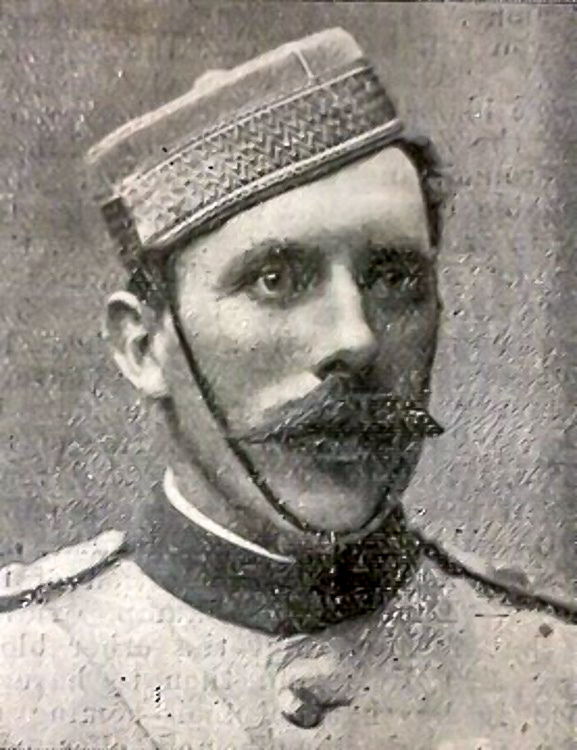
In May 1900, when Rupert was eight, Howard sailed for South Africa amid great fanfare as a Captain with the 4th Imperial Bushmen for service in the Boer War. He served with distinction, being promoted to Major and being mentioned in Despatches. However, when the unit returned to Australia in July of the next year, he remained in South Africa with the 5th and 6th Imperial Bushmen.
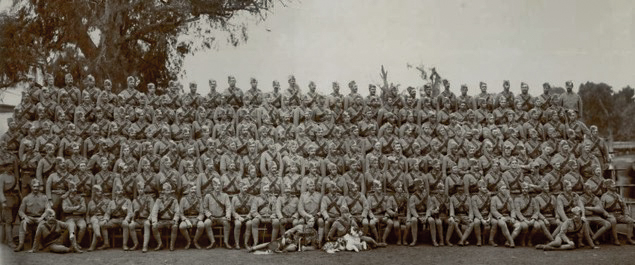
His wife, Martha, at home near Mt Gambier with her seven children (aged from newborns to eleven years when Howard left) proudly provided long excerpts from his letters to newspapers. These gave details of his combat experiences. For example:
”I had command of all the Australians at the fighting at and near Bethlehem. Colonel Rowell having been thrown from his horse was unable to ride, and the two majors were unfit to take the field on account of one being wounded in that part that comes most in contact with the saddle, the other having put his knee out. I am pleased to say that we were mentioned in despatches for the work we did between Kroonstad and Lindley, and I also received the personal thanks of the officer commanding for the work I had done; and at the taking of Bethlehem, after the final rush, a staff officer came up to me and said, "Well done, Australia. Splendid! Allow me the pleasure of shaking hands."
How Martha felt about her husband’s continued absence after the rest of his unit returned to Australia is not known, but she must have been under some stress, especially in April 1902 when her second daughter, 11 year old Violet, died of typhoid. In early 1903, newspapers reported that Howard had told his wife that he would be returning to South Australia in February. It appears that Howard never returned and that after the war; he continued to serve with British forces as a military commandant in various locations in South Africa.
There are no other newspaper references to him until February 1907, when it was reported that Martha had been informed that her husband had died of malaria in South Africa in December 1906. The same report stated that Martha was a teacher at O.B. Flat School, near Mt. Gambier. Married women were generally not allowed to teach in South Australian schools, so this suggests that there must have been some special circumstances to allow her to do so. She continued to teach, being appointed in 1911 to a newly opened school at Caroline, near the SA/Victorian border.
Rupert was educated at the O.B. Flat School. In September 1906, aged 14, he passed an exam held to provide for vacancies for the position of telegraph messenger with the Post Master General’s Department and in April the following year, after having had a period on probation, he officially became a telegraph messenger in Mt. Gambier. Rupert continued to be employed in the Postmaster General Department, becoming a mechanic in the Electrical Engineer’s Branch in Adelaide. Rupert was an active member of the Methodist Church.
In April 1910, while still only 17 years old, he became an accredited lay preacher in the Mt. Gambier Methodist Church. On the occasion of his accreditation, a large congregation was told that Rupert had given himself to Christ, had a desire to preach the Gospel to their fellow men, had passed an exam, had preached trial sermons to the minister and been recommended by the quarterly meeting. After he moved to Adelaide, he was a member of the Young Men’s Class in the Maughan Methodist Church in central Adelaide.
Off to War
In July 1915, Rupert, aged 23, went to Keswick Barracks in Adelaide to enlist in the AIF. He reported to Mitcham Camp on 22 July and when the 32nd Battalion was formed on 9 August, he was assigned to 3 Platoon in A Company. A and B Companies were made up of recruits from South Australia and C and D Companies came from Western Australia. There was much fanfare about this new battalion in South Australia, with gatherings, community support, such as the Cheer-up Society and reviews of the troops by the Premier.
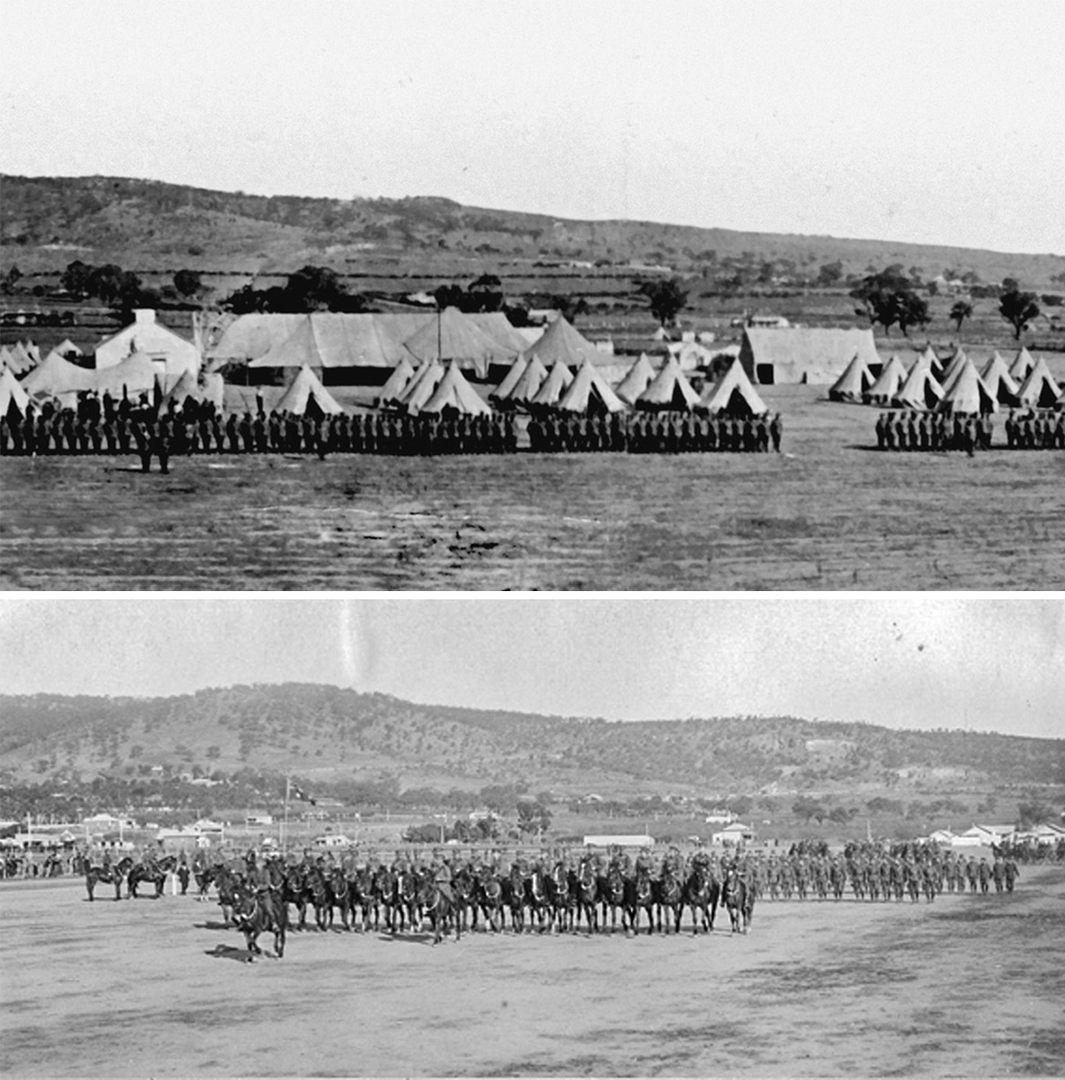
The Western Australian men had trained at Blackboy Hill Camp near Perth before arriving in Adelaide at the end of September. With their arrival, the whole battalion assembled at Cheltenham Racecourse Camp and continued training in preparation for overseas service.
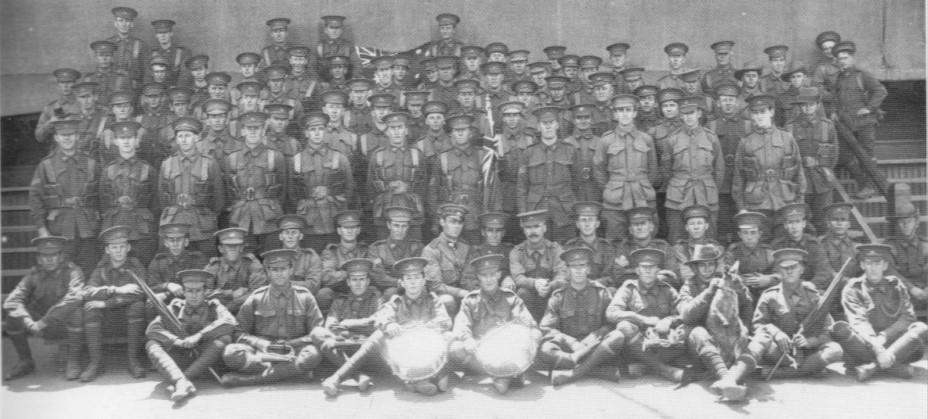
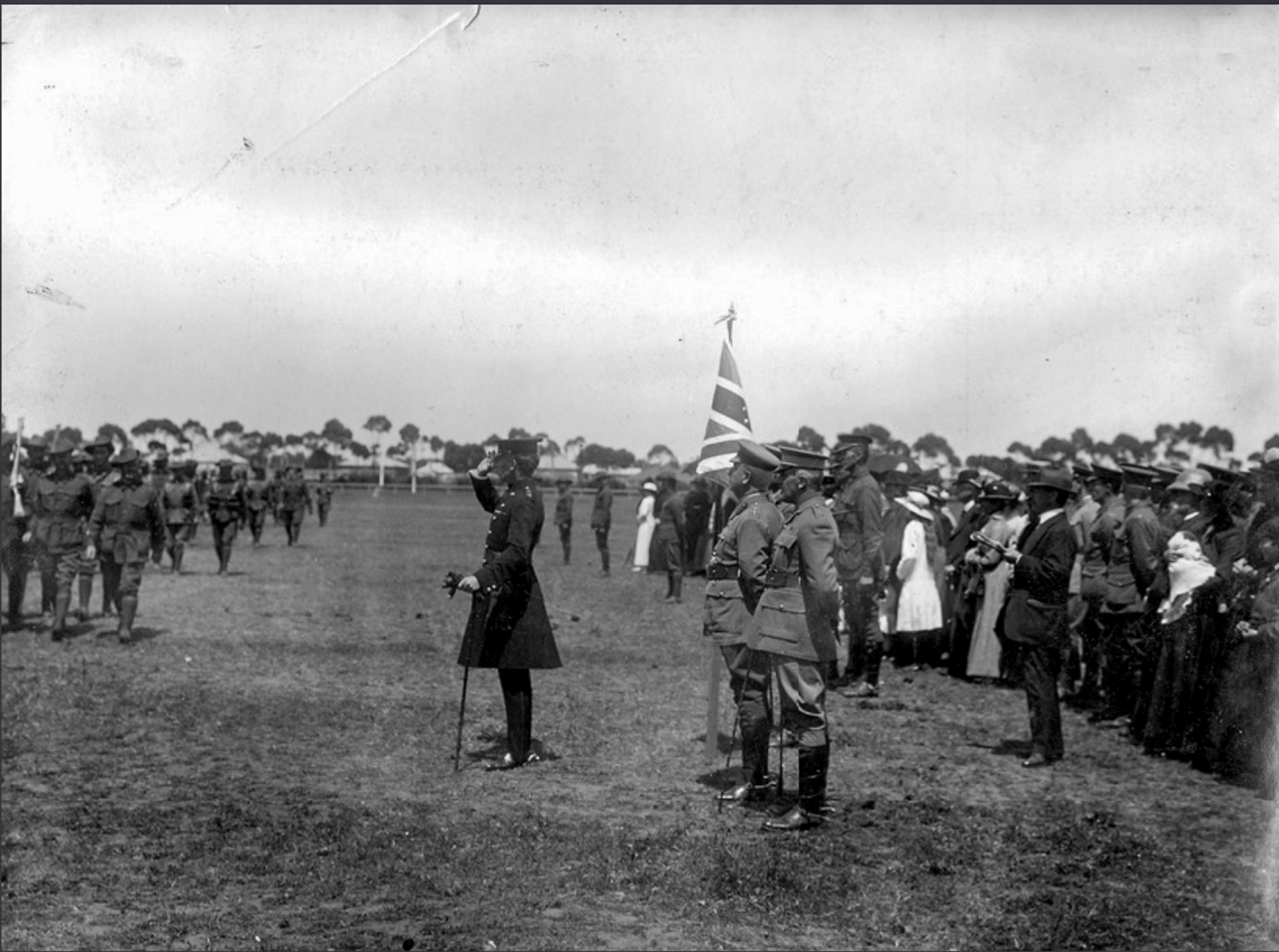
Training continued until the battalion departed for Egypt on 18 November 1915, with the unit being split between two troop ships HMAT A2 Geelong and HMAT A13 Katuna. As reported in The Adelaide Register:
“The 32nd Battalion went away with the determination to uphold the newborn prestige of Australian troops, and they were accorded a farewell which reflected the assurance of South Australians that that resolve would be realized.”
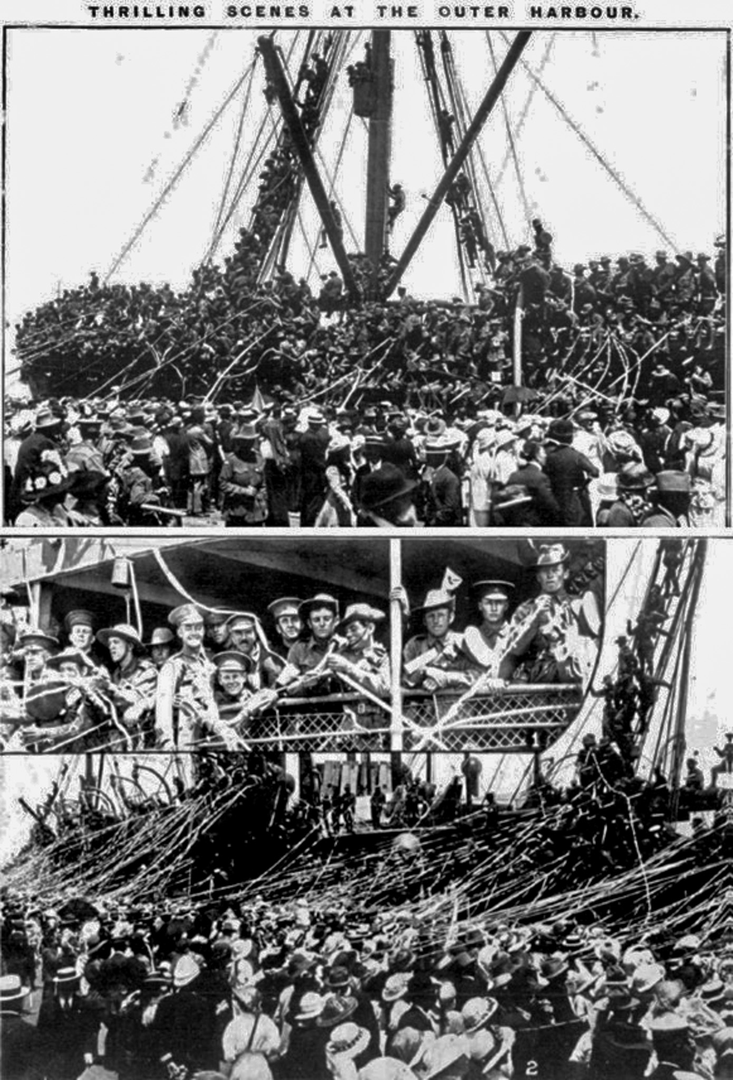
Rupert arrived in Suez on 14 December 1915 and moved to El Ferdan just before Christmas. A month later the 32nd marched to Ismailia and then to the major camp at Tel-el-Kebir where they stayed for February and most of March. Tel-el-Kebir was about 110 km northeast of Cairo and the 40,000 men in the camp were comprised of Gallipoli veterans and the thousands of reinforcements arriving regularly from Australia. Their next stop was at Duntroon Plateau and then at Ferry Post until the end of May where they trained and guarded the Suez Canal. The battalion’s last posting in Egypt was a few weeks at Moascar.
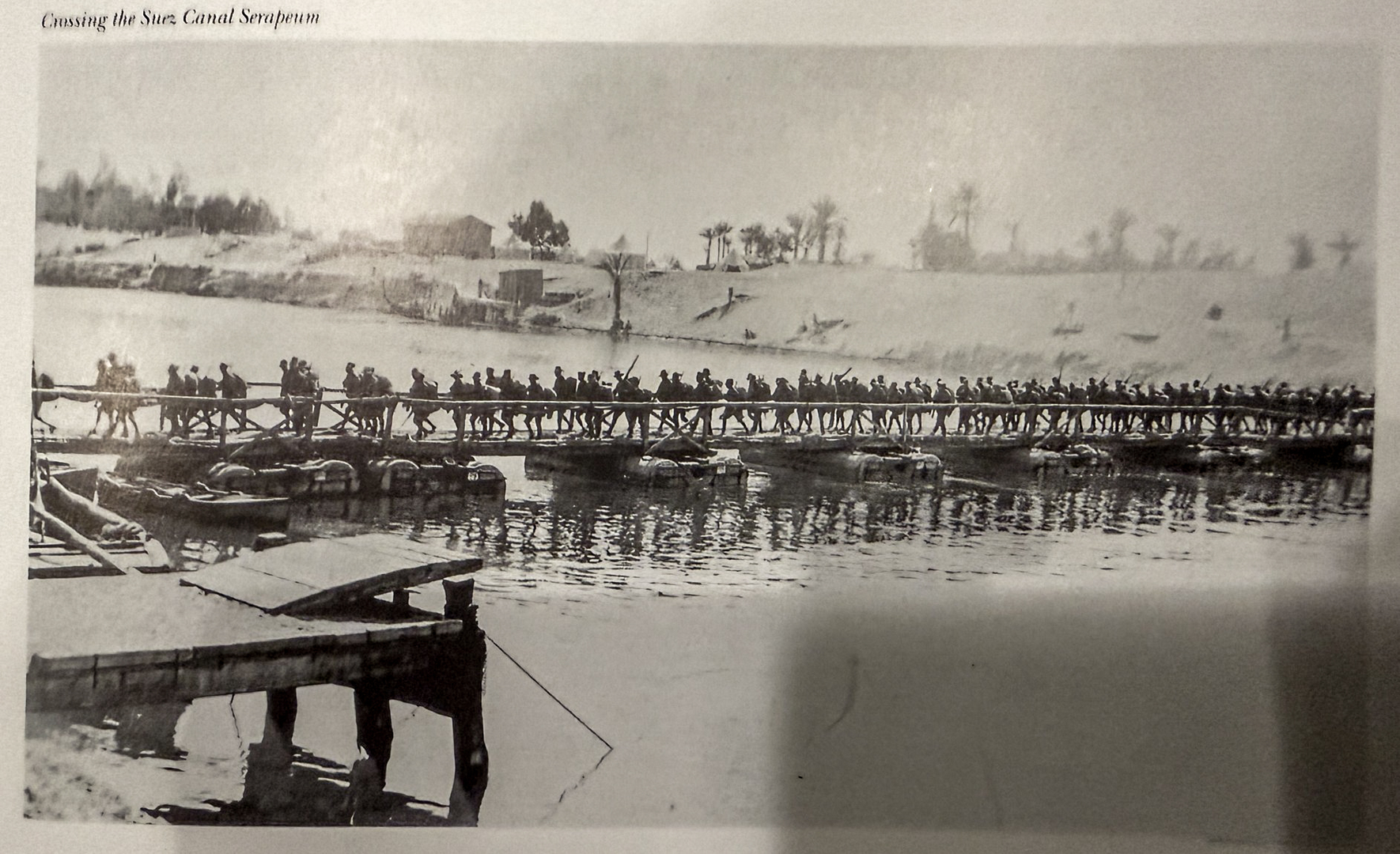
One soldier’s diary complained of being “sick up to the neck of heat and flies”, of the scarcity of water during their long marches through the sand and he described some of the food as “dog biscuits and bully beef”. He did go on to mention good times as well with swims, mail from home, visiting the local sights and the like.”
Source AWM C2081789 Diary of Theodor Milton PFLAUM 1915-16, page 29, page 12
During their time in Egypt the 32nd had the honour of being inspected by H.R.H. Prince of Wales.
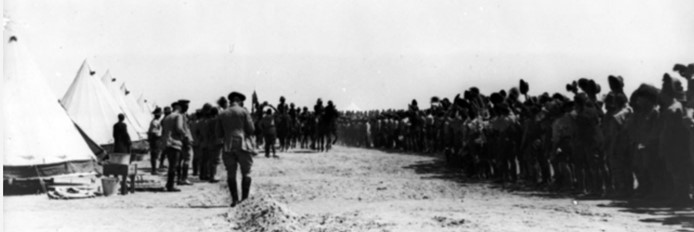
After spending six months in Egypt, the call to support the British Expeditionary Force on the Western Front came in mid-June. The 32nd left from Alexandria on the ship Transylvania on 17 June 1916. While on the ship, Rupert wrote home:
”At Sea, June 21. — We are having a pretty good time. Still, I am not allowed to say anything about our doings or whereabouts. Just at present I am enjoying a beautiful fresh morning. Horace Haddy is with me, and we have just been watching some interesting sights through glasses. It is about a month since I heard from you last, so I am looking forward to getting the next batch of mall, which should be fairly large. When next I write I hope to be able to give you some news of our doings.”
Immediately on arriving in Marseilles, France on 23 June 1916, the battalion entrained for a three-day train trip to Steenbecque. Their route took them to a station just out of Paris, within sight of the Eiffel Tower, through Boulogne and Calais, with a view of the English Channel, before disembarking and marching to their camp at Morbecque, about 30 kilometres from Fleurbaix. Rupert added to his letter home:
”France, June 28th. After disembarking, we had a train trip which lasted about 60 hours, in which we covered about 600 miles. So you see we saw a good deal of the country which was beautiful. It is summertime, and the crops are out in ear. There are wild red poppies amongst them. This and the trees and the lanes and the old houses go to make a beautiful scene. Everything is so beautiful that it is difficult to realise that we are within sound of the guns. The people have given us a splendid time. It is a great contrast to Egypt.”
The men were headed to the area of Fleurbaix in northern France which was known as the ‘Nursery Sector’ – a supposedly relatively quiet area where inexperienced Allied troops could learn the harsh realities of Western Front trench warfare against the Germans. Rupert let his mother know that they were now near the front-line, but was gently reassuring to her (and possibly to himself) about the dangers:
”It will not be very long before we are in the trenches, but things are pretty quiet here just now. In fact they say that is just as safe in the trenches as out. I am hoping to get a letter from you soon, for I have been without one for so long. I think I shall be able to write regularly now.”
But the quiet times did not last long. Training continued with a focus on bayonets and the use of gas masks, assuredly with a greater emphasis, given their position near the front. The 32nd moved to the Front on 14 July and they were into the trenches for the first time on 16 July, only three weeks after arriving in France.
Battle of Fromelles
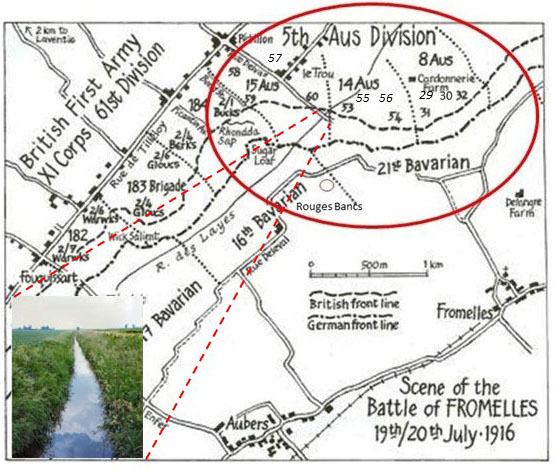
Inset - River Layes from the Australian Front Line looking towards the Sugar Loaf
The overall plan, as part of campaign in the Somme, was to use brigades from the Australian Fifth Division to conduct a diversionary assault on the German trenches at Fromelles. The 32nd Battalion’s position was on the extreme left flank, with only 100 metres of No Man’s Land to get to the German trenches. As they advanced, they were to link up with the 31st Battalion on their right. However, their position made the job more difficult, as not only did they have to protect themselves while advancing, but they also had to block off the Germans on their left, to stop them from coming around behind them.
D Company’s Lieutenant Sam Mills’ letters home were also optimistic for the coming battle:
“We are not doing much work now, just enough to keep us fit—mostly route marching and helmet drill. We have our gas helmets and steel helmets, so we are prepared for anything. They are both very good, so a man is pretty safe.”
On the 17th they were reconnoitring the trenches and cutting passages through the barbed wire, preparing for an attack, but it was delayed due to the weather. On the morning of the 18th, A Company and C Company went into the trenches to relieve B and D Companies, who rejoined the next day. Sergeant Frederick Stolz (later Lieutenant) described the calm before the storm:
“The fellows were wonderfully cool and not during the whole time did I see anyone get excited or do anything silly, and such a lot were only young boys of between 18 to 20.”
The Zero Hour for advancing from their front-line trenches was to be 5.45 PM, but the Germans knew this attack was coming and were well-prepared. They opened a massive artillery bombardment on the Australians at 5.15 PM, causing chaos and many casualties. The charge over the parapet began at 5.53 PM. Rupert’s A Company and C Company were in the first and second waves to go, B and D were in the third and fourth. They were successful in the initial assaults and by 6.30 PM were in control of the German’s 1st line system (map Trench B), which was described as:
“practically a ditch with from 1 to 2 feet of mud and slush at the bottom”.
Unfortunately, with the success of their attack, ‘friendly’ artillery fire caused a large number of casualties because the artillery observers were unable to confirm the position of the Australian gains. The 32nd were able to take out a German machine gun in their early advances, but were being “seriously enfiladed” from their left flank.
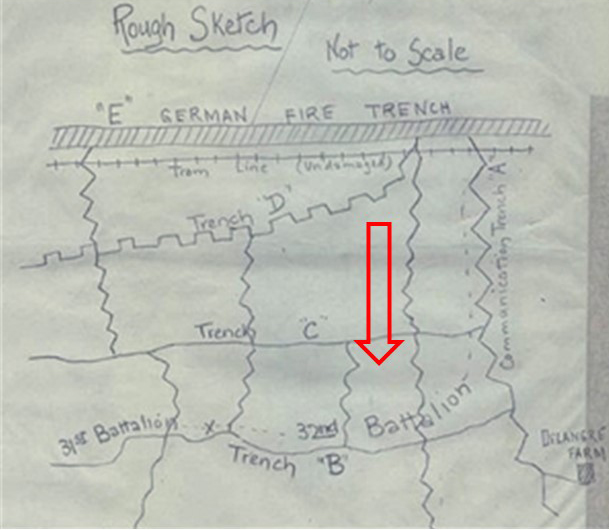
By 8.30 PM their left flank had come under heavy bombardment with high explosives and shrapnel. Return bombardment support was provided and the 32nd were told that “the trenches were to be held at all costs”.
Source - AWM4 23/49/12, 32nd Battalion War Diaries, July 1916, page 12
Fighting continued through the night. The Australians made a further charge at the main German line beyond Trench B, but they were low on grenades, there was machine gun fire from behind them from the emplacement at Delangre Farm and they were so far advanced that they were getting shelled by both sides. In the early morning of the 20th, the Germans began a counterattack from the Australian’s left flank, bombing and advancing into Trench A (map).
Given the Australian advances that had been made earlier, the rear Trench E had been left almost empty, which then enabled the Germans to regain that trench and envelop the men of the 32nd. At 5.30 AM the Germans attacked from both flanks in force and with bombing parties. Having only a few grenades left, the only resistance they could offer was with rifles:
“The enemy swarmed in and the retirement across No Mans’ Land resembled shambles, the enemy artillery and machine guns doing deadly damage.”
What remained of the 32nd Battalion had finally withdrawn by 7.30 AM on 20 July. The initial roll call revealed the scale of the disaster, with 71 killed, 375 wounded and 219 missing, including Rupert. The devastation remained visible long after the fighting had ended. When Australia's official war historian Charles Bean visited the battlefield two and a half years later, he observed bones, torn uniforms and Australian equipment still scattered across the ground.
The final impact on the 32nd Battalion was devastating. 225 soldiers were killed or died from wounds sustained at Fromelles, of whom 166 were unidentified. Lieutenant Sam Mills survived the battle. In a letter home he recalled the courage of the men as they went into the attack:
“They came over the parapet like racehorses……… However, a man could ask nothing better, if he had to go, than to go in a charge like that, and they certainly did their job like heroes."
After the Battle - A Prisoner of War?
With about 85 percent of the 32nd Battalion killed, wounded or taken prisoner, there was enormous confusion in determining what had happened to individual soldiers. For many families, weeks and months passed without definite news. Some of the missing had been killed in the German lines and buried by the Germans, while others had been wounded and taken prisoner. Martha Wilson was informed at the end of August that her son had been missing since 20 July.
The families of two other Mt. Gambier men in the 32nd Battalion, Horace Haddy and Melville Hall, received the same news on the same day. Some of her anxieties and her roller coaster of hopes and fears about Rupert over the next few months are shown by the news about Rupert that she shared with newspapers. On 15 September, the Mount Gambier newspaper, the ‘Border Watch’ reported that “Word has been received that Private H. Rupert Wilson, who was reported missing, is really a prisoner in Germany. Although this is not very pleasant news, still it is much better than some people anticipated.”
Source - "AUSTRALIAN EXPEDITIONARY FORCES." The Border 16 September 1916, p.2. http -//nla.gov.au/nla.news-article79774826
This was picked up Adelaide newspapers, changed to say that a telegram had been received.
Where this information had come from is not certain, but it is possible it was from a mis-reading of a letter from the South Australian Red Cross Information Bureau which had been contacted by Rupert’s sister, Rita. She had written, “Will you kindly inform me what is meant by ‘missing’? Does it mean that he is a prisoner?”
Source - South Australian Red Cross Information Bureau – Howard Rupert Wilson p.4
The response of the Red Cross is not in his file, but it may have been optimistic about the likelihood of him being a prisoner. Responses to enquiries in the very first days after news reached Australia that men were missing, i.e. responses in the first days of September, were often unduly optimistic and showed a misunderstanding of trench warfare on the Western Front. It did not take long for the SA Red Cross to realise that this assessment of battlefields on the Western Front was incorrect, and that such optimism was “ill-advised.” Rupert’s friend from Mt. Gambier,
Horace Haddy, had been taken prisoner. His parents received a card from him on 20 September and letters followed. With no such news from Rupert, the Wilson family became increasingly anxious. In November, Martha wrote to the Red Cross, asking for their help in getting information from:
”any returned soldier of the same Battalion who would possibly know what might have happened to those missing about that time. A great many were taken prisoners, some may have been badly wounded or even killed. Corporal Haddy of this town, missing the same date, has already written three times to his parents. It is an anxious time.”
A Report of Rupert’s death?
Like many other families held in suspense by a lack of official information compounded by the chaos created by the battle, Martha Wilson made her own enquiries. One avenue was to place an advertisement in the English paper, the ‘British Australian’. Shortly after, in December 1916, she received a telegram.
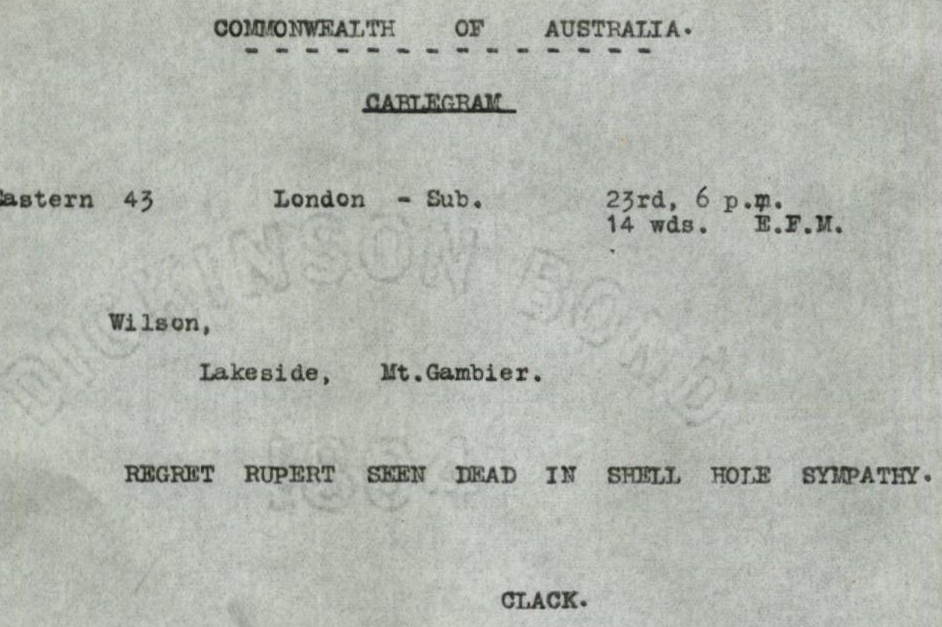
Martha did not recognise the name Clack and assumed he was a soldier. She shared the news with the Mount Gambier Border Watch.
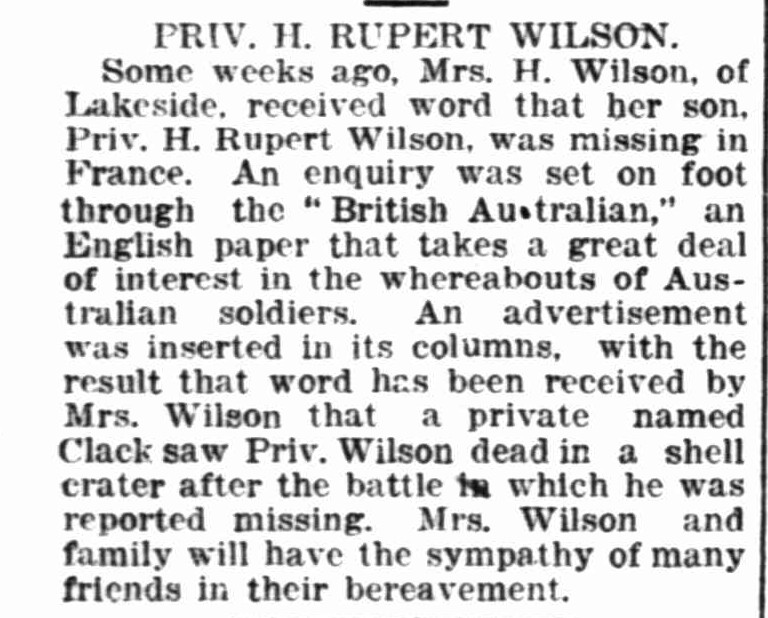
Later she received a letter, posted before the telegram arrived, from Mr. Clack who was the YMCA Organising Secretary for the Australian Army Abroad, saying that he was going to make enquiries on her behalf. There were many letters and enquiries by both the military and Martha as a result of Clack’s cable. When Clack was questioned, his information found to be hearsay. Clack’s information, however, may have come via an informant to a Red Cross enquiry which cited a T. Thawson (296) of 3 Platoon in A Coy, Rupert’s platoon, who in December 1916 “When we were retiring from an unsuccessful attack, I saw him dead in a shell hole.”
Source - South Australian Red Cross Information Bureau
Howard Rupert Wilson p.9 Martha eventually believed this was Clarence Thorsen (425), who was in B Coy. His file suggests he may have been at a school of instruction at the time of the battle, but Clarence also told Charlie Plunket’s family that the saw Charlie going over the top, so he may well have been at the battle. (ed. - a number of Red Cross witness statements have been found to contain errors about the identities of the reporting soldiers, is understandable given the situation.)
It wasn’t until September,1917 that Martha Wilson was informed that a Court of Enquiry had officially declared that Rupert had been killed action. In December 1918, when Henry Siggins (180), who had been in the same platoon as Rupert, was repatriated from Germany after 2½ years as a prisoner of war he was able to give a further confirmation of Rupert’s death:
”He was of A Company 3 Platoon. At Fleurbaix on 20 July 1916 during our attack was killed outright. Shot through head. This happened just as we had gone over and had got about 30 yards. I was alongside him when he fell. Came from Mount Gambier.”
In December 1917, Rupert’s younger brother, Roland Cooper Wilson, enlisted in the AIF. He embarked for Egypt at the end of April and was there assigned to the 3rd Light Horse Regiment. Due to illness, he was not taken on strength until shortly before the cessation of hostilities.
Remembering Rupert
Rupert was awarded the 1914-15 Star Medal, the British War Medal, the Victory Medal, a Memorial Plaque and a Memorial Scroll. Rupert’s name is on Panel 6 at the V.C. Corner Australian Cemetery which honours all Australians who died at Fromelles and who have no known grave.
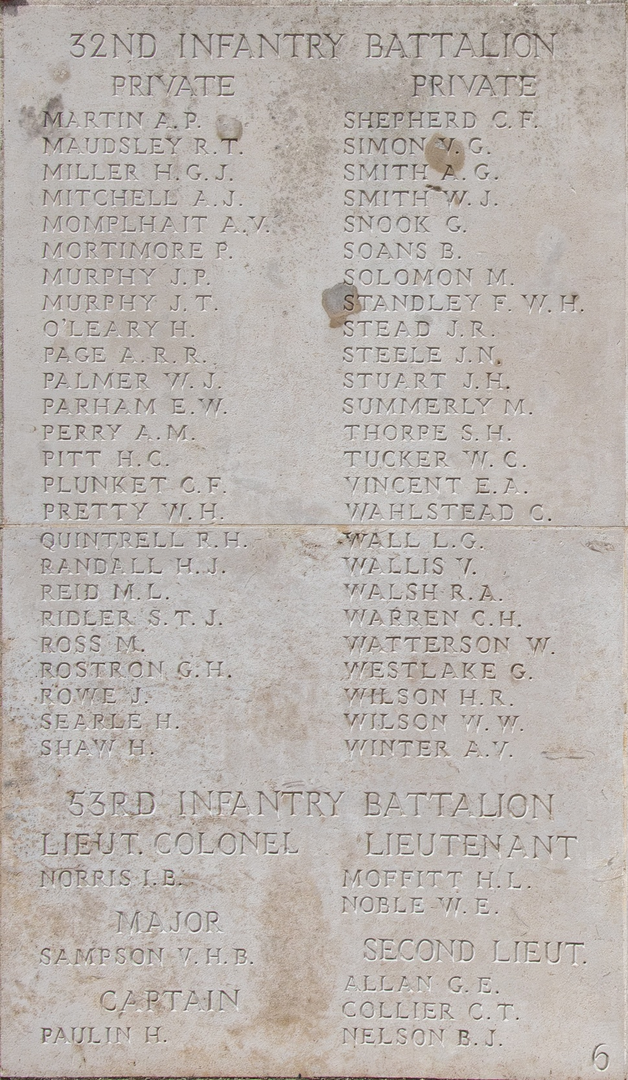
Rupert is also remembered on the following Honour Rolls and Memorials:
- O.B. Flat School Roll of Honour
- Adelaide Officers of SA Post, Telegraph and Telephone Department Great War Roll of Honor
- Adelaide Postmaster General's Department WWI Honour Board
- Australian Postmaster General's Department Honour Board, Melbourne
- Australian War Memorial Roll of Honour
- South Australian National War Memorial
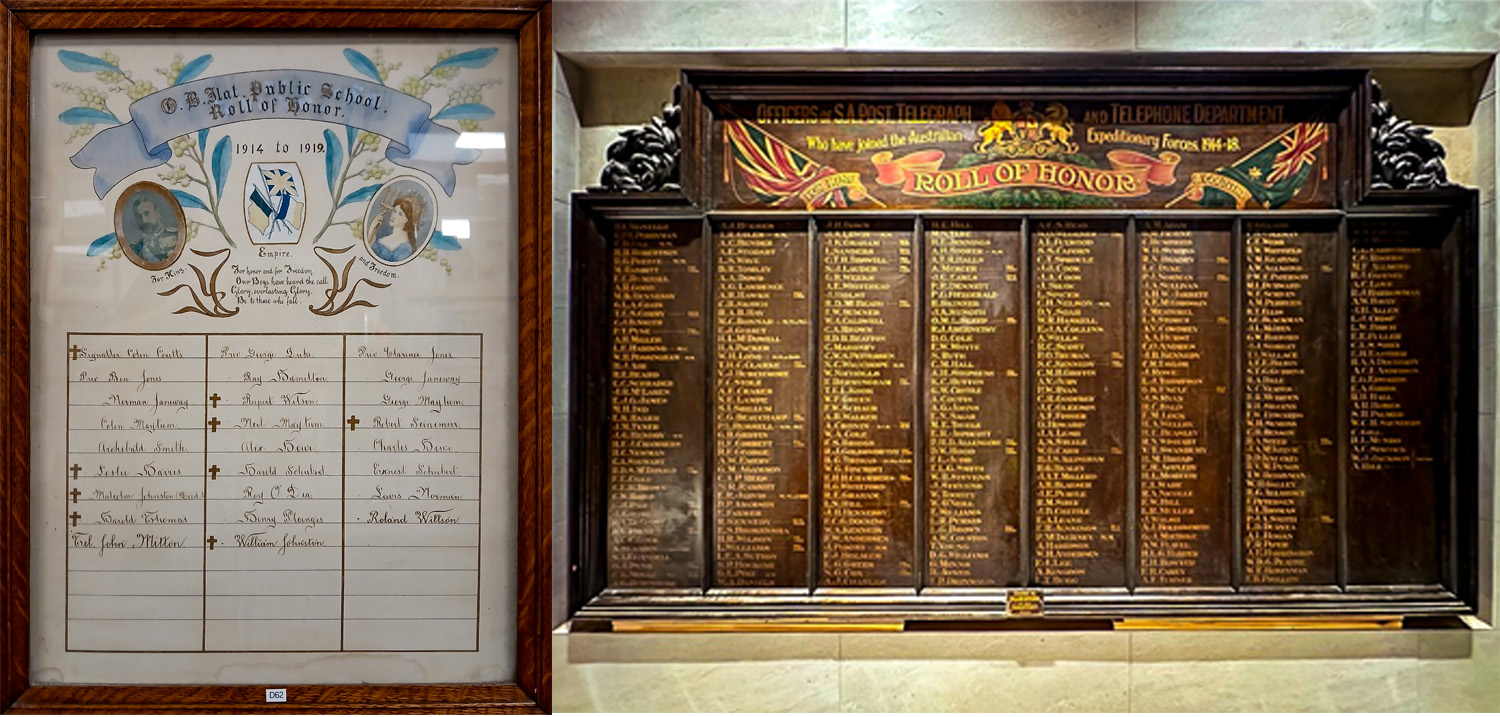
Finding Rupert
Rupert’s remains were not recovered; he has no known grave. After the battle, the Germans recovered 250 Australian soldiers and placed them in a burial pit at Pheasant Wood. This grave was discovered in 2008 and since then efforts have been underway to identify these soldiers by DNA testing from family members. As of 2026, 181 of the soldiers have been identified, including 41of the 166 unidentified soldiers from the 32nd Battalion.
We welcome all branches of Rupert’s family to come forward to donate DNA to help with his identification. If you know anything of family contacts, especially those with roots in Mt Gambier, Adelaide and Yorkshire, England, please contact the Fromelles Association. We hope that one day Rupert will be named and honoured with a known grave.
Please visit Fromelles.info to follow the ongoing identification project and Rupert’s story.
DNA samples are being sought for family connections to
| Soldier | Howard Rupert Wilson (1892-1916 |
| Parents | Howard Lock(e) Dexter Wilson 1864-1906) b. Precolumb (One Tree Hill), South Australia d. Cape Colony South Africa, and Martha Charlesworth (1863-1937) b. Thebarton, SA, d. Mount Gambier, South Australia |
| Siblings Martha Rita Mary (Rita) (1889-1965) (b. Mt Gambier, SA d. Woodville, SA | |||
| Violet Joy Wilson (1890-1902) b. and d. Mt Gambier, SA, | |||
| Roland Cooper Wilson (1894-1984) b. Mt. Gambier SA, d. Bellevue Heights m (1). Hilda Selina Hobson 1 son m (2) Thelma Ellen Campbell | |||
| Annie Coralie Crystal (1885 -1989 ) b. Mt Gambier , SA d. Adelaide, SA . Benjamin Rogers, 4 children | |||
| Victoria May (1897-1972) b. Mt. Gambier SA, d. Frankston, Vic, m. Hugh Agnew., 4 children | |||
| Marjorie Faye (1899-1923) b.& d. Mt Gambier, SA |
| Grandparents | |||
| Paternal | Matthew Cooper Wilson (1823-1908) b. Stilton, England, d. Mount Gambier, SA. and Mary Palmer (1824-1903) b. Kent, England d. Mt. Gambier, SA | ||
| Maternal | William Charlesworth (1830-1896) b. Yorkshire d. Thebarton, SA, and Martha Helliwell (1831-1897) b. Yorkshire, d. Thebarton, SA |
Seeking DNA Donors

Contacts
(Contact: carla@fromelles.info or geoffrey@fromelles.info).
(Contact: army.uwc@defence.gov.au or phone 1800 019 090).
Donations
If you are able, please contribute to the upkeep of this resource.
(Contact: bill@fromelles.info ).