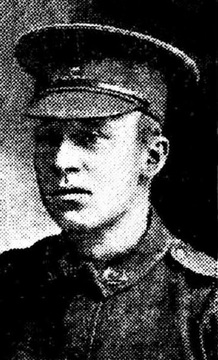
Edward Alfred WOLFF
Eyes blue, Hair very fair, Complexion fair
Edward Wolff - ‘When the world called him, there he went’
Early Life
Edward Alfred Wolff was born In Goodwood, South Australia, on 20 April 1886, the youngest of Johann Wilhelm (c1818-1894) and Emma Pauline Adelaide (nee Nohse) Wolff’s (1849-1946) five children:
- Emma Auguste Wilhelmina (1873-1958)
- Ernest Theodore (1880-1949)
- John William (Will) (1877-1937)
- Hilda Jubiletta (1887-1970)
- Edward Albert (1886-1916)
Johann had arrived in Adelaide with his first wife, Henriette, and a daughter in December 1849 on the barque Pauline, which had sailed from Bremen in Germany with German immigrants to South Australia. Henriette passed away in 1870, but two years later he married Emma. Interestingly, Emma was the daughter of Friedrich Ludwig Andreas Nohse and his wife Pauline (nee Rohkohl) who were also on the Pauline.
Emma was born at sea on the voyage to Adelaide, thus she was named Emma Pauline Adelaide. Edward’s father Johann was an organ tuner in Germany but in Australia he became a well-known organ builder with a workshop in Wakefield St Adelaide. He built instruments for many Adelaide churches, including St. Francis Xavier Roman Catholic Cathedral, and for private individuals. Emma’s father Friedrich was a coachbuilder and established a coach trimming business in Pulteney St, Adelaide.
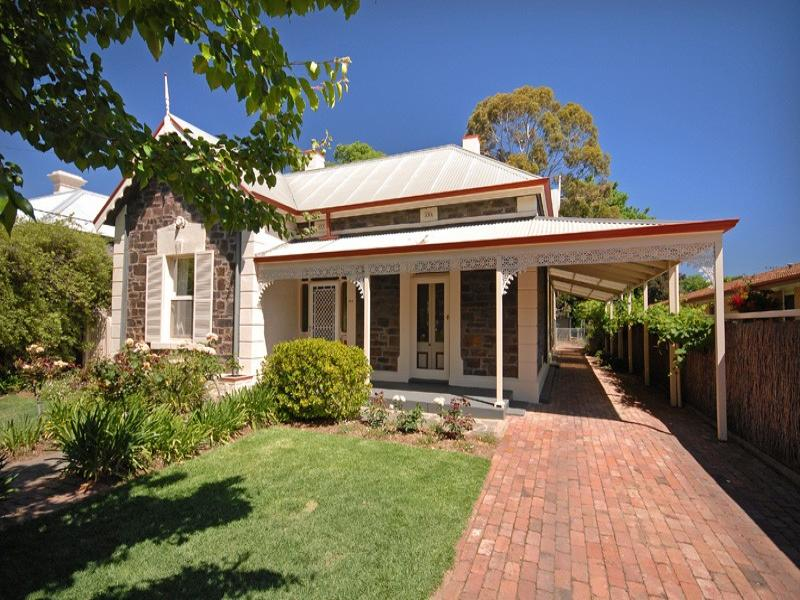
The family was living on Charles St, Goodwood when Edward was born, but when he was about five, they moved to Fisher Street, Malvern, at a time when substantial sandstone and bluestone villas were being built in that street.
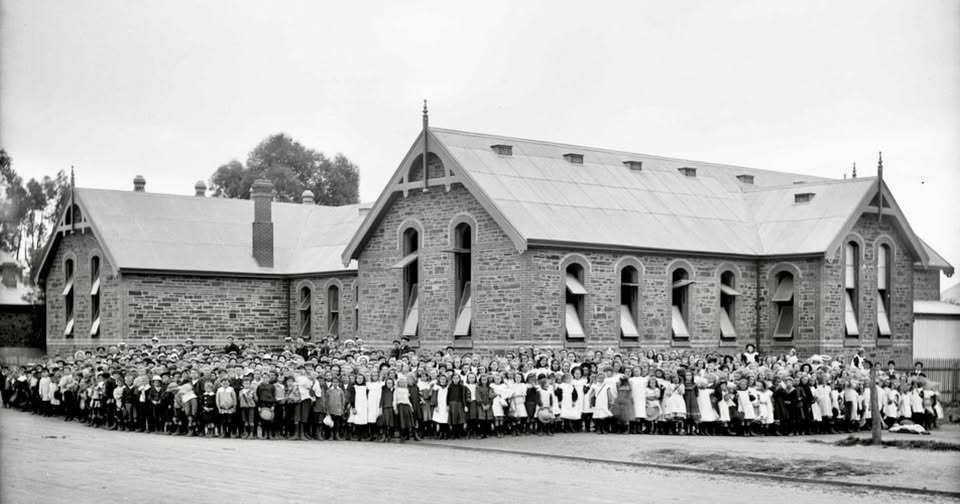
Edward attended Unley Public School and finished his education at Hayward’s Academy on East Terrace, Adelaide.
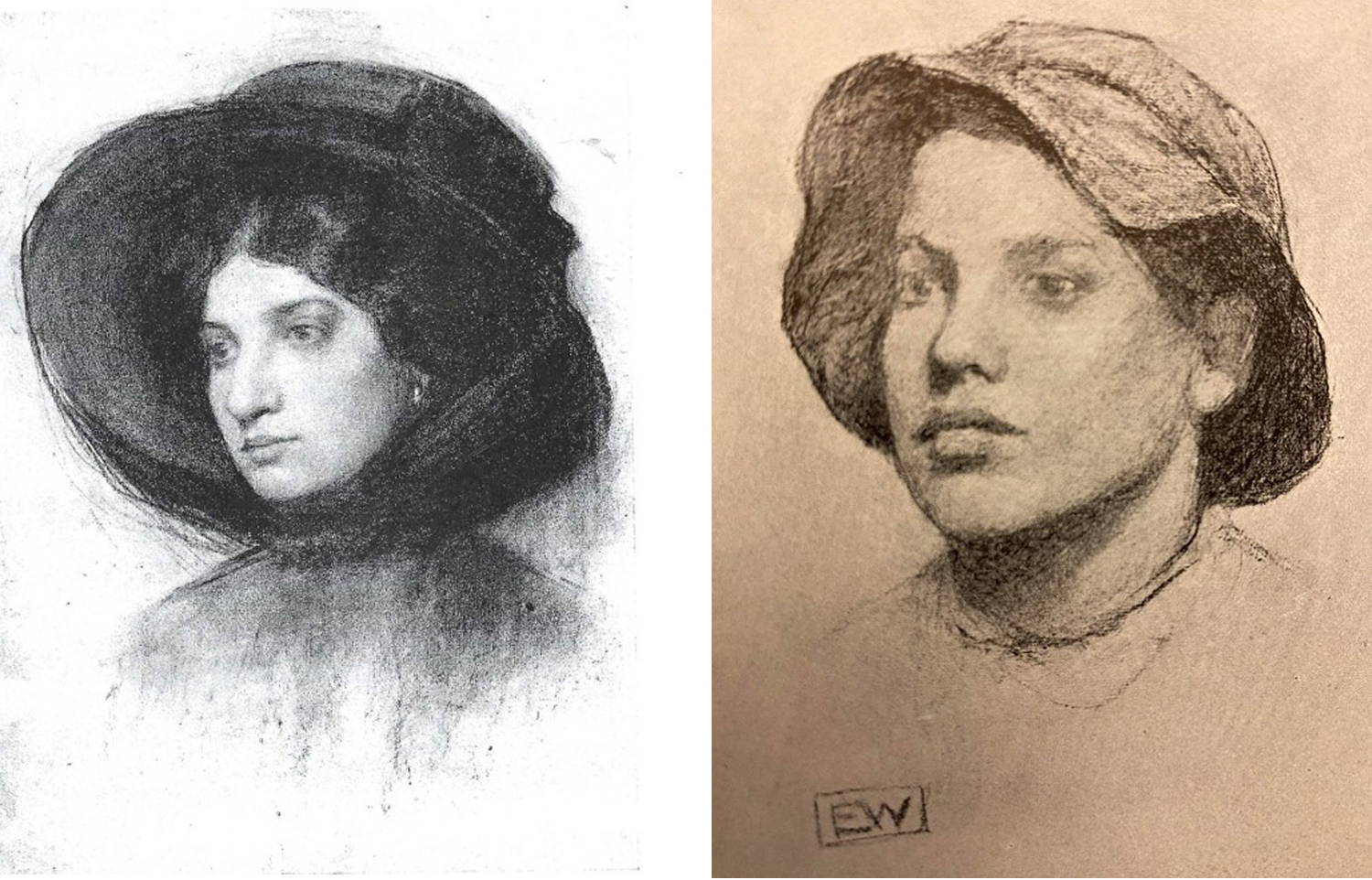
Edward became an apprentice photo engraver, converting photographs and artwork into raised metal printing plates. This allowed newspapers, magazines and books to print images on a mass scale. After finishing his apprenticeship, he worked at the Melbourne Herald, but later returned to Adelaide, where he was employed by Halliday Bros., a lithographic printing firm. Edward was also a talented artist. He studied at the Adelaide School of Design, and with other students who had studied in the Life Class, formed the Adelaide Drawing and Sketching Club. T
The club had its own rooms at 74 Pirie St. He was a friend of Bernard Dubois, a young accountant who was secretary of the Club. In 1910, to raise funds for the facilities needed to make the Club a success, Bernard edited The High Light a 110-page collection of literary and artistic contributions from prominent artists and writers from across Australia.
The contributor to the High Light with the most enduring fame was Mary Gilmore (later Dame Mary) whose first volume of poetry had been published in the same year. Edward worked closely with Bernard in the production of this publication. He designed the cover, contributed headpieces for literary works and was the major contributor of artistic work in the volume. It is likely that, as a photo engraver, he was responsible for the high quality of the reproductions of artistic work. His employer at the time, Halliday Bros, is acknowledged for their provision of blocks for a colour reproduction.
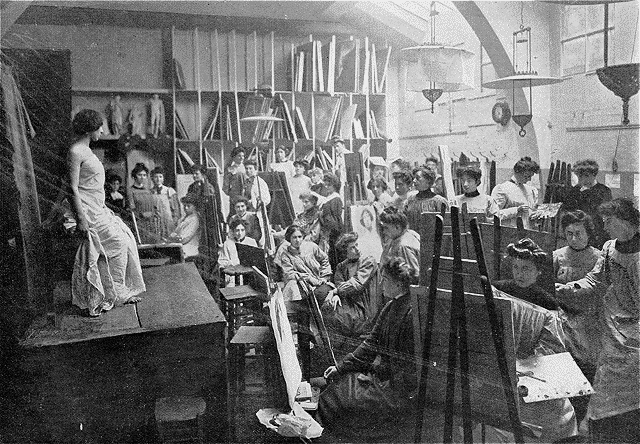
For three years from about 1911, Edward travelled overseas, living in France and America while gaining further expertise and experience in his trade. While in Paris, he received twelve months tuition at Academie Julian, a prestigious and influential private art school, which offered studies of live models and sessions of corrections with well reputed artists.

When war broke out, Edward was in America. Shortly afterwards he returned to Adelaide where he renewed his friendship with Bernard Dubois.
Off to War
It is almost certain that Edward Wolff and Bernard Dubois made the decision to go together to Keswick Barracks in Adelaide to enlist. The various dates in their attestation papers are identical for both men – they filled in forms and had their medicals on 14 July 1915 and began their service when they reported to Mitcham Camp on 20 July. Edward was 30 years old, and, as a single man, named his mother, Emma Wolff, as his next of kin. Edward and Bernard were assigned to the 32nd Battalion when it was formed in August, and both became members of A Company.
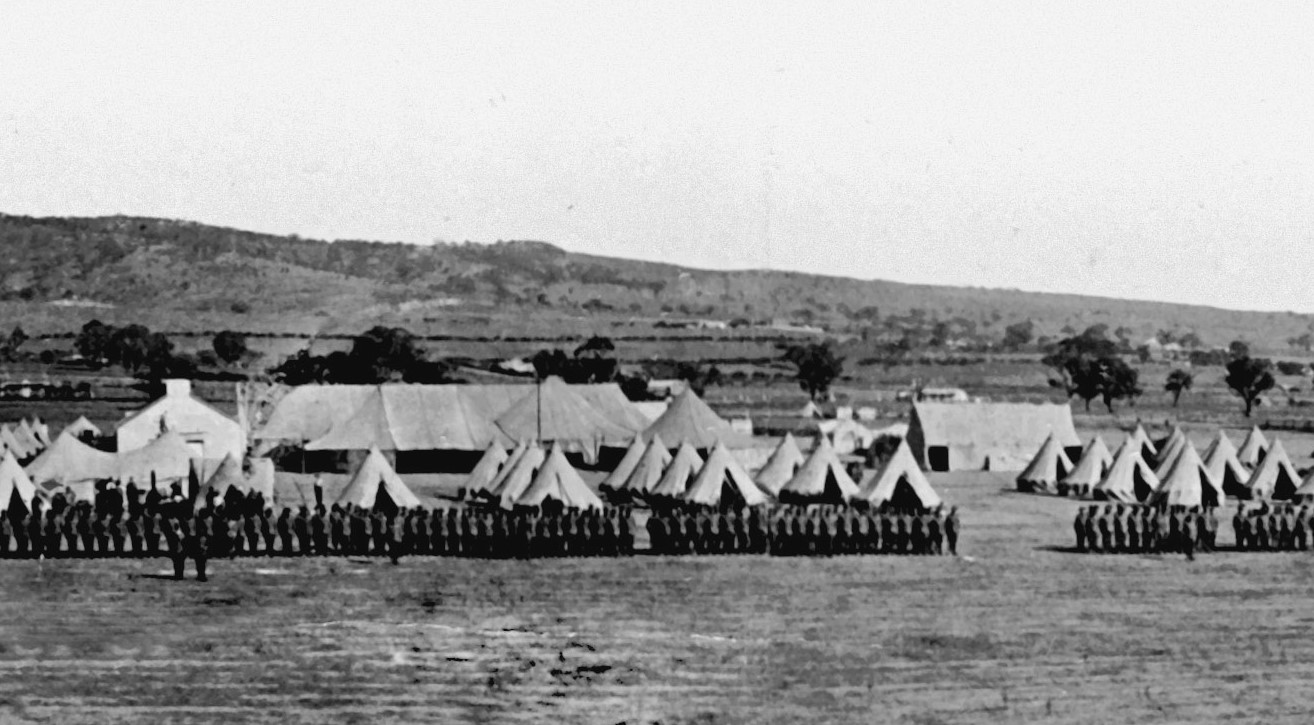
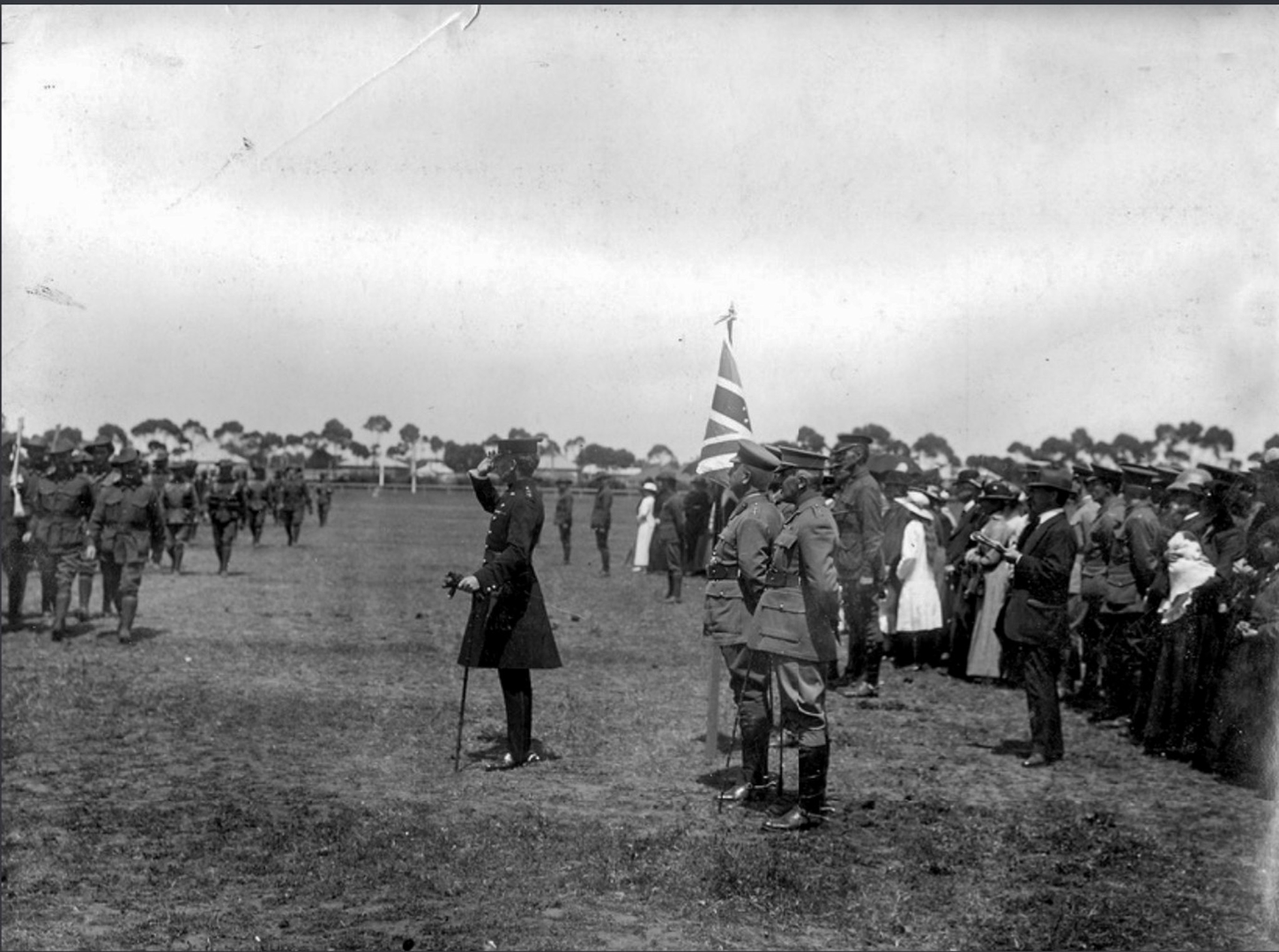
The 32nd Battalion was made up of recruits from South Australia and Western Australia. There was much fanfare about this new battalion in South Australia, with gatherings, community support, Cheer-up Society activities, reviews of the troops by the governor, and parades through the streets of Adelaide. On 16 September, the South Australians members of the Battalion moved to a new camp at Cheltenham Racecourse and the West Australians who had begun their training at Blackboy Hill near Perth joined them at the end of September.
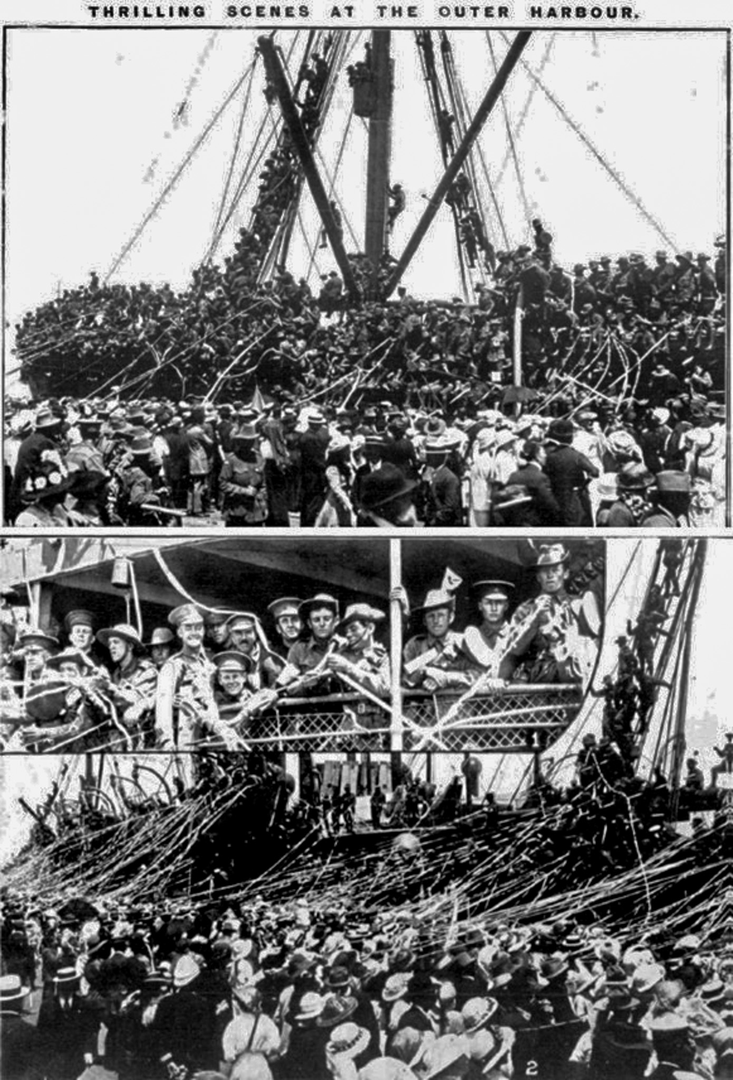
The 32nd Battalion departed for Egypt on 18 November 1915 on board HMAT A2 Geelong. As reported in The Adelaide Register:
“The 32nd Battalion went away with the determination to uphold the newborn prestige of Australian troops, and they were accorded a farewell which reflected the assurance of South Australians that that resolve would be realised.
The 32nd arrived in Suez on 14 December 1915 and moved to El Ferdan just before Christmas. A month later they marched to Ismailia and t hen to the major camp at Tel-el-Kebir where they stayed for February and most of March. Tel-el-Kebir was about 110 km northeast of Cairo and the 40,000 men in the camp were comprised of Gallipoli veterans and the thousands of reinforcements arriving regularly from Australia. Their next stop was at Duntroon Plateau and then they were at Ferry Post until the end of May, where they trained and guarded the Suez Canal.
Their last posting in Egypt was a few weeks at Moascar. One soldier’s diary complained of being “sick up to the neck of heat and flies”, of the scarcity of water during their long marches through the sand and he described some of the food as “dog biscuits and bully beef”. He did go on to mention good times as well with swims, mail from home, visiting the local sights and the like.
Source - AWM C2081789 Diary of Theodor Milton PFLAUM 1915-16, page 29, page 12 During their time in Egypt the 32nd had the honour of being inspected by H.R.H. Prince of Wales.
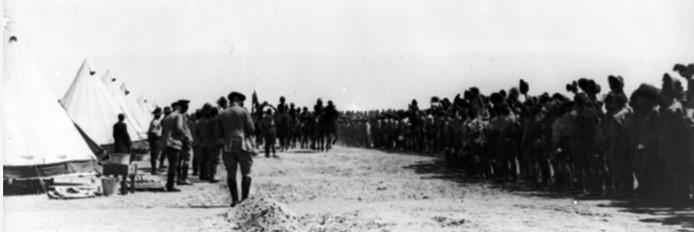
After spending six months in Egypt, the call to support the British Expeditionary Force on the Western Front came in mid-June. The 32nd left from Alexandria on the ship Transylvania on 17 June 1916, arriving at Marseilles, France on 23 June 1916 and they then immediately entrained for a three-day train trip to Steenbecque. Their route took them to a station just out of Paris, within sight of the Eiffel Tower, through Boulogne and Calais, with a view of the English Channel, before disembarking and marching to their camp at Morbecque, about 30 kilometres from Fleurbaix.
Theodor Pflaum (No. 327) and Wesley Choat (No. 68) wrote about the trip:
“The people flocked out all along the line and cheered us as though we had the Kaiser as prisoner on board!!” – Theodore Pflaum
“The change of scenery in La Belle France was like healing ointment to our sunbaked faces and dust filled eyes. It seemed a veritable paradise, and it was hard to realise that in this land of seeming peace and picturesque beauty, one of the most fearful wars of all time was raging in the ruthless and devastating manner of "Hun" frightfulness”. – Wesley Choat
They were headed to the area of Fleurbaix in northern France which was known as the ‘Nursery Sector’ – a supposedly relatively quiet area where inexperienced Allied troops could learn the harsh realities of Western Front trench warfare against the Germans. But the quiet times did not last long. Training continued with a focus on bayonets and the use of gas masks, assuredly with a greater emphasis, given their position near the front. The 32nd moved to the Front on 14 July and Edward was into the trenches for the first time on 16 July, only three weeks after arriving in France.
The Battle of Fromelles
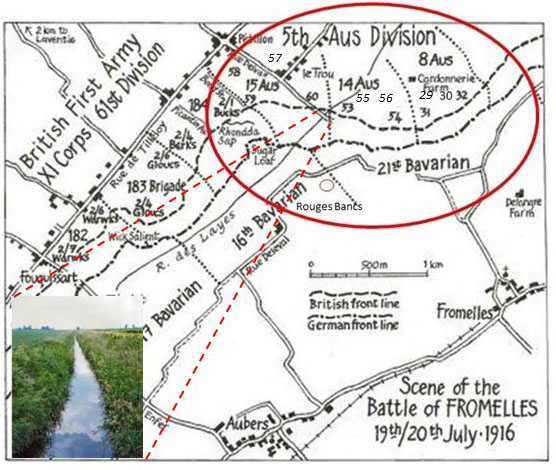
Inset - River Layes from the Australian Front Line looking towards the Sugar Loaf
On the 17th they were reconnoitring the trenches and cutting passages through the barbed wire, preparing for an attack, but it was delayed due to the weather. D Company’s Lieutenant Sam Mills’ letters home were optimistic for the coming battle:
“We are not doing much work now, just enough to keep us fit—mostly route marching and helmet drill. We have our gas helmets and steel helmets, so we are prepared for anything. They are both very good, so a man is pretty safe.”
The overall plan was to use brigades from the Australian Fifth Division to conduct a diversionary assault on the German trenches at Fromelles. The 32nd Battalion’s position was on the extreme left flank, with only 100 metres of No Man’s Land to get the German trenches. As they advanced, they were to link up with the 31st Battalion on their right. However, their position made the job more difficult, as not only did they have to protect themselves while advancing, but they also had to block off the Germans on their left, to stop them from coming around behind them. On the morning of the 18th, Edward’s A Company and C Company went into the trenches to relieve B and D Companies, who rejoined the next day.
The Zero Hour for advancing from their front-line trenches was to be 5.45 PM, but the Germans knew this attack was coming and were well-prepared. They opened a massive artillery bombardment on the Australians at 5.15 PM, causing chaos and many casualties. Edward’s A Company, along with C Company were in the first and second waves to go over the parapet at 5.53 PM. B Company & D were in the third and fourth. The men, despite heavy losses, were successful in the initial assaults and by 6.30 PM were in control of the German’s 1st line system (map Trench B), which was described as “practically a ditch with from 1 to 2 feet of mud and slush at the bottom”.
Source - AWM4 23/49/12, 32nd Battalion War Diaries, July 1916, page 11
Unfortunately, with the success of their attack, ‘friendly’ artillery fire caused a large number of casualties because the artillery observers were unable to confirm the position of the Australian gains. They were able to take out a German machine gun in their early advances but were being “seriously enfiladed” from their left flank.
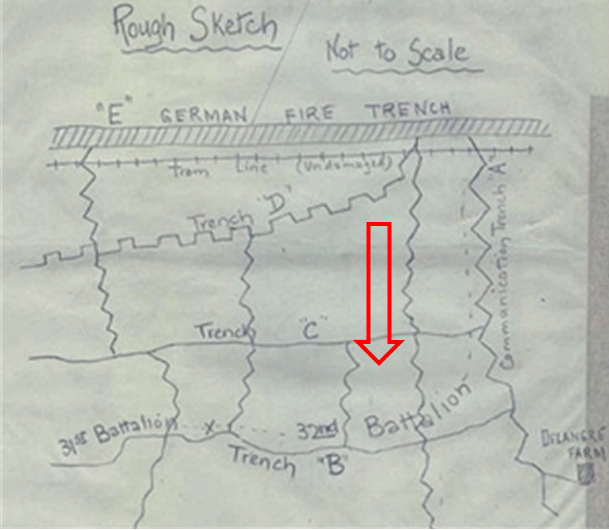
By 8.30 PM their left flank had come under heavy bombardment with high explosives and shrapnel. Return bombardment support was provided and the 32nd were told that “the trenches were to be held at all costs”.
Source - AWM4 23/49/12, 32nd Battalion War Diaries, July 1916, page 12
Fighting continued through the night. The Australians made a further charge at the main German line beyond Trench B, but they were low on grenades, there was machine gun fire from behind them from the emplacement at Delangre Farm and they were so far advanced that they were getting shelled by both sides. In the early morning of the 20th, the Germans began a counterattack from the Australian’s left flank, bombing and advancing into Trench A (map).
Given the Australian advances that had been made earlier, the rear Trench E had been left almost empty, which then enabled the Germans to regain that trench and envelop the men of the 32nd. At 5.30 AM the Germans attacked from both flanks in force and with bombing parties. Having only a few grenades left, the only resistance they could offer was with rifles:
“The enemy swarmed in and the retirement across No Mans’ Land resembled shambles, the enemy artillery and machine guns doing deadly damage.”
What was left of the 32nd had finally withdrawn by 7.30 AM on the 20th. The initial roll call count was devastating – 71 killed, 375 wounded and 219 missing, including Edward and his mate Bernard. To get some perspective of the battle, when Charles Bean, Australia’s official war historian, attended the battlefield two and half years later, he observed a large quantity of bones, torn uniforms and Australian kit still on the battlefield. The final impact was that 228 soldiers of the 32nd Battalion were killed or died from wounds sustained at the battle and, of this, 166 were unidentified. Lieutenant Sam Mills survived the battle.
In his letters home, he recalls the bravery of the men:
“They came over the parapet like racehorses……… However, a man could ask nothing better, if he had to go, than to go in a charge like that, and they certainly did their job like heroes."
An Unofficial Telegram
About 85% of the 32nd Battalion were casualties at Fromelles, killed, wounded or taken prisoner. In the immediate aftermath, there was much confusion and great difficulty in working out what had happened to each man. Edward Wolff was one of the many men missing after the battle. It took several weeks for there to be an awareness in South Australia that the 32nd had been involved in a momentous battle and that there had been many casualties.
However, on 31 July, ten days after the battle, an unofficial telegram was received in Adelaide from London at the offices of the legal firm of Glynn, Parsons and McEwin Edward’s mate, Bernard Dubois, had worked at the firm before enlisting. The telegram stated that Corporal Bryan Humphris was killed, Bernard Dubois and Edward Wolfe were missing and Lt. Allan Campbell was wounded. It had originally been sent on 22 July by a mate of these men, 122 Lance Corporal Lawrence Stewart Kelly, a clerk in the 32nd Battalion Orderly Room. It is a good example of how pre-war mates looked after one another.
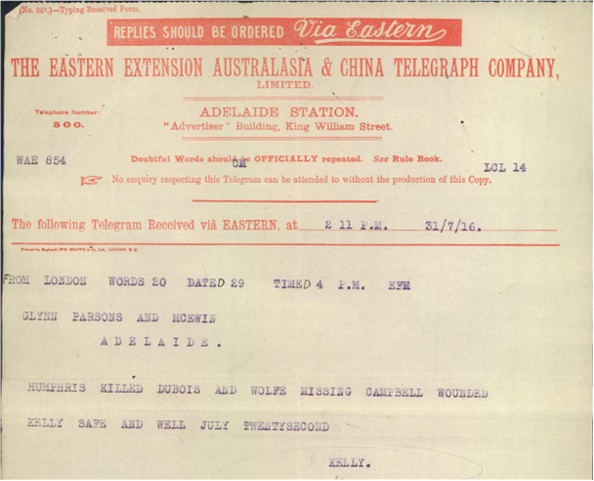
How it made its way to London and then to the legal offices in Adelaide is unclear, but it meant that these families were aware much earlier than the families of other casualties. The Information was correct, although it did not become official for several weeks (and the Humphris family was, in the meantime, incorrectly informed by the military that he had been wounded.)
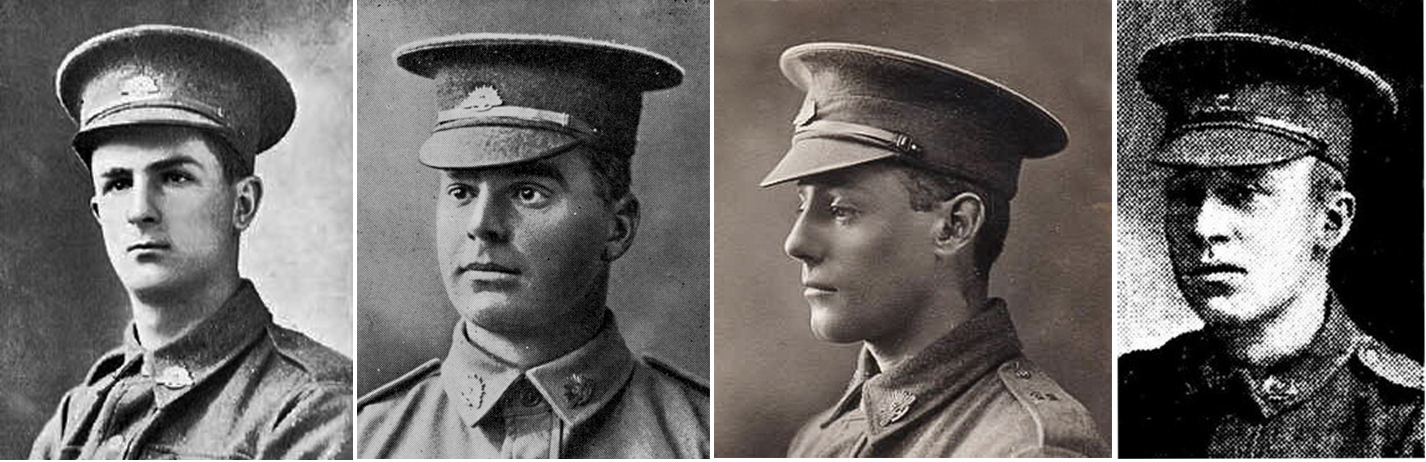
The anxious families sought definite information from the military through the SA Red Cross Information Bureau. On 30 August, Emma Wolff was officially informed that her son was missing.
Edward - Wounded and Prisoner of War
At some stage during the battle, Edward was wounded. He was hit with a bullet or shrapnel in the neck, which caused a spinal injury, making him unable to retreat with the rest of the 32nd. Edward was taken prisoner by the Germans, one of eighty-eight men from the 32nd who became prisoners of war. German documents say that Edward was captured on 21 July, which if accurate, means that after the battle was over, he spent a day and a night lying on the battlefield before he was picked up by the Germans.
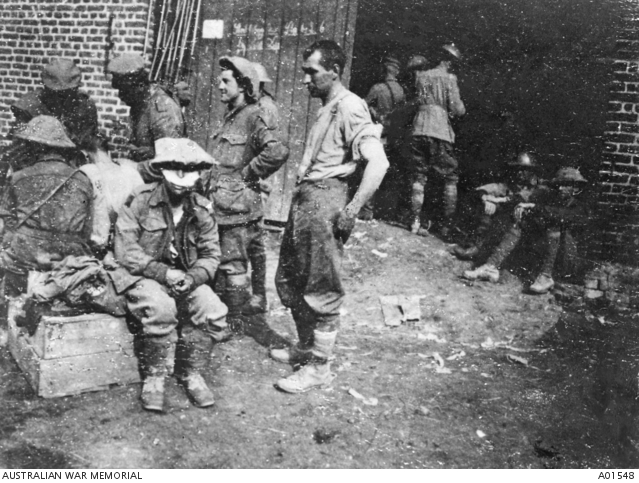
The second in command of the 32nd Battalion, Major Jack Hughes, had also been wounded and taken prisoner. After the war he reported that while his wounds were being dressed, he noticed several Australians being treated, and that ‘no discrimination appeared to be made between them and the German wounded’. He had previously seen “several of our men being carried down on improvised litters made of a blanket and a pole”.
Source - Australia War Memorial; Prisoner of war statements, 1914-18 War 5th Australian Division AWM30 B16.1
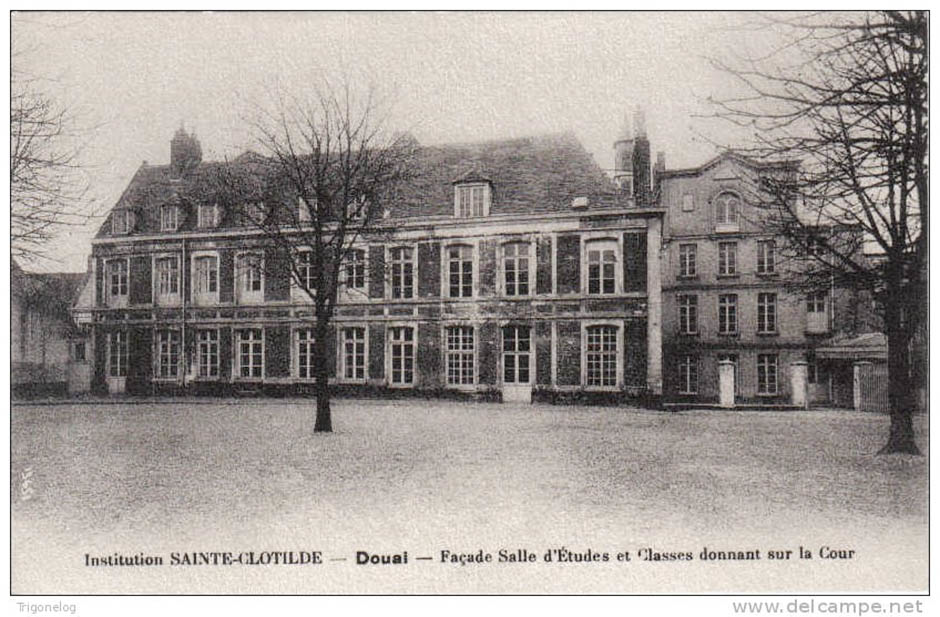
Wounded men who were taken prisoner were first taken to Haubourdin Field Hospital, near Lille. Most, including Edward, were then transferred to St. Clothilde Military Hospital in Douai.
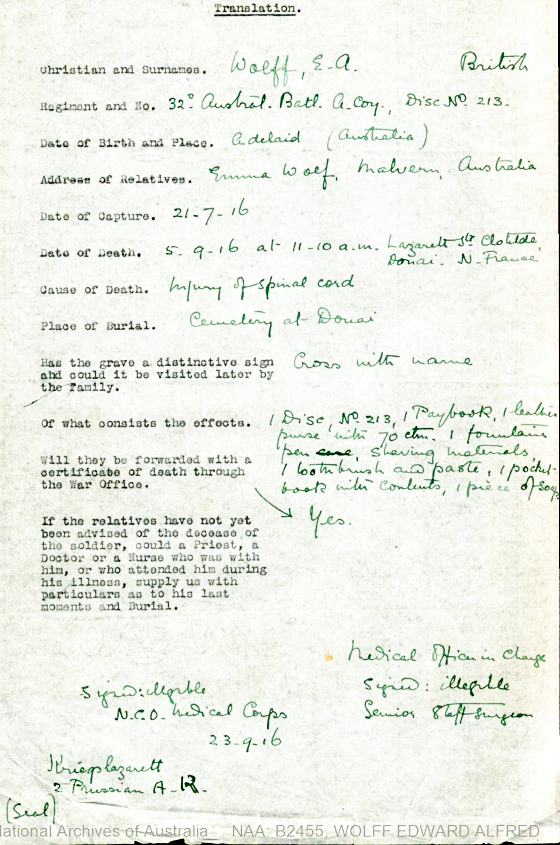
Seven weeks later, at 11.10am on 5 September, Edward died from his wounds. His death was meticulously recorded by his German captors – there are copies of nine German documents in his file. The cause of his death was given as ‘injury to spinal cord.’
Edward was buried in Douai Communal Cemetery, 45 km south of Fromelles. His grave was originally marked with a cross bearing his name, but after the war a formal headstone was put in place.
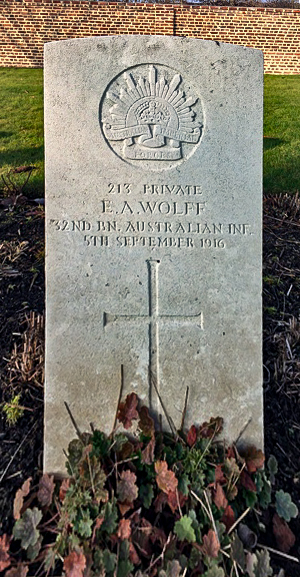
Edward’s family in Adelaide
Unlike the initial telegram the family received about Edward being missing, news through military channels was slow. His mother was officially informed that Edward was missing at the end of August. On 6 October, a short notice in Adelaide newspapers announced that Emma Wolff had been told that Edward was a prisoner of war in Germany.
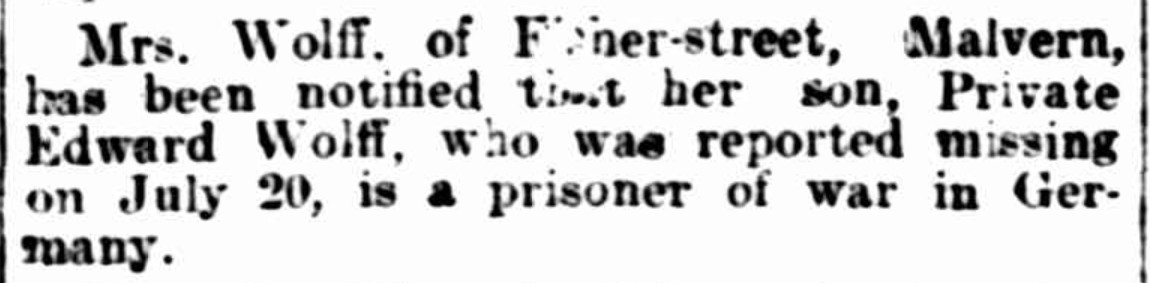
(It is surely no coincidence that four days later, Edward’s eldest brother, Ernest Theodor Wolff, aged 36 and a clerk, living in Queensland, enlisted in the AIF. Seventeen days later, he embarked with the 17th Reinforcements to the 26th Battalion). In December, Emma was finally informed of Edward’s death. Her newspaper obituary shows that she had at some stage she had received a message from her son after he was taken prisoner. This was not surprising – some families first learned that a man was a prisoner when they received a postcard from the man himself. The obituary also shows that at first she was given incorrect information about the time and place of his death:
”The late Pte. Edward Wolff, who was 31 years of age, was the younger son of the late Mr. J.W. Wolff, who for a number of years was a well-known organ builder in Adelaide, Some time ago, his mother, Mrs. Emma Wolff, of Fisher Street, Malvern, received an intimation that he had been wounded in action and take prisoner. As he was able to communicate with her, it was hoped his injuries were not serious, but these hopes were ended by an intimation which stated he had died at Wahn, Germany on September 15, 1916.”
One of the regrets of many of the families of men who died at Fromelles is that they did not have any of the man’s belongings or personal items returned to them. In April 1918 however, Emma Wolff received from Germany her son’s identity disc, and the small personal possessions that he had when he died.
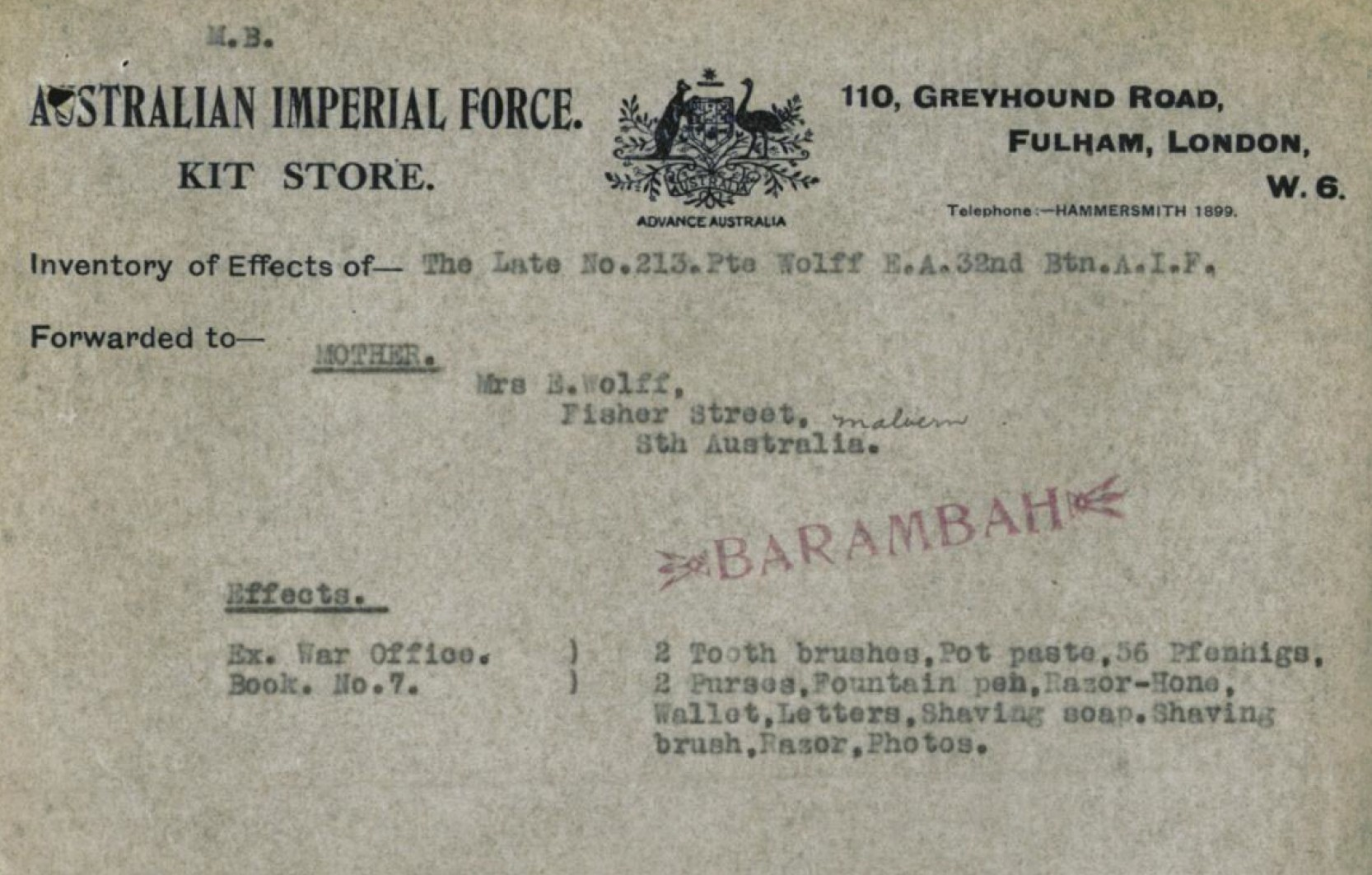
One can only imagine the emotion as these small items were unpacked by Edward’s mother. Also returned via the Red Cross were letters sent to Edward after he became a prisoner, but which arrived after his death. As well as one from his mother, was a letter from Marjorie Church, who had been one of the contributors to the 1910 publication, The High Light. In 1919, also via the Red Cross, Emma Wolff received a visitor’s description of the part of the Douai cemetery where Edward was buried which stated, ‘it really is a credit to the Boche or whoever looks after it.’
Source – South Australian Red Cross Information Bureau Wounded and Missing Files -Edward Wolff. P.16
The family of Bernard Dubois, Edward’s friend, did not have these small satisfactions. Bernard was also listed as missing after the battle. His family’s private enquiries led them to believe that, like Edward, he had been wounded while in the German trenches. Beyond that, they knew nothing, and Bernard has no known grave. In following years, on the anniversary of his death, Edward was remembered by his family in the ‘Heroes of the Great War ‘column of Adelaide newspapers.
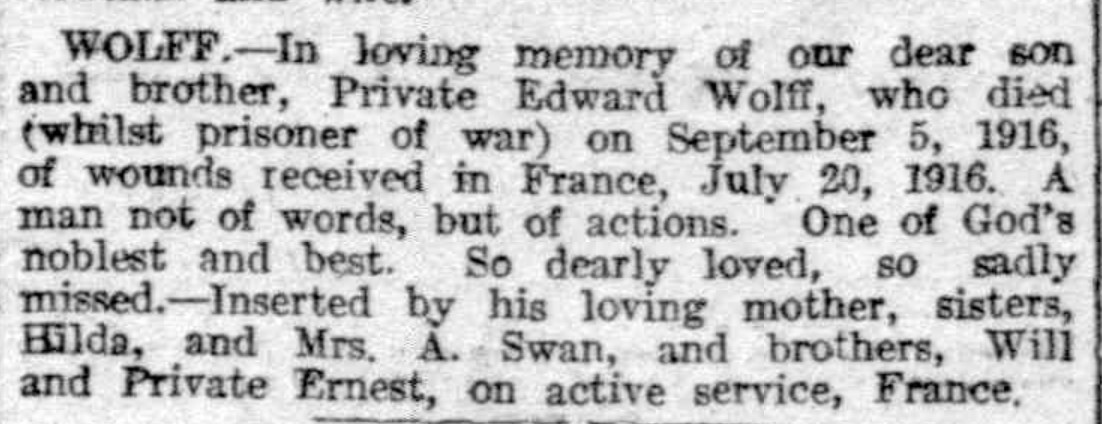
Edward Wolff is remembered in his local community on the Unley Arch of Remembrance and the Unley Town Hall Honour Board, as well as the South Australian National War Memorial. His name is on the Australian War Memorial Roll of Honour and the Ballarat Australian Ex-Prisoners of War Memorial.
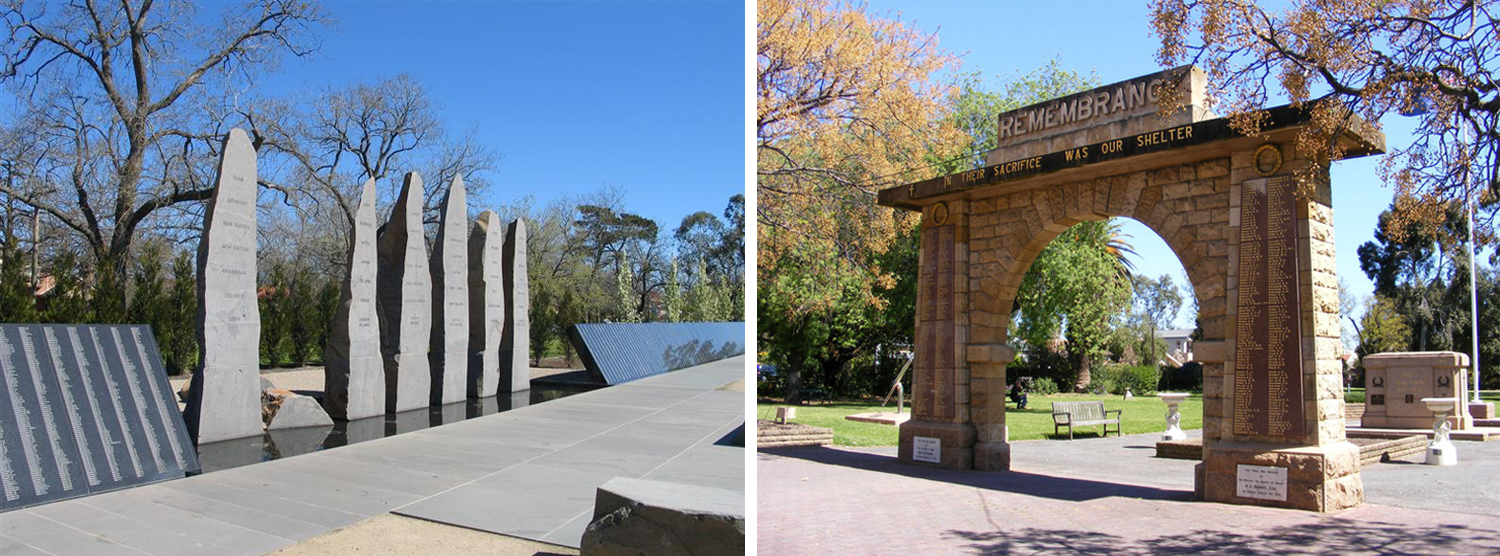
Right - Unley Arch of Remembrance
Family at War
Edward’s brother, 6185 Ernest Theodor Wolff, who enlisted immediately after the family was informed that Edward was a prisoner, served with the 26th Battalionin France from June 1917 to June 1918. When his fluency in German was recognised, he was he was detached to 2nd Divisional Headquarters Linguist School, and then, at the Armistice, ‘detached for duty as German speaker’. He returned to Australia in July 1919.
A Post-War ‘Reflection‘ by Poet Dame Mary Gilmore
In 1910, Edward Wolff illustrated a poem by Dame Mary Gilmore for publication the High Life . She later wrote a war poem, ‘Gallipoli’, which well reflects Edward’s fate (an extract below):
“When the world called him, there he went;
When the war called him, there he bent,
Now he is dead.”
The Fromelles Association would love to hear from you

Contacts
(Contact: carla@fromelles.info or geoffrey@fromelles.info).
(Contact: army.uwc@defence.gov.au or phone 1800 019 090).
Donations
If you are able, please contribute to the upkeep of this resource.
(Contact: bill@fromelles.info ).