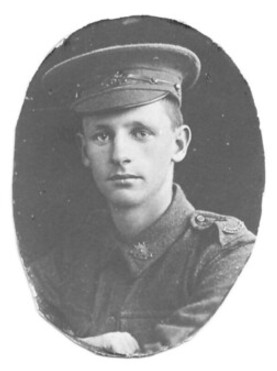
Charles Henry Benjamin WHITEHOUSE
Eyes blue, Hair brown, Complexion fair
Ben Whitehouse - “First up the ladder”
With thanks to Vince Aitkin for help with this story
Early Life
Charles Henry Benjamin Whitehouse, known to his family as Ben, was born in 1900 at Redfern, New South Wales, the eldest son of Charles Whitehouse and Sarah Ann Dunstan.
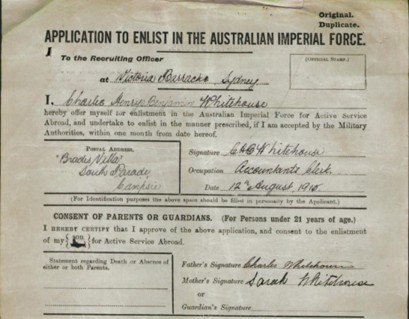
His father, Charles Whitehouse, had been born at Smethwick in Staffordshire, England, before emigrating to Australia. His mother, Sarah Ann Dunstan, was born at Vaughan in the Victorian goldfields district. The family settled in the growing Sydney suburb of Campsie, where they lived at Brades Villa on South Parade, later numbered 28 South Parade.
Ben grew up in a close-knit Methodist household during a period when Campsie was transforming from a semi-rural village into one of Sydney's expanding suburban communities. He attended Sydney High School and was regarded as a bright young man. After leaving school, he found employment as a clerk, a respectable occupation that offered opportunities for advancement and reflected his educational background.
Children of Charles and Sarah Whitehouse:
- Charlotte Ivy Whitehouse (1891–1948)
- Elizabeth Lindell Whitehouse (1892–1941)
- Frank Philip Whitehouse (1904–1965)
- Jack Wilbur Whitehouse (1912–1963)
As the First World War continued and reports of Australian service overseas filled newspapers across the country, patriotic enthusiasm swept through communities large and small. Recruiting campaigns, public meetings, church gatherings and newspaper reports encouraged young men to enlist in the Australian Imperial Force.
By 1915, Ben was still only fifteen years of age. He was what we would now describe as a "boy soldier". Determined to serve despite being underage, he enlisted in the Australian Imperial Force on 12 August 1915 and overstated his age by several years in order to meet the enlistment requirements. His attestation papers include a letter of consent that appears to have been signed by his parents, allowing their underage son to join the army.
The decision would have been a remarkable one for a young clerk from suburban Sydney. While many of his fellow recruits were adults, Ben was still a school-aged teenager. Yet, like thousands of other Australians caught up in the patriotic fervour of the time, he was eager to do his part in what many believed would be a short and glorious war.
A small portrait photograph believed to have been taken shortly before his enlistment survived inside a tiny gold locket passed down through the Whitehouse family. Preserved for many decades by Noelene Florance (née Whitehouse), it remains the only known image of Ben and provides a poignant reminder of the youth of one of Australia's youngest volunteers to serve during the Great War.
Off to War
Following his enlistment, Ben reported for training at the Liverpool and Holsworthy camps southwest of Sydney. Although only fifteen years of age, he entered the same demanding military routine as the older men around him. Days were filled with route marches, rifle drill, bayonet practice, physical training and field exercises as recruits were prepared for active service overseas.
Ben remained closely connected to the Campsie Methodist Church community during his training. The congregation took a keen interest in the young men who had volunteered for service, regularly publishing their names in church publications and recognising their commitment to King and Country. Parishioners also supported the departing soldiers by knitting socks and gloves and making woollen jackets to help them endure the cold conditions they were expected to encounter abroad.
The Methodist newspaper of 16 October 1915 carried a report praising local recruits and the support being provided by the Campsie congregation.
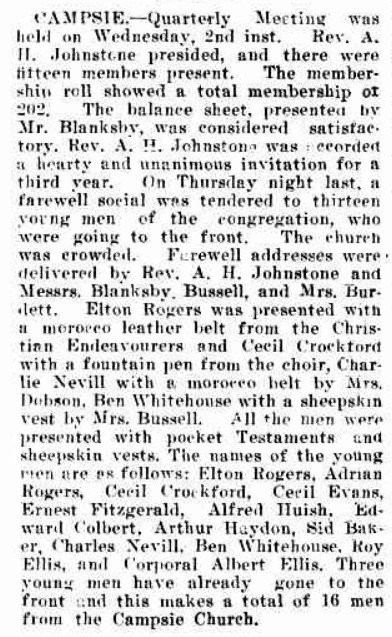
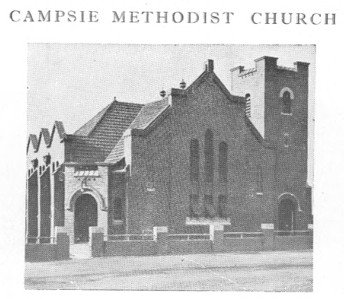
In December 1915, shortly before Ben departed Australia, Campsie Methodist Church unveiled a Roll of Honour recognising seventeen local men connected with the congregation and Sunday school who had enlisted for military service. The Methodist newspaper reported that the church was filled beyond capacity for the ceremony, with "many having to be turned away." Ben's name appeared among the local young men honoured that day.
On 20 December 1915, Ben embarked from Sydney aboard HMAT A60 Aeneas as part of the 4th Reinforcements to the 18th Battalion. Family and friends gathered at the wharves to farewell the departing troops as the transport steamed out of Sydney Harbour.
The voyage first took the Aeneas across the Great Australian Bight to Albany, Western Australia, where it joined a large convoy of troopships bound for the Middle East. Conditions aboard were crowded but generally uneventful, with soldiers undertaking regular drills, physical training and shipboard duties during the long journey.
After several weeks at sea, the convoy reached Egypt, where Ben disembarked and joined the thousands of Australian troops then undergoing further training and reorganisation following the Gallipoli campaign.
Egypt
Following arrival in Egypt, Ben underwent further training as the AIF reorganised after Gallipoli. During this period he was transferred from the 17th Battalion reinforcements to the newly formed 55th Battalion, before later being allotted to the 59th Battalion as part of the expanding 5th Australian Division. The 59th Battalion was raised in Egypt on 21 February 1916, following the evacuation from Gallipoli and the influx of reinforcements from Australia. Half of its men were experienced soldiers from the 7th Battalion; the other half were new recruits, many from rural Victoria. The battalion formed part of the 15th Infantry Brigade under Brigadier General Harold “Pompey” Elliott, within the newly created 5th Australian Division.
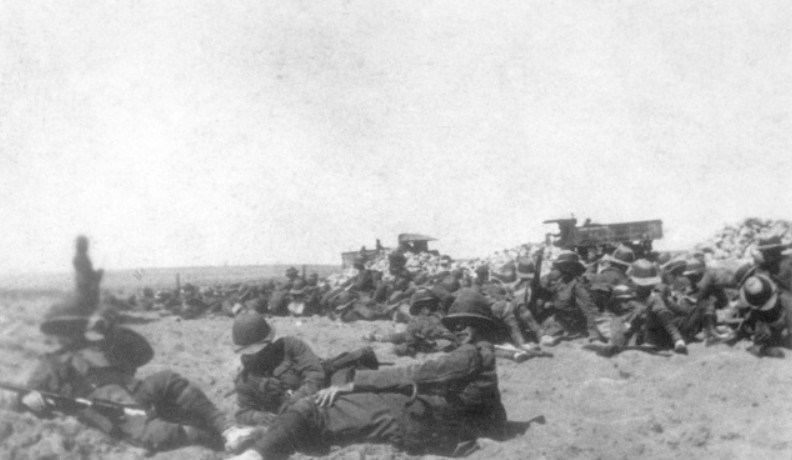
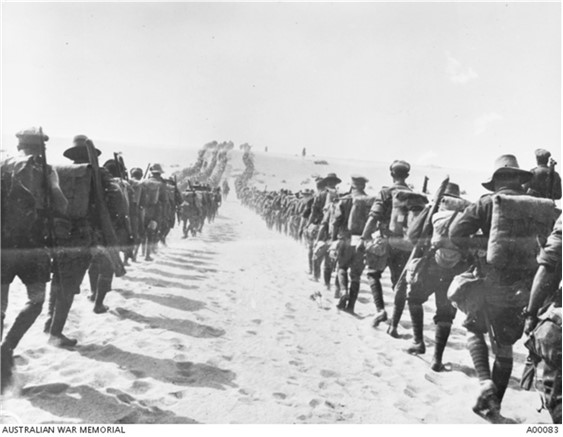
Training took place at Tel-el-Kebir, followed by a three-day march through the desert to Ferry Post, where the battalion continued training and undertook canal defence duties.
France
On 18 June 1916, the 59th boarded the transport Kinfauns Castle, arriving at Marseilles on 29 June. By 2 July, they were stationed at Steenbecque in northern France, around 35 kilometres from the front. Ben would have been exuberant at seeing the green fields and no doubt marvelled at the moderate climate of France, so vastly different from the sand and dust, flies, and heat of the desert country they had just left behind in Egypt. As they moved closer to the front line, the men were issued gas masks and steel helmets, and underwent instruction in trench warfare. On 9 July, they were moved to Sailly-sur-la-Lys, positioned just 1,000 yards from the German lines near the Sugarloaf salient — a heavily fortified section of the enemy defences which dominated the surrounding battlefield with machine-gun fire.
Charles Bean later described the Sugarloaf as a position from which the Germans could sweep the advancing Australians with devastating enfilade fire.The battalion moved into the trenches for the first time at 4.00pm on 18 July 1916, relieving the 57th Battalion. Heavy artillery from both side s pounded the narrow sector as the men prepared for the coming attack. One young soldier from the neighbouring 58th Battalion, Bill Boyce, summed up the feelings of many men entering the line for the first time. “What have I let myself in for?”
Source - Australian War Memorial Collection C386815
The Battle of Fromelles
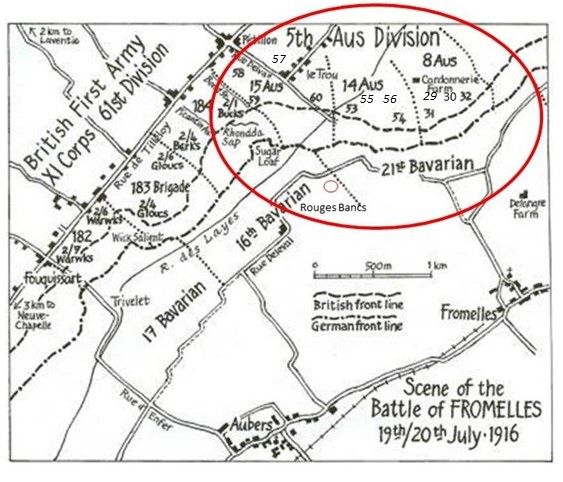
At 4.00pm on 18 July 1916, the 59th Battalion entered the front-line trenches at Fromelles, relieving the 57th Battalion. The trenches faced the Sugarloaf salient, where the German positions were especially strong. The men had arrived in France only weeks earlier and many were about to experience major battle for the first time. At 5.45pm on 19 July, the battalion launched its assault in four waves at five-minute intervals, with A and B Companies leading, followed by C and D Companies. The attack took place in broad daylight across flat ground under full enemy observation. The German defences responded immediately. Heavy rifle and machine-gun fire swept the battlefield, particularly from the Sugarloaf strongpoint on the Australian right flank. Messages sent back from the front during the assault revealed the scale of the disaster unfolding:
“Every man who rises is shot down.”
“Cannot get on — the trenches are full of the enemy.”
“They were enfiladed by machine guns in the Sugar Loaf and melted away.”
The battalion’s commanding officer was incapacitated by shell shock early in the attack. His second-in-command, Major H.T.C. Layh, assumed command but was later wounded after being blown into a water-filled shell hole. The British 184th Brigade, positioned to the right of the 59th Battalion, faced the same devastating fire and halted their advance by 8.00pm. However, poor communication across the line meant the Australians continued their attack without support from their exposed flank. Some parties of the 59th Battalion reached the German parapet and captured prisoners, but without reinforcement or reliable contact with adjacent units, they were eventually forced to withdraw or dig in under constant fire.
At 11.15pm, a message acknowledged that the battalion was attempting to consolidate a position 100 yards forward of the German line. The position proved impossible to hold. Early on 20 July, the brigade ordered a general withdrawal. By 8.00am, only four officers and ninety other ranks had reported in from the entire battalion. Private George Martindale, one of the surviving members of the 59th Battalion, later recalled:
“We went into action… a regiment at full strength – ninety seven answered their names – not one in ten.”
The brigade’s operational report, signed by Brigadier General Harold Elliott, described the outcome bluntly:
“The attack was made in broad daylight… The effect of the fire was devastating and order was lost.”
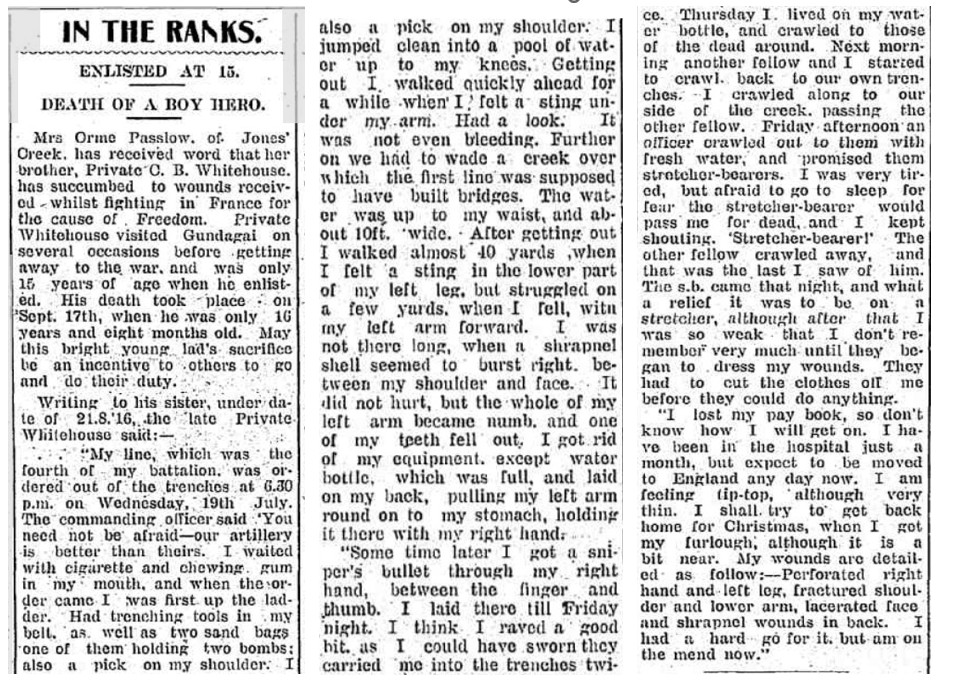
Among those advancing into the darkness was sixteen-year-old Private Charles Henry Benjamin Whitehouse. Only weeks later, while recovering in hospital, Ben wrote a detailed account of the battle to his sister. The letter was later reproduced in the Gundagai Independent:
“My line, which was the fourth of my battalion was ordered out of the trenches at 6.30pm on Wednesday 19th July. The commanding officer said, ‘You need not be afraid - our artillery is better than theirs’. I waited with cigarette and chewing gum in my mouth, and when the order came, I was first up the ladder.”
“Had trenching tools in my belt as well as two sandbags one of them holding two bombs, also, a pick on my shoulder, I jumped clean into a pool of water up to my knees. Getting out I walked quickly ahead for a while when I felt a sting under my arm. Had a look, it was not even bleeding.”
“Further on we had to wade a creek over which the first line was supposed to have built bridges. The water was up to my waist, and about 10 ft. wide. After getting out I walked almost 10 yards when I felt a sting in the lower part of my left leg, but struggled on a few yards, when I fell with my left arm forward.”
“I was not there long, when a shrapnel shell seemed to burst right between my shoulder and face. It did not hurt but the whole of my left arm became numb, and one of my teeth fell out.”
“I laid there until Friday night.”
“Thursday, I lived on my water bottle and crawled to those of the dead around.”
“Next morning another fellow and I started to crawl back to our trenches.”
“Friday afternoon an officer crawled out to them with fresh water and promised them stretcher-bearers.”
“I was very tired, but afraid to go to sleep for fear the stretcher bearer would pass me for dead and I kept shouting ‘stretcher bearer’.”
Ben survived the battlefield and was eventually carried from no-man’s-land by stretcher bearers after lying wounded for almost two days. His wounds, however, were catastrophic. He had been shot and suffered shellfire in the arm, chest, face, hand and leg. The 59th Battalion suffered catastrophic losses at Fromelles. Initial casualty figures recorded 26 men killed or died of wounds, 394 wounded, and 274 missing — a total of 694 casualties. Later analysis confirmed that 338 men of the battalion were killed in action or died of wounds. More than 240 of the dead were never identified. When Charles Bean, Australia’s official war historian, revisited the battlefield more than two years later, he observed torn uniforms, Australian equipment, and bones still lying across the fields, silent evidence of the scale of the disaster.
The 59th Battalion was withdrawn from the line and rebuilt over the following months, but for the survivors of Fromelles, the memory of the battle never faded.
After the Battle
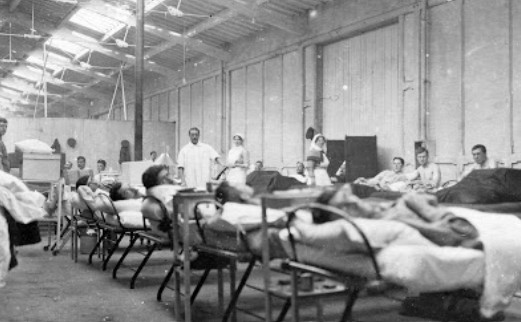
After being recovered from no-man’s-land, Ben was evacuated through a series of dressing stations and hospitals behind the lines. His wounds were severe and extensive. He had suffered gunshot and shrapnel wounds to his left arm, chest, face, hand and leg, including a compound fracture of the left forearm.
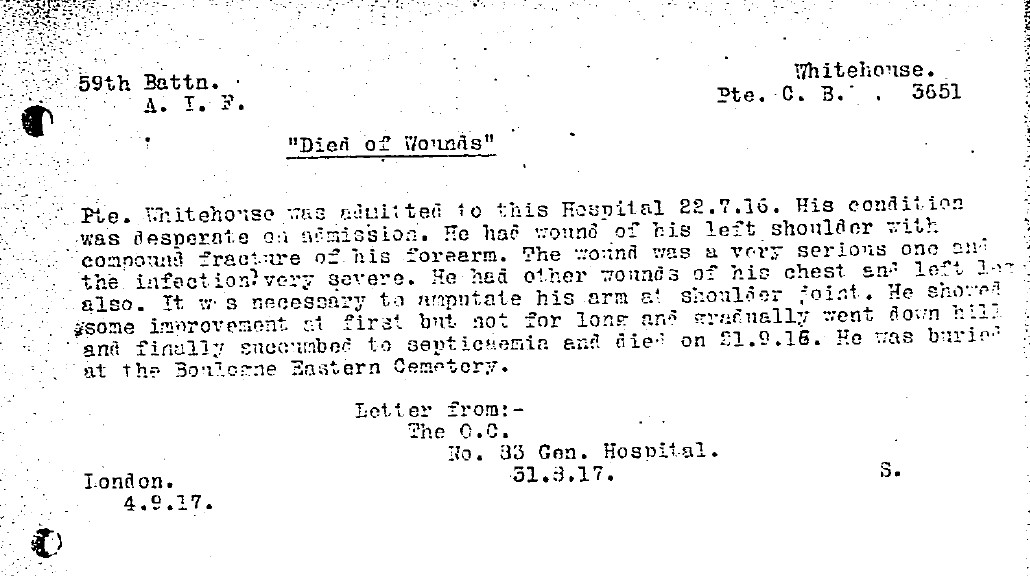
A report in his Australian Red Cross Wounded and Missing file later described the extent of his injuries “He had wound of his left shoulder with compound fracture of his forearm. The wound was a very serious one and the infection very severe. He had other wounds of his chest and left leg also. It was necessary to amputate his arm & shoulder joint.” The report added “His condition was desperate on admission.”
Source - Australian Red Cross Wounded and Missing File – Charles Henry Benjamin Whitehouse
Despite the severity of his wounds, Ben remained hopeful. Writing to his sister from hospital on 21 August 1916, more than a month after the battle, he described his condition:
“I had a hard go for it but am on the mend now.”
He also expressed hope that he might eventually return home:
“I shall try to get back home for Christmas when I get my furlough.”
For a time, Ben showed signs of improvement. However, infection continued to spread through his wounds. Before the widespread use of antibiotics, septicaemia claimed the lives of many soldiers who had initially survived the battlefield.
The Red Cross report recorded the final stages of his decline:
“He showed some improvement at first but not for long and gradually went down hill and finally succumbed to septicaemia and died on 21.9.16.”
At 10.15pm on 21 September 1916, Private Charles Henry Benjamin Whitehouse died in No. 13 Stationary Hospital at Boulogne, France. He was just sixteen years and nine months old. News of Ben’s death devastated his family and the Campsie community. In October 1916, the Sydney Morning Herald published memorial notices placed by family and friends:
“WHITEHOUSE.- Died from wounds, in France. Sept. 21, 1916, Private C. B. (Ben) Whitehouse, beloved eldest son of Mr. and Mrs. C. Whitehouse, South Parade, Campsie, aged 16 years and 9 months.”
And another from his siblings:
“WHITEHOUSE.-Died of wounds in France, September 21, 1916, dearly loved brother of Lottie, Lindell, Frank, and Jack Whitehouse. Sadly missed.”
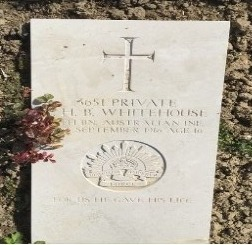
More than a century later, the young soldier from Campsie continues to be remembered through his surviving photograph, family memories, and the records he left behind.
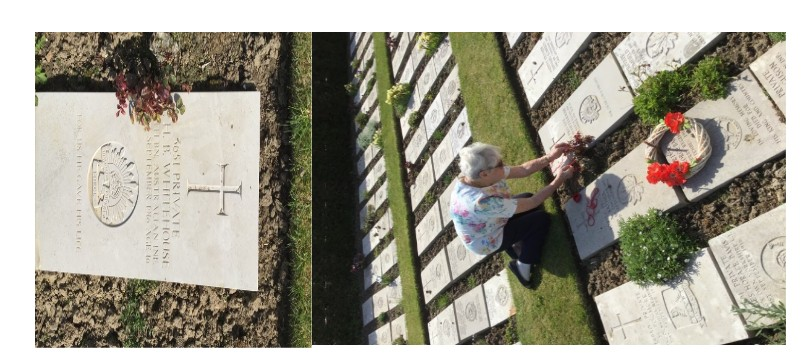
The visit formed a deeply personal connection between the young soldier who died from wounds after Fromelles and the generations of family who continued to remember him long after the war had ended.
Although Ben’s life lasted only sixteen years, his story endured through the memories of his family, the records of the war, and the small personal items that survived him. Following his death, his parents remained at South Parade, Campsie, where they continued to mourn the loss of their eldest son. In March 1918, Ben’s father acknowledged receipt of his personal belongings returned from overseas. The effects included identity discs, photographs, letters, cards, a devotional book, brushes, shaving items and other small possessions carried with him during his service.His mother, Sarah Ann Whitehouse, died in 1929, aged 58.
His father Charles Whitehouse died three years later in 1932. Both were buried at Rookwood Cemetery in New South Wales. Ben’s name continued to appear in memorial notices published by the family in the years after the war, ensuring he was not forgotten. He was commemorated on the Australian War Memorial Roll of Honour and on the Campsie Methodist Church Roll of Honour alongside the other young men from the congregation who enlisted during the war. Of the seventeen men named on the church honour roll unveiled in 1915, only six returned to Australia after the war. Others were killed at Pozieres, Passchendaele, Fleurbaix, Ypres and Fromelle.
Vince’s Reflections
Researcher Vince Aitkin first became aware of Ben Whitehouse through family connections and surviving memories passed down within the Whitehouse family. What began as a search for information about a young soldier from Campsie gradually developed into a much larger effort to reconstruct Ben’s short life and wartime service. Central to that story was a tiny gold locket containing the only known photograph of Ben. Preserved for decades by Noelene Florance (née Whitehouse), the image became a powerful reminder that behind every name on a memorial was a real person, a family, and a life interrupted by war. In reflecting on Ben’s story, Vince noted the extraordinary youth of the boy who enlisted underage, fought at Fromelles, and endured terrible wounds before dying in hospital two months later.
Ben’s letter from the battlefield, written while recovering from his injuries, provided a rare and deeply personal insight into the experience of one of Australia’s youngest soldiers to serve on the Western Front. Particularly moving were Ben’s recollections of the attack itself, waiting in the trench with “cigarette and chewing gum” before climbing out into the gunfire, describing himself as “first up the ladder,” then lying wounded for almost two days amongst the dead and dying in no-man’s-land. His account of desperately calling out “stretcher bearer” through the darkness captured both the terror and endurance experienced by wounded soldiers after the assault had failed. For Vince, these recollections transformed Ben from a name in a service file into a vivid human story.
The detail and honesty contained in the young soldier’s own words offered a confronting glimpse into the reality faced by many inexperienced Australian troops at Fromelles in July 1916. Vince also reflected on the close-knit Campsie Methodist community that farewelled so many young men during the war. The honour roll unveiled in 1915 represented not just names, but families and friendships from the same streets, schools and church pews. Many never returned. More than a century after Ben’s death, Vince helped reconnect the Whitehouse family with the story of their young relative and assisted in preserving his memory for future generations. Through photographs, newspaper accounts, military records and family recollections, the story of Ben Whitehouse continues to endure.
Shortly before Noeline’s passing, I arranged for the local ABC radio Station to broadcast an interview conducted with Noeline. It was all about Ben and focused on her placing flowers at his grave. Here is the link to that interview which is current https://www.abc.net.au/listen/programs/goulburnmurray-breakfast/ben-whitehouse-ww1-soldier-just-a-kid/103768398
DNA is still being sought for family connections to
| Soldier | Charles Henry Benjamin Whitehouse 1900-1916 |
| Parents | Charles Whitehouse (1865-1932), Smethwick, Staffordshire, England and Sarah Ann Dunstan (1871-1929), Vaughan, Victoria, Australia |
| Siblings | Charlotte Ivy Whitehouse (1891-1948) | ||
| Elizabeth Lindell Whitehouse (1892-1941) | |||
| Frank Philip Whitehouse (1904-1965) | |||
| Jack Wilbur Whitehouse (1912-1963) |
| Grandparents | |||
| Paternal | Henry Whitehouse and Elizabeth Adderley | ||
| Maternal | Benjamin Dunstan (1837-1889) and Hannah Phillips (1844-1905) |
Links to Official Records
The Fromelles Association would love to hear from you

Contacts
(Contact: carla@fromelles.info or geoffrey@fromelles.info).
(Contact: army.uwc@defence.gov.au or phone 1800 019 090).
Donations
If you are able, please contribute to the upkeep of this resource.
(Contact: bill@fromelles.info ).