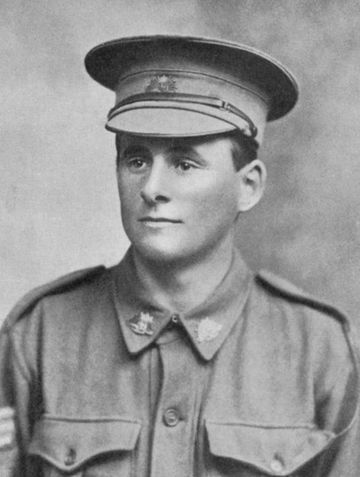
Edgar Charles HOLMES
Eyes Blue, Hair Black, Complexion Sallow
Edgar Charles Holmes - A Scholar and Teacher Lost at Fromelles
With thanks to Janeice Quin (nee Holmes) for the family details, insights and her reflections.
Can you help find Edgar?
Edgar Charles Holmes’s body was never found after the Battle of Fromelles, and there are no records of his burial.
A mass grave was found in 2008 at Fromelles, a grave the Germans dug for 250 Australian soldiers they recovered after the battle. As of 2026, 181 of these soldiers have been able to be identified via DNA testing from family members.
Edgar may be among these remaining 69 unidentified men. There is still a chance to identify him — but we need help. We welcome all branches of his family to come forward to donate DNA to help with his identification, especially those with roots in Sandford, VIC.
See the DNA box at the end of the story for what we do know about his family.
If you know anything of contacts for Edgar Charles, please contact the Fromelles Association.
Early Life
Edgar Charles Holmes was born on 10 December 1890 at Sandford, Victoria, the fourth child of William Tyers Holmes and Elizabeth Jane Baxter. Their children were:
- Edith Sarah Holmes (1883–1938)
- George Baxter Holmes (1886–1971)
- Harold William Holmes (1887–1974)
- Edgar Charles Holmes (1890–1916)
- Mahala Mary Holmes (1893–1894)
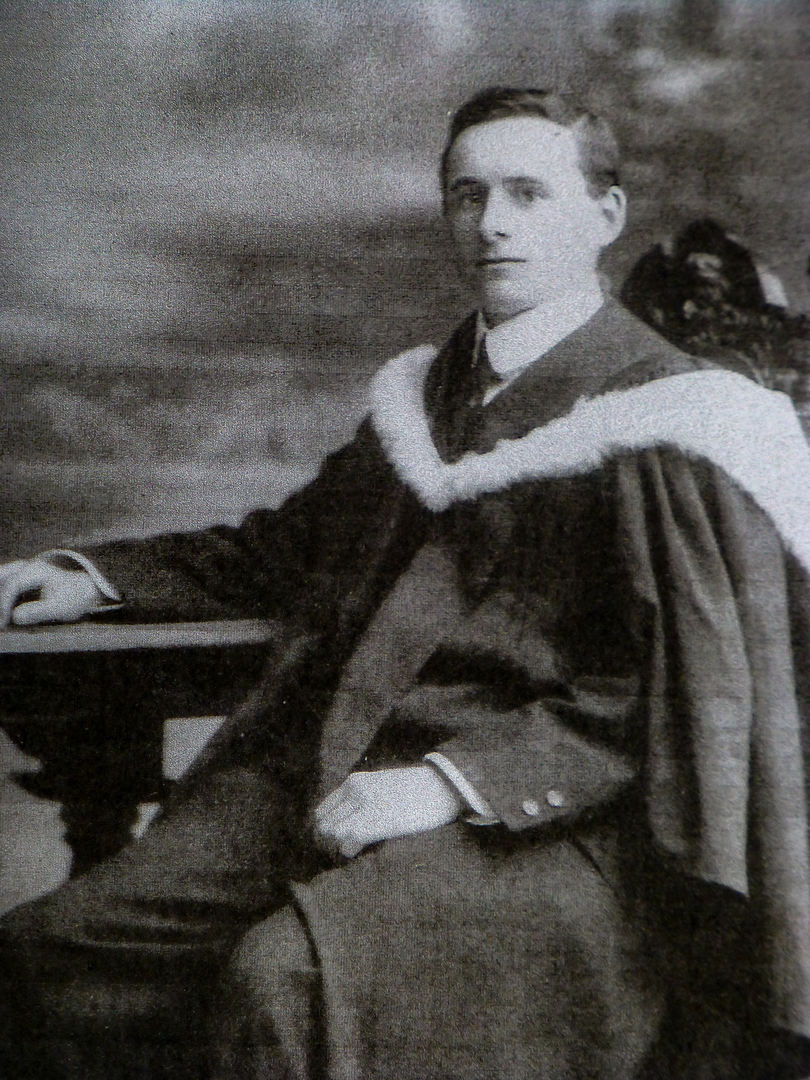
Edgar’s father had arrived in Victoria from England as a small child aboard the Saldanha in 1856, while his mother was born at Casterton in the Western District of Victoria. Edgar grew up in the Sandford and Merino districts and began his education at Sandford State School, where he later became a junior teacher. He continued his studies at Essendon High School before entering the Teachers’ College in 1909. An intelligent and highly regarded student, Edgar graduated successfully and won the Gladman Prize in 1911. He later completed a Bachelor of Arts degree through the University of Melbourne and, at the time of his enlistment, was studying for a Bachelor of Science.
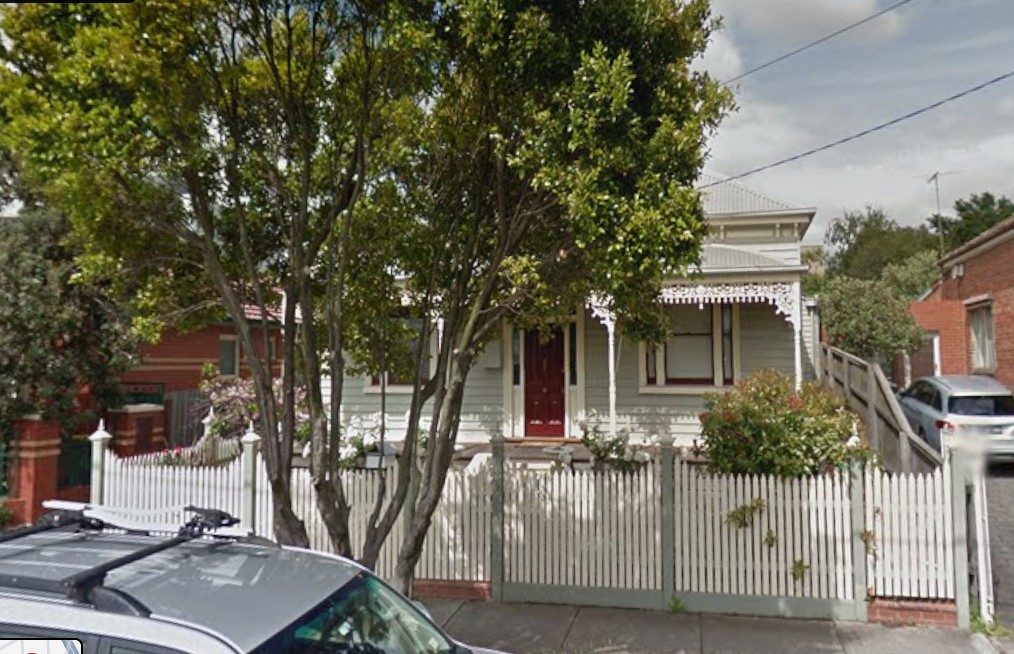
Following his training, Edgar taught at Mokepilly before transferring to St Arnaud Higher Elementary School. He later moved to Essendon High School, where he was teaching before the war. Electoral records from 1914 show him living at 20 Flower Street, Essendon, where his occupation was listed as “State School Master”.
Before enlisting, Edgar had already attempted to join the military twice but had been rejected, reportedly because of dental issues. Determined to serve, he eventually enlisted in the Australian Imperial Force in July 1915.
Off to War
Among those reinforcements was Edgar Charles Holmes, a young Victorian school teacher and university graduate who had enlisted in Melbourne in July 1915. His cousin, Frederick Holmes (266) also enlisted, in September. Fred was assigned to the newly formed 32nd Battalion. After training with the 23rd Battalion reinforcements, Edgar arrived in Egypt aboard HMAT Wiltshire in March 1916. With the ‘doubling of the AIF’ as it expanded from two infantry divisions to five, major reorganisations were underway. The 59th Battalion was raised in Egypt on 21 February 1916 at the 40,000-man training camp at Tel-el-Kebir, about 110 km northeast of Cairo.
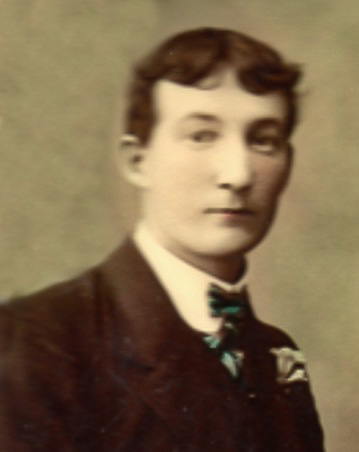
The battalion formed part of the 15th Infantry Brigade under Brigadier General Harold “Pompey” Elliott, within the newly created 5th Australian Division. Approximately half of its recruits came from the 7th Battalion Gallipoli veterans and the other half from reinforcements from Australia. The 59th was predominantly composed of men from rural Victoria. Edgar was transferred to the 59th Battalion at Duntroon Plateau on 20 April 1916. While military training in the desert was very hard, hot and dusty, it was not all work, however. A 5th Division Sports Championship was held on 14 June, which was won the by the 59th’s 15th brigade. The very next day they began preparations for heading to the Western Front.
The 59th departed aboard the Kinfauns Castle from Alexandria on 18 June 1916. After a brief stop in Malta, they disembarked at 7.00 AM in Marseilles on 29 June. By 10.00 PM they were on a train headed for Steenbeque, 35 km from Fleurbaix in northern France, arriving on 2 July. This area near Fleurbaix was known as the “Nursery Sector”, a supposedly relatively quiet area where inexperienced Allied troops could learn the harsh realities of Western Front trench warfare against the Germans. But the quiet times and the training period did not last long.
Training continued, but with a higher sense of urgency, and it now included the use of gas masks and learning to deal with the effects of large shells. On 6 July 1916, Edgar was promoted to Lance Corporal, recognition of his leadership and ability only days before entering battle. The move to the front continued. On 9 July they were in Sailly sur la Lys, just 1000 yards from the trenches. At 4.00 PM on 18 July 1916, the 59th Battalion entered the front-line trenches relieving the 57th.
The Battle of Fromelles
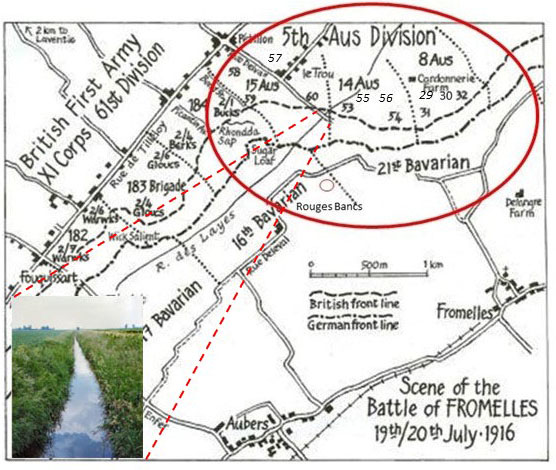
Inset - River Layes from the Australian Front Line looking towards the Sugar Loaf
The overall plan, as part of the campaign in the Somme, was to use brigades from the Australian Fifth Division and the British 61st Division to conduct a diversionary assault on the German trenches at Fromelles. The battle plan had the 15th Brigade located just to the left of the British Army. The 59th and 60th Battalions were to be the lead units for this area of the attack, with the 58th and 57th as the ‘third and fourth’ battalions, in reserve. The main objective for the 15th Brigade was to take the trenches to the left of a heavily armed, elevated German defensive position, the ‘Sugar Loaf’, which dominated the front lines.
If the Sugar Loaf could not be taken, the other battalions would be subjected to murderous enfilade fire from the machine-guns and counterattacks from that direction. As they advanced, they were to link up with the 60th battalion and the British on their flanks. The main attack against the Sugar Loaf position was planned for 17 July, but it was delayed due to bad weather. On 19 July, Zero Hour for advancing from their front-line trenches was to be 5.45 PM, but the Germans knew this attack was coming and were well-prepared. They opened a massive artillery bombardment on the Australians at 5.15 PM, causing chaos and many casualties. A fellow soldier, Bill Boyce (3022, 15th Brigade, 58th), summed the situation up well, “What have I let myself in for?”
Source - Australian War Memorial Collection C386815
Their attack on the German lines began at 5.45 PM on the 19th. The 59th went over their parapet in four waves at 5 minute intervals, but then laid down to wait for the support bombardment to end at 6.00 PM. A and B Companies were in the first two waves, C and D in the next two.
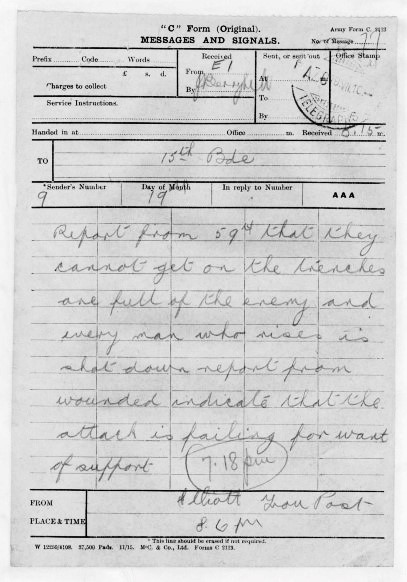
There was immediate and intense fire from rifles and the Sugar Loaf machine guns. As documented in the messages sent back to HQ just after the attacks began:
“cannot get on the trenches as they are full of the enemy”
“every man who rises is shot down”
“‘they were enfiladed by machine guns in the Sugar Loaf and melted away”

The British 184th Brigade just to the right of the 59th met with the same resistance, but at 8.00 PM they got orders that no further attacks would take place that night. However, the salient between the troops limited communications, leaving the Australians to continue without British support from their now exposed right flank. The official reports indicate advances against the Sugar Loaf fortification were limited, but individuals’ reports suggest that some did reach the German parapet. However, their gains were impossible to hold and with little support being available they had to drop back.
The attack was ended early on the morning of the 20th. At the 8 AM roll call, out of a battalion of about 1000 soldiers, 4 officers and 90 other ranks reported in. While there was no cease fire after the battle, parties did go to No-Man’s Land to bring back wounded soldiers, with over 200 recovered on 20 July. The initial toll on the 59th was 26 killed or died of wounds, 394 were wounded and 274 were missing – 694 soldiers.
Ultimately, 332 soldiers were killed in action or died from their wounds from this battle. 239 of the soldiers were unidentified. One soldier has been found to be in the burial pit that the Germans dug at Pheasant Wood that contained 250 Australian soldiers. As of 2026, 181 of these soldiers have been able to be identified via DNA matching. To get some perspective of the battle, when Charles Bean, Australia’s official war historian, attended the battlefield two and half years later, he observed a large quantity of bones, torn uniforms and Australian kit still on the battlefield.
After the Battle
In the days following the Battle of Fromelles, Edgar Charles Holmes was officially listed as missing in action. Like many families across Australia, the Holmes family endured months of uncertainty, hoping that he may have survived and been taken prisoner. Edgar’s cousin Frederick, fighting in the 32nd Battalion, was badly wounded, a bullet damaged the network of nerves controlling movement and sensation in the shoulder, arm and hand, but he did survive the battle. After he was well enough to travel, he returned to Australia. Newspapers in Victoria carried brief reports on Edgar as the uncertainty continued:
Pte Edgar Holmes, son of Mr William Holmes, of Merino, has been missing since 19th July. He was a teacher in the Education Department, and took his B.A. degree last year, before enlisting,
Another local paper noted:
Lance Corporal E. C. Holmes has been reported missing since the 19th July. Before enlisting he was a teacher at the St. Arnaud High School.
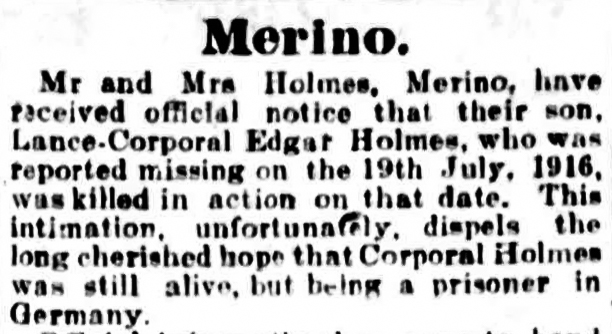
For more than a year, Edgar’s fate remained unresolved. Finally, a Court of Enquiry held in the field on 29 August 1917 determined that he had been killed in action at Fromelles on 19 July 1916. The official notification devastated the family:
Mr and Mrs Holmes, Merino, have received official notice that their son, Lance Corporal Edgar Holmes, who was reported missing on the 19th July, 1916, was killed in action on that date. This intimation, unfortunately, dispels the long cherished hope that Corporal Holmes was still alive, but being a prisoner in Germany.
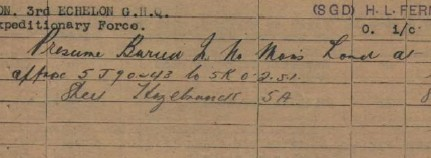
No grave for Edgar was ever located. His service file later recorded the haunting notation:
Presumed Buried In No Man's Land at approx 5J90-43 to 5K0.2.5.1 Sheet Hazebrouck 5A.
In December 1918, Edgar’s name was included among the fallen honoured at the unveiling of the Soldiers’ Memorial Stone at Merino. The ceremony, attended by Governor Sir Arthur Stanley and Lady Stanley, drew large crowds from across the district and commemorated the local men who had served and died during the war. The loss of Edgar deeply affected his mother Elizabeth Jane Holmes. She died at Merino on 22 August 1919 during the influenza epidemic which swept Victoria after the war. A newspaper notice observed:
“It will be remembered that the deceased lady lost a son at the war, Lieut. E. Holmes, a young man of much ability and promise, and from this blow the deceased lady never seemed to have fully recovered”.
In the years that followed, Edgar’s father William Tyers Holmes received his son’s memorial plaque, memorial scroll, the “Where the Australians Rest” pamphlet, the British War Medal and the Victory Medal. Edgar Charles Holmes has no known grave and is commemorated on the VC Corner Australian Cemetery Memorial at Fromelles, alongside hundreds of Australians whose bodies were never recovered or identified.
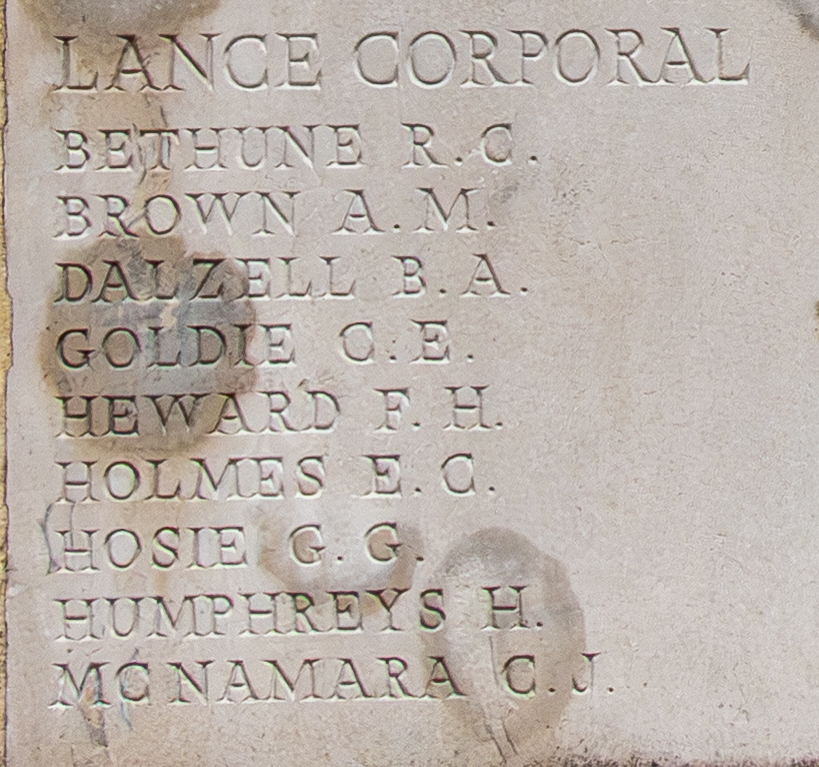
VC Corner Australian Cemetery Memorial at Fromelles
Edgar is commemorated at:
- VC Corner Australian Cemetery Memorial, Fromelles, France
- Australian War Memorial Roll of Honour, Canberra
- Casterton War Memorial, Victoria
- Merino War Memorial, Victoria
- Merino Digby Honour Roll, Victoria
- Sandford War Memorial, Victoria
- Sandford School Honour Roll, Victoria
- Sandford St Mary’s Roll of Honour, Victoria
- Essendon High School Honour Roll, Victoria
- Parkville Old State College Memorial Windows, Victoria
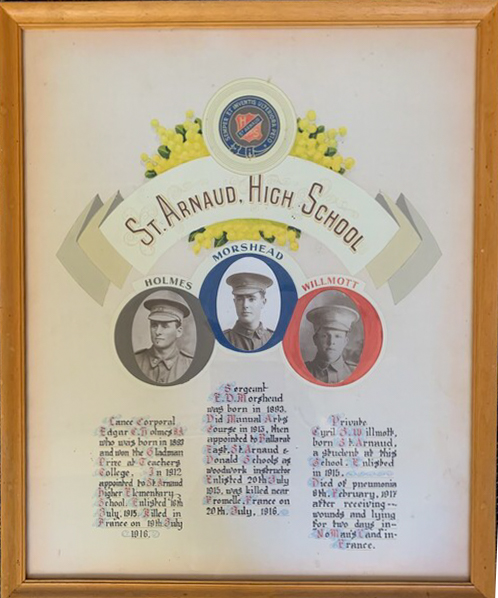
- St Arnaud High School House Captains Memorial, Victoria
- St Arnaud High School Roll of Honour WWI, Victoria
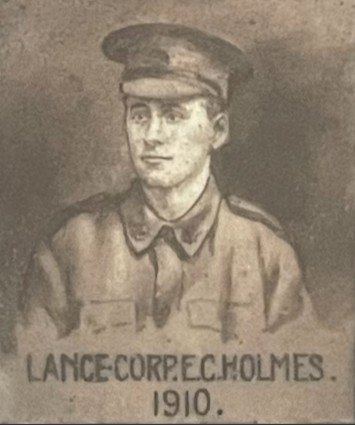
Edgar’s connection to St Arnaud has endured for more than a century. At St Arnaud Secondary College, one of the school sporting and student competition houses, Holmes House, is named in his honour. Students compete under the Holmes House banner in school events and activities, and each year House Captains are appointed to represent the house, ensuring Edgar Charles Holmes remains part of everyday school life for new generations of students.
The Parkville Old State College Memorial Windows in Victoria also commemorate Edgar Charles Holmes. The memorial windows honour former students and teachers connected to the Teachers’ College who served during the First World War, including those who were killed in action such as Edgar.
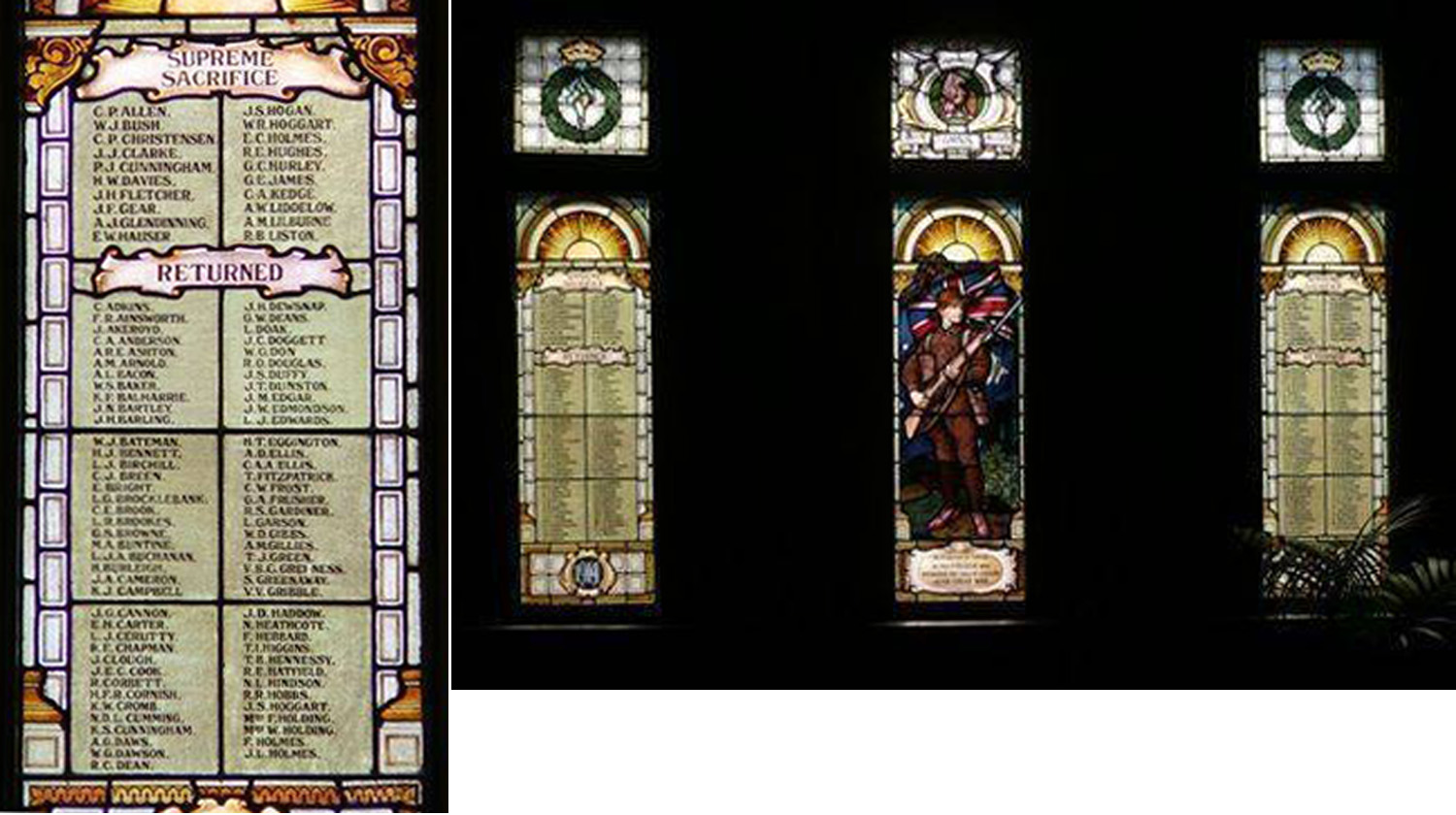
(Edgar, top right)
Edgar Charles Holmes is remembered as one of the many promising young Australians whose life and future were cut short at Fromelles. A gifted student, respected teacher, and university graduate, he had already established a reputation for intelligence, character, and dedication before the war. The Victorian Education Department later wrote of him:
“He was a young man of fine character, earnest, upright, and faithful in the discharge of his duty, and an able teacher, keen and energetic, maintaining always a high standard of efficiency in his classes. He had an assured future.”
Edgar’s former headmaster at St Arnaud, Mr N. P. Dick, also remembered him warmly after his death:
HOLMES.—A tribute to the memory of Lance Corporal E. C. Holmes, killed in action at Pozieres, July 19, 1916 (previously reported missing).
“We count it a privilege to have called him friend.”
— Inserted by Mr. and Mrs. N. P. Dick, Stawell.
Family Reflections
More than a century later, Edgar continues to be remembered by descendants of the Holmes family. One of those descendants, Janeice Quin, undertook extensive family history research following her retirement, focusing particularly on Edgar’s life, military service, and the Battle of Fromelles. Janeice later wrote:
“I believe I would have said that the chance of discovering anything relating to my ancestor Edgar Charles Holmes was of course very remote, but, nonetheless, I was very interested in the whole project.”
She also described the family’s involvement in the DNA identification project connected with the Pheasant Wood mass grave:
My cousin, Stuart Holmes of Sydney (one of the four appropriate family members I managed to put together to supply DNA for our records), was able to visit northern France in 2010, including Fromelles, and sent me photos of the various memorials there.
In 2015, Janeice travelled from Queensland to western Victoria to attend ANZAC Day services at Casterton and Merino in memory of Edgar and other family members who served during the war. She also visited the local memorials where Edgar’s name appears. Continuing the family’s remembrance, Janeice attended the Australian War Memorial in Canberra on 4 May 2025, where she laid a wreath for Edgar during the Last Post Ceremony and placed a poppy beside his name on the Roll of Honour.
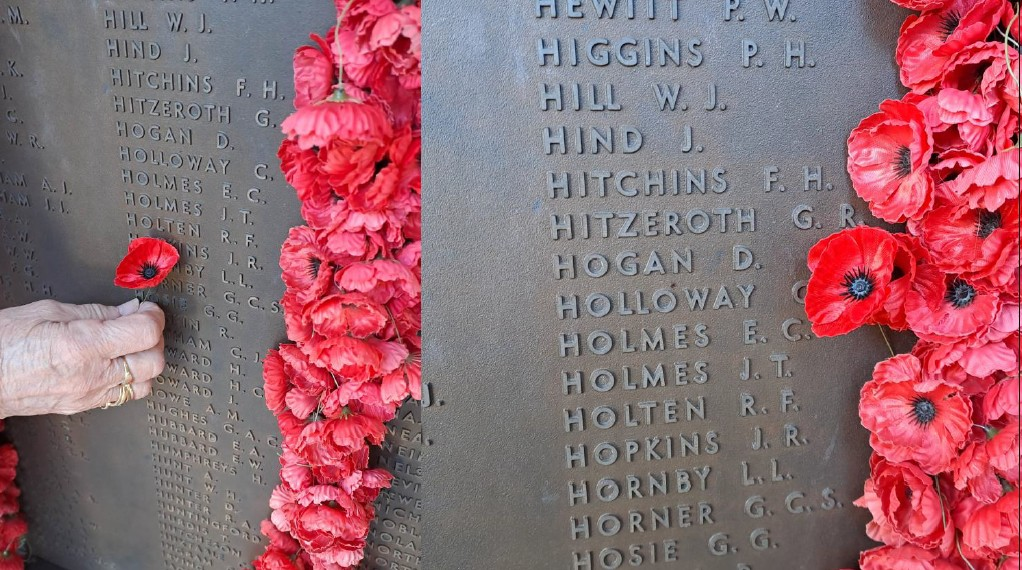
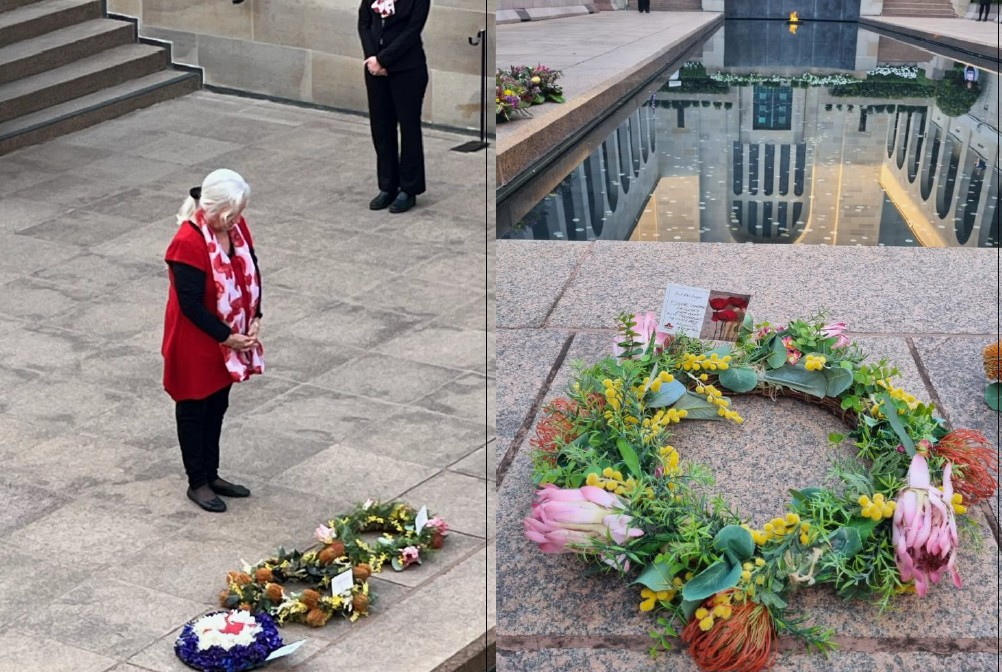
More than a century after his death, Edgar’s family continue to remember him — not simply as a name on a memorial, but as a teacher, scholar, son, and young Victorian whose future was lost at Fromelles.
Finding Edgar
Edgar’s remains were not recovered; he has no known grave. After the battle, the Germans recovered 250 Australian soldiers and placed them in a burial pit at Pheasant Wood. This grave was discovered in 2008 and since then efforts have been underway to identify these soldiers by DNA testing from family members. As of 2026, 181 of the soldiers have been identified, including one of the 239 unidentified soldiers from the 59th Battalion.
Members of the Holmes family have already contributed DNA to the identification program in the hope that one day Edgar may finally be identified and laid to rest under his own name, but additional donors are also sought to strengthen the identification process. If you know anything of family contacts, please contact the Fromelles Association. We hope that one day Edgar will be named and honoured with a known grave.
Please visit Fromelles.info to follow the ongoing identification project and Edgar’s story.
DNA samples are being sought for family connections to
| Soldier | Edgar Charles Holmes (1890–1916) |
| Parents | William Tyers Holmes (1852–1937) and Elizabeth Jane Baxter (1859–1919) |
| Siblings | Edith Sarah Holmes (1883–1938) | ||
| Siblings | George Baxter Holmes (1886–1971) | ||
| Siblings | Harold William Holmes (1887–1974) | ||
| Siblings | Mahala Mary Holmes (1893–1894) |
| Grandparents | |||
| Paternal | George Holmes (1817–1903) and Jane Tyers (1823–1900) | ||
| Maternal | George James Baxter (1833–1900) and Sarah Bowler (1832–1894) |
Links to Official Records
Seeking DNA Donors

Contacts
(Contact: carla@fromelles.info or geoffrey@fromelles.info).
(Contact: army.uwc@defence.gov.au or phone 1800 019 090).
Donations
If you are able, please contribute to the upkeep of this resource.
(Contact: bill@fromelles.info ).