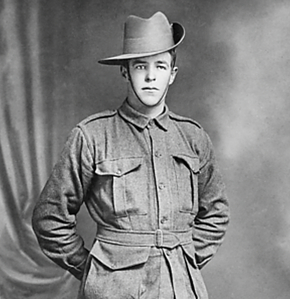
John Gordon MCKENZIE
Eyes blue, Hair brown, Complexion fair
Gordon McKenzie ‘Once lost and now found’
Gordon’s Family
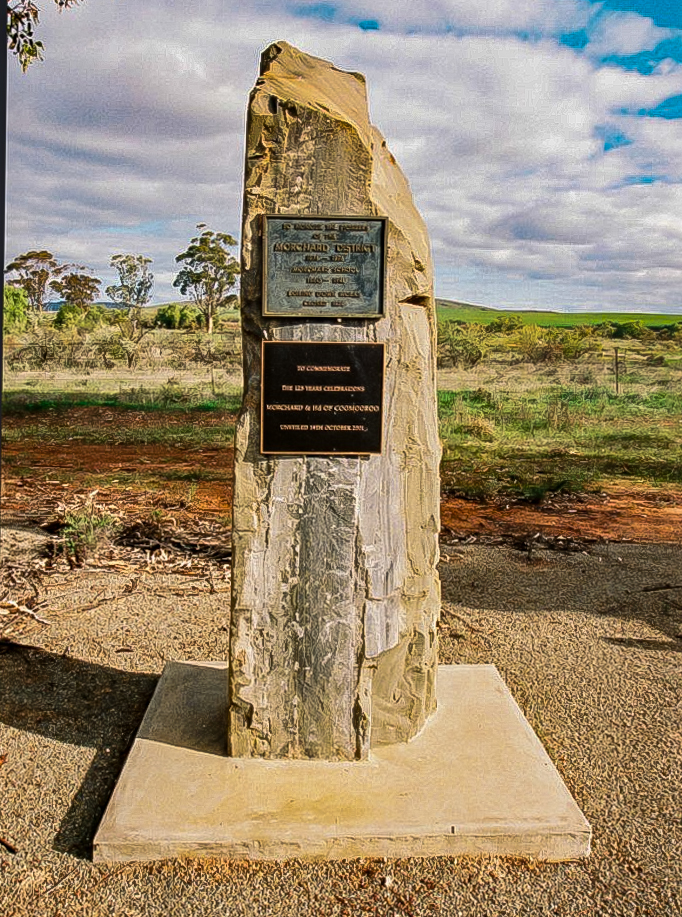
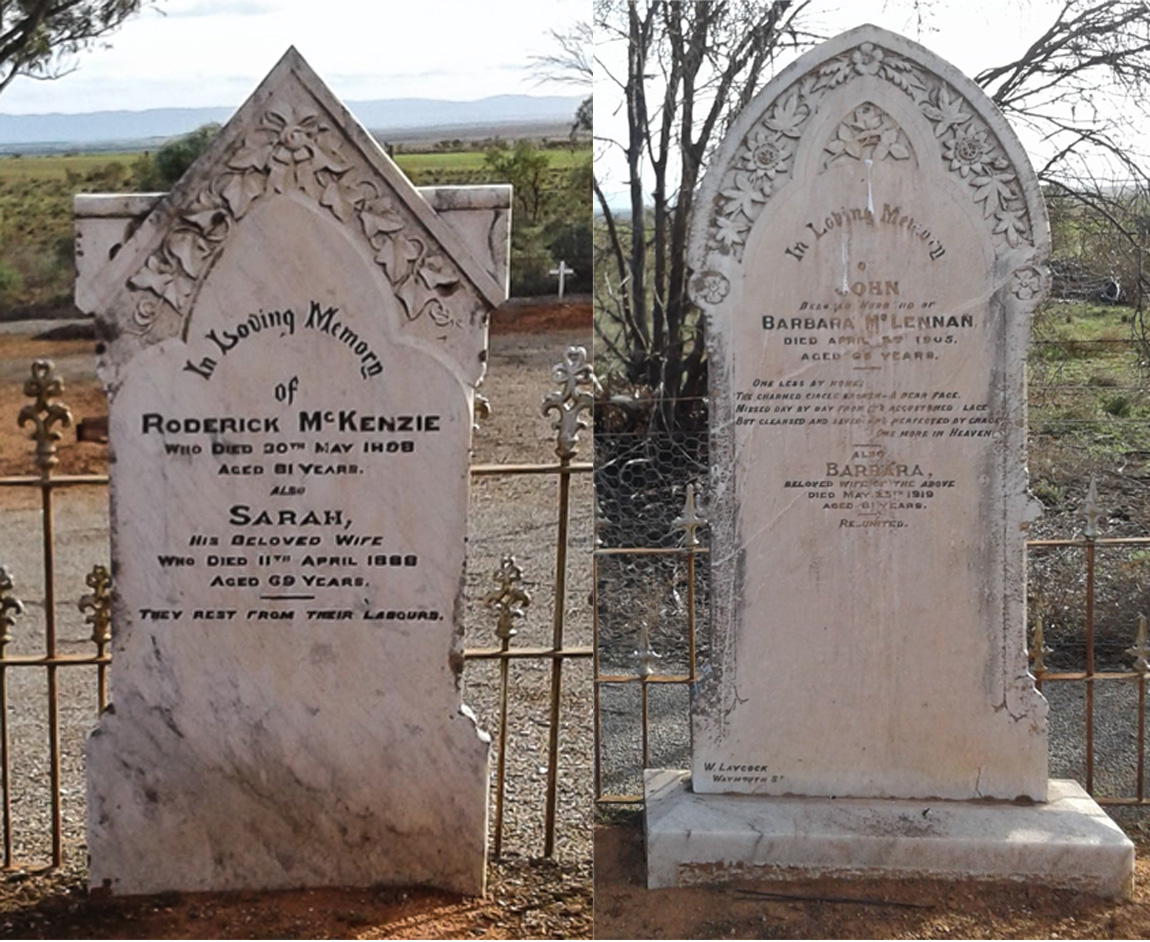
John Gordon McKenzie (known as Gordon) was born on 17 December 1890 at Morchard in the hundred of Coomooroo, a small rural community north-west of Orroroo in the Southern Flinders Ranges of South Australia. He was the third child and eldest son of James McKenzie and Kennethina McLellan, who had married in 1883. Gordon’s paternal grandparents, Roderick McKenzie (c1817-1898) and Sarah McDonald (c1819-1888) were early colonists in South Australia. They arrived from Scotland, as single passengers, on the Pestonjee Bomanjee in October 1838, less than two years after the founding of the colony. The passengers on the ship included Governor George Gawler, the second Governor of South Australia, and Roderick would tell of how, on arrival at Glenelg, he had carried Governor Gawler’s daughter to the shore on his back.
Gordon’s maternal grandparents John McLennan (1835-1905) and Barbara (nee Munro) (1837-1919) McLennan arrived in South Australia, from the Orkney Islands in Scotland on the Atlanta in 1866, with their daughter, six-year-old Kennethina. After first living in Coromandel Valley, they moved to Burra where John worked in the copper mines. In !875, land in the hundred of Coomooroo, previously part of a pastoral lease, was surveyed for closer settlement and sold in 1876 for between twelve and fifteen shillings per acre with a10% deposit. The McKenzie and McLennan families were among the original farming pioneers. Two of Roderick McKenzie’s sons, James and Alexander, were among the first buyers, each taking up land near where the township of Morchard was proclaimed in 1877, and they were joined by another brother, John, during the 1880s.
The youngest son, Donald, also farmed in the area for many years. Roderick and Sarah moved to the area with their sons and lived there for the remainder of their lives. John and Barbara McLennan, with their daughter Kennethina also moved to Coomooroo when John bought land in 1876. He and Barbara lived there until John’s death in 1905. They were stalwarts of the Morchard Methodist church. Until the building of a church, early services were held in their home. John and his two cream buggy ponies would take the minister to visit far away members of his flock. Sarah was always on call to attend the sick. Source - Courtesy of Joan Ellery The Coomooroo pioneers endured some anxious years, before good rainfall in 1879 led to renewed optimism.
A newspaper article reported that ‘One of the finest crops we have seen is being cut for hay by Mr. McLennan, near the Morchard township’.
Source - THE NORTHERN TERRITORY. (1879, November 8). South Australian Chronicle and Weekly Mail, p. 12. http://nla.gov.au/nla.news-article94750702
However frequent dry years made life difficult and uncertain for the Coomooroo pioneers. They worked hard – James McKenzie had the record for sowing an 80-acre paddock of wheat (broadcasting) between sunrise and sunset - but one year his crop realised only half a bushel per acre.
Early Life
James McKenzie and Kennethina McLellan were married in the Morchard Methodist Church in 1893. They had 6 children:
- Barbara McDougall (1885-1958)
- Flora McKenzie (1889-1980)
- Adelaide (May) Teague (1893-1984)
- James McKenzie (1895-1990)
- Donald McKenzie (1902 -1989)
Life for Gordon and his family in the remote district revolved around the farm and the community. There was no water for gardens, so very few vegetables or fruit were grown so there was a dependence on potatoes, onions and homemade bread. A steer was usually killed for meat and distributed among neighbours and a pig was killed now and then for bacon and ham. Chickens and rabbits were plentiful.
Source - Courtesy of Joan Ellery
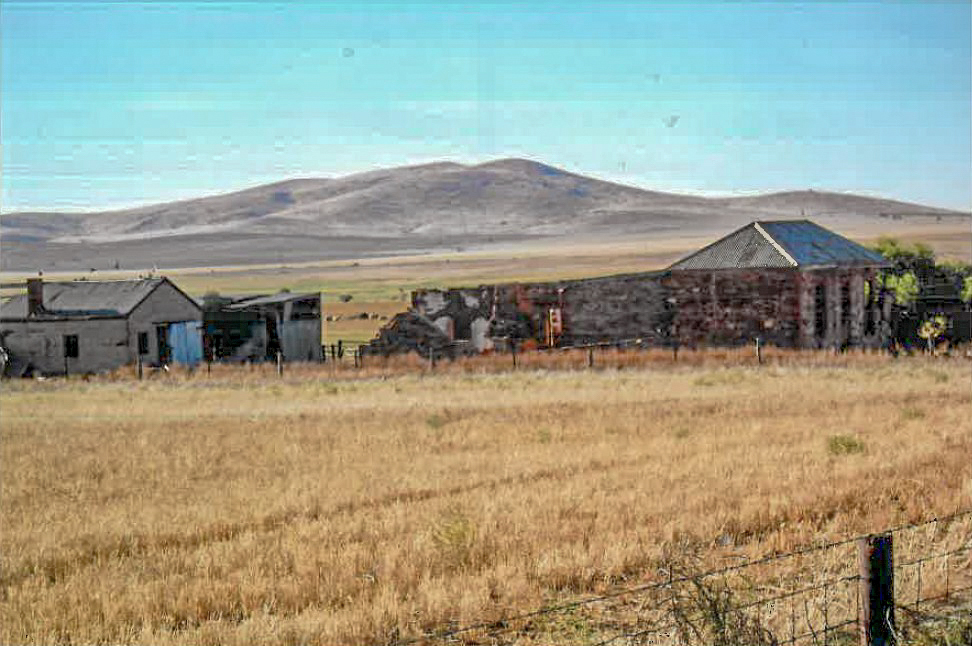
Amusements were socials, dances, concerts, picnics, tea meetings. The big event attended by the whole community was the school picnic when everyone met at the store and all got into crowded wagons to be taken to their destination in a scrub paddock. Picnics often ended with a dance at the Institute, with music on an accordion.
Gordon attended Morchard School, a one-teacher school in a wooden building with an average attendance of about 30 students. He went to Sunday school at Morchard Methodist church where the teacher was his grandfather, John McLennan.
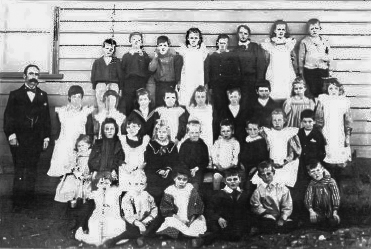
He went to Sunday school at Morchard Methodist church where the teacher was his grandfather, John McLennan.
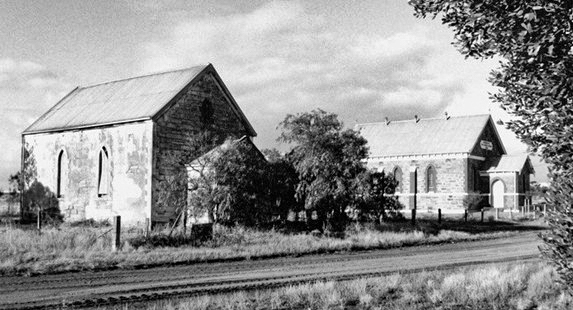
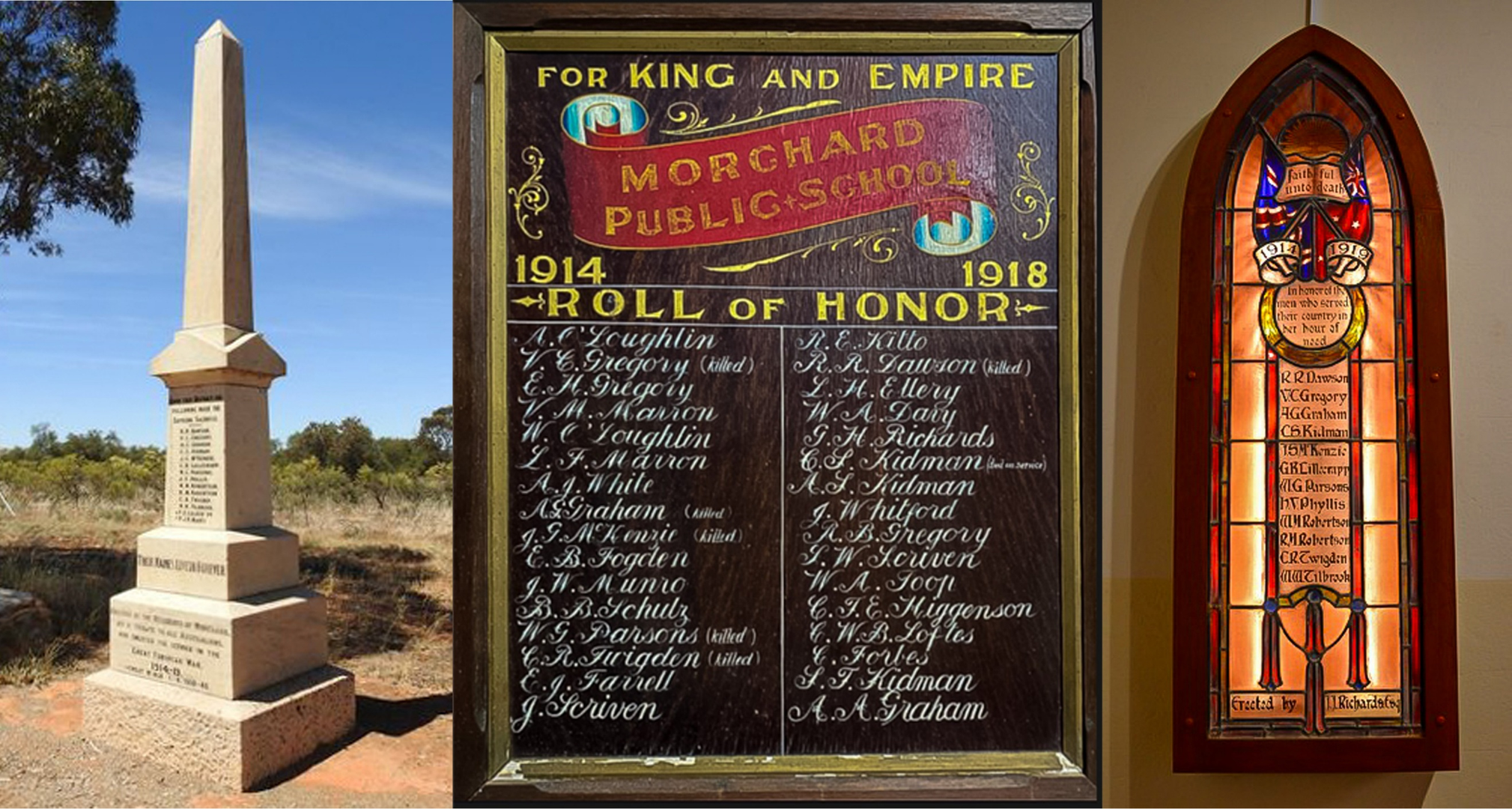
On the left is the original church where James and Kennethina were married, and the family worshipped. On the right is the new church opened in 1924 which included a memorial window to Gordon and other Morchard men who fell in the Great War
Gordon became a farmer. From about 1910 he lived in Orroroo, probably with his parents who left their farm and moved into Orroroo. It is likely that he continued to work on family properties. From 1910 he was a member of the Orroroo Light Horse, which until 1912 was part of the 17th Australian Light Horse Militia Regiment, and from 1912, part of the 24th Light Horse (Flinders Light Horse).
Off to War
In July 1915 there was a surge in enlistment as, in the wake of the landing at Gallipoli, men decided that it was their duty to fight ‘for the Empire’. When Gordon made that decision he would have gone into the District Office in Orroroo and been given a rail ticket to Adelaide. On 21 July he presented himself at Keswick Barracks in Adelaide. He was 24 years old, and named his father, James, as next of kin. He passed his medical and reported to Mitcham Camp on 22 July, the same day as another Orroroo man, Len Wall. With Len he was assigned to K Group Base Infantry and then to the 32nd Battalion when it was formed in mid-August. They both became members of A Company.
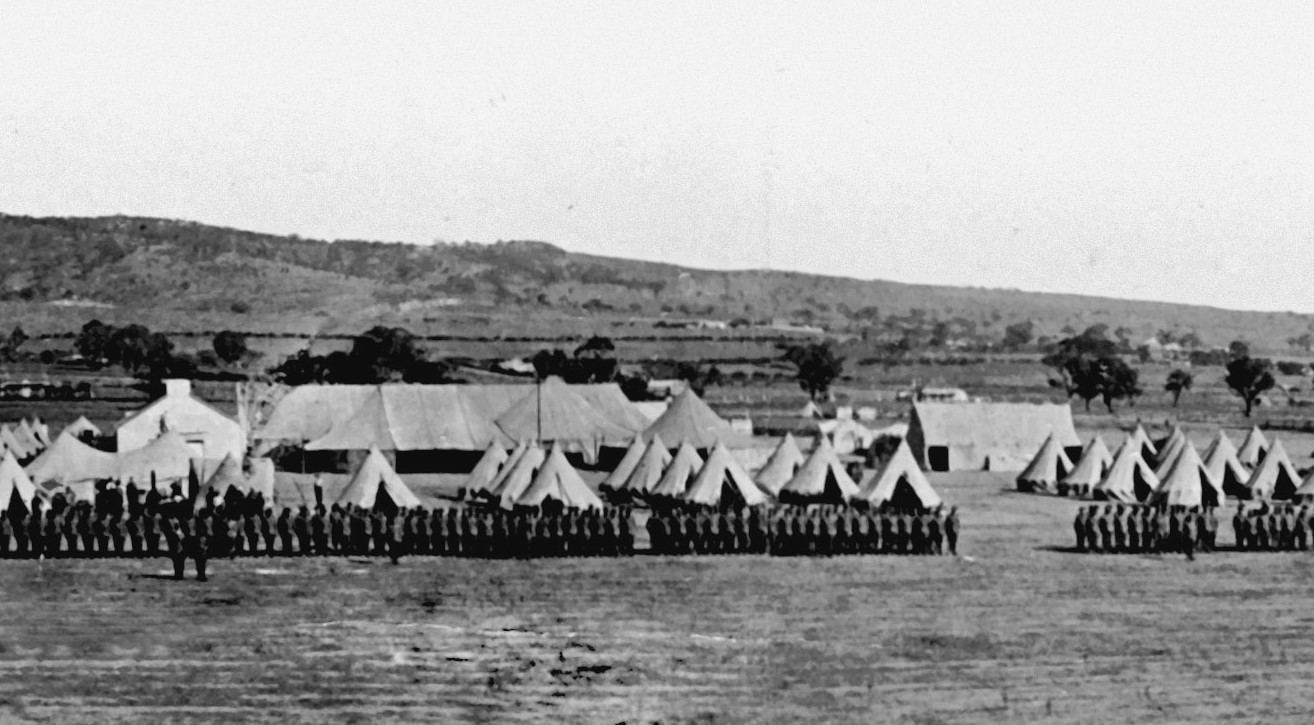
A and B Companies were made up of recruits from South Australia and C and D Companies came from Western Australia. There was much fanfare about this new battalion in South Australia, with gatherings, community support, Cheer-up Society activities, reviews of the troops by the governor, and parades through the streets of Adelaide. On 16 September, the South Australians members of the Battalion moved to a new camp at Cheltenham Racecourse and the West Australians who had begun their training at Blackboy Hill near Perth joined them at the end of September.
As the time approached for departure of the 32nd Battalion, many men were given leave so they could be farewelled by their local communities. On 9 October there was a large attendance at a social held at the Orroroo Town Hall to farewell Gordon, Len Wall and two other residents from the Orroroo district who had joined the expeditionary forces. There were speeches and a musical programme before the presentation of a safety razor was made to each man:
‘”Pte Len Wall, in responding for himself and comrades, thanked the Orroroo people for their kindness, and said it would be something to remember out in the fighting line.”
The files of both Gordon McKenzie and Len Wall show they had clean disciplinary records – except that they were both admonished and fined two days’ pay for being absent without leave for a day on the weekend of the Orroroo farewell. Perhaps they had not obtained permission to attend the farewell – or perhaps they had decided that taking an extra day to spend with family and friends was worth any punishment that might follow. The 32nd Battalion departed for Egypt on 18 November 1915, HMAT A2 Geelong As reported in The Adelaide Register:
“The 32nd Battalion went away with the determination to uphold the newborn prestige of Australian troops, and they were accorded a farewell which reflected the assurance of South Australians that that resolve would be realised.”
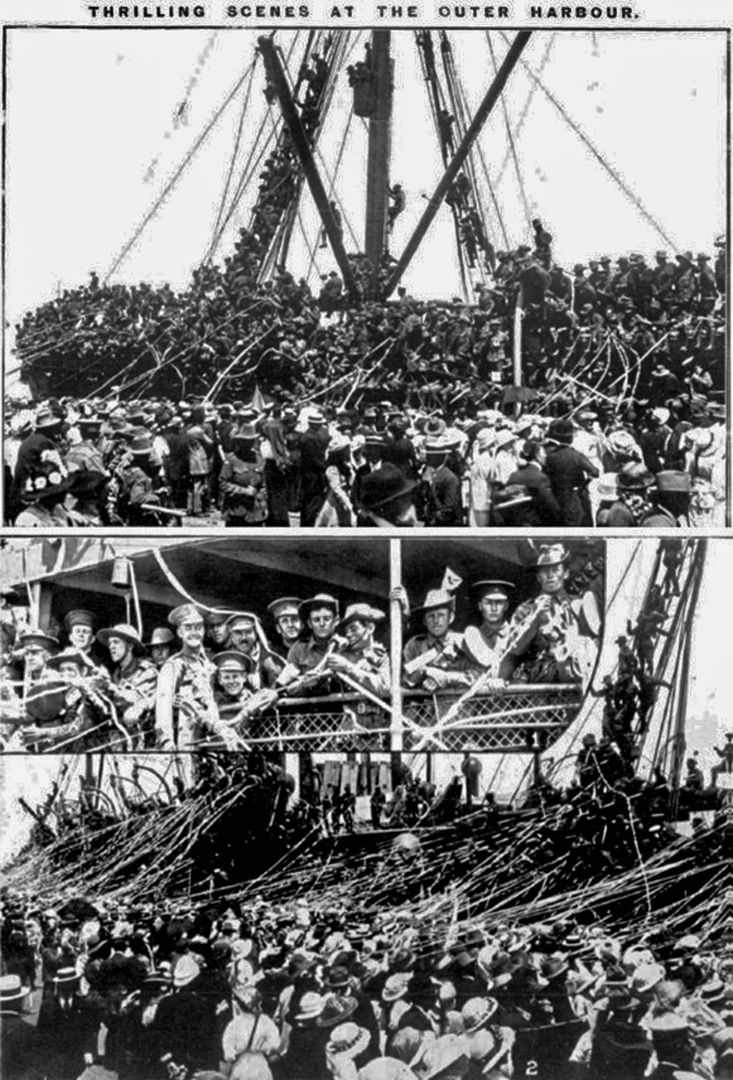
The 32nd arrived in Suez on 14 December 1915 and moved to El Ferdan just before Christmas. A month later they marched to Ismailia and then to the major camp at Tel-el-Kebir where they stayed for February and most of March. Tel-el-Kebir was about 110 km northeast of Cairo and the 40,000 men in the camp were comprised of Gallipoli veterans and the thousands of reinforcements arriving regularly from Australia. Their next stop was at Duntroon Plateau and then they were at Ferry Post until the end of May, where they trained and guarded the Suez Canal. Their last posting in Egypt was a few weeks at Moascar. One soldier’s diary complained of being “sick up to the neck of heat and flies”, of the scarcity of water during their long marches through the sand and he described some of the food as “dog biscuits and bully beef”. He did go on to mention good times as well with swims, mail from home, visiting the local sights and the like.
Source - AWM C2081789 Diary of Theodor Milton PFLAUM 1915-16, page 29, page 12
During their time in Egypt the 32nd had the honour of being inspected by H.R.H. Prince of Wales.
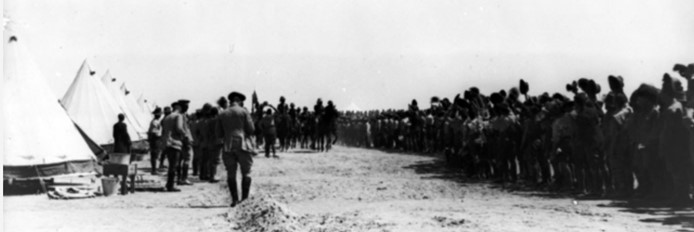
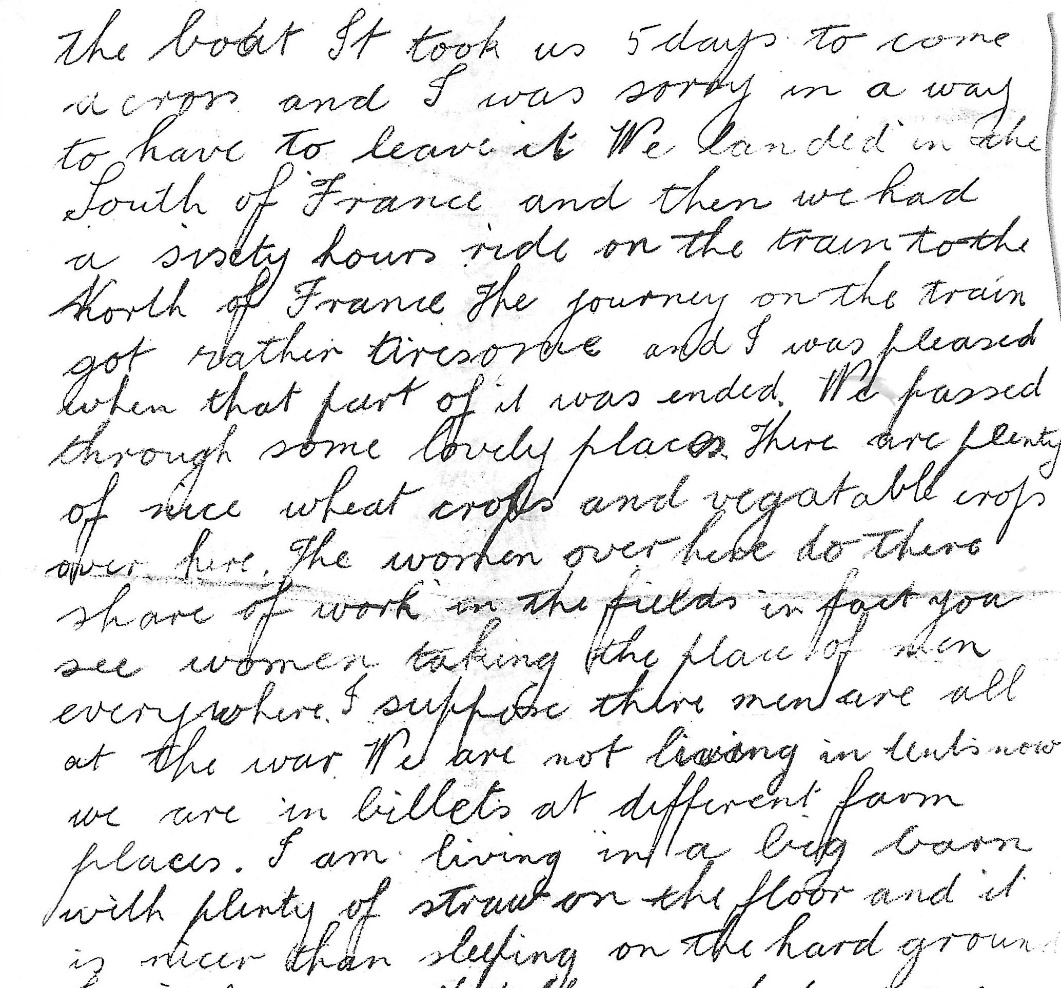
After spending six months in Egypt, the call to support the British Expeditionary Force on the Western Front came in mid-June. The 32nd left from Alexandria on the ship Transylvania on 17 June 1916. In a letter to his mother, Gordon wrote, “We had a lovely trip across on the boat. It took us 5 days to come across and I was sorry in a way to have to leave it.” Source- Letters collected by Roger Freeman, Army Museum, Keswick, South Australia Arriving at Marseilles, France on 23 June 1916 they then immediately entrained for a three-day train trip to Steenbecque. Their route took them to a station just out of Paris, within sight of the Eiffel Tower, through Boulogne and Calais, with a view of the English Channel, before disembarking and marching to their camp at Morbecque, about 30 kilometres from Fleurbaix.
Theodor Pflaum (No. 327) and Wesley Choat (No. 68), Ray’s brother, wrote about the trip:
“The people flocked out all along the line and cheered us as though we had the Kaiser as prisoner on board!!” – Theodore Pflaum
“The change of scenery in La Belle France was like healing ointment to our sunbaked faces and dust filled eyes. It seemed a veritable paradise, and it was hard to realise that in this land of seeming peace and picturesque beauty, one of the most fearful wars of all time was raging in the ruthless and devastating manner of "Hun" frightfulness”. – Wesley Choat
Gordon’s description of the trip in the letter to his mother was not as effusive, although he did appreciate the scenery:
”We landed in the south of France and then we had a sixty hours ride on the train to the north of France. The journey on the train got rather tiresome and I was pleased when that part of it was ended. We passed through some lovely places. There are plenty of nice wheat crops and vegetable crops over here. The workers over here do their share of work in the fields. In fact you see women taking the place of men everywhere. I suppose their men are all at the war.”
They were headed to the area of Fleurbaix in northern France which was known as the ‘Nursery Sector’ – a supposedly relatively quiet area where inexperienced Allied troops could learn the harsh realities of Western Front trench warfare against the Germans. Gordon had time to write what was almost certainly the last letter to his mother. He began by writing about his longing for letters from home:
3/7/16
Somewhere in France
My Dear Mother
Now for a start to answer your ever welcome letter that I received a day or so ago. I suppose you will have missed a mail or two that you didn’t get a letter and you would be wondering what had gone wrong. But when you get this you will know the reason. This is our first mail we have had for a month and I can tell you I was seriously waiting for some letters. I think we will be getting some more in a day or so. They say there is a big mail in for the 8th Brigade. Now that we have arrived in this part of the world we will get our letters as usual, but I suppose they will take a little longer to get to us.”
He then told her as much as he could about their present situation -
“France is a much nicer place to be than Egypt. I like it here very much. It has made a different man of me. We haven’t got it hot now, thank goodness. The first two or three days were wet, but that was better than the heat. We have been landed over here a fortnight now. We are not living in tents now. We are in billets in different farm places. I am living in a big barn with plenty of straw on the floor and it is nicer than sleeping on the hard ground.”
Gordon finished his letter by gently letting his mother know that they were not far from the front lines.
“I might as well tell you that we are not too far from the firing line now and we can hear the big guns getting at it, especially at night. They make enough noise now we are a way back. Goodness knows what sort of a row they make when we are close to them. We are a long way behind them yet. I don’t know when we will be getting into it. We were issued with gas helmets this morning and I believe we are to get steel helmets yet and then we will be fixed.
I think I will stop now as I want to write a few more letters.
With very best love to all
From your loving son
J.G. McKenzie
P.S. It might be only field cards that you get from me in future. I hear we are getting issued with them. Every chance I get I will send a letter. Perhaps before you get this we might be a bit closer to the firing line.”
The 32nd moved to the Front on 14 July and Gordon was into the trenches for the first time on 16 July, only three weeks after arriving in France.
The Battle of Fromelles
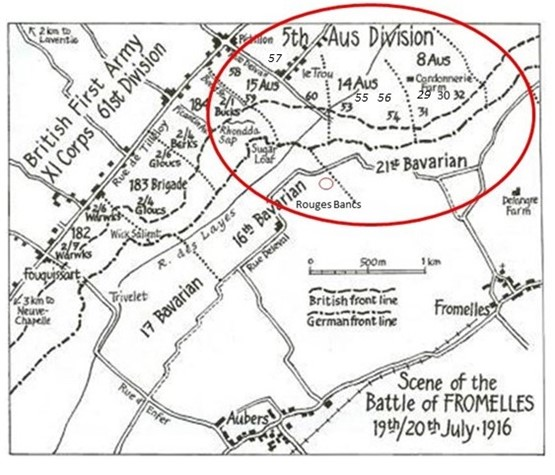
On the 17th they were reconnoitring the trenches and cutting passages through the barbed wire, preparing for an attack, but it was delayed due to the weather. D Company’s Lieutenant Sam Mills’ letters home were optimistic for the coming battle:
“We are not doing much work now, just enough to keep us fit—mostly route marching and helmet drill. We have our gas helmets and steel helmets, so we are prepared for anything. They are both very good, so a man is pretty safe.”
The overall plan was to use brigades from the Australian Fifth Division to conduct a diversionary assault on the German trenches at Fromelles. The 32nd Battalion’s position was on the extreme left flank, with only 100 metres of No Man’s Land to get the German trenches. As they advanced, they were to link up with the 31st Battalion on their right. However, their position made the job more difficult, as not only did they have to protect themselves while advancing, but they also had to block off the Germans on their left, to stop them from coming around behind them. On the morning of the 18th, Gordon’s A Company and C Company went into the trenches to relieve B and D Companies, who rejoined the next day.
The Zero Hour for advancing from their front-line trenches was to be 5.45 PM, but the Germans knew this attack was coming and were well-prepared. They opened a massive artillery bombardment on the Australians at 5.15 PM, causing chaos and many casualties. Gordon’s A Company, along with C Company were in the first and second waves to go over the parapet at 5.53 PM. B Company & D were in the third and fourth. The men, despite heavy losses, were successful in the initial assaults and by 6.30 PM were in control of the German’s 1st line system (map Trench B), which was described as “practically a ditch with from 1 to 2 feet of mud and slush at the bottom”.
Source - AWM4 23/49/12, 32nd Battalion War Diaries, July 1916, page 11
Unfortunately, with the success of their attack, ‘friendly’ artillery fire caused a large number of casualties because the artillery observers were unable to confirm the position of the Australian gains. They were able to take out a German machine gun in their early advances, but were being “seriously enfiladed” from their left flank.
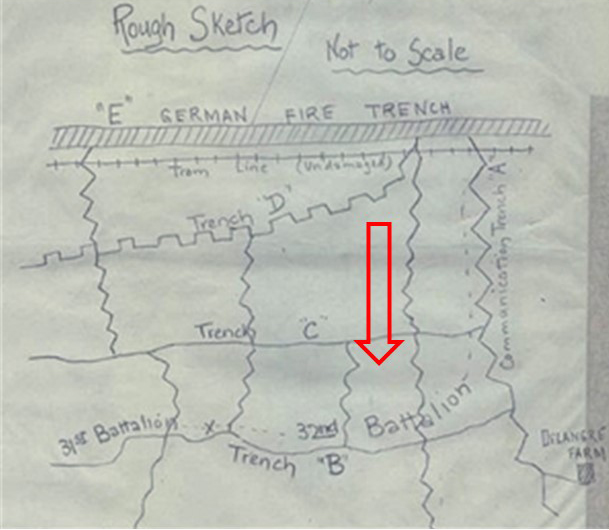
By 8.30 PM their left flank had come under heavy bombardment with high explosives and shrapnel. Return bombardment support was provided and the 32nd were told that “the trenches were to be held at all costs”. Source - AWM4 23/49/12, 32nd Battalion War Diaries, July 1916, page 12
Fighting continued through the night. The Australians made a further charge at the main German line beyond Trench B, but they were low on grenades, there was machine gun fire from behind them from the emplacement at Delangre Farm and they were so far advanced that they were getting shelled by both sides. In the early morning of the 20th, the Germans began a counterattack from the Australian’s left flank, bombing and advancing into Trench A (map).
Given the Australian advances that had been made earlier, the rear Trench E had been left almost empty, which then enabled the Germans to regain that trench and envelop the men of the 32nd. At 5.30 AM the Germans attacked from both flanks in force and with bombing parties. Having only a few grenades left, the only resistance they could offer was with rifles:
“The enemy swarmed in and the retirement across No Mans’ Land resembled shambles, the enemy artillery and machine guns doing deadly damage.”
What was left of the 32nd had finally withdrawn by 7.30 AM on the 20th. The initial roll call count was devastating – 71 killed, 375 wounded and 219 missing, including Gordon. To get some perspective of the battle, when Charles Bean, Australia’s official war historian, attended the battlefield two and half years later, he observed a large quantity of bones, torn uniforms and Australian kit still on the battlefield. The final impact was that 228 soldiers of the 32nd Battalion were killed or died from wounds sustained at the battle and, of this, 166 were unidentified. Lieutenant Sam Mills survived the battle. In his letters home, he recalls the bravery of the men:
“They came over the parapet like racehorses……… However, a man could ask nothing better, if he had to go, than to go in a charge like that, and they certainly did their job like heroes."
After the Battle
About 85% of the fighting strength 32nd Battalion were casualties at Fromelles, killed, wounded or taken prisoner. In the immediate aftermath there was much confusion and great difficulty in working out what had happened to each man. Gordon McKenzie was one of the many men who were missing. Late in August his father in Orroroo received the news that his son had been missing since July 20. The family placed a notice in newspapers -
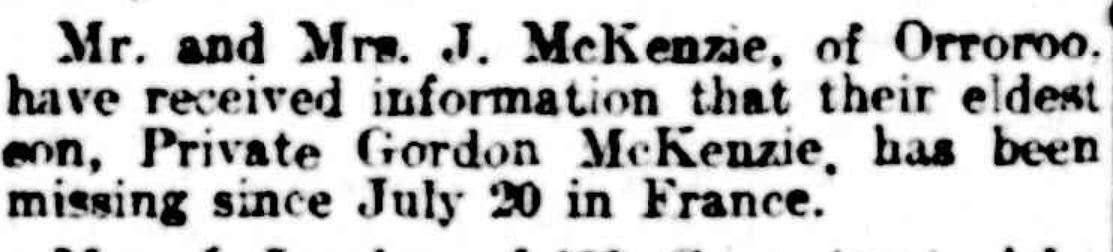
For families of missing men, each day was one of uncertainty and suspense. They waited and longed for news, but for many, it was months before they received any further information from the military. On 14 October, Gordon’s eldest sister, Barbara McDougall turned to the Red Cross Information Bureau for assistance. The Bureau assisted families of wounded or missing men to get any available information about them. It was through a letter from the Red Cross early in February 1917 that the family was informed that Gordon’s name was on a ‘German Death List’ dated 4 November 1916:
“We understand that these Death lists were made up of the Discs gathered from the dead bodies of soldiers in the event of ground being retaken.”
In April, the McKenzie’s were officially informed by the military that Gordon had been killed.
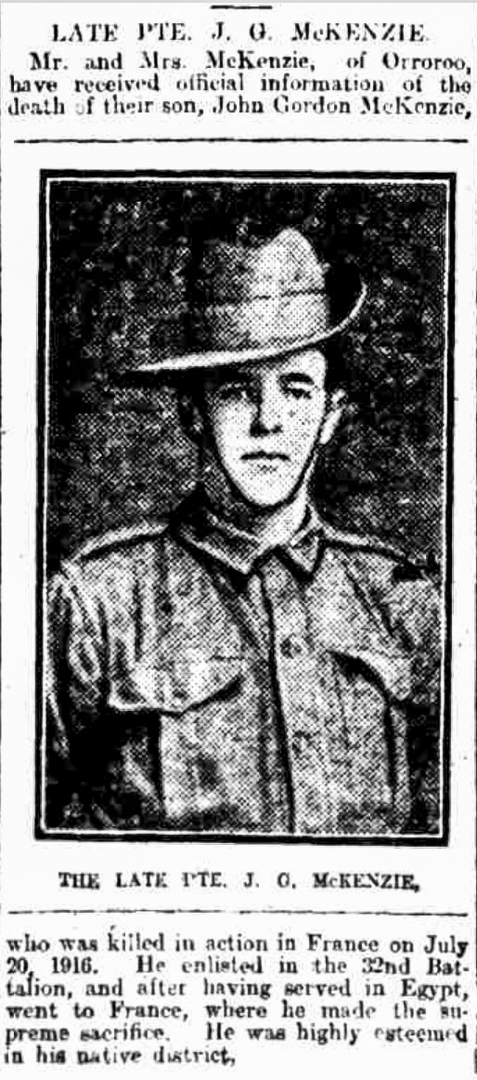
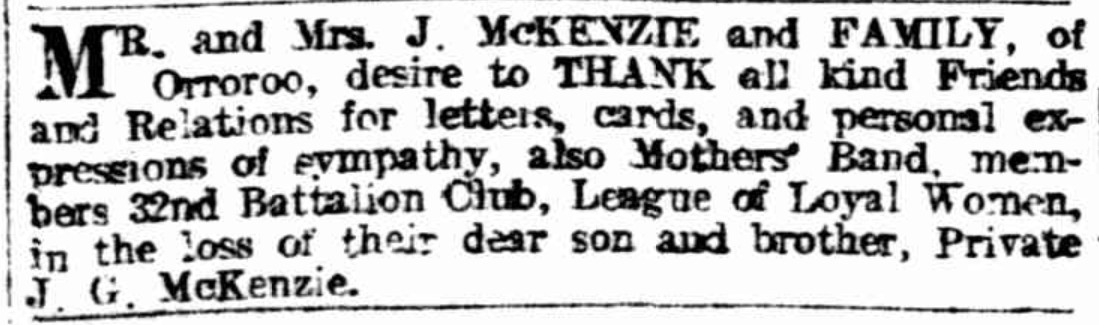
There was a large community response to this news, which Gordon’s family recognised by placing an article in the newspapers.
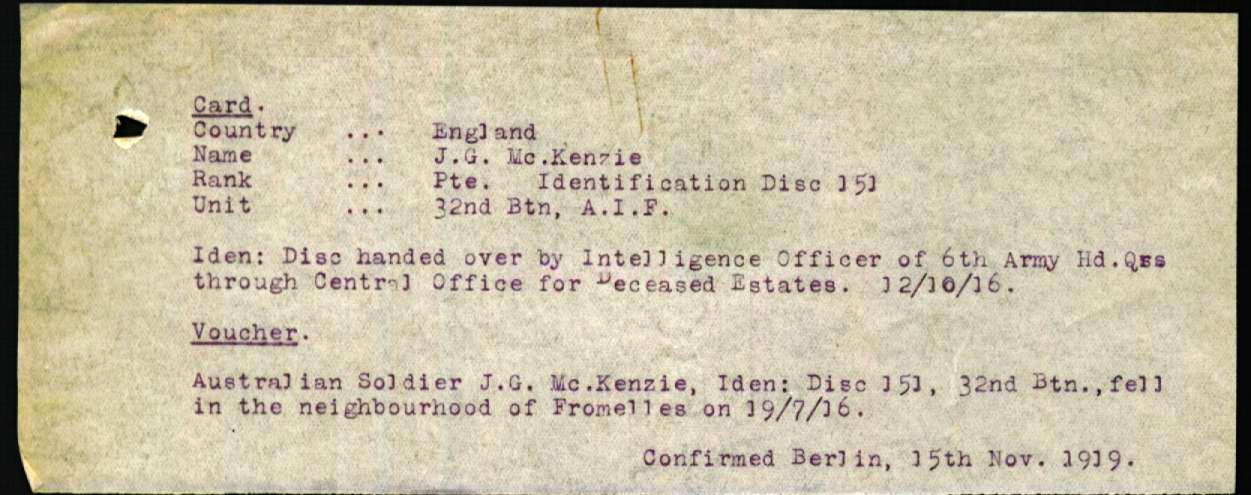
With the 32nd having advanced well into the German’s lines, Gordon’s identification disc had been recovered from his body by the Germans and was handed over to authorities in England. This was returned to James McKenzie, as next of kin, in November 1917.
Finding Gordon
Gordon’s parents and siblings died not knowing where Gordon lay. We now know that their son and brother was buried in a mass grave at Pheasant Wood. The location of the missing soldiers at Fromelles became the focus of the now historically famous and long-running investigation by Lambis Englezos, Ward Selby and John Fielding. Lambis had found aerial photographs of the site at Pheasant Wood, taken after the battle, showing what were believed to be burial mounds. Lambis thereafter concentrated his investigation on the site adjoining Pheasant Wood.
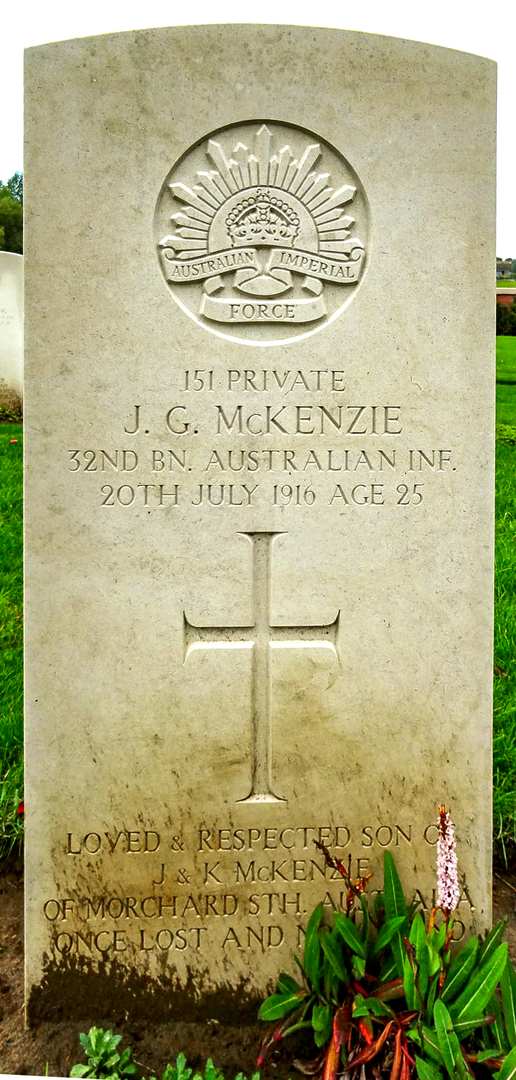
This eventually led to the remains being unearthed in 2009 and buried in new Pheasant Wood Military Cemetery at Fromelles. All the men were reburied in their own dedicated plots. The dedication of the cemetery ceremony took place on 19 July 2010. As of 2026, 181 of 250 soldiers found in the burial mound have now been identified via DNA testing from relatives. Gordon’s identification was officially confirmed in 2013.
Source:
Remembering Gordon
Gordon’s name is inscribed on Panel 5 of the V.C. Corner Australian Cemetery Memorial at Fromelles, which commemorates all the Australians killed at Fromelles whose bodies were not recovered in the years after the battle.
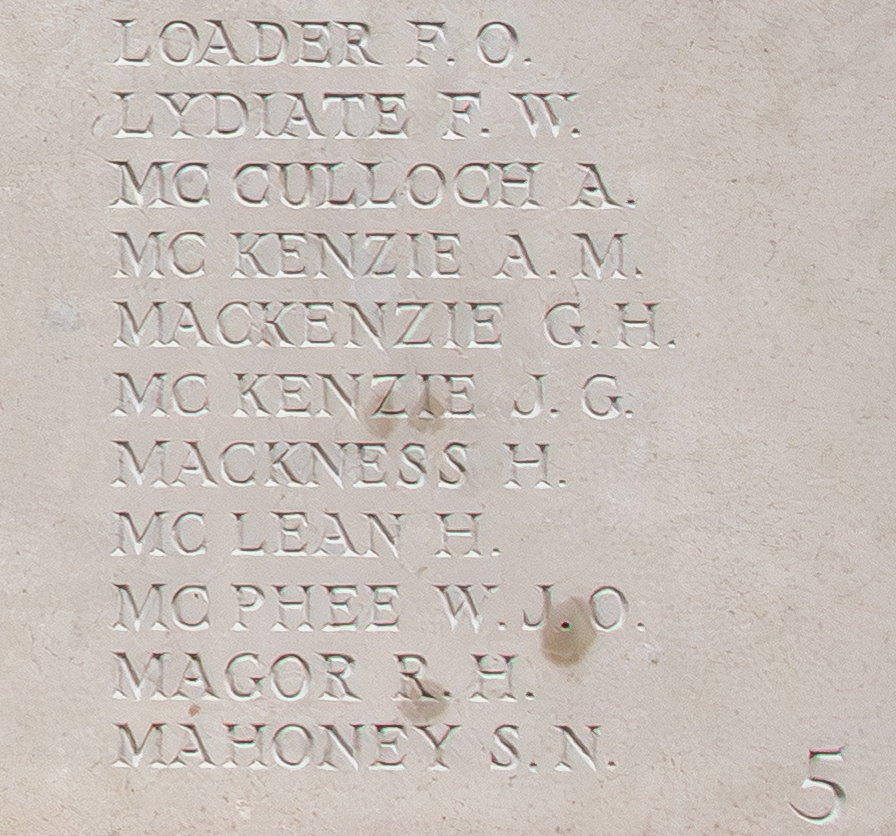
VC Corner Memorial Panel
[[Source:https://www.findagrave.com/memorial/55965111/samuel-nicholas-mahoney#view-photo=22341580/]]
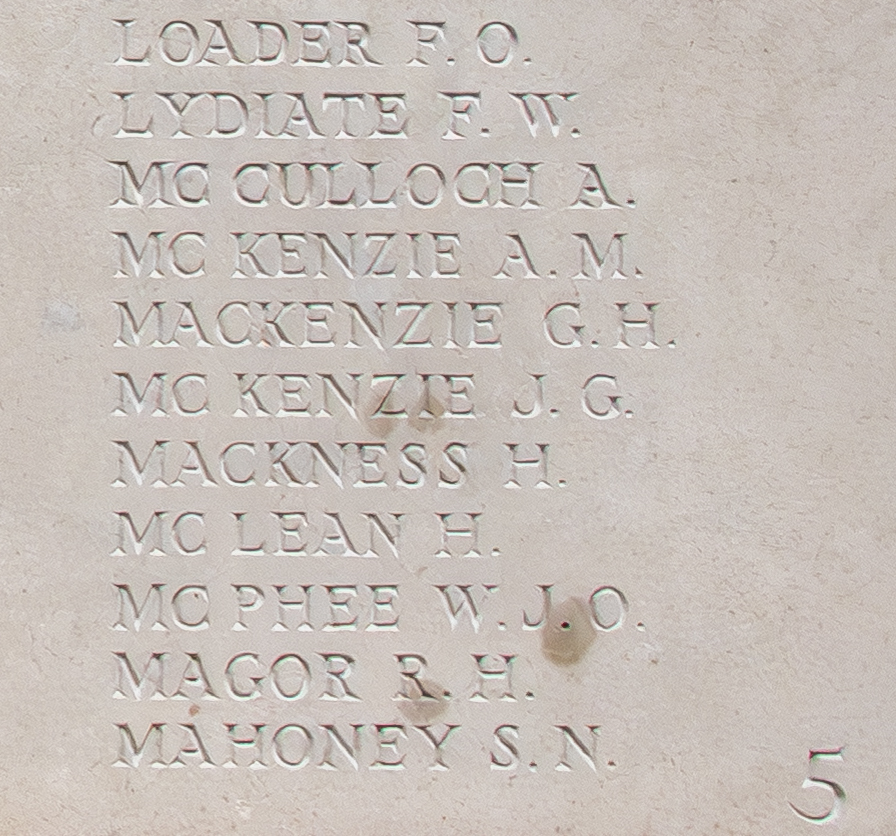
VC Corner Memorial Panel
[[Source:https://www.findagrave.com/memorial/55965111/samuel-nicholas-mahoney#view-photo=22341580/]]
In Australia, Gordon is remembered at:
- Australian War Memorial Roll of Honour,
- Orroroo District Roll of Honour WW1,
- Orroroo Morchard Public School Roll of Honor,
- Orroroo Morchard War Memorial,
- Orroroo War Memorial
- and The South Australian National War Memorial
The Morchard School Roll of honour is on a memorial window originally installed in 1924 in the newly built Morchard Methodist church. It is now located in the Orroroo Soldiers Memorial Hall.
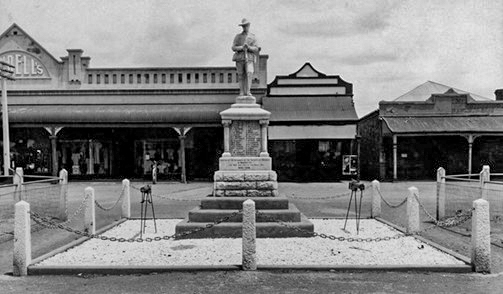
The McKenzie family at war
Two of Gordon’s cousins also enlisted in the First World War. Melville John (Jack) McKenzie (1887-1922), the son of James McKenzie’s eldest brother, William and his wife, Jessie Milroy Crawford, had emigrated to Canada and served with the Canadian 9th Regiment Mounted Rifles. He was awarded the Meritorious Service Medal.
James Roy McKenzie, (1893-1939) the son of John McKenzie and Christina Chalmers, enlisted in September 1916, immediately after the family was told that Gordon was missing. He served as a driver with the 3rd Divisional Ammunition Column.
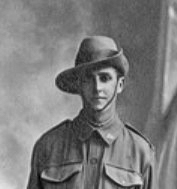
Gordon’s youngest brother, Donald Keith McKenzie (1902-1989) was too young to enlist in the Great War. He had a significantly different educational background to Gordon. After attending prestigious Prince Alfred College in Adelaide, he studied medicine at Adelaide University, graduating in 1925. He joined the Royal Australian Naval Reserve in 1933 and was mobilised at the outbreak of the Second World War, serving as a surgeon lieutenant commander, later surgeon commander, in the Royal Australian Navy, and by secondment, in the Royal Navy during the war.
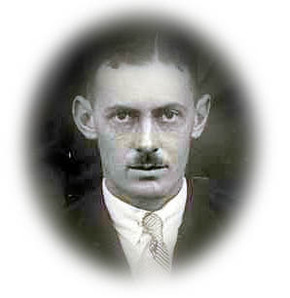
Royal Australian Navy, World War 2
For almost a century, Gordon McKenzie was one of the missing men of Fromelles. His parents, James and Kennethina, his brothers and sisters, and the community of Morchard and Orroroo mourned a son and brother who never came home and whose resting place was unknown. Although his identification disc was recovered by the Germans and returned to his family after the war, Gordon's grave remained lost. The discovery of the mass burial site at Pheasant Wood and the subsequent identification program finally answered the question that had remained unresolved since July 1916. In 2013, Gordon was officially identified and today rests under his own headstone in Pheasant Wood Military Cemetery, Fromelles. The inscription chosen by his family says it best:
"Loved and respected son of J. & K. McKenzie, of Morchard, South Australia. Once lost and now found."
The Fromelles Association would love to hear from you

Contacts
(Contact: carla@fromelles.info or geoffrey@fromelles.info).
(Contact: army.uwc@defence.gov.au or phone 1800 019 090).
Donations
If you are able, please contribute to the upkeep of this resource.
(Contact: bill@fromelles.info ).